Support WBUR
In the Gulf of Mexico, an oil hub sees opportunity in offshore wind
At the shipyard of Metal Shark Boats in Franklin, Louisiana, workers are cutting through the skeletons of aluminum ships 100 feet long, suspended in sheds the size of airplane hangars.
“They’re built like a tank, I’ll tell you that,” says Nate Geiger, the company’s president.
Some of his vessels are destined for the Navy or the Coast Guard, but the biggest one in the works is bound for a servicer of offshore wind farms based more than 2,000 miles away in Rhode Island.
Metal Shark Boats is building a crew transfer vessel that will ferry maintenance technicians around wind farms on the East Coast. It’s not too different from what shipbuilders in Louisiana have been making for decades to serve the offshore oil and gas industry.
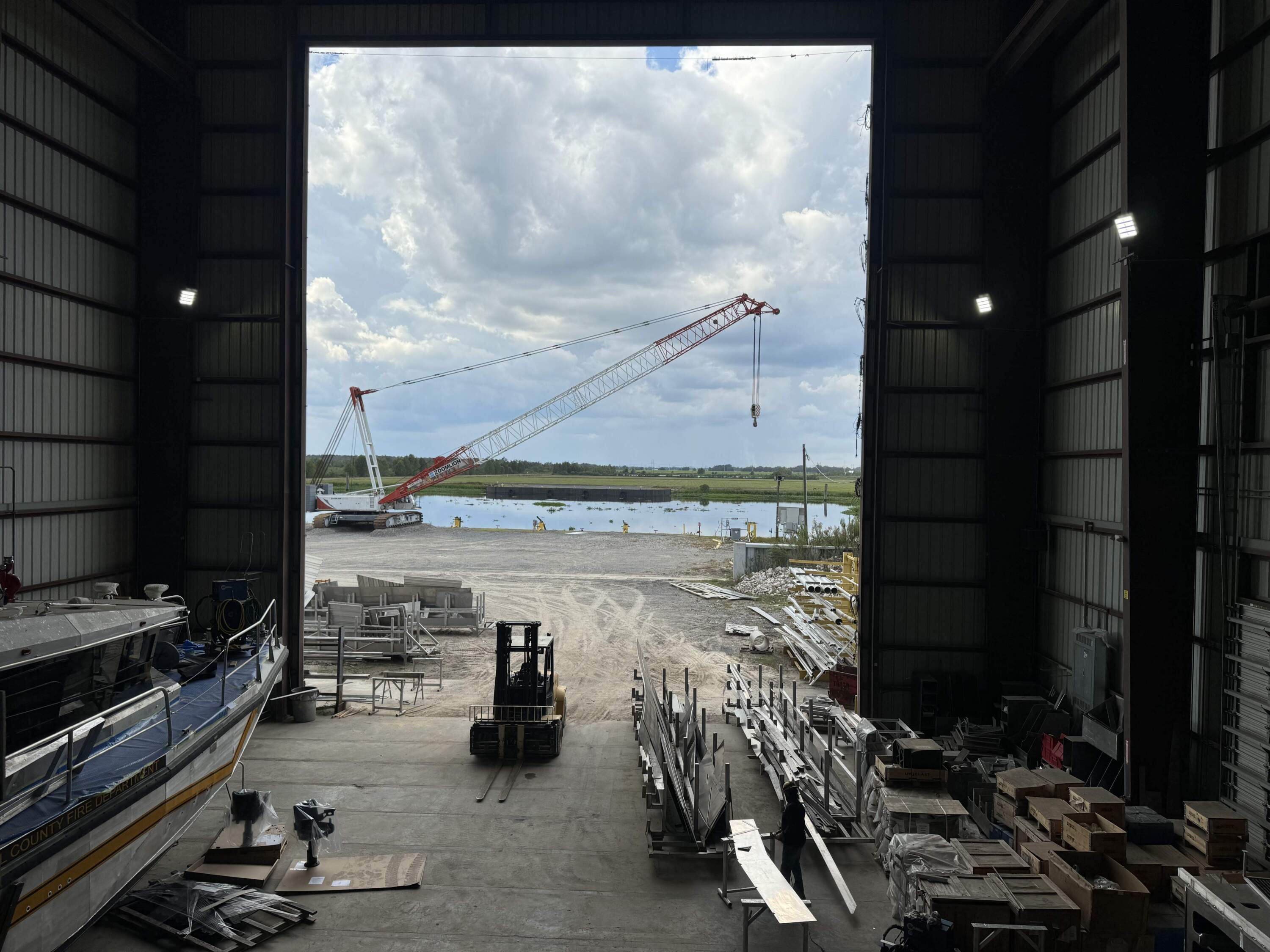
Geiger says he’s ready to build more.
"The capacity is here and everyone’s just waiting for the orders,” he says. “My perspective and most of the folks I employ are excited about being a part of something that could be good for the environment and is good business. Everyone’s making money and it’s the right thing to do."
Offshore wind energy is a major source of power in China, the UK and Germany, but there are only 19 turbines spinning off American shores. Three more projects under construction are on track to greatly expand U.S. offshore wind capacity to more than 4 gigawatts in the next two years, and the Biden administration has set an ambitious goal to install 30 gigawatts by 2030. So far, they are all slated for the East Coast.
While the industry has struggled to take off in the U.S., it has nonetheless spurred investment in American shipbuilding and is already bringing jobs to some unexpected places, including the bayou of Louisiana.
‘Cajun ingenuity’
Joseph Orgeron saw the potential for offshore wind jobs in fossil fuel-friendly Louisiana years before most people.
Orgeron is a Republican state legislator who has represented Lafourche Parish, the heart of the state’s offshore oil and gas business, since 2020. Before that, he was in the family business supplying oil drillers with specialized vessels – tugboats, crew boats and boats that can lift themselves out of the water.
About 10 years ago he got a call from the people building the country’s first offshore wind farm off the coast of Rhode Island. They needed his boats, and soon others did too.
"I came back telling my fellow oil and gas operators, ‘Look, I know my brother’s been calling me Don Quixote chasing after windmills, but I’m telling you, despite the long shipping and maritime history of the East Coast, they have never built offshore infrastructure,’” Orgeron says. “So, I started pushing even amongst my competitors: ‘You need to stay in tune to this.’"
They listened. Louisiana shipbuilders, engineers and marine welders had a hand in building not just the Block Island Wind Farm, but others that have broken ground off the East Coast since.
Orgeron calls that ability to adapt “Cajun ingenuity.”
“The guy that’s getting paid to do his job really doesn’t care if the end result is to reach down for hydrocarbons or up for air pressure,” he says. “His job is all the same.”
A recent industry report found 458 companies in Louisiana “with potential applicability to supply products or services in the offshore wind industry.” It estimates offshore wind could create thousands of jobs in Louisiana over the next decade.
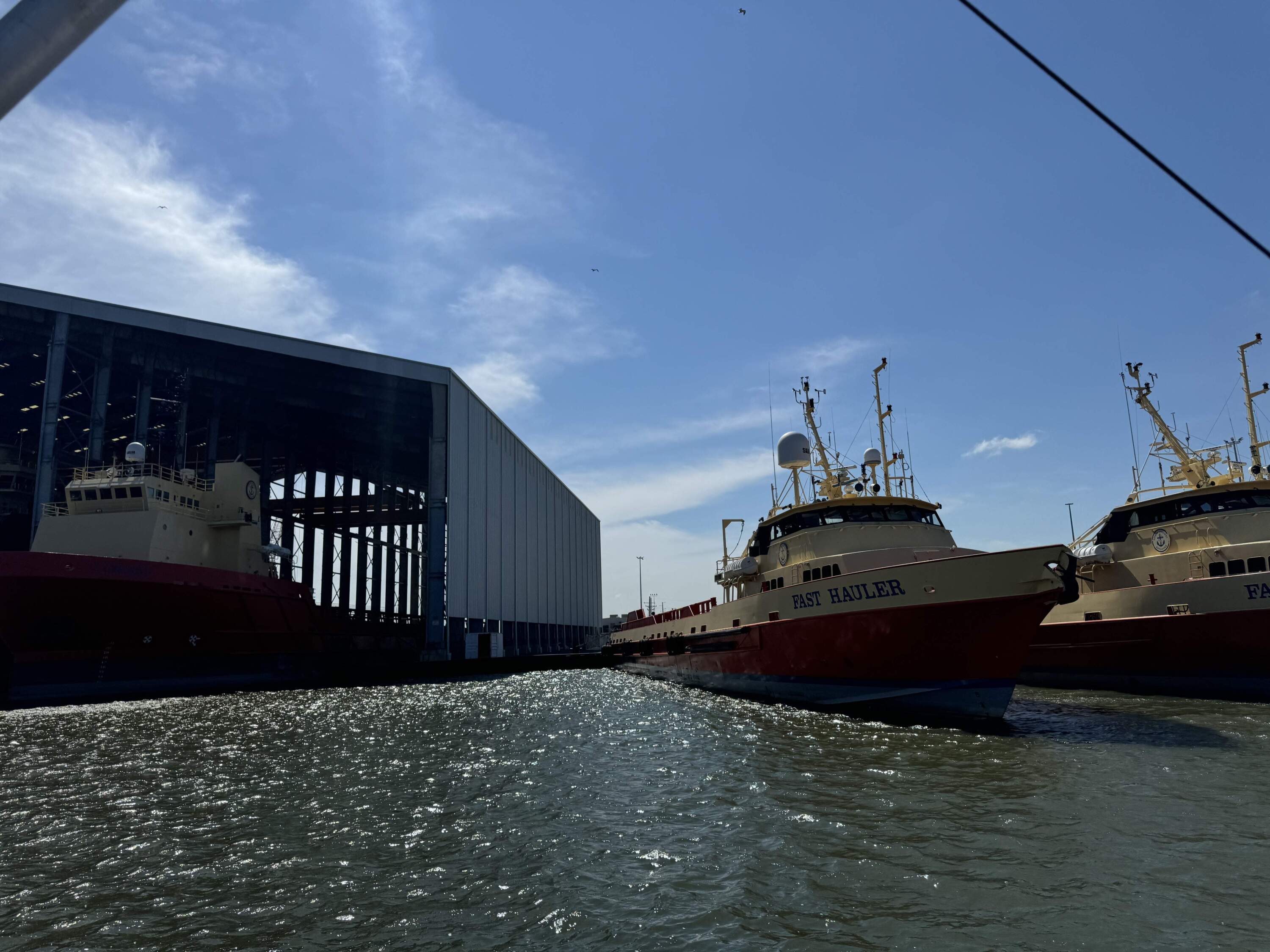
So far, those jobs have supported wind farms in New England, New York, and Virginia, but there are plans to build wind farms off the coast of Louisiana, in both state and federal waters. Louisiana's state climate plan set a goal of 5 gigawatts of offshore wind power by 2035. If that happens, it could change the face of Port Fourchon, a long-time hub for servicers of the Gulf’s deepwater oil and gas business.
‘An all-of-the-above mentality’
Pelicans and dolphins frolic in the shadows of platform supply vessels the size of cruise ships at Port Fourchon.
With clear skies, several offshore oil rigs are visible on the horizon beyond a creeping wall of mangroves planted to blunt some of the erosion that is reclaiming southern Louisiana’s coastal wetlands.
More than 200 ships with names like Gator, Caribou and Grizzly traverse this port each day, boasting flashy color schemes to stand out at sea. Some are big enough to have their own helicopter landing pads.
Chett Chiasson calls this part of the port the “Walmart of offshore energy, a one-stop-shop” for oil and gas drillers. He’s the executive director of the Greater Lafourche Port Commission.
Port Fourchon helps service every deep-water port in the Gulf of Mexico, and Chiasson says one day it could be the Gulf’s hub for offshore wind too.
“I don’t call it an energy transition. I call it an energy addition. We need more energy, and petroleum products are going to continue to be the base of all of the things that we enjoy in our life on a daily basis,” he says. “In our mind, it’s about a balanced approach to our energy portfolio in the country and around the world, and the state of Louisiana, the Gulf of Mexico will play a key role in that."
A steel bulkhead guards a vacant plot of land where that “energy addition” might begin. Chiasson says the offshore developer Crowley Wind Services has first dibs on 40 acres of waterfront if offshore wind takes off in Louisiana.
Before that happens, though, engineers have to solve a few problems. The Gulf of Mexico has lower average wind speeds than the Northeast, but also extreme highs like hurricanes.
Mitchel Graff with the group Gulf Wind Technology, which is building a demonstration wind turbine at Port Fourchon that will start spinning next year.
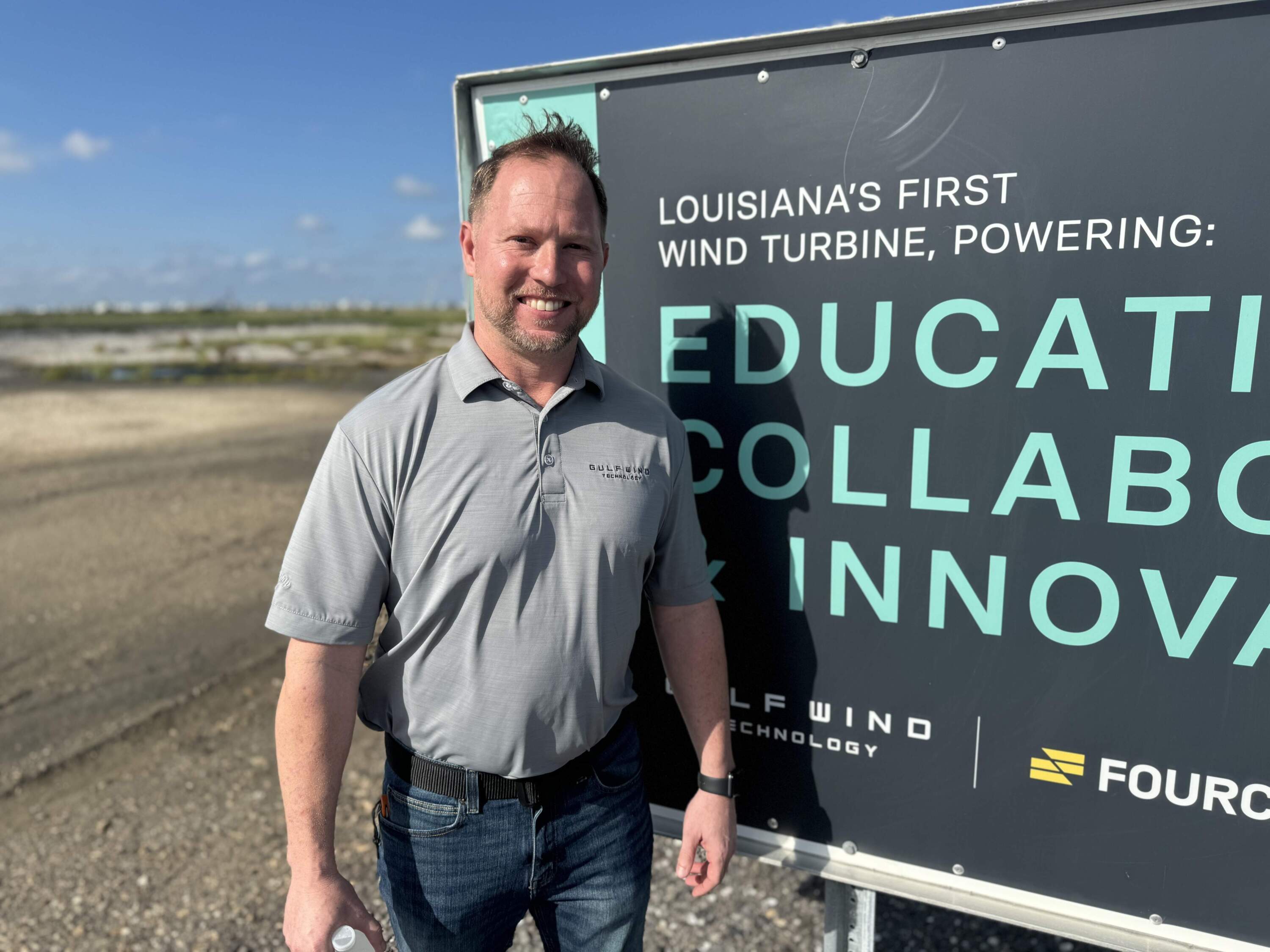
Mitchel Graff with the group Gulf Wind Technology is among those studying ideas from typhoon-prone Taiwan and southern China, where some turbines recently survived 145 miles per hour winds. (Others were not so lucky.)
“I’m looking at a palm tree,” Graff says. “You watch how the prongs of a palm tree kind of bend and conform to the wind and kind of shed some of that load. Those will be some of the technologies that we’re looking at installing in the Gulf.”
Gulf Wind Technology will test some of those ideas here in Port Fourchon with a demonstration turbine that will start spinning next year. It won’t generate much power, but Chiasson says it’s fitting that Louisiana’s first wind turbine will be on the grounds of one of the country’s biggest ports for oil and gas.
“It’s not either/or here. We’re a yes to everything,” he says. “Incorporating offshore wind is just another step in expanding the capability of creating energy and our community, which is an all-of-the-above, let’s-do-it-all mentality.”
Carbon tariffs
In the Gulf of Mexico, the link between offshore wind and fossil fuels could be more than symbolic.
Louisiana has the cheapest residential electricity in the country, less than half the price per kilowatt hour as in New England. So, while East Coast wind farms can more easily compete with other sources of electricity on the grid, offshore wind farms in the Gulf might sell to very different customers: petrochemical companies.
Dozens of chemical companies are based in Louisiana, making plastics, industrial inputs and the chemical building blocks of countless household goods. One of their most important raw materials is hydrogen, which they typically get from fossil fuels. Instead, some have proposed building an electrolyzer — which splits water into oxygen and hydrogen — powered by solar farms and offshore wind farms.
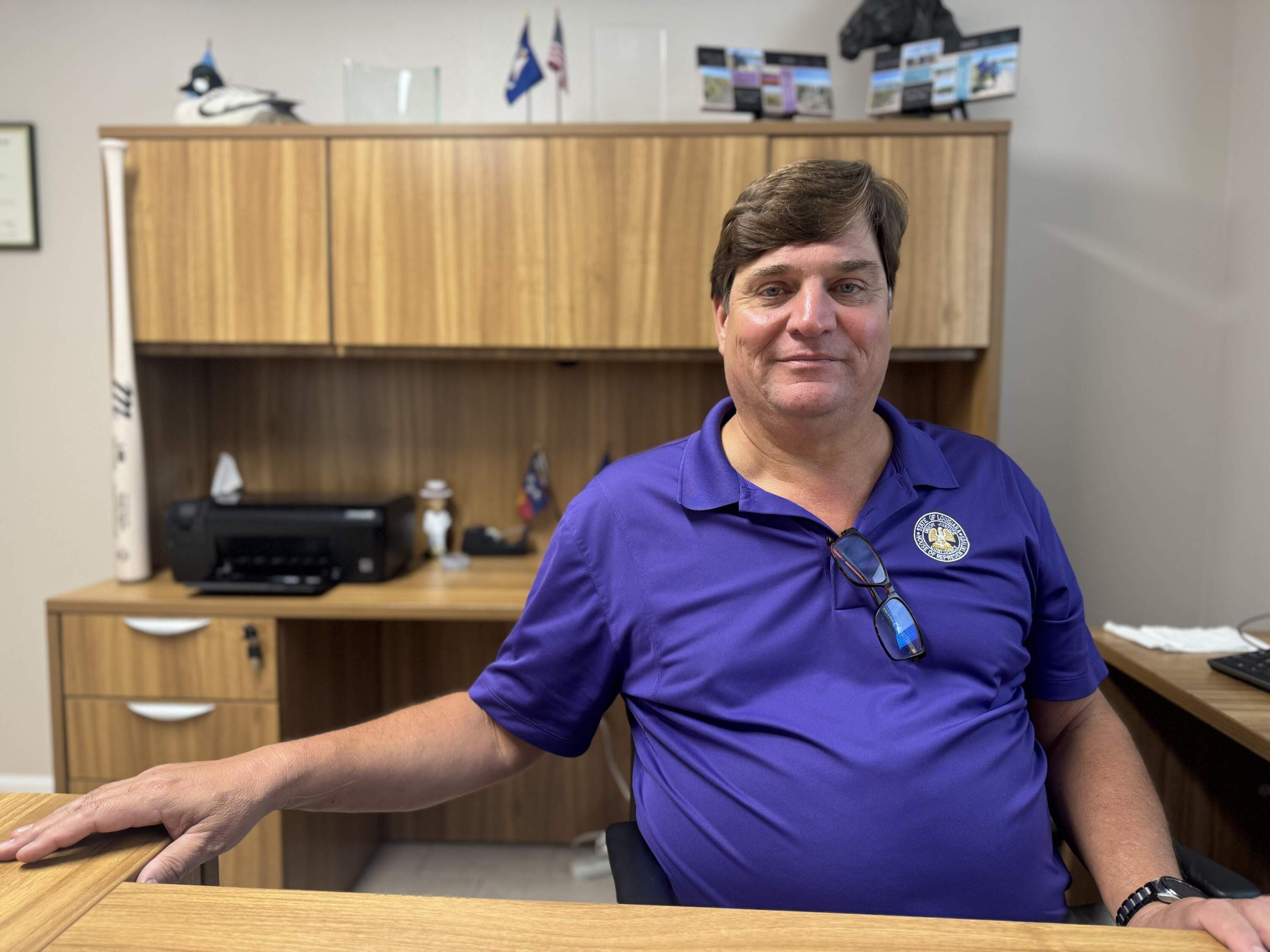
State Rep. Orgeron says petrochemical companies are eager to reduce their supply-chain greenhouse gas emissions because the European Union will soon start taxing imports with big carbon footprints.
“They’re global players and they want to be globally competitive,” Orgeron says. “It’s those companies that are really driving the whole renewable energy demand for Louisiana."
There are significant challenges to building wind farms in the Gulf of Mexico. Inflation, interest rates and supply chain problems have long hampered the American offshore wind industry.
“The big problem with offshore wind at the moment is the cost of capital has gone up,” says James Martin, CEO of Gulf Wind Technology. “Supply chain, raw materials, turbines, borrowing has gotten more expensive. Insurance has gotten more expensive, and therefore your dollars per megawatt has gone up.”
Last year, a federal auction for offshore wind leases off the coast of Texas got zero bids. An American subsidiary of the German multinational company RWE bought the rights to develop offshore wind in a 102,480-acre area off the coast of Lake Charles, Louisiana, for just a fraction of what a similar lease cost off the Northeast.
Projects that take years to plan and build face political hurdles too. To his Republican colleagues in the state legislature who think every dollar spent on wind energy is a dollar taken away from oil and gas, Orgeron says offshore wind work can also help Louisiana “spackle over the rough patches” in the boom-and-bust cycle of oil. That’s already been the case for shipbuilders and vessel operators who service the oil industry in his district.
“One of the biggest headaches is the cyclical nature of the oil and gas industry,” says Otto Candies, whose family has been building ships to supply offshore oil drillers since the 1940s. “I think offshore wind certainly is an opportunity for Louisiana and the broader Gulf Coast region to diversify the economy and supply supplemental energy.”
Keep it local
Global economics and national politics will decide the future of offshore wind power, but Louisianans are trying to keep the benefits of this new industry local.
It’s the inaugural semester of a new wind energy course at Nunez Community College in Chalmette, Louisiana – one of several new wind programs at colleges and universities around the state, including at Louisiana State University and the University of New Orleans.
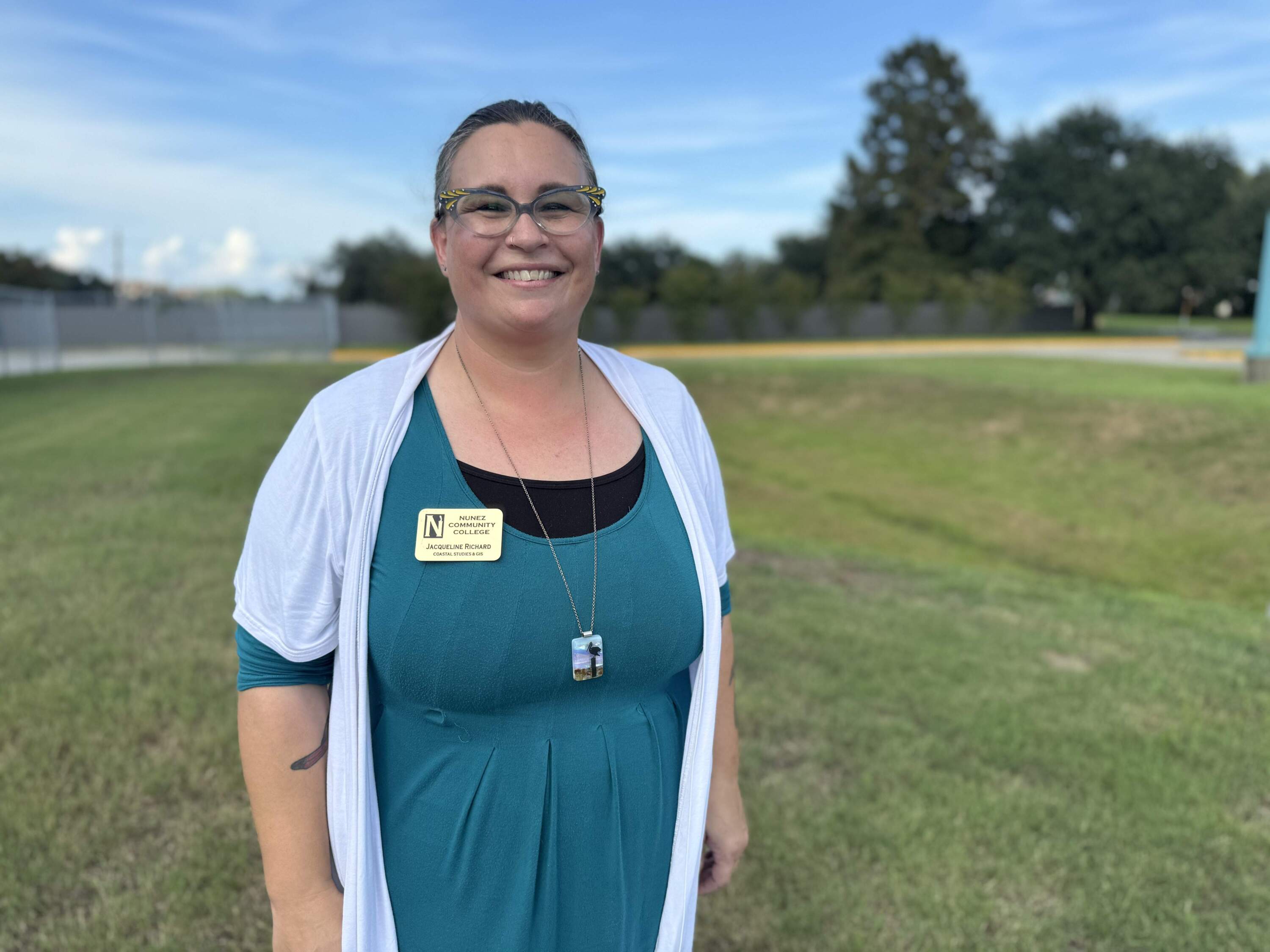
Program chair Jacqueline Richard looks on as students practice evacuating a 35-foot-high platform meant to simulate an offshore rig. Safety training is part of this associates’ program, which emphasizes hands-on learning.
Right next to the mock platform is a replica of an oil refinery for students training to go into the oil and gas business. There’s a real refinery down the street from Nunez Community College, Richard says.
“We’re just looking to diversify and to add as energy demands increase especially with AI and more people,” she says. “We know that we have to have more energy, so we all have to work hand-in-hand with each other."
Richard wants to see more support for internships and apprenticeships throughout the state as the wind industry grows, to keep graduates from moving away.
"The best thing about this is just with this two-year degree, our students will be making somewhere around $62,000 just as they start. The median Louisiana pay is around $59,000, so they’re already making more at an entry-level job than the median pay for the state,” she says. “It’s important for our state to continue to be an energy leader, but it’s also important to start building that generational community wealth, bringing it back to these places."
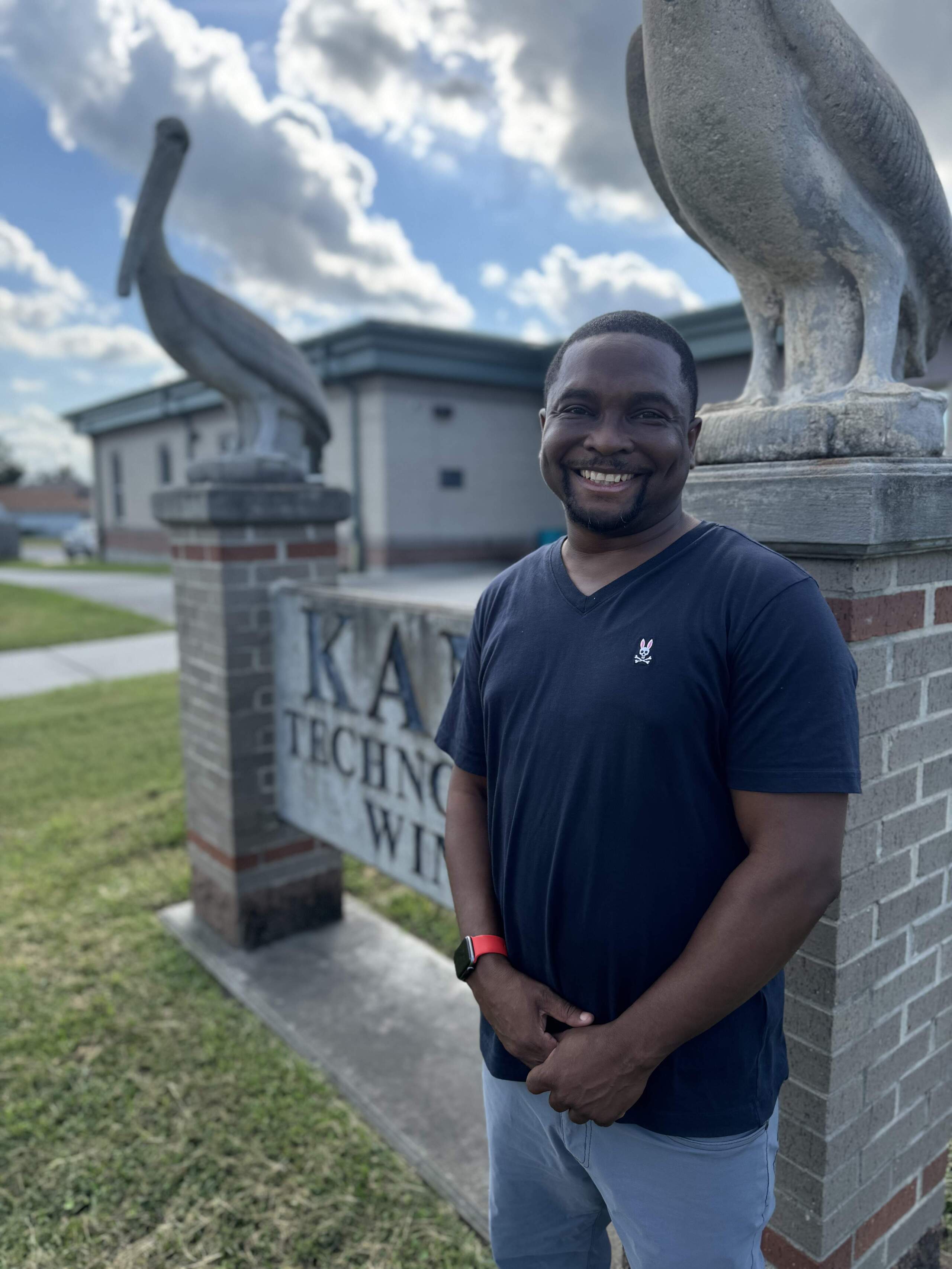
Donald Lofton, 41, is one of Richard’s first students. He’s from the Ninth Ward of New Orleans. Lofton hopes a new career as a wind turbine technician could build on his skills as an electrician, and hopefully broaden his horizons too.
"I don’t have to climb in attics. I don’t have to climb in little spaces anymore. I’m out there in the free world,” he says. “I’m out in the wind, I’m out in the sun. Wherever the world takes me. Traveling is always good, but Louisiana is my home. New Orleans is my home, and I love it."
It will be years before giant turbines spin alongside oil rigs off the coast of Louisiana, if ever. Luckily for Lofton, offshore wind jobs are already here.
This segment aired on October 29, 2024.