Support WBUR
Measles outbreak in Texas is the state's worst in nearly 30 years
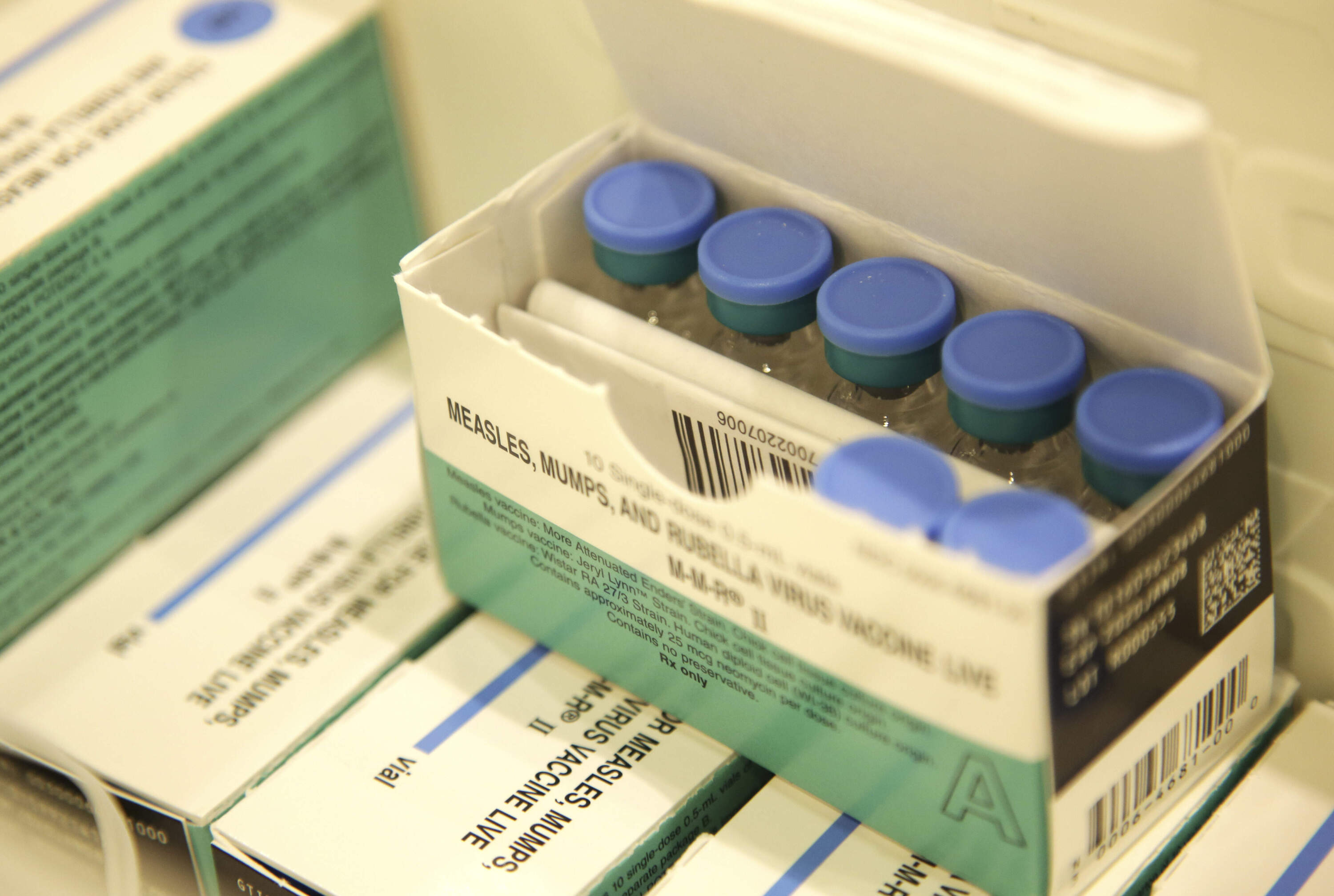
In Texas, health officials say a measles outbreak is the state’s largest in nearly 30 years.
As of Tuesday at least 58 people in rural West Texas were diagnosed. And it appears to have spread to New Mexico, where eight people are sick from a smaller outbreak.
Measles is a respiratory virus that can cause rash and fever and can lead to pneumonia, blindness, and death. It can be prevented by a vaccine.
The outbreak in Texas comes as vaccine skeptic Robert F. Kennedy Jr. steps in as the new health secretary. In 2009, he infamously traveled to Samoa as chair of an anti-vaccine nonprofit to support an anti-measles vaccine movement there. Soon after, health officials said 83 people died in a measles outbreak in Samoa.
Dr. Peter Hotez, dean of the National School of Tropical Medicine at Baylor College of Medicine and co-director of the Texas Children’s Hospital Center for Vaccine Development, says the people he’s spoken to on the ground of the epidemic say it’s continuing to accelerate.
“Measles is a bad actor,” Hotez says. “At least 20% of kids usually are hospitalized and there are awful complications, including pneumonia, ICU admissions, encephalitis, deafness from measles, otitis. It's a terrible disease.”
4 questions with Dr. Peter Hotez
Before the 1960s, there would be an outbreak, especially among children, every two to three years. But then with the advent of vaccines, measles was declared eliminated in the U.S. in 2000. That means 12 months with no continuous spread. How effective is the measles vaccine?
“A single dose is 93%, and so we give us the first dose usually towards the end of the first year of life, and then usually a second dose for school entry. When you get the second dose, it's 97% protective, so it's one of the most effective, safest and the most effective vaccines that we have.”
Do we know if this particular community with the outbreak was not vaccinated?
“That's what they're reporting. First of all, most of the cases are in kids around 5 to 17 years of age. Most are in unvaccinated or in those whose vaccination status is unknown. I think there are a couple, two to three cases, who had been vaccinated, probably just got a single dose. But when you get this kind of level of transmission though, this, this thing could really start to accelerate.”
What advice can you share?
”The single most important thing you can do is to get vaccinated. So if you're unvaccinated, you definitely want to go to one of the clinics that are being set up there. There's local health departments in West Texas are sending up a bunch of free vaccination clinics. And so that definitely is something that you want to do. This is probably the most highly transmissible virus that we know of. And that's why it's often when vaccination rates decline, this is often the first one that pops up because it is so highly transmissible.”
What are you concerned about?
“My concern is right now our vaccine ecosystem is very fragile. We've had a fourfold rise in measles outbreaks from 2023 to 2024, and look how we're starting 2025.
“We're already going in the wrong direction. And given how fragile the vaccine ecosystem, both in the U.S. and globally, I worry that if this continues, then measles could become a new normal for us. And that's not something we want.
“Remember measles kills over 100,000 kids every year globally. And in the year 2000, it was half a million kids dying every year of measles. This is not something we want to bring back.”
Samantha Raphelson produced and edited this interview for broadcast with Peter O'Dowd. Allison Hagan adapted it for the web.
This segment aired on February 19, 2025.