Support WBUR
Former DOD official Mick Mulroy calls Signal chat 'significant breach of security'
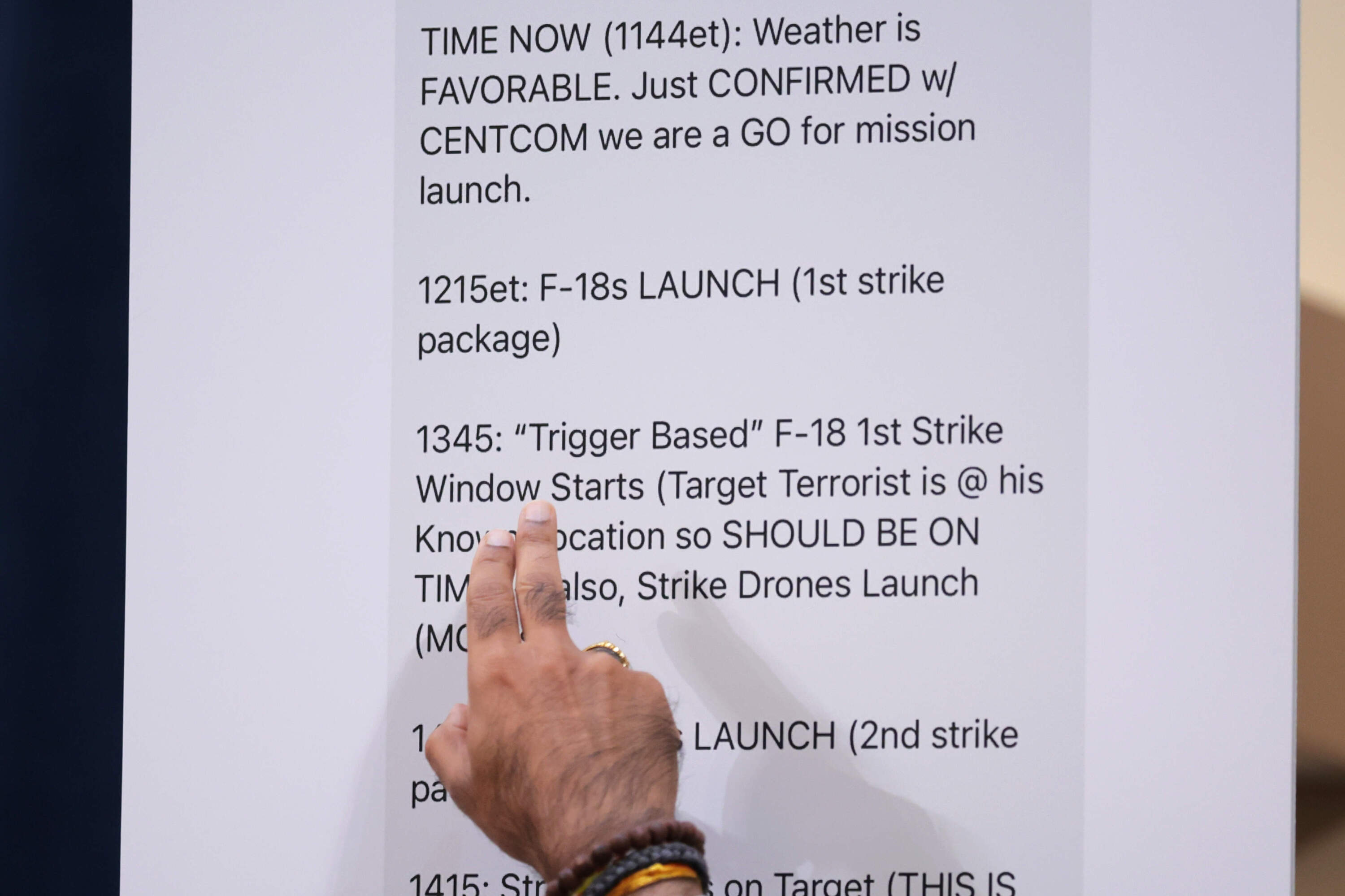
A former Defense Department official in President Trump's first term criticized national security officials for discussing in a Signal group chat plans to attack the Houthis in Yemen.
“They could have easily with this information shot down our pilots, and we could have lost some people on this,” Mick Mulroy said in an interview with Here & Now's Scott Tong when asked if military service members could have been put at risk had the Houthis gotten their hands on the information. “What we should be talking about is the attack on the Houthis and the escalation, which I think was the right thing to do. But because of what I would say is carelessness on the part of these individuals, we're talking about this because it is a significant breach of security."
The Atlantic editor-in-chief Jeffrey Goldberg was inadvertently added to the chat by Trump national security adviser Michael Waltz.
On Wednesday Goldberg released the transcript of that chat.
4 questions with Mick Mulroy
What stands out to you about the details revealed in the full chat transcript?
"To me, as somebody very familiar with how these attack plans work, this was clearly taken from classified material. It's talking about how this would be executed to include the type of system used, in this case an F-18 jet and the type of munitions and the timing and of course it didn't include the exact locations, but the enemy knows where they're located. So, if this information was leaked — and it could have been, particularly if the Russians would have been able to intercept from Mr. Witkoff being in Russia — they would have known everything they need to know to essentially repel this attack. So very sensitive and should never have been relayed on an unclassified system."
What are the risks to American military members?
"Yes, they use Signal in the government. They also use open-line, unsecured phones, but neither are authorized to carry out and discuss war plans or attack plans, which are essentially the same thing. One's a subset of the other. And by doing so, if this was compromised, not just by adding somebody inadvertently. But if it was compromised, and these individuals are going to be the most sought after intelligence collection of anybody in the U.S. government, if it was compromised, they would have all the information that they were relaying on this chat, and I think everybody on this chat knew it should not have been used for this and should have said something and ended it. But it really does put service members at risk."
What would happen to a lower-level official who had communicated this information over Signal?
"There would be an immediate investigation launched. They'd be removed from any access to classified information, and if this is what they in fact did, they'd likely get court-martialed. I think everybody in the military knows that is the case. And unfortunately, instead of owning up to it and taking responsibility, it seems to be that they're making excuses for every reason why they could be able to do this."
What should the public understand about the administration’s response?
"In general, war plans, if you want to think about it this way, is we had a plan to invade Iraq, for example, in 2003. That's a war plan. An attack plan goes down to the subunits inside that plan for how it's actually going to be executed. So that is actually more detailed on time, place, and manner. Both are classified, but one could actually make the argument that the attack plan is more sensitive because it does describe exactly how we're going to carry it out and puts people at risk if it's compromised.
"To [CIA] director [John] Ratcliffe's point, maybe he's making a distinction that it didn't actually say classified or top-secret SCI [Sensitive compartmented information] or what have you, but you can't take the information from a top-secret SCI and put it anywhere because that's the point of the of the classification and the reason why we're protecting it. So, he might have not have taken the actual document. But taking the information out of the document, and this is just, I think, common sense. You don't have to be a CIA officer or a military officer. That is what we're trying to protect. So, if you took it out and you put it in an unclassified, you have violated all rules and regulations when it comes to protecting classified information."
This interview has been edited for clarity.
Editor's note: Katherine Maher, the CEO of NPR, is chair of the board of the Signal Foundation.
Lynn Menegon produced and edited this interview for broadcast with Michael Scotto. Scotto and Allison Hagan adapted it for the web.
This segment aired on March 26, 2025.