Support WBUR
Review
'The Room Next Door' finds solace in the acceptance of death
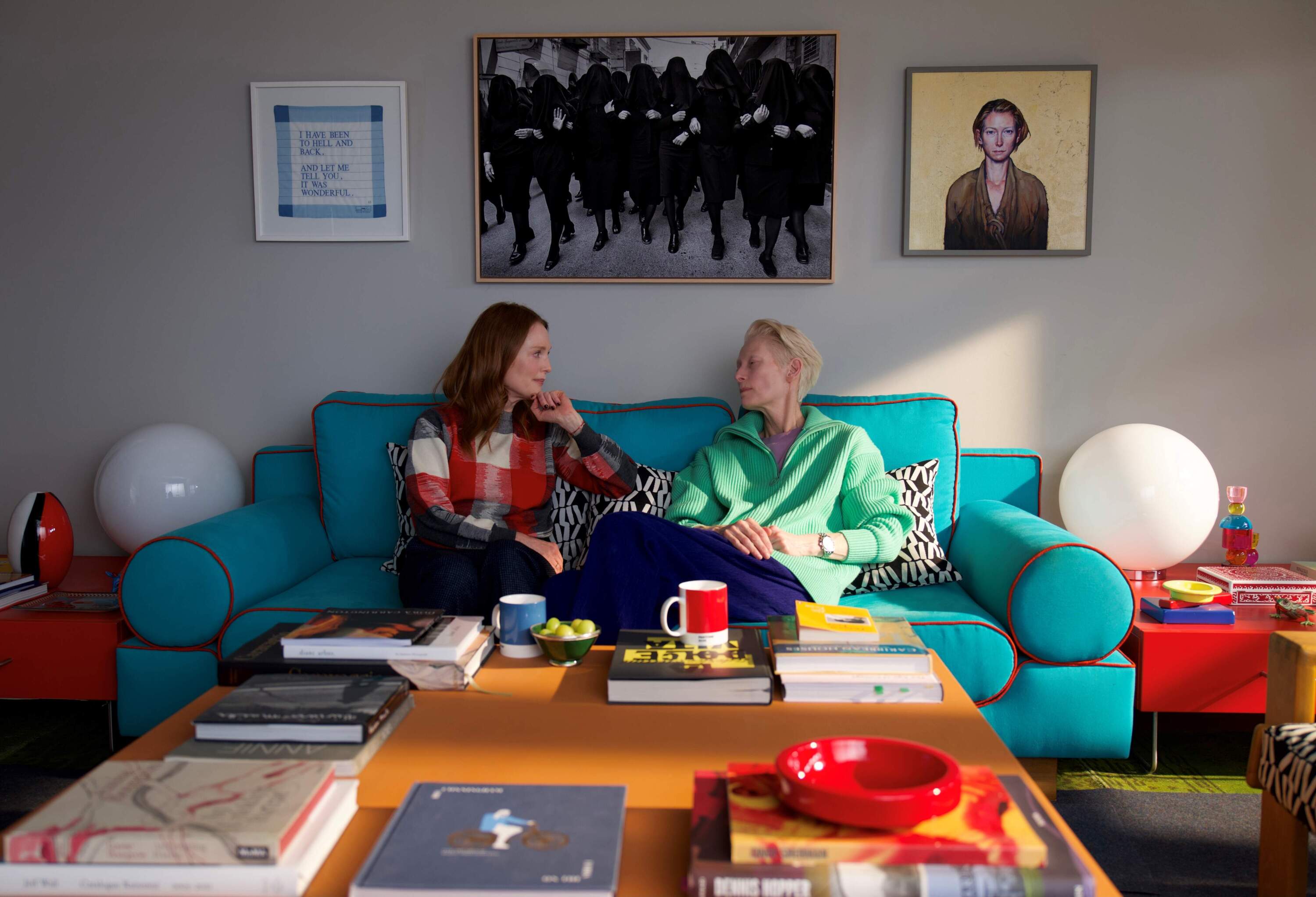
“The Room Next Door” is director Pedro Almodóvar’s 25th feature, and his first in the English language. The 75-year-old filmmaker has been building up to this for a few years now. His marvelous 2020 short “The Human Voice” and 2023’s “Strange Way of Life” were brief forays into a language with which the director isn’t entirely at ease. (He still keeps an English interpreter around at post-screening Q&As.) Tilda Swinton, who also starred in “The Human Voice,” headlines “The Room Next Door” as Martha, a former war correspondent dying of cervical cancer. She’s visited in the hospital by Ingrid (Julianne Moore), an old colleague from their heady, 1980s Paper magazine days. As the two rekindle their friendship, Martha approaches Ingrid with an unusual request.
She’s not going back for another round of treatments, but nobody knows that yet. Martha has purchased a euthanasia pill “from the dark web” and intends to take it, but she doesn’t want to do it alone. She’s not asking Ingrid to watch her die, she just wants to know that there’s someone else there, in the room next door. Adapted from Sigrid Nunez’s 2020 novel “What Are You Going Through,” Almodóvar’s screenplay is a much more muted affair than we’ve come to expect from the manic melodramatist. The bad boy provocateur’s films have grown increasingly genteel and reflective in recent years, with the director’s 2019 “Pain and Glory” an especially moving, nakedly autobiographical reckoning with age and infirmity.
The desire to go out on one’s own terms is what motivates Martha. She’s furious at people who describe her “battle” with cancer, as if a patient could somehow defeat an incurable disease if they only fought harder. Gaunt and losing her mental faculties from “chemo brain” — a horrifying fate for someone who made a career of putting thoughts into words — Martha can feel herself slipping away and wants to be done with it before the disease takes any more from her. That’s her way of winning the so-called battle, declaring victory and leaving the field.
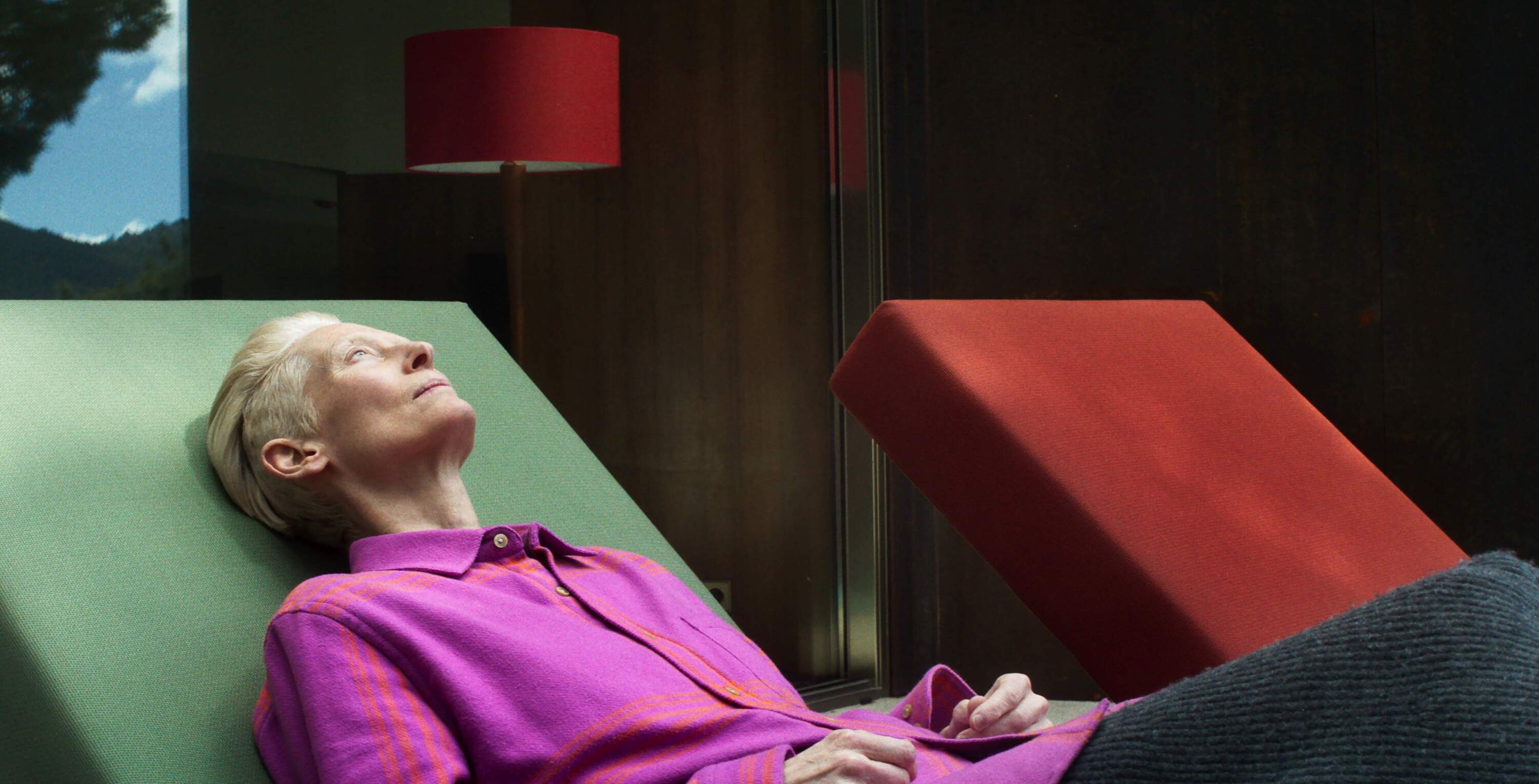
Ingrid is terrified of death. She even wrote a book about it. But she can’t say no to an old friend, so the two take a trip to the Catskills, where Martha has rented an almost comically gorgeous marvel of modernist architecture (like most of the film’s locations, the house is actually in Spain) where they can both rest, write and relax until Martha eventually decides to end her life. It’s the filmmaker’s most unexpectedly tranquil film, serene in its acceptance of the inevitable.
It’s hard to think of two more obvious choices than Swinton and Moore for Almodóvar’s first English language leading ladies, as they’re both icons of independent film and longtime muses of queer cinema pioneers. You also just know he couldn’t wait to dress them, with the statuesque Swinton outfitted in flowing swaths of fabric and Moore’s fire-engine red hair and lipstick offset with so many shades of green she looks like Christmas. These two actresses are particularly adept at heightened, stylized dialogue, of which “The Room Next Door” has some ungainly mouthfuls.
The film has been dinged by a lot of critics for the way these characters speak. Almodóvar’s script is heavy on exposition and allergic to subtext. It took some time for me to figure out why “The Room Next Door” sounded so familiar, and then I realized that the dialogue is straight out of an ‘80s Woody Allen movie. Everyone tells you how they know each other and exactly what’s on their mind. These are verbose, sophisticated New Yorkers musing about art, literature, morality and death while hanging out in bookstores and attending classy cultural events. Heck, if you recast the two leads with Mia Farrow and Dianne Wiest, the film could be from Allen’s “Another Woman” era.
John Turturro co-stars as an old flame of both Martha and Ingrid’s who becomes the latter’s secret confidant during the ordeal. He’s basically playing the Max von Sydow role from “Hannah and Her Sisters,” a brilliant, lady-killing professor turned reclusive, pathetic crank. A climate change obsessive, he’s one of those guys who never really got back out of the house after the pandemic, the kind who uses a casual conversation as an excuse to lecture you about “neoliberalism.” Turturro being Turturro, he does it all with a rascally eye toward trying to get Moore back into bed. (The character even apes Allen’s ickiest screenwriting tic, constantly talking about “making love.”) There’s also a one-scene wonder of a performance by frequent movie-stealer Alessandro Nivola as a busybody, Christian cop. Everyone’s always so stylishly outfitted in Almodóvar films, you know you’ve got to watch out for the guy in khakis and a polo shirt.

Maybe the dialogue didn’t bother me because every other aspect of the film is so stylized, too. Nobody else’s movies look like Pedro Almodóvar’s, which take place in a beautifully designed alternate reality where even the rental house has an Edward Hopper painting on the wall. I could only dream of living in one of these apartments, with their recessed record cabinets and wallpaper coordinated with the actresses’ outfits. “The Room Next Door” was pretty obviously filmed in Spain — check out the accents on the day players — with its vision of New York City just as much of an imaginary construct as Allen’s squeaky-clean Manhattan.
There is one notable scene shot on location at Lincoln Center’s Alice Tully Hall, an inside joke Almodóvar clearly designed to bring down the house when “The Room Next Door” screened there during the New York Film Festival. There’s always something magical about seeing the movie theater that you’re sitting in during the movie that you’re watching, as anyone who saw “The Holdovers” at the Somerville Theatre can attest.
The story has some strange speedbumps and a curious casting choice near the end makes promises that never quite pay off, but I’m always taken with how smooth and easy to watch Almodóvar’s movies are, even when they’re not entirely successful. Scenes flow into each other so effortlessly, there’s something comforting about his relaxed command of film grammar. Especially during a film like this, which is about finding solace in acceptance and grace. We all die alone, but if you’re lucky there might be someone in the room next door.
“The Room Next Door” opens at the AMC Boston Common and the Alamo Drafthouse Seaport on Thursday, Jan. 9, and at the Coolidge Corner Theatre on Friday, Jan. 10.