Support WBUR
UMass biomedical scientist freezes pediatric brain cancer research due to federal funding problems
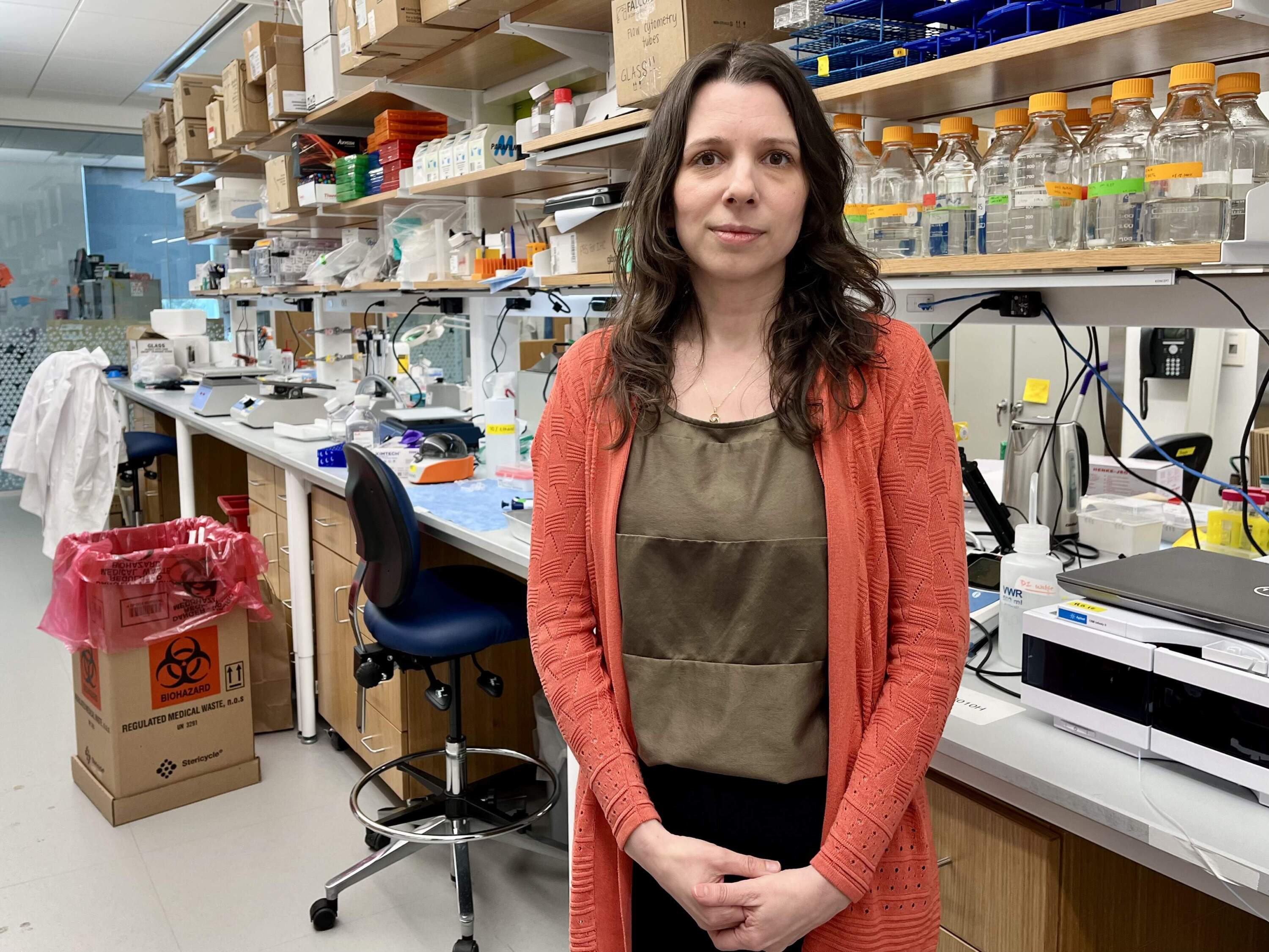
Cuts and delays in federal research funding have led a scientist at UMass Chan Medical School to shut down some of her lab's work.
Biomedical engineer and professor Rachael Sirianni says the research in question is aimed at developing tools to help treat brain cancer in children.
"I'm passionate about that for many reasons," Sirianni said. "One is that I've met many families that have been affected by this, that have lost children and loved ones to these particularly malignant and difficult to treat brain tumors."
The Trump administration wants to to broadly reduce some funding from the National Institutes of Health, saying it would bring the federal government more in line with how private foundations fund research and trim government waste. That's being challenged in court. Meanwhile, NIH is canceling and holding up many grants. UMass Chan Medical School's Morningside Graduate School of Biomedical Sciences recently rescinded admission offers to incoming doctoral candidates as a result.
Sirianni has expressed her worries about the research cuts on Bluesky, where her first post about it went viral. She told WBUR's All Things Considered host Lisa Mullins she wants people to know about the work she and other scientists do, and how it's now at risk.
Interview Highlights
On the focus of her lab's research:
Rachael Sirianni: "I'm what you call a drug delivery scientist. So, my science is understanding how therapeutic molecules move through the body and working on different kinds of strategies we can use to improve their delivery to particular tissues or sites in the body. ... [People] have something called a blood-brain barrier that is a very tightly regulated network of cells and extracellular materials that prevent most drugs from actually reaching the brain in a concentration that would enable them to be effective.
"I have one person in my lab that works on making nanoparticles that we can administer directly to the cerebrospinal fluid that surrounds the brain and spinal cord. ... And we developed those nanoparticle systems to better deliver chemotherapeutic agents to tumors that have metastasized within that space."
On what's happened to her team's research funding:
"What we're experiencing right now is a pretty severe delay on funding. Our grants have not been pulled, but what's happened is that the grants that were in the pipeline — where we expected funding to hit in the future — those are the ones that are being delayed.
"We also have what I call discovery work, which is work that's not currently funded, but that we're pursuing because we believe it's something that might change how we treat particular diseases or open new opportunities for us to design therapies. And when we see delays on projects where I was expecting funds to hit, we have to redirect or reconsider the type of experimental work that we do. And it makes work on risky projects, it makes work on difficult-to-fund projects — like pediatric brain tumor work — particularly difficult to pursue right now.
"There's no innovation without risk ... and many of the promising or innovative things that we would like to move forward with, we now have to pause or be more cautious about that to make sure that we can literally keep our individuals employed and our laboratories running."
On social media responses suggesting Sirianni and her research colleagues could move their work to Canada:
"I've had many people state that Canada would be happy to have us. I've not received an actual offer letter with details of an offer. But ... the truth is that we are going to experience loss of talented scientists, and that's going to occur at every level. Whether they're junior faculty, just starting out postdocs or graduate students, that means that the loss of workforce that we're going to be experiencing will not be realized for another five to 10 years."
On what she believes the wider impacts will be:
"I will argue passionately that the relationship that academic research has had with the federal government since 1948, when these institutions [such as NIH] were first developed, that relationship has enabled our country to be the global leader in science, medicine, and technology. And it works. The systems work. They may have challenges, they may have inefficiencies, and we need to address those. But the way that this is being done right now is simply destroying it. And it's destroying it in a way without any rhyme or reason or logic.
"We can look at every drug that's been approved from 2010 through 2019, and during that decade, the vast majority of them come from NIH research — 354 out of 356 drugs. We have to ask ourselves, as a country, why would we sacrifice NIH? Why would we sacrifice these activities that, in fact, have yielded incredible benefit for our society? ... This is what has enabled us to understand our bodies better, to understand our world better, and to develop the technologies that allow us to exist and enjoy our lives."
On whether she's worried she could be on the receiving end of federal government pushback or retribution:
"It does worry me. It's uncomfortable to speak up, and I think that's one reason why we don't see a lot of scientists talking about this. ... We do fear retribution, and we fear that there may be consequences. But ultimately, we have to do what's right for us as individuals. And for me, that means making these stories be heard and trying to help the public understand, because I don't think that they want this to happen."
This segment aired on March 27, 2025.