Support WBUR
Critics hammer Gov. Healey as she ends shelter emergency
The first two years of Gov. Maura Healey's term in office were dominated by the state's migrant crisis, and the headlines came at a blistering pace: Images of families sleeping on the floor of Boston's Logan airport; news that whole hotels were booked to accommodate families; criticism of the hundreds of millions of dollars the state would spend on services. By August 2023, the situation felt untenable to most leaders on Beacon Hill.
That's when Healey made a big announcement: The Massachusetts shelter system was in a state of emergency. She did so from a podium at the State House, speaking to a gaggle of reporters as cameras rolled.
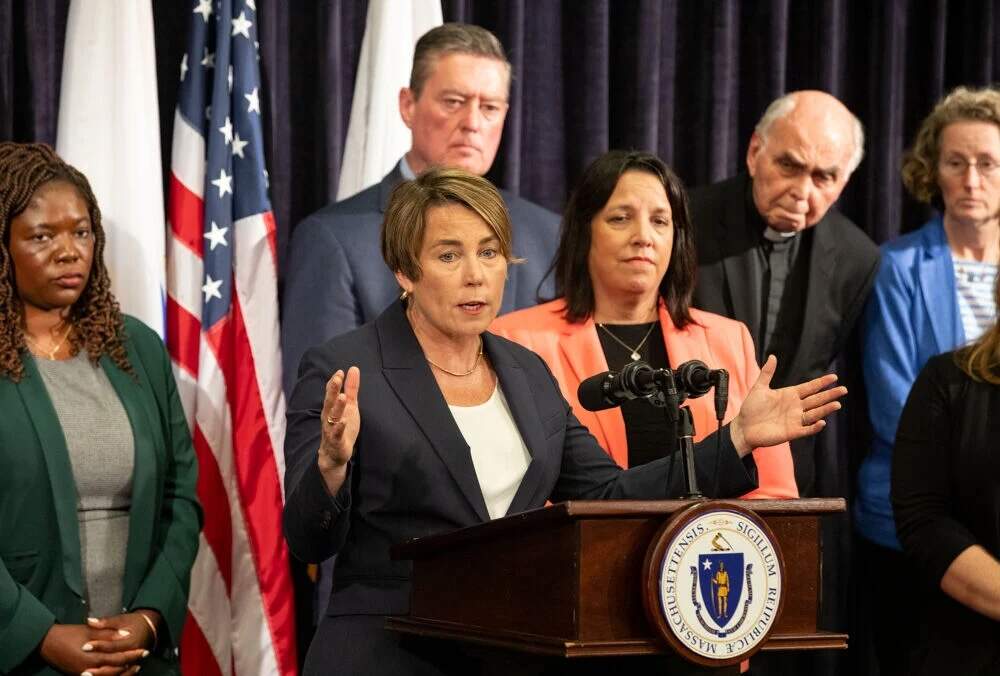
So it surprised some political observers this month when Healey announced, without fanfare, the "end" of the shelter emergency. There was no press conference, no podium, no cameras. Just an email sent to reporters on a Friday afternoon.
A spokesperson for Healey said the governor ended the state of emergency on Aug. 1 because the final hotel shelters had closed the day before.
Jerold Duquette, a political science professor at Central Connecticut State University, said the Friday press release was a "classic" news-burying tactic on an issue that became a major political and financial challenge in her first term.
" She doesn't really want to loudly say that she essentially used a bunch of policies that were conservative," he said.
In his view, Healey had "created all kinds of barriers for homeless people to get services."
When Healey declared the state of emergency in 2023, thousands of families from countries like Haiti and Venezuela were arriving in Massachusetts to seek shelter. Many had fled their homelands to escape political, criminal and economic crises.
Some of these families qualified for emergency assistance under the state's unique right-to-shelter law. The 1980s-era law guarantees shelter to homeless families and pregnant women who meet certain criteria.
" She doesn't really want to loudly say that she essentially used a bunch of policies that were conservative."
Jerold Duquette
But as the sheer numbers of new arrivals grew, Healey capped the number of families that could receive shelter at any one time. Those that didn't make it under the 7,500 family cap were put on an ever-expanding waitlist. In 2024, the state-run emergency family shelters housed 24,000 people, about half of whom were migrants.
Healey urged Congress to pass a bipartisan border bill that would have sent more money to states while tightening immigration restrictions — a stance that put her at odds with U.S. Sen. Elizabeth Warren and other several other Massachusetts Democrats.
Then in 2024, the governor limited most family shelter stays to nine months, with shorter stays in temporary overflow sites. And this year the Legislature implemented a first-ever residency requirement, aimed in part at keeping other states from sending immigrants here.
The number of families in Massachusetts emergency shelters has now fallen to about 3,200, less than half the number at the height of the state of emergency.
“As a result of my reforms and our efforts to help families get jobs and stable housing, we have fewer families in shelter than the day we took office, and all hotel shelters are now closed — months ahead of schedule," Healey said in this month's statement. "We’re saving taxpayers hundreds of millions of dollars and putting families on a path to self-sustainability."
State data show over 1,800 people who entered the system as migrants, refugees or asylum seekers have successfully filed for work authorizations. And more than 7,000 families are now enrolled in HomeBASE, a rental assistance program.
Massachusetts Republicans say the decline in numbers is attributable to a dramatic drop in border crossings following President Trump's return to office. Federal data show the flow of people over the southern border has fallen to its lowest level in decades.
" The burden on Massachusetts taxpayers and the burden on the government in Massachusetts, and therefore our Democratic governor, has been clearly lessened by the policies enacted by the Trump administration," said Massachusetts Republican Party chair Amy Carnevale.
The state of emergency is over, but Carnevale said that should not end scrutiny of the Healey administration's handling of the crisis.
" The hotels may be off the front pages and the headlines in the news, but the fiscal impact remains a concern in Massachusetts," she said.
Former housing secretary Mike Kennealy, who's running in the Republican primary for governor next year, piled on.
"Maura Healey will spend the final sixteen months of her political career avoiding, deflecting, and spinning what happened in her migrant shelters," Kennealy said in a statement. "It was a national embarrassment — and it all happened on her watch."
The formal end of the state of emergency doesn't change much on the ground, in terms of the day-to-day operations of the state's emergency shelters. The capacity cap, limits on lengths of stay, and residency requirements were all enacted by the Legislature and remain in place.
Advocates for migrant and homeless families say they'll continue to fight to lift those restrictions.
"We are seeing that more and more families are experiencing homelessness," said Kelly Turley, associate director of the Massachusetts Coalition for the Homeless.
But with the new barriers to shelter, they " are not being served through the state's emergency assistance shelter program," she said. "And in some cases, not really served by the state at all."