Support WBUR
How John Axelrod shaped the MFA's collection

Editor's note: This story is an excerpt from WBUR's weekly arts and culture newsletter, The ARTery. If you like what you read and want it in your inbox, sign up here.
In 2008, when the Museum of Fine Arts was building its Art of the Americas wing, John Axelrod approached the museum with an offer. The Boston collector and longtime patron wanted to give the museum his collection of American modern design.
Nonie Gadsden, MFA curator of American decorative arts and sculpture, spent several days with Axelrod, sorting through a vast trove of pieces from the 1920s, ‘30s and ‘40s that were displayed – and hidden – around his Back Bay home.
“ I went into his apartment and came out with about nearly 400 objects, which was amazing,” Gadsden said. “They were everywhere. They were under the bed, they were in the cupboards.”
Gadsden reflected on this remarkable donation after news broke that Axelrod had been killed in a hit-and-run on the morning of Jan. 3 while walking his dog on the Commonwealth Avenue Mall. Police say it was a deliberate attack. A 42-year-old suspect, William Haney Jr., pleaded not guilty to first-degree murder and animal cruelty. He is being held without bail and was ordered to undergo psychiatric evaluation.
In the wake of Axelrod's shocking death, there has emerged renewed appreciation for his prolific contributions to the MFA. Over the course of his 40-year relationship with the museum, the retired attorney donated or sold nearly 900 objects to the institution. He served on several advisory committees, supported the publication of two books and established the museum’s Darwin Cordoba Fund for Latin American Art.
“John was one of the most passionate collectors I've ever met,” Gadsden said. “He researched, he built his own library. He met the people who could help him understand more. He is a collector that I learned so much from.”
Axelrod, whose wealth The Boston Globe reported came from his work as a lawyer and his family’s hotel business, liked to build up collections and then unload them and start fresh. In addition to his collection of American modern design, the MFA acquired several of his collections of 20th-century European decorative arts, which included French art deco glass and pieces by the famed postmodern design collective the Memphis Group. But perhaps most significant was the museum’s purchase, in 2011, of 67 works by Black artists from Axelrod’s personal store.
“He said, ‘You cannot have a collection of American art without these artists,’” Gadsden recalled. “And he was one of the first to truly not only believe that, but collect and then get the collection into a public sphere.”
The MFA described the acquisition as “transformative.” It included works by Loïs Mailou Jones, Archibald Motley, Romare Bearden and Jacob Lawrence, as well as a stoneware jar by the enslaved poet and potter David Drake, which the museum recently restored to Drake’s descendants.
In recent years, Axelrod had turned his attention to street artists of the 1970s and ‘80s – a departure from what Gadsden called his “sweet spot” of work from the 1920s, ‘30s and ‘40s. But she identified a throughline in all of his collecting obsessions, be it obscure New York City graffiti artists, painters of the Harlem Renaissance or overlooked Jazz Age design.
“One of John's most abiding and strongest thoughts was to expand what we thought of as American art,” Gadsden said.
She considers herself lucky to have worked with someone with a discerning eye and an uncanny ability to identify interesting areas of collection years ahead of the mainstream art market. Axelrod often developed friendships with living artists whose work he admired, like the street artist Daze.
“ John had him come to his 50th high school reunion,” at Phillips Academy in Andover, Gadsden recalled. “ And had his whole class tag a mural. Can you imagine?”
Gadsden, who worked with Axelrod on a book focused on his collection of 20th-century American design, described him as extremely knowledgeable and hardworking, with equally high expectations of others. After reading a draft of one of the chapters in the book, he paid her what she considers his greatest compliment: that he had learned something new.
“ He was rough around the edges. He could be brash, but he was truly gold at heart,” Gadsden said. “And his ultimate goal was to get these objects in the public light, to get people to get to know them and have the opportunity to learn from them. And he achieved that.”
The nearly 400 objects that Axelrod offered to the MFA back in 2008 became the basis for the John Axelrod Gallery in the museum’s Art of the Americas wing. Gadsden shared four highlights from the collection, which are currently on display.
Archibald Motley's 'Cocktails,' 1926
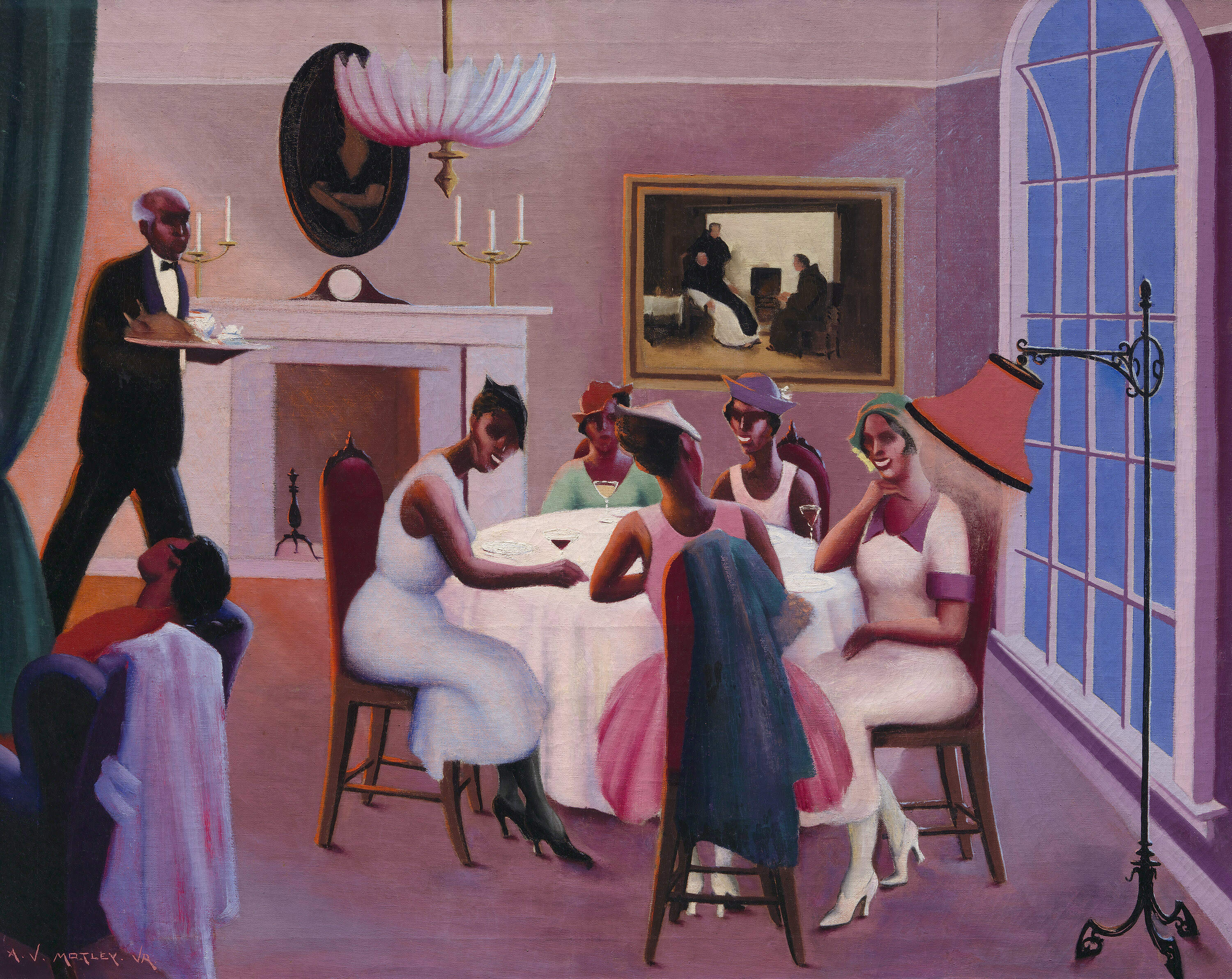
Painter Archibald Motley rose to prominence in Chicago during the Harlem Renaissance. “Cocktails” depicts five sophisticated Black women in hats and high heels, enjoying cocktails around a table while a butler serves them dinner.
“ One of the most fascinating things about Motley's work is how he showed a range, and humanity, within the Black community,” Gadsden said. “There's so much about freedom, and freedom to be yourself, in that painting.”
When “Cocktails” was installed as part of an MFA gallery about art and jazz, the museum invited local jazz musicians to compose music in response to a work of their choosing. Renowned drummer Terri Lyne Carrington chose “Cocktails.” In an exhibition label, she described her attraction to the image in feminist terms: “While jazz symbolized freedom and change — urging a resonation with self-authenticity as well as community — it was presented as men’s work, historically presided by male experts. But perhaps these women were contemplating and analyzing the music they had heard — or conspiring to have their own jam session! At the very least, I’m hoping they were happily shunning the burden of respectability politics, enjoying their autonomy (with no kids or husbands), and exploring their identities — while enjoying the butler’s offerings.”
Viktor Schreckengost's punch bowl from 'Jazz Bowl' series, 1930
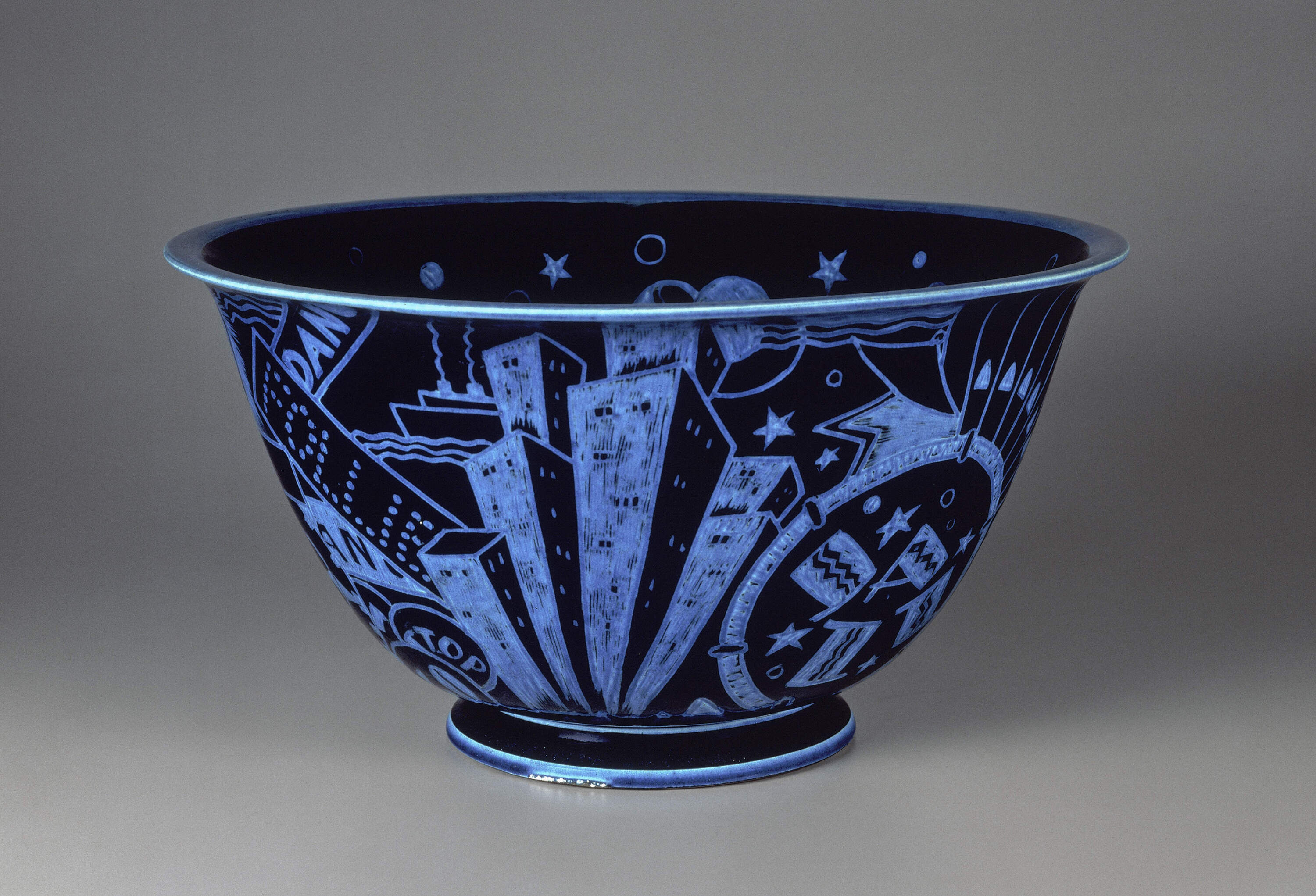
Born in 1906, Viktor Schreckengost was an American industrial designer and sculptor. The “Jazz” bowl was one of his first assignments as a new hire for Cowan Pottery Studio. The anonymous request was for a punch bowl with a New York-ish theme. The stylized images on the bowl playfully evoke jazz, the New York skyline, and even alcohol consumption, although it was illegal at the time.
“ After he delivered it, the patron, Eleanor Roosevelt, whose husband Franklin had just announced he was running for president, said she'd like two more,” Gadsden said. “Including one for the White House, because she was sure he was going to win.”
Schreckengost, who lived to 101, was one of the artists Axelrod befriended. “He bought stuff directly from Vik, as he called him,” Gadsden said.
Paul T. Frankl's 'Skyscraper' desk and bookcase, c. 1927-28
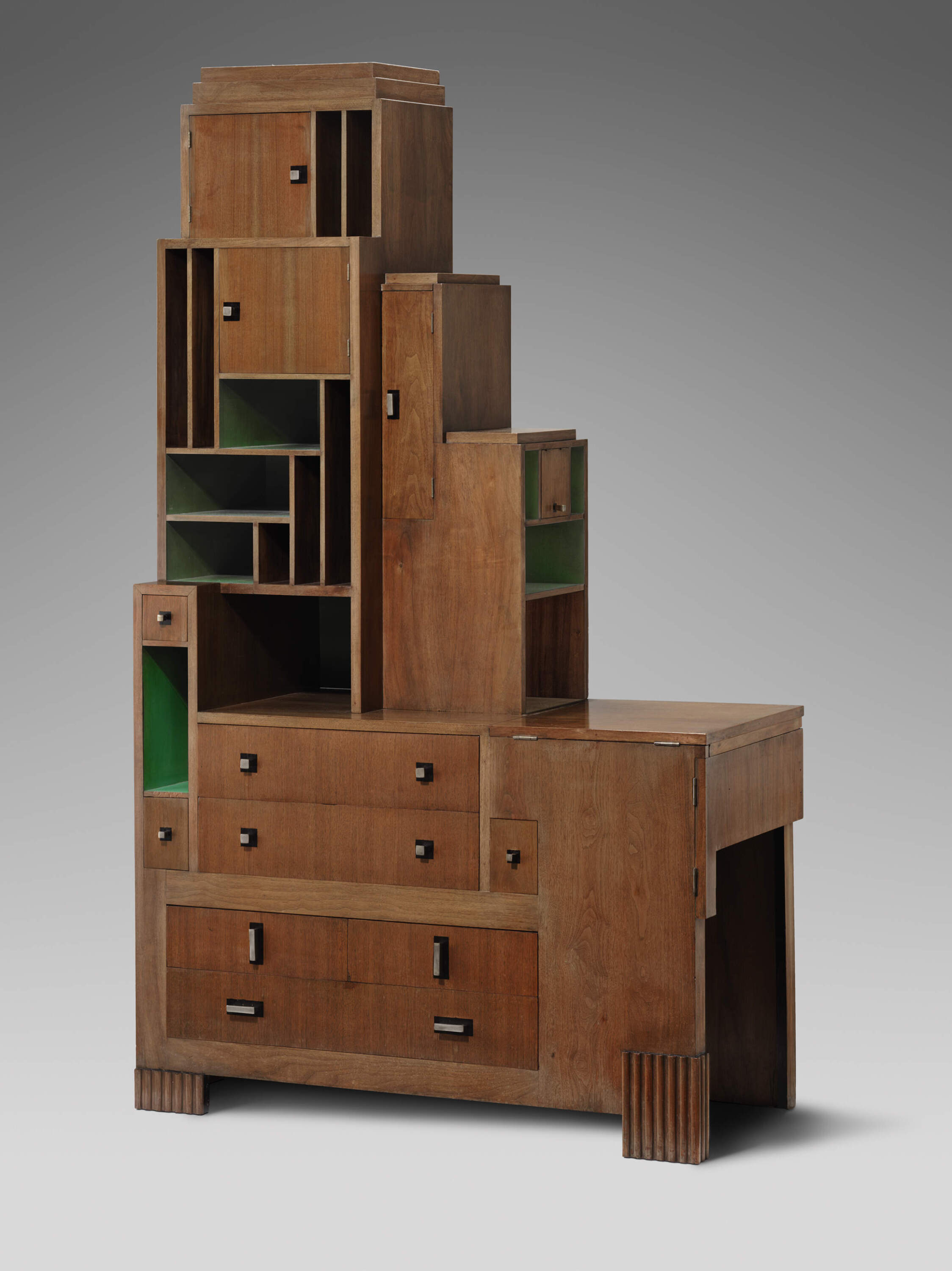
Paul T. Frankl was a Viennese architect and designer who came to the United States and sought to carve out an American design vernacular. While his colleagues were over in Paris studying the art deco styles on display at the 1925 World’s Fair, he stayed at his home in the Berkshires and tried to come up with something that was distinctly American.
“He had all these architecture books that were large and unwieldy and things were just all around his studio. So he quick-made a bookshelf to fit the different sizes of books that he had,” Gadsden explained. “And his neighbor came over and said, ‘Oh, those look like one of those skyscrapers that are going up in Manhattan.’”
That was the birth of Frankl’s famed skyscraper-style of furniture. The striking bookcase on display at the MFA features a fold-out desk and wired-in lighting.
“ It was an attempt to use the small space of apartment-style living and have multiple uses of this object,” Gadsden said. “It was truly innovative.”
Screen designed by Donald Deskey, c. 1930
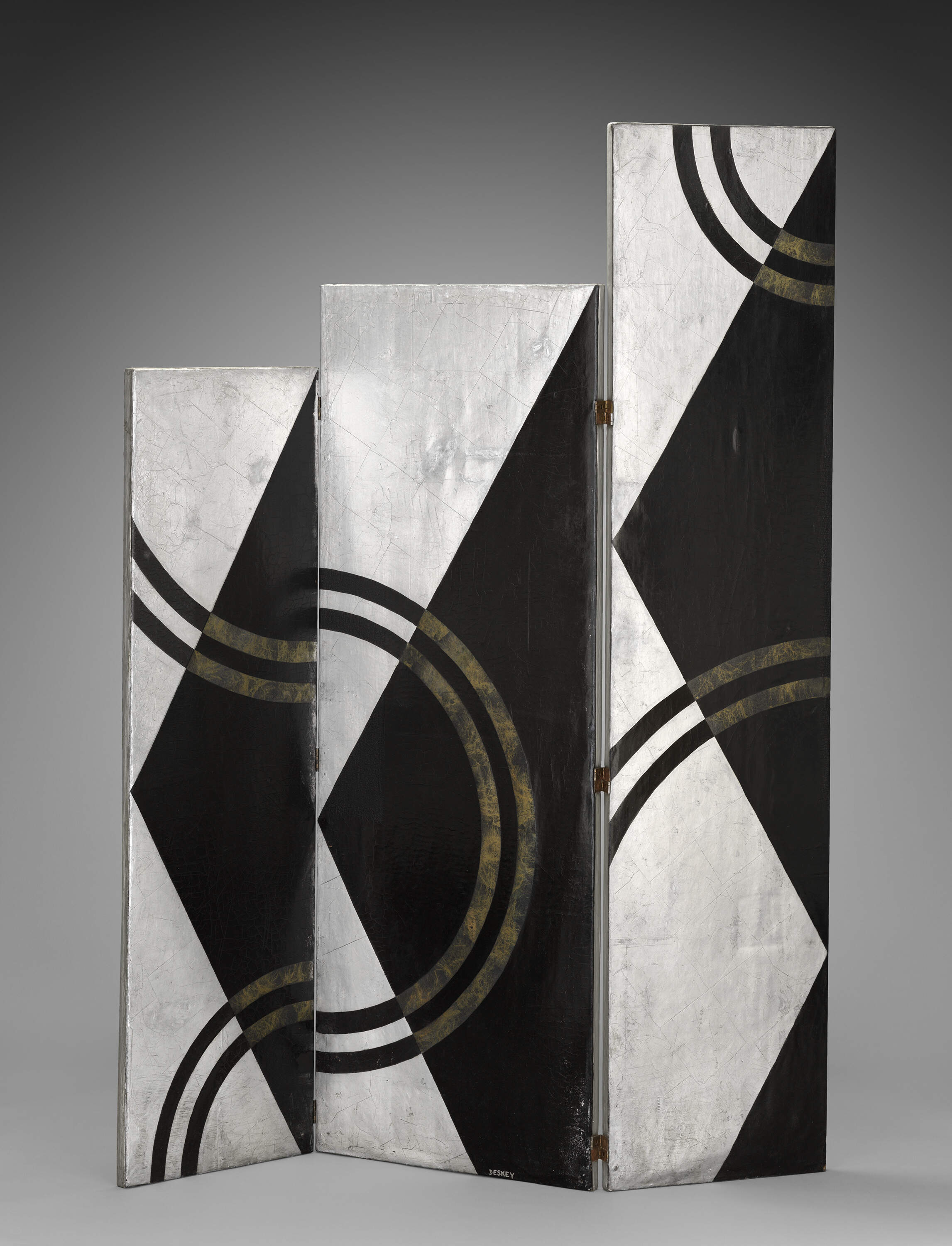
The American industrial designer Donald Deskey is perhaps best known for winning a competition to design the interior of Radio City Music Hall. Before his big break, he was commissioned to create several screens to sell in Frankl’s design store. The stepped screen evokes the skyscraper theme in Frankl’s furniture, and utilizes aluminium leaf for a shiny, modern look. The aluminium “ brings out that glitzy era of the jazz age and created sort of abstract rhythmic designs on it,” Gadsden said. “That’s how Deskey got his start in the modern design world.”
This article was originally published on January 08, 2026.