Support WBUR
Inside the year‑long restoration of a 16th century painting
Editor's note: This story is an excerpt from WBUR's weekly arts and culture newsletter, The ARTery. If you like what you read and want it in your inbox, sign up here.
In 2022, Yuhua Ding discovered a damaged Chinese scroll sitting in storage at Wellesley College’s Davis Museum.
Underneath its many stains and cracks, she recognized a familiar figure: the Magu deity from the 16th-century Ming Dynasty.
Ding is an assistant curator of collections and academic affairs at the Davis. Her research focuses on ancient Chinese art and antiques. Seeing “The Immortal Magu” in poor condition, she was determined to preserve the piece.
The artwork was donated to Wellesley by Lois Levin in 1983. She had graduated from the college in 1942 and wanted to make the work available to students.
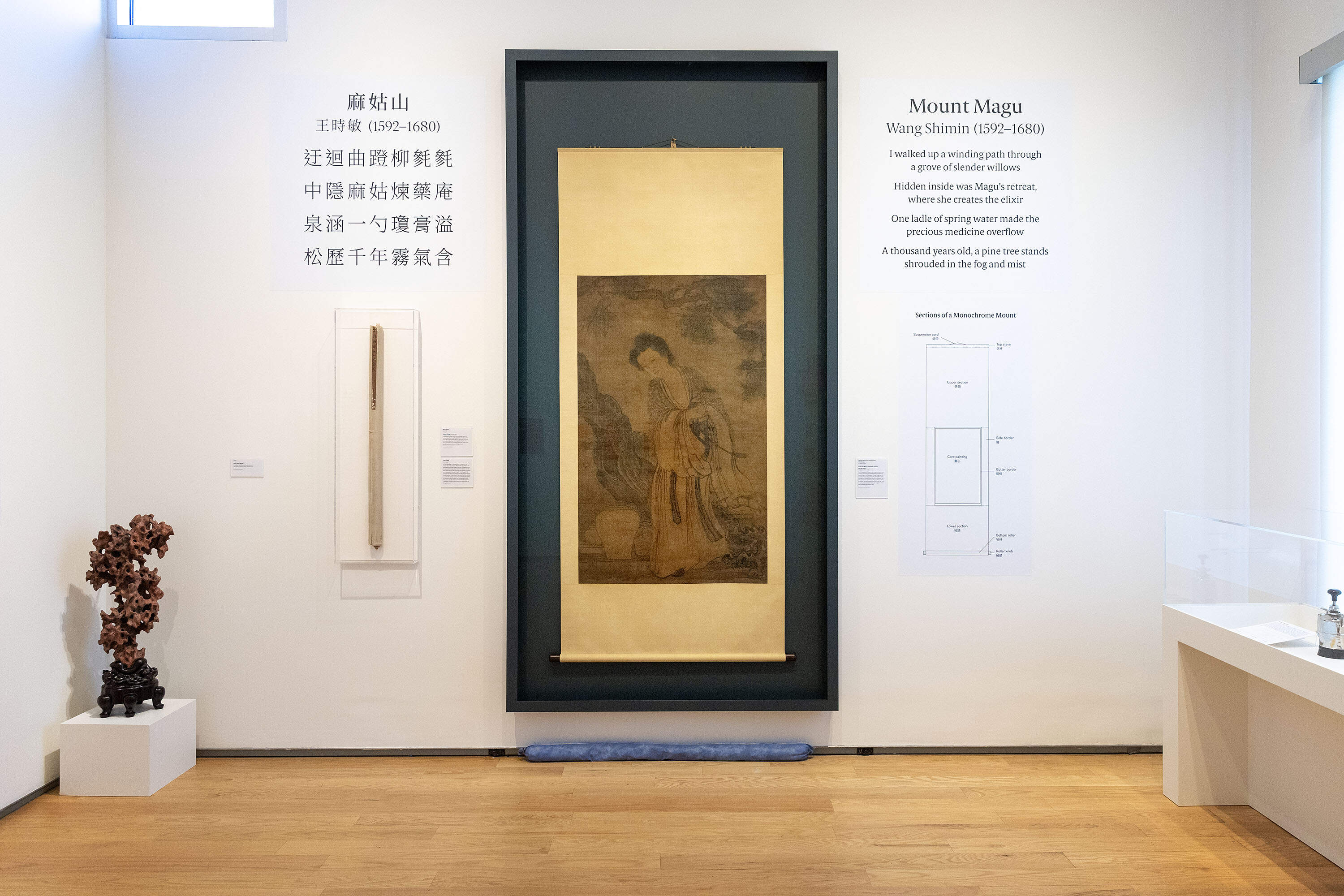
After a lengthy restoration process, the artwork will be on view at the Davis beginning tomorrow. “The Immortal Magu: A Sixteenth Century Painting Up Close” provides a rare window into the restoration process and a chance to view the restored painting itself.
To repair the hanging scroll, Ding sought the help of conservator Jing Gao and Studio TKM Associates, a conservation studio in Somerville that restores artistic and historic works on paper. Gao trained at the Palace Museum in Beijing, and he is a world-renowned conservator of Asian paintings.
“Scrolls look so simple. You think to yourself, ‘Oh, it just rolls up,’ you know?” said Deborah LaCamera, partner and senior conservator at Studio TKM Associates. “But the structure of a scroll is so intricate and so precise that you really can't make a functioning scroll if you're not an expert … That’s why somebody like Jing with his expertise really is so amazing.”
In 1988, Gao became the first and only conservator for Chinese paintings in the United States upon joining the University of Michigan’s Museum of Art. He became a conservator at the Museum of Fine Arts, Boston, in 1995, which is home to the oldest Asian conservation studio in the United States. For 26 years, he restored major works and trained a new generation of conservators.
Now retired at age 70, Gao independently consults on projects at the MFA and throughout New England.
“He cannot really retire,” joked Ding. “There are only several Chinese conservators in the United States, and they’re all in high demand. Especially in painting. People will wait for the right hands to touch it.”
Gao lent his spare Fridays for the year-long process of restoring “The Immortal Magu.”
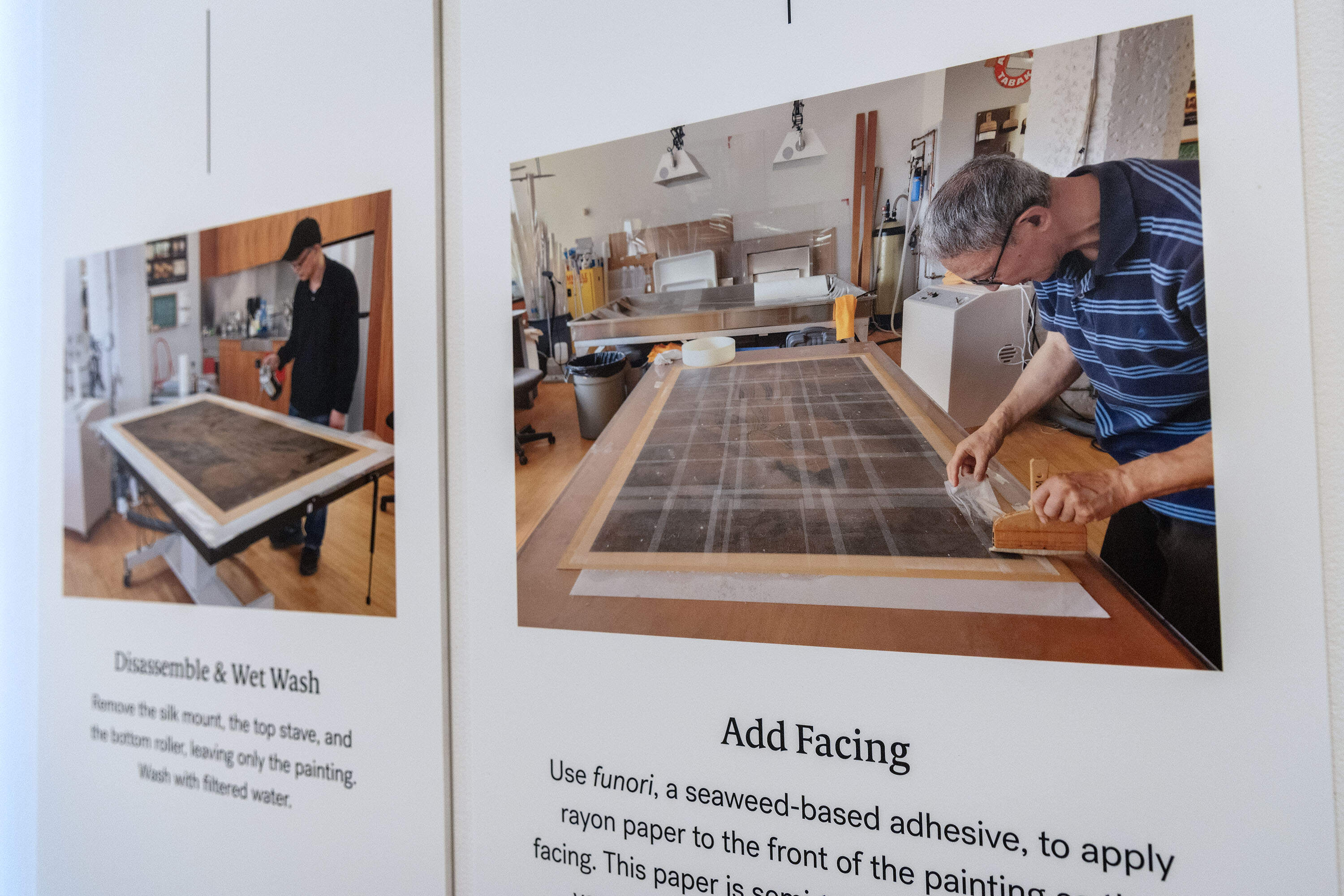
First, Gao dismantled the original scroll, removing the old backing paper and replacing it with several layers of new backing and a custom-made silk mount. Instead of using traditional Chinese paper, Gao introduced innovative materials, incorporating two Japanese papers and Taiwanese pineapple paper.
When examining the ink painting of Magu, LaCamera and Gao used raking light and microscopic photography to identify creases, cracks, and stains. Upon close examination, they found several inconsistencies in the silk density and weaving patterns, clear signs that the painting had been restored twice before.
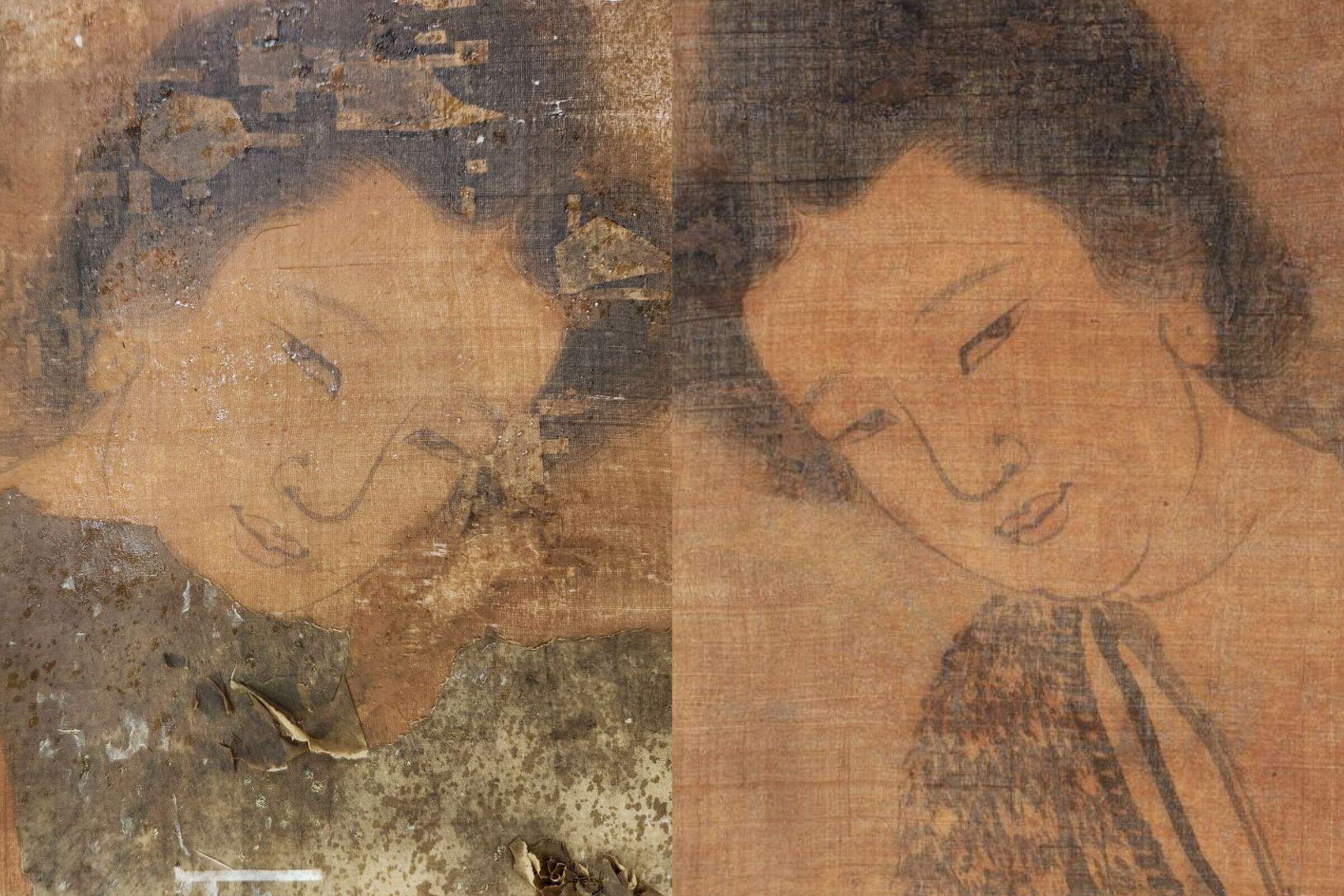
“Art conservation is essential to understanding the process of art making and to reveal hidden stories of art,” explained Ding.
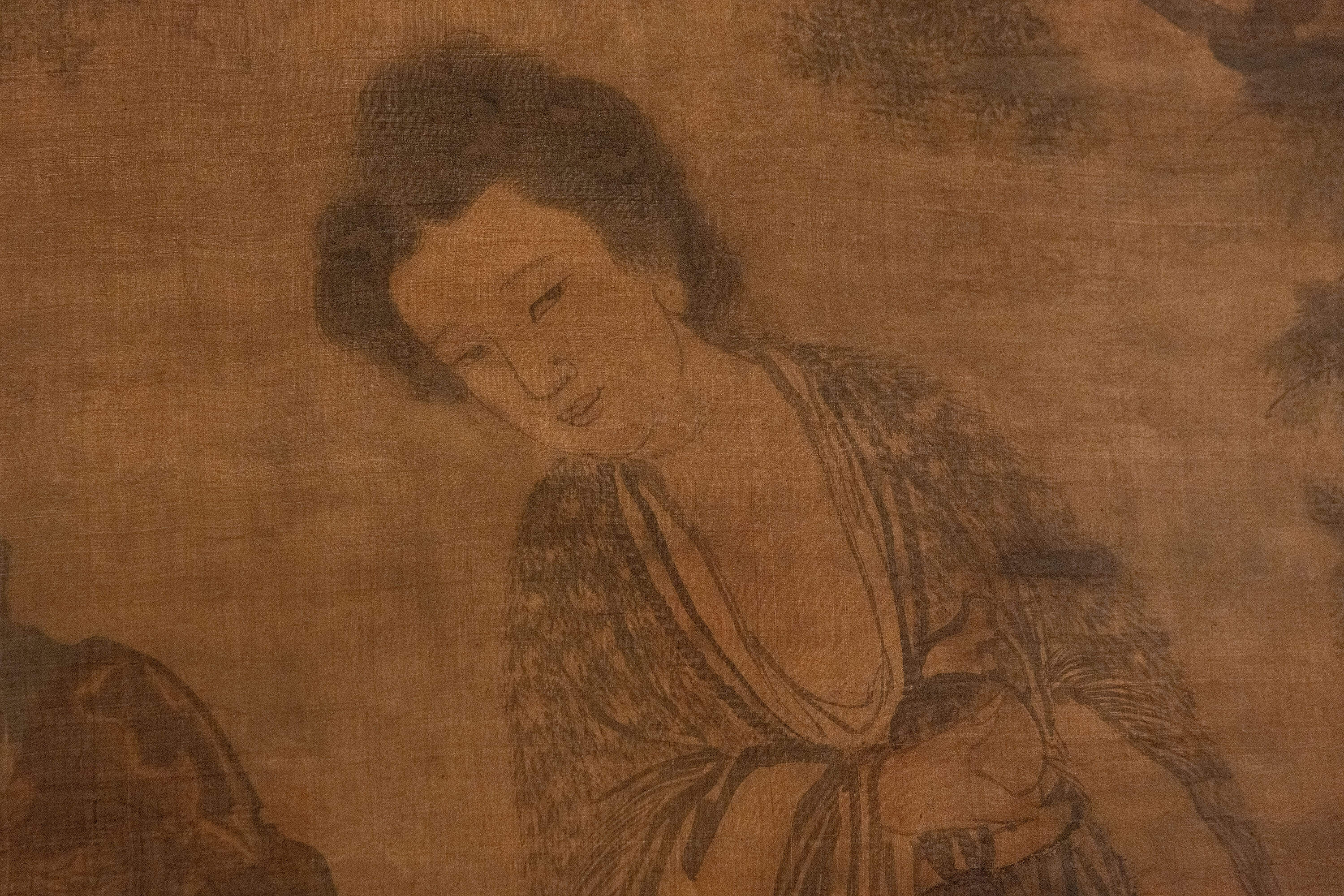
Juxtaposed against a large black frame, the cream-colored silk scroll stands out in the small exhibition room. No creases or tears in sight, the ink painting hangs in near-perfect condition. In it, a woman with long fingernails sways with her feather cape. She is enveloped by the branches of a tree and three wine jars that rest by her feet.
The woman is Magu, a legendary Taoist immortal deity associated with longevity and beauty. In the 2nd century, she was a fierce bird goddess with claw-like fingernails and a fury that caused eye-bleeding and fainting. By the 16th century Ming Dynasty, Magu became a symbol of beauty and longevity. “The number of Magu paintings in the Ming Dynasty are very rare,” explained Ding.

For the final stage of “The Immortal Magu” restoration process, Ding and curatorial intern Berit Raines visited the Somerville studio to watch Gao in action. Gao used a traditional pressing stone to flatten the fibers of the backing paper, a process that took nearly eight hours.
According to LaCamera, scrolls traditionally need to be remounted every 50 to 100 years depending upon the extent of handling and exhibition. Through modern preservation methods such as careful handling, and climate-controlled storage, the lifespan of “The Immortal Magu” will be prolonged significantly.
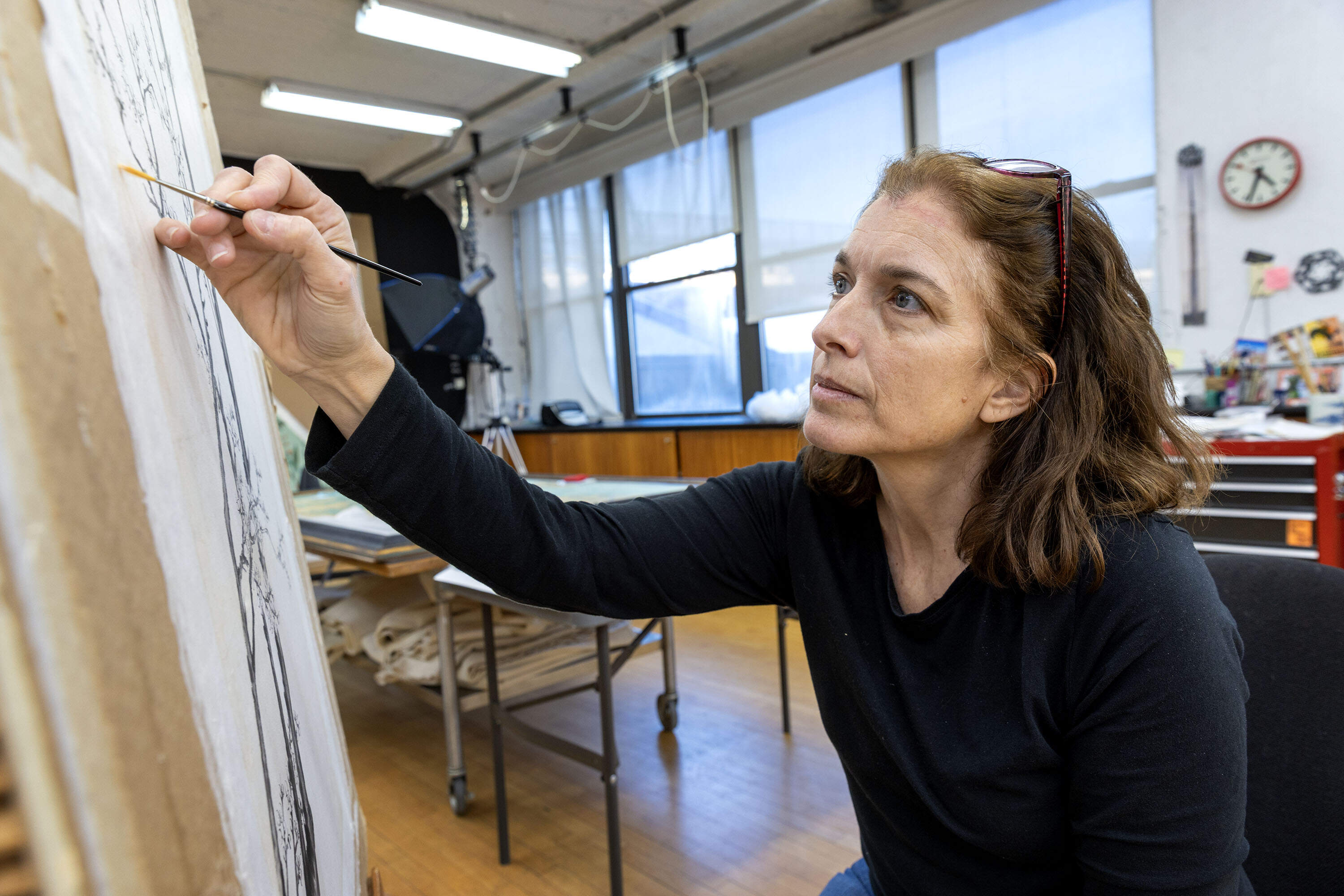
“This project really, firmly established that this is the field that I want to go into,” said Raines, a junior at Wellesley College who worked closely with Ding in developing the exhibition.
“I’ve been thinking a lot about how art conservation can be used as a tool to reveal what we give meaning to,” she said. Raines is currently writing a senior thesis proposal on the importance of developing new conservation methods for works that are not typically preserved.
Working on an influx of conservation projects related to the upcoming 250th anniversary of the United States, questions about conservation also linger on LaCamera’s mind: “What parts of history do we conserve, and do we preserve it all?” she asked.
On April 8, Ding will moderate a conversation with Gao, LaCamera, and Raines at Wellesley College. They’ll share insights and reflections from the year-long conservation project on “The Immortal Magu.”
“The Immortal Magu: A Sixteenth Century Painting Up Close” is on view at the Davis Museum at Wellesley College Feb. 6-May 24.