Support WBUR
Read key passages in the court decision that blocked Trump from ending TPS for Haitians
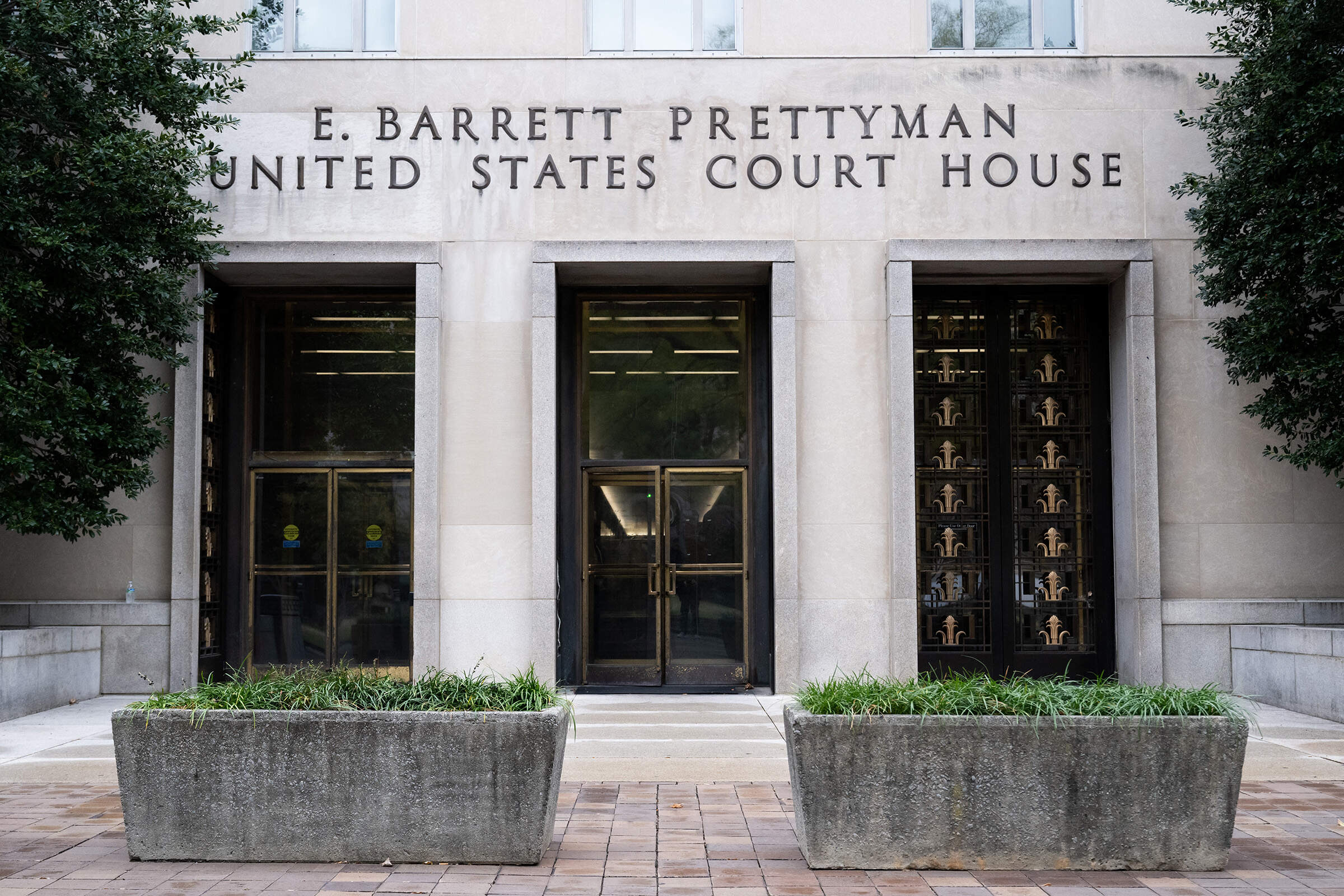
A federal judge in Washington D.C. granted a motion Monday night that prevented more than 300,000 Haitians — including some 20,000 in Massachusetts — from losing their legal status by the following day.
The Trump administration wants to end Haitians’ Temporary Protected Status, which has been renewed multiple times as safety deteriorated in the country since a devastating earthquake in 2010.
The plaintiffs argue the administration failed to demonstrate — or even properly consider — whether it’s safe for Haitians to return to the island.
In an 83-page opinion excoriating Department of Homeland Security Secretary Kristi Noem, District Judge Ana Reyes agreed. She paused termination of the legal status while the case plays out.
Here are some key passages from Reyes’ opinion:
George Washington v. Donald Trump
Reyes began her ruling by contrasting the values of the nation’s founders with the administration seeking to end the program that allowed Haitians to live and work in the U.S.:
On December 2, 1783, then-Commander-in-Chief George Washington penned: “America is open to receive not only the Opulent & respected Stranger, but the oppressed & persecuted of all Nations & Religions.” More than two centuries later, Congress reaffirmed President Washington’s vision by establishing the Temporary Protected Status (TPS) program.
Department of Homeland Security (DHS) Secretary Kristi Noem has a different take.
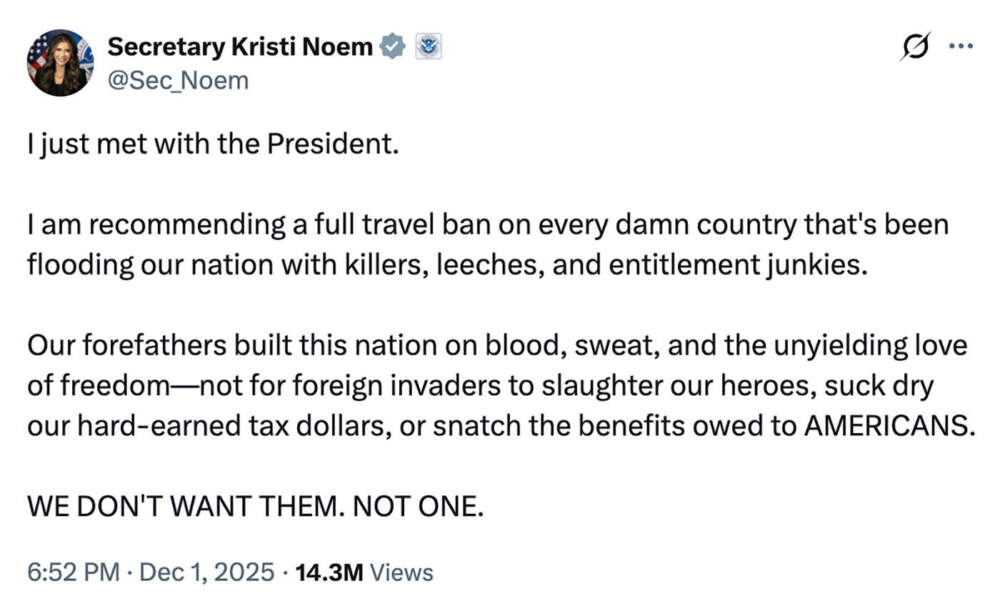
So says the official responsible for overseeing the TPS program. And one of those (her word) “damn” countries is Haiti. Relevant here, three days before making the above post, Secretary Noem announced she would terminate Haiti’s TPS designation as of February 3, 2026.
The judge cited this social media post as evidence that Noem’s decision to terminate TPS for Haitians was predetermined.
Conditions in Haiti
The law stipulates that in order to terminate a country’s TPS designation, the government must determine that the country “no longer continues to meet the conditions” under which it was granted.
Noem argues that the situation on the ground in Haiti no longer merits the TPS designation. Reyes pointed to the current U.S. travel advisory for Haiti, issued by the Department of State. It begins: “Do not travel to Haiti due to kidnapping, crime, terrorist activity, civil unrest, and limited health care.”
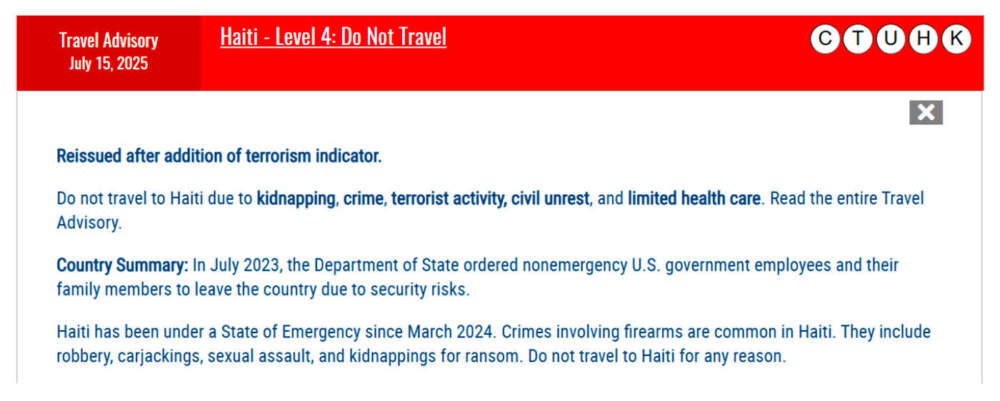
“Do not travel to Haiti for any reason” does not exactly scream, as Secretary Noem concluded, suitable for return. And so, the Government studiously does not argue that Plaintiffs will suffer no harm if removed to Haiti. Instead, it argues Plaintiffs will not certainly suffer irreparable harm because DHS might not remove them. But this fails to take Secretary Noem at her word: “WE DON’T WANT THEM. NOT ONE.”
The 'national interest' claim
In its defense of the termination, the Justice Department argues that “permitting Haiti TPS holders to remain in the United States would be contrary to the national interest, taking into account current administration domestic policies and foreign policy interests.”
Reyes dismissed that.
[Noem’s] “national interest” analysis focuses on Haitians outside the United States or here illegally, ignoring that Haitian TPS holders already live here, and legally so. And though she states that the analysis must include “economic considerations,” she ignores altogether the billions Haitian TPS holders contribute to the economy.
Reyes picked up the economic consideration again on the next page:
Secretary Noem complains of strains unlawful immigrants place on our immigration-enforcement system. Her answer? Turn 352,959 lawful immigrants into unlawful immigrants overnight. She complains of strains to our economy. Her answer? Turn employed lawful immigrants who contribute billions in taxes into the legally unemployable. … This approach is many things — in the public interest is not one of them.
Policy experts estimate that there are about 20,000 Haitians in Massachusetts who would become subject to deportation if TPS expired.
Reyes cited an amicus brief filed by a team of labor unions, including the AFL-CIO, the SEIU and the American Federation of Teachers.
In Massachusetts alone, approximately 2,000 long-term caregivers will lose work authorization if Haiti’s TPS designation is terminated.
“[B]ecause Haitian immigrants are highly concentrated, with almost 66% residing in just three metropolitan areas — Miami, New York City, and Boston — suddenly removing Haitian TPS holders would have a drastic impact on co-workers’ workload and patient care quality.”
Racial animus
A key argument by the plaintiffs is that the decision to end TPS was partially a result of “racial animus.” Reyes concurred.
During a presidential debate, [Trump] accused Haitians of “eating the dogs,” “eating the cats,” and “eating the pets of the people [who] live” in Springfield, Ohio. He stated elsewhere that he would “[a]bsolutely . . . revoke” Haiti’s TPS designation and send “them back to their country.”
Reyes found that the DHS secretary is expected to make TPS determinations. However, she argued the decision-making was blurred, citing comments by Trump taking credit for terminating the status.
Trump’s influence aside, Reyes said Noem herself showed a level of hostility toward “nonwhite immigrants.”
Secretary Noem has described Haitians — and people from eighteen other nonwhite countries — as “leeches,” “entitlement junkies,” and “foreign invaders” who “suck dry our hard-earned tax dollars,” and has expressly claimed that “WE DON’T WANT THEM. NOT ONE.”
And recall that [Noem’s] X post and her recommendation that President Trump ban anyone from Haiti coming into the U.S. occurred a mere three days after she made the termination decision. Plaintiffs allege that she separately accused TPS holders of being “poorly vetted migrants” who include “MS-13 gang members to known terrorists and murderers.”
Though a closer call, even if the Court ignored President Trump’s statements altogether,
Secretary Noem’s expressed animus towards nonwhite foreigners would support a stay.
‘Through the Looking-Glass’
Congress requires the DHS secretary to consult with “appropriate agencies” in determining to continue or to terminate the status, Reyes wrote, adding that it’s unknown if other agencies agree with the decision, as Noem “ignored Congress’s requirement.”
Reyes cited one email exchange between a DHS staffer and a State Department counterpart, on Sept. 5, the same day the Trump administration received a separate ruling against its attempts to curtail TPS for Haitians.
A DHS staffer emailed a State staffer at 4:55 p.m.: “Due to the litigation, we are re-reviewing country conditions in Haiti based on the original TPS deadline. Can you advise on State’s views on the matter?” The State staffer responded within 53 minutes: “State believes that there would be no foreign policy concerns with respect to a change in the TPS [status] of Haiti.”
This was it. The full extent of the supposed “consultation with appropriate agencies.”… But Congress did not vest the Secretary with Humpty Dumpty-like power to make the word “consultation” mean “just what [she] chooses it to mean—neither more nor less.” (Lewis Carroll, Alice’s Adventures in Wonderland and Through the Looking-Glass)
When asked by the court, the government confirmed no other agency was consulted. By terminating the designation without meaningful consultation, Reyes writes that Noem acted "in excess of statutory authority."
In conclusion
There is an old adage among lawyers. If you have the facts on your side, pound the facts. If you have the law on your side, pound the law. If you have neither, pound the table. Secretary Noem, the record to-date shows, does not have the facts on her side—or at least has ignored them. Does not have the law on her side—or at least has ignored it. Having neither and bringing the adage into the 21st century, she pounds X (f/k/a Twitter).
Kristi Noem has a First Amendment right to call immigrants killers, leeches, entitlement junkies, and any other inapt name she wants. Secretary Noem, however, is constrained by both our Constitution and the [Administrative Procedures Act] to apply faithfully the facts to the law in implementing the TPS program. The record to-date shows she has yet to do that.
By accompanying Order, the Court GRANTS Plaintiffs’ Renewed Motion for a Stay.
The order allows TPS for Haitians to remain in place as the lawsuit challenging the termination plays out in court. The Trump administration has indicated that it plans to appeal the stay, all the way up to the U.S. Supreme Court if necessary.