Support WBUR
Joseph Sater, co-owner of the Middle East Restaurant & Nightclub, has died
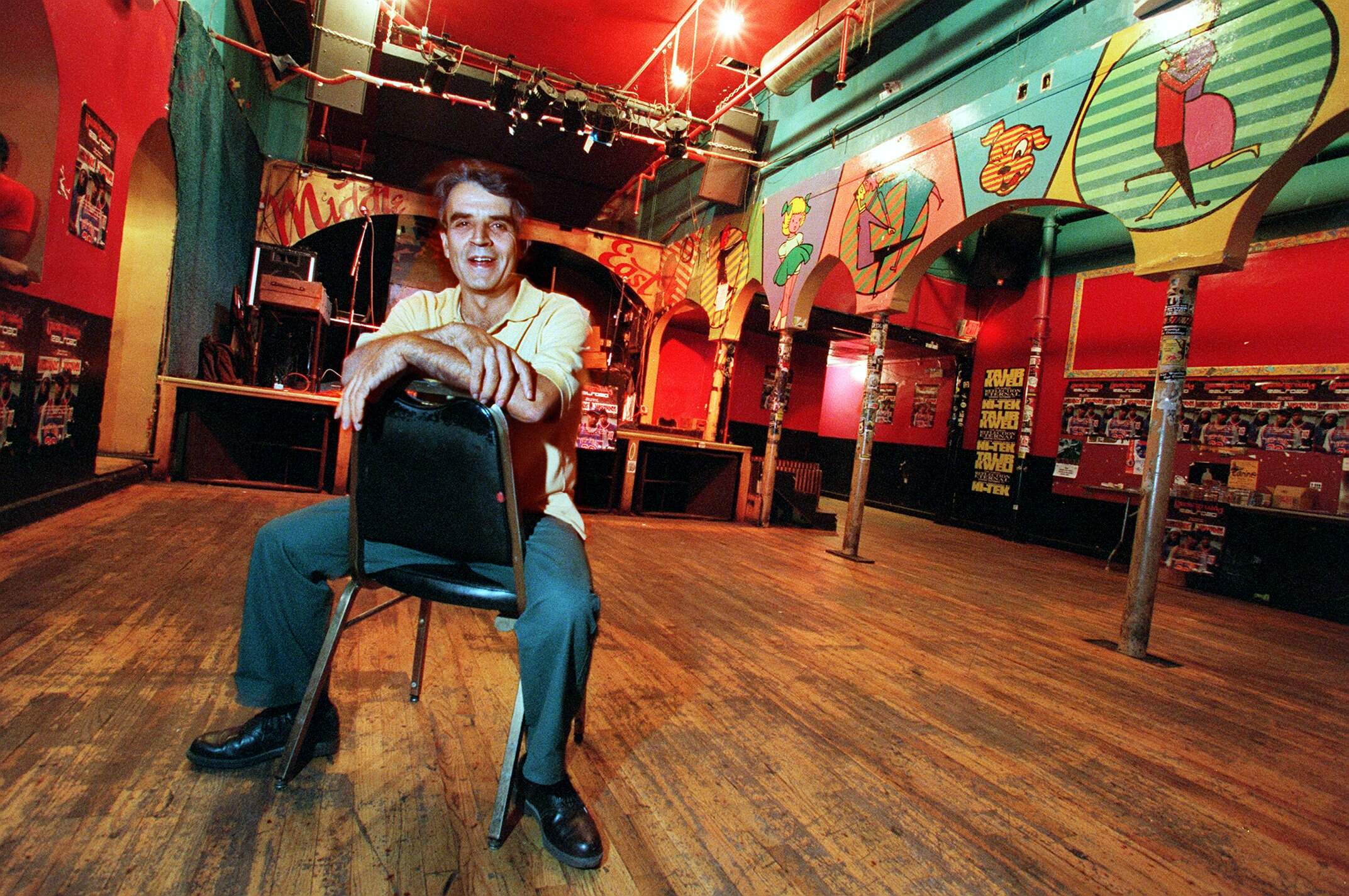
Joseph Sater, the longtime co-owner and night manager of the Middle East Restaurant & Nightclub in Cambridge, has died. Sater, 73, had been living in South Florida since his 2018 retirement. The death was confirmed by club spokesperson Clay Fernald, who said the cause of death had not yet been officially determined.
When it came to establishing the Central Square complex of clubs and restaurants as a cultural mecca, “Joseph’s role was huge. It was all him. It was his personality, how he was always there, he always said hello and knew everyone by name,” said Thalia Zedek. She has played the venue for about 35 years with groups like Come and the Thalia Zedek Band. “He was so welcoming that it felt like going to your family’s house.”
Sater moved from his native Lebanon to the U.S. in 1974, around the same time his brother, Nabil Sater, first bought what was a neighborhood restaurant whose live entertainment mostly consisted of belly dancing. The site became a rock destination after a famed incident where promoter Billy Ruane threw a 30th birthday party at the adjacent T.T. The Bear’s Place, but invited more friends than could fit into the space. Joseph initially resisted Ruane’s request to let the party spill into the Middle East, but soon allowed the tireless Ruane to book bands on a weekly basis.
For the most part, Nabil was the daytime presence running the restaurant, while Joseph would be seen at night, holding court with a glass of wine at his corner table and closing down the club at curfew time, recalled Mahmood Shaikh, who was the club’s publicist from 1995 to 2001. (In typical Middle East fashion, Shaikh started as a publicity intern but quickly got promoted by Joseph after the actual publicist departed.)
Sater “would hold court at that back table,” said Shaikh. “He was super friendly with the musicians and the regulars who would hang out at the bar and go to shows. It was not uncommon to see people who played in bands just hanging out there. Sometimes you’d see Mark Sandman or Peter Wolf where [Joseph] held court.”
“It was our home away from home,” agreed Zedek. “It was just such a great hang. We’d get back from a tour, throw our bags down, and find our way to the Middle East. Besides seeing a band there, it was one of those places where you would go and always run into people. They created a real community there.”
For touring artists, the Saters’ hospitality was an oasis on the often grueling road. “Everyone got fed, everyone got a drink ticket,” said Shaikh. “Maybe there wasn’t a cushy dressing room, but you knew that the staff were people who also play in bands and want to see the show.”
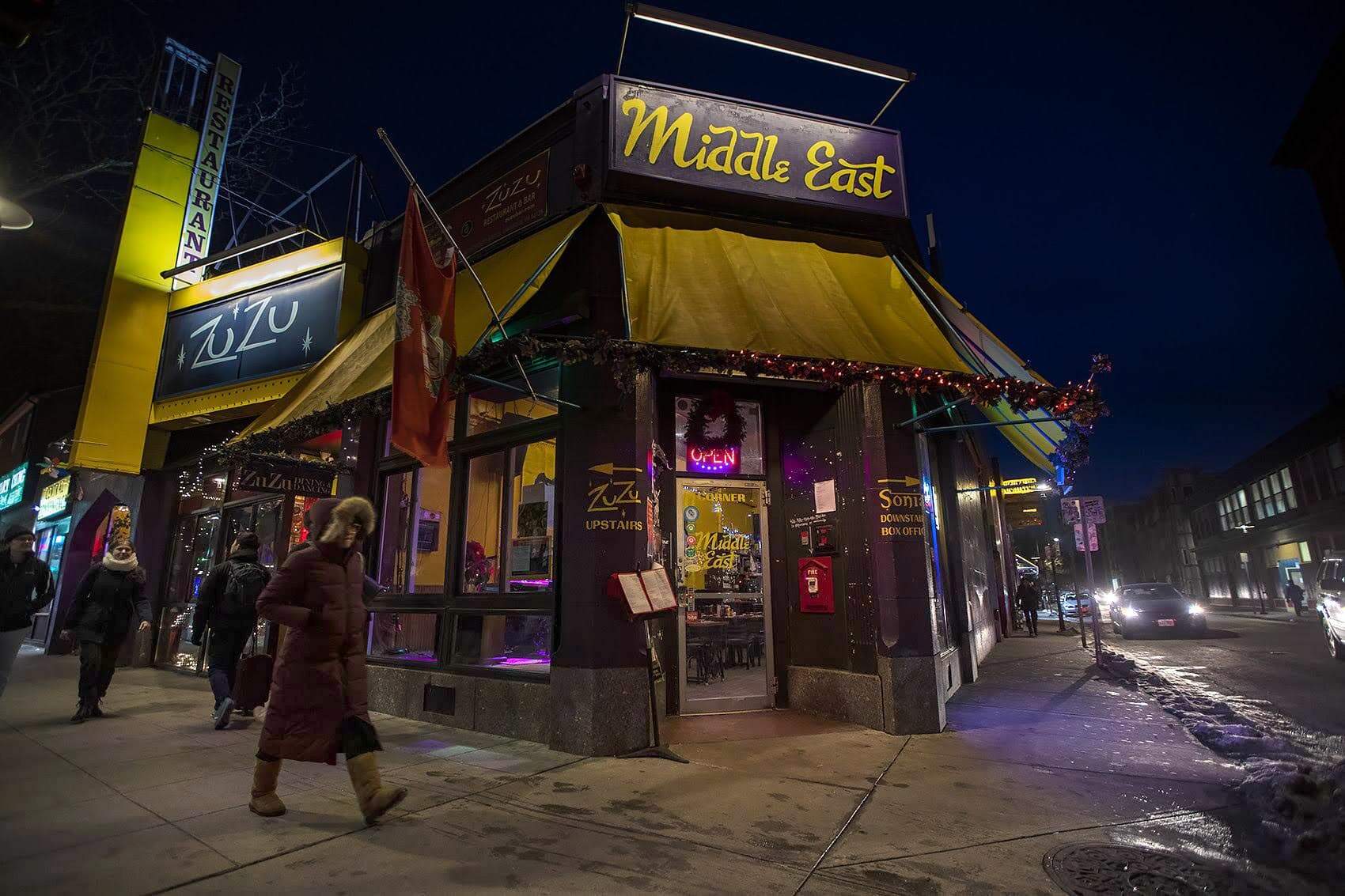
While local bands played for no cover by the entrance at the corner of Brookline Street and Mass. Avenue, the club’s 175-capacity Upstairs room became a crucial indie rock breeding ground. Shaikh mentioned seeing the likes of Modest Mouse, Sleater-Kinney and Death Cab for Cutie before they went on to larger venues. In the early 1990s, the former bowling alley in the basement became the 550-capacity Downstairs. Fliers and a club calendar from February 1999 show a typical month at the club: A pre-fame Eminem, spoken word great Gil Scott-Heron, ska pioneer Laurel Aitken, Dave Davies of the Kinks, avant-garde jazz drummer William Hooker, and rockers Clutch were all featured. Eminem would hardly be the last superstar to play the complex on his way up: So did Billie Eilish, Vampire Weekend, the Dropkick Murphys and Mumford & Sons. Aerosmith played a secret show, while the Mighty Mighty Bosstones would play an annual multi-night holiday run captured on the LP “Live from the Middle East.”
Competition with corporate venues like the Paradise Rock Club and, in more recent years, the Sinclair, has meant that the Middle East has long actively sought and served musical communities like hardcore and hip-hop that aren’t always welcome elsewhere.
“The Middle East was more open to everybody. A lot of venues are afraid to have hip-hop or punk rock because of the stigma, but the Middle East always had a good system in place and things went smoother there,” said Boston rapper M-Dot, who first played the club in 2007 and recently held his album release party there. Before he started touring overseas, “The number one thing on my bucket list was to play the Middle East. That was the epitome of live Boston hip-hop – it starts and ends there.”
Fernald, who first started working as a doorman in 2001, said the brothers were “never going to take a stance against anything. They wanted creative people to have a place. Their attitude was ‘This is our home, and people come here to play music.’”
Cindy Bortman Boggess, a longtime family friend of the Saters who worked as a Middle East waitress around the time Ruane was beginning to host shows there, pointed out that there were often works by local visual artists hanging on the wall. “Having a welcome, creative space was exactly what the plan had always been for them. There was this cafe culture in Lebanon in the ‘70s, and they wanted to recreate the good parts of that … If you had something that you wanted to do and share you could do it there. They let the culture invent itself.”
Joseph Sater, said Boggess, was “magnetic, generous, and kind. He could solve three people’s problems at once. The amount of food that they gave away … if you couldn’t pay for it this time, you’d pay next time.”
Zedek also remembered how Sater would “invite you to have a drink with you at his special table, he always had a smile for everyone,” she said. “And what I also appreciated about him was that he was really good to people when they weren't doing well. I had some friends who, at some point in their lives, were struggling with various things, and he would always have an encouraging word. He was always very positive and non-judgemental – just a really good guy.”
Joseph and Nabil “were always so encouraging,” said musician and aerobics teacher Hilken Mancini. She recounted how when her band Fuzzy was being considered by Atlantic Records, the Middle East added them at the last minute to a bill so the label’s scouts could see the band, which they signed. When Mancini started her Punk Rock Aerobics, the Saters gave them a space for free. “They never cared about ‘What does this mean for me?’ and that’s something that you don’t find in other cities,” she said.
The Saters also supported the arts in other parts of Greater Boston with mixed results. The Sater-owned FireHouse building in Allston was the home of the Out of the Blue Gallery for several years. In 2004, the family bought the Somerville Armory and turned it into an arts center, but after the facility struggled during the pandemic, it was taken by eminent domain by the City of Somerville in 2021.
Joseph retired from the club in 2018 following allegations of sexual misconduct. WBUR was not able to substantiate the claims. The aftermath divided the local music community. Some artists and promoters took their events elsewhere, but today the club remains busy: Thanks to the additions of Zuzu and, in the former T.T. the Bear’s spot, Sonia, the complex often has four bands or DJs playing at the same time. This Saturday, seven events are slated between the afternoon and late evening. Next Thursday, the Downstairs room will be the site of a benefit show for Jeff “Monoman” Conolly of Lyres, one of countless benefits and memorials the club has hosted over the years. Fernald said a memorial event for Joseph at the venue hasn’t yet been formally announced, but is all but inevitable.
In 2000, the club was listed for sale, and in 2022, a proposal to build a hotel with some music stages on the site was floated. Asked about the club’s status, Fernald said that the hotel proposal is no longer on the table. “We own the building and we will always be here. Nabil has ensured that there will always be a Middle East,” even if the current site is sold in the future. “As you can see, we’re a very busy club, and no one is talking about selling it. We are not going anywhere.”
Boggess said that after spending most of his life working late nights, Sater’s final years in Florida were full of early mornings that he spent taking photos on the beach and reporting on when sea turtles had laid eggs. At the same time, he kept up with his old friends in the Boston music scene. The 2024 documentary “The Road to Ruane” featured Sater as one of the subjects as it recounted Ruane’s colorful history. When the film premiered as part of the IFFBoston at the Somerville Theatre, the audience spontaneously and loudly applauded when he appeared on the screen.