Support WBUR
Commentary
Reimagining a new self through a year of creative experiments
Editor's note: This story is an excerpt from WBUR's weekly arts and culture newsletter, The ARTery. If you like what you read and want it in your inbox, sign up here.
I’ve decided that 2026 is the year of experiments.
Here’s how it works: Each week, I learn more about a specific craft or art form and then play around with it. Since I have drawers and shelves crammed with yarn, beads, buttons, paper and more, my goal is to explore making something new with what I already have. Then I keep track of these creations in a log book to see what I liked, what worked and what didn’t.
As the year goes on and I continue these “experiments,” I realize that I’m learning as much about myself as I am about different craft and art forms. Recently, collaging was my experiment of the week.
To start, I delved into collage history. I learned that our modern conception of collage was coined “papier collé” in the early 20th century by cubist artists Georges Braque and Pablo Picasso. However, the act of taking disparate materials or images and bringing them together goes much farther back, perhaps to the invention of paper in China, with early forms traced back to around 200 B.C.
Many 20th-century artists have been inspired or influenced by collage, like surrealist painter André Breton and Dadaist Hannah Höch. For me, I’m always in awe of the collage works of Black artists like Lorna Simpson, Romare Bearden and Betye Saar.
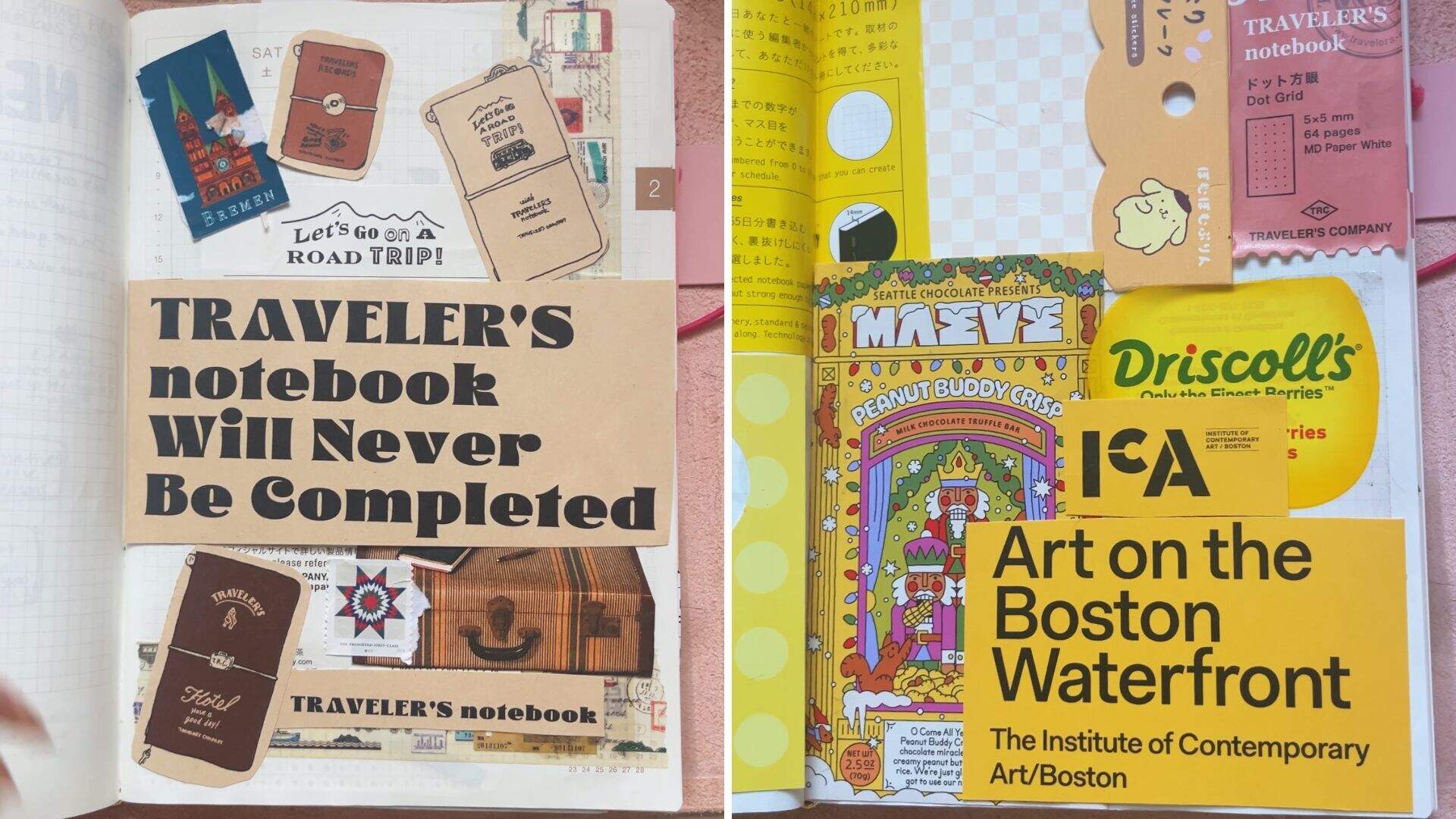
When I first started my experiment, I randomly pasted different things together. I guess most people would call the ephemera I collected “trash.” (I may or may not have actually dug some stuff out of the trash.) But when placed alongside or on top of another element, these pieces of “junk” transformed into something visually pleasing. I played around and grouped pieces by color and sometimes by category or genre, like travel ephemera or drink labels. This was easy and low stakes.
After a few days of making “junk,” I started to seriously think about the collage that I wanted to make. This was the hardest part. When I became a new mom last August, I found myself struggling to find inspiration or the motivation to create. I still do. How can I create when I can’t even craft an identity for myself? How can I make art when I don’t really know who I am now or what I’m trying to say about this new experience?
Parenthood is simultaneously beautiful and terrifying because it's like giving birth twice. The first time, you bring a tiny, perfect little human into the world. Then, your old life fractures and breaks, and you’re tasked with giving birth to your new self in its remnants.
I spent a lot of time trying to fix the fracturing that I could see in my old self. Postpartum, I quickly tried to get back to old habits. I pestered my OBGYN about when I could return to the gym. I kept myself busy with writing and research while my baby napped, despite the fact that I needed naps too. Quite frankly, I was in denial that everything would need to shift and change.
In the process of thinking about this, I came across an old photo of my mom, my grandmother and my great-grandmother. They’re sitting on a couch and my mom has me, just a baby at the time, in her arms. There’s a rip in the copy that I have, so I cut us out.
I decided to use this photo and a recent one of myself and my son for my collage. As I arranged them on a sheet of paper, I realized that there was something deeply moving about seeing the images together. My great-grandmother passed away around 7 or 8 years ago — she never got to meet my baby. But in this collage, we’re all together. And when I look at it, I can imagine her meeting my son the same way she met me.
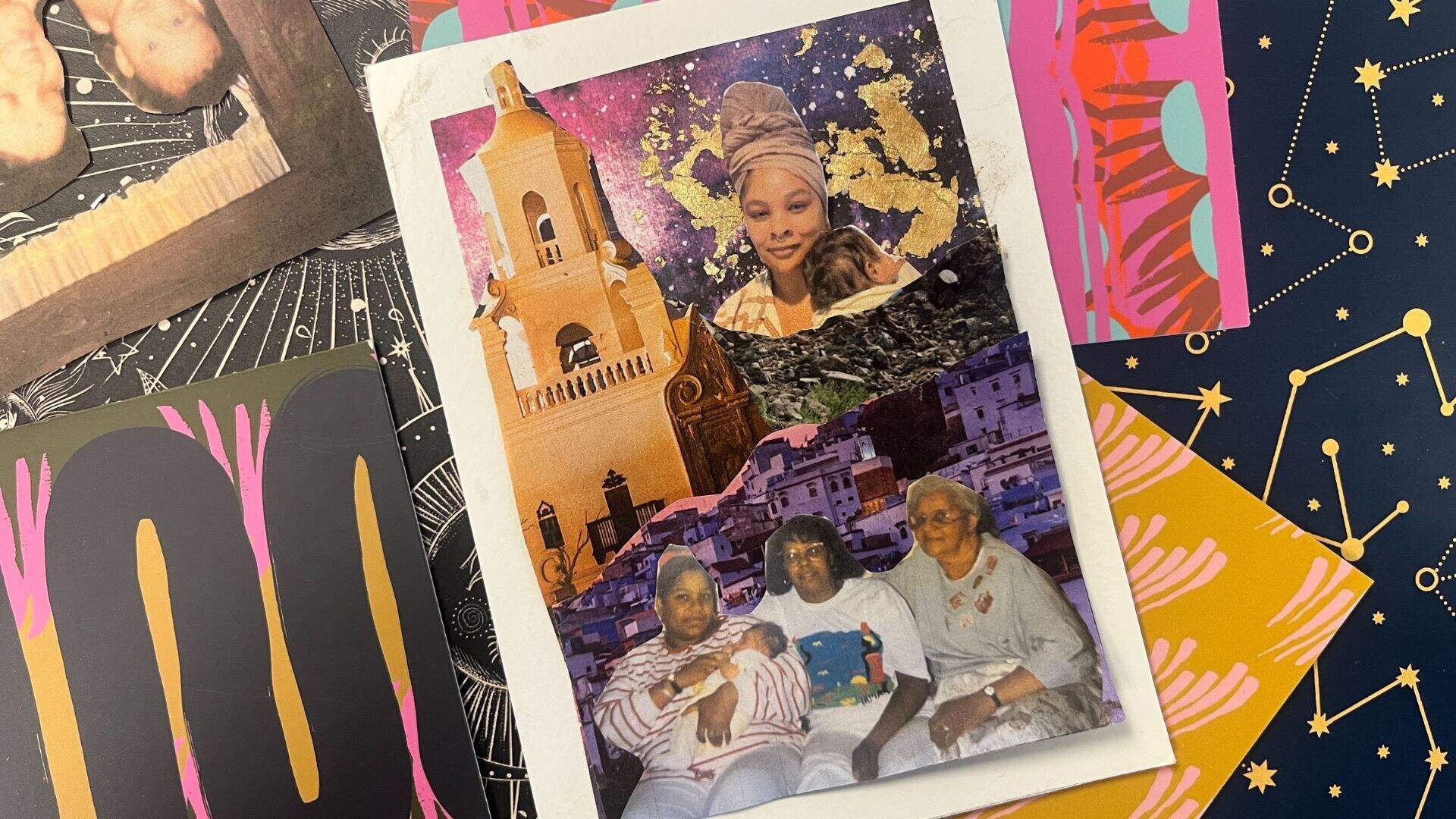
This gave me some sense of peace. It also made me remember that my mom, my grandma and my great-grandmother are all so much more than the motherhood they opted into. They aren’t defined by the fact that they gave birth. They fashioned their own beautiful, unique collages of life.
By the end of my experiment, I ended up with a draft collage that I plan on remaking at some point in the future. I think the most important thing I learned, though, was that a rip or a tear in a photo, picture or illustration isn’t the end. It’s a new beginning. By cutting out different elements, you’re releasing them from what they were and creating a possibility for what those elements can be. You are repurposing. Reimagining. Rebirthing.
It made me realize that sometimes a fracture can be a starting point. Is the same true for me?
I’m still so new to being a mother. I still feel like I’m holding disparate pieces of myself together.
But maybe I need to let those pieces go so that I can reuse and repurpose them into something beautiful.