Support WBUR
Kennealy looks to distance himself from Baker in GOP primary race for governor
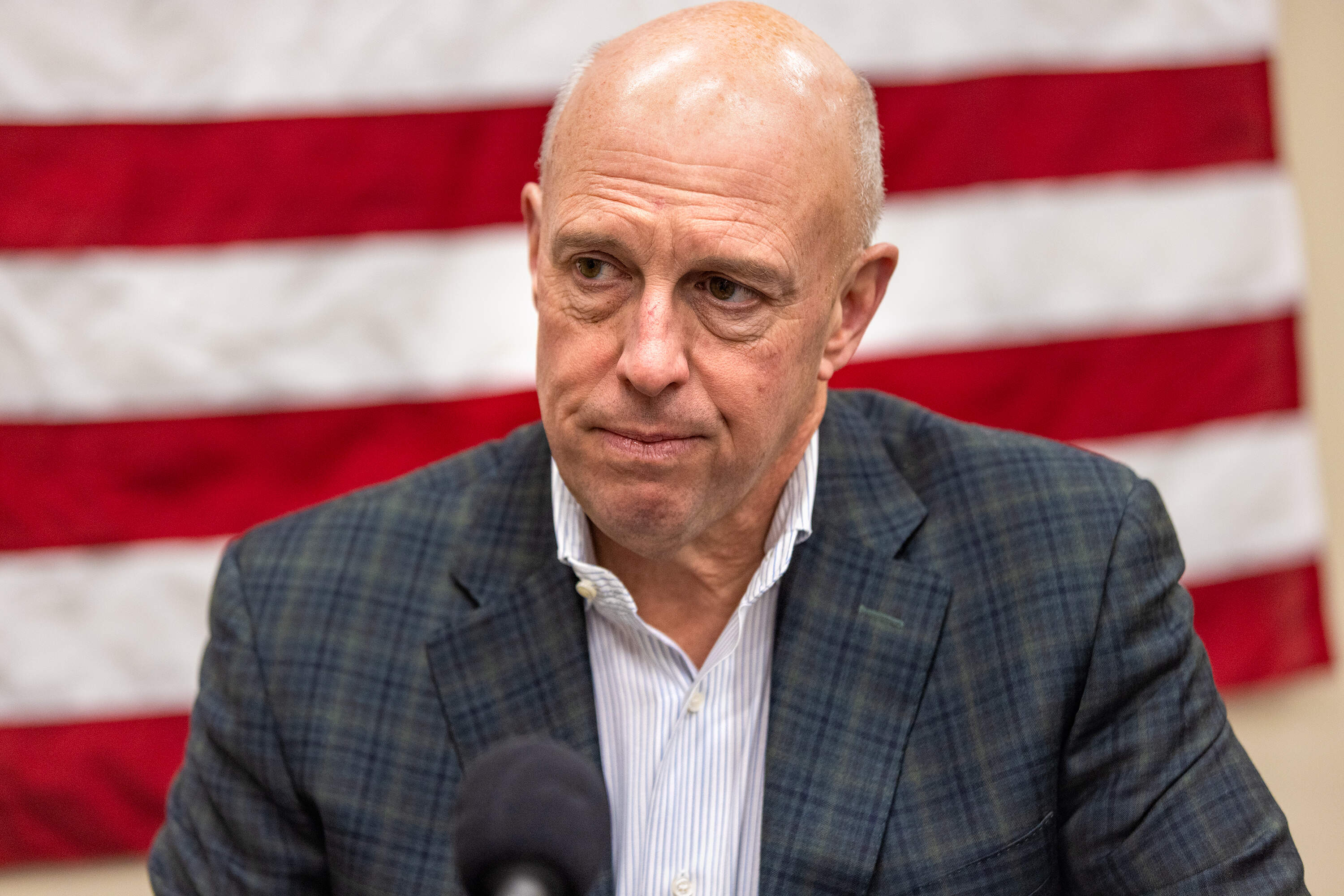
Mike Kennealy was on a stage last fall, making the case to a crowd of Republicans for why they should hand him the party’s gubernatorial nomination to challenge Gov. Maura Healey.
The former housing and economic development secretary under Gov. Charlie Baker ticked through familiar talking points — pledging to cut taxes, promoting transparency in state government and declaring that Massachusetts is not a “sanctuary state” for immigrants.
But as he set out to hype up the crowd in Worcester, he was met with relatively tepid applause.
“I know I can defeat Maura Healey because I have a track record across business and education and government," he said. "And a set of experience where I can convince the voters to fire the incumbent and hire the Republican, and that's what I intend to do."
Kennealy, 58, hails from the moderate era of Republicans in Massachusetts.
He worked for eight years under the former governor and, unlike his opponents, has a track record closely tied to the Baker administration. He also had a hand in some of the Baker-era policies that have since become controversial in the party.
He has tapped for his campaign some of the key people who helped Baker get elected twice to the state’s highest public office. But they are trying to set Kennealy apart from the popular former governor at a time when the Massachusetts Republican Party has shifted further to the right.
Kennealy is battling two other candidates in the party’s primary — former MBTA chief and venture capitalist Brian Shortsleeve and former biotechnology executive Mike Minogue.
All three aim to appeal to the third of the state that voted for President Trump, as well as to independent voters who feel disaffected from the Democratic Party. The trio is also set to compete for their party’s endorsement at the MassGOP convention in Worcester this Saturday.
Stephanie Pollack, Baker’s former transportation secretary who worked in the administration at the same time as Kennealy, said the Republican Party has “changed a lot” since Baker ran in a primary.
“I don't see any of the candidates as running as Charlie Baker. But I also understand that it may not be possible to run in a Republican primary in Massachusetts as Charlie Baker,” Pollack said in an interview.
If Baker were running in this year’s primary, she said, she’s not sure he’d win.
“It's a different party with a different dynamic,” Pollack said. And she noted that the rightward turn of the candidates could leave them with an uphill climb when they face Healey in the general election in November: “I think there's a serious question of whether what you have to do to win the Republican primary in Massachusetts undermines your ability to win statewide.”
“I think there's a serious question of whether what you have to do to win the Republican primary in Massachusetts undermines your ability to win statewide.”
Former state Transportation Secretary Stephanie Pollack
In an interview with WBUR this month, Kennealy distanced himself from Baker’s politics and policies.
“There'll be parts of the job from a leadership style that are going to be very similar, but look, it's a different time in the state. There's different needs and different opportunities, and I've got my own track record, and I'm proud of that,” Kennealy said.
Like his Republican opponents, Kennealy argues the state’s economy is floundering, and promises to cut regulations that he says hinder business growth. He also pledges to cooperate with federal authorities to remove “criminal illegal immigrants” from the state and to cut back on spending to assist migrants.
But on other key political issues, like abortion rights, Kennealy is more moderate. He says “women should make their own decisions,” a position that distinguishes him from one of his Republican rivals, Minogue.
Both men are Catholic, but Minogue describes himself as “pro-life” and suggests he’d push for alternatives to abortion.
Kennealy grew up in a Catholic family. He was born in Medford and raised in Reading, the son of a steelworker who went on to become an accountant and then chief executive of the Roche Bros. supermarket chain. The candidate says he never bagged groceries as a kid; he graduated from Dartmouth College in 1990 with a degree in government and earned an MBA from Harvard Business School in 1997.
He lives in Lexington, where he and his wife, Trisha Kennealy, own multiple homes in a neighborhood minutes from the town’s famous Revolutionary War-era Battle Green. Trisha runs the Inn at Hastings Park, a four-star hotel where nightly rates can run from $350 to nearly $700.
Kennealy is at home in the upper echelons of the economy, having worked in private equity for many years before jumping into public service. He spent 15 years at the investment firm Spectrum Equity, where he says he helped boost the value of the portfolio companies from $360 million to $4.7 billion.
Chris Mitchell, a managing director at Spectrum Equity, said Kennealy’s primary job at the firm was to “go out and meet with these management teams and describe how we could help and why we think we would be a good financial partner.”
Kennealy left the firm in 2013 to help turn around the troubled Lawrence Public School system, which was under a state-appointed receiver. It’s a point on his resume he frequently refers to.
Jeff Riley, who was the receiver, said as a special advisor, Kennealy helped with three things — “cutting the bureaucracy” in the central office (reducing administrators by more than 30%), maintaining relationships with local politicians and community groups, and fundraising.
“He wasn't expected to know everything about certain portions of the teaching and learning department,” Riley said in an interview. “But he understood the general concepts. And because of his business background, he was able to help us think about how we could do things in a way that was both meaningful and impactful, but also manageable at the same time.”
After a brief stint at the Massachusetts Life Sciences Center, Kennealy joined the Baker administration in February 2015 as an assistant secretary for business growth. He was promoted to secretary of housing and economic development in December 2018 during Baker’s second term.
While Minogue has no government experience and Shortsleeve was focused mainly on the T’s finances under Baker, Kennealy was a key player in an array of matters in the Baker administration.
Kennealy had a hand in three issues that are now hot-button talking points in the race: the state’s response to the COVID-19 pandemic, a controversial transit-linked zoning law and the migrant shelter crisis.
After the shutdown of the state amid the pandemic, Kennealy co-led a 17-member group of government, private sector and education officials tasked by Baker with developing a reopening plan for Massachusetts. The advisory board eventually settled on a phased plan to restart the state economy.
It was a challenging period. The reopening group led by Kennealy and Lt. Gov. Karyn Polito faced an unprecedented situation in determining how and when to reopen various parts of the economy and restart in-person gatherings.
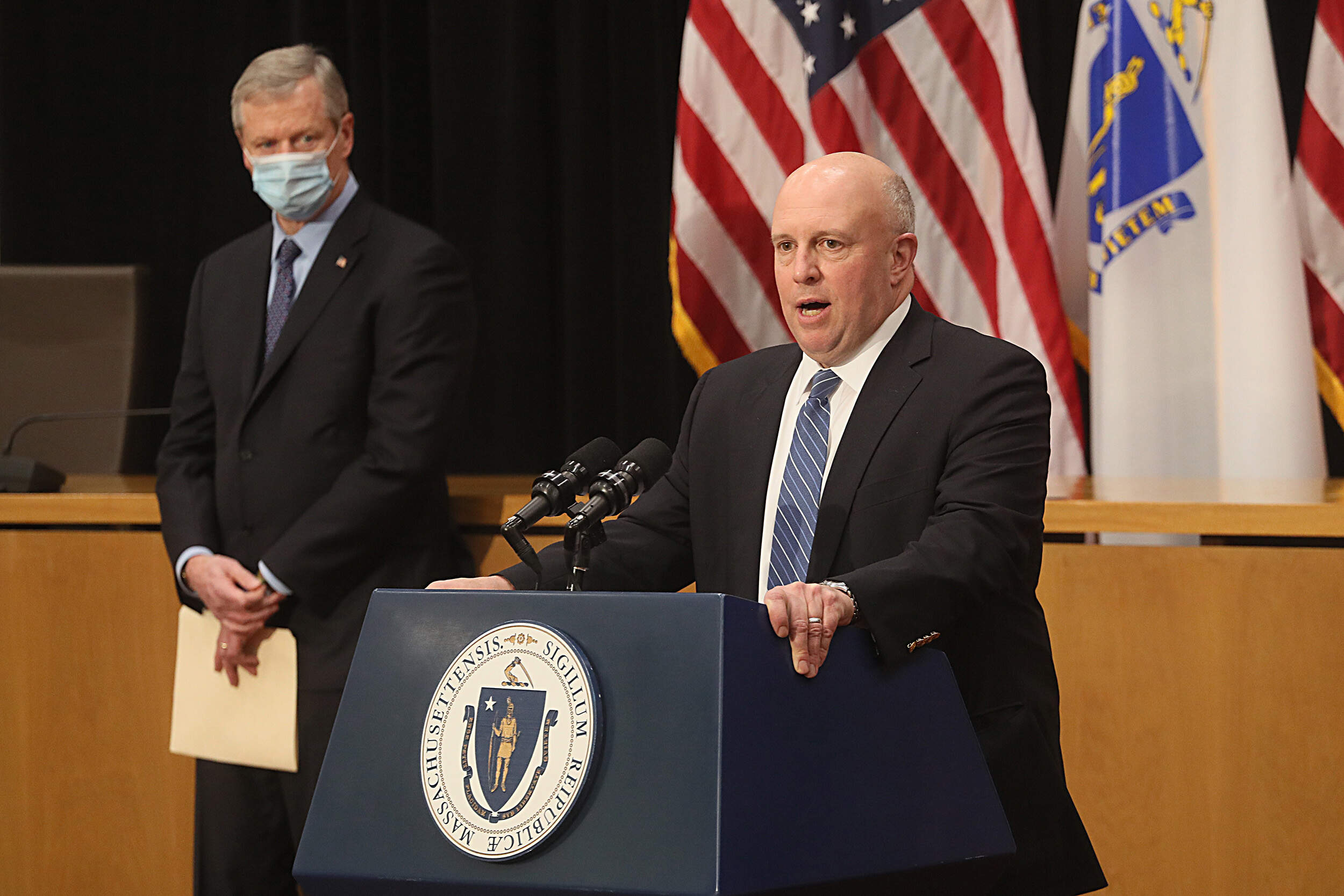
Jim Peyser, Baker’s former education secretary who has donated to Kennealy’s campaign, said Kennealy was “stuck in the middle” of the business and public health communities.
“His job wasn't to balance all those things. That was the governor's job. But his job was to move the ball forward as fast and as effectively as possible, given the constraints. And I think he was very good at that,” Peyser said in an interview.
Peyser said the state’s education agency was lucky — “if that’s the right word” — that students were soon heading into summer vacation when Baker shut down Massachusetts in mid-March of 2020 because of the rapidly spreading coronavirus.
“But that wasn't the case with the economy and with businesses," Peyser said. "They didn't have summer vacation, and so there was a greater need, a greater demand and a greater urgency for them to be able to open up. And they didn't have the luxury of waiting."
Pollack, Baker’s former transportation secretary, said Kennealy was “a big contributor” to the reopening board’s work.
“I'm not going to say we did everything perfectly, but given what we knew at the time, I think the overall framework, which was to [reopen] in phases and to have benchmarks that we would use to evaluate whether we could move to the next phase, is actually how a lot of places ended up opening,” Pollack said.
Baker and his administration faced heated pushback from within the Republican Party for shutting down the state economy and imposing vaccine mandates.
Kennealy acknowledged the criticism and now says the administration’s shutdown of the state was “too fast and too extreme.” But he defends his own work, saying there is “general acceptance that the reopening strategy was sound.”
Of the critics who argue the administration mishandled the pandemic, Kennealy said, “I’m sure a lot of people might say that now, but that is with the benefit of a lot of hindsight.” At the time, he said, “there was no playbook."
Another Baker administration policy that’s come under scrutiny is the MBTA Communities Act, which was signed into law in 2021. The statute requires municipalities near transit hubs to allow zoning in at least one district for multi-family housing.
The administration was responsible for implementing the law, including an initial attempt at drafting regulations, which Healey’s administration finished in 2023. The state’s high court struck down those regulations in 2025, saying state officials did not adhere to state law when producing the guidelines.
Kennealy has said he didn't initially support the measure, but the former secretary helped write the guidelines that the Supreme Judicial Court struck down. Now, on the campaign trail, he has criticized the law.
Perhaps the issue that most animates Republicans — after their critique of the state’s economy — is immigration. That’s both in terms of enforcement and the cost of sheltering immigrant families.
Kennealy claims he personally warned Healey about the rising demand for state-run shelter services back in a November 2022 meeting and in a transition document he gave to the Democrat as she entered the governor’s office in January 2023.
Shelter demand did spike in 2023 and 2024, amid an influx of newly arrived migrants to Massachusetts. The surge led state officials to spend more than $1 billion a year on temporary housing, including at hotels and motels around the state, plus other services.
Kennealy says he foresaw the rising expenses. Months before the Baker administration left office, Kennealy advocated in a December 2022 public letter that the state Legislature allocate more money to the emergency shelter system.
Kennealy has been criticized by his Republican opponents for pushing for more shelter cash. In response, Kennealy told WBUR that “the letter was not a policy document." Instead, “It was, ‘Look, we’re legally obligated to tell you, the Legislature, the system’s running out of money,’ ” Kennealy said.
However, he said Democratic leaders in the Legislature at the time “made it clear” they wanted to work with the incoming Healey administration on the shelter issue, rather than the outgoing Baker administration.
At a debate this month, Kennealy criticized a range of local immigration-related policies, like a law allowing people without proof of lawful presence in the county to obtain a Massachusetts driver's license.
“We have to find a way for local and state law enforcement to work with ICE. I support having more of these 287(g) agreements,” he said, referring to deals that allow local law enforcement to enforce federal immigration laws.
Peter de Silva, chair of the Kennealy campaign’s finance committee and chief executive of a Pittsburgh-based financial tech company, IRALOGIX, said Kennealy is similar to Baker “from a political perspective, in terms of what he believes and how he’ll function and how he’ll operate.”
But in terms of policies, Kennealy stands apart, de Silva said in an interview.
“I think Mike will bring his own unique blend of his capabilities and his thoughts and his strategies to enhancing and improving the state,” de Silva said. “I know he looks fondly on the time he spent with Gov. Baker, and Mike did an excellent job as our secretary.
"But that said, Mike's his own man.”
This segment aired on April 23, 2026.