Support WBUR
‘Grievance games’: Can sports still bring people together?
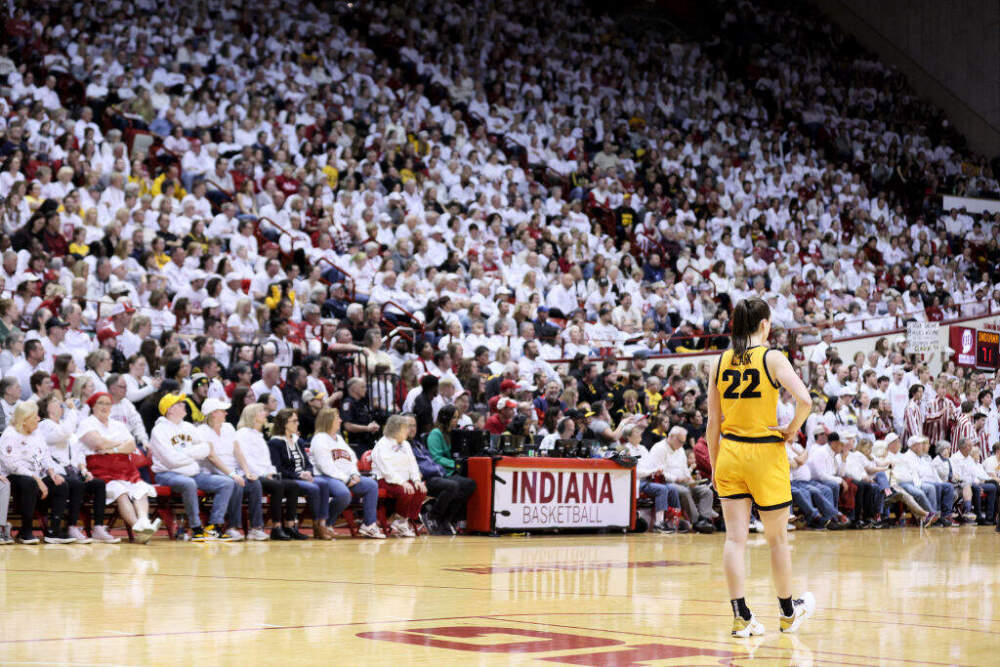
Washington Post sports columnist Jerry Brewer used to have no doubt about the unifying power of sports.
But in recent years, Brewer says that Americans are bringing political divisions to the games.
Today, On Point: Can sports still bring people together?
Guest
Jerry Brewer, sports columnist at The Washington Post. Author of a series of columns called Grievance Games, which examined how the promise of sports as a national unifier has buckled under the pressures of grievance and division.
Transcript
Part I
MEGHNA CHAKRABARTI: Sports have long brought people together. Tens of thousands of fans show up to every game to support their local team or their country in the Olympics or even just for the love of the game itself. At least that's how we like to idealize sports.
PROTESTER: “He can take his male body and compete against male bodies and fair enough.
LAURA INGRAHAM: As someone once said, shut up and dribble.
DONALD TRUMP: “Get that son of a [expletive] off the field right now. Out. He’s fired. He’s fired!” (CHEER)
CHAKRABARTI: Our guest today says grievance, which seems to have seeped into much of American life, has also now tainted sports. Jerry Brewer's recent series, Grievance Games, asks if that means sports is no longer a unifying experience in this country. Brewer is a sports columnist for the Washington Post, and he joins us today.
Welcome to On Point.
JERRY BREWER: Thank you for having me, Meghna.
CHAKRABARTI: So when did you first notice what you think is grievance having infiltrated sports?
BREWER: This goes back about three, three and a half years. I think we had a period of athlete protest, particularly against police lethality on Black lives. And you felt all the tension was about that.
And then after the 2020 election, on into early 2021, there was no athlete protest. Yet there was still this tension. And I started to realize that there was a counter movement to the movement that we had experienced. And I observed it for about a year and a half. And then over the past two years, it was about figuring out how to access those thoughts, figuring out how to report them.
Figuring out how to drum up the courage to say that sports aren't what we've always believed that they are.
CHAKRABARTI: So when you say movement versus counter movement, can you put a little sort of more specific definitions around those so we all are reading from the same page here?
BREWER: Yeah. I think anytime in American history or even in world history, when you have a progressive movement, in this case, we're talking about Black Lives Matter as a slogan, not the organization.
There's always going to be a reaction to any progress that you've made there. And I think in sports, it was particularly interesting because that movement, that protesting for people in communities, that these athletes, many of them, no longer live in, but are still dear to them. It connected them to a level of influence in their leagues, and a level of influence versus their fans that they had never experienced before, at least this generation.
And so that created a movement that not only was about equality, but it was about power in the lives of a lot of sports fans. When that died down, you were going to hear the other side, because I think the other side felt that it got drowned out in the conversation.
CHAKRABARTI: Okay so then specifically, are you talking about, like you said, a progressive movement, and for lack of a better term, a conservative backlash that's now a part of American sports?
BREWER: Yes, most definitely. And I would add to the conservative backlash, a backlash from people who just want sports to have no politics in it whatsoever, which I think is a bit naive.
CHAKRABARTI: Okay. Actually okay. I'm going to come back to that, because that's a really interesting thought that I think has been long debated within sports, but so the use of the term grievance, I just want to dig into definitions here a little bit. Because just the flat-out dictionary definition, Jerry, is a real or imagined wrong or other cause for complaint or protest or belief of unfair treatment.
So grievance I think has become, it went from being a really potent and interesting word to really overused one in American politics. So is that really what you're talking about here? Because is it grievance that people are expressing in the in the world of sports or something else?
BREWER: Yes, I think so. I think that under the big umbrella that is grievance, I think you can get to a lot of other things.
CHAKRABARTI: Okay, so tell, give me some examples then of what you've been seeing in the past couple of years, after that initial Trump statement that you talked about.
BREWER: I think there's been a strong backlash, challenging the diversity of sports.
And I think you see a lot of this grievance in, for instance, the biggest thing that's related to grievance politics in sports right now is the transgender issue, related to transgender athletes in the women's sports space. And that is something that if you step back, it's actually really popular in a bipartisan way, but it's the manner in which certain culture war politicians, I won't even say conservative politicians.
I'll say culture war politicians are manipulating that to access even more punitive kind of actions against transgender people in general, and I think that's a manipulation of sports that we haven't seen, maybe ever.
CHAKRABARTI: So you say that's the biggest one. Okay. So let's explore that a little bit, because when you say it's popular overall, maybe I'm misinterpreting you, but I'm just pulling up some polling here.
For example, there's one from last year through Axios that found almost 70% of Americans, 70% said transgender athletes should only be allowed to compete on sports teams that conform with their birth gender. What exactly do you mean by it's popular?
BREWER: Yeah, I mean that's exactly what I mean there, when you say 70%.
I think when you step back and you say, when you look at this just as a generalized fair play issue related to women, most people are going to say, someone who was born not a woman should not be competing in the women's space. And I think that overall, like that's where you get to that 70% number.
When you drill down and you start to think about things, such as what exactly that means and what it means in terms of your lived experience, what it means in terms of your mental state, when you truly believe that you are another gender, that you identify as another gender, and you're not allowed to be that. And you decide to change.
I think a lot of times people have looked at this as a fair play issue from the standpoint of men are wanting to be in the women's space in order to have better results, as opposed to it being what I've experienced a lot, and talking to transgender athletes, which is there is just a difference between the way that I was born and who I truly am.
CHAKRABARTI: Yeah, no.
BREWER: So the nuance gets lost in that conversation.
CHAKRABARTI: Yeah, no, I completely hear that. And my question doesn't come from a space where I'm questioning the experience of the trans athlete at all. That's not where it's coming from, but it does seem as if you're landing on the side that says this is unfair to the trans athletes.
But I do think that there's a lot of resonance of that it might be unfair, and we're not talking about identity or belief of self. We're talking about biology. It's unfair to the women. Suppose that in the men's side, we had people who said I firmly believe that I need to have performance enhancing drugs to be my true self.
And those people were allowed to participate in men's sports. I think there'd be a pretty strong and legitimate backlash to that. People who have gone through male puberty and have a lot of testosterone in their bodies, for that reason, it's pretty well established that there is some kind of biological advantage. I think that's what the concern is for folks, and I don't know why this issue has been hijacked with, getting back to your grievance thesis. I agree. It's become a very political. And in fact, I'd say it's become very outsized in terms of in comparison to the actual number of athletes we're talking about here.
But anyway, I just wanted to give you a chance to respond to what I just said, about fairness to women.
BREWER: Meghna, I don't disagree with any of what you said. I think what I disagree with is the lack of nuance in having half the states in America have very firm legislation that is essentially banning. And most of those bans relate to the participatory level.
We're talking youth sports, and a lot of those haven't considered the nuance of, the difference between when you go through puberty and when you don't. And I think it's a different conversation if we're talking about eight-year-olds playing soccer. And I have an eight-year-old, and I know there's a lot of girls who are way better than the boy eight-year-olds.
It changes when you're 13, 14 years old. And so I don't think we've sufficiently handled the nuance. And I think one thing, looking at it from a sports perspective, when we have decided, any decision we have made in sports history, where we've said, we're not comfortable with them being on the field.
So we're going to put them, whether it's Black and Brown athletes or whatever, over here and we're going to do our thing over there. I know it takes decades, if not centuries, to undo that. And so my thing is, yes I do believe that there are studies that have shown a clear biological advantage. Then there's other studies that have emphasized some murkiness and some things that we need to think.
I don't think there's anyone looking at it from a medical or scientific way who's an expert, who's saying this is exactly what you should do. They're saying, these are exactly the things that you should consider. And to take that, which is still murky when you read it all and you absorb it all, and you decide that you're going to put firm policies in place, and then you decide in the next wave that we're starting to see is an attack on gender affirming health care.
When you look at the big picture there, that's what concerns me. So then you start to take this thing that we can solve in sports itself. That's a very small thing and you put it up against just your ability to live your life. That's what I want people to look at.
Part II
CHAKRABARTI: Jerry, I just want to read a quick quote from one of, I think it was like the first article in your series. Cause it's very, it's quite moving actually. You write, I used to have no doubt about the unifying power of sports, how they turn strangers into teammates and teammates into family, how they make community out of motley spectators, how they raise the curtains for societal progress.
I used to believe it was an imperishable kind of magic. What about your experience with sports made you believe in that magic?
BREWER: Oh man. Sports define so much of my life. I can take you back to being three years old and my mom decides to get married and I'm going to have a stepfather. And I'm a kid who was raised by a bunch of women. I'm a bit spoiled. I didn't know how to act. And I think the thing that really brought us together was sports, watching baseball games. And he indulged how much I love the Chicago Cubs. And then we went on to college basketball and so on and so forth. So many of my lessons in life have been learned through sports. November 7th, 1991.
I was 13 years old. Magic Johnson announced to the world that he had HIV and was retiring from the NBA. I came home from that day. I'm the biggest Magic Johnson fan in the world. My dad sat me down and we had to talk, and I had to pretend that I didn't know much about sex.
But then I learned so many lessons and things that now I have a 12-year-old and it's about time to have the talk. And some of the things that my dad shared, I will share with him as well. And I even think now with my youngest son, he doesn't like any of the sports I like, he loves hockey.
And so being able to sit with him and watch the Stanley cup playoffs and just have moments with him and share things with him. It's just a fundamental part of my upbringing and a fundamental part of how I built community.
CHAKRABARTI: Yeah. And then how have you seen, again, that magic expand into that higher level of national unity?
BREWER: Oh, man. You think about another seminal moment, I think about 1996 at the Olympics in Atlanta and Muhammad Ali with the torch in his hand. And really understanding the totality of his life, the things that he protested, that he fought for, that he represented. How unpopular he was early in his life, to being someone, at that age in 1996, who brought tears to the eyes of everyone.
And just thinking about the messages that we have sent throughout time, in sports. And the difficult conversations that have been forced to the forefront through sports. Sports makes things explicit. And I think sometimes we forget about that, the societal benefit of sports. Because when our worldviews are being challenged, while we're watching games or connected to games, we recoil, and we forget sometimes that this has been around. This has been around since long before Jackie Robinson. And we have, as a society, learned some really valuable lessons by having to go there, while we're enjoying watching games.
CHAKRABARTI: Yeah so I'm really glad that you mentioned all the people that you just did, right?
Obviously, the legendary Muhammad Ali, Jackie Robinson, and I want to play another clip here regarding, out of the NBA. Because actually back in 2020, we spoke with former NBA player Etan Thomas about the history of sports activism, and he told us that many former athletes, and Jerry, you know this as well as anyone, told Thomas that they were frequently silenced when they tried to speak up.
ETAN THOMAS: Kareem Abdul Jabbar told me that he was told to shut up and dribble back in the '60s. Bill Russell told me the same thing. Everybody loved him when he was winning championships with Boston, but then as soon as he started talking about segregation and racist practices, then they told him to shut up and dribble, as well.
CHAKRABARTI: Jerry, I play that, because I guess you'll have to forgive me, I'm a little confused and help me straighten myself out here. Because I don't actually think, especially in the examples that you've given, that sports has ever been a national unifier. All the examples we've been talking about are ways which, to your point, have forced a national conversation, forced progress, but the athletes in particular, or the sports that they were playing weren't bringing people together over these issues.
I feel like sports have instead always been nothing more and nothing less than a reflection of the societies they're in. And a lot of the times that society in itself is pretty fractured and not unified. So I guess I'm wondering, you have to respect me for this. I'm not a huge sports fan like you, but I'm not sure I've ever believed in that unifying magic.
CHAKRABARTI: I think Meghna, that was part of the exploration of this series. Was I think sometimes we romanticize things. And we forget the way that they were. Part two of this series really excavates Jackie Robinson's story and tries to emphasize what have we learned and what have we just lionized about the story?
What have we whitewashed? And a lot of that happens, I think, throughout sports history. Now there are moments when you think about Jesse Owens in the Berlin Olympics and Nazi Germany. And you think about the movie The Boys in the Boat, about the Washington rowers, in a similar circumstance, those things have been unified.
I think about the World Cup in 1999. And the U.S. Women's Soccer Team and Mia Hamm and Brandi Chastain and Julie Foudy and that moment that they had. There are moments that bring us together in a certain kind of way. But it's far more fleeting than it is, it's more let's stand up and let's cheer together and let's sit down and let's go home and let's go back to our same old problems, than it is something that sustains itself.
CHAKRABARTI: No, it really, I totally hear you on that. And the Jesse Owens example shows both sides of that, right?
First of all, there was Owens and his just brilliance. And then it took place in the Munich Olympic Games, that the Nazis were deliberately using to advance or celebrate Nazi fascism. That's what the games were used for by Hitler. So you mentioned the second part of your series, and I'd love to talk more about that, because you're right.
The exploration gets deeper. And in that part, you write that Jackie Robinson didn't even believe in his own myth. Tell me more about that.
BREWER: I know. I think that everybody thinks that there was a before and after with baseball and Jackie Robinson. That things were really bad before and really racist before and then Jackie came and then everything was great.
And then not only that, but Jackie had a tremendous impact as an early figure, right in the '40s, to what became the civil rights movement, 15 years down the road, essentially, or at least 10 years down the road. And we tend to just, once again, we have forgotten all the bad stuff.
And when we talk about history, we only tell all the sweet things. And we think it's always just this wonderful story. Jackie was committed to the struggle. And I think when you talk to everyone in this family who's keeping that alive, they don't want you to just appreciate the progress that we've made.
They want you to understand the progress that is left to be achieved. And I think that's an important factor in the Jackie Robinson story that we don't want to pay attention to. And we don't want to always go down and think about how hard Jackie had it. The fact that Jackie Robinson died at 53 years old, and he was in really bad shape.
And a lot of people believe that's just the stress that was put on him his entire life. Jackie Robinson, as soon as he got comfortable in the major leagues, he spoke his voice. He was someone who marched, he was someone who anytime there was a national racial crisis in America, everyone convened at Jackie Robinson's house to talk about it and advise him.
And he was a different kind of Black man from the standpoint of everything that people commonly associate with Blackness, when you start to think of us as just one. Jackie was different. He thought in his own way and Jackie had to reevaluate some of the things that he thought, but he kept, for his entire life, he kept doing the work and everyone in his family continues to do the work. And that's what they want you to understand. Is that it's the work, it's the work, it's the work.
CHAKRABARTI: Yeah, you say pretty clearly in that column, in that part of the series that it's, as you just mentioned, it's the perfect example of how with breakthroughs in sports, while they are they're historic for the country, as well.
They can be very sanitizing, right? We like to think that there was the before and the after. I was really moved by what you quoted Robinson at the beginning. From his own autobiography, which, by the way, the title, I didn't know this, the title in and of itself is quite telling, right? "I never had it made."
And he talks about how, that he was the grandson of enslaved people. He himself was the son of a sharecropper, born on a plantation in Georgia. And he has this very painful relationship with even just the National Anthem.
BREWER: Yes, he does. And he couldn't bring himself at the end of his life to stand for the anthem.
And you think about that in 1972, and then we fast forward all the way to 2016 when Colin Kaepernick decided to take a knee for an entire season, which led to Donald Trump giving that speech in Huntsville, Alabama in 2017, which led to three years of just intense back and forth between all factions that come together in sports.
That's a pretty powerful thing. And so it, once again, it reminds you, this is all connected. The glorious things that we see in sports are just the glorious things we see in history. We should always reevaluate and try to put ourselves back in that moment, and try to really understand not only the lesson that endures. But the road we have to take to get to those lessons.
CHAKRABARTI: Robinson, I think it's worth reading some of the part that you quoted directly because it's very powerful. Again, in that autobiography, he was writing about hearing, remembering hearing the national anthem in the first game of the World Series.
And then he writes, "As I write this 20 years later, I cannot stand and sing the anthem. I cannot salute the flag. I know that I am a Black man in a white world. In 1972 and 1947, at my birth in 1919, I know that I never had it made." So I guess, Jerry, what lesson are we supposed to take from that, in terms of how often there's been this sort of push and pull between grievance and progress in sports.
It sounds like to me, as you're exploring through this series, that we're just in another cycle of that now.
BREWER: Yes, we're just in another cycle of it now. And I think I try to emphasize, I think we are more ignorant than we've ever been. Because we don't have the proper respect for history, just history in itself, the ability to teach it is being attacked. And there's just a lot, there's a lot that we need to reevaluate. And at this point, most of us don't want to do that.
And so much of what I'm trying to say throughout these pieces is there are systems, and sports is a system that can control your mind. And there's legacy and tradition and all of these things that compound the way you think. You have to take, if that's a heavy crown to wear, you have to take that off of your head somehow and think for yourself.
And reevaluate constantly, and then come to a new understanding. And I think often we just think of all of these things as static, and the person who tells it is the way that it is. And I think that history is a lot more fluid and a lot more flexible than that.
CHAKRABARTI: Yeah, a lot of people look back to as far as like the Roman gladiator spectacles, right?
In terms of a system used to, depending on your point of view, to either pacify people's passions or inflame them, right? So this is a very long and historical part of humanity. But I also wonder if perhaps as we struggle through these social issues in sports, that maybe that's not such a terrible thing. Because another way of looking at it is that sports has perhaps always been the one place where it's societally acceptable and perhaps even beneficial to demonstrate some real profound tribalism, right?
Whether it's, I'm based in Boston, right? Whether it's Red Sox fans calling the Yankees the evil empire or the United States boycotting Olympic Games and the Soviet Union doing it, vice versa. It is a very public forum to work out not just our tribal inclinations as human beings, but what directions we want to go with those impulses.
Perhaps that's actually a positive service that sports has always done for people.
BREWER: Yeah, I think one of the great benefits of sports is that there's constant conflict. You have to confront things. You go to a game to watch this player against this player, or this team against this team. And you are in a stadium, or in an arena, or in a gymnasium or ball field.
And one side is for this team. The other side is for that team. And you literally can be sitting next to someone whose interests are different than yours. You have to understand how to handle that in a healthy manner. And I don't think we often think about that when we think, Oh, we just went to a game and the Red Sox play the Yankees and it was mostly Red Sox fans.
And great, I had a wonderful time, but in actuality, you're constantly, there's a push pull. That's very similar to living your life in the United States or in the world.
Part III
CHAKRABARTI: Jerry, a little earlier in the show, you mentioned Muhammad Ali, and I really just want to give him his due here. So here's one moment from his storied career. This is in 1967. When, and he was speaking in response to being challenged about his objection to fighting in the Vietnam war.
MUHAMMAD ALI: My enemy is the white people, not the Viet Cong or Chinese or Japanese. You’re my opposer when I want freedom. You’re my opposer when I want justice. You’re my opposer when I want equality. You won’t even stand up for me in America for my religious beliefs. And you want me to go somewhere and fight, but you won’t even stand up for me here at home.
CHAKRABARTI: Muhammad Ali in 1967. Jerry, that obviously wasn't, he wasn't saying anything popular when you think about American public opinion at that time, in that moment.
It took a lot of courage for him to do that. A lot of fans, a lot of boxing fans also saw him being decisive in exactly the way that you're seeing other people being decisive now. And what do you think about that?
BREWER: Yeah, it's interesting.
CHAKRABARTI: Did I say decisive? I meant divisive. I'm sorry, forgive me if I wasn't speaking correctly, but go ahead.
BREWER: My dad is from Louisville, and I think one of the best experiences of my journalism career was in 2016 going back to Louisville to cover Muhammad Ali's funeral and how they drove him throughout the entire city. And just seeing hundreds of thousands of people in the streets, appreciated and mourning Ali's life.
So much like when you think of before the illness really silenced Muhammad Ali, so much of his life that that he could articulate, was unpopular. And then now, I'm not sure that most Americans could name 10 significant figures in anything, and not mention his name, and just the overall impact that he had was tremendous.
It was a different road, and we haven't really gotten into this man. It was a different road for Muhammad Ali. Because he was essentially by himself with other people who are connected on their own. When you think of Bill Russell, when you think of Jim Brown, when you think of Kareem Abdul Jabbar. They all supported him.
But Muhammad Ali as a boxer, as someone who stepped in the ring by himself, that's different than LeBron James, who has his entire franchise, if not the entire NBA, supporting him.
CHAKRABARTI: Tell me more about that. Because I think that is important. And Ali paid the price for his courage and his political views, also during his career.
BREWER: Yes, absolutely. He missed what, three years of his career, as had the heavyweight championship stripped, missed three years of his prime, it's a really remarkable story. But I think that when we see that, start talking about grievance and sports.
So the politics of resentment in sports. I think one of the reasons that there is such a strong resentment to sports in general is because in this wave, athletes were able to get their leagues and their teams involved. It felt like you were just being, especially in 2020, after the murder of George Floyd, it felt like you were just being swarmed by messaging and everything.
It wasn't just like you could put all of your ire at Colin Kaepernick. All of a sudden, all of your ire was at the entire. We had never seen actual leagues get involved. It was always Billie Jean King taking a stand on her own for women, and maybe some other women would come along on their own, but it was never the entire Women's Tennis Association joining that fight.
And so I think that was something that was different and it speaks to how corporate sports are now and how much money there are in sports. And I think it's easier, it's a lot harder to disentangle when you see Black Lives Matter on an NFL field or on an NBA court.
And then all of a sudden, everyone is complicit in that. I think it's tainted the experience for a lot of people where in the past they could just point and say, I like or dislike that guy, you would root for or against them, they would win or lose. And that would be the end of it. As opposed to, the NBA is too woke, as some people would say.
CHAKRABARTI: Yeah. So you used a really interesting word there, about people feeling like they're being swarmed because, just to take your point a little further, in one of your articles, you quote Robert Lipsyte, right? The sports journalist who, in the context of talking about the 2014 NFL draft, when Michael Sam became the first openly gay draft pick for the NFL.
And I think, as you say, Lipsyte was the ESPN ombud at that time. And Sam had kissed his partner. And he got lots of email from people who really objected to ESPN broadcasting that. And he told you that the way those folks wrote those emails, it gave him the feeling that men were leading their wives and children to a giant rec room.
They were all confronted by Michael Sam giving his partner the longest kiss. And they were incredibly offended, because they had felt that sports was their last sanctuary. And then you quote him as saying, he's not sure that they were wrong to feel that way. They too are feeling swarmed, I guess is my point.
BREWER: Yeah, and I think Lipsyte point was that, I think in just the commercialization of sports, everything gets amplified. Anything that's considered brave or courageous or heroic, you see it a thousand times. And Caitlin Clark has got a commercial, like right after the final four, and all of these things, really appreciating and congratulating her after breaking the scoring record. When you think about just what a commercial success Michael Jordan was, and now it seems like Michael Jordan is ancient, right?
And you think about that, 30 years ago, versus now. Everything is just supersized in sports. And anytime that they think something is the thing, it winds up being overplayed. And I think for a long time, I think one of the reasons that sports as a unifier has become just this popular thing, is that for a long time you didn't have any protests, and then you are able to just live off of like the progress that had been made for a 20- or 30-year period.
And all of a sudden, it goes from remember how hard it was for Jackie Robinson to break through into the major leagues. Look at how wonderful and diverse Major League Baseball is, right? At least for a period there, that was the way we thought about Major League Baseball. And in so many other sports, it's the same thing.
And I think just they aren't false messages, but they are embellished messages. And once those messages get inside people's heads, they start to believe, okay, this is the only place where, like, we can do America as America should be done. And I don't think that was the message that anyone who lived that struggle wants you to think about sports.
But somehow that entered the conversation, and I'm 46 years old, and people in my generation grew up fervently believing that. And we need to reassess that in order to have a more healthy relationship with these games.
CHAKRABARTI: There's another really interesting aspect of grievances in sports that you bring up in a part of your series, and that has to do with what's out there in sports media, particularly on the air, because when you listen, you'll often hear this.
(MIKE AND THE MAD DOG MONTAGE)
Are they going to be in the playoffs? Tell me out. I need you to argue me. Okay. I need your argument. What do you mean? That's my argument. They're going to be in the playoff.
This is David Robinson. What's the score? David Robinson. What's the score? David Robinson score 50 points in college and 70 points in the NBA.
No, he was being told. He was being told. He's being told by his bosses. He can't play in his own day play. Chris, let me finish.
CHAKRABARTI: Yelling, arguing, bellicose bravado. That was a montage of several different moments. And Jerry, you call it rage culture in sports. And of course, social media and sports betting, I'd say, have added some rocket fuel to this rage.
But there's a particular kind of addictive anger that you note, that goes back to at least 1989, with one particular radio show.
(MIKE AND THE MAD DOG THEME SONG)
CHAKRABARTI: Mike and the Mad Dog first aired on New York's WFAN in September of '89, and the sports radio show hosted by Mike Francesa and Chris Mad Dog Russo soon became a staple of the New York sports scene, in a large part because the two brought energy to anything sports related, from playoff sports to the state of baseball stadiums.
You can't go to the bathroom, dog, during a game that takes five innings. You have to figure out I understand that. Well, that's not the case at Fenway Park. At Canada Yards, it takes two minutes to go to the bathroom. But it doesn't take you five minutes Yes, it does. At Yankee Stadium? No, at Fenway Park, it takes two hours. Mike, we're talking about Yankee Stadium here. It can take a while to go to Oh, cut it. Oh, yes, it can. Are you nuts? Yankee Stadium? Absolutely can. Mike, I've been to Absolutely. I have been to a hundred playoff games there. I have had no problem. I've been going to the bathroom for a hundred put up games in twelve years. If you think there's a line there, you're not witnessing – I’m done with that.
CHAKRABARTI: Okay, Jerry it's entertaining to listen to for a little while. Some people love to listen to it for hours, but what's the problem here?
BREWER: For one, it gives me a headache, and I think I'll probably have a headache for the rest of the day.
CHAKRABARTI: (LAUGHS)
BREWER: I think that the problem is the abundance of it, right? Mike and the Mad Dog was such a big deal, because there was only one Mike and the Mad Dog. However, now, there are about 20 places you can go for that within your day. And you're just constantly inundated with that. If ESPN doesn't have SportsCenter on, it's for most of the day, until 6 p.m., it's people arguing with each other. And very few of them have the nuance and the chemistry of Michael Wilbon and Tony Kornheiser who entertain, and you can tell they have a rapport and they're not just trying to like hammer each other with their points. They're trying to listen to each other and have an elevated discussion.
I think the nasty discourse propagates a culture that allows all of your resentment, your grievance, your backlash, all of your emotions, come to the forefront. And all of a sudden, when we start to talk about something serious, then we get some really seriously negative, deeply harmful things that people say, because all they are trying to do is be louder, as opposed to encourage people to think for themselves.
I've been a sports columnist for 21 years. And, I started at a ridiculously young age, 25 years old, which is like going from middle school to the NBA. And the only thing that, my standard is I am trying to get, I am trying to provoke you to think for yourself. And sometimes the words might be particularly provocative in general.
Sometimes they may not be, but what I write, I'm not trying to just hammer you with my point. And I'm not trying to get worldwide recognition for just the volume of things that I say, I want to just help people think through this life. And for some reason, all of my heroes did that.
And for some reason, I start to feel like I'm more of an outlier in this sports conversation, as opposed to just following what had always been the standard.
CHAKRABARTI: Doesn't that have more to do with something you mentioned earlier, that just the business of sports and the business of sports media is not really in columns like yours are what bring the clicks and the eyeballs, unfortunately.
BREWER: No, and that becomes the problem, right? Everybody is trying to, you want to get your ratings, you want to get your hundreds of thousands, your millions, and in elite sport cases, your billions. And no one's thinking about what's the proper messaging, and that's very dangerous when we're just willing to say whatever we need to say to get people's attention.
CHAKRABARTI: I have to say that I still find, and I know you end your column, your series with still a measure of hope for what sports can do for us. And I would say one of the things that it can do for us is, no matter how much rage or tribalism or politics enters how we talk about the game, ultimately, it's still this space where individuals or teams come together and agree to engage in a common pursuit with a set of rules, right?
Yes. And they follow the rules, and someone wins, and someone loses. And at the end of the day, in most cases, it's at least the last space in America where we can agree that those rules will be followed, and if we lose, we're just going to try and do better next time. Those kind of spaces are shrinking in my view, and so it gives me hope that sports still stands as a place for that way of approaching how to live.
BREWER: Yes, it gives me a bit of hope as well. But again, I think there's been an erosion of some of the standards. When we talk about sportsmanship, when we talk about the things that we platform, when we talk about prominent athletes talking conspiracy theories, and we just write them like it's just someone giving a take.
So we have to be careful. We really do have to be careful. But yes. It is one of the last bastions of hope in that regard.
This program aired on July 2, 2024.