Support WBUR
An anthropologist lived amongst migrant smugglers. What did he learn?
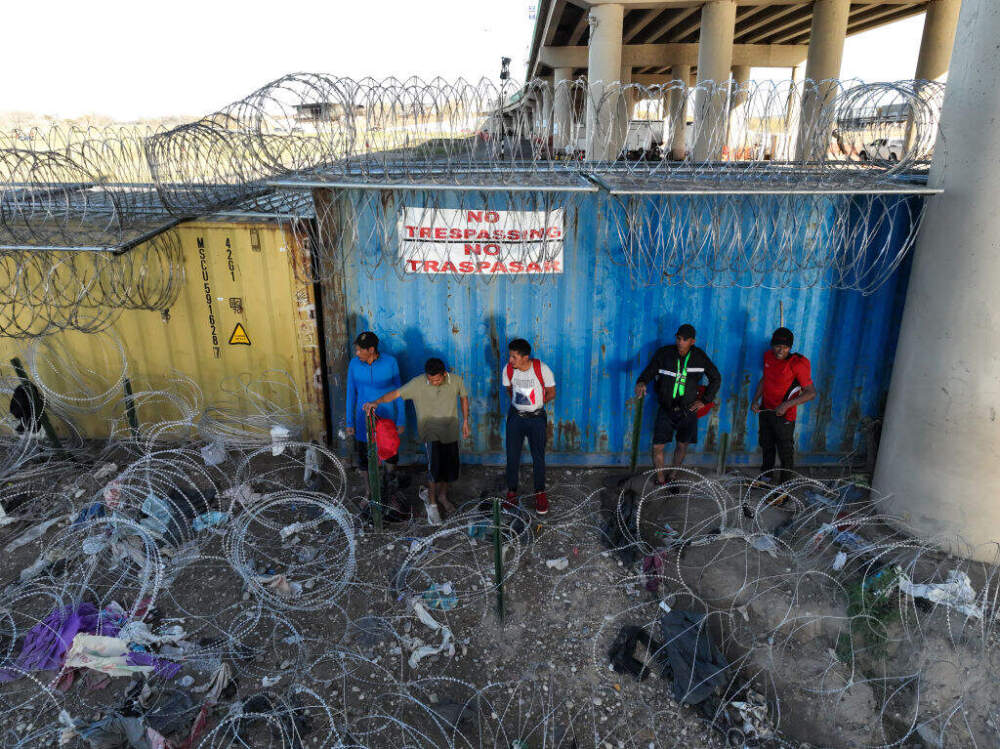
Jason De León spent nearly seven years embedded with a group of smugglers moving migrants across Mexico.
Today, On Point: How that experience changed his perspective on the smugglers’ world.
Guest
Jason De León, professor of anthropology and Chicana/o Studies at UCLA. Executive director of the Undocumented Migration Project. Author of "Soldiers and Kings: Survival and Hope in the World of Human Smuggling."
Transcript
Part I
MEGHNA CHAKRABARTI: We're joined today by Jason De León. He's a professor of anthropology and Chicana/Chicano studies at UCLA. He's also executive director of the Undocumented Migration Project. And he's author of the book Soldiers and Kings: Survival and Hope in the World of Human Smuggling.
The book chronicles the nearly seven years he spent embedded with a group of smugglers moving migrants across Central America and Mexico and eventually across the U.S. border. Professor De León, welcome to On Point.
JASON DE LEÓN: Thank you so much for having me.
CHAKRABARTI: So I'm hoping to hear a lot of stories from you about a world that basically almost none of us know or understand very well.
So can you start by telling us about someone you talk about in the book, Roberto. When did you first meet him?
DE LEÓN: Roberto was a young kid, a 19 year old kid from Honduras who I met, the very beginning of this project. And it was actually a funny, I had been wrapping up a project on migration and was ready to move on to a totally different subject, and was in Southern Mexico working in a migrant shelter, run by a bunch of nuns. And the nun said to me, whatever you, don't go outside, don't go to the train tracks.
That's where you're going to run into the riffraff, the delinquentes. You're going to get in a lot of trouble out there. And so of course, the first thing I did was go outside and walk around on the train tracks and see who I could meet. And Roberto was one of the first people that I ran into. And he asked me what I was doing and I tried to explain to him what an anthropologist was.
I had just written a book about the U.S.-Mexico border, about migrants dying in the desert. And he said something very simple to me, he said, Everybody talks to migrants about their stories, but no one ever talks to smugglers like me and my friends here. And he says, people always think of us as the bad guys, but they never ask us about our lives and about why we're here.
And that was a very profound statement to me. And really sent me down this rabbit hole. So I got to know him very well. He was tragically murdered. Soon after I began the project and it was his death that ended up being the catalyst for me taking a very deep dive into the world of human smuggling.
CHAKRABARTI: How and why did he die?
DE LEÓN: He was murdered by another smuggler and I think people have to understand that the world of human smuggling over the last 10, 15 years has really evolved from a mom and pop kind of industry to now being completely controlled by transnational drug cartels, by transnational gangs like MS-13. And so all of the people who are moving migrants now across at least Latin America have criminal ties to these organizations. And so it's just gotten very violent. And, for a lot of smugglers to do the work now, you have to be gang affiliated, cartel affiliated.
And once you get locked into that world, it's really difficult to get away. And so Roberto was someone who wasn't even 20 yet and saw that things were not gonna end well for him if he didn't get out of that world. And as soon as you try to leave, it becomes very difficult, and you lose whatever little protection you might have had by being gang affiliated. And his attempts to step away from the violent world of human smuggling is what led to his death.
CHAKRABARTI: The thing about him, though, that really stands out to me, you write so clearly in the first pages of the book. Is that, just to underscore, he was in Mexico illegally himself. Because can you tell us more of the story of what he was trying to do or how he was trying to live before he became one of these smugglers?
DE LEÓN: Yeah, I think what people don't realize is that, nobody actively, I think, chooses to become a smuggler. All of the people that I worked with were failed migrants. They were people who were fleeing poverty, violence corruption, climate change. They had all tried to get to the United States at some point and had failed or had been deported.
And many of them did not have kind of social networks in the USA that could support them. So they found themselves in this kind of perpetual motion. And Roberto was someone who, after failing numerous times to define the American Dream, whatever that is these days, realized that this perpetual motion that he was in had equipped him with the necessary skill sets to help other people.
And he realized he's never going to be a successful migrant, but what he can do is provide a service for those who are trying to get to the United States.
CHAKRABARTI: Is that how he saw it, as he was helping other people? Definitely everybody that I worked with, despite a lot of the smugglers I worked with had been involved in various gang activities.
Some of them had been dealing drugs, they were assassins at different moments in their lives. And almost, probably all of them really saw or see the work of smuggling as this kind of form of redemption. So they can make up for these other violent acts by providing a service to people and really trying to help them. And so many of them really saw themselves as these kind of Heroic figures who are also trying to make a dollar during the process.
But yeah, I think that it's often portrayed as it's simply about money. And money is a huge part of the smuggling industry. But many of these folks try to characterize themselves as people who are providing a good service to others.
CHAKRABARTI: Smuggling as redemption, I want to just put a little pin in that. Cause I definitely want to come back to that in a couple of minutes Professor De León, but the bigger story you tell is all that you witnessed and learned when you embedded yourself with a group of smugglers who did exactly what you described, who helped move migrants from Central America up through Mexico. First of all, how does one go about doing that?
How did you get embedded in this group and what group was it?
DE LEÓN: So I ended up working with several different people. All of, everybody that I worked with us was from Honduras. I would say half of them were under 25 and then the other folks were in their kind of early to mid 30s, which if you're a smuggler in your mid 30s, you've had a lot of luck, you're probably pretty smart and you're what would be considered a veteran.
I ended up working with groups of both kind of mestizo white, light complected Hondurans, as well as Garifuna or Afro Honduran smugglers, each of whom were moving people who looked just like them. And, to get in with those guys, it was pretty, actually, interesting.
I think it took about an hour, is what it felt like. And that was really just me being there and saying, I'm here, I want to learn I'm going to try very hard to not be judgmental. And I just want to listen to people's stories, and I want to try to tell those stories.
And these were folks who I think no one in their entire life had said to them, your stories are important, your lives are important. And we want to understand that. And so I think that me just being very honest about my intentions and being completely comfortable being with these folks for many years opened up a lot of doors for me. And people were more than willing to pull me along and to show me as much as they possibly could.
CHAKRABARTI: So then tell me more, because again, this is a world that few, beyond you, Professor De León, don't have any kind of first-hand experience with.
So once they let you in, essentially, what were your first few months like out of what would eventually become seven years?
DE LEÓN: I think, smuggling is interesting because it's both, it's crazy. You're in this hyper violent context.
It's a hyper masculine context. You're picking people up. You're dropping them off. You're moving them to the jungles. You're getting on the tops of freight trains. You're paying off the police. You're running from rival gangs. But then you're also spending hours and days in safe houses on the train tracks.
So it goes from these moments of like hyper intense, hyper masculine, hyper violent kind of moments to just a significant amount of downtime. And most of the time I was with these folks, in the downtime. I wasn't someone who was going to get on the top of a freight train.
I didn't think that me being in those situations was going to be all that helpful. But I find that when people go in that direction, it tends to be more about the person who's reporting that stuff in that context, as opposed to what those people's experiences are on a day-to-day basis.
And so for me, so much of the work was sitting on the train tracks in the jungles in Mexico, being locked in a safe house for days in Mexico City and really talking to these folks about how they had gotten to this point, what work was like, how much money they made, what their dreams and aspirations were if they could ever get away from these things.
A lot of it was me not being really prepared for this at all, but I think a lot of these guys saw me as a therapist. Because they could finally unload all these stories about their violent and troubled lives to someone who was really, wanted to be there and wanted to listen.
But it was funny. I'd never expected. There were many intense and violent moments on the train tracks and other things, but there was also just a lot of sitting around, listening to music. I like the joke that with this project, I have a PhD in drinking beer and shooting the breeze, because so much of it was just, like, boredom.
And I think for me too, or for those guys, I was a form of entertainment. I was someone who, I was an active listener who was there to entertain these guys, who just maybe found me to be a bit ridiculous. Here's this professor who just wants to be sleeping on the ground and being in the jungles with these guys when that's the last place that they want it to be.
CHAKRABARTI: We got to take a break here in just a minute, but you did, just to be clear, you did draw the line in terms of how deeply your embeddedness went, like you said. Does that mean that you never actually went with any smugglers and migrants, that they were smuggling?
You never actually physically crossed the U.S. border with them?
DE LEÓN: No, the bulk of this work took place in Mexico. I never crossed the U.S.-Mexico border with migrants or smugglers. And really, I was mostly with smugglers when they were not moving. And so someone would call me and say, Hey, I'm going to be in this little village in Southern Chiapas, Mexico for a few days.
I would go there. I would spend three or four days with them and then they would move and then I would see them in another three days in Mexico City or someplace else.
CHAKRABARTI: Okay. I wanted to make that clear. Because of course, there's all sorts of ethical questions in terms of the kinds of research that you were doing.
But stopping short of actually physically crossing the border with migrants is a good ethical line to draw, amongst others, that you did in the research, professor. So we have a lot more to learn from you when we come back. This is On Point.
Part II
CHAKRABARTI: You're back with On Point, I'm Meghna Chakrabarti, and today Jason De León joins us. He's a professor of anthropology and Chicana/Chicano Studies at UCLA, also executive director of the Undocumented Migration Project. And he's author of the book, Soldiers and Kings: Survival and Hope in the World of Human Smuggling.
And the book chronicles all that he learned in the seven years he spent embedded with smugglers, taking migrants from Central America through Mexico and ultimately into the U.S. But of course, Professor De León, clarified in the previous segment, he didn't actually cross the border with any of these smugglers or ride on top of trains, amongst other things that he did not participate in. But professor, in the book, you write that at the street level or at the train tracks, right? You'll meet no crime kingpins. It's all, we'll talk about those kingpins later, but it's all those soldiers of this giant churn of migration.
And I still want to hear more about who they were, how they lived, what they did. For example, in the second chapter of the book, you describe the people that you met in a place called Pakalna. Can you tell us more about that place and what it was like and who you met there?
DE LEÓN: Pakalna is a tiny little village in Southern Mexico in the state of Chiapas.
For those that are familiar with Chiapas, it's very close to the archaeological site of Palenque, which is a very famous tourist destination. Pakalna, literally the other side of the train tracks. And it's a major stopping point for migrants coming up from Central America and further south.
And it's a town overrun with smugglers, with migrants, with people who are trying very hard to make money off of smugglers, off of migrants. In various ways, kidnapping, extortion, robbery, and so the folks that I worked with were largely just, yeah, the foot soldiers.
And I think people, when they think about smuggling, they think about a billion-dollar industry where people are making lots of money on it. And the folks that I work with who represent the majority of people involved in this process, these are minimum wage or less workers who are these kind of disposable labor force.
They're often more destitute than the people that they're actually smuggling. And many of these folks are young men from Central America who, you know, get involved in gangs. To be a smuggler these days requires being comfortable with a particular level of violence.
And so all of these folks come from these violent backgrounds and find that those skills serve them well on the train tracks, as they're trying to protect their clients, as they're negotiating with other criminal organizations, greasing wheels and those sorts of things. But the folks who are doing the kind of grunt work of moving migrants across, through the jungles or into the desert, these folks often live very short lives. Because it is such a such a violent world where you can be killed by the police.
You can be killed by rival gangs. You can be killed by drug cartels, or you can fall off of a moving train or die of dehydration in one of these extreme environments.
CHAKRABARTI: Tell me more about Chino, Santos. ... Tell me about them. I ended up meeting these guys Chino and Santos. And they were a couple of young kids under 20 who had failed to migrate to the United States, had left home very young.
Everybody that I worked with had left home by the time they were 12 or 13, left Honduras. And they ended up growing up on the train tracks and learning the skills necessary to avoid the police, to negotiate with other criminal organizations. And they were, they're the folks who if I'm a migrant and I leave Honduras, oftentimes, people are leaving in the middle of the night, they're running from gang violence, they're running from corruption or climate change, they get to southern Mexico with no help, and they need a guide to get them to the jungle.
And so they would meet someone like Chino or Santos who says, okay, pay me $200 and I'll get you 150 kilometers. And so they'll scrape together what little money they have. Pay it to those guys and then trudge through the jungles to get to the next point.
And at every point, you have to meet a Chino or a Santos or someone, some young, oftentimes male smuggler, who then can get you to the next destination and can help you kind of negotiate with all the perils and the obstacles that will arise during that process. But these are just young people who are already semi homeless, nomadic and realize that they can make a little bit of money by putting someone on the top of a train and getting them a little bit farther north.
CHAKRABARTI: There's so many just arresting details in the book, Professor. For example, for Chino, you observe that he has a collection of machete scars on his right arm.
DE LEÓN: Yeah. He is someone who just grew up in very rough parts of Honduras, had been involved in gang life very early on, had almost been killed several times.
His arm is just ravaged by machete scars after an attack that had happened to him near San Pedro Sula. And, he basically had to leave because of gang problems there, as many do from Honduras. And that's the kicker for I think a lot of these migrants, is they're leaving a place like Honduras because of MS-13. They get to Mexico and realize that they need a smuggler to get them through this gauntlet of dangers in Mexico. And oftentimes the people they end up having to pay are someone like Chino, who was in MS-13, or gang affiliated, who now takes on this kind of new role.
But all these young people who get involved in smuggling come from these very difficult backgrounds. And I think, for me, one of the most shocking things that I discovered early on was that everyone that I worked with had witnessed someone they care about be murdered. Which really, I think speaks to the types of dangers that these folks are fleeing.
And then also I think the experiences that these smugglers bring with them to these hyper violent contexts.
CHAKRABARTI: Did the complexity of the fact that you say that you met all these young people who, they were many times themselves, they were failed migrants as you said.
They were gang affiliated, whether out by choice, or out of necessity or by force, right? So there's that nuance there to understand. But then there's also the things that they had to do while being these sorts of street level, small time, point to point smugglers that were paid, as you say, very little for what they did. It's not all just holding migrants by the hand and taking them through the jungle to the next point.
Did you, when they unburdened themselves to you, Professor De León, did any of them talk about having done things to migrants that they regretted? There are moments in the book where some people, you know, and this is the thing, for me with being an anthropologist and having as much time as I did to follow these stories, it allowed me to ask the same questions over and over again. And to learn more each time that same question was asked.
And there would be some, most of the smugglers that I worked with, nobody wanted to cop to the brutality of the things that they may have been involved with against migrants. And no one wanted to admit that Hey, this is this relationship of what political economists would term negative reciprocity.
And this, I have a client, they've paid for a service and I've promised to get them to where they want to go. But all along the way, I'm going to nickel and dime them and try to get more and more money out of them as much as possible. And by the end, the hope is that they'll get to where they need to go. But it could be that they get double crossed at the end, and that happens a lot, and people don't want to admit to that oftentimes when you ask him about it, but you can definitely see it.
But most of the violence that smugglers talked about when I would ask those kinds of questions, they didn't necessarily want to admit that they were doing stuff to migrants. Even if I knew they were, they wanted to often portray themselves as like the best of that group and to say some smugglers do really terrible things, but not me.
I'm a good person in this whole kind of process. But that definitely, is part of the game, I think. And everybody understands that. Migrants understand that they've contracted someone to get them to where they're going but we don't trust them and that it can go bad at any point.
And the smugglers perspective is, okay, I've promised this person the service, but that doesn't mean that I can't keep adding these hidden fees along the way, and try my best to get as much money as I possibly can out of this economic interaction.
CHAKRABARTI: It's interesting to me because, as you pointed out, and I want to explore with you further. These soldiers, as you call them on the ground, are one part of a much larger system, right? A much larger system of ineffective and failed laws in the United States, and these transnational gangs and cartels and criminal syndicates who are actually making a lot of money off the cruel exploitation of the hopes and dreams and needs of migrants. We'll talk about them in a second, but in order for every piece of this to work, in a sense, everyone has to convince themselves individually that they're doing the right thing. And so much close contact with the smugglers on the ground.
Was it interesting to you that on the one hand they, as you said, they came to you almost cause no one knows their stories. No one hears their stories. They needed kind of a therapist. They wanted to be seen and heard, but at the same time they had to, a sense, I don't know, I might be reading too much into this, but like seeking absolution for their sins.
They wouldn't even acknowledge that bad stuff had also happened too.
DE LEÓN: Oh yeah. People, and that's why I think for me, as an anthropologist and ethnographer, it was so important to just keep going back. And to be there as much as I possibly could, because you start to see these things unfold. And whether people want to admit it or not, you can just your presence there, you get more and more kind of an understanding of all of the intricacies that are happening.
But people, they all wanted to think about themselves as the work, as a form of work. And a work that had some nobility to it. And so there are people in the book, like a guy that I call Flacco who was in his mid thirties. He'd been doing this for a long time and I had seen him rob migrants.
I had seen him rip people off, but I'd also had conversations with him where he would say things to me like, I'm a good smuggler. I want my children to know that I'm providing a service, that I'm not out robbing people. Even though, he clearly was.
And so there's, I think, sometimes a bit of this cognitive dissonance of everything I'm doing is, at the end of the day, is a good thing, even if there are questionable things that kind of happen along the way. And no matter what, people are going to get to where they want to go.
And I think, and in general, that's how this world of smuggling works. It's often portrayed in the media, especially, or more I think, by like the U.S. Border Patrol as every terrible thing that happens to migrants is a smugglers fault and that it's this thing that's completely dominated by violence and by treachery.
But if that was the case, this system wouldn't function. There are enough, quote-unquote, good smugglers in the world that keep the system going, that people still can put trust in them, knowing that they're going to hopefully or likely get to where they want to go.
And so it's not, it is this very gray kind of thing that I had found, one of my desires to do this project was I just felt like it had been painted in such a black and white way of from one perspective, it's smugglers are all bad. But when you ask migrants, the smuggler oftentimes plays this kind of heroic role. Because they are the people that are getting them to where they want to go at the end of the day, even if it costs more money than they had agreed upon, or even if bad things happen along the way, they still got to where they needed to be.
CHAKRABARTI: Yeah. So that sort of serving a need, right? This idea of service, that you've actually said that word many times. In terms of how the smugglers themselves see the work that they're doing. I completely understand that. And correct me if I'm wrong professor, because as I was reading through the book, the analogy that kept popping up in my mind was the transnational drug trade, right?
Because the dealers on the corner could very, maybe, I don't know, if I want to use the word rightly, but understandably see themselves as serving a need, right? Like people who need their latest dose of fentanyl or heroin or what have you, they actually have a genuine physical need for it and the dealer's just serving that need.
But on the other hand, while they may be considering themselves heroic, or even the users say, thank goodness you're dealing here. Otherwise, I'd have to go to someone else who was way more violent. That too is also how a system is just perpetuated for the tragic end of the users, ultimately.
So is that a fair analogy, you think?
DE LEÓN: I think it's one that gets us closer to understanding the complexities of this system. Because what happens when, If you start to frame smuggling as a service, because just that language of someone who smuggles is providing a service to a paying kind of client, then suddenly you're like, Oh that doesn't sound, that's not like the boogeyman that it's made out to be, and then you go, okay if it's a service, who is it a service for?
It's serving a client, but also what, who on the other end of that is benefiting from this service. And so I think, the smuggler is both connected to the migrant, but also to the other end of the system that's pulling all these people, all the people who want to employ undocumented laborers in the United States.
Smuggling is providing a service that helps that system and I, and for me, that shift in language is important for, I hope, for us to be able to see the much bigger thing going on and so that we're not kind of compartmentalizing these things.
Or are being so narrowly focused as to think that oh, it's just about the brutality of smuggling. It's really about way bigger kinds of things and I think the same thing with the drug trade, and you know the person on the street corner isn't doing that in a vacuum, right?
It's connected to these much bigger industries and individuals and communities. And I think it's the same thing with smuggling. And so I really wanted to complicate that phrase. And I hope that it forces people to look at it from a much bigger picture. Because right now, we look at these things and we, I think, as Americans, we tend to look at migration in a political and economic vacuum and think about it as, Oh, it's just a U.S.-Mexico border problem.
It's just a Honduras problem. Smuggling is just a problem for migrants, but I really want people to know that we as Americans, we benefit every day from the labor of smuggling. The smugglers provide a service for these people who come to the United States and then provide an enormous amount of services for American citizens.
And so the whole project is to really force that type of perspective. I think. To get us away from being so narrow about it.
CHAKRABARTI: So to be, to put a finer point on it, do you see U.S. employers, specifically, as clients, indirect clients of the smugglers that you spent seven years with?
DE LEÓN: Absolutely. 100%. They benefit from it daily. They need it.
Part III
CHAKRABARTI: Early-ish in the book, you have this whole section called The Road. It was really eye opening to me, and I was wondering if we could just take a few minutes to walk through what you described there, kind of step by step.
And it begins with someone you call Zero, a gangster and a mid level smuggler. Who is Zero, and what role does he play?
DE LEÓN: Zero is one of these people who is involved in smuggling, but doesn't really do the footwork. So he answers the phone. He arranges money transfers through a company, Western Union.
And then he's just got a small army of underlings that he can text and say, Hey, I got a group of five people in Tapachula, Chiapas, or in some place in Southern Mexico or in Honduras and says, I need you to get them from there to wherever I am or to this next kind of location.
I'll send you half the money right now. Someone like Chino and Santos, these low-level guys would go pick that money up at a convenience store and then would pick those folks up, move them through the jungle. Meet, maybe meet with Zero, maybe not. But basically, he's a low-level middleman who's probably graduated from walking through the jungles now to being a little bit more stationary and controlling at least some of those economic transactions.
CHAKRABARTI: And Zero of course is, it's a generic name for this type of person, right? Just to be clear.
DE LEÓN: Right.
CHAKRABARTI: Okay. So then in the example that you unfold, as you say, the guides don't ask questions, right? That's actually probably a dangerous thing to do, I imagine. And then they get paid a little bit of money to cover the expenses that they might incur in moving the migrants across the area that they'll be moving them?
DE LEÓN: Yeah, so you could imagine maybe they get #200 wired to them to move people 150 to 200 kilometers. That could take a week or longer. And they've got to pay for food for everybody. They've got to pay for cell phone credits. They've got to probably pay for either some taxis or bribes to bus drivers.
They may have to pay some money to local police who might catch them. The money goes pretty quickly. And it's usually not enough to even cover that, those 200 kilometers. And the expectation is that those low-level guys are going to find other ways to nickel and dime their clients along the way.
And Zero will say, you get my guys to Pakalna and then I'll give you another, the other half of your money. Or I'll give you a little bit, the other half and a little bit more to keep moving them farther north. But those guys, like a person like Chino and Santos, they might move those guys 150 kilometers, over the course of a week through brutal heat, walking through all these kind of dangers, trying to avoid attacks and other things.
And they may end up with, 60 or 70 bucks between, each. And it's not much money, but it's definitely more money than they would have made cutting sugarcane back in Honduras.
CHAKRABARTI: But then as you write, you say as soon as they're on the road the guides are smugglers and the migrants, guys like Chino and Santos tell the migrants that each person has to cover their own food, which is not what they get told by their initial contact, the Zero person.
DE LEÓN: Yeah. So people are lying to you all the time. The expectation is that you were going to be lied to. And so it's this kind of this uncomfortable relationship between client and smuggler where nobody fully trusts anybody. And migrants are really, especially at this level, because if you've contracted someone like Chino and Santos, the likelihood is you've just met them and that you don't really have a strong kind of social connection.
People, the preferred way to get smuggled is if you contract someone from your local village, you can pay them $3,000 up front. And they will broker the deal with people who there's some level of trust with. Because the idea is that if you go missing in the jungle you can go to the local smuggler in your home community who you might have a familiar relationship with, or at least a social connection to, and you can ask them about, there's some accountability, but most people these days don't have $200 to their name.
And so they have to contract these low-level folks that they're meeting on the road which just then leads to way more distrust and a higher likelihood of betrayal.
CHAKRABARTI: And then this 200 mile, 200 kilometers, I should say, which is largely undertaken by foot because, you're right, it's been harder to do that on the roofs of trains for example.
But there are places that the smugglers and the migrants stop homes occasionally where, I guess, you say the smugglers get to recharge their cell phones and get some free food. The migrants maybe not so much. But then also in the jungle there, there's a moment that you write about, where the migrants might get a drink of water from a kid who just emerges.
This kid is also part of the system.
DE LEÓN: Oh, everybody's making money off of this. One of the strangest things to me is like when you'll be in, on the train tracks in the jungle in southern Mexico and someone will come out of their house and they're preparing Honduran food for all of the Hondurans who are coming through.
There's a whole industry where all these folks, you don't have to be moving migrants necessarily to be capitalizing on the smuggling industry. And so yeah, food, drink you can go to a place like Pakalna and get a Honduran style haircut. Because they have Honduran barbers who are there who just cater to that population that's moving through.
That's how well developed that this whole thing has become now. And in many ways, Mexico is starting to look a lot like the United States in terms of both the rise in deportations and law enforcement who are targeting migrants, but also, there's a growing undocumented labor force in Mexico that's from Central America that can't get to the United States because of all of this border security.
And so now they're taking on these jobs in Mexico in a very similar way that we've seen in the United States.
CHAKRABARTI: So then there's the dangers, of course, are myriad for the migrants. No doubt about that. But also for the smugglers themselves, you write that it's not uncommon for people to put the smugglers at gunpoint.
DE LEÓN: Smugglers now, just expect to face incredibly high levels of violence, which is why you need a smuggler who can reciprocate that violence. It's surviving this process is really difficult. People either, that's why you don't see a lot of smugglers who are above the age of 25. Because they're either dead, in jail or if they're lucky, they've been able to escape this violence. They're courting death on a daily basis.
And these are a lot of folks who come from these very difficult backgrounds where they've known death their entire lives, where if they're able to get out of their teenage years and survive gang life in Honduras they're living on borrowed time in the world of smuggling in Mexico.
Which is a really, it's a brutal industry. It's one that just grinds people up and it's the loss of life is just mind boggling.
CHAKRABARTI: And then, as you put it, to the benefit, that grind, that churn is to the benefit of the U.S. economy in terms of the hunger for undocumented workers, but also the kings in your book, right?
MS-13, these transnational narcotics groups and cartels. Do you think, can you talk about that a little bit? Because while we've been focusing on the soldiers, because that's who you were able to embed with these smugglers, there are groups and individuals who are profiting mightily off of this exploitation.
DE LEÓN: Yeah, I think what people don't really realize about Mexico in 2014, when we had this first big kind of rush of unaccompanied minors largely from Honduras, the United States at that point decided to put all this political pressure on Mexico to stop the flow of migrants before they could get to the U.S.-Mexico border. Frontera Sur, which was this binational, actually beyond Mexico into Central America, where we were using, we're providing training for law enforcement in Mexico and Central America, technology, and trying to stop migrants before they can get out of Mexico. In response to that, the cartels see that, Oh, now it's getting so much harder to cross, that they can now start to tax the movement of migrants and start to charge more and make more of a profit on it.
And it had to become, smuggling had to get more organized to overcome this rise in border enforcement. And then along the way, these transnational criminal organizations realize that now, as the system gets more organized, they can begin to tax it in a better and more systematic kind of way. And they're making more as we crack down on migration, these criminal organizations see that now as a way to, they can just make more money from it because it's way more sophisticated and has to be more organized.
Now, the same thing, I mean we saw the same thing happen with the drug trade. Once we stopped shipping drugs into like Miami and had to go overland into Mexico. The Mexican drug cartels had to get more organized in order to negotiate with the Colombians and with other folks.
And as the system gets more complex, there's a lot more money to be made.
CHAKRABARTI: Yeah. In the last few minutes that we have. Professor, I'd love to hear from you about what this experience has led you to think, in terms of what might be effective policies. Because we've done shows in the past, multiple shows about how part of this hemispheric problem that we have comes from the near failed state status of many of the countries, where the migrants are fleeing for both fear for their lives, fear crime, economic reasons, et cetera.
And that the U.S. has a role to play in helping to stabilize and rebuild those countries. So that we have, we had those discussions. But beyond that, I'm wondering now, given that you have this clearer view, even if it's not a perfect one of these vast networks, where would you suggest the U.S. put pressure to stem the flow of migrants? Because ultimately, in terms of U.S. policy, in American eyes, that is a desire. Where would you put that pressure?
DE LEÓN: I mean I think, I've been saying this for probably 20 years now, that we spend so much money, we waste money on border enforcement.
And we're putting this band aid on these gaping wounds that stretch across the Western hemisphere and beyond. And so for me, a lot of people don't want to leave their home countries. And smuggling is just as a symptom of these bigger problems. And we have these anti-smuggling task force, which I mean, we really should be having these, like how to deal with climate change task force, how to deal with political corruption and gang violence and the drug wars that are forcing people out of their homes.
I think we need a more serious investment in those issues. And also, I think part of it too, we have to get the American public to understand that these are big problems. Bigger problems that extend beyond our borders. And whether people get a little touchy about the political instability in places like Central America, even though, the original banana republic in Honduras is a product of U.S. interventionist policies. That aside, just even thinking about climate change, which is pushing all these people out of a place like Honduras, is being driven by countries like the United States.
And I always find that it's the irony that you have a country like Honduras, it's been destabilized by over a hundred years of U.S. interventionist policies. Now people were watching this laboratory for climate change push these people out consistently. And these migrants are fleeing climate change, that's being driven by the United States. Being now driven towards the United States. And so I think, we need to think about more nuanced policies that extend beyond our borders and that take seriously these bigger issues. And really shifting away from this, the problem, the quote-unquote problem of smuggling. That for me, that's not the problem.
It's a symptom of these things.
CHAKRABARTI: Yeah, I take your point, but also there's an issue of time scales here. Because as you just mentioned, first of all, politically, this is a century long problem in the making. Also, but regarding the future, like climate change isn't going to turn around anytime soon.
We agreed we should invest a lot in climate change policies and supports, not just for the smuggling reason, but for the future of the planet reason. But that is, again, a project of decades, if not, more centuries. There's also, so that can be done, but there's also this acute need right now.
I'm wondering if you would see that is it time for the U.S. government, whether it's politically unpopular or not, to get, to crack down on U.S. employers? Or is it time for some kind of task force to go after, if possible, more successfully, again, the kings, the heads of these cartels that are helping to drive the system that's satisfying the employment need in the United States.
Can we do both simultaneously?
DE LEÓN: Yeah. I think for me, the real kicker is. we hate migrants at the U.S.-Mexico border. The American public is totally fine with them dying in the Sonoran Desert of Arizona, but this understanding that if you can survive the Sonoran Desert of Arizona and get to the United States, we'll completely ignore you once you enter one of these labor industries that most American citizens wouldn't want to touch with a stick.
And so I think if we were to make these employers responsible for this, or really to look at them and to say what is going on and if we were, if we truly didn't want migrants ... in this country we could crack down on all these industries. It would crash our economy quickly.
But maybe that's what it's gonna take for people to, for the general public to understand just how important this labor force is. Because I mean, this kind of duality of, like, we ignore them once they're here, but we let them die in other places, or we brutalize them in these other contexts, for me that doesn't sit well, but that really speaks to this kind of refusal for the public to see the complexity of the actual issue.
And we're in an election year. And so right now it's very easy to demonize migrants. We're very good at doing that and migration, smuggling, these are all smoke screens for these much bigger and more complex problems.
This program aired on July 9, 2024.