Support WBUR
The battle for control of state governments
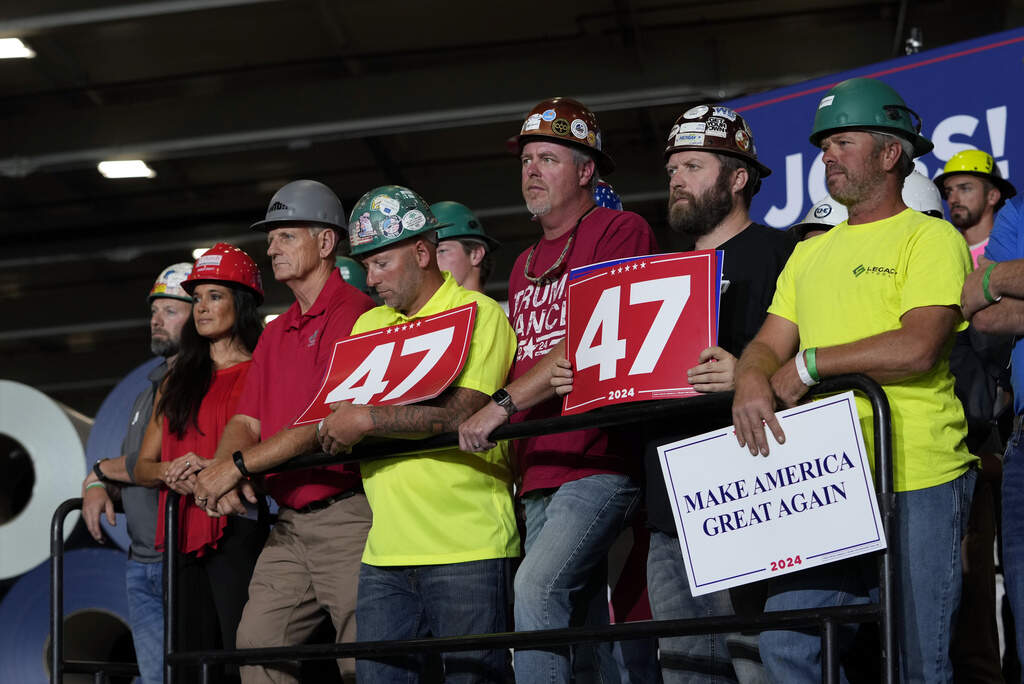
While the presidential race is getting most of the attention, control of several key state legislatures is also up for grabs, in places like Arizona and Michigan.
Today, On Point: The contests for legislative control across the country – and why they matter.
Guests
Liz Crampton, state policy reporter at Politico.
Ray Stern, state politics and issues reporter for The Arizona Republic.
Chad Livengood, politics editor and a columnist at The Detroit News.
Steven Porter, New Hampshire-based reporter for The Boston Globe.
Transcript
Part I
ANTHONY BROOKS: Millions of Americans are already voting for the next president of the United States. With Election Day, the last day of voting, less than three weeks away, it seems like it's all we talk about these days. But voters are also casting ballots for their local House and Senate candidates, races that don't get as much attention but have immense impact on our daily lives.
Think about it. From taxes and health care, to education and guns, to voting access, and more, and abortion. The list goes on and on. State houses debate and vote on some of the biggest issues that affect us all. So this hour, we're looking at some key states where legislative races could have major consequences.
From Arizona, where Democrats are gunning to flip Both the House and Senate. To Michigan, where Republicans have a shot at breaking up a Democratic trifecta, which means control of both legislative chambers and the governor's office. To New Hampshire, where Democrats have a chance to end Republican dominance there.
So joining us now to help us through this is Liz Crampton. She's a state policy reporter at Politico. She's been traveling around the country covering these legislative races for many months. Welcome to On Point. Liz, good to have you.
LIZ CRAMPTON: Thanks for having me.
BROOKS: Yeah, this is such an interesting topic and I'm really excited to discuss it with you.
So let's start with a basic question. Why should voters care about these legislative races? You've been covering them for months now, as we said. Remind us just how important some of these local legislatures are, really, what they do.
CRAMPTON: It's more true than ever that what happens in the states is the most important policy fights.
Look at what's happening in Washington, which is not much. And so that gridlock means that policy and politics, it's all at the local level. That's what impacts people's everyday lives more than anything else.
BROOKS: Right. So you're saying, given that Congress is so gridlocked. It gives these state legislatures even more opportunity to wield significant power and influence, right?
CRAMPTON: Yes, absolutely. Perhaps the best example is the Dobbs decision, and how that thrust abortion politics into the national conversation. And we saw so much activity in states, whether it was states passing abortion bans, or expanding access to reproductive rights, that really proved the point that it's all about the states.
BROOKS: Right. In a presidential election year, it's not surprising that the top of the ticket sucks up a lot of the oxygen, even much of the oxygen. So is it your sense that because of that, people pay a lot less attention to local legislative races?
CRAMPTON: That may be true, but I believe that it's changing. You know, it is a challenge for state ledged candidates to break through that political noise.
Especially because looking at the biggest fights in state legislatures over power, there's a near perfect overlay with the presidential battlegrounds. So that states like Arizona, Michigan, Pennsylvania, the presidential contests are tight there and so are the fights in the state legislature.
So that really ups the intensity of these races.
BROOKS: Interesting. So let's talk about some numbers and which party controls how many state legislatures. Republicans have an advantage. Tell us by by how much.
CRAMPTON: Republicans have had a hold on state legislatures for well over a decade. You know, ever since 2010, when the the GOP flipped state legislatures across the country.
They've maintained that grip. Democrats however, have really been waking up to the fact that in order to be a strong political party, you have to have a deep bench within the states. So those margins have shifted, and Republicans and Democrats have picked up some pretty important chambers in the last few cycles.
Just looking towards Michigan in 2022. The party surprise flipped both chambers and that set them on a path to enact a pretty progressive policy that has set an example for Democrats in other states who are trying to also do the same thing and replicate what happened in Michigan.
BROOKS: Right. I see. So Michigan, that great term trifecta, right? Control of both houses as well as the governor's office. So it gives Democrats a lot of sway there. And that's one of the races we're going to dip into, one of the states we're going to dip into in just a little bit. But in terms of Democrats catching up with Republicans, I think these numbers are right.
Correct me if I'm wrong. Liz, Republicans control 28 state legislatures, Democrats control 20, and two are evenly split. Is that what your numbers suggest?
CRAMPTON: Yes, that's right.
BROOKS: All right. Yeah, I'm looking at reporting from NPR. They break it down even by the total number of legislative seats in the country, 7,386 Republicans control 55% of them.
Overall, the GOP is on top in 57 of the country's 99 legislative chambers. So there's a lot at stake this year. In at least six states, the margins are so close that partisan control of the legislature could flip. Those states include Arizona, Michigan, New Hampshire, which we're going to talk about in some detail, as well as Minnesota, Pennsylvania, and Wisconsin.
So big opportunities here for both parties. Liz, what kind of spending are we seeing on these legislative races?
CRAMPTON: Record spending. Republicans have long dominated spending in the states, but Democrats are catching up. And thanks to the help of new groups, such as the States Project and Forward Majority, who are singularly focused on electing Democrats into state legislatures.
The DLCC, the Democratic Legislative Campaign Committee, which is the main national group focused on state legislatures, has set a $60 million fundraising target this year. It's highest ever. The States Project, that group that I just mentioned, is trying to raise $70 million. We're seeing just a tremendous amount of money into the states. And even individual races are breaking records.
There's one really tight race in Pennsylvania, for example, where we're expecting to see at least $4 million just in this one race. And that's never been true before.
BROOKS: And what explains that? Is it because there's a sort of relatively recent recognition of the importance of local legislative races that hadn't been there before.
CRAMPTON: That's true. And I think donors have become disillusioned with D.C. and the focus for so long was always on the White House and the Senate. But now they're turning their attention towards the states. Like I said before, the fall of Roe has really increased intensity around activity in state legislatures and that's where the money is following.
BROOKS: So I wanted to ask you about that, before we dip into individual states. What are the key issues in local legislative races? You mentioned the fall of Roe and abortion rights. I gather that's one of the big ones that dominates a lot of these local races. The nationalization of local politics means that what people are talking about in Michigan is pretty similar to what people are talking about in Oregon, or in Florida.
For Democrats, that's primarily abortion rates. They're also talking about affordability and housing and child care and education. Meanwhile, Republicans, they're working to tie these down ballot candidates to the Biden-Harris administration. A warning of high inflation rates, immigration challenges, and limited choices for parents in educating their children.
BROOKS: It's really interesting because, of course Tip O'Neill, the famous former Speaker of the House, the late, great Tip O'Neill famously said, all politics are local. But in these divided times and in a divisive presidential race, it sounds like that we're moving into a world of all politics are national.
Is that the way it seems to you, when you look at these legislative races?
CRAMPTON: It's true that the national conversation shapes the contours of these races, but the state ledged candidates are very quick to bring it back to local. I was just in Pennsylvania this week with a Democrat candidate who would tell voters at the doors, I don't comment on the presidential election.
I'm here to talk to you about the budget, about education and that's in part strategy. He's a Democrat running in a 50-50 district and so he's trying to convince Republicans to split their ticket and vote for him. But also it's true, state lawmakers don't have any control over border security.
So even though voters will tell them that's their top issue, the challenge is acknowledging that, but then steering the conversation back to issues that they can take action on.
BROOKS: Interesting. So you mentioned that Republicans have controlled more state legislatures for a bunch of years, going back to 2010.
What's the explanation for that? What happened in 2010 that gave Republicans this advantage?
CRAMPTON: That was the first midterm of the Obama presidency. And there's a huge backlash to his election among Republicans. And they orchestrated a very calculated strategy to take back power in the states, because they did not capture the White House and it worked.
They funneled money. They had a pretty unified agenda, policy agenda that they pursued across the country, and they really hacked the political strategy for owning the states.
BROOKS: Interesting. But Democrats making a big effort to even that score. As you mentioned, they're spending lots of money.
Has this become a priority for them that maybe they didn't have just a few years ago?
CRAMPTON: Definitely within local groups. There's been some groups that have been devoted to this mission for a long time now. But we just saw the DNC, a few weeks ago, give money to the DLCC, that main group for Democrats.
So we are seeing national interests care more about the states on Democrats. However, the party is far behind Republicans and they have a lot of catching up to do.
BROOKS: And do you get the sense as you've been moving through these states, looking at local legislative races, that voters are really paying attention to these down ballot races?
Because it would strike me as challenging, I guess I'm talking about the issue of voter fatigue, with so much national election news, top of the ticket focus, due to this presidential election.
CRAMPTON: The voter fatigue is real, especially in these battlegrounds, and you often don't find voters who even know the name of their state representative.
So that makes this job even harder for these candidates to introduce themselves to people in their district. They're knocking on thousands of doors. They're having conversations over and over again about the issues, because breaking through that political noise is really challenging.
BROOKS: Liz, I said we're going to be dropping in on at least three of these states as this hour goes forward.
Before we move toward a brief break, tell us what state was most interesting to you as you've moved around the country, and where there's a lot at stake in one of these local legislative races.
CRAMPTON: I'd say Arizona. It's the top target for Democrats trying to flip both chambers in the legislature.
They've tried for years. They've come closer every cycle, and they really believe that this is the cycle that they're going to do it. They've invested more money than they ever have before. You know, that they're boasting about their candidate recruitment. And if Democrats do flip legislature, that would give them a trifecta for the first time since the 1960s.
And I'm really interested to see what Governor Katie Hobbs would do with that agenda. Up until now, she's basically had to stand in opposition to the Republican legislature and veto bill after bill. But given a cooperating body, I'm eager to see what she would do with that power.
Part II
BROOKS: This hour we're talking about the fight for control of state governments this election season and why they matter. Liz Crampton, state policy reporter at Politico is with us, and joining us now is Ray Stern. He's a state politics and issues reporter for the Arizona Republic.
He joins us from Tempe, Arizona and Ray, good to have you. Thanks for being with us.
RAY STERN: You bet. It's good to be here.
BROOKS: You heard Liz before the break talking about the fight in Arizona over legislative control as being one of the races in the country where Democrats are hoping for big gains, give us your sort of brief thumbnail sketch of what's going on out there.
It didn't surprise me to hear Liz say that Arizona was the most interesting race that she's been looking at. And there's a lot of interesting races out there. I would agree. Of course, I'm biased. I'm here in Arizona. But it is super interesting here. Democrats do have, everyone says that this is one of their best chances that they have to flipping the legislature.
And this would be during a time, as Liz mentioned, when we have a democratic governor. A flip in the legislature right now would be historic. There hasn't been anything like this really in modern Democratic Party times. And if the Democrats can do this, there could be some really interesting power moves.
They're going to have to be careful. If they want to win again two years from now, but again, this would be a historic win if they did win.
BROOKS: And just to bring our listeners into the picture here. So the state has a Democratic governor, she's Katie Hobbs, and Republicans are defending tiny majorities in both the State house and the Senate. So Democrats have a chance to win that trifecta for the first time since 1966. Why do Democrats, Ray, think that this is their year?
STERN: It has gotten closer. The demographics of Arizona have changed as people continue to move in. It's just gotten to be a more purple state, and there's a lot of evidence for that.
This year in particular is another year where the Democrats just have one seat, they only need to flip one seat in each chamber, so it's as close as you can get. There's been the Trump effect where candidates are seen by a lot of voters as maybe not as viable, they were two years ago.
There's concern about the MAGA effect and this really obsession with election denialism. And so there's a thought that the candidates are too extreme. At least this is what the selling point that Democrats are trying to put out there. And Democrats have the alternative, which is less extreme, more focused on education, affordable housing.
And things like that. So they're focusing on those aspects, and abortion as well has been a huge issue here in Arizona.
BROOKS: I want to talk about abortion, but first let's hear some sound from the race in Arizona. So first, we're going to hear from Republican Shawnna Bolick. She's the current state senator in Arizona's District 2.
She's being challenged by Democratic Representative Judy Schwiebert for a key seat that Democrats are trying to flip. In a recent TV ad, Bolick's message is all about the border and supporting law enforcement.
SHAWNNA BOLICK: Together, we've stood shoulder to provide resources for police, strengthen penalties on drug dealers and committed resources to secure a border and protect our neighborhoods.
We need a fighter to represent our district, and I'm committed to defending the men and women who answered the call, whether you're a veteran police officer.
BROOKS: All right. That's Republican Shawnna Bolick. And here's tape from Democratic Representative Judy Schwiebert, who's running against Bolick. She's a proponent of abortion rights, and as a former teacher, she's also advocating for public education.
JUDY SCHWIEBERT: Very sadly, the Republicans have gotten it into their heads that they want to privatize education. And yet, as much as they've tried to do, 90% of us Arizona families continue to choose our public schools.
BROOKS: Liz Crampton, let me bring you back in the conversation. What do you hear in those two bites about the sort of political scene out there in Arizona?
CRAMPTON: It's a lot of what I said before. The conversations in Arizona are really similar to the conversations in other states, and you see the parties very aligned in trying to get things quickly back to their talking points. For Republicans, that's inflation, cost of living, and the border, and immigration, and for Democrats, that's abortion and education and affordability.
BROOKS: And Ray, talk a little bit about the key issue of abortion in Arizona and how that's playing out. I'm reading that it's one of ten states with a reproductive rights ballot measure this year. So that's obviously gonna drive people to the polls to vote. Tell us how abortion is playing.
STERN: And just to your last point, Republicans are fearful of this, that this abortion access or this abortion measure could bring a lot of people out who are gonna then look at their down ballot and vote Democrat. And when the Dobbs decision came down and the Roe vs. Wade was overturned, Arizona was left with this quandary of like, where's our law really at here?
Because the legislature and our former Governor Ducey had just enacted a new law, which is our 15 week law. And that basically means abortions are legal up to 15 weeks. After that, there's got to be a medical emergency, and there's no exception for rape or incest either. So some people are still very concerned about this 15 week law. Except when the Dobbs decision came down, there was also this question of, what about the 1864 law?
And this is a law that literally had been here for from the very first territorial legislature that we had. It was a complete ban on abortion. It required mandatory prison for anyone that would give someone an abortion. It actually required a year in prison for women that got an abortion, although that was repealed just a few years ago, actually.
But this 1864 law became this monster out there, that really did threaten to shut down abortions completely in the state. Republicans were very interested in keeping that law alive. And it became a court fight, and the Supreme Court had to decide whether it was the 1864 law that was the law of the land or the 15-week law.
And to a lot of people, this horror, it came down as the law of the land, basically. Which isn't a surprise, because the Republican legislature did want this law to be in place. But then there was this political effect like, oh my god, Republicans were in a panic basically, we're going to lose the election because of this.
And because of that, a few Republicans, they had a little bit of a mutiny. Shawnna Bolick from District 2, who was going up against Judy Schwiebert, voted against her party to repeal the 1864 law. And with just a few Republicans and the Democrats, we did repeal the 1864 law here in Arizona, leaving the 15-week law.
So the question, is there still enough momentum, anger, about what happened, to not only make this abortion measure win, and it does poll well, but also to affect the down ballots, and especially in something like District 2.
BROOKS: Interesting. Even though legislators scrambled to repeal that 19th century law, Democrats are still taking aim at GOP lawmakers who voted against repealing that ban, right?
STERN: Very much. And that's the problem. It's taking place all across the districts here as well. One of the messages from Democrats is that Republicans, if they win the majority again, then your reproductive rights are still in jeopardy, potentially.
BROOKS: And Liz, what do you think about this issue?
Because one of the things across all of these states that we're going to be talking about is, in many of them, abortion is still a very big issue in the wake of the Dobbs decision. It had a big effect in 2022. Do you get the sense that there's staying power for this issue in 2024?
CRAMPTON: That is the biggest question I have this election, especially in states where the voters may feel that this abortion issue has been settled by action. Look in Michigan, Democrats did a similar version as in Arizona, where they repealed a ban on abortion and voters approved a ballot initiative protecting reproductive rights. So is it as salient now as it was two and a half years ago when Dobbs happened? That's an open question. And it also marks a political gamble by Democrats, because they are leaning so heavily into this issue. It's like blanketing the airways on TV and radio and it's where most of their ad spending is going.
And so the question is, are voters going to turn out the way that they have before because of this abortion issue? Or because we have some distance from Dobbs and other issues have risen to be just as important to voters, like the cost of their groceries, for example, can Democrats continue to bank on abortion rights as the driving issue for them?
We don't know yet, and we'll find out in just a few weeks.
BROOKS: And Ray, let me ask you one more follow up question about that. The border is a big issue in Arizona. So keeping in mind what Liz said, that the big question, how salient does the abortion question remain two years after Dobbs, what's your view, and compare it to an issue as important in Arizona as the border?
STERN: It's still very important here as an issue. People are still talking about its abortion that is, but immigration and the economy I'd say are just as important, maybe more important to most voters, I would say. Because there is this 15-week law that takes care of 95% of the abortions. And despite the fact that there's no exception for rape or incest, I think a lot of people feel that we have this abortion law.
And then there's also a question of Republicans who are going to vote for the abortion measure, and there's interest by Republicans and men, according to a recent poll, to vote for the abortion measure. So then maybe they'll vote for that and then still vote Republican, and so it might not have the effect that Democrats want.
Plus, there's an immigration or a border bill that's going to be on the ballot as well, and that may also drive people to get out to vote as well. So there's several factors there in terms of, will it be abortion? Will it be immigration? Will it be the economy?
And I'd say that, yes, that abortion has faded a little bit, but there's still this concern that, again, that the legislature, if it stays Republican, could very well be interested in reviving the some kind of ban or at least even if the abortion measure passes here after that happens, there's going to be more legislation and maybe litigation in terms of getting rid of some of the Arizona laws that have confounded and very much frustrated Democrats here. And women when they try to get abortions, such as a law that says that you have to get an extra ultrasound and have a 24 hour waiting period where the doctor explains to you that there's alternatives to abortion.
So there's interest in getting rid of those sorts of auxiliary laws to the abortion culture here. And if Republicans win, then that may not happen. So Democrats need to keep that in mind, whether they are keeping that in mind, though, we'll see.
BROOKS: All right.
Ray Stern, standby. Liz Crampton, standby. I want to introduce Chad Livengood. He's political editor and a columnist at the Detroit News. We're going to jump from Arizona to Michigan and Chad, good to have you. Thanks for being with us.
CHAD LIVENGOOD: Thanks for having me, Anthony.
BROOKS: So when we talk about local legislative races there in Michigan, let me set the scene a little bit.
So Democrats are attempting to preserve the trifecta that they gained in 2022 after Governor Gretchen Whitmer won re election and the party gained narrow majorities in both legislative chambers. Let me start my first question there. How did that happen? What happened in 2022?
LIVENGOOD: The issue of the Dobbs decision, they capitalized on it.
There was already a ballot proposal in the works before the Supreme Court ruling. And when that court ruling got leaked early, the ballot committee went into overdrive. They got the signatures they needed, and they got it on the ballot, survived all the normal court challenges. And they used the constitutional amendment to enshrine the right to abortion and reproductive rights into the state constitution as a way to drive voters to the polls and to boost Gretchen Whitmer's reelection campaign, she won the state over a female opponent by more than 11%, almost 11%.
And they ran up, essentially ran up the score in just enough key districts in order to capture the state house with a 56-54 majority. And the state Senate with a 20-18 majority. The first time the Democrats have had control of the state Senate in 40 years. The Republicans have had a monopoly on the state Senate for over almost two generations, essentially.
And that's how they were able to do it. And then now, they're trying to defend that majority in the House and they're doing it with a redrawn lines that are much more competitive than ever, because we went to a citizens controlled redistricting commission, and we now have some really competitive races.
Particularly in the suburbs of Detroit, what I call battlegrounds within the battleground, and they are west of Detroit, north of Detroit, and in the Downriver region from the city.
BROOKS: So let's hear some sound from Michigan. Michigan Democrats, as we mentioned, successful in 2022. They pushed abortion rights, including a ballot initiative that created a constitutional right to an abortion.
That passed with 56% of the votes. And Democrats are running this year on the same issue, hoping to keep that trifecta. So here's Democratic State Senator Mallory McMorrow in an interview talking about how Democrats are counting on mobilizing voters that helped them to win two years ago.
McMORROW: This is something I have to give credit where credit is due on the right. That the anti-choice movement did and did successfully for a long time, was attempt ballot measures even though they knew it wasn't going to be successful, because it mobilized volunteers. Allowed the contact information. Now we're doing it on our side.
These people are engaged. They're connected. We have organizers in all 83 counties and they are ready to go again.
BROOKS: So Chad, I'd love to hear what you think. We were talking with Liz and Ray about the enduring power or raising the question about how enduring the abortion issue is two years after Dobbs, does it still feel like a powerful issue there in Michigan?
Oh, absolutely. House Democrats have campaign ads against their Republican opponents in these keys swing districts, that are almost entirely revolved around the Republicans' position on abortion and trying to pin them and say if so and so is elected, then we could, we can see the clock turn back.
Now, part of that argument is based in the idea that if Republicans were to get back in the majority, they would move to change the constitution. It's a little bit of a leap though, because you've got to get two thirds vote in the legislature in both Houses, by the way, in order to get something on the ballot. But they're using this, and this is going to be like the other guests said, this is a real first big test about whether there is staying power and in mobilizing voters on abortion and making it, it was already a wedge issue, but now making it a litmus test, particularly with candidates, Republican candidates, as they're trying to appeal to women in the suburbs of Detroit.
Part III
BROOKS: Chad, we were talking about the situation in Michigan. And just to recap, Democrats hoping to preserve that trifecta that they gained in 2022. Of course, you've got a Democratic governor in Gretchen Whitmer. Democrats hold a slim 56-54 advantage in the Statehouse, a 2018 advantage in the State Senate, but that upper chamber is not up for election this year.
But Chad, talk a little bit about what Democrats were able to do with that trifecta since they gained it.
LIVENGOOD: Yeah they were first out of the gate. They were able to repeal the 10 year old right to work law. That Republican governor Rick Snyder and a Republican legislature passed back in 2012, was a watershed moment in a pretty pro union state like Michigan they were able to repeal taxes on pensions that Rick Snyder and the Republicans put in place and restore earned income tax credit that was cut as well, as the Republicans in Rick Snyder needed to make up ground for a big tax cut they gave to businesses a decade ago. And so there was a number of these big pent up democratic priorities. They also went in, repealed the 1931 law that criminalized abortion, even though the voters had just amended the constitution and essentially overrode any kind of previous statutes.
There was this law still on the books that actually predates back to the Civil War as well, just like the one out in Arizona. And so they went into the books and just stripped all these laws out that had related to criminalizing abortion for doctors and for women, in order to essentially backstop in the event that conservatives get back in power one day enough to amend the constitution, which is quite a process, but they wanted to make sure that these sort of ghost laws were stripped out of the books for good.
BROOKS: They can argue that they're getting stuff done, so to speak. What's the pushback against them? What's the Republican case against Democrats in this fight for control of state government?
LIVENGOOD: There are arguments out there focused more around the economy, larger they're latching on to Donald Trump's campaign strategy.
To focus on inflation and the cost of goods and then pointing to record spending in state government, of a variety of sort of pork barrel projects. It's all very targeted there. And then there's a lot of defense going on with Republicans on this abortion issue, trying to say, look, the voters have spoken and we're going to honor the voters, we can't criminalize abortion anyway.
We can't throw women in jail. The constitution doesn't allow it. So that they're trying to to push back on that. And we're seeing that both at the state house and also a couple of our key Congressional races here in Michigan as well.
BROOKS: Sure. Liz, I'm curious in general when it comes to the Republican position on abortion, as you cover these states, there's this handful of states where you know where there's so much at stake at the local legislative, the state legislative level.
What's the Republican position in general?
What are you seeing across those states?
CRAMPTON: It's muddy, because Republicans know that this is not a winning issue for them. And so they've really struggled to chart a unified path forward on what to say about abortion. And it depends on the state. I know in a place like Michigan, they might say it's settled, or in Pennsylvania, if Republicans do flip there, they do face a Democratic governor who has said he will not change anything on abortion. So you see some messaging from them saying that they support women's health. So that's a way of them kind of dancing around it and not being specific about whether or not they would like to see a ban. But it's tricky, and like I said, they know that Democrats have the momentum and the winning record on this.
And so they're really backed into a corner on abortion.
BROOKS: Really interesting. Let's bring in one more voice. We're going to, we started in Arizona, touchdown in Michigan. Now, let's go to New Hampshire and bring in Steven Porter. He's a New Hampshire based reporter for the Boston Globe. Steven. Good to have you.
STEVEN PORTER: Hi, Anthony.
BROOKS: So we want to talk about New Hampshire, which, by the way, has the largest state legislature in the nation. This is a state of what, 1.4 million people and more than 400 members in the state legislature. Control of the legislature has bounced back and forth over the years, but Republicans currently have the trifecta there, they control the governor's office, the House and Senate.
But Steven, I gather Democrats are hopeful that they can flip that this year. Yeah, that's correct. So governor Chris Sununu is a Republican and Republicans have majorities in both the House and the Senate. Their majority is extremely narrow in the House this session. A little bit more comfortable in the Senate for them, but Democrats are really working hard to break that trifecta this year.
All of our legislative seats and the governor's office are on the ballot this year, and Democrats have significant backing from the national level. They've set up a number of coordinated campaign field offices. So they're working to support candidates up and down the ballot from President, Congress, governor on down to these state legislative races, which, as you mentioned we have 1.4 million residents and 400 state representatives, 24 state senators, so these are highly local contests. The representative to constituent ratio, for example, is 1 to about 3,500 constituents, so we don't really have race by race polling on these state representative seats. But certainly, it'll be interesting to see how they pan out.
BROOKS: And I'll disclose I live in New Hampshire, so I follow with interest up close what's going on in New Hampshire. Abortion is a big issue there. New Hampshire is one of the few states in New England without abortion protections enshrined in the state constitutions. Democrats are hoping to use that issue.
Steven, how are you seeing that, how abortion is playing out across New Hampshire?
PORTER: Yeah, so abortion under the current state law is legal until 24 weeks and then after, of pregnancy, and then after that there are exceptions if the life of the pregnant patient is at risk or if there's a fatal fetal diagnosis at play.
A lot of Republicans are trying to make the case that they're not going to change that, that the law is settled and they're happy with how it is, but as you mentioned, Democrats are arguing that, hey, we need to do what our neighbors have done, and really provide affirmative protection for abortion, not just restrictions at 24 weeks.
There is a variation of course on each side of the aisle. I spoke with a Republican voter last week, who is supporting candidates, Republican candidates who are making the case that the law should not change, but that voter in particular said he would prefer a stricter abortion law at that 12 weeks instead of 24 weeks.
And so we do see some of those ideas reflected in certain subsets of the Republican Party, while Democrats are really making the case that those affirmative protections are the route to go.
BROOKS: So let's play some tape from New Hampshire. Democrats there are counting on abortion rights as one of the big issues that will help drive voters to the polls.
And what could help Democrats flip the House in November is their gubernatorial candidate, they hope, Joyce Craig. She's the former mayor of Manchester who's running against Republican Kelly Ayotte, a former U.S. senator and former state attorney general. So here's Joyce on WMUR going after Ayotte on abortion.
JOYCE CRAIG: She has voted multiple times for a national abortion ban. She has voted multiple times to defund Planned Parenthood. She celebrated when Roe v. Wade was overturned. Now she's trying to shy away from her record, but we know the truth. And people in New Hampshire know the truth.
BROOKS: And here's Joyce's opponent, Kelly Ayotte.
KELLY AYOTTE: She's running on the slogan, Don't Mass Up New Hampshire, which is a dig at neighboring Massachusetts and an appeal to avoid high taxes and crime. This election is so important for New Hampshire and a very stark contrast of keeping New Hampshire strong or taking us down another path, the path of Massachusetts with higher taxes, higher crime, sanctuary cities.
That's not what's right for New Hampshire.
BROOKS: Chad give me a sense, give us a sense of how important this governor's race is when it comes to affecting those legislative races.
LIVENGOOD: Yeah, so I think of that.
BROOKS: Oh, I'm sorry, Chad. I meant to say Steven. Excuse me, Chad. Steven, you in New Hampshire. My apologies. I was getting confused with my notes in front of me.
Go ahead, Steven.
PORTER: Absolutely. The governor's race is absolutely one to watch in relation to the legislature. So as I mentioned before, he's not running for reelection. So this is a wide open seat for governor and the outcome of these state legislative races will really determine how much friction the new governor encounters when they come into office.
And so we're seeing a very tight race for governor between Ayotte and Craig. So we will see how that plays out. And I think that there are down ballot impacts, from the same way that we see down ballot impacts from the president on the congressional races, we see that to some effect on the gubernatorial to the state legislative races.
So we'll see how big of an impact that has here in a couple of weeks.
BROOKS: And Chad, I do want to bring you back into the conversation. I'm going to ask both you and Steven this. I'll start with you, Chad, earlier in the hours talking to Liz about the effect of the top of the ticket, the presidential race, and there are two effects that we talked about.
One is voter fatigue. There's so much attention on the top of the ticket, Chad, are you seeing that as having a sort of negative effect on local races? That is people just tuning out and not paying as much attention as they should.
LIVENGOOD: People are getting, people that are voters that have a propensity of voting often, they're probably getting swamped right now with mail and definitely digital and television advertising.
In a whole variety of races, but the state house races, they are getting a lot of attention because of just how narrow the majority is. The Republicans just need to flip one seat and it's a tie, and flip two seats and they're in power. And but there are some critical districts in these races that where the Trump factor is going to be a big deal, particularly like Macomb County.
There's a couple of competitive state house races up there where Trump has always performed well. It's more blue collar suburbs of Detroit, very automotive industry focused. And Republicans up there running on basically the Trump agenda, to try to break through that fatigue and and win these seats and win Democratic seats.
And whereas two years ago, Trump was on the ballot. They' do have an advantage up there with Trump at the top of the ticket.
BROOKS: Interesting. Steve, what are you seeing in New Hampshire in terms of the effect of the top of the ticket?
Chad mentioned the Trump effect, for example. How's that playing out in New Hampshire?
PORTER: Yeah I recently interviewed a voter who's going to be supporting Donald Trump. He told me that in 2015, he didn't want to vote for Donald Trump during the presidential primary. He said that Trump was the last of his picks, and there were like 17 candidates on the ballot at that point, but he said, now that he believes Trump has proven himself and he's going to support him this year, and so I asked him about the down ballot races.
I said, Okay, who are you supporting for governor? And he said, I'm going to support Kelly Ayotte for governor. And I asked about the state legislative races. And he said I don't really know who's running in the state legislative races, but I'm going to vote Republican straight down the ballot because I think that Republicans are representing the ideals that this voter had.
And so I think that we're seeing that those down ballot impacts where people are voting straight ticket, even if they don't know who is on a particular race. At the same time, we in New Hampshire do have a pretty significant history of ticket splitting voters. Although we have a trifecta in Concord, we have an all-democratic federal delegation to Congress.
I think it's pretty tough to predict how that will shake out.
BROOKS: I think you're right. I really scratched my head about that ticket splitting in New Hampshire and I should be in a position to understand it better, but Steven, I'm really curious to get your thinking on this. What explains that, in particular, in New Hampshire, this ticket splitting?
You mentioned Republican trifecta at the state level. But in all democratic congressional delegation and yeah, people in New Hampshire, again and again, seem very willing to split their tickets in that way. What do you think explains that?
PORTER: How much time do you have?
BROOKS: (LAUGHS)
PORTER: I think that in New Hampshire, we've got a pretty rich tradition of independence.
We have more undeclared voters, which are independents, than either Republicans or Democrats who are registered to vote in the state. I think some of that is just a reflection of having an open state primary. So when the presidential primary rolls around, if you're an undeclared voter, you can pick which of the two primaries to participate in.
So a lot of times, an undeclared voter will lean toward one party or the other pretty consistently. But choose to remain undeclared for that purpose. But I think that kind of also carries forward to other elections and prompts voters to think more independently about who they're going to pick. And each individual race, perhaps an overly simplistic explanation, but I think there might be something to it.
BROOKS: No, I think that's a good one. Liz Crampton, I'm wondering what you hear about what's playing out in New Hampshire and if it reflects any of the issues or differs in any significant way in what you've seen in these other states where legislative battles are drawing so much attention.
CRAMPTON: I want to add to that ticket splitting idea because you see that phenomenon in other states too, Michigan, where you look at state ledged districts that Trump won, but a Democratic state representative or senator won, especially in some of those like more tightly contested areas like the Downriver region.
And that may come down to just, did the candidate meet a voter face to face at the doors and talk to them about the issues? And when that voter goes to the ballot and they're looking at who to vote for and they will remember that conversation. It does happen and that adds to a lot of the pressure on these state lawmakers' ground games, because they need to have those face to face interactions to remind voters like who they are and that they even exist, and they hope that will then influence them at the ballot box.
This program aired on October 17, 2024.