Support WBUR
A deep dive into Kamala Harris' foreign policy
With Election Day quickly approaching, many voters are still wondering what a potential Kamala Harris presidency would look like — and how it would differ from the Biden administration.
Guests
Joshua Keating, senior correspondent at Vox, covering foreign policy and world news.
Jeffrey A. Friedman, associate professor of government at Dartmouth College, who researches the policy and psychology of foreign policy decision-making.
Transcript
Part I
MEGHNA CHAKRABARTI: Earlier this month, we spoke with international observers about the U.S. presidential election, and they all agreed that the next president of the United States will have a profound impact on their countries. In fact, on every country around the world. One European analyst said that the U.S. election matters so much for Europe that he jokingly told us that he wished he had a vote here. Kamala Harris and Donald Trump clearly have very different views of the U.S. 's role in the world. Trump maintains his so-called America First worldview, isolationist, protectionist, against forever wars, hostile to some allies, welcoming to some adversaries.
Harris is more in the mainstream foreign policy mold, but also still somewhat enigmatic. She says she believes in the importance of U.S. global leadership and the importance of a functioning U.S. democracy as an example to the world, as does current President Joe Biden. But beyond that, and on critical issues, Harris's approach is less clear.
Exactly how would she handle the conflict between Israel, Gaza, and now Lebanon? What would her approach to Iran be? Does she believe in some kind of protectionist trade. The Biden administration has imposed some tariffs on China with the intent to protect U.S. jobs and industry. Would she continue that?
How much would she deviate from Biden's foreign policy, if at all? These are important questions, and for answers today, we're going to turn to Joshua Keating. He's senior correspondent at Vox, covering foreign policy and the rest of the world. Josh, welcome to the show.
JOSHUA KEATING: Hi Meghna. Thanks for having me.
So first of all, let me just ask you something that I also pointed out in our foreign voices round table. That I said, while foreign policy is of course extraordinarily important to countries around the world, it's not necessarily top of mind for voters when they go to cast their votes in the United States for president.
Does that sort of conventional wisdom hold true this time around for 2024?
KEATING: I'd say for the most part, and it's a little ironic because even though foreign policy issues tend to get a little less attention in presidential elections, they don't get as much coverage, as much time in the debates. This really is an area where the president has a lot more freedom to act, than they do on domestic issues, on economic policy, where they're much more reliant on congressional approval, just because of the way our system set up. President can really unilaterally put their stamp on American foreign policy much effectively than they can in other areas.
So it's a little ironic that it tends to get a little less attention in presidential elections, at least not in years when the U.S. is not involved in a major war. Exceptions to that rule would be, you can't really tell the story of Barack Obama's rise to the presidency without his opposition to the war in Iraq.
So that was a case where it did matter. This year, obviously the war in Gaza and the [crisis] in the Middle East is something that's been getting a lot of attention, a lot of coverage. People scrutinized her statements about that, how they might differ even subtly from the current administration from Jordan, but whether that's actually the primary issue that voters are deciding on that's a little more of an open question.
Although an election this close, any sort of subtle differences can make a big difference in one or two swing states.
CHAKRABARTI: Yeah. This is the theme that keeps coming up, that this election in every possible dimension is one on the margins. You wrote a really interesting article last month, Josh, called The Guessing Game Over Kamala Harris's Foreign Policy.
In introducing today's show, I actually found it quite easy to summarize Donald Trump's foreign policy, right? America First. Etc., etc. I didn't have such an easy time summarizing what a Harris foreign policy would be. What are the kinds of things or approaches that she said she might take or have been applied to what little we know about her foreign policy stances?
KEATING: Not to analyze your question a little bit, but I think that what people are asking when they ask about her foreign policy is how it's different from Joe Biden's. Obviously, as you said in the introduction, she's very much in the mainstream of the Democratic Party. You could say even in a sort of bipartisan mainstream in comparison to Donald Trump.
But what people want to know is are there going to be shifts? And she's almost in a kind of tough position in a way, because I think any sort of serious difference she expressed with the current administration would be interpreted as a criticism, as a critique of the administration she's currently serving in.
She's in a kind of tough spot there where it's hard for her to both sort of show independence from the Biden administration without looking like she's breaking with it to definitively, one thing that I have heard, from people who've worked with her and from a lot of the coverage of her, is that her background as a lawyer, as a prosecutor, as she views it, that sort of helps define the way she approaches foreign policy as well. You could look at that as issues like territorial claims in the South China Sea or Russia's violations of international law.
Perhaps Israel's position on international law, she tends to, people say, approach these questions in a more sort of lawyerly way, looking at where its adherence to legal norms when she talks about Russia and Ukraine, for instance, which is a bit of a subtle difference from Joe Biden, who tends to look at it as the most sort of civilizational struggle between democracy and authoritarianism.
CHAKRABARTI: Cause this point that you've made, I think is very important. And I haven't heard it as clearly articulated as you just did. I would just quibble with your use of the word subtle difference. I think it's a profound difference, if indeed the Harris approach would be, I don't want to say strictly, because it's never that way, but largely driven by a sort of a legalistic view of the world.
I'm not judging whether that's right or wrong, but that is incredibly different from the kind of role that President Biden has repeatedly says he believes the U.S. has played and wants and needs to continue to play, you said it, civilizational sort of existential turning point for democracy. Has on that point, has Harris clearly articulated sort of her view about the importance of U.S. democracy, not just to Americans, but to the rest of the world.
KEATING: She has. And again, like the actual rhetoric is not that different. She did in her DNC acceptance speech, like there were lines about winning the competition for the 21st century with China, which is a big theme Joe Biden talks about, she talked about being on the right side of history.
But it doesn't. And again, like to use a maybe overused buzzword from this cycle like the difference in the vibes. Like it doesn't seem to be a kind of like organizing principle of her foreign policy the way it is for Joe Biden. I'd say for Biden, it's almost even when he talks about domestic things like investments in clean energy, the Chips Act, investments in infrastructure. He always comes back to the need to show that democracy can deliver to win the competition for the 20th century against authoritarian countries, namely China, also Russia. That doesn't, you don't hear that rhetoric as much from her.
Like it comes out once in a while, but it doesn't seem to be as defining a principle for her. As it is for a president who spent much of his career coming up through the Cold War. That's like still the framework that that he operates in, she's from a different generation.
And I think views the so-called great power competition between the U.S. and other authoritarian powers a little differently.
CHAKRABARTI: Yeah, could it be in part because being of a different generation, she's seen the limits of the United States power?
Because look, perhaps not talking that much about what are the specific differences are between her and the current president. Maybe she's taking that tack because doing so in any way, shape, or form is a losing battle. It's a very much a Catch 22 for her.
Cause like you said, on the one hand, if she says, no, I would view the situation in Israel differently. Then it's a criticism of the current Biden approach. But if she says no, I would, it's just a vibes difference and it's really going to be the same. Then there are many people in the United States who look at foreign policy under Joe Biden, and what they see is the Russia war in Ukraine still going on with a terrible seeming stalemate there.
They see Iran now lobbing missiles at Israel in Lebanon, 40,000 people dead in Gaza. They actually don't see a huge slate of successes or evidence of U.S. influence abroad under the Biden administration.
KEATING: Not to be the spokesman for the campaign, but I think what she would say is that the area where they have success is in building alliances, particularly in strengthening U.S. partnerships, and that's a big point of emphasis for her. And I think one area that she's been assigned in by administration that people might not know about, she's gotten the Southeast Asia portfolio.
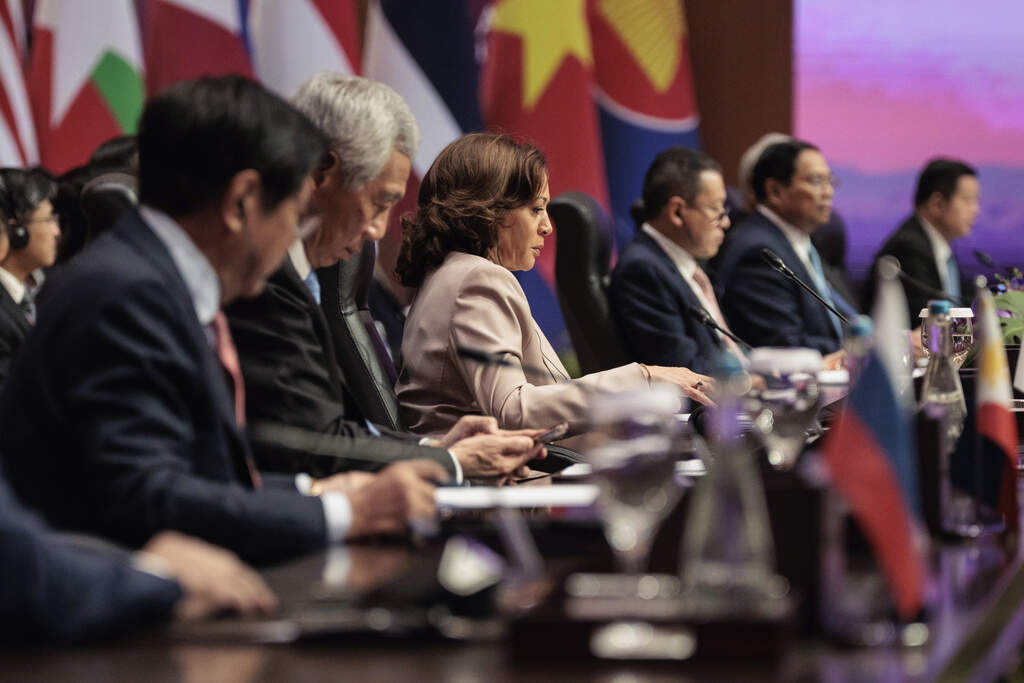
She's represented the U.S. at several ASEAN conferences. It's the association of Southeast Asian nations. She's had six meetings with President Marcos of the Philippines, which is a lot. And I think they would, and then, this is obviously all about China. This is a need to like shore up U.S. alliances among Southeast Asian countries, strengthening both economic and military partnerships. I think she has been a part of that strategy that for very obvious reasons gets a lot less attention than the wars in Ukraine and Gaza do. But there are like subtle areas where she's been working.
CHAKRABARTI: Yeah, you do note though. We've got about 30 seconds before our first break Josh. You do note that, gosh, I risk doing this even in this conversation, that the media has painted the vice president as a foreign policy neophyte. But in your story you say she actually, if she wins the presidency, she would come into office with more experience than a whole bunch of other presidents did.
KEATING: Just by virtue of having been vice president, she's sat in on the president's daily briefs, been to meetings, the National Security Council, she's traveled to more than 20 countries, met dozens of leaders, represented the U.S. at forums like ASEAN, like the Munich Security Conference. Maybe she's not as, doesn't have as much experience as Joe Biden coming in, but compared to Bill Clinton, Barack Obama, George W. Bush, Donald Trump, I think it's hard to say that she hasn't been involved on these issues.
Part II
CHAKRABARTI: Josh, so let's dig into some specific regions here. Starting off of course, with the Middle East. Here is a portion of what Vice President Harris said during her nomination acceptance speech at the Democratic National Convention.
KAMALA HARRIS: I will always stand up for Israel's right to defend itself. And I will always ensure Israel has the ability to defend itself, because the people of Israel must never again face the horror that a terrorist organization called Hamas caused on October 7, including unspeakable sexual violence and the massacre of young people at a music festival. At the same time, what has happened in Gaza over the past 10 months is devastating. So many innocent lives lost. Desperate, hungry people fleeing for safety over and over again. The scale of suffering is heartbreaking.
President Biden and I are working to end this war. Such that Israel is secure, the hostages are released, the suffering in Gaza ends, and the Palestinian people can realize their right to dignity, security, freedom. (CHEERS)
CHAKRABARTI: Vice President Harris at the Democratic National Convention. In a more recent interview with CBS's 60 Minutes, a portion of which was broadcast on CBS's Face the Nation, Kamala Harris struggled to find a strong response to a question from Bill Whitaker, and this was about whether Israeli Prime Minister Benjamin Netanyahu is listening to the Biden-Harris administration.
BILL WHITAKER But it seems that Prime Minister Netanyahu is not. --
HARRIS: Bill, the work that we have done has resulted in a number of movements in that region by Israel that were very much prompted by or a result of many things, including our advocacy for what needs to happen in the region.
CHAKRABARTI: That's Vice President Harris on CBS's 60 Minutes.
Okay, Josh, in the DNC cut, we heard a very clear and forceful Harris there essentially almost promising the world. But then when asked about the simple question of whether or not U.S. influence in this conflict is in fact palpable, she struggled to find a clear answer. How does she land in terms of what she thinks the extent of U.S. intervention could be with, let's just stick with the Netanyahu administration in Israel?
KEATING: Yeah, it's tough to discern. I think that she's clearly trying to straddle a issue that is maybe more than anything else this cycle, divided her own party. People threatening not to vote for her ticket because of U.S. support for Israel. Then there are also Democrats who think the U.S. is insufficiently supportive of Israel, who may drift towards the Republicans. So she's trying to articulate a position that gives everyone enough that they think they hear what they want to. In terms of her stance on Israel, she has been maybe a bit more, like emotive, let's say in talking about Palestinian casualties, about the death toll.
There was a notable speech gave earlier this year at a civil rights commemoration in Selma, Alabama, where she talked about the civilian toll in Gaza and called for a cease fire when that was still a kind of evolving position within the administration in terms of policy differences. Like it's hard to also, in that same 60 Minutes interview, she described Iran as America's greatest global adversary, which raised a lot of people's eyebrows.
Most people would have expected her to say China or Russia, but putting Iran up there definitely indicate some more hawkish pro Israel position in the Middle East, and it's a little weird that there's this idea out there that she's more critical of Israel than the rest of the administration. I'm not always sure where that comes from. It definitely wasn't the way she was viewed when she joined the ticket. She's someone as senator.
She spoke twice at the APAC, American Israel public affairs conference in D.C. One of our first votes as a senator was condemning the UN for criticizing Israeli settlement. She traveled to Israel and met with Benjamin Netanyahu as a senator. Like definitely when she was put on Biden's ticket, she was viewed as making, quote marks, pro Israel.
But there's definitely been some maybe evolution, at least in how she talks about this issue. As that DNC clip you played, she builds to Palestinian self-determination as the big applause line, as the kind of climax of that section of the speech, which is a difference in tone, if not in policy, which is a lot like harder to discern at this point.
CHAKRABARTI: I'm glad you brought up her Senate record, right?
Because there at least we have a series of votes or statements put out from her that give us some kind of measure of what her approach was as a senator, if not as a vice president. And to your point she seemed to be more pro-Israel as a senator, at least at that time. But you've also talked with some analysts, who said pretty clearly to you that they don't anticipate any meaningful change, if there's a Harris presidency over the Biden approach.
Does that mean though that there's no disagreement between the two about how the U.S. involvement in the region? I think, again, the people who are hoping that she'll make a break with the Biden administration would point again to what I was talking about earlier to this more lawyerly legalistic background.
So she may talk more about Israel's adherence to international law, to international humanitarian law. And the record is what the record is. But I don't think she has the sort of deep commitment and engagement on this issue that Joe Biden, who's met with every Israeli prime minister going back to Golda Meir has, it's not like they like fundamental part of her foreign policy worldview that the way it is for him, but if you're looking for signs that may be where you'd see them.
CHAKRABARTI: And linking back to your previous point about generational difference.
We have spoken to some analysts who say that Biden's long, like half century long, right? Foreign policy experience, also means that there are times where it seems like his approach is preserved in aspic from 1970, or so it hasn't evolved as though as the world has changed. But to that point, let's just briefly move to China. Because, of course, in terms of direct impact on America, China is enormous on that front.
So here's a little bit of what the vice president said again, during her nomination acceptance speech at the DNC. This is about the importance of the race between the U.S. and the United States for future technology.
HARRIS: I will make sure that we lead the world into the future on space and artificial intelligence. That America, not China wins the competition for the 21st century.
And that we strengthen, not abdicate, our global leadership.
CHAKRABARTI: And forgive me, I meant to say the race between the U.S. and China, obviously. Josh, anything further to add there? Because I can't hear any difference in her China approach from the Biden administration's.
KEATING: No, I think that's one area where you're going to see continuity.
And I think this is an area where you've seen shifts in the Democrats overall from the Obama era. There's more, there's less talk about cooperation with China, more sort of viewing them as the in defense circles, they call it the pacing challenge.
The main challenge around which defense investments are made. And also, in terms of industrial policy, there's been a move away from free trade, towards industrial policy, towards making the investments in domestic manufacturing, and that's very much with an eye on China.
And I don't see a huge break on that moving into the new administration.
CHAKRABARTI: The one place in which domestic and foreign policy are completely intertwined is of course at the border. And this is the place in which I think the Trump administration makes its greatest inroads in terms of its criticisms of Harris, if not for her actions and for the Biden administration's actions as a whole. Again, this is from her DNC acceptance speech and Vice President Harris alleges that Donald Trump is the person who killed a bipartisan border deal that she and President Joe Biden worked on. This is of course the one with Senator James Langford of Oklahoma, Republican.
And here's what the Vice President said in her speech.
HARRIS: I refuse to play politics with our security. Here is my pledge to you. As president, I will bring back the bipartisan border security bill that he killed, and I will sign it into law. (CHEERS) I know, I know, we can live up to our proud heritage as a nation of immigrants and reform our broken immigration system. We can create an earned pathway to citizenship and secure our border.
CHAKRABARTI: So that was the Vice President at the Democratic National Convention, and I want to withdraw the fact that I said she alleges that Donald Trump killed that border bipartisan border deal. Because I think it's fairly well reported that when he said he wouldn't, he doesn't support it at all, Republican support for it fell apart as well.
Josh, we could talk for endlessly about the border and the situation there, and its impact on the Harris campaign. But what would you say her approach to migration or immigration is? Can it be strongly defined?
KEATING: So early in the administration, she was given this portfolio, someone saying thankless portfolio of addressing the root causes of migration.
So she made several trips to Central America, announced some investment deals, basically aimed at giving economic aid to countries in Central America where migrants come, helping to tackle the security situation there, address some of the drivers, those weren't great trips for her politically.
Those are ones where they're remembered for her saying, Don't come, being her message to migrants. There was another where she fumbled an answer when she was criticized for not visiting the border, saying she hadn't been to Europe either. So this was, earlier I talked about the fact that she does actually have a fair amount of foreign policy experience, I'd say, like this idea that she's a foreign policy neophyte, it may come partly from some missteps on these early Central America trips.
More recently, you've heard less about root causes, less about that, and more about border security. And I'd say that this is an area where you've seen a huge shift from the Democratic Party compared to 2020 that it's definitely a very security first approach, the bipartisan approach.
Border security bill they talked about was very much security first, whereas, before there was maybe more trying to balance those two, you're creating pathways to citizenship for undocumented migrants who are already here. There's definitely, this is an issue where they're reading the room and they see the voters have moved rightward on this, one a more sort of security first border policy, and that's what they're promising.
And basically, the line is that they tried to deliver it, and Trump killed it. But this is an area where the Democratic party rhetoric is hugely different than what you've heard in previous cycles. And it'll be interesting to see, how that she said she wants to sign this bill when she gets into office.
I'm interested to see if she'll get some pushback from Democrats and from immigration rights advocates, whether to attach some provisions for pathways to citizenship, for pathways for Dream Act recipients attached to all the border security.
CHAKRABARTI: We should spend a few minutes, if we can't really pin down a defining Harris doctrine, has been thrown around in in various headlines, let's take a minute to talk about some of the people advising her, right? Her current national security advisor is a man named Philip H. Gordon whom reportedly she leans on quite a lot for advice on national security and foreign policy.
Can you tell us a little bit about him?
KEATING: Yeah, it's funny. The foreign policy, the national security advisor to the vice president is not a job that tends to get a huge amount of attention from the press from Washington. But Jake Sullivan, who's the current national security advisor to President Biden.
He had a job for Biden when he was vice president. So it's not the most high-profile job until your vice president becomes president and all of a sudden, you're thrust in the spotlight. Phil Gordon is somebody who's a longtime fixture in Democratic party foreign policy, has been in administrations.
He's been in think tank world. He's someone who's traditionally a Europe specialist, strong Transatlanticist impulses, definitely. Puts a lot of emphasis on the importance of alliances on NATO. He's also worked a fair bit on Middle East policy and wrote a notable book called Losing the Long Game, which is about a sort of critique of several decades of U.S. regime change, U.S. backed regime change in the Middle East, going back to Iran in the 1950s, like up through Iraq and Afghanistan and Libya.
And pointing out the sort of mistakes that led the U.S. to get involved in long term ... operations backfired on the U.S foreign policy. So that's where he comes from maybe a more sort of humble restraint minded approach to foreign policy. I think with all these things, we look for clues in the campaign speeches in the statements their advisors makes, but, it comes back to that like Mike Tyson line.
Everybody has a plan until they get hit in the mouth. And I think that is very much true of presidents when it comes to foreign policy. George W. Bush also came into office promising a humbler foreign policy. That's not what we got. Barack Obama came in as a critique of U.S regime change in the Middle East. He ended up doing just that in Libya. I don't think a major land war in Europe was on anyone's bingo card in 2020 when Joe was running, but it's going to be hard to tell the story of his foreign policy without Ukraine. I think when we talk about Kamala Harris's foreign policy, I think, it's frustrating to talk about now, cause we all want clues from the statement she's saying, but we're going to know what her foreign policy is when she has to deal with a crisis.
And judging by recent history, she's going to have to deal with one pretty soon.
Part III
CHAKRABARTI: In 2020, as a senator, Harris said, quote, I unequivocally agree with the goal of reducing the defense budget and redirecting funding to communities in need.
That was in 2020. This summer, in 2024, at her acceptance speech at the Democratic National Convention, this is what the vice president said about America's military might.
HARRIS: As vice president, I have confronted threats to our security, Negotiated with foreign leaders. Strengthened our alliances and engaged with our brave troops overseas.
As Commander in Chief, I will ensure America always has the strongest, most lethal fighting force in the world.
CHAKRABARTI: Joining us now is Jeffrey Friedman. He's associate professor of government at Dartmouth College. His research area focuses on the politics and psychology of foreign policy decision making.
Professor Friedman, welcome to On Point.
JEFFREY FRIEDMAN: Hey, thanks so much for having me. So those two different approaches to the U.S. military is an example, I would say, because our earlier guest, Josh Keating, pointed out those two moments as saying, look, in truth, politicians frequently evolve in their perspective on all, any number of issues, but especially foreign policy.
So going from reducing the defense budget to guaranteeing the most lethal fighting force in the world, maybe that's Harris's evolution. But could it also be seen as a rebuke to, again, this presumption that we all have, that foreign policy doesn't actually matter to U.S. voters when casting their ballots, Professor?
FRIEDMAN: Yeah, I think that's right. Joshua is certainly right to say earlier in the hour that individual foreign policy issues seem to have relatively little impact on Election day, but at the same time, voters do seem to put a substantial amount of emphasis on making sure that the person they elect to sit in the Oval Office is competent to be commander in chief. And historically, voters have paid a lot of attention to making sure that a president has the right to strength of leadership, decisiveness, judgment, these kinds of personal attributes that really matter when it comes to managing foreign policy crises.
And that's different from saying that they evaluate the merits of individual foreign policy positions. So in that clip that you just played where you can hear Vice President Harris talking about how she would be a strong commander in chief, I think that's pretty clearly an attempt to appeal to Americans to say that she has the right personal attributes to sit at that desk and confront adversaries and lead the U.S. military, which is something that a lot of Americans care about, even if individual foreign policy issues don't play a whole lot of role in their vote choices.
CHAKRABARTI: Okay. So this is really interesting, Professor, because basically what I hear you saying is that when it comes to voting, when thinking about foreign policy, many voters are simply thinking about the U.S. military, right? Because if a candidate has to project strength and competence in being a commander in chief, that's understandable, but the military is not the only instrument of U.S. foreign policy.
FRIEDMAN: I think that's right. I think voters want a strong leader across the board in foreign policy. So I think, for example, part of President Trump's appeal to voters is that he promises to be a hard nosed negotiator in all sorts of realms, like pushing back against allies, trying to get them to contribute more to defense or pushing back against other states and trade negotiations.
But I think what links all of those domains together is that what resonates with voters is the sense of whether the person running for president is somebody that will vigorously stand up for American interests. And I think across those domains, if candidates can project leadership strength, talking about leadership of the military is certainly one good way to do that.
That appears to create the kind of image that matters to voters, or at least reassures them that this is the kind of person that they can trust as their commander in chief.
CHAKRABARTI: Okay, so tell us then what history shows about the role of foreign policy in an election. Has this sort of recognition of the need to project personal and leadership strength been with us for a long time.
FRIEDMAN: Yeah, I think this is a really consistent theme in the history of foreign policy and presidential elections. So I'll just give you a couple of quick examples. In 1952, voters go to the polls right as at the heart of the Korean war.
A few weeks before Election day the Republican nominee Dwight Eisenhower gives a speech in which he says he will go to Korea. And he doesn't say what he's going to do in Korea, but nevertheless that appears to give him a large bump in the polls that many people think is decisive. I think part of the issue here is Eisenhower doesn't have to say what exactly he's going to do in Korea. Because as the general who won World War II in Europe and served as the supreme allied commander of NATO, voters trust that he knows what it takes to get the job done there.
So it's a very clear example where Eisenhower leveraged his personal reputation in order to convince voters he'd be a good commander in chief while remaining vague on the foreign policy issues. If I could just give you one more recent one, in 2004, when George W. Bush is running for reelection during the Iraq war, polls show that most voters disagreed with how he had handled the invasion of Iraq.
And ordinarily, you might think that if voters didn't like what Bush had done on the issues, that his campaign would seek to minimize the salience of those issues in the campaign. But many listeners will recall that Bush put the Iraq War front and center in that campaign. And talked about how he was able to stay the course in the face of criticism for how he'd handled the war. And his campaign after the fact was very clear that the reason they did that was that they thought what mattered to voters wasn't the substance of the candidate's policies but their image and the idea that Bush was seen as a strong leader in contrast to John Kerry, who the Republicans portrayed as flip flopping on his stance on the war.
And I think that's another place where the politics of national security in presidential elections really seems to revolve around candidates building their personal images for being strong leaders rather than debating the merits of individual foreign policy issues.
CHAKRABARTI: Do you think that's a good way for voters to make a decision about who to send to the White House?
FRIEDMAN: That's a tough question. It certainly matters to trust that the president is competent at handling foreign policy crises. As you mentioned before the break, nobody would have anticipated that President Biden's foreign policy would be defined by war in Ukraine, just as when Harry Truman became president nobody anticipated his foreign policy would be defined by the Korean war.
So it definitely matters to believe that the president is competent in general on foreign policy. But I think part of the drawback to this is that it gives candidates an incentive to try to shape their image often by taking foreign policy positions that voters don't actually like on the substanc.e So a good example of that is that in 1960 when John F. Kennedy is running for president?
He makes the centerpiece of his presidential campaign on foreign policy. The idea that he'd ramp up defense spending in order to close an alleged missile gap with the soviet union. And it turned out at the time that only a quarter of Americans actually thought that the defense budget was too small, but nevertheless, Kennedy was able to use that promise to raise defense spending in order to convince people he would inject new life into U.S. foreign policy.
So if you think about the statement from his inaugural address, that we will pay any price, bear any burden, in order to protect U.S. national interest. That still resonates, I think, with a lot of citizens today, is capturing the energy and vigor of Kennedy's presidency, even if many voters are still quite skeptical of raising defense spending.
So I think one of the tensions in this so-called commander in chief test. Is that it obviously matters to trust your commander in chief, but that can often steer the politics of U.S. foreign policy in directions voters wouldn't otherwise choose.
CHAKRABARTI: I want to come back to that because it's a very important point, but in your writing, you also point out an interesting example from eight years after Kennedy's 1960 run, with Richard Nixon, who apparently, if I can conflate a phrase from this election to 1968, he had the concepts of a plan to end the war in Vietnam.
FRIEDMAN: Yeah. So Nixon in 1968. He implies he has a secret plan for winning the war. He never actually used that term, but it is fair to, historians have used that label to describe his campaign.
That's essentially what he did. He said, trust me that when I get into office, I will know how to bring peace with honor to Vietnam, even though he never explained how he would handle the war differently from the incumbent president, Lyndon Johnson, or his Democratic rival, Hubert Humphrey.
And that was very helpful to Nixon in 1968, because voters thought he was a much stronger leader than Humphrey, and they trusted that he would do a better job of handling the war. But then once in office, having set these high expectations for bringing peace with honor in Vietnam, that also ends up making it a lot harder for Nixon to end the war, in a way that wouldn't make it look like he was abandoning his vague promise.
And records show that the Nixon administration deliberately delays signing the Paris Peace Accords until after the '72 election is over. So that's another place where maybe it makes total sense for voters to trust that one candidate can handle the war better than others, but that still ends up altering the politics of foreign policy.
In ways that aren't necessarily ideal.
CHAKRABARTI: And so you actually have another example of that, although there'd be different views on whether or not it was ideal, but I had forgotten about this one, Bill Clinton in 1992, who took a very hawkish view on Bosnia at the time as a way to win votes.
FRIEDMAN: Yeah, and it's an interesting case because Clinton's campaign manager in 1992, James Carville, is the person who's associated with saying, that foreign policy doesn't matter in presidential elections. That presidential elections are all about the economy, stupid. That's the conventional wisdom.
But at the time, Clinton's campaign also felt that it was important to at least blunt the perception that the incumbent president George H.W. Bush would be much better at handling foreign policy. And so the campaign looked for at least one area in which they could, as they say, get a jab in Bush's face or get to his right, or show that Clinton could offer some new element of foreign policy leadership that Bush wasn't willing to offer.
And the place where they chose that was, as you say, in Bosnia, where there was a Civil War that the Bush administration had said they weren't going to take part in. And whereas, by contrast, on the campaign trail, Clinton promised that he would intervene in the conflict, and by the end of this first term, of course, he did, by bombing Serbia and by sending U.S. troops to Europe to help keep the peace. So I think the interesting thing there is that even an election that we associate as revolving almost exclusively around economic issues. And for a candidate who didn't really have foreign policy credentials, we still see that same dynamic of a candidate attempting to create a reputation for being a strong leader, a competent commander in chief.
Injecting new life into U.S. foreign policy.
This program aired on October 21, 2024.