Support WBUR
On Point live: How to guarantee a secure election in Wisconsin
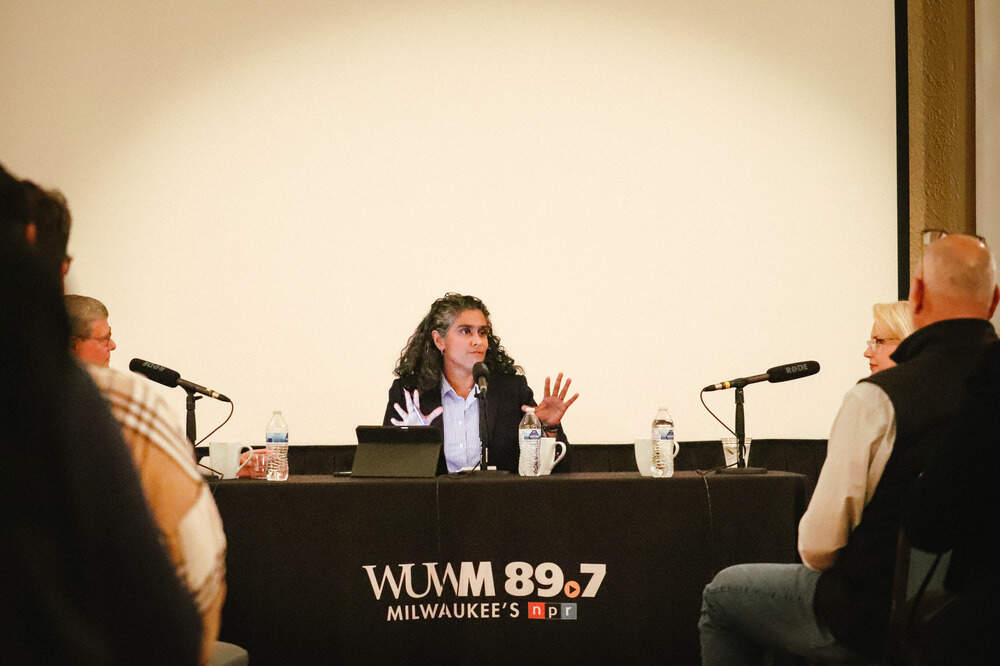
Wisconsin is one of the states that will likely determine the 2024 election.
It's also home to some of the most passionate 2020 election deniers.
On Point goes on the road to Milwaukee, Wisconsin to talk to the chair of the state election committee about the security and trustworthiness of the vote.
Guests
Ann Jacobs, chair of the Wisconsin Election Commission.
Charlie Sykes, founder and editor at large of The Bulwark, a centrist website from 2018 to 2023. Longtime conservative talk show host in Milwaukee.
Transcript
Part I
MEGHNA CHAKRABARTI: Here's one way to measure the importance of Wisconsin's 10 electoral votes in the 2024 presidential election. Or at least one way that I discovered. Turn on the TV here, and every other ad is for a political campaign.
Try to take an evening stroll in downtown Milwaukee, and you're highly likely to be diverted by Secret Service and local law enforcement who've set up a secure corridor along several downtown streets because a presidential candidate is in town. Again. Which is what happened to me and my senior editor just last night as we were walking to dinner, because Vice President Kamala Harris's motorcade was about to speed through.
So we apologized to the restaurant host for being late. When we got there, explaining why, and he rolled his eyes and said, just another day in Milwaukee.
(AUDIENCE LAUGHS)
Truth is, Wisconsin is one of the most critical swing states in this election, as it has been in almost every recent presidential election in this country.
President Joe Biden won here in 2020 by just about 20,000 votes. In 2016, former President Donald Trump won Wisconsin by 22,000 votes over Hillary Clinton. And this is in a state where more than 2.2 million votes are cast. So we're here in Milwaukee to learn more about Wisconsin politics, its electoral process, and about what may happen here, not just on Election Day 2024, but the crucial days and weeks after November 5th. To do I'm joined by Ann Jacobs. She is the chair of the state of Wisconsin's election commission. Ann Jacobs, welcome.
ANN JACOBS: Thank you so much for having me.
CHAKRABARTI: And also with me is Charlie Sykes, former longtime conservative talk show host in Milwaukee, later the co-founder and editor at large of The Bulwark, and author of the book How the Right Lost Its Mind.
Charlie, it's great to meet you in person.
CHARLIE SYKES: It's good to be here.
CHAKRABARTI: Okay. So I actually did want to start back, Ann, the first couple of questions are going to be for you with what happened in 2020, right? Because there was that tiny, less than 1% difference in the votes cast for either candidate.
What was that election like for you from your perspective?
JACOBS: So going into the election, there had been some, I don't know, some court cases about odds and ends. Nothing that seemed particularly unusual going into the election. Election night, Joe Biden wins by 20,000 votes. Two things are important about election night.
Number one, in Wisconsin, we report late, and we report late because our major metropolitan areas, many of them, not all of them, choose to process their ballots, their absentee ballots at a central location. They cannot report those results until they are all tallied, and that goes into the wee hours. So in the wee hours in 2020, Joe Biden is announced to be the winner of Wisconsin.
Okay. So far so good. We then do our ordinary processes, which is our local canvas, and canvas is just an election word for tallying and making sure our numbers add up. And then it goes from the local canvas to the county canvas, and they check the numbers again, and it goes from the county to the state.
And once they're reported to the state, because the margin was less than 1%, there was the right of the aggrieved party to have a recount. Now in 2016, when Donald Trump won, we did have an entire state recount because the Green Party requested it. So 2020, the right fell to the Trump campaign to have a recount, and they said, Yes, we would like a recount, but we only want it in Dane and Milwaukee counties.
And okay, that's their right. They had to pay their money up front. They have 24 hours to decide and pay us. They did. And we did a recount in Dane and Milwaukee counties. And remember, this is in the height of COVID. So we're doing a recount, and people are behind plexiglass and there's lots of gloves and masks and everything.
And the numbers come in basically the same, which most of us know is the way recounts work. Like rarely is there a glaring error enough to swing something like 20,000 votes. But in any event, so those results came in and so they come into the state and then they are canvassed at the state level.
And then I was the certifying state official, I certified those results, gave them to the governor. The governor issued his certificate of ascertainment. Off it went to the archivist of the United States and everything seemed fine. And when I say everything seemed fine, I was like, done and dusted.
I have done my job. Governor did his. The big gold seal machine, wooded seal on it, all is well. And what we all know now was the little mice were playing. At the game of how do we undo a valid election in the state of Wisconsin? And that is when then the electors go to meet in the state capitol. And this is done by state statute.
So the electors of Wisconsin, because those electors are actually humans, and they go, by state statute, they have to go to a room in the capitol on, I don't remember what the day was in 2020, but they have to go in a special room on that day at noon and they've got the WisconsinEye, that's our like public television folks in there, and all the electors are there, and they're all very excited, and the governor's there, and they all sign their electorate thing, and off that goes.
Meanwhile, in another room, in an undisclosed location in the Capitol at noon, are what has now become known as the fake collectors. And they do the same thing, but they do it privately and quietly and secretly. And then begins the whole saga of them trying to get that to D.C.
CHAKRABARTI: Ann, actually, I want to just interrupt on that point because there's a twist.
So we're going to come back to that.
JACOBS: Okay.
CHAKRABARTI: Okay. In a second. But just to be clear, you are the person, you're the last stop before the election is fully certified by the governor in the state of Wisconsin.
JACOBS: My job is to certify the numbers. So we have those three checks. You got to make sure that the number of ballots matches the number of voters, matches, etc., etc. And that's our job at the state. So I have, as we're learning, based on some recent court cases, a ministerial duty. In other words, no matter who wins, it is my job to certify those numbers, because numbers are things that just exist. So even if I don't like it I have to certify it. We had a Democratic chairperson in 2016, they certified the Donald Trump election.
So that's what I do. And then the government, the governor also has a non-discretionary duty to issue the certificate of ascertainment. And then that's what goes to Washington to start the formal process of electing a president.
CHAKRABARTI: Okay. I want to just clarify that because again, for our listeners across the country, essentially what that means is that you are extremely knowledgeable in the logistical functioning and integrity of Wisconsin elections.
So with that in mind, Charlie, what I wanted to ask you is, we can keep this in the context of 2020, or you can broaden it, but the fact that Wisconsin, for the past several elections has been so tight, in terms of votes cast for either candidate. For the rest of the country, what do you think that means that people should know or understand about Wisconsin voters?
SYKES: Everything's on a knife's edge here. And to your point, 2020 was not the first close election here. In 2018, Governor Scott Walker was defeated by a very narrow margin of 20,000 votes. They recognized that was the result. There was not a massive challenge to the shocking victory by Donald Trump in 2016.
We were used to that, 2020 was different, because it was the beginning of this de-legitimization of the electoral process. What I think took people by surprise in 2020 was that up until then, there had been no challenge to the result. There was no infrastructure in place. Most elected Republicans in Wisconsin probably rolled their eyes at all of this, because they understood that this was the margin of close elections in Wisconsin.
So 2020 really marked that moment when I think there was this concerted effort. It was a conspiracy to overturn the election, and at least back then, even Republicans were shocked by the notion that somehow we would throw out all of these votes from Milwaukee and Dane County, that you would perhaps invalidate millions of votes.
In fact, even the conservative dominated state Supreme Court rejected the legal challenges. So back then, I think was perhaps, hopefully not, but I think a turning point in the way that we react to elections. And the other point that is so important to mention, everyone knew in advance that the election, that votes would come in late.
That democratically dominated Milwaukee County would come in late. This was no surprise, and yet it's been weaponized in the years since then. There are charts out showing, look, Donald Trump leading up until the last moment, and yet every single knowledgeable observer.
CHAKRABARTI: And that's just customary in terms of when those votes do come in.
SYKES: Yes.
CHAKRABARTI: There's nothing unusual about that. Okay. With that said, Ann, let's get back to the quote unquote fake electors now. I had forgotten that Wisconsin was in fact, if I can just put it this way, ground zero for the national fake electors. I had honestly forgotten that with Ken Chesebro coming up with this idea and then coordinating with people around the country, including the Trump campaign.
That was in, what, November 8th, I have it here. And then by the time December rolls around, he had created a template for these fake electoral votes. And then as you said, with December 14th, the state Supreme Court ruled against the Trump challenges, et cetera, et cetera. Okay. Now here's the thing. I will admit not being a native Wisconsinite, I did not know until very recently that one of the people who signed a fake electoral vote is a Mr. Robert Spindell, Jr.
JACOBS: Yes. Who was then, and still now, a member of the State Elections Commission, of which you are the head.
JACOBS: Correct.
CHAKRABARTI: So a man who actually has settled a civil lawsuit, or was part of a settlement of a civil lawsuit, where, in which the fake electors admitted that they had tried to overturn a free and fair election.
JACOBS: More importantly, and that Joe Biden won.
CHAKRABARTI: And that Joe Biden won.
JACOBS: The 2020 election.
CHAKRABARTI: And they intended to interfere with the peaceful transfer of power is still on the commission for the state of Wisconsin that oversees the elections process.
JACOBS: I know. Isn't that something.
(AUDIENCE LAUGHS)
CHAKRABARTI: Inquiring minds want to know how is that possible?
Part II
CHAKRABARTI: Before the break, I asked Jacobs how someone who had settled a lawsuit about their involvement in the fake elector scheme of 2020 could still be sitting on the State Election Commission in 2024.
JACOBS: So it's just a quirk of how the commission is appointed. We are political appointees, partisan political appointees. I'm appointed by the leader of the Senate minority leader, who's a Democrat. And only the persons who appoint us can remove us. Bob is appointed, I believe, by -
CHAKRABARTI: Senate Majority Leader.
JACOBS: Senate Majority Leader. And so only the Senate Majority Leader can remove him. He remains on our commission.
CHAKRABARTI: Can you tell me, Charlie, what that means about the current state? Just the essence of what the Wisconsin GOP is, that they are willing to keep this gentleman on the state commission.
SYKES: It's as breathtaking as it sounds for the reasons you described. That the Republican Party in Wisconsin, a little bit of history. The Republican Party in Wisconsin was not pro Trump initially back in 2015, 2016. In fact, he lost the primary here by a rather substantial margin to Ted Cruz.
But in the years since, they've become increasingly Trumpified to the point where they look at this attempt to steal the election with the fake electors and they shrug their shoulders, which is really remarkable. And it's also just a reminder that many of the people who tried to perpetrate this massive fraud against Wisconsin voters, were never held accountable. There had been criminal charges, belatedly filed, but I think what we've seen is the delays both at the federal level and at the state level and the complications mean that many of the people who you would hope would have been held accountable have not. Which raises questions, how much of a deterrence that has for bad actors in the future.
So to be fair though, and you said that the commission is essentially, because it's made of appointees, is a partisan commission.
JACOBS: Correct.
CHAKRABARTI: And there's five members?
JACOBS: Six.
CHAKRABARTI: Six members. So it's three and three.
JACOBS: It is three Republicans and three Democrats.
CHAKRABARTI: As we get deeper into this election the making the sausage part of local and state elections becomes ever more important, right?
Because there's so much going on the ground. So I want to just ask you, can you tell me a little bit about what the titular or statutory function of the commission is?
JACOBS: Sure. Wisconsin's very unusual. We do not. We do not administer our elections at the state level, and we don't administer them at the county level.
We administer our elections at the municipal level, which means we have 1,850 clerks who each administer the election for their municipality. And if that sounds a little nuts, it's because it is. We're the only people who do that, which is why I'm always slightly entertained when people are like, the Russians are hacking the machines.
I'm like, they gotta hack 1,850 machines across the state. I digress. So that's very unusual. So what the Elections Commission does is essentially set election rules and policies for the state, and then that comes down to our municipal clerks. So we also provide guidance to the clerks on how to administer elections, what the laws say.
We provide forms, like there are state forms that they have to use. So we do a lot of that nuts-and-bolts administration of elections.
CHAKRABARTI: It's supposed to be boring in a good way.
JACOBS: And it is. That's not the sexy stuff. We do not get into the New York Times because we approved a new form.
Which we really should because we did a really good one on challenges last week. But that's not the exciting stuff.
CHAKRABARTI: But what's so interesting to me is that this partisan structure for the State Elections Commission was not always thus.
JACOBS: It was not. So the elections board existed. I remember when, in the '80s and I think early 9'0s to mid '90s and they were a partisan board.
Then the government, the state government decided that they wanted to move to a nonpartisan model and the government accountability board was created. It was staffed or the membership of the gab was retired judges. So it was seen actually as a model for the nation. Of how to do nonpartisan election administration.
They started investigating some alleged misdeeds by some Republican, I believe our then Republican county executive, and then it went into the governor's ship and that was --
SYKES: Scott Walker.
JACOBS: And that was the John Doe investigations and the Republican legislature, cause we had one by then was so incensed that they would dare do that, that they decided they were going to gut that.
They were going to get rid of that nonpartisan model. 'Cause how dare they? And they reinstated a partisan model. So that was created in 2016 and that's where we're at now.
CHAKRABARTI: Okay. Again, Charlie, I'm going to come to you with various versions of the same question, because I still can't quite wrap my head around it, particularly given Wisconsin's very interesting and important history as an important foundation for the Republican party as a whole, is what Ann described regarding the changes with the state board.
Is that just down and dirty state politics or is it an indication of what seems to be the rapid evolution, devolution, whatever your point of view, of the Wisconsin GOP?
SYKES: No it's very much a part of all of that. You have to go back a little bit further. From the, of course, the Republican Party was founded in Wisconsin in Ripon, Wisconsin. And I think that for many years, the Republican Party was generally centrist. Maybe it had moments of being reformist.
There was, of course, the Joe McCarthy era, which would be an asterisk. But we had a long serving governor named Tommy Thompson who won lots of Democratic votes. Was able to work across the aisle, was a very bipartisan governor. Eventually left office. Fast forward to 2010, the election of Scott Walker, who was mentioned here, no state flipped as dramatically from blue to red as Wisconsin.
The day before the 2010 election, which was a tea party phenomenon, the Democrats dominated absolutely everything in Wisconsin. On that day, they lost control of the assembly. They lost control of the governorship, lost a U.S. Senate seat. And Republicans decided at that time that if not now, then when, they became very aggressive pushing through what's known as Act 10, which strip public employees.
I'll get to where we're going.
CHAKRABARTI: I remember that led to a lot of protests.
SYKES: There were a lot of protests. And so what really happened was in many ways. That was a precursor of the really intense partisan divides that you would see at a national level. Between the protests, the Democrats tried to recall the governor and many members of the legislature.
So the partisan lines hardened in Wisconsin very dramatically, from 2010 to 2016. So by the time you get to this particular issue, Republicans had the knives out. There was not a lot of bipartisan cooperation. It was extremely intense. When you try to recall the governor, Democrats in the legislature fled to Illinois, so they wouldn't have to, things got very partisan.
So that kind of Tommy Thompson era of Republicans and Democrats working together completely vanished by the mid teens.
CHAKRABARTI: Okay, just to, again, to refresh our memories, what you're talking about in 2010 regarding, there was the move to strip, was it public sector unions from the right to organize?
SYKES: Yes.
CHAKRABARTI: Which is why Wisconsin teachers unions in particular, I remember did a lot of protesting, even protestors. Flooding into --
SYKES: hundreds of thousands of people. Yeah.
CHAKRABARTI: Okay. So that was a huge turning point. You're saying.
SYKES: That was a huge turning point. And it also really hardened. I said the animosity between the parties.
Okay.
CHAKRABARTI: But in the meanwhile, I don't know. You mentioning Scott Walker, even though that was a very dramatic and polarizing action, his name, former congressman Paul Ryan's name, Reince Priebus, at this exact same time, these were supposed to be the shining new lights of a modern GOP.
SYKES: I remember this.
CHAKRABARTI: You're old enough to remember it, so am I!
SYKES: I remember this.
CHAKRABARTI: It was a mere decade and a half ago. And that like their political careers for sure, and even their names have seemed to been like tossed down the memory hole.
SYKES: It's hard to overstate how dramatic that was because I, of course I knew all of these guys.
So at one point, Reince Priebus was chairman of the Republican National Committee. Paul Ryan was the Speaker of the House of Representatives. And Scott Walker was a plausible, at least for a brief time candidate for president of the United States, the Republican Party in Wisconsin felt that it was ground zero in the fight for the issues.
But also, that this was the face of the future of the Republican party. When Donald Trump came in, they all lined up against Trump, every one of them, but one by one, they made their peace with him. And now all of them are basically footnotes. So the transformation of the Republican party in Wisconsin is still quite extraordinary.
Now I will say, that there are many elected Republicans who will privately say, this seems like an old story, right? Will privately say that they deplore what Donald Trump has done, have tried to resist him. But ultimately, one after another, they basically say, it's not worth it to go up against him.
And that's, again, my fear. About this coming election, because that infrastructure and that willingness to cave in was not present before the 2020 election. Maybe they went along with it, but they were not primed to resist the election the way they are now, because no Republican who wants a future in party politics wants to stand up to Donald Trump and say, you're lying about these election results.
CHAKRABARTI: Just one more question for you on the historical and political background here. Charlie, because you had mentioned that Governor Walker, that his first his victory was a surprise, right? This 2010 victory.
SYKES: No, it was expected.
CHAKRABARTI: It was expected.
SYKES: The size of the victory was very surprising.
CHAKRABARTI: Okay but that sort of the political complexion of the state had changed very rapidly after that. What do you think Walker had keyed into? At that time in order to have pulled off such an unexpectedly large victory.
SYKES: Walker did not run on the radical agenda of stripping all public employees of their collective bargaining rights, however.
So that was something that was rolled out, and I think it took a lot of people on both parties by surprise. And did not poll particularly well. I think at a certain point, the fight became about the fight.
CHAKRABARTI: Yeah.
SYKES: And this is something that I think people sometimes miss about the fights that we have right now, because people think what are people believing?
Why do they disagree on this particular issue? At a certain point, it becomes us versus them. We beat you or you beat us.
CHAKRABARTI: So that's something for us to keep in mind because it does present some sobering possibilities for 2024. Ann, thank you for your patience, but as I said, I think understanding how the sausage is made is very important.
So you explained that there was, there are 1,850.
JACOBS: 1,850.
CHAKRABARTI: Elections officials in Wisconsin, and can you just tell me a little bit more than about the mechanics of how the election unfolds or how, and how ballot counting happens?
JACOBS: Sure, so most of our municipalities are very small, so polls open at 7, they open their poll sites, and folks come in and vote, while the day is going on, they process their absentee ballots at the poll sites.
So that's where they open their envelopes, they check off the voters. They put the ballots through at the poll sites. And that's why at the end of the night, right after 8 p.m., when the polls close, you start to see results right away, because those are the communities that are immediately reporting their votes.
In the larger municipalities that use a central count for their absentee balloting, they will report the results from the Election day voting that goes on in their wards. So in city Milwaukee, I don't remember how many wards we have, but all those machines, at all the different wards, they push the button, they tally the numbers, the tape comes out.
Those are the numbers that are reported right away when the polls close. And then, as we were discussing, we all wait for 1:32, 2:33, 3:30 in the morning for the final numbers to come in.
JACOBS: And I want to make one more point following up on what Charlie just said, which is this sort of radical shift in how people view elections in Wisconsin and how polarized it is.
Our elections commissioner, Commissioner Spindell, was a prime speaker at some of the Stop the Steal rallies right after the 2020 election. We administered that election, like we canvassed it, we did all that, and he was out there, as a poster child, saying that the election was stolen, and that incongruity, I can't make sense of to this day.
CHAKRABARTI: Since you brought it back to him, I have to ask, I'm sorry to use a Stranger Things reference, but it sounds like the Upside Down.
SYKES: Oh, God.
CHAKRABARTI: Because it does, it just doesn't make any sense. Not from a political standpoint, not from a Republican or Democrat, Democratic standpoint, but just in the administering of an election to maintain someone on that board who challenges the very election that, as you said, he, in part, oversaw.
It just, it breaks my brain a little bit. And is there nobody who can challenge his participation on the commission?
JACOBS: I don't even know that's possible.
SYKES: Okay. The conservatives had a 4-3 majority on the Wisconsin Supreme Court, but one of the conservatives who had won a very hotly contested race named Brian Hagedorn, who I think he used to be the legal counsel for Scott Walker, ruled against Donald Trump.
It was a completely bogus lawsuit. It was clearly the right thing to do. Trump immediately targeted Brian Hagedorn, has gone after the justice in the last gubernatorial election. The assumption was that, this will actually make sense. I promise. The assumption was that the former lieutenant governor named Rebecca Kleefisch was going to be the Republican nominee for governor.
And she had the support of virtually the entire establishment. But Donald Trump, someone told Donald Trump that Rebecca Kleefisch's teenage daughter had gone to prom with the son of justice, Brian Hagedorn.
JACOBS: Yep.
SYKES: As a result of that, Donald Trump endorsed her opponent, a man named Tim Michels, who goes on to win the Republican nomination for governor.
And then goes on to be defeated. I bring this up because every Republican in Wisconsin is wetting their pants over the prospect of being singled out and attacked by Donald Trump. That if your child goes to prom with somebody who called you out on the lie, that could end your political career. So you're asking, why would these legislatures leave someone like Bob Spindell in office, it's obviously humiliating, it's embarrassing, it's outrageous, and yet they know that if they were to take him off, they would incur the wrath of Donald Trump. And so this is the environment we're in right now, that if you're waiting for Republicans to speak up or do the right thing, as they did last time, you might be disappointed.
Part III
CHAKRABARTI: Charlie Sykes, longtime Republican commentator, joined us. So did Ann Jacobs. She's a Democrat and chair of the Wisconsin State Elections Commission. She thinks Republicans' loyalty to Donald Trump may not be the winning strategy it was in past elections. And I think it's also going to be interesting to see how that plays out with the new maps that Wisconsin has.
We went through a lawsuit on regarding the gerrymander that we had in Wisconsin, which was pretty amazing. We had the best gerrymander in the country, or very close. And then, we're number one. And then we had this lawsuit, the court changed its tipping point. We had a lawsuit, and new maps were put in place.
And the new maps were put in actually through agreement. The court did not impose their maps. The parties all came together, and they put in new maps. What I think is going to be interesting though is there's a lot of communities that are now 51-49s before they were 60-40. So how is that sort of obedience to Trump going to play in a 51-49 community, before it played gangbusters when it was 60-40 Republican to Democrat.
So I think it's going to be interesting to see that. What I think is actually most interesting is you haven't seen a tempering much of their allegiance to Donald Trump and his ideals, even in those sort of on the cusp communities. And I think I'm fascinated to see how that's going to play out.
CHAKRABARTI: So we will get back to how, especially Ann, how you and the commission are thinking through this election that's coming up in mere days now.
But Charlie, I wanted to ask you something. So as you were describing, it's more than fealty now that Wisconsin Republicans have to Donald Trump. Right now, I'm watching the, I guess the Emmy award winning show Shogun. And it's a beautiful depiction of Japanese culture in the 17th century.
Which was the absolute power, through the feudal system, right? And that when dishonor occurred, men would kill themselves. So I know this might sound extreme, but what you're describing is not a political party anymore. It just. it sounds, I don't even know what to call it.
And it's especially ==
SYKES: Cult?
CHAKRABARTI: But it's especially tragic given the important history of the Wisconsin GOP in particular.
SYKES: It's even more remarkable if you know some of the players that are involved here and know that they are repulsed by what's happening. And yet this culture of fear is remarkable.
You're talking about a culture in which people would commit ritual suicide. You won't even have state assemblymen willing to give up their seats. To do the right thing. This election is probably going to be decided in Wisconsin by 20,000, 25,000 votes again. So we are going to have the exact same issues that we had last time.
The question is how will the Republican party respond this time compared to last time? And will you have judges and justices who are willing to stand up and say, numbers are actual real things. This is, these are the facts.
CHAKRABARTI: Because the difference between 2020 and 2024 is now we have four years of added threats, essentially, against the people who are standing up for the institution of American democracy.
SYKES: They've spent four years, the Republican electorate, marinating in these stories of electoral fraud, everything. They will have different expectations than they had four years ago.
CHAKRABARTI: Ann, this brings me back to you and how the commission views being sure that the integrity of the Wisconsin election is maintained. Because in 2020, lots of things happened that many of us, not just in Wisconsin, of course, but across the country, that many of us were like, I never thought that could happen in America. Oh, I never thought that could happen in America. I never thought there could be fake electors. I'm wondering if there are new possibilities that the state is trying to prepare for, that fall into the, I never thought that could happen category.
JACOBS: I think one thing we're doing much differently in 2024 compared to 2020 is literally brainstorming and preparing for all of those eventualities.
What does it look like to have a terrorist style attack shut down a polling site? If there's white powder in an absentee ballot, what do you do? Because you're opening it at a poll site, what do you do? And I want to reassure you all, we're thinking about this. There's plans. But trying to think about all the different ways you can thwart the administration of the election proper.
CHAKRABARTI: Can I just jump in here for a second? Because the danger to poll workers, that is something that every state is thinking about. Yeah, because we did this show with elections, county elections officials in Nevada and North Carolina and Pennsylvania, and all three of them said one of the things we're working hardest on is to make sure that the physical safety of poll workers is assured, which is sad, actually, that has to be the case.
But go on. Actually, let me say, the fact that we're talking about an election denier still sitting on the state election commission, there has been a lot of movement to get local elections officials also who have similar views about the 2020 election, to work in some certain positions.
Is that a concern here?
JACOBS: I'm always happy when people who are election deniers want to work as a poll worker. Because I think it's actually a really good thing. Because first of all, it's frequently boring. And I think they're convinced they're going to be the hero of their own story by being a poll worker.
And instead, they've discovered that at 2:30 in the afternoon, it's like nap time at the poll site. But the importance of it is learning what all of those safeguards are. What all of the documentation is. What all these processes are. And there's just myriad of processes and things that we do that show all of the integrity of that process.
So I think it's really good when they do that. I am also nervous, though, of the folks who think that their job is to be the extra super judge of voting. You have a weird last name.
CHAKRABARTI: I do.
JACOBS: Are you sure? Are you sure you're a citizen? Can you show me some proof? That concerns me. And we do a lot of training to make clear that's not what you get to do.
Because you see that sort of thing going on or people making noises about it, whether they do it, we don't know, but we are preparing and training to make sure that sort of activity doesn't happen.
CHAKRABARTI: You also rely on the transmission of the vote count to come up the chain, right?
Correct.
JACOBS: The moving of the canvas from the 1,850 municipal clerks to the 72 county clerks and then to the state, those are not discretionary actions. You don't get to be on the board of canvas of a local municipality and be like, this was a Dominion machine, and I've read bad things about that, so I'm not going to send those votes up.
And it sounds silly, but there are folks who are really of the opinion that you can't do that. And that's based on the same lies that have been subject of lawsuits and what have you. Wisconsin even does a post election audit. So after the election's done, if we don't have a recount, we do a randomized sample of our communities and they have to do a hand count of certain ballots and run it against the machines.
And we pass that every time. And nobody ever seems to remember that we do it because it doesn't fit with the conspiracy theory that the machines are flipping these votes.
CHAKRABARTI: You rightly said you don't get to just decide that you're not going to send the count to the next step, but you also don't get to storm Congress, right?
You don't get to stop Congress from completing its constitutionally mandated process of starting the next presidency of the United States. And yet that happened. So I guess the reason why I bring up that example is, are you, is the commission or elections officials in Wisconsin trying, like even trying to think about what would you do if the previously unimaginable happens?
JACOBS: Yes. The same way the folks at the Capitol are not just going to have some bicycle gates to keep people out this January, right? That same sort of mentality of security and reliability is being built into this system. So yes, of course we're thinking about, you've got a rogue board of canvass that says, we're not going to send our votes.
Cause if we don't send them, we don't think you can send any votes to Washington. There are smart people preparing for exactly that. But I think the other difference is instead of being reactive to that, plans are being made to be proactive on that. In other words, this isn't going to be like, Oh, but would you please send it anyway?
That's not what's going to be happening. It's going to be very aggressive. It's going to be really rapid and we're going to have to be in courts and folks are preparing for that.
If I may, the concern I have though, is there's a town in Wisconsin that has been ordered by a federal judge to use disability accessible voting machines, Town of Thornapple.
Because they decided they didn't want to use any machines, even the ones that people with disabilities use to mark their ballots. So a federal judge has now ordered them to do that, and they're basically, at this point, from last report, saying, we still don't want to. First of all, to not let disabled people vote is bad, but also the paranoia of machines combined with this willingness to ignore federal court ruling.
I don't want to demean talking about things like sending in the troops into the schools for desegregation, but at a certain point, you're going to wind up with a tension between what a federal court orders and what some communities might not be willing to do. I truly hope it doesn't get to that.
I don't think it will. Man, just plug in the machine and let the folks vote. But that's something else that's going on.
CHAKRABARTI: We are in a world where those things must be considered.
Charlie, it seems like you wanted to, did you want to follow up with that?
SYKES: I am increasingly alarmed about how the environment is different in two respects.
Number one, I don't think that there's any lie that is too outrageous that will not be disseminated and believed. The meaty ecosystem is such, in fact, just in the last couple of weeks we've seen lies about Haitian immigrants eating dogs. Widely believed, even though debunked. Lies about hurricane recovery, widely disseminated, even though debunked.
And then you layer that onto the real potential for political violence in the wake of this election. And we have this very toxic stew. And again, I think that what people ought to understand. Is that no matter what the result is, there's at least one political party that is not going to acknowledge it.
This is not going to be resolved on November 5th. And I'm not predicting this is going to happen, if Kamala Harris wins 420 electoral votes, it will not make any difference. Donald Trump is not going to concede graciously. He will not simply surrender and say, this has been the verdict of the American voters.
And if you do believe, in fact, that an enemy within has stolen your election, is violence an irrational response? And this is why I have argued that I think that even though you may not have a January 6th, that the aftermath of this election could be even more dangerous. Because again, the ground has been plowed for this kind of reaction.
CHAKRABARTI: This connects back to what you were saying earlier, which is what is the fight actually about? And your answer to that, regarding Trump and Trumpism, what is the fight about?
SYKES: The fight is about keeping people out of power who you believe hate America, hate God, hate everything that you stand for.
When you make the divisions so toxic, then defeat becomes unthinkable. And so a lot of the big lies over the last four years have been pretextual, their pretext, because you'll notice that one after another, they've been debunked. That didn't happen. That didn't happen. Italian space satellites did not change votes.
No, you didn't have bamboo ballots in Maricopa County and in Arizona. And yet, as each one of these lies is exposed, it doesn't change the fact that people still doubt the election. Why? Because the fight's about the fight, it's not about the facts. There are some lies that you cannot drive a stake through if you just simply will not accept the possibility of defeat.
And that's the real danger of democracy. Is not that we would like to think that we could sit in a room like this and say here are the facts, here's the truth. And we'll all agree as Americans that we're going to respect the outcome. I'm not sure that we live in that environment right now.
And that's the real challenge to democracy in 2024.
CHAKRABARTI: We do have to talk frankly about all the potential consequences aftermath and threats. But I also want to return it to the work that is being done in Wisconsin to guarantee an election that's carried out with integrity. And since Ann, you are on the commission, the state elections commission.
Can you say with confidence? And this is really important because people in Wisconsin are listening. People across the country are listening. Can you say with confidence that elect this election in Wisconsin will be carried out?
It will be an election with integrity. And that the count can and will be trusted?
JACOBS: 100%. I have no doubt in that, and I didn't doubt it in 2016 when Trump won, and I didn't doubt it in 2020 when Joe Biden won, and I'm not going to doubt it in 2024. Wisconsin has an incredibly well run system. It's goofy, but it is really well run, and we do a good job. We've got the guardrails in place, and I tell anyone, come ask real questions, not trolling ones, ask real questions, because we've got answers for all of it.
This program aired on October 22, 2024.