Support WBUR
A look at political ads in 7 swing states
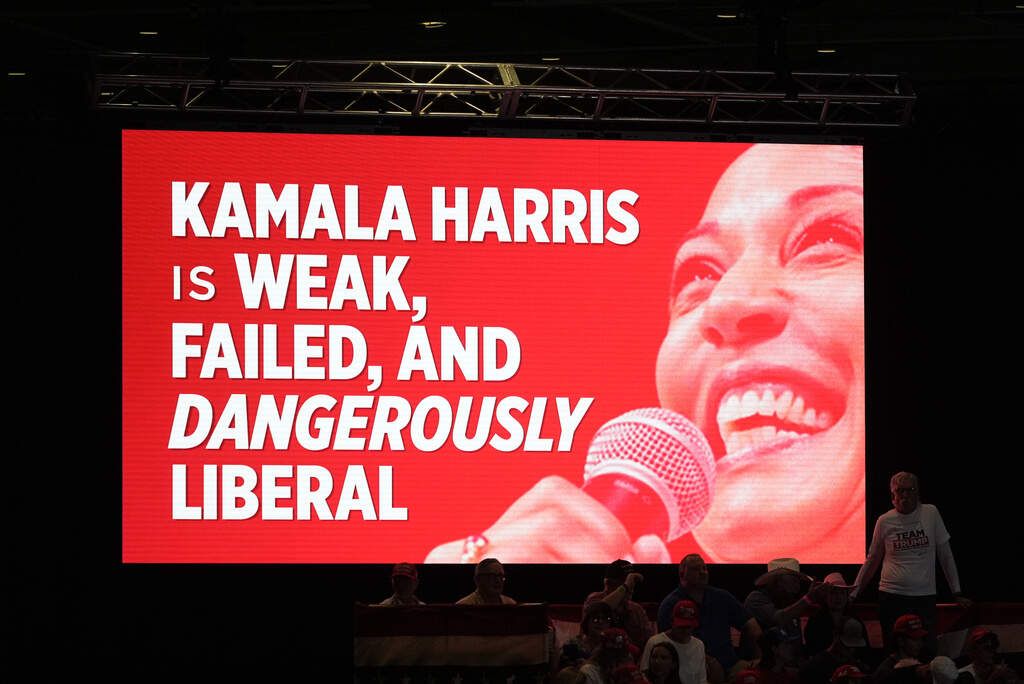
2024 is set to be a record-breaking year for political advertising, with some $10.2 billion spent across the U.S.
Most of those dollars are aimed at seven swing states.
Today, On Point: What voters in those states see on their TVs and online — and what that says about the state of political messaging.
Guest
Erika Franklin Fowler, Professor of government at Wesleyan University where she directs the Wesleyan Media Project, which tracks and analyzes political advertising in real time and local television news across the country. Co-author of the book Political Advertising in the United States.
Transcript
Part I
MEGHNA CHAKRABARTI: A little later in the show, we're going to go to Georgia to hear from a member of the state's election board. A judge there recently found last minute elections rules changes sought by the board to be unconstitutional. That's a little bit later in the show. But for the first part of the program today. This year is breaking records for money spent on political advertising and On Point swing state listeners are living it.
(ON POINT LISTENER MONTAGE)
BROOKE: So I live in Milwaukee, Wisconsin and we are just inundated with ads 24 7. They are impossible to avoid.
JOSEPH: Seems that this year the ads are very relentless about the presidential election.
JULIA: It's interesting because it always seems to be balanced. If you get one for Harris, you get another one for Trump. Another one for Harris, another one for Trump
KATHY: I'm overwhelmed with them. I think they have no influence on me. I've been a never Trumper since he first came on the political scene, and I think his ads are full of lies and vicious. And, you know, quite honestly, I'm not sure the Democrats do a whole lot better with that.
JULIA: I don't pay much attention to them because you can tell by the editing that most of them are quoting things completely out of context.
GRAY: And I just wish that there was a way that once you early vote, you could turn off all the ads, but I guess that's not gonna happen.
MOLLY: I feel like there's no real low that they won't stoop to in order to get a vote. I will not be sad when it gets to November 5th. Seeing the political ads stop would be a blessing.
CHAKRABARTI: It's estimated that more than $10 billion will be spent this year on political advertising, and most of that money is being spent in just seven swing states. Pennsylvania, Michigan, Wisconsin, Georgia, North Carolina, Arizona, and Nevada. And that's where the On Point listeners you just heard, that's where they live.
There's Brooke in Milwaukee, Wisconsin. Joseph in Georgia, Julia in Pittsboro, North Carolina. Kathy in Savannah, Georgia, Gray in Charlotte, North Carolina, and Molly in Camp Hill, Pennsylvania. So what does the record spending and microtargeting say about the influence of money in American politics now?
Erika Franklin Fowler joins us. She's a professor of government at Wesleyan University and also co-directs the Wesleyan Media Project, which tracks and analyzes political advertising in real time. She's also author of Political Advertising in the United States. Professor Fowler, welcome to On Point.
ERIKA FRANKLIN FOWLER: Thanks so much for having me.
CHAKRABARTI: First and foremost, regarding this vast sum of money that's being spent on ads this election cycle, is it meaningfully different than previous election cycles, or is it just that we're inexorably climbing towards ever higher and higher spend values?
FOWLER: I do think it's mostly the latter.
Every presidential cycle that is competitive, you will see an inundation of both spent spending and advertising. And it's still the case that television in particular is a dominant medium, but the campaigns are spending all over the place. They're essentially trying to reach any possible undecided voter in any way possible on any screen available to them in each of those, especially battleground states, but not exclusively.
CHAKRABARTI: Have we seen the spending be as concentrated in the battleground states this time around as it was before, because I don't know, maybe I've just willfully forgotten the amount of money that's being spent in American politics historically, but knowing that so much money is just being spent in seven states feels a little different.
Or again, is it not?
FOWLER: It's definitely the case that when everyone knows the race is competitive, you're going to spend your money in the places that you think will have maximal impact. And because of our electoral college, those seven states are deemed to be the place where the battleground is.
It does differ in some, we have seen campaigns in the not-so-distant future that have taken different tactics. Barack Obama, for example, had a national strategy, one of the years that he ran for office. But I think at least in the past several years, it definitely has been concentrated in the battlegrounds, because the race is just simply that close.
CHAKRABARTI: Okay. So let's listen to some of what the swing state voters are here hearing and seeing. And actually, before we do that, Professor Fowler, one of the reasons why I wanted to have this discussion with you today is as in other aspects of the campaign, it feels like there are almost two different realities going on here, not just in terms of what Trump and Harris are presenting to voters, but the fact that voters in those seven states are really experiencing the sharp and powerful end of all the campaign's efforts. And every other American seems to, it's quiet as usual or as usual on television.
It's so dramatically different.
FOWLER: I think that's right. And it's hard for someone who is living, I live in Connecticut, or in Massachusetts or California. Folks there are like likely not understanding the extent to which the citizens of battleground states are being completely inundated on every possible screen. Those of us who have paid attention to politics will know that there's a campaign going, because we hear it in other places. We might get some national ad buys in the news that we watch, and we're obviously paying attention to the news. But if you are not one of those people and you're not living in a battleground state, you are living in a completely different universe than the residents of the battleground states.
CHAKRABARTI: Yeah. And I think what's important to understand and what we'll talk about through the remainder of our conversation is these are the ads that the campaigns are using to sell themselves to these battleground state voters. The rest of us might hear excerpts on TV, yhe news or in our social media feeds, but these are the shaped messages that both campaigns want swing state voters to hear.
So let's hear a couple of them. So this first one is in support of the Trump campaign. It's from a super PAC called MAGA Inc, and it attacks Vice President Kamala Harris's history as a prosecutor.
Before she was the most liberal U.S. Senator, Kamala Harris was the liberal San Francisco prosecutor, the most progressive in all of California.
She let an MS-13 gang member go, who then murdered a father and his two sons. She agreed to release another felon, who then committed murder. And Kamala even protected illegal alien drug dealers, so they could escape deportation. Kamala Harris, a dangerous San Francisco liberal.
CHAKRABARTI: Again, that's from a pro Trump super PAC called MAGA, Inc.
Here's one in support of the Harris campaign. This is, in fact, from her campaign, and it uses Donald Trump's former top officials. And their comments about him as too risky to be trusted in office again. It's running in seven battleground states. And in the ad, you're going to hear the voices of Vice President Mike Pence, former defense secretary Mark Esper, former national security advisor, John Bolton, and former chairman of the joint chiefs, general Mark Milley.
NARRATOR: In 2016, Donald Trump said he would choose only the best people to work in his White House. Now those people have a warning for America. Trump is not fit to be president again. Here's his vice president.
PENCE: Anyone who puts themselves over the Constitution should never be president of the United States.
I cannot in good conscience endorse Donald Trump this year.
NARRATOR: His defense secretary.
INTERVIEWER: Do you think Trump can be trusted with the nation's secrets ever again?
ESPER: No, I mean it's just irresponsible action that places our service members at risk, places our nation's security at risk.
CHAKRABARTI: So that's an ad from the Harris campaign, quoting, or actually a showing video of former Trump administration members saying that he is too dangerous to return to office.
Professor Fowler, you heard listeners earlier, On Point listeners from battleground states, and one of them in particular said, I'm sick of these ads, and they don't have any impact on me. In any way, what do we know about the efficacy overall of campaign ads, especially in this last stretch of an election cycle?
FOWLER: Yeah, so two things I think are important. First, television, people tend to think that television advertising, overall, if they're talking about all the persuasion that's out there, is more effective then political science was. Suggest that it is the best evidence that we have, suggested that presidential ads in particular, it would be a different story if we're talking about advertising down ballot, but in presidential ads, presidential races, the advertising matters very little.
It really matters just at the margin, small percentages. That doesn't mean that the margin doesn't matter. And obviously in this election, the margin may be the difference between someone getting into the White House and not. And so that's the reason why you see so much advertising, is because the campaigns are fighting for every fractional percentage that they can get anywhere they can get it.
It's also true that citizens, people who pay attention to politics and/or who are already partisans are not necessarily the audience for most of this advertising, because those people already have made up their mind, like the caller suggested, right? They know what they think, and they're not going to be persuaded.
Especially about candidates who have been around for a long time, like Donald Trump, right? There's very few people, I think, in our society who don't already have an opinion of the former president. So the advertising in some ways, to those particular audiences is going to seem like it is completely ridiculous, because they wouldn't think that the advertising would affect them at all.
And really, the ads that are airing on television are designed to persuade, and they're designed to go after anyone who might still be undecided. And even if that audience is relatively small in the battlegrounds at this moment, that's still an audience that is worth it to the campaigns to go after.
CHAKRABARTI: Can you tell me a little bit more about why so much of the spend is still on television? Because as you said, it may not be that effective. I was thinking that in the age of micro targeting social media and bombarding people's phones directly, that more of the, a larger fraction of the money would be spent on that, if you're especially going for those voters in that very slim margin.
FOWLER: Right. It is definitely the case. We're seeing a large amount of money going to digital and social media advertising this cycle, much more so than we've seen in the past. I think when the Harris campaign came out and said that they were going to spend $480 million on digital, to include streaming, that was an eye-popping number, but it's also true that television is still a way that you reach mass audiences and they also are more likely to reach older citizens, which are more likely to turn out.
So they're definitely a core audience that is important to both campaigns. And so one of the reasons why you still see so much money in the television space is both because they're trying to spend lots of money to reach large audiences, and they're also trying to reach particular demographics of voters who are more likely to turn out on Election Day.
CHAKRABARTI: Okay. We are talking this hour about the enormous sums of money, record breaking amounts of money being spent on political advertising in this presidential election. And by the way, of the seven swing states that are getting most of the ads, Pennsylvania, looking at you, there has been an estimated $280 million spent just in Pennsylvania alone on presidential political advertising, that's 21% of all aired presidential tv ad spend.
Part II
CHAKRABARTI: Here's a couple of more examples of what swing state voters are being inundated with. This is an ad from the Harris campaign, and it directly takes on former President Trump and the role that he played in the repealing of Roe vs. Wade.
(ADVERTISEMENT)
TRUMP: 54 years they were trying to get Roe v. Wade terminated, and I did it.
MONTAGE OF WOMEN: He did it.
It was pretty devastating.
He is bragging about the rights that he stole from American women. And Trump is promising to do more in Project 2025.
They are restricting birth control.
Tracking pregnant women.
Enforcing a nationwide abortion ban.
The government should get out of my business, stay out of my business.
That's not the government's business. In America, women make their own decisions.
CHAKRABARTI: That was an ad from the Harris campaign. Here's another one, and this one was just released in the final weeks of this presidential election season. It is from, directly from the Trump campaign, and it is attacking the transgender community.
And in the ad, you're going to hear comments that Vice President Harris made in a 2019 interview, where she says she supports transgender inmates having access to gender affirming care.
(ADVERTISEMENT)
Kamala supports taxpayer funded sex changes for prisoners.
Surgery.
For prisoners.
For prisoners. Every transgender inmate in the prison system would have access.
It's hard to believe, but it's true. Even the liberal media was shocked Kamala supports taxpayer funded sex changes for prisoners and illegal aliens.
Every transgender inmate would have access.
Kamala's for they/them. President Trump is for you. I'm Donald J. Trump and I approve this message.
CHAKRABARTI: That's from the Trump campaign.
And so Professor Fowler, what I'm wondering about is what are the rules around accuracy and context here? Because regarding that ad we heard from the Trump campaign just now, the New York Times soon after the ad was released, noted that under the Trump administration as well, the Bureau of Prisons did provide an array of gender affirming treatment, hormone therapy, things like that for a small group of inmates who requested it.
But of course, that's not going to appear anywhere in that Trump ad. Remind me, are there any rules around what can be said in political advertising?
FOWLER: I think the first thing to say is that advertising, because it is directly from the campaigns, is each campaign's opportunity to use their best messaging, part of the fact checking.
There is a lot of fact checking in elections, but it doesn't come directly with the same message. And the extent to which campaigns can air messages that are misleading. They are trying to get out their best message. To some extent, it depends on whether the television stations will air that advertising. And obviously in this case, that particular ad is airing all over the country.
It hasn't crossed lines as far as the broadcasters think, because they will have reviewed each of the ads.
CHAKRABARTI: So let me play a little bit of some frustration that On Point listeners have been sharing about their being subjected to all of these ads. This is Sarah from Atlanta, Georgia, and her lament is that even though there's a lot of locally important elections going on in Georgia as well, all she's seeing are presidential ads, and she finds the ads to be horrible and dispiriting, and one of the reasons why, Sarah told us, is that she sees in the ads, evidence of the public's lack of awareness about what presidents can really do.
SARAH: Our level of civic education is such that people believe that presidents have magic wands, and they can do all kinds of things that they absolutely cannot do. That's not how our system works, and yet, people believe that's how the system works, and people are willing to believe a lot of just completely bonkers things that these ads, it's amazing to me how anyone can believe a lot of the things that get said in these ads.
It's not great here.
CHAKRABARTI: That's Sarah in Atlanta. Professor Fowler, did you have a comment on that? I think that the caller's not wrong. Certainly, I think that there are limits to what presidents can do, generally. And then there are even more limits to what vice presidents can do. And so some of the rhetoric or discussion around Harris in particular about, why didn't you just go, find a bill and sign a bill, do demonstrate some lack of understanding of how the system works and what presidents have control over.
But it's still the case, I think, that the American citizenry looks to our presidential candidates and office holders to lead and to be in charge. And so even though the color is right, I think the ordinary American could be further educated about the constraints of our system. It's still, unfortunately, or fortunately, the case that officeholders are held accountable for the state of the affairs and in the American electorate.
If the economy is doing well, incumbents tend to do well, if the economy is doing poorly, incumbents tend to get punished, regardless of how much effect that they have on those sorts of things.
CHAKRABARTI: Since you mentioned the economy there are lots of ads going out about the financial state of not just the country, but individual Americans' pocketbooks.
So here is one, it is in support of the trump campaign. Excuse me, of the Trump campaign, and it uses clips of Vice President Harris speaking that have been selectively edited, let's say that, to make it sound like she's saying something different than intended. So you're going to hear in this clip, in the ad, she says, Quote, taxes are gonna have to go up twice, but according to CNN, the soundbite of Harris had been excerpted from an event in 2019 in which what Harris really said was, quote, estate taxes are going to have to go up for the richest Americans.
But here's how that got edited for this Trump ad.
(ADVERTISEMENT)
Kamala Harris is going to significantly raise taxes.
Taxes are going to have to go up. Kamala's plan will raise families' taxes by nearly 2, 600 a year. Under Kamala, prices have already soared. Now she'd make it worse, with even higher taxes. Taxes are going to have to go up.
President Trump will cut taxes again. No taxes on tips, overtime, or Social Security.
CHAKRABARTI: That's a pro Trump ad, and again, it was excerpting, selectively, something Vice President Harris said in 2019 before she was Vice President, but where she said estate taxes are going to have to go up for the richest Americans.
On the other side of the ballot, here is an ad from a pro Harris super PAC called Future Forward. And it begins with some fuzzy audio of Trump addressing a group of donors at Mar-a-Lago, where he says, I know 20 of you and you're rich as hell, he says, and we're going to give you tax cuts.
(ADVERTISEMENT)
What are you doing? You're rich as hell. We're going to give you tax cuts.
I'm not rich as hell. I'm the one that really needs the break. Not the people that are already rich and have the money. The 1% don't serve anybody but themselves. So for them to get a tax break? No, that's not cool. Kamala Harris is going to make billionaires pay their fair share.
And she's going to cut taxes for working people, like me. I'm Buddy, and I'm not rich as hell. And I'm voting for Kamala Harris.
CHAKRABARTI: Again, that's from a Harris Super PAC called Future Forward. Professor Fowler, in an era in which there are potentially hundreds of thousands of hours of video and audio of the candidates speaking, it almost seems like the selective use of that video and audio has become a high art in presidential campaign ads.
FOWLER: Yeah, I think it's always super effective for one campaign to take the other person's voice and to use that voice against you is a very effective tactic. It's not someone else telling you that Kamala Harris or Donald Trump said the following things. You're actually hearing them in their own voices say something that the concern, of course, is, as you said, when audio or video gets selectively edited so that it's not in full context.
Obviously, that's important, details that hopefully the news media help expose, because the campaign ads themselves are not going to do that.
CHAKRABARTI: I'm wondering what as the major themes coming out from the campaigns this time around and what that tells you.
FOWLER: Yeah, so I think a lot of, and they're underscored in a lot of the audio that you've shared already.
I think there's a lot of discussion of bread-and-butter issues about the economy and how citizens are feeling. There's a lot of discussion, the cycle of housing and affordable housing on both sides, which I haven't seen before. So definitely a lot of pocketbook issues. But then both campaigns have taken different tactics when you move beyond the economy, right?
So the Harris campaign is definitely focusing on abortion and women's rights in particular, because the Democrats definitely see that as maybe one of their strongest talking points. And we saw that not just this cycle, but also in the 2022 midterms, that the extent to which gender was in campaign ads.
It was definitely dominated by the Democrats and Republicans, haven't found a way to talk about those issues such that they are helpful to them. And so they're picking other issues with the exception of the transgender attacks. And I can talk more specifically about that if you want, but the other big focus that is led by Republicans, but then Democrats play defense on it, is the abortion or I'm sorry, the immigration discussion. And definitely, like what you hear from, it's a lot about border security. There are tons of sheriffs appearing in ads all over the place, to bolster either side being concerned about border security and things like that.
But definitely also there are some racial undertones to some of those messaging, especially on the Republican side, that do the work of othering people as illegal aliens, you heard that term explicitly, even in the transgender ad. So definitely tapping into fears and concerns about people who are not like you.
CHAKRABARTI: Now you said you could, you wanted or were able to say more specifically about those ads regarding or attacking the transgender community. I'd love to hear what you have to say.
FOWLER: Sure, yeah. So a couple of things I think are important to say. Certainly that topic is not top of mind for most Americans, so it's somewhat puzzling.
I think at first why the Trump campaign would spend so much money on attacking that particular community. But I think the ad that you hear is definitely again, it's doing a lot of work and tapping into a lot of fears and concerns. And definitely again, not dissimilar from the discussion about immigration, othering people that taps into fears and uncertainty. I think also not just about other people and how they might be changing our society, but also some uncertainty about Harris. As your callers mentioned, people know how they feel about Donald Trump. Harris is still, although she's introduced herself to voters.
She's included a lot of not just negative ads on television, but also positive ones talking about who she is and what her record is. That's still not quite the same thing as having a record and citizens know how they felt under to current President Biden and then former President Trump.
And so I think to some extent the Trump campaign is trying to chip away at Harris's argument about, I'm for you and he's for billionaires. And they're trying to come up with some other way of cutting into that line of thinking.
CHAKRABARTI: Right? So speaking of billionaires, the other thing that again this election cycle just highlights in ever sharper relief is how much money is coming from a small number of people, right?
Those super PACs that we're talking about, for example, for the Harris super PACs, I think the biggest one is Future Forward that we just heard their ad, $19 million coming from Michael Bloomberg, $56 million. Oh, sorry, for Future Forward USA Action, that's a separate Democratic non-profit.
On the Trump side, MAGA, Inc., we heard an ad for them, $125 million from Timothy Mellon, a railroad, Timothy Mellon, a railroad magnate. $100 million for the Preserve America PAC. That's Miriam Adelson's PAC. She's a widow and a businessman, Sheldon Adelson. And then Restoration PAC, there's almost $70 million being spent by one couple there.
Just your thoughts on that.
FOWLER: They're stunning numbers, right? And they're numbers that average citizens would have a hard time, I think, wrapping their head around, let alone how you have that much money to put spend on advertising. And so I think part of this is, it's been the case since the Supreme Court allowed unlimited money to flow into outside group.
Advertising that we have seen them take an increasing role in elections. And not surprisingly, outside groups when they do get involved are also involved in those top of, like the most competitive contests across the country. And in some races, it's not the case in the presidential contest, where you have two relatively well funded campaigns who have enough money to also be airing, they are the dominant voices on air. The advertising that comes from them. But in other races where you have, you sometimes will have outside groups out airing the candidates themselves. And so that means that a lot of the spending and the voices are coming from places other than the candidates, and that might be of a concern to citizens.
I know it's certainly transparency and elections is important.
CHAKRABARTI: Last question for you, Professor Fowler, there's an onslaught of negative ads, right? We talked about that at the beginning here, and their limited effectiveness. There's been some observation that the Harris campaign came out of the gates with a much more positive tenor to their advertising, but that has swung a little more negative now that we're in the last stages of the election.
But overall, when you hear their messages, they're trying to say something about, both campaigns are trying to say something about the way they see this country. And I'm thinking about some of the most famous presidential advertising ever, Morning in America, right? From the Reagan era.
I'm just wondering, what do you think that these campaigns are saying about the state of the nation that either candidate wishes to lead?
FOWLER: Yeah, I think that is where you do definitely see some difference, right? Between the two campaigns. In fairness, I don't know that this is, we need to be fair, but the Harris campaign had to go out with some positive advertising, because she was relatively unknown, right?
So she's had a microburst of a campaign. Normally, a candidate has the full, not quite a two-year cycle, but at least a good solid eight, nine months to introduce themselves to voters and to move into a general election phase, whereas Harris had basically the last few months.
So one of the reasons why she put out positive spots to start would be she needs to introduce herself biographically to the American public, even though she's vice president, lots of people still don't know a lot about her. And so that's definitely the reason why she did it. But it's also the case.
I think that when you watch her ads, there is more positive talk about our country and where we live and what the vision is for the future in comparison to the Trump campaign. And that's partly, like she, again, part of her motto is turning the page, right? We want to turn the page on the negativity that describes, where we are and where we live.
But two different visions. Very different visions, as you said.
This program aired on October 28, 2024.