Support WBUR
Former Trump staffers raise alarms about a second Trump term
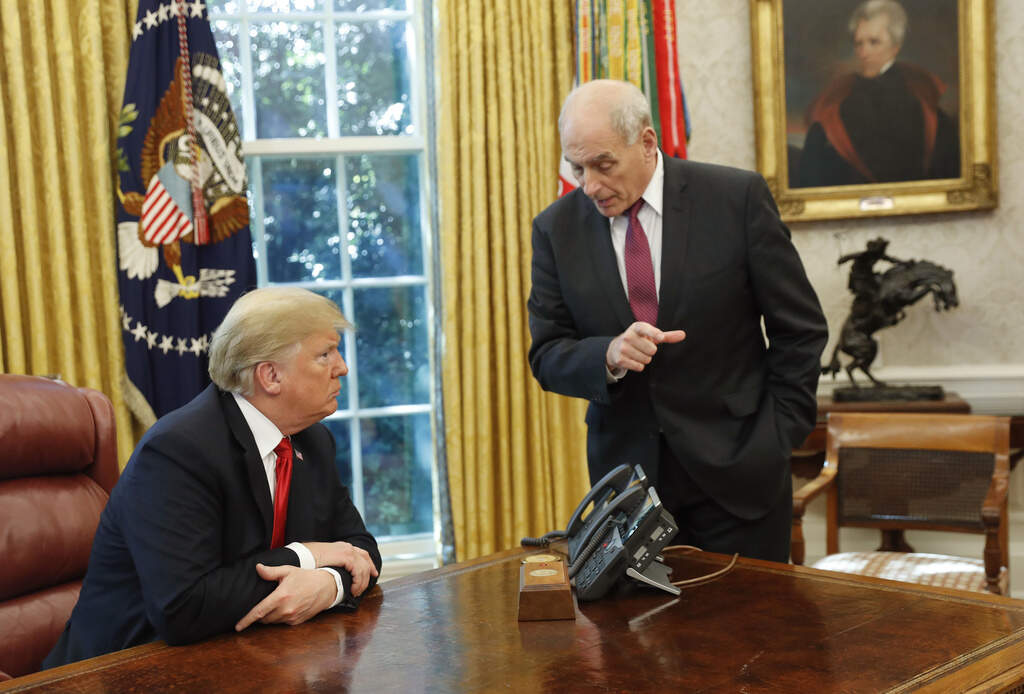
This month, more than a dozen former Trump staffers went on the record to say that everyone should heed the warning that Donald Trump is a fascist and would rule as a dictator.
Guests
Elizabeth Neumann, former deputy chief of staff of the Department of Homeland Security (DHS) and senior advisor to DHS secretaries, including Gen. John Kelly, during the Trump Administration.
Peter Jennison, former White House policy advisor and director for preparedness on the National Security Council during the Trump Administration.
Also Featured
Olivia Troye, former homeland security, counterterrorism and coronavirus advisor for Vice President Mike Pence.
Transcript
Part I
MEGHNA CHAKRABARTI: General John Kelly enlisted in the United States Marine Corps in 1970. Over as many decades as a Marine, he served in Europe, Iraq, and in leadership positions in the Pentagon. From 2017 to 2019, General Kelly was White House Chief of Staff for then President Donald Trump.
Kelly has spoken occasionally about how challenging it was to work with Trump, but he has never spoken so sharply or clearly as he recently did with the New York Times, when he said, in his opinion, Donald Trump meets the definition of a fascist.
JOHN KELLY: Looking at the definition of fascism, it's a far right, authoritarian, ultra nationalist political ideology and movement characterized by a dictatorial leader, centralized hypocrisy, militarism, forceable suppression of opposition, belief in a natural social hierarchy. So certainly, in my experience, those are the types of things that he thinks will work better in terms of running America. He's certainly an authoritarian. Admires people who are dictators. He has said that, so he thought certainly falls into the general definition of fascist, for sure.
CHAKRABARTI: Kelly's words were released by the New York Times just days after Bob Woodward revealed that former chairman of the Joint Chiefs of Staff, General Mark Milley, called Trump, quote, the most dangerous person ever. I had suspicions when I talked to you about his mental decline and so forth, Milley told Woodward, quote, "But now I realize he's a total fascist. He is the most dangerous person to this country." End quote.
Kelly and Milley's statements are only the beginning of an historically unprecedented series of warnings being issued to the American people. And they're not coming from television pundits or social media click baiters or Democratic operatives. The warnings are coming from people who worked directly with Donald Trump in his administration.
More than a dozen staffers recently signed an open letter in support of General Kelly's comments. The letter writes, quote, "In a second term, those who once tried to prevent Donald Trump from his worst impulses will no longer be there to rein him in. For the good of our country, our democracy, and our Constitution, we are asking you to listen closely and carefully to General Kelly's warning."
End quote. Today we are joined by two of the signatories of that letter, and we'll hear from them about what they saw up close during their time in the Trump administration. Elizabeth Neumann is a former Deputy Chief of Staff for the Department of Homeland Security. She also served as Senior Advisor to DHS Secretaries, including General John Kelly, during the Trump administration.
Elizabeth Neumann, welcome back to On Point.
ELIZABETH NEUMANN: Thanks for having me, Meghna.
CHAKRABARTI: Also with us today is Peter Jennison. He's a former White House Policy Advisor and Director for Preparedness on the National Security Council during the Trump administration. He has also served for over 30 years in the military and is a retired U.S. Army Aviation Lieutenant Colonel. Lieutenant Colonel Jennison, welcome to you.
PETER JENNISON: Thanks for having me on today, Meghna.
CHAKRABARTI: Okay, so first of all, let me just read to you both a little bit more from the letter you signed. You said, the letter says, quote, The revelations General Kelly brought forward are disturbing and shocking, but because we know Trump and have worked for and alongside him, we were sadly not surprised by what General Kelly had to say.
This is who Donald Trump is, end quote. Lieutenant Colonel Jennison, let me start with you. What, in your experience, made you put your name to that letter that this is who Donald Trump is?
JENNISON: That's a great question. First of all, I signed the letter because as a military officer, I'm also an attorney.
I'm defending another officer. I think we live in a society where what is truth has become dependent on which side of an issue you're on. And I think it's great that we have freedom to question what our leaders say and do, but I've learned after 30 plus years of military service that when one general speaks, you listen intently, such as General Kelly.
When two say something, it becomes unquestionable. When three say it, what is said is equivalent to gospel. And I think we should all be listening. I'm talking about General Kelly's shared opinion of the former president, by not only General Kelly, but former secretary of defense, Jim Mattis, and former chairman of the joint chiefs, Mark Milley.
These aren't politicians. They're public servants, and they've dedicated their entire lives to the service of the American people and to the Constitution, and what are they telling us? They're telling us, Jim Mattis said that he was the first president in his lifetime who didn't try to unite the American people, didn't even try to try, didn't even pretend to try.
He said that Mattis was very limited on his opinion of when the military, especially the National Guard, should be used in civilian situations, and that it should only be used when requested to do so by state governors, and that he firmly believed that militarizing a response to protests would destroy the rapport that we as military members have with the American people.
So as a military officer who is a policy director in the White House, I'm defending another officer. What did I see? What I saw was a president who put his personal agenda above the welfare of the American people, and a willingness to deploy the military against American citizens who disagree with that agenda.
I have a couple examples that I would be willing to talk about. In August of 2019, just seven months before the World Health Organization officially declared COVID-19 a global pandemic, I was the former president's representative for Crimson Contagion. Which was a nationwide exercise conducted by the Department of Health and Human Services that simulated a novel influenza pandemic and the acceleration phase that actually originated in Asia. Election security was prioritized over the findings, despite our strong recommendations that significant work needed to be done to strengthen our posture in the event of a pandemic, which occurred literally seven months later.
On another note, I personally witnessed direct pressure by the former president on cabinet level officials to pull aid from a major disaster area because of the former president's personal feelings towards the state governor.
CHAKRABARTI: This is California?
JENNISON: That's all the detail that I can provide on that.
CHAKRABARTI: Okay.
JENNISON: I would also say that despite the NSC's strong opposition, the former president's close advisers made the decision to hover National Guard medevac helicopters over protesters in downtown Washington D.C. Following the murder of George Floyd. As a career military aviator, in my opinion, this was extremely reckless.
It was highly inappropriate and arguably the illegal use of a medevac asset that's strictly supposed to be employed to save lives and alleviate human suffering. And as a result of the decision that was made at the highest level, soldiers were disciplined. I remember a time that after publicly misreading notes that our team on the NSC had provided the president regarding an impending major hurricane. Rather than correct his error, the former president continued to provide incorrect information to the public. And when this was later discovered, blame was placed on a senior executive staff member, resulting in their resignation.
Those are some of the personal things that I saw.
CHAKRABARTI: Elizabeth, I really appreciate your patience in listening with me to Lieutenant Colonel Jennison, and I'm going to come to you in just a second because I also want to hear in depth from you, Elizabeth. But if I may. Lieutenant Colonel, let me just follow up with one thing.
The examples that you just gave are quite striking. Some of them are known, some of them I hadn't heard before. But I think many people are hung up on this term authoritarian or fascist and could plausibly argue that the examples you're giving are simply examples of bad leadership and not necessarily someone who's a danger to the United States.
How would you respond to that?
JENNISON: I don't think we can have, we can afford to have bad or toxic leadership at the highest level of freedom in the Western world, period. We can't afford that. I'm not an expert on fascism, and I'm not sure I can give you the historian answer to whether Donald Trump is a fascist, but I am willing to give my thoughts if you want to know.
CHAKRABARTI: I do want to know, we just have a couple of minutes before the first break, but let me ask you this instead for now. Do you think that in your interactions during the Trump administration that you witnessed then President Trump making decisions in the best interests of the United States or in the best interests of himself?
JENNISON: I fear that the decisions that he made were self-serving. I fear that like the example I provided with Crimson Contagion, we were confronted with concrete evidence that we had significant work to do to be prepared for a pandemic, which, as we saw, had devastating effects on our country and our economy, and the president made a conscious decision to prioritize election security in 2020.
Then to prepare for a pandemic. So I just think ... that's a concrete example of putting his own agenda before the American people.
CHAKRABARTI: We have just one minute before the first break, Lieutenant Colonel, do you, have you seen anything in the intervening four years that would make you think that the Donald Trump you worked for in the Trump administration is a different man, an improved man or worse even than what you saw back then.
JENNISON: We certainly never saw the president selling shoes, watches, and Bibles, between 2016 and 2020. So that's a new tinge to the presidency and the office of the presidency. What I see is he's emboldened. His rhetoric is emboldened. He's not surrounded by people that say anything other than yes, when he becomes unhinged.
And I fear that without great men like Mattis, Milley, Kelly, reigning him in, he's just become worse.
Part II
CHAKRABARTI: Elizabeth, again, thank you for listening to Lieutenant Colonel Jennison along with me. I have the same question for you. Lots of people in the media talk around what Donald Trump says in public, in the inflammatory things, which a lot of that language is overtly authoritarian.
But the reason why I'm grateful that the two of you have joined us today is you can tell us as much as you can about what he actually did as president, even behind closed doors, if you can. So when you were at DHS, do you have an example or a story of something that gave you pause about Trump's leadership or his even belief in the American system of democracy?
NEUMANN: I would say the entire three years that I was serving gave me pause on multiple times a day, often. What we found in 2017 was a group of people, including Trump, but all of the people surrounding Trump who really didn't understand how government worked. And so initially, there was this thought that, oh, we just need to help them understand how the process works, what your role is, and actually what we found in the Spring, and this is when John Kelly was at the Department of Homeland Security, he would come back from meetings and almost befuddled that Trump didn't seem to understand that being the president didn't mean you get to do whatever you want.
He was actually frustrated that there were so many, what he perceived to be constraints, that he did in some ways had less power as president in his perception than he did as a business leader.
And so there was this learning curve for Trump to discover that actually, no, we have this constitutional system and their checks and balances. And yes, Congress has a say, and the courts have a say. And just because you want to do something, doesn't mean that you're allowed to do it. You have to be authorized by law.
And he just, he found that so frustrating, to the point where there were times where we were like, I don't know, he might quit. Like he just doesn't seem to enjoy this very much. But the parts of the job that he did love was getting out in front of the crowd, doing the campaign type events.
Throughout his presidency gave him that sense of adulation and stroking of the ego. And once they got him back out on the trail, really the summer of 2017, you saw him turn around a bit, maybe didn't, wasn't as frustrated in the role. The problems came when he got tired of the people in the room, the adults in the room, if you will, saying, no sir you don't have the authority to do that, or that would be unconstitutional.
And always when the cabinet secretaries would be delivering that message, they would always offer an alternative. It sounds like you want to achieve this, here's the right way to do it. And that worked for a while, but by 2018, there was a decided frustration. That's when he fires Tillerson.
He at this point had moved Kelly from the Department of Homeland Security to be his chief of staff, but he was starting to get frustrated with Kelly. He would eventually push Kelly out in 2019. A number of Homeland Security officials start getting fired in 2019, because in Trump's perception, they just kept saying no too frequently to what he wanted to do.
CHAKRABARTI: Yeah, I'm so sorry that I seemingly interrupted you there, but I think both you and Lieutenant Colonel Jennison are pointing out something very critical in how U.S. government is supposed to work, right? Because, we don't have a monarchy, when a king, when the president says something there are processes in place that both of you have described to ensure the legality of the president's request or the policy, to be sure that everyone's informed to run through different perspectives, et cetera.
Both of you could describe the reasons why those processes exist, but I'm hearing from you that frequently, as president, Trump not only disrespected those processes, but wanted to just completely circumvent them. Let me ask you specifically, Elizabeth, when you were at DHS, I understand that for part of that time, you had a team that was responsible for implementing the so-called Muslim travel ban, right? And you were working on this at the time that the Supreme Court was considering the constitutionality of that question, which ultimately there was a form of it that was found constitutional. What happened after that?
NEUMANN: Yeah, I oversaw a team that that had the responsibility for doing the data poll and the data analysis that would determine which countries were not meeting the standard and therefore could receive some sort of penalty, like having their citizens not be allowed to travel into the United States.
And in order to do that work, you're collecting data from 180 countries across the world. We had to work with the lawyers, because the lawyers were quite convinced that we would be back in front of the Supreme Court at some point. So we needed to make sure the process was rigorous and defensible and based on logic, not based on a religious test the way the original the original version of the ban was signed in 2017.
We were doing all this work, and the pressure was, just come up with a list of countries. He just wants to ban more countries, and you're like, oh, I understand. He wants us to move faster, but we're moving as fast as we can. So there was about an eight- or nine-month period where I, weekly, was getting asked, where are we on this?
He's asking again, can you just give me a list of countries? And I don't think the people that were asking me that were not necessarily telling me, you need to break the law and just come up with a list. But certainly, that's in Trump's head, and Stephen Miller, who was the architect behind this they had in their head the list of countries that they wanted.
In fact, there was an initial list of countries that was provided and some of the names on that list, all of those names would be classified, but some of the names were countries that just economically would have been impossible for anybody to actually try to ban, so they were like, ah, this is going to be challenging.
I think we need to relook at our methodology, and they were like, we'll just tell you the countries that need to be on the list. We're like no, you can't. You can't do it that way. We have to be driven by the data. But it really led you to realize no, they know who they want to ban.
They don't care about this methodology. They just want, certain countries to not be allowed to enter in the United States.
CHAKRABARTI: So you mentioned Stephen Miller and another point that former members of the Trump administration, including you and Lieutenant Colonel Jennison have been making. Is that folks like you, if there is another Trump administration, won't be part of that administration, right? Stephen Miller most certainly will, if Donald Trump is returned to the White House. Can you tell me a little bit about some of your interactions with him or the kinds of things, the pressure he put on DHS. Because obviously immigration is his most passionate area, policy area.
NEUMANN: Yeah. And Stephen is a great almost metaphor for I think how the second term will run. Donald Trump actually doesn't care too much about policy. He goes out on the stump and has some riffs. And every once in a while, if something becomes really associated with his brand, like the wall did, he does care about that.
And so he will follow up and ask questions about things that he perceives to be his brand, or if he's getting bad press on a topic, he'll dig in. But most, for the most part he actually doesn't care, right? It's the people around him that are the ideologues that have a very specific vision they want to implement.
And for the most part, Trump will just let them do what they want to do unless some outside voice comes to him and complains, and at which point he might tell them, you've gone too far. You need to back off. But that's one of the things that I feel like is missing in the conversations around policy.
When people are like, Oh, I like the Trump policies. You're like, there is no such thing as Trump policy. It's the people around him. And do you know who those people are? And in the case of Stephen Miller, he's been quite public about the plans on day one to mass deport people, to round up using National Guard, possibly using the Insurrection Act to federalize the National Guard and round up people in American cities.
And I will tell you, having observed, I was not a part of the decision-making process, but I observed and privately protested the child separation decision. One of the reasons we, at the time, it was Secretary Nielsen who was actually pushing back against the idea of doing child separation.
The argument was we don't have the infrastructure or the operational processes in place to do this well. And sure enough, even when this order got signed, it ended up the Department of Justice signed something and made it happen, de facto. There weren't processes in place.
Children are still missing from their parents because it was executed poorly. And I can't, as I take that microcosm of an example. It was a horrific example that relatively small numbers of people were impacted, compared to the idea of trying to deport 20 million people from this country, the infrastructure that would be needed, the camps that would be needed.
The logistics that would be needed, this will be a full-scale military option. It will far exceed anything FEMA has the capacity to do and is that really what we want as Americans? Is military camps set up across the country to deport people who I don't even know that will have due process? Will probably end up deporting people that are legal citizens of the United States because of the color of their skin.
It's really horrific to think about the execution of some of these policies. They will not follow any sort of due diligence and due process. And Elizabeth, one more thing about the specificity with which Stephen Miller in the Trump administration was actually trying to dictate not just policy, but actions, right?
You said that he was on, sometimes he was on calls with ICE officials. No one even would know that he was on the call, but then he would speak up and actually say, you need to conduct raids in this certain place and that certain place.
NEUMANN: Yeah, so there's this longstanding principle, and the Lieutenant Colonel will know this, when you're White House staff, you do not dictate agency operations, because that is a violation of the constitutional structure.
It's President to Cabinet Secretary and Cabinet Secretary down, so operational decisions have to come from the Cabinet Secretary. If a White House staff person has an idea, they have to follow a process and they can give it to the cabinet secretary. And it's up to them to make the decision if they want to issue operational orders.
Stephen at the beginning didn't know that, right? Like he just didn't know how the system worked. And he was told no, you got to stay in this lane. And he would call me or he would call Chief of Staff Kirstjen Nielsen at the time and would call the secretary to tell us what he thought we needed to be doing.
And we kept him in that lane for a while. But as things devolved, by the time you get to 2019, and a number of cabinet secretaries have been fired and General Counsel John Mitnick was fired. The wheels were off at that point. And yeah, he would call in and tell ICE where we needed to conduct raids.
He would basically come up with what he perceived to be the campaign plan for various aspects of immigration policy. And I think in a second term, he won't even have to, it won't even be like a violation of the campaign command and control he'll just be in charge, right? He will probably be the Secretary of Homeland Security or some role like that, and he'll just be able to give those orders directly.
CHAKRABARTI: Lieutenant Colonel Jennison, I'm wondering if you wanted to add to that or comment further on what this tells you about the potential dangers of another Trump administration.
JENNISON: Yeah, sure. Just a couple of thoughts. One of the first acts of every president is to set the priorities and the foundations of national security policy.
And I think she's right that he can set the policy as he likes. And if he's surrounded by yes men who are influential, the results could be devastating. The other thing I wanted to say was, I personally witnessed on more than one occasion, anyone with creative thought in the White House who didn't support the rhetoric, somebody would show up at your desk with a box.
And say your services are no longer necessary. Probably the most prominent case of this was then Lieutenant Colonel Alexander Vindman, Ukrainian American who spoke out about a call to President Vladimir Zelenskyy, was escorted off the complex because of his role and what he thought was right. So I guess what I'm trying to say in a nutshell is I fear that without the bumpers of people that have the guts to say no, Elizabeth is referring to, he is completely all powerful and that's pretty scary.
CHAKRABARTI: I want to turn back to some of the things that Generals Kelly and Milley have said.
This once again is from the New York Times, where Kelly spoke with them. And he said that Trump, quote, certainly prefers the dictator approach to government.
KELLY: I think he'd love to be just like he was in business, he could tell people to do things and they would do it. And not really bother too much about whether what the legalities were and whatnot.
CHAKRABARTI: So that's General John Kelly speaking to the New York Times. And here's General Mark Milley and something he said at his farewell ceremony.
MILLEY: We don't take an oath to a country. We don't take an oath to a tribe. We don't take an oath to a religion. We don't take an oath to a king or a queen or to a tyrant.
Or a dictator, and we don't take an oath to a wannabe dictator. We don't take an oath to an individual. We take an oath to the Constitution, and we take an oath to the idea that it's America, and we're willing to die to protect it.
CHAKRABARTI: Lieutenant Colonel Jennison, we have 30 seconds before our next break.
When you hear General Milley say that with that passion, what does that engender in you?
JENNISON: Said before, that's gospel. That is the oath of every military member in our country, that they make when they assume an office. And what's ironic about that is that was completely dismissed.
I think Trump called him a loser. And then even more disturbing, I think he went on social, his Truth Social platform and literally suggested that Milley should be executed for treason for those remarks. Are those the words of a great leader? I heartily disagree.
Part III
CHAKRABARTI: Lieutenant Colonel and Elizabeth, I wonder if you could listen along with me a little bit more because we reached out to many other folks who signed that letter and formally served in the Trump administration.
Olivia Troye is one of them. She's former Homeland Security, counterterrorism and COVID advisor for Vice President Mike Pence during the Trump administration. And she told us that in her experience, senior White House staff had to constantly worry about the types of things that former President Trump would say in their meetings.
OLIVIA TROYE: People in the meeting, would obviously, it's the president of the United States, they would be respectful, and they would say Mr. President, that is not an appropriate use of the military. Or when he was wanting to invoke the Insurrection Act, which he has said he will do. Going forward, again, to the strategizing behind the scenes, a lot of the time, we would look across the room at each other in shock about, is this really happening right now?
Are we really hearing this? And then other times, we would walk out of these meetings, there would be smaller conversations and private, of strategizing. How do we navigate this? What are we going to do? Because he is the commander in chief.
CHAKRABARTI: So the question of what was happening in private versus public also applied, Olivia says, to President Trump himself because he would offer differing opinions in public versus in private.
TROYE: Especially on issues like Venezuela, I worked on national security issues where we were publicly saying, liberate Venezuela, Libertad, and then in a meeting, he would praise Maduro, and it was just like, what are we doing here? This is the hypocrisy, first of all, and also the recklessness in terms of our international relations and forum policy, I think, at times, was very concerning to a lot of us.
CHAKRABARTI: Also concerning, Olivia says, is Donald Trump's talk about the United States military. Now, Elizabeth Neumann and Lieutenant Colonel Peter Jennison have both mentioned their concerns about when Trump says he wants to use the military within the United States and against Americans. General John Kelly also mentioned something about this to the New York Times that he was deeply troubled by Trump's recent comments about using the military against Trump's perceived domestic opponents.
KELLY: This issue of using the military to go after American citizens is one of those things I think is a very bad thing, even to say it for political purposes to get elected. I think it's a very bad thing. Let alone actually doing it.
This goes back to my, when I was in the White House, for that matter, DHS, I was, originally the conversation would be, Mr. President, that's outside your authority, or, that's a routine you really don't want to do that inside the United States. But now that he's talking about it as, I'm going to do it, is, again, it's disturbing.
CHAKRABARTI: That's General John Kelly speaking to the New York Times. Olivia Troye, when she spoke with us, she says when she hears Trump talk about using the military against quote, the enemy from within, she believes what he says.
TROYE: This isn't hyperbole. And so when Donald Trump says things like this, he will absolutely do it, because we saw him try to do these things the first time around.
We were just, there were people in the room who kept it from happening. And like I said, those people will be gone.
CHAKRABARTI: Finally, we asked Olivia Troye about this word, about being a fascist and whether Donald Trump is a fascist. And here's what she said.
TROYE: Yes, I do think he has those tendencies, and I think we've seen it in him.
And I think what fascism is to me, is just watching someone who is going to undermine our Democratic institutions, which Donald Trump has done. He's undermining the rule of law, which is what he's done. He plans to weaponize the Department of Justice. I would say that we saw tendencies of that already during his first presidency.
I think all of these things, the military. Using the military against the people. It all adds up.
CHAKRABARTI: That's Olivia Troye. She was formerly advisor to Vice President Mike Pence during the Trump administration, and also an advisor on Homeland Security, counter terrorism, and COVID. Elizabeth Neumann, this word fascist or fascism or dictator, a lot of people getting hung up on it and some people just close their ears to it, right?
Because it's an inflammatory word, but I think a lot of people are making the argument that it's the appropriate one right now. But for people who close their ears to those, that specific language or say, it's just hysterics, it's just Trump derangement syndrome. So let's put those words aside, when you say specifically that you believe another Trump administration would present a clear and present danger to the United States.
You give me your definition of what that danger is. What would you say to people to make them listen?
NEUMANN: He is cruel. I watched him, and you actually played a clip of this at the beginning of the show. I watched him take great joy in coming up with how we could possibly be more cruel to migrants that were trying to come into the country and crossing, not at ports of entry.
So illegally entering, it wasn't enough to just arrest them or even to just separate children from families. No, he wanted to put spikes on top of the wall so that anybody trying to climb ever would be impaled. He wanted border patrol to be able to have the authority to shoot somebody approaching the wall.
By the way, that would be shooting somebody on a foreign country's territory. That's an act of war. He wanted drones to be able to not just surveil the border, which we do have drones that do that, to look for people crossing, but he wanted drones to be able to shoot or to drop bombs on migrants.
CHAKRABARTI: Do you mind if I just jump in here for a second, and forgive me for interrupting, but as you're describing those things specifically, I'm reminded of all the things that I've heard Trump's most passionate supporters, voters, say that's exactly what they want. They don't mind.
So if that's your definition of a dictator, they say, Let me vote for a dictator.
NEUMANN: And this is where I would push back. I absolutely want our border to be secure. And I am not happy with the state of things. But you do not have to kill people in violation of both morality, as well as international law, in order to have a secure border.
The point I'm trying to make is that there was joy in coming up with those things. It was not a, Oh, gosh, we don't have any choice. This is a very difficult decision. I think we're going to have to use up our use of force. This was Oh, how can we come up with more sadistic ways to hurt people? And here's the thing.
American people, that sadistic mindset will turn and eventually affect you. This is not limited to just the immigrants. Eventually, if you are not loyal to him, and this is his mindset, he is a person that is all about loyalty. If you disagree with him, you're out. This is why the entire Republican Party will say privately to a reporter, I think he's crazy. I don't like his policies, but they will never say that in public. Because they know that he will viciously turn on them and make their lives miserable.
A second Trump term, there is no constraint anymore. There's not another election that he has to worry about. All the gloves are off and he will when he says, as Olivia points out, when he says he's going to go after the enemy from within.
And he's not just talking about Antifa, like some people are trying to say, Oh, he's just talking about the far left. We're gonna clean up our streets. No, he's talking about political enemies. He's talking about anybody that publicly disagrees. I think we're likely to see people practicing their First Amendment rights in protest.
Unlawfully rounded up and detained, and I think we're in for a very dark period because the character of the man is such that he wants absolute power, and he has a willingness to use the power of the state against the people. And we saw a little bit of this during his first term. And we saw more of it in the lead up and how January 6th occurred, but in a second term, those constraints are off.
There's no more adults in the room to tell him no. And we are likely to see much, I'm not concerned that we're going to lose the country, but I think it is a very dark four years if he is president.
CHAKRABARTI: So let me ask Lieutenant Colonel, let me ask you this, because I very much hear loud and clear what Elizabeth is saying about Donald Trump saying the gloves are going to be off.
If he goes back to the White House, because he has been saying that clearly on the campaign trail, but within what Elizabeth said, I'm also reminded that during the Trump administration there were strong institutions of American democracy that held fast, right? Even on January 6th, members of the Capitol Police, Vice President Mike Pence, the Congress itself, when it finally came back into session, completing its constitutional duty regarding certifying electoral college votes, that happened.
We've seen courts of law issue rulings in line with what the law says a policy should be. So to Elizabeth's point, she doesn't hear us losing America, but perhaps we have a weakened one under another Trump administration. But regarding those Democratic institutions, of course, the military is a huge and important one.
We have been talking about Donald Trump wanting to use the U.S. military within this country and on the American people. Can you tell me what you think would happen if he actually Issued that order.
JENNISON: Absolute disaster. Absolute disaster. I have long believed that the military is one of the remaining professions that has been untarnished wholly in the political processes, and the evolution of the direction that our country is going, for very specific reasons.
I was on a plane once to a major disaster area with a very respected senior official who asked me the question. Why do they respect you? Why don't they respect me? And I said sir, it's because I don't have an opinion. We are a tool that is to be used in a very limited capacity. And that capacity stops short at serving the American people as a whole.
Not serving an element of the American people. It's to respond to a natural or man-made disaster. And we stop at that, at that line and we could never pass that line. And if we do, it would be a disaster for this country. I think that one of the examples that I gave about the use of the D.C. guard and hovering the medevac helicopters over protesters in D.C., was a foreshadow to that.
That is, not only did that put the lives of those aviators, and I'm a career aviator, in jeopardy. You put the lives of Americans that were protesting in jeopardy. That's completely reckless. In short, you're looking at the ruination of America, the bedrock, one of the bedrock foundations of our democracy is the use of the military for national security, to protect and defend the people of the United States as a whole, not as a group or a party.
CHAKRABARTI: But the ruination would come only if that order was complied with, right? And maybe Michael Flynn would comply with an order like that. But do you think, can you think of any other person at a high level in the military that would say yes, sir, to orders of using soldiers and Marines against the American people?
JENNISON: So I have to believe, like Elizabeth said, in multiple layers of process that are in place as a safeguard and a stopgap against that kind of authoritarian decision by a sitting president. I have to believe that individuals would come forward and step up with the courage or the strength to not act on an unlawful order, because, as Milley said, we do swear an oath to the Constitution of the United States, but also to the lawful orders of the president of the United States.
I would hope that there are multiple layers in place where people would have the courage to say no to an unlawful order. And, in my opinion, using the military against our own people. As General Milley said, is an absolute bastardization of the intent of the military since the founding of our nation.
CHAKRABARTI: Elizabeth, you get the last 30 seconds today. Go ahead.
NEUMANN: I'll say what my colleagues have said here. I agree with John Kelly's warning that he has fascistic tendencies. And I think for the American people, it's really hard to imagine that happening here. Because our lives are pretty good and it's hard to imagine the stories we hear about 1930s Germany or Italy, that that could ever happen here.
And I want to encourage all of us to recognize that what we have, this gift of freedom is so precious. But we have to constantly be vigilant and protecting against losing that. And we might be on the precipice of losing it if we reelect him.
This program aired on October 31, 2024.