Support WBUR
On the ground in swing states as the votes are tallied
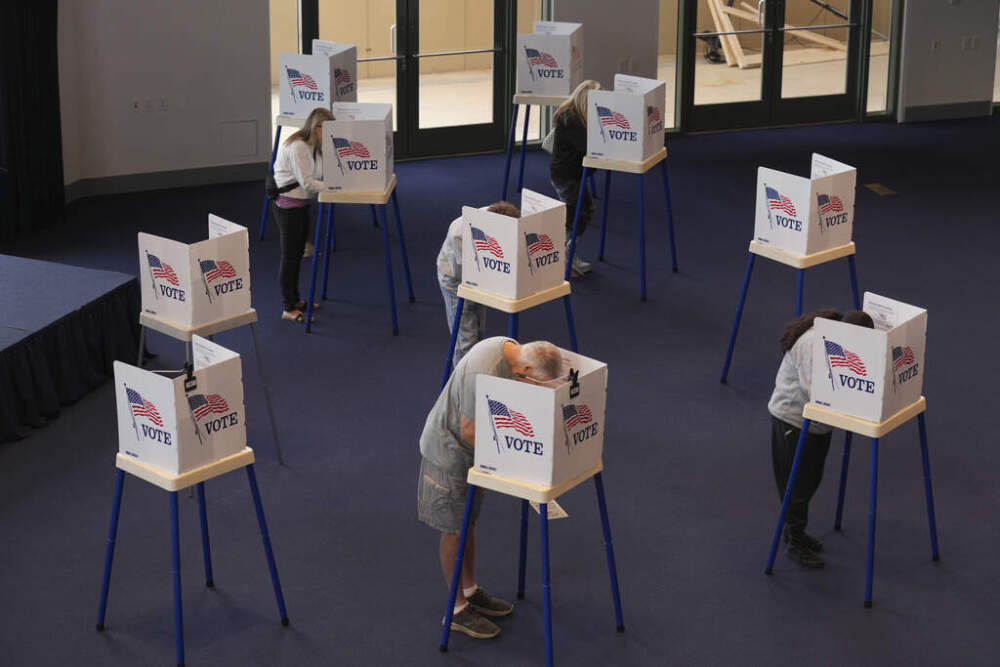
Just seven swing states decided the fate of the 2024 U.S. Presidential Election.
Today, On Point: A roundtable conversation with journalists on the ground, right after Election Day.
Guests
Rose Scott, host of “Closer Look with Rose Scott” on WABE, an NPR station in Atlanta.
Stephen Henderson, host of "Created Equal" on WDET, an NPR station in Detroit.
Joe Schoenmann, host of “State of Nevada” on KNPR, an NPR station in Las Vegas.
Carmen Russell-Sluchansky, politics reporter at WHYY, an NPR station in Philadelphia.
Chuck Quirmbach, news reporter at WUWM, an NPR station in Milwaukee, Wisconsin.
Camryn Sanchez, field correspondent covering state politics at KJZZ, an NPR station in Tempe, Arizona.
Transcript
Part I
DONALD TRUMP: This was, I believe, the greatest political movement of all time. There's never been anything like this in this country and maybe beyond. And now it's going to reach a new level of importance because we're going to help our country heal.
MEGHNA CHAKRABARTI: At 2:30 a.m. Eastern this morning, former President Donald Trump addressed a crowd of his supporters at the West Palm Beach Convention Center, declaring his victory in the 2024 U.S. presidential election.
A few hours later, the Associated Press made its call and confirmed that he is America's president elect.
TRUMP: We have a country that needs help, and it needs help very badly. We're going to fix our borders, we're going to fix everything about our country, and we made history for a reason tonight, and the reason is going to be just that.
CHAKRABARTI: Trump's victory is unique in American history, as the lead paragraph to an AP story today stated, quote, Donald Trump was elected the 47th president of the United States on Wednesday, an extraordinary comeback for a former president who refused to accept defeat four years ago, sparked a violent insurrection at the U.S. Capitol and was convicted of felony charges and survived two assassination attempts, end quote.
TRUMP: Success is going to bring us together, and we are going to start by all putting America first. We have to put our country first for at least a period of time. We have to fix it, because together we can truly make America great again for all Americans. So I want to just tell you what a great honor this is.
I want to thank you. I will not let you down. America's future will be bigger, better, bolder, richer, safer, and stronger than it has ever been before. God bless you and God bless America. Thank you very much.
CHAKRABARTI: Trump's victory is due to a strong showing in the seven key swing states that all along were going to determine the outcome of this presidential election.
Today, we'll speak with local journalists from those states to understand what happened there on Election Day and what they're seeing on the ground now. Rose Scott joins us. She's the host of Closer Look with Rose Scott on WABE, NPR station in Atlanta, Georgia. Rose, it's great to have you back.
ROSE SCOTT: Thank you, Meghna, and I have a little bit of a voice left after hosting our own election special last night.
CHAKRABARTI: I was just gonna ask, how much sleep did you get?
SCOTT: A little bit.
CHAKRABARTI: A little bit. Okay, so I'll give you ten seconds of rest while I introduce Stephen Henderson. He's host of Created Equal on WDET, the NPR station in Detroit, and that's where he joins us from. Stephen, it's great to have you back on the show.
STEPHEN HENDERSON: Great to be back, Meghna.
CHAKRABARTI: And also with us today is Joe Schoenmann. He is host of State of Nevada on KNPR, NPR station in Las Vegas, Nevada. Joe, welcome to On Point.
JOE SCHOENMANN: Hey, it's great to be here, Meghna.
CHAKRABARTI: All right, so let's get started, but before we do, I just want to add a tiny disclaimer. We're actually all having this conversation right now in our first broadcast, which is at 10 a.m. Eastern time. So there are some races that we're talking about which might further develop over the rest of the day, but we'll do our best to stay on top of things. So first of all, let me start with a little bit of sound from Georgia. Rose, unfortunately, I'm not going to let your voice rest too much. Because it's, of course, one of the, it was one of the most hotly contested swing states, both in 2020 and this year.
And here's just the voice of some voters in Georgia reflecting on why they voted for Donald Trump.
(GEORGIA VOTERS)
VOTER #1: The border's a big issue, and those people don't work, and we're giving them money like crazy. And I've worked all my life, I'm nearly 72 years old, didn't even start drawing Social Security till I was 70. And it's just ridiculous what the Democrats wants to do. They're ruining this country.
VOTER #2: I love America, and I love Trump, and I love Jesus Christ.
VOTER #3: The women are for Trump. We're middle class women. We're the ones that have to buy the groceries, pay the bills, and we know what's going on.
CHAKRABARTI: Okay, so those are some Georgia voters there. Now, Rose, as I can see, the latest numbers from Georgia show that, yes, Trump won, but it was still relatively tight, about 50.8% for Trump, 48.5% Kamala Harris. Just your thoughts on the outcome so far.
SCOTT: I think when you look at the map, and I think it's a great way, listen, we all learn our colors, what, around kindergarten.
You look at the map, red and blue, red, Trump, blue for Kamala Harris. It was just, it was overwhelmingly in support of Donald Trump, and I think he was able to chip away enough votes. And other areas that Biden had won and perhaps even around, there's a county here in the Atlanta area called Gwinnett County.
And I'm reading, she didn't get enough of a surge in Gwinnett County that she needed. And I think this was the playbook that worked for the swing states that Donald Trump won. You gotta have your base, but you're also chipping away at those areas where folks thought maybe Donald Trump wouldn't do as well.
And he did.
CHAKRABARTI: It's worth remembering that in 2020, Georgia is the state that Biden only won by that 11,000-ish number of votes. So it was super tight in 2020. So perhaps that chipping away that you're describing that happened in Georgia this time around isn't that much of a surprise?
Rose?
SCOTT: To people I'm talking to, so far, they say they're not surprised. They're disappointed, obviously, those who were supporting Kamala Harris, but no, not a surprise. And look, let's be very clear, because I've had this conversation so many times on my program, Meghna, about the history of Georgia. There was a lot of enthusiasm with the work that Stacey Abrams had did in mobilizing and getting voters out.
There was this optimism about, oh, Georgia is going to be blue, Georgia is going to be purple. But the Republicans returned to that same playbook that had worked so well for them for so many years, which was outside of the Atlanta area, the core of Atlanta. And around Savannah, and some other pockets.
But it is going to be Republican territory. And that's what they went after, and that's the vote they got. And based on the clips that you played, I would like to know, it wouldn't be a hard guess for me to know where those voters lived.
CHAKRABARTI: I'm going to come back to you in a minute, because we do also have to talk about those bomb threats that were going on yesterday in Georgia.
But Rose, I'll give your larynx a chance to just take a quick breather here and let's move over to Detroit. Okay, so what is going on right now in Michigan? Is there anything we can say for sure?
HENDERSON: They're still counting votes. And we have slow vote counting in some places here in Michigan, Detroit is one of them.
There are a lot of reasons for that. It happens every time, we expect it. I expect that sometime in the next few hours, though, we'll have official results. But we do know some things about what the overall trend was here in Michigan. And there's no question that Donald Trump did better than he did in 2020, and Kamala Harris underperformed previous Democrats.
And I want to talk about three areas that I think really illustrate what happened. So Detroit itself, I think is where I would start. It's the largest city in the state. It is a very heavily Democratic city, of course. And when Detroiters turn out in large numbers, it's almost impossible really for a Republican to win a statewide race.
There are that many votes here. In 2008, there were more than 300,000 votes that were cast in favor of Barack Obama, for instance. It was a huge part of his win in the state and his win nationally. Last night, yesterday Kamala Harris got just over 200,000 votes in the city of Detroit.
It's the lowest total since 2008. It is about 30,000 less than what Joe Biden was able to get in 2020. The other place I would point to is the city of Dearborn, which is just to the West.
CHAKRABARTI: I was going to ask you, yeah.
HENDERSON: And is home to a very large Arab American population. And they have been really upset with Joe Biden and now Kamala Harris, over the way they have handled Israel's war with Hamas in the primary, the Democratic primary, here in the Spring, led a campaign to have Democrats vote uncommitted in that race, as opposed to voting for Biden.
They got about 15% of the overall vote to do that. Yesterday in South Dearborn, which is where the heaviest concentration of Arab American voters is, Donald Trump won the precincts in that area. In 2020, Joe Biden didn't just win those precincts, he won 88% of the votes in those precincts.
So an incredible switch there. And then I want to talk about Monroe County, which is the first county you enter when you come into Michigan on I-75 from Ohio and is a very working class, blue collar kind of place. It is a Republican County. It has almost always elected Republicans locally and supports Republicans in national races. In 2020 Joe Biden, or Donald Trump.
Donald Trump won Monroe County, as he did in 2016, but he won by about 11% or 12 percentage points. Yesterday, he won Monroe County by 25%, percentage points. A huge switch. And in all three of those places is an erosion of Democratic support and pickups for Donald Trump.
And that pretty much tells the story.
CHAKRABARTI: Now we don't know yet whether he's going to win the state. I think they are still counting the votes, but it looks likely that he might, if he does, that will be the story, that in all three of those places, very different issues. But similar outcome in terms of the transition from 2020 to 2024.
CHAKRABARTI: Okay. Now Joe, very delighted to have you here. Because as a Westerner myself, we want to talk about the Western United States here. We only have a minute before our first break, so let's just get started with Nevada and we'll pick up on the other side of the break. Can you say anything for sure right now, since the vote count hasn't completed there yet, right?
SCHOENMANN: It's not completed yet, but it does look like Donald Trump is really leading. Just looking at some of the headwinds we've seen overnight, it was a huge, it was a sea change here from Democrats to Republicans. And I'll talk after the break about a very small, tiny school board race that really tells the tale. Very interesting.
Part II
CHAKRABARTI: Joe, I just want to clarify one thing, first of all, before we get to some of the other races that you want to talk about. In Nevada, I think absentee ballots can be counted as late as what, November 9th?
Do I have that right?
SCHOENMANN: Yeah. Until three days after the election.
Yes. So there is a long way to go here. Nobody really knows how it's going to turn out for president. It's pretty razor thin right now. Donald Trump's ahead by about four percentage points, and that comes to about 59,000 votes and there are about 140,000 votes yet to count.
We'll see how that turns out, but things are looking like it is going to be the Republican's day. And I mentioned before the break, a small race, and that is for the Clark County school board. The school board manages the fifth largest school district in the country, but two of the candidates are people who are associated or members of Moms for Liberty, both of those candidates are doing very well. The votes aren't final yet, but it looks like they're going to win. And for people who don't know, Moms for Liberty, it's a right wing group that wants to ban certain books on LGBTQ issues and racism issues.
That's never happened before on this school board here. So it was a significant change.
CHAKRABARTI: Okay. And then talk to me also about some of the other quote-unquote down ballot races, right? There's a U.S. Senate seat. That's being very closely contest contested.
SCHOENMANN: Yes between Jacky Rosen and Sam Brown.
Sam Brown is a injured, disfigured military veteran. He really came on strong with a lot of TV ads over the about the last week. He's ahead now by about 0.1%. But again, there are 140,000 votes to go. He's ahead. I don't know what that amounts to, 8,000 votes right now. And just really too close to call, but it's gonna be crucial when they count the votes to see who maintains a majority in the U.S. Senate.
You could just see these changes all over. Even in Clark County, Trump did so much better than he did in 2020. He's lost Clark County, but only by about 2.2% percentage points. And he took Washoe County, which is the area around Reno, the second largest city in the state. He won this time around, where he lost that in 2020 to Joe Biden.
CHAKRABARTI: And just for Clarity's sake for the rest of the country, Clark County is where you are, right?
SCHOENMANN: Yeah, Clark County is where I am.
CHAKRABARTI: In Las Vegas.
SCHOENMANN: And don't think I could just drive up to Reno, no, it's about an 8 hour drive.
CHAKRABARTI: (LAUGHS) I know, right? When I first moved out to the East Coast and people were like, oh my god, you have to drive 2 hours, that's so far.
I'm like, no. No, that's the next town over. Come on. One more quick question about congressional races. Because while the presidential race may be saying something about who Nevadans want for White House leadership. I'm seeing here right now for the four House seats in Nevada, at this point, at least, Democrats are leading in three of those races and only it looks like one of them is going to be strongly Republican.
So again, it's that sort of, they want someone from the House, but maybe someone different, someone from the presidency, but someone different in the House.
SCHOENMANN: Yeah, the Republican seat will always be Republican. I think it covers most of the top half of Nevada, which is vastly rural. And because of that, it's mostly GOP voters.
The one seat in the South that really is close is between Susie Lee and Drew Johnson. And Drew Johnson is a very moderate Republican. It's very close. It's going to be interesting to see if Susie Lee takes that one. The other seat is Steven Horsford versus John Lee. John Lee was the mayor of North Las Vegas, a very well known person.
He was a Democrat at one time, and he switched to Republican and he became mayor. Both of those people are very well known, but Steven Horsford is going to win that race. He's up by six, seven percentage points right now.
CHAKRABARTI: Yeah. Interesting. So I just wanted to capture that mix there.
SCHOENMANN: It's very strange. Yeah, it is. But it looks like the Dems will hold the four seats in the South and they, the Republicans will hold the one in the North.
CHAKRABARTI: Joe, Stephen and Rose, hang on here for just a second because let's move a little bit away from Nevada and over to Arizona. Here's a couple of voices from Arizona voters.
This is Carol Keane, who voted early. early in Phoenix this year, and she told the Associated Press why she voted for Donald Trump.
CAROL KEANE: I'm absolutely petrified at the thought that Kamala Harris would be president, because I don't like her policies. I like the way the country ran when he was in charge, not liking his personality.
Absolutely, I don't like his personality, but I like his policies.
CHAKRABARTI: Okay, and here's Arianna Welker, who also voted early in Phoenix, and she told the AP why she voted for Kamala Harris.
ARIANNA WELKER: A lot of reasons, personally, that I just don't agree with Trump, and I do, as I am a colored person, I am in support of reproductive rights, that's a big thing for me.
CHAKRABARTI: Joining us now from Tempe, Arizona is Camryn Sanchez, field correspondent covering state politics for KJZZ, the NPR station in Arizona. Camryn, welcome to On Point.
CAMRYN SANCHEZ: Hi, thanks for having me.
CHAKRABARTI: Okay, once again, I'm not, I don't know, can we say anything for certain yet in Arizona?
SANCHEZ: No, on behalf of Arizona, sorry, everyone's going to have to wait on us for probably several days.
CHAKRABARTI: (LAUGHS)
SANCHEZ: But that's par for the course. It usually takes a long time to get results here.
CHAKRABARTI: And remind me why that is.
SANCHEZ: A few reasons. We have our complicated state laws. We have to count our late-early ballots. And that's basically people who bring in their ballot on Election Day and drop it off. And then there's also the issue of ballot curing, which is where you have to verify an issue like a signature check.
And then there's just a lot of tight races here. So it takes longer to call those. And there's the possibility that some races are so tight that they're going to go to recounts. We have automatic recounts in a certain margin. So if that happens, that'll draw out the results longer as well.
CHAKRABARTI: Yeah. Okay. So right now I am seeing that at least according to the New York Times election tracker, that some 60 plus percent of votes in Arizona are in, meaning still a huge chunk to be counted, but at this point in time, Donald Trump does have an edge over, a pretty substantial one, over vice president Harris.
And I think that was how Arizona was polling as well, prior to election day, right?
SANCHEZ: Yes. Trump in polls was up by a few points over Harris. In the last few here, he's currently up by I would say roughly a hundred thousand votes, but I want to emphasize that yes, we don't have all our votes counted yet.
Maricopa County alone, our largest county, still has hundreds of thousands of ballots to count, to put that in perspective. It could get down to a much smaller margin, but Biden won Arizona last time around by around 10,000 votes, which is a teeny, teeny, tiny margin.
CHAKRABARTI: Again, just like Georgia, right?
That's a tiny slice there. And also Arizona historically, other than Biden and I think Bill Clinton and maybe one other race in the deep, distant past, has voted Republican for its presidents.
SANCHEZ: Yes. We've known for being, we've been a historically red state that's only been recently considered purple, largely thanks to Biden's win in 2020.
But Arizona still has a very large percentage of Republicans, Democrats, not as much. Although Democrats have been doing well in local and statewide races here. Relatively speaking.
CHAKRABARTI: Okay. So tell me more about that because you said the hotly contested Senate race. Of course, that's between Democrat Ruben Gallego and Republican Kari Lake.
What have you been seeing so far?
SANCHEZ: So one thing that's interesting about that is even though Lake is Trump endorsed and campaigns with Trump and has a very similar platform to Trump, in polling up until the election, she was always down.
Early ones are showing the same thing, which is that Trump is leading Harris, but Gallego is leading Lake, even though Gallego is a Democrat.
CHAKRABARTI: Camryn Sanchez, field correspondent covering state politics for KJZZ, joining us from Tempe, Arizona. Camryn, thank you so much, and we'll still be waiting with bated breath for the next several days, as Arizona gets its final vote counts in, but thank you.
SANCHEZ: Thanks, me too.
CHAKRABARTI: Okay, Rose in Atlanta, let me turn back to you here. And I would just love to hear from you about this pattern that we have seen this time around in the 2024 election, of kind of pretty relatively stark differences between how people may have voted for the president versus other races. Did you see that in Georgia or not?
SCOTT: Meghna, I'm going to ask that can you repeat the question? We've having some difficulty with the connection. I didn't even hear your question. I just heard, Rose.
CHAKRABARTI: No problem. So I was asking that one of the patterns, it seems like is emerging from various states is that split ticket pattern, where people are voting for one, one party for president and making some different choices on those down ballot races. Is that something that you have seen in Georgia?
SCOTT: That really wasn't the case here in Georgia. We didn't have any major, there were no, obviously there were no statewide races, in terms of leadership in some of the areas.
CHAKRABARTI: Looks like we've got a really rough connection with Rose. We're going to try and get her back. Stephen, I don't know, I can't even remember now if I asked you this question beforehand, but I'm going to just toss the same one to you.
HENDERSON: So we do have a Senate race here in Michigan, and it's a really interesting Senate race.
It features Elissa Slotkin, who is a member of the House of Representatives versus Mike Rogers, who is a Republican and a former member of the House of Representatives. Both of them have national security backgrounds. Mike Rogers worked for the FBI and specialized in anti-terrorism and national security.
Elissa Slotkin worked for the CIA for a very long time. Elissa Slotkin appears to be in position to win that. I think, and they may have actually just called it recently in the last hour or so. But interestingly on the show that I host today, we had a call from somebody who talked about voting for Donald Trump for president and voting for Elissa Slotkin, the Democrat for Senate.
And he was a young white voter from the suburbs. He talked about being put off by Kamala Harris's campaign. Economic policies and the struggle that he felt like he had finding his way through this economy in the last eight years, that made him very nervous about her leadership.
At the same time, he thought that Slotkin was more trustworthy than Mike Rogers, who has flip flopped on whether he's pro Trump or not pro Trump. But I think there's a lot of people in this state who did that yesterday, who voted one way on the top of the ticket and then in this important Senate race, voted the other way.
Important note in that Senate race, a Republican has not won a Senate seat here in Michigan since 1994. A very long time. So it looks like that streak will continue, despite Donald Trump's very good performance.
CHAKRABARTI: Even if it's by the that Senate, that streak will continue even by the tiniest of margins, it looks like in that Senate race.
But one quick follow up, Stephen, that caller who you just mentioned, when he said he was uncomfortable with Harris's economic positions, was that he was uncomfortable with the economic policies she was advancing during the campaign? Or the Biden administration's economic policies?
HENDERSON: I'm pretty sure he was saying that what's happened over the last four years has just continued the struggles that he's had.
He talked about graduating from college during the recession and not being able to find a job. And then over the last many years, trying to find his way through the economy, he said he just has never felt like he had a good start and that he didn't have, that start over the last four years, he did not believe that Kamala Harris was going to change things in a way that would give him a better shot.
Now, he didn't say why he believed Donald Trump will. He wasn't specific about that. But I think, one of the dynamics in this election is it's a change election. People are dissatisfied with what they see, and they think something different has to happen. Donald Trump, even though he was president for four years, that's four years ago.
And so people see him, I think in many ways, as that change agent.
CHAKRABARTI: And Harris was the de facto incumbent.
HENDERSON: That's right. Yeah. That's right.
CHAKRABARTI: Joe, I'm going to come back to you in a few minutes, because I do want to ask you also about how these various issues about the economy, inflation, et cetera, were playing out amongst Nevada voters, but let's first take a moment to visit another very important state.
This is Pennsylvania, and here are two voters in Pittsburgh talking to CBS News affiliate KDKA.
REPORTER: Is there anything that you've been watching this year or in the last couple of years and you've just been thinking, Hey, like that's a big issue and I got to get out and I got to support?
VOTER #1: The whole thing about abortion. It's women's right what they want to do with their bodies. So that's what brought me out. I haven't voted in eight years.
REPORTER: What are some of the issues that are really important to you?
VOTER #2: Yeah, I think prices, like for groceries and stuff, they've gone up over the last couple of years. So I think that if we make a change at the top, then maybe something will help.
CHAKRABARTI: So those are some Pittsburgh voters speaking to CBS News. Joining us now from Philadelphia is Carmen Russell-Sluchansky, politics reporter for WHYY. Carmen, welcome to On Point.
CARMEN RUSSELL-SLUCHANSKY: Thank you so much for having me.
CHAKRABARTI: Okay, so give us your read of Donald Trump's victory in Pennsylvania.
RUSSELL-SLUCHANSKY: It looks like Pennsylvania is keeping its record of wins of successfully predicting who the president is.
But he, but Donald Trump won very big here. He, it's probably the widest margin for a Republican presidential nominee ever in Pennsylvania ever, at least since Ronald Reagan, still seeing obviously some of these numbers. And it looks like, he was really able to pull his voters out in rural parts of Pennsylvania.
And I was just looking at numbers in Philly. Philly, for example, the urban centers that Kamala Harris really needed a big turnout, did not come out, at least not compared to the same numbers that Biden needed them, that they came out for Biden in 2020, pretty significantly lower, actually.
CHAKRABARTI: Hey, Joe, I'm sorry, Carmen, can I just jump in here? Because I did want to ask you about that. This seems to be another pattern that we're seeing. The Philly numbers, quite frankly, surprised me. Do you have any read on why the turnout was lower than the Harris campaign would have wanted, especially in comparison to 2020?
RUSSELL-SLUCHANSKY: Yeah. Harris had a very short window to really make her case, shorter than most. I think that had an element, there was an element of that. And it really depended on who I was talking to at the time. There just didn't seem to be quite the same energy over the last few months.
A lot of people were more ambivalent, but I should also just throw out that, another case that's going on here in Philly. And I think again, very representative of what's going on in the country. You saw young, Black male voters, and young voters generally, actually, break more for Trump than they had for Democrats in the past.
And also in Pennsylvania, more than 41%, more than 40% of Latino and Hispanic voters broke for Donald Trump, which is considerably higher.
Part III
CHAKRABARTI: Carmen, I just want to reemphasize something that I've been saying on this show for the past couple of weeks, that every path to victory for the presidency ran through your state, through Pennsylvania.
And that led a huge amount of money to be spent there, plus a lot of talk about the Harris ground game in Pennsylvania. She closed her campaign in Philly, social media was full of celebratory remarks prior to yesterday about more than 800,000 doors knocked on by Harris volunteers, etc.
And a comparison of a relatively weak Trump ground game. So first of all, in your reporting, did you find that to be true? And second of all, what do you think the Harris folks missed if they did have this overwhelming ground game but couldn't result or couldn't bring enough people to the polls for her.
RUSSELL-SLUCHANSKY: I find it to be so true. They were touting the Democratic apparatus here even before, when Biden, back as far as February, they were talking about how they're opening offices, how much staff they had, volunteers and so forth. It was actually relentless.
I made a joke that I wanted to put a restraining order on the Democrats because they just, were, reaching out to me so much. It was almost borderline harassment, but seriously, they threw so much here. And Harris herself. She made multiple, so many trips to Philadelphia, which I think is reflective, that they saw, they potentially saw what we already discussed, about the potential depressed turnout.
She spent full days in Philadelphia going to five, six stops, just even a couple of weeks before the election and so forth, and like you said, she had her huge event here on Election Day eve. So yeah, I think that's absolutely 100% true. I think when they say that, it was definitely what I witnessed, which is just a huge amount of activity on the part of the Harris campaign here in Philly and around Pennsylvania as well.
CHAKRABARTI: And yet it didn't result in the outcome they wanted. So there's some kind of disconnect there. It'll take a long time to --
HENDERSON: Can I say something?
CHAKRABARTI: Yeah, Stephen, go ahead.
HENDERSON: Urban voters, the ads that were running, heaviest in Detroit, at least, and I know in some other cities, were those transgender prison sex change ads and other kind of cultural scare tactic ads.
And those ads were aimed at African American and Latino men. I talked to someone who works in campaigns, who said that there was a sense among Republicans that there was a frustration among Black and Latino men about this cultural struggle over gender identity, and that if they pulled on that string a bit, they could get to a lot of them not to vote at all.
In other words, not to vote for Kamala Harris, which would be the predictable outcome, but that they would also get them, some of them to vote for Donald Trump. And we won't know for a long time, but I do wonder how effective, that was given the numbers that we're seeing. The swing in Latino men toward Donald Trump and the depressed numbers that you're seeing among African American men in cities.
That explains the difference in Philly. It explains the difference in Detroit. It explains the difference in places like Atlanta.
RUSSELL-SLUCHANSKY: Let me, can I respond to that?
SCOTT: And yeah, after I respond, because it's interesting to me, because was there a real frustration or a sort of made up frustration? Targeting, telling those demographics, Hey, this is a problem that you should be concerned about.
There's a big difference there, and I just wanna make that note for listeners to understand the difference between what is a real frustration and what is a possibly fictitious frustration used to target certain demographics.
HENDERSON: Yeah, for sure, I don't agree with the idea that it's a frustration. I think it is a manipulation by those campaigns to try to get those voters to think about that issue more than they probably should.
But I guess my question is how effective was it? Is that part of what explains what we're seeing in terms of suppressed turnout and the switch over among those demographics to Donald Trump.
RUSSELL-SLUCHANSKY: But if I may, so --
CHAKRABARTI: Is that you, Joe, or Carmen?
RUSSELL-SLUCHANSKY: Carmen.
CHAKRABARTI: Okay, go ahead. Carmen.
RUSSELL-SLUCHANSKY: Yeah, look, I actually did, when I was talking to voters in the run ups of the election including young Black men and Puerto Rican voters and Hispanic voters, that actually did not come up a lot.
I went around North Philly and largely Black neighborhoods. And I met a number of young black men who said they were voting for Donald Trump and their reasons, what I heard the most, was economic, right? Like things are very expensive and they would say things like, the last few years have not been great for me.
And they'd also talk about, and I heard them say, I can't even walk to work without stepping over homeless people and needles, so that was their on-the-ground perception. Now, the transgender thing did come up a couple of times, but that's what I saw overwhelmingly.
SCHOENMANN: ... I was just going to say, I completely agree with both of those guys. And in Nevada, the two main issues here were definitely the economy. Almost everybody we talked to, we probably talked to 30 people yesterday, mentioned the economy, but they also said they came out for the abortion vote and that was to codify abortion rights into the constitution.
That passed overwhelmingly by about 65%, but it also demonstrated a split ticket here. Everybody supported it, but Republicans really ran away with a lot of the seats that people didn't expect them to run away with.
CHAKRABARTI: Okay. So Carmen, before I let you go, and by the way, thank you all for engaging with that question. Because I was actually going to ask all of you about the sort of shift amongst certain voters that we've seen.
But Carmen, we have to talk about the U.S. Senate race in in Pennsylvania, because Senator Bob Casey, he's synonymous with Pennsylvania politics in the Senate. And it looks like he is not going to get reelected.
RUSSELL-SLUCHANSKY: It's too close to call, certainly at the moment right now, but you're absolutely right.
Bob Casey has been, his father was a governor and he's been in that seat for 18 years. Synonymous with Pennsylvania politics, I think is a good way to describe him. He was always ahead of David McCormick, the Republican challenger for the entire election, I watched as it did narrow over the last several years.
The primary difference here, I think, is that this was a case of Trump lifting up David McCormick like he did many of the other down the ballot. He was always, we knew that, we could see that David McCormick was going to be two, three points behind, in terms of the number of votes that he got compared to Donald Trump.
And so when it was going to be really close between Donald Trump and Kamala Harris here, there was, it looked like McCormick, who tied himself very closely to Donald Trump, wasn't going to have a chance. But if Trump is getting 2% to 3% over, then, he, it's pretty clear he helped out McCormick big time.
CHAKRABARTI: Interesting. And back in 2022, McCormick lost in that Senate primary, the Republican Senate primary, to Dr. Oz, if memory serves. Okay, we'll keep our eye on that Senate race as Pennsylvania finishes up counting its vote. Carmen Russell-Sluchansky at WHYY in Philly.
Thank you so much, Carmen.
RUSSELL-SLUCHANSKY: Thank you. It was really my pleasure. Thank you.
CHAKRABARTI: Okay. Joe, in Las Vegas, let me go back to you really quickly, because there's this other quick issue that, it's not quick, it's a major issue that I wanted to ask you about, because you had mentioned it about the economy.
Price of housing, inflation. These are things that have hit Nevada very hard. And when that happens, we've seen time and again that there's a sort of a referendum against the incumbent or the incumbent party that happens to be in office when things get too expensive for people to be able to live securely on.
But what I'm curious about though, is in your conversations with your listeners, was there a sense that, did they say that they felt confident that Donald Trump's policies would somehow make prices go down or the cost of housing go down? I'm thinking about the truth of what tariffs would do, especially to a place like Nevada.
I'm just curious about how your voters were thinking about that.
SCHOENMANN: It's interesting. One of the other people on, I can't remember who, was mentioning people will bring up the idea that, yeah, we expect this change, but when you ask them why do you think it's going to change that way? They don't really have an answer.
They have a feeling. And this was, I think, a lot of this election was based on something that Steve had said earlier, that this is election of change. People just wanted to change. We have seen a 20% increase in homelessness here in the last year and 17% increase in homeless families.
You mentioned the price of housing here has just skyrocketed. Even though it's leveled out, it's still way beyond the point where a couple decades ago, if you were parking cars, you could afford a house, a car and raise a family. You can't do that. This is not a place where the streets are lined with gold anymore, and I'll just give you an example of one of the comments.
I don't have it queued up here, but I'll just read it, from somebody who was on one of the campuses, a student on one of the campuses, who was pro Trump, who says the economy was good when Trump was in. For single mothers, it wasn't as hard as it is now. I have four kids. It's not easy to deal with groceries, everything else.
I believe he will make a change. I believe right now who is in office isn't making a change. And that's why I did vote for Trump. People really just have a feel that they want a change, and they think somehow, some way, I really don't think it's the no tax on tips, and this is a tips economy in Vegas.
I don't think people bought that, but I don't think they cared. I think they just wanted to hear something different. They wanted to hear the potential for a change.
CHAKRABARTI: There's one more state that I want to visit before we run out of time, and that is Wisconsin. Here is Khadijah Grimes, a first time voter in Milwaukee, and this is what she told ABC News affiliate WISN.
KHADIJAH GRIMES: My decisions on my health is very important, and like all women, I feel like we should have our choice over our bodies, so I made it my business to come out and vote, and this is my first time voting, because it's something I feel like everybody should have their right to do.
CHAKRABARTI: All right. Joining us now from Milwaukee is Chuck Quirmbach. He's news reporter for WUWN, the NPR station in Milwaukee. Chuck, welcome.
CHUCK QUIRMBACH: Thank you very much. Hello.
CHAKRABARTI: What can you tell us about how Wisconsin voted in the presidential race?
QUIRMBACH: Donald Trump won, it seems by about 32,000 votes. There's a percent maybe to come in yet from around the state, various counties, 99% Milwaukee, slightly less than that.
So Trump by 32,000, that would be like his 2016 victory here of about 21,000. Joe Biden won Wisconsin by about 20,000 four years ago. So we're flipping back and forth. But Trump actually, it seemed Wisconsin at about 4:30 this morning, pushed Trump over with its 10 electoral votes, pushed Trump over the 270 mark.
CHAKRABARTI: Okay. And was that how Wisconsin was polling before yesterday? I can't remember.
QUIRMBACH: No, at least the Marquette University poll, which is highly regarded had Harris up by 1%, but this is certainly within the margin of error. There's maybe a 1% win for Trump at this moment. Margins of error matter in polling, as political scientists regularly tell us.
And that's what is the case here.
CHAKRABARTI: Yeah. You just heard our other guests talk about a lot of people who voted for Trump this time around were voting for a change election, even if they weren't specific on exactly what the change would be. Did you get that sense from folks that you've been talking to in Wisconsin or was it something different?
QUIRMBACH: A little bit. I certainly talked to a retired Marine and his wife outside Greenfield, a suburban voting area, suburban of Milwaukee, who were saying, listen. We voted for Barack Obama at one point, voted for Trump before, sat things out in 2020. And we're just tired of inflation going up and they say illegal immigration causing problems.
There was some. It was a heavy push by Trump, too, on the illegal immigration issues, just as much probably on inflation. And that may have been out enough to win over, again, not a lot of change from four or eight years ago, but enough to give the Trump, the apparent victory.
CHAKRABARTI: So It's so interesting to me, because what I'm seeing right now is Trump in Wisconsin getting 49.7%, roughly, percent of the vote, Harris 48.8%, but in the U.S. Senate race, it's those same numbers, but the parties flipped, right?
Because Senator Tammy Baldwin, the Democrat, getting about 49.4%, and Eric Hovde, the Republican, getting 48.5%. Tell us about that.
QUIRMBACH: Yeah Baldwin, two term incumbent Democrat, has apparently held off Eric Hovde, a very wealthy Republican businessperson who has a mansion in California, owns a West Coast bank, never quite got over the image that he was an outsider from Orange County trying to come into Wisconsin, but he is a Wisconsin resident.
Grew up here and so on, but Baldwin held him off, it appears, by about 27,000 votes. The Associated Press, as of last time I looked, 20 minutes ago, had not called the race, so we have to be a little careful, but what happened was this Milwaukee, early morning, actually it was like 4:30 this morning, curve, where Milwaukee's absentee ballots were counted, more than 100,000, and Baldwin went from about 54,000 votes down to 27, 000 votes up.
Harris almost caught up to Trump.
She was down 111,000, it got to about 32,000, not quite enough for Harris, but it appears helped Milwaukee and Milwaukee County, a couple of close in suburbs that lean Democratic helped Baldwin.
CHAKRABARTI: Okay. Chuck Quirmbach, news reporter at WUWM in Milwaukee. Thank you so much.
QUIRMBACH: Thank you.
CHAKRABARTI: So Rose, Stephen, and Joe, you're gonna sympathize with me because I have 1 minute 40 seconds to wrap up with all three of you. (LAUGHS)
You know we're sharing that pain right now. So I'm gonna ask you a totally different question. And each of you get 10 seconds, okay? Now that the election, at least for the time being, is settled somewhat, obviously we still have a lot of races that we still have to keep our eye on, but what is the first nonelection thing you're going to do? Alright? Rose.
SCOTT: Go for a walk.
CHAKRABARTI: Good idea. Fresh air, clean that, clear that head out.
CHAKRABARTI: Stephen?
HENDERSON: Sleep. I need sleep.
(LAUGHS)
CHAKRABARTI: And Joe?
SCHOENMANN: I'm going to go hike in the desert.
CHAKRABARTI: Oh, beautiful.
SCOTT: Sounds good.
CHAKRABARTI: There's a lot of re-centering going on.
This program aired on November 6, 2024.