Support WBUR
Starr County and the new politics of Texas border communities
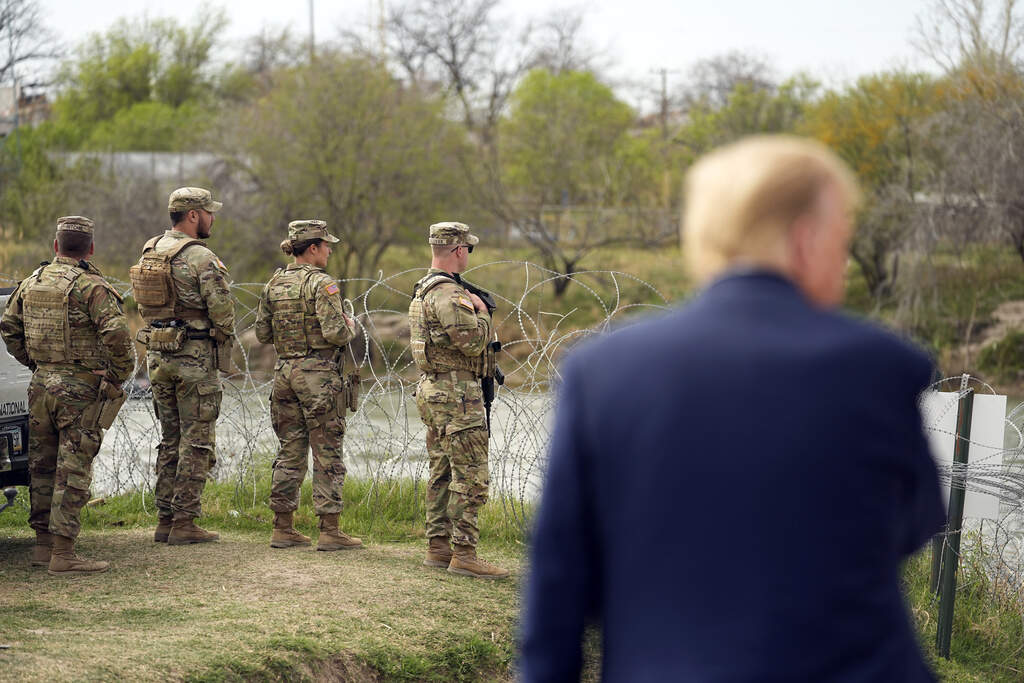
Starr County, Texas is 97% Latino. For more than 130 years the County voted for Democrats. Until last week.
In fact, Starr County has been swinging right for the past 8 years, with a 75-point shift to Republicans since 2016.
Today, On Point: What's motivating Latino voters in Starr County to back Republicans over Democrats?
Guests
Jeronimo Cortina, political science professor at the University of Houston. Author of "Proximity Politics: How Distance Shapes Public Opinion and Political Behaviors." Co-author of “Red State, Blue State, Rich State, Poor State: Why Americans Vote the Way They Do."
Perla Trevizo, reporter with the Texas Tribune-ProPublica Investigative Initiative. Author of Trump’s near sweep of Texas border counties shows a shift to the right for Latino voters" and "A pro-gun, anti-abortion border sheriff appealed to both parties. Then he was painted as soft on immigration."
Also Featured
Jorge Bazán, Starr County Democrat who voted for Trump.
Wayne Hamilton, executive director of Project Red Texas.
Marcus Canales, Starr County Republican Precinct Two Chair who voted for Trump.
Nelda Gonzalez, Starr County resident who voted for Trump.
Transcript
Part I
MEGHNA CHAKRABARTI: Jorge Bazán is a general manager at the Union Water Supply Corporation in Rio Grande City, Texas. It's a water and wastewater utility that services residents of Starr County, a border county near the southernmost tip of Texas. Jorge has lived in Starr County all his life, all 56 years of it.
JORGE BAZÁN: And I'm a lifelong Democrat, so I won't change party.
CHAKRABARTI: In fact, Jorge comes from a long line of Democrats, which include his parents, grandparents, and entire generations that have always voted blue. This, in fact, makes him unremarkable in Starr County. The county is 97% Latino and has voted for Democrats in every single presidential election since 1896, almost 130 years straight, beginning back in the days of William Jennings Bryan.
That is, until last week.
This is On Point. I'm Meghna Chakrabarti, and today it's our latest collaboration with the award winning non-profit newsroom ProPublica, where we combine ProPublica's investigative reporting with On Point's analysis to examine some of the most important issues facing the country. Last week Donald Trump made history in Starr County, Texas.
He won there, the first Republican to do so in those 130 years I mentioned before. 58% of Starr County voters cast their ballots for him. That's a 39-point swing since 2016. And Jorge Bazan is one of the voters who helped swing it.
BAZÁN: The better choice was a Republican. Bottom line.
CHAKRABARTI: In fact, Jorge has voted for Trump three times in 2016, 2020, and again in 2024.
But as you heard him say earlier, he still considers himself a Democrat. He has voted for some Democrats down the ticket as well. Just last week, he voted for Congressman Henry Cuellar. So why did Jorge vote for Trump?
BAZÁN: This past four years, me and my family, and I'm talking most of my family members, have been struggling financially.
Everything is very expensive. Even if you go to a regular, just a normal fast-food restaurant, let me give you an example, Whataburger. Are you familiar with Whataburger? It's a restaurant, a hamburger chain restaurant. We used to buy three combos for $20, under $20. Now we're paying $25 for two combos. Same size of combos and everything.
It's expensive. It's expensive.
CHAKRABARTI: Jorge says that for him, groceries and gas were more affordable in the first Trump administration. Since 2020, of course, inflation has been the cost driver in Americans lives. But almost all economists say that whether a president gets blamed for inflation going up, or wants to take credit for it going down, a president actually has very few levers to directly control inflation.
However, Jorge strongly believes that President elect Trump can bring down prices because Trump says he can, even if he has not specified how. Now, Starr County is one of the poorest counties in the entire United States with a median household income of $36,000. And as I mentioned, it's also a Texas border county.
BAZÁN: I'm not too into immigration. My ancestors were immigrants. But they did it the right way. They came to the procedure they need to go through, the process they need to go through. My concern is the overflow of immigrants. It tends to be a problem in the United States right now.
CHAKRABARTI: Jorge also supports Trump's mass deportation plan.
BAZÁN: Take all those people, those criminals out of here. Get them out. The rest, they're already here. Again, to me, it's giving a license to work or a permit or whatever the case. They're gonna work, but don't give them everything in their hands. Everything's being given right now to them.
They receive credit cards for I don't know how much, so much money. The housing, everything for free. You have to work for it here, it's very hard for you when you somebody here in your own country that has a lot of problems getting housing, or getting subsidies or whatever case, when somebody else comes in, the first day they receive everything.
That's bad. That's wrong.
CHAKRABARTI: And the last big reason why Jorge backed Trump? Jobs.
BAZÁN: Most of the citizens that live here in my area, they work in the oil fields. Or pipelines, so they rely on those jobs. Some time back in, I don't know when it was, 2020, when they shut down the pipeline. They shut down a lot of drilling and all that.
A lot of people were unemployed. They started losing their houses or vehicles and all that. They suffered.
CHAKRABARTI: That trifecta of campaign rally promises, a better economy, secure border, and more jobs, that won Jorge's vote. And he says the details of exactly how the next Trump administration might accomplish those things, the details don't really matter to him, simply because he's confident that Trump can get the job done.
BAZÁN: Hopefully cheaper gas, that would help a lot. Cheaper groceries, he's done it one time, I think he's going to be able to do it again.
CHAKRABARTI: So that's Jorge Bazan, a Democrat who voted for Donald Trump this past election, as did the majority of voters in Starr County, Texas. For the first time in 130 years.
Throughout the hour, we're going to hear the voices and perspectives of many more Latino voters from Starr County about why they backed Donald Trump, and we're going to understand what the changes in Starr County mean for the country as a whole. So joining us now is Jeronimo Cortina, a political science professor at the University of Houston, and he is an expert on American and Latino politics and immigration, and author of "Proximity Politics: How Distance Shapes Public Opinion and Political Behaviors." and co-author of “Red State, Blue State, Rich State, Poor State: Why Americans Vote the Way They Do."
Professor Cortina, welcome to On Point.
JERONIMO CORTINA: Hi, Meghna. Thanks for having me.
CHAKRABARTI: I imagine that the residents of Starr County right now are thinking you didn't pay attention to us for a century. Why are you paying attention to us now? Is that part of what's going on here, that here's a county in the United States, in Texas, that actually didn't receive a lot of focus from politicians of either party, but especially the Democratic Party, that they had so faithfully voted for so long.
CORTINA: Absolutely. And I think that the Latino vote has become more and more important, especially in a state like Texas where you have around one third of the electorate being, or tracing their ancestry back to, or identifying themselves as Latinos. So it is important in the sense that you need Latinos to be part of your winning coalition.
If you don't have Latinos, you're not going to win. And obviously, the Latino electorate behaves as any other part of the electorate, is a sophisticated electorate that understands if political parties are trying to get them to vote for them, they're going to understand if representatives, if political party operatives are going to be there on the ground trying to identify the needs, the wants, the preferences over their constituents.
And if they're not being paid attention, this is something natural. In addition to everything that you have said that happened during this election. So it's very natural to see one way or the other, these, let's call vote for Trump, maybe interpret as a way of Latinos having a protest at the ballot box saying, I'm important.
I'm a voter. My votes count. And if you don't vote for me, if you don't pay attention to me in terms of the policies that I want, then I'm sorry, I'm not going to vote for you.
CHAKRABARTI: Let's talk a little bit more about sort of the demographic specifics of Starr County. Now, I had mentioned that it's, what, according to the latest U.S. Census data, it's 97% Latino. Does that make it any different than neighboring border counties or not?
CORTINA: Each county, each part of the border has its own identity. The border has its own identity. The border is a real, I would say, a mixture of Mexican and American values. Most, every single border resident has relatives on the other side of the border, international commerce going back and forth for medical purposes, so on and so forth.
So it's a very dynamic region and that region has very unique needs that, for example, a Latino may have in Houston or in Dallas, or something like that, confronting the issues of immigration, confronting the issues of high inflation. These part of the borders, you have colonia that are very poor developments. That, for example, in some cases, do not have even running water.
When you look at housing costs, very high, when you look at unemployment, very high, in comparison to other parts of the state. When you look at poverty, about more than 37%, when you look at those statistics from the CDC. So all these things have and make a very unique environment that is poised for both Democrats and Republicans to deliver, and we can get into that a little bit further.
CHAKRABARTI: Definitely. I want to still take a little bit more time to understand the reality of life in Starr County, because so the unique needs that you just talked about, they also coincide with another fact that I mentioned earlier. That I believe it has one of the lowest median incomes of any county in the United States.
So being on the border and the sort of economic strains that people in Starr County may be living under. How do you think that informs the way they look at what they need from their elected officials?
CORTINA: Oh, absolutely. It's a thousand percent. You're talking about the classic, what we call in the literature, pocketbook voting.
And that is just, Jorge just mentioned it right now, and a very clear example in terms of, I go to Whataburger. Now I cannot afford three combo meals. I can't afford price of gas, also very high. So those things really affect you. So if you have political candidates, you're working 12 hours a day and still you cannot make your basic needs, then you are looking for someone that is going to solve the issue.
You don't care. And you're not worrying about these issues in terms of how can the president control immigration, control inflation? We don't know! It's very hard. It's very complex. You have the Fed, you have international commerce, you have the global economy. So it's not as simple as saying I'm going to send an executive order and tomorrow inflation is going to be over.
So you want someone that is going to solve your issues. You don't care about it anymore.
Part II
CHAKRABARTI: Now, a lot of focus has been put on Starr County just in the past week. And when exit polls showed that Starr County went Republican for the first time in 130 years, Wayne Hamilton, a longtime GOP strategist in Texas he wasn't surprised at all.
WAYNE HAMILTON: Before the election, we predicted Starr County would vote for Donald Trump.
CHAKRABARTI: The Republican Party has been expanding outreach and its activities in South Texas for years. And largely because of Wayne Hamilton, he's former executive director of the Texas Republican Party. He also ran Texas Governor Greg Abbott's campaign in 2014.
And a few years after that, in 2018, Governor Abbott came to Hamilton with an idea about South Texas.
HAMILTON: He said, Hey, we haven't really made any inroads locally. We've made a few, but what do you think about just jumping right in the middle of this and let's see if we can get some locals elected?
I went, great! We formed Project Red Texas, jumped in the middle of it, and I was all ready to support local candidates, and the first thing I found out was, we had no local candidates.
CHAKRABARTI: The new goal of Project Red Texas? Recruitment.
HAMILTON: We ended up recruiting a little over 50 candidates to run up and down the border, South Texas and points between.
And so we ended up winning 17 races, which is pretty phenomenal.
CHAKRABARTI: And the Texas GOP had even more success in 2022 and this year.
HAMILTON: And then in 2024 we had 133 candidates and of the 133, after primaries and going into the general election, a little over 100 candidates, and of those 100 candidates, about 40 of them ended up being uncontested, and of the remaining 60, and again, these are very Democrat areas.
And election night, we won 11 of the races that we were focused on.
CHAKRABARTI: Hamilton says the biggest reason counties across South Texas flipped red is because the GOP built an electoral infrastructure there that simply hadn't existed before.
HAMILTON: And all of a sudden, we were out there and we started working. And boom, people started going yeah, that's what I believe.
And there's a lot of hard work that's gone on. In places where we didn't have county chairman, we all of a sudden had county chairman. When you have a county chairman, they begin to build a local party infrastructure. When you have a local party infrastructure, then good candidates are drawn to your party and they say, I want to run.
And that's, and Project Red Tech steps in and helps them.
CHAKRABARTI: Hamilton doesn't like to call this shift in Latino voters in Southern Texas a realignment, but rather --
HAMILTON: I'd rather it's referred to as an awakening. People are awakening to that there's another party besides the Democrats and I think one of the reasons why is because we're there.
CHAKRABARTI: So that's Wayne Hamilton, longtime GOP strategist and executive director of Project Red Texas. I'd like to bring in Perla Trevizo into the conversation now. She is a reporter with ProPublica and the Texas Tribune Investigative Initiative. And she's written a bunch of articles about Texas border communities recently, including "Trump’s near sweep of Texas border counties shows a shift to the right for Latino voters."
And that was ProPublica, excuse me, that was co-published by ProPublica and the Texas Tribune. Perla, welcome to the show.
PERLA TREVIZO: Hi. Thank you for having me.
CHAKRABARTI: Okay, so tell me a little bit more about Starr County, but then also all the rest of the Texas border counties that did make, what seems from the outside, to be this tremendous shift, but you heard just Wayne Hamilton just now. It seems like the direction has been headed in that way for many years.
TREVIZO: Yeah, I think that's exactly right. While Starr County has been, a lot of the headlines recently, I think the previous election was about the county. We've been spending the last year in Valverde County, which is a more conservative county along the border on the southwest part.
We're actually, Project Red Texas has been playing a role in seeing more Republicans running, and their locals were telling us that Democrat was, blue was power in this part of the state. And as Republicans are getting more organized, you are starting to see that shift in Valverde County, for instance. Trump lost in 2016, but then Abbott won in 2018, then Trump won in 2020.
And he won by a bigger margin in 2024. At the local level, while Project Red Texas was recruiting candidates, at least in Valverde County, they did not win, but you had much closer races than you would have expected, including one of the sources that we talk about in our story of Valverde County, who was the local sheriff who had been running for the past 15, had been the sheriff for the past 15, 16 years, and this time, Project Red Texas had approached him asking him to switch parties and they would support him.
He declined the offer, and so they recruited a police officer out of San Antonio to run against him. And while he held on to his post, it was a much closer race than it should have been.
CHAKRABARTI: Okay. So I want to explore with both of you more about, again, we can talk forever about how the rest of the country is looking at places like Starr County right now, but I want to deeply understand how the residents of these border counties see themselves.
And please correct me if I'm wrong, but I understand that you're from El Paso?
TREVIZO: That's correct, yes.
CHAKRABARTI: Okay. You heard Professor Cortina a little earlier talk about, obviously, Latino votes are not a monolith in this country. I don't think any particular group of Americans are ever a monolith, but would you say, is there a kind of Texas border resident?
Identity, political identity, and if so, what would that be Perla?
TREVIZO: I don't think so. Even as you said, I'm from El Paso. I've been spending a lot of time in Valverde County, even in terms of identity I feel like in El Paso, you go into any grocery store, you go into a restaurant, and you hear a lot more the Spanish, English, people identifying a lot more with their Mexican roots.
I was surprised visiting Valverde County for the first time where I would hear a lot more English. You also have a military base as we do in El Paso, but Valverde is a much smaller place. And I feel that there is this more of the Tejano or more emphasis on the American than the Mexican in some of this county.
So even, you know, and this is also West Texas, right? We're not even going South Texas, in the Rio Grande Valley which was the source of Starr, Texas. So I don't think, I do think we share a lot of commonalities, and I think what Jeronimo was saying, I do think the border region on both sides of the border, the Mexican and the U.S. side, are their own entities by themselves.
But I don't think any border community, they are all each unique and they have their unique needs. We do share a lot of the same issues as Jeronimo was saying, higher unemployment rates, jobs that pay less, lower educational attainment, less access to health care, but within that, there's a lot of variances that I think we see reflected in the vote, right?
I think for the longest time it's been Latinos, border Democrats, and time again that's showing that's becoming farther from the truth.
CHAKRABARTI: Right? Exactly. So professor Cortina, let me go back to you on that, I would say that the Democratic Party, or I don't have to say this, many analysts have, that for a long time just made that facile equation that Perla described perfectly, Latino American border equals Democrat, right?
Is that presumption simply correct by virtue of the voting habits of voters there? Or were there some sort of alignment with values that has broken now? Because I don't think that a party should ever take any voting bloc for granted, but here is definitely one that it seems like the Democratic Party took for granted for generations.
CORTINA: Yeah. I think Perla is 100% right. And the issue here is that the Texas Democrats, and especially when you think about border Democrats, are not your traditional Democrat from the Northeast. These Democrats tend to be more conservative. We have some internal realignments, for example, Representative Guillen, Going from the Democratic column to the Republican party a couple of years ago at the state legislature.
And overall, you have seen even Congressman Cuellar tends to be very conservative. So if you think about the Latino voter at the border or in general the Latino voter in Texas, they tend to be more conservative. Latinos, we did some research, I think, 20 years ago, asking this question.
If Latinos are the natural constituency of the Republican Party. And to a certain extent, they are, at least at that time, they were. Why? Because they share some of the President Trump ideological values with the Republican Party. Naming, for example, family values, very important to the Latino community, high rates of being entrepreneurship. High rates of having more conservative positions in terms of certain social issues. Those things have changed over time. Don't get me wrong.
But overall, you have that, let's say, common denominator that aligns them. So the question here is which political party is going to invest time and Mr. Hamilton, just right on the spot. It's we invested in the community, and it's as simple as that.
CHAKRABARTI: Yes whoops, sorry as I punched my own microphone here, I want you to hold on to that thought. Because I want to come back to it, but I did say that we were going to hear from more residents of Starr County during this hour and so I want to give voice to another one.
This is retired educator Marcus Canales, and he has not always been a Republican.
MARCUS CANALES: Before 2016, no ma'am, I was a Democrat, you go back in my family tree and it's pretty darn blue Democrat. And it's been like a family tradition, for lack of better words.
CHAKRABARTI: Canales lives in Rio Grande City, the county seat of Starr County.
He voted for Barack Obama in 2008, then he sat out the 2012 election saying he was disinterested in both the incumbent president and Republican challenger Mitt Romney. Heading into 2016, Canales was disillusioned with the Democratic Party, and anything but about candidate Hillary Clinton.
CANALES: It was, like, unreal to see the country fall so far down economically, border security wise.
You started seeing things going on that just didn't seem right or were not right. People were, like, disgusted.
CHAKRABARTI: And then?
CANALES: And then there came Donald Trump. We started to hear and see things from him that were, like, Hey, this guy is on the legit, talking about things like the deep state. And corruption and people sat up and listened.
And I said to myself, Jesus, what the hell am I doing as a Democrat? Pardon my French there. But I said, no, it's time for change. And so I became a Republican and didn't regret it. Not even for a second.
CHAKRABARTI: Canales has voted for Trump at every chance he's got. 2016, 2020, and 2024.
CANALES: What appeals to me about him is the fact that he's, for lack of better terminology, he's the alpha male.
This man is not a politician and didn't start out as a politician. He's a businessman. This man came in and basically commanded the room and said, I'm going to do things according to what should be done, basically like a business sense.
CHAKRABARTI: President elect Trump has made Canales a believer in the Republican Party.
He's now a Republican precinct chair for District Two in Starr County, where he helps organize voters and promotes Republican candidates driving around with Trump flags attached to his vehicle. But even Canales couldn't have predicted what happened in Starr County just last week.
CANALES: I was like speechless, and I said to myself, this is surreal what I'm just like looking around and watching.
Is this real? Starr County just turned red literally overnight. It was like somebody switched the Christmas light bulbs and put on red bulbs and click, everything went red. Everything felt like things are going to be all right. We're going to be able to sleep comfortably at night, that we know progress and a reckoning are coming.
CHAKRABARTI: So that's Marcus Canales, retired educator and precinct chair, organizing with the Republican Party in Starr County. Perla, Marcus said so many interesting things there, but I was wondering if you could actually further elaborate on the immigration question and how he reflects on his concerns about what he's been seeing on the border.
I mean in your reporting, what have people been telling you about what they've been seeing that's causing them this concern about immigration, about migration, and therefore their alignment with the U.S.?
TREVIZO: Yeah, I think both of the people that we've been hearing, the voters that we've been hearing about, there's a connection between the economy and immigration.
I think in talking to political scientists, as well there, this is not the first time when there's economic downturn. We always look for the scapegoat or someone to blame. And in this case, and often is immigration, or it has been in the past, as well. And it was surprising. I think that's the part that has surprised me the most in spending time in this communities, including in my hometown of El Paso, because, as it's been said, including by some of the voters, like we all have connections on both sides of the border, either we, I was born in Juarez, raised in El Paso, I still have family, people keep going back and forth.
And so these are places, to me, it was different than if you're in Iowa or Idaho. And you're seeing the images of people coming across, and I can see how that can be interpreted as an invasion, but if you're at the border coming into this reporting, I figure, better than anyone what's happening.
But I think it was that each of these border towns has had this highly visible events. For example, in Valverde County, we had up to 20,000 mostly Haitian migrants come in 2021, almost at once. Where you had them camping under an international bridge that garner national international attention in El Paso.
You had the port of entry having to shut down a couple of times because hundreds of migrants were trying to make their way through. You had the images of migrants pushing against the National Guard. In El Paso, we had the park taken over in Eagle Pass. So I think even though it's not like this all the time, I think, as one Republican told me in Valverde County, all you need is fear and fear.
It's a very powerful tool. So even though nothing has happened, for example, in Del Rio since 2021. Everyone I talked to would mention the economy, immigration, and what about immigration? That event we had three years ago and the fear that it would happen again. And in their minds, the Biden administration had not responded, had not been there when these communities needed the federal government to respond, that they had been warning them that things were getting out of control.
And you know who showed up? Governor Abbott. You know who showed up? Trump with his rallies. And in their minds, this is, we don't want a repeat of what we had four years ago.
Part III
CHAKRABARTI: I've really enjoyed hearing the residents of Starr County across this hour.
And we've got one more. This is Nelda Gonzalez. She's a Republican voter in Starr County, 69 years old, and has lived in Starr County, a blue stronghold, until now.
NELDA GONZALEZ: It's been over a hundred years that people were voting Democrat. But I guess because people down here were used to the Democrats were for the poor people, the Democrats were for the poor people, but now they, I guess they woke up and they saw that this time around they didn't and they haven't.
CHAKRABARTI: Nelda says the Democratic Party says it's for poor people, but for decades, Nelda says the party hasn't done anything for her.
GONZALEZ: The Democrats back in my grandparents and parents, they did help the middle class. They did, but not anymore. Not anymore. They don't help the middle class. I don't see it. I see that the Republicans help more in the middle class than the Democrats do, at least here for us down here.
CHAKRABARTI: As we mentioned earlier, Starr County is one of the poorest counties in the nation with that $36,000 median household income. So the economy was Nelda's number one issue this presidential election, and she believes President-elect Trump can turn things around.
GONZALEZ: When he left office, the gas down here was $1.76 a gallon. As soon as he, Biden came in, it went up to all the way to $3. Yeah, that's that was a big change and the economy started going, like the inflation started going up and up. And I don't know how these people don't see that. So hopefully that now that he comes back into office, I hope we see changes in the gas prices and on the inflation and all this, our food, and all that, groceries.
Many people don't see it, but I did. I saw the difference. There was employment, especially employment. For all these young people that work with the oil fields, oh, there was a lot of employment there.
CHAKRABARTI: So Nelda's list is very similar to what you've heard before, including securing the border, also on Nelda's priority list.
GONZALEZ: And at least he's doing something for us here down in the border. Only us that live here in the border, we know what we're going through. It's like a little Iraq, that's how I call it. Living down here with all this commotion here with illegals, the border patrol and the helicopters and everybody's after them.
And he's the only one that has ever, he talked about it. The other presidents, they don't even mention it.
CHAKRABARTI: Although Trump has said many disparaging things about Latinos, including Latinos like Nelda, she says she doesn't care. Not even a little bit.
GONZALEZ: Honey, I don't understand these people. They get all, oh, he said this about us and he said that about us, but they themselves, they say it too. (LAUGHS)
If they themselves don't say it, their members, the family members say it. I don't know. That doesn't bother me. It doesn't bother me, because I know it's just a figure of speech. And I know he, sometimes he says things that, it's best if he just doesn't say them, but he just comes out and say them.
It happens to all of us too. Sometimes we say things out loud and instead of keeping it to ourselves, we just blurt it out. And I think he's frustrated, he just blurts it out.
CHAKRABARTI: Nelda has voted for Donald Trump every time he's run. And since she's living in Starr County, which as we've been saying, has been historically blue, she's gotten a lot of flack for it.
GONZALEZ: Yeah, like they even come up and they tell me, oh, you voted Republican, and wait and see, they're going to come after you and they're going to deport you. Why are they going to deport me? I'm a fourth generation. I live here. I'm an American citizen. Yeah, that's their way of thinking now. That's what they're saying.
I was shocked. All I tell them is just wait and see when he comes into power that you're going to see all the changes right away.
CHAKRABARTI: And that's something Nelda wholeheartedly believes.
GONZALEZ: I think that we're finally on the map. We had never had no attention at all. We don't exist. We're supposed to be one of the poorest county in the whole nation, and I think this put us in the map. Hopefully, when he gets into the office, hopefully he can come and visit us.
CHAKRABARTI: That's Nelda Gonzalez, a Republican voter in Starr County, Texas. Professor Cortina, I want to stick with immigration for another minute here. Because of course, as we've heard, it's come up with every person that we've talked to.
And both of you will be familiar with what I'm about to say, because in every show that we've done, especially about the Rio Grande Valley, guests have said, I'm fourth generation, I'm fifth generation. We didn't move, the border moved, we didn't cross, the border crossed us, right?
Because of the dynamic nature of the U.S.-Mexico border over time. And with that in mind, Professor Cortina, I also, I'm really struck by how each one of these voters and residents are saying, Hey, my family in the past did it the right way. Now they have a point, right? Because a lot of what we've been seeing recently is, are people crossing the border, claiming asylum.
Of course, those cases have to be adjudicated to find out whether those asylum claims are legitimate or not, but that is different than their own families. The Starr County residents' own families experience of becoming American. Professor Cortina.
CORTINA: Absolutely. And the history of Latinos in Texas, in particularly Mexican Americans, the political struggle is something that is very important to talk about.
So the first thing about immigration, I think there's generally a misconception in terms of assuming that if you're Latino, you're pro-immigration. And as we know, Ms. Gonzalez, Mr. Canales said very clearly, that is not the case. Perla just mentioned the 2021 issue with Haitian migrants.
And it's an issue that has been ever present since the 1940s, since the Bracero program. Mexican Americans were 1,000% opposed in general to these influx of Mexican workers, because it's direct competition for jobs. Also, these very important issue in terms of what Mrs. Gonzalez was saying, this issue of incorporation or assimilation is a two way street.
So if you're a fourth generation, you want to signal to the mainstream, to the political mainstream or society's mainstream, hey, I'm on your side, I'm part of your team. I have been here fourth generation. So it's another way of saying, I belong here. So that creates this issue of proximity, or having the issue right in front of you.
Something that I talked about in my book, that makes you react and behave politically in different ways. And also, it's also very important to give the context in the sense of this election, we're talking about significant lower turnout. We're talking about 45%. We're talking about around 9,500 votes, give and take, that went for the Republican party.
So we need to contextualize these to the overall context in which Latino politics are developed.
CHAKRABARTI: That's that 45% turnout in Starr County, right?
CORTINA: Correct.
CHAKRABARTI: Yeah. So when we say that it flipped red and Trump almost got 60% of the vote, it's not 60% of all eligible voters in Starr County.
CORTINA: Correct. Correct. You're talking about 45%.
CHAKRABARTI: Yeah. Yeah. Of course, the truth is that's how elections are won these days, on the margin.
CHAKRABARTI: But Perla from your reporting, the other thing, and this links together issues of the border and the economy. I understand that some of these border communities, many people actually have their source of employment or their livelihoods connected to law enforcement on the borders, is that right?
TREVIZO: Yeah, and we do see that change, especially as I was mentioning earlier, right? I think in a place like El Paso, that is much bigger. It does have a lot of Border Patrol. It does have the military base, but I think it's a kind of, it's a little more diversified. But if you go to smaller rural places like Valverde, where you have border patrol, you have customs at the port of entry, you have the soldiers at the bays, you have the DPS troopers sent by Abbott.
You do end up having this shift where law enforcement tends to, very generally speaking, vote more Republican or associate themselves or identify themselves more with the Republican party. And you're seeing that being reflected in the elections, as well. As one of the brothers that we profile in our story said, you don't bite the hand that feeds you. And I do think that's what they're seeing in places like that.
I think one of your other, one of the voters that you've highlighted here mentioned something that I thought was very interesting. That, I believe it was the last one saying that Democrats are not about helping the middle class anymore. And another thing that's happening in these border communities is that Governor Abbott has launched an operation.
And, right now, it's over $10 billion that he's put in there. And you can see that money, being reflected in this communities, with the deployment of hundreds, if not sometimes thousands of DPS troopers of the National Guard, that hotels are full, restaurants are full. The housing, now you have this influx of people needing housing, you have grants going directly to this community, either to the county, the city or the law enforcement agencies to help enforce border security initiatives.
And when you are a cash strapped rural community along the border. And you're getting millions of dollars on border enforcement grant through the state. I think you're going to associate that this is who's helping us, right? The Biden administration was ignoring the issue, not wanting to even use the word crisis for the longest time.
Here you have all this influx of resources coming in around border enforcement and immigration.
CHAKRABARTI: Okay, Professor Cortina, I'm going to get back to you in just a second. But Perla, this, everything that you've been saying in reporting makes me wonder if this is less a realignment amongst Latino Americans issue, but instead of it being the Texas version of what we're seeing nationally, which is the divergence between rural and urban communities.
TREVIZO: That is exactly what another colleague of Professor Cortina has said. I think, again, you did see a shift overall to Trump as we saw nationwide, right? Even in El Paso, Trump, I think, got 40% of the vote, which they hadn't gotten since George W. Bush, who was the native Texan.
But I do think you see more of this shift in the rural urban. Rural voters have gotten, have been more conservative for a while. And as he put it, what I was describing to him happening in Valverde County, to him, it was the story of North Texas several decades ago. And it's the border catching up to some of that.
Rural America has, generally speaking become more conservative or shifted to the right.
CHAKRABARTI: Professor Cortina, you had mentioned Congressman Cuellar a little bit ago, who just narrowly won re-election last week. We had him on the show a few years ago, and I remember even back then, he was saying, he was practically pleading with the Democratic Party to pay more attention to border communities in Texas.
And just saying a lot of the things that the party was saying at the national level, in addition to the taking voters there for granted, was going to potentially haunt the Democrats in the near future. With that in mind, and that near future perhaps having come to pass, is this sort of a permanent shift, do you think, tilting red?
Or would the reinvigoration of electoral or party infrastructure, plus the investment, the kinds of investment that Perla was talking about, could it make a difference for Democrats there?
CORTINA: I think it's the latter. I don't think we have enough data to suggest that this is going to be a complete realignment. Because when you're thinking about the political ideological issues, I don't see Latino voters just switching to the new Republican Party.
That's a new issue post Trump, that the Republican Party is itself defining, in terms of what's going to be in the next couple of years. So that's point number one. Point number two, I think it's very telling to say, Okay. If you want voters to vote for you, you need to have infrastructure. And Democrats have not done that for the past, I would say, 50 years since the Viva Kennedy clubs were in place back in South Texas.
So that is extremely important. And also, I think that the Democratic party needs to understand the way that politics are done and conducted today. It's very important in terms of the messaging. You cannot move voters to your side when you have high inflation and so on and so forth, with a very abstract concept of what the economy means.
If you have a candidate that says, I'm going to lower gas prices. Period. You don't need to live with anything else. It's very clear. Everyone understand it. And if you have other candidates saying we're going to have an economy that is going to be structured in such a way that you have certain opportunities to advance, it's you're done.
You lost the voter right there, in terms of comparing it to the message side. No more inflation, lower gas prices. You're going to go to the grocery store and buy whatever you want. That's it.
CHAKRABARTI: But doesn't that have to also be partnered with making an actual difference in people's lives? Because I was really struck by what Perla said, that Governor Abbott is pouring money into some of these border communities right now.
And that's what's really maybe resonating with them.
CORTINA: Absolutely. 100%. That's a different story, right? If they deliver or not, we're going to see in the midterm election, and then we're going to see what happens in the presidential election. Republicans control the Senate, the House, the White House, control the states.
So if Republicans do not deliver, then I think that voters are not going to buy the same thing all over again.
This program aired on November 14, 2024.