Support WBUR
Who is Pete Hegseth? What to know about Donald Trump's Pentagon pick
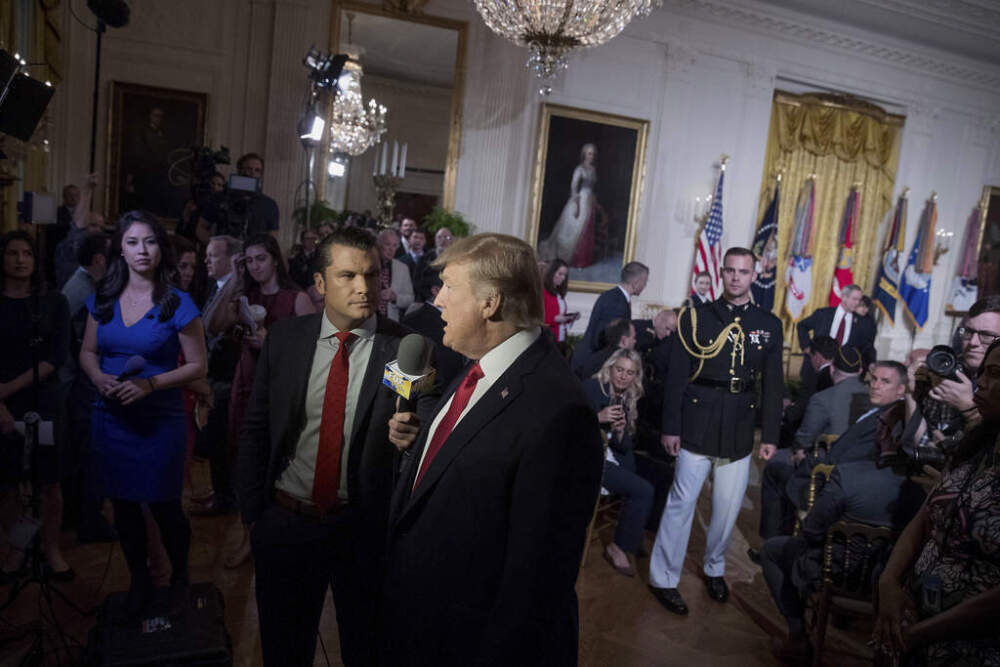
President-elect Donald Trump has tapped Fox News host and military veteran Pete Hegseth as his nominee for Secretary of Defense. Who he is — and what this pick could mean for the direction of America’s national security.
Missy Ryan, reporter for the Washington Post, covering national security and defense.
Allison Jaslow, CEO of Iraq and Afghanistan Veterans of America.
Also Featured
Mikey Weinstein, founder of the Military Religious Freedom Foundation. Author of With God on Our Side: One Man's War Against an Evangelical Coup in America's Military.
Transcript
Part I
MEGHNA CHAKRABARTI: This is On Point. I’m Meghna Chakrabarti.
By 2010, Pete Hegseth was a decorated infantry platoon leader. He served at Guantanamo Bay Naval Base, then in Baghdad and Samarra in Iraq. He was awarded the Bronze Star. By 2012, he'd served in Afghanistan with U. S. counterinsurgency operations.
Now, those two service stints in Iraq and Afghanistan bookended an elite education. In 2003, he graduated from Princeton University, then worked on Wall Street — Bear Stearns, to be exact — and then went to Harvard University for a graduate degree.
It was around then, 2010, that he testified before the Senate Judiciary Committee in opposition to Elena Kagan's Supreme Court nomination. Kagan had been the dean of Harvard Law School and due to the military's "Don't ask, don't tell" policy, she had barred military recruiters from Harvard Law School.
PETE HEGSETH (Tape): While Ms. Kagan sought to block full access to military recruiters, she welcomed to campus numerous senators and congressmen who voted for the law she calls "a moral injustice of the first order."
Additionally, Harvard Law School has three academic chairs endowed by money from Saudi Arabia, a country where being a homosexual is a capital offense. So rather than confront the congressional source of the true legislation, or take a stance against a country that executes homosexuals, Ms. Kagan zeroed in on military recruiters for a policy they neither authored nor emphasized.
CHAKRABARTI: So that was the Pete Hegseth of about a decade and a half ago.
After that, he followed a path to right wing republicanism and then Fox News. In 2022, he made a television event out of giving his Harvard degree back to the university.
RACHEL CAMPOS-DUFFY: So, how are you doing this? Are you burning it? Are you sending it? You're going to send it?
HEGSETH: I'm going to send it back. I've got an envelope over here.
CAMPOS-DUFFY: Okay. What other changes are we getting?
HEGSETH: It does say "Peter Brian Hegseth, degree of master in public policy." So I think we're gonna scratch that out. And then I think we finish it off by saying, "Return to sender" right here. And then I'll just sign it for good — (LAUGHTER)
CHAKRABARTI: Obviously, he didn't actually rescind his Harvard degree. Can't do that. He just sent the piece of paper back. But nevertheless, Hegseth also, as a Fox News host, frequently commented on what he saw as the excesses of the left.
HEGSETH: First of all, she's a Marxist at home. And then she's a globalist and apologist overseas. And you know, most empires lose their influence around the world because they lose their compass at home. And under Marxist Kamala Harris, Comrade Kamala, it would accelerate. We know exactly who she is. She is a radical.
CHAKRABARTI: Hegseth has also used Fox News to make clear his view of the role of the U.S. military.
HEGSETH: The rules, the bureaucracy, the rules of war get twisted in certain ways where now war heroes are being prosecuted like criminals. I'm straight-up just saying we should not have women in combat roles. It hasn't made us more effective, hasn't made us more lethal, has made fighting more complicated. We only have one military, and if the military goes woke, then it is less equipped to fight the wars it needs to fight.
CHAKRABARTI: Now, all of that made him a darling of now President-elect Donald Trump, who very recently named Hegseth as his nominee to be the next Secretary of Defense.
Now, Hegseth's views, not just about the United States military, but about Christian nationalism has raised alarm bells among many, including from some of his fellow veterans, such as Paul Rieckhoff, founder of Iraq and Afghanistan Veterans of America.
PAUL RIECKHOFF: This is a very, very radical and bold move. And I think it's a reflection of Hegseth's loyalty to Trump more than anything else. Hegseth is a very effective culture warrior. He's very good at communications and at the religious war and at the political war. But he is the most unqualified candidate for this position in the history of America. He is so underqualified that from the moment the news broke, my phone blew up with everybody saying, "Whiskey tango foxtrot. Is this serious?"
CHAKRABARTI: Well, today, we're going to talk more about who Pete Hegseth is, what he believes, what his background is, and what his leadership, if he is indeed confirmed, might look like at the Pentagon.
And we're going to start today with Missy Ryan. She's a reporter for the Washington Post. She covers national security and defense. Missy, welcome back to On Point.
MISSY RYAN: Thank you.
CHAKRABARTI: So, first of all, I'm wondering if, uh, if you've heard from any of your sources around the military, around the Pentagon, what they think of the possibility of a Secretary Hegseth?
RYAN: Well, I think it depends where you stand within the military, whether you're a senior officer who feels liek they mgiht have the potential to be targeted for retaliation or some sort of purge, as we're hearing may occur under the Trump administration. None of that has been confirmed yet. Or whether you're someone who feels like the military does need shaking up.
And the reason why I think the selection of Hegseth is such an interesting glimpse into what we might expect from a second Trump administration is that he shows how Trump is going to prioritize loyalty and sort of ideological objectives over experience. And in some ways, he won't be deferring to the Republican establishment, to the security establishment, in the same ways that he did during his first term. And Hegseth sort of is embodying that, the idea that they're going to be focusing on cultural wars issues, social and personnel issues for the military during Trump's second term.
CHAKRABARTI: Okay, so we're going to talk about that in a second. But on the experience front, I mean, I just went quickly through his military experience. He is a veteran, a decorated U.S. military veteran. What is it about his CV, if I can put it that way, that makes some people think he's inexperienced for the position of Secretary of Defense?
RYAN: Yeah, well, Meghna, I've now covered nine Secretaries of Defense, and he does have vastly less management and sort of public service experience than many of the other people who have held this job. People like Bob Gates, people like Leon Panetta, who ran the CIA. The former — Trump's first Secretary of Defense, Jim Mattis, who had commanded U.S. Central Command, Lloyd Austin, who is now the head of — who is the defense secretary currently, who also was a long-term, was a lifelong Army general before his retirement. You had people like Pat Shanahan, who were, you know, business leaders.
So yes, Pete Hegseth is a veteran. He spent more than a decade in the National Guard. He deployed to Afghanistan in 2011, 2012. He deployed to Iraq in 2005, 2006. He ran a couple of small veterans advocacy groups, but it's not on the same level as what you're seeing from some of the previous defense secretary picks. And certainly, you know, according to critics, not something you'd want to see going in to cover the — excuse me, to lead an organization that is more than three million people, if you're counting civilians and military personnel.
CHAKRABARTI: Well, on that point, we actually have heard quite a bit from people concerned with the Hegseth nomination. I mean, for example, here's Rep. Adam Smith, Democrat of Washington and a ranking member of the House Armed Services Committee, and here's what he said.
REP. ADAM SMITH (Tape): It is concerning just given that lack of experience. You know, the Pentagon, biggest bureaucracy in the world, it's a hard thing to run. So I think it's going to be a challenge.
CHAKRABARTI: Missy, though, ket me, I mean, it's — this won't come as any surprise to you, but for, I would say for President-elect Trump and for people who support him, the lack of bureaucratic experience is actually a feature in Hegseth's background, not necessarily a bug to them. What is it about the bureaucracy of the Pentagon that others say needs kind of organizational leadership experience?
RYAN: Well, I think, you know, so Hegseth actually just wrote a book in 2024 called The War on Warriors, and it's all about this issue of what he calls, and other people call, the woke military. President Trump has spoken about this himself. In the lead-up to the election in November. He promised to fire woke — quote-unquote — "woke generals."
And what Hegseth talks about at length in his book is he believes that the chief reason for what, you know, what he views as a decline in American military power, decline in American strength writ large on the global stage, is an exaggerated emphasis on diversity, on increasing the racial, ethnic, gender diversity of the military. And so he talks about different issues, including the decisions to allow transgender troops to openly serve, the decision to integrate women into combat. And in his view, this is about, in his telling this is, you know, lowering of standards, a distraction from the core issues of lethality. And this is really a worldview that is shared by President Trump and the people around him.
And so, you know, he has spoken about these issues on Fox for years now. He played a key role back in the first Trump administration in advocating for the pardon of people who were either on trial or had been convicted of war crimes. President Trump went ahead and took those decisions against the advice of his military leaders at the time. And so Hegseth, I think, is really just a sort of ready agent for Trump to execute what he thinks is a fix for what's wrong with the military.
CHAKRABARTI: Hmm. Now, there's a whole swath of things that he's talked about very openly on Fox and in his books, as you mentioned, Missy. We're going to go over a bunch of them. But I also want to note that I believe Hegseth has defended, vocally defended, many of the people who have been sent to prison for their criminal acts on January 6th, 2021. Is that right as well?
RYAN: Yeah, he has. He has definitely come out in the camp of people who were, you know, people being wrongfully accused. He himself has talked in his book about being labeled an extremist. He was part of the D.C. National Guard around the time of January 6th. He was actually slated to be one of the people who were providing security for President Biden's inauguration in January of 2021, and he had his orders rescinded because of a tattoo that he had. So I think that really intensified his belief that there was sort of a woke agenda or a pretext related to white nationalism or extremism in the military that he sort of rejects.
CHAKRABARTI: Okay. Well, Missy, we're actually going to talk about not his Christianity per se, but the Christian nationalism that many people are seeing in his beliefs. We'll do that when we come back.
Part II
CHAKRABARTI: Let's listen to a moment of someone who supports the Hegseth nomination. This is Sen. Markwayne Mullin, Republican from Oklahoma. Hegseth has also recently been accused of alleged sexual abuse and Sen. Mullin still throws his support behind Hegseth. And here's the senator.
SEN. MARKWAYNE MULLIN: He's an individual that served 20 years in the service. He's an honorable discharged veteran who served as a combat individual that walked into Afghanistan and Iraq, has two Bronze Stars, highly decorated combat veteran that is a civilian today. He's a major. And he fits the role of defense — Secretary of Defense. I think he's a good pick.
But once again, as allegations come out, we'll figure out if, as the Senate moves forward with the advise and consent to the president of the United States and doing our constitutional duties, we'll figure out if he can get confirmed or not. And I do think that Pete's a good pick for this position.
CHAKRABARTI: Again, that's Oklahoma Sen. Markwayne Mullin, a Republican.
Here's a little bit more of Hegseth speaking for himself. He was on the Shawn Ryan Show just this month. And as Missy pointed out earlier, Hegseth has been quite vocal of his criticism of the emphasis on diversity in the U.S. military.
HEGSETH: Any general that was involved — general, admiral, whatever — that was involved in any of the DEI woke (BLEEP), has gotta go. Either you're in for warfighting and that's it. That's the only litmus test we care about. You got to get DEI and CRT out of military academies, so you're not training young officers to be baptized in this type of thinking.
CHAKRABARTI: Missy Ryan, you've reported extensively on Hegseth's criticism of what he sees as wokeness in the military. I'm wondering if you could talk more about what you found and what his particular targets are.
RYAN: Yeah, well, diversity writ large is something that Pete Hegseth has been talking about and writing about since his early days in college.
He was an undergrad at Princeton, and he was involved in a conservative publication there called the Princeton Tory. There were articles that he wrote sort of talking about the specter of diversity, was a publication that came out against gay marriage and affirmative action. So it's something that he has actively voiced an opinion on for a long time now.
When it comes to the military, he has this sense that the military is overly focused on, sort of percentages of people from different racial ethnic backgrounds, different genders, rather than what he would describe as the core mission of lethality.
But Meghna, I think it's important to mention here that he is sort of, you know, this narrative, which is shared by some, many vets that you will hear from, he's picking up on a sort of widespread source of dissatisfaction among vets and some active duty service members about the way things have gone for the U.S. Military. I think that, you know, he would point to this issue of diversity and equity initiatives associated with that as a reason for the failures of the United States in, you know, the counterinsurgent wars in Iraq and Afghanistan.
I think he's picking up on dissatisfaction that people feel about America's place vis a vis China, America's economic and security place being challenged by, you know, countries like China and Russia, a sense of -- a broader sense of decline of America. And that's something that he talks about at length when it comes to the military, but also when it comes to other issues. You know he has written extens — he wrote a whole book about education and, you know, what he would describe as the negative effects of taking God out of public education. And so I think that he's tapping into — he and people like Trump and and people who would support this view are sort of tapping into this feeling of dissatisfaction.
Now, there's not much evidence that I've ever seen that steps to foster diversity in the military have anything to do with America's failure in Afghanistan and Iraq. But those failures were real. And I think that that is providing fertile ground for his kind of view to gain traction among a segment of America.
CHAKRABARTI: Okay. So that is a really important insight. And I'm going to come back to that a little bit later because we're going to have a veteran on with us as well. But Missy, I had mentioned, you had actually mentioned, and I wanted to dig into more of Hegseth's beliefs, not specifically his Christianity, but the form of Christianity he has embraced and how that may overlap with Christian nationalism in this country.
So specifically about his tattoos. The story as far as I understand it is, as you had mentioned, just before Joe Biden's inauguration in 2021, on January 20th of 2021, Hegseth was informed that he would not be allowed that even though his D.C. National Guard unit had been called up to help secure the inauguration, he would not be allowed to serve on that because of at least one particular tattoo he has. Which is "Deus vult," a phrase that means "God wills it," which apparently was a battle cry for the Crusaders.
But also perhaps more importantly, and I think this is what sources inside the Pentagon have told some reporters, that that same "Deus vult" battle cry was heard on January 6th, as people were attacking Congress. Do you know — what more do you know about that, Missy?
RYAN: Well, he was — what we know for sure is that he was flagged by other members of the D.C. National Guard unit that he was assigned to. This was after January 6th and before the inauguration as well. (COUGH) Excuse me.
The authorities in Washington were trying to make sure that the inauguration went off securely. And so some members of his unit saw pictures on social media of his tattoos, including, you know, this Jerusalem cross that he has on his chest. And then this one on his arm that you just mentioned that says "Deus vult," which means, you know, "God wills it." And and they flagged that as a possible concern.
And you know, frankly, Meghna, it's this very gray area. You know, he has spoken about it. He does in that Shawn Ryan podcast that you mentioned and says, you know, this is just a religious symbol. This is, you know, part of my faith and you know, and in some ways, you know, maybe, you know, we have to take him at his word. He got that tattoo.
But at the same time, it is something that has been associated with far right extremism. And so, you know, what were his reasons for getting that? Obviously, we can't tell. but it was enough to trigger him being flagged and then have his orders rescinded in 2021. That is what we know. He obviously says that it was nothing to do with extremism and they're just expressions of his faith.
But, you know, I do think that what we can point to with certainty is that he has written extensively about, you know, his views on Islam as a threat to America of, you know, Muslims trying to take over Europe and the United States and infiltrating American institutions. You know, we have other things that we can point to, I think, with greater certainty to tell us about his views and who Pete Hegseth really is.
CHAKRABARTI: Mm. Okay. Well, here is Hegseth himself speaking to Fox News' Jesse Watters about not being, or being prevented from, serving with his National Guard unit for Joe Biden's inauguration.
HEGSETH: I signed up to fight extremists, and 20 years later, I was deemed one. By my unit, I was called a white nationalist extremist. And my orders were revoked to guard Joe Biden's inauguration.
JESSE WATTERS: Wow.
HEGSETH: If that can happen to me, it can happen to anybody else.
CHAKRABARTI: Well, the reason why I find this particularly interesting and important, Missy, is, I take your point about we don't know, we can't know exactly what's in Hegseth's mind vis a vis that tattoo. But the fact that he was flagged by members of the guard unit that he served in as potentially being, those tattoos being of concern, interests me because the Pentagon itself has issued multiple reports on the threats of extremism from within the United States military and particularly religious extremism within the United States military.
So to that point, just listen to this for a moment.
MIKEY WEINSTEIN: Well, you wanna talk about his tattoos? He has many of them. They're all Christian focused. One says "Deus vult" on it, which basically says, "God wills it." Most folks this guy has a strong connection to loving the Crusades.
CHAKRABARTI: So this is Mikey Weinstein. He's the founder and president of the Military Religious Freedom Foundation.
WEINSTEIN: Whatever it was, his array of tattoos were so heinous that he was not even allowed to take part in Biden's inauguration because he was viewed as being too much of an extremist. He has an incredibly close nexus to Christian Reconstructionism, which is another version of extremist Christianity on a number of levels.
CHAKRABARTI: Now, Christian Reconstructionism is the idea that society should be reconstructed to reflect the kingdom of God. So here's what Mikey Weinstein says that could look like.
WEINSTEIN: I think the first thing is that Trump wants to establish — and this would I'm sure would be completely controlled by Hegseth — warrior boards. Former officers, retired senior officers, who will decide which generals and admirals follow the MAGA agenda, the Christian nationalist agenda strongly enough to remain in positions. All those who don't will be jettisoned.
And the concept, remember, of Christian nationalism is reshaping our constitutional Republic, this democracy, into a force for whatever it could be done to lubricate the process to bring Jesus's kingdom back pursuant to the book of Revelation, the eschatology of the end times. We're almost there. Let's make it happen as quickly as we can. We want to get rid of anybody that would serve as a speed bump for this concept of Christian nationalism. The idea of a warrior board itself to determine whether you are Christian enough to stay is just antithetical to the Constitution.
CHAKRABARTI: Weinstein also says that that mission comes hand in hand with some of what Weinstein sees as discriminatory values that he says Hegseth has propagated.
WEINSTEIN: It's not just about, "Oh, we want to have bureaucratic control and own the libs." No. It's about bringing their version of Jesus back and slaughtering all of those who will stand in the way of their utopian vision of fundamentalist Christian nationalistic subservience. And it hates Jews, it hates women, it hates Muslims, it hates LGBTQIA+. And it hates the Constitution.
CHAKRABARTI: That's why Weinstein believes that Hegseth is not fit for the position of Secretary of Defense.
WEINSTEIN: You know, the best way I can describe it, because humans understand analogy very well, is that anyone that remembers Bernie Madoff, the Ponzi scheme king, who died in prison several years ago. It would be as if Trump had nominated Bernie Madoff to be the Secretary of Treasury. He would be the absolutely last person that you would want to put in a position like this.
CHAKRABARTI: That's Mikey Weinstein, founder of the group the Military Religious Freedom Foundation. Well, Missy, hang on here for a second because I want to bring in Allison Jaslow into the conversation now. Allison is CEO of Iraq and Afghanistan Veterans of America, and a veteran herself. Allison, welcome to On Point.
ALLISON JASLOW: Thanks for having me.
CHAKRABARTI: So, you know, I'm, I'm always wanting to scrutinize our own analysis here, and I would love your view on this. Is this concern or, let's say, tying Hegseth to Christian nationalist views in the context of the United States military, is that warranted?
JASLOW: I mean, I think if you are a political appointee, all parts of your background should be scrutinized. I'm not the alarmist type. So I'm not, you know, freaking out right now the way that some people are freaking out. But I think that there's, you know, Missy was very thoughtful earlier to like, we should — there's like ,concrete things about his background that should be scrutinized. And I think we should focus on those.
You know, for example, lobbying to get war criminals, convicted war criminals, pardoned is probably the most concerning thing about his background for me. I don't think that we should have a Secretary of Defense who thinks that war crimes are okay. And I think if we focus in on stuff like that and actions he's actually taken, there should be enough to have, you know, deliberate discussion about in the United States Senate as his nomination is considered.
CHAKRABARTI: Mm. Okay. Point taken. And I will come back to that. But I just wanted to clarify something that I had said earlier about the Pentagon itself being, at least a couple of times, very vocally concerned about extremism in the military. Because it was in February of 2021, I believe, that Secretary of Defense Lloyd Austin ordered a department-wide stand-down for a period of time to focus on extremism in various branches of the military. And the Biden administration itself has also issued a national strategy for countering domestic terrorism, which includes aspects of tamping down extremism in the military. So that's the context in which I bring all of this to — that I bring to all of this.
But Allison, so then, so then take me into more detail on the aspects of what Hegseth has said or has done that you, in your position as head of Iraq and Afghanistan Veterans of America, find most concerning?
JASLOW: Well, I think his views on women in the military are disappointing, especially because he's a contemporary of mine. Pete Hegseth is, I think, two years older than me. And if Missy got his deployments right, I saw combat before Pete Hegseth did. We have fought, you know, post 9/11, on an asymmetrical battlefield. And whether you want to or not, combat found you, especially in Iraq and Afghanistan.
And I think that, you know, our advances in terms of like, opening more roles, have acknowledged that fact. To allow women in combat roles in 2016 was a great stride forward for not just women in the military, but also if we're going to continue to fight our wars with an all-volunteer force, we want every able-bodied American who wants to serve to raise their hand and to step up and to serve. And we shouldn't put restrictions on them as to how they can serve their country once they're in uniform, if they're qualified and capable to fulfill a certain role.
And when you see women graduating from Ranger School, there are certainly women who are way tougher, both physically and mentally, than many men who they're served alongside. To give your listeners context, Ranger School has about a 50% failure rate. So the women who are graduating from Ranger School are objectively much tougher, both in mind and physically, than many, many other men who are serving in the military right now.
And so I think, you know, we just need to look at the facts here about not only women in their service, but also, you know, when you have a recruitment crisis going on in our country right now, as we do, we need to look those numbers head-on as well and see whether we actually want to like, take some of these policies and advances that we've made, you know, during the last 20 years, whether it was the repeal of "Don't ask, don't tell," allowing transgender service members to serve if they so choose, and also to allow women to serve in whatever roles that they are capable and qualified for, could have, you know, adverse impacts on our all-volunteer force.
Part III
CHAKRABARTI: Missy, I'm going to come back to you in a second. I haven't forgotten you're there. I appreciate your patience. But Allison, you know, I think I really failed in something. I should — should I be referring to you by the rank in which you left the, the Army? Is that captain?
JASLOW: I'm a former Army captain.
CHAKRABARTI: Former Army captain. Would you, would you prefer, I have the habit of referring to folks by their highest earned rank. (LAUGHS)
JASLOW: (LAUGHS)
CHAKRABARTI: So would you prefer me to refer to you as Captain Jaslow?
JASLOW: No, because I actually don't hold the rank anymore.
CHAKRABARTI: Okay, good. Just wanted to make sure. But I also wanted to note, because I mentioned this about Hegseth at the top, you are also a decorated Army veteran, though. Bronze Star and an Army Commendation Medal, at least. Can you actually just take a second to tell us about your, a little bit more about your service, your deployments to Iraq?
JASLOW: Sure. So I deployed to Iraq the day after Thanksgiving in 2004. So almost 20 years ago. The first time I was deployed, I was a platoon leader. We originally had a warehousing mission when I got on ground, but pretty quickly, because many of the roles were contracted in our most recent wars, my soldiers' jobs were taken over by Kellogg Brown and Root contractors. And our mission shifted to a force protection mission.
So my soldiers both protected the base that we were on in Taji, Iraq, and then my platoon also became a gun truck platoon. So that's the convoy security element that helps protect logistics convoys as they're traveling across the battlefield, taking, you know, supplies and/or taking debris from one place to other across the battlefield.
And so, you know, I will say it's, you know, from that experience that I can tell you that there are women in the military who like, knocked my socks off when the mission got changed and really rose to the challenge. And then I also had male soldiers who were like shaking in their boots, who thought that we would be just confined to our base the entire time that we were deployed that go-round. You know, we were protecting convoys that were under small arms fire, got hit by IEDs or roadside bombs as well. So that was a — I would say a challenging deployment for me for a number of reasons.
I redeployed to Fort Carson, Colorado in October of 2005. And then deployed again to Iraq in January of 2007, was there during the surge. So that deployment, because I was active duty Army, got extended, and I didn't return back home again until April of 2008 to Colorado Springs. That was much more of a staff role for me personally. And you know that comes with its own challenges. It's mostly leadership challenges.
And we were outside of Baghdad for that particular deployment as well. Supported the surge, our soldiers, you know, built new bases to help support the surge. That's also where I got intimately — or I have an experience of sleeping next to a place called Camp Trashcan where a burn pit was. And so, you know, like so many other who served during our wars, I have those stories to tell as well from my wartime service.
And it's a lot of that, you know, that inspires my advocacy today. You know, I think some people, especially in our politics, want to make things that are very complex, whether it's war, you know, military service, how each person's service experience can be so vastly different, want to paint it as black and white and it's just not, not as such.
CHAKRABARTI: Okay. Well, Thank you for sharing that, by the way, Allison.
JASLOW: Of course!
CHAKRABARTI: Because it really gives us bigger context on what you — and Missy, actually — have been saying about what is "a combat role," right, in the modern U. S. military, in the theaters that our forces have been engaged in.
I want to share Hegseth's actual words regarding women in the military. So here he is again this month on the Shawn Ryan Show. And according to Hegseth, he believes that having women in combat roles has lowered the standards of the military.
HEGSETH: Everybody knows, between bone density and lung capacity and muscle strength, men and women are just different. And so, if you want to, I'm okay with the idea that you maintain the standards where they are for everybody. And if there's some, you know, hard-charging female that meets that standard, great. Cool. Join the infantry battalion. But that is not what's happened. What has happened is the standards have lowered.
CHAKRABARTI: Well, that's obviously drawn a lot of criticism from many members, current and former of the United States military, including Sen. Tammy Duckworth, Democrat of Illinois, who was severely wounded, lost limbs, during her combat service. She is a veteran herself.
SEN. TAMMY DUCKWORTH: He's shown that his absolutely — absolute lack of experience and his lack of suitability for the job. Because anybody that truly knows the military knows that we cannot go to war without over 225,000 women who are serving on active duty right now. Our military cannot go to war without our female service members.
You know, this is not the Revolutionary War where there's a — some sort of a line in the sand and, you know, combat is on one side and the rest of us can stay behind this line and that's not combat. I would ask him, you know, where do you think I lost my legs? In a bar fight? (LAUGHS) I'm pretty sure I was in combat when that happened. And, you know, it just shows how out of touch he is with the nature of modern warfare if he thinks that we can keep women behind some sort of imaginary line.
CHAKRABARTI: So Missy Ryan, let me turn back to you because people can say things about their beliefs on just about anything. But how in the role of Secretary of Defense does that actually then dovetail with the kind of power that a secretary actually has over the United States military? Or let me put it more clearly — sorry, I'm too wordy today. Hegseth says he doesn't believe in having women in combat roles, but as Secretary of Defense, could he actually change that?
RYAN: He could. Before I answer that, let me just just mention, though, you know, Tammy Duckworth's comment really raises the question of how his comments on women in combat will impact his nomination in the Senate. For example, there is Sen. Joni Ernst, who's a key member of the — Republican member of the Senate Armed Services Committee, served in Iraq, was a company commander in Iraq and Kuwait. So, you know, there are people even among the Republicans who you think might be questioning some of those statements.
So as Secretary of Defense, he does have broad powers to make changes to policies about who serves where. If you recall, it was in 2015 under the Obama administration that there was a decision to open all combat roles to women. And, you know, that was a controversial decision at the time. There was one service, the Marines, that, you know, continue to resist that. And there was, I think, a lot of concern about what it would do to morale, you know, what the implications would be for men and women living together under these circumstances, for sexual assault.
But, you know, we have not heard of major problems since then. And it really hasn't — some of the things that were raised as concerns have really not borne out. But, you know, there are still people who, I think, like Pete Hegseth, would have their concerns. But he, as Secretary of Defense, could reverse that policy. Like a lot of these sort of personnel policies, that's really within the discretion of the administration.
CHAKRABARTI: I see. Allison, do you want to comment on that as well?
JASLOW: What specifically?
CHAKRABARTI: Well, about the — what actual power does a Secretary of Defense have to make changes on the makeup or the deployment, the use, the mission of the United States military?
JASLOW: I mean, it was — so including women in combat roles is something that was led, you know, from the Secretary of Defense Ash Carter's office. So anything that can be, you know, led from within the department can also be unraveled from within the department.
You know, I have to think it would be pretty controversial. As I mentioned beforehand, like, we've got a recruitment crisis going on in the background and we don't need to be discouraging people from serving. I also think it's a — I would not want women who are currently serving in the infantry and currently serving in other combat arms roles to have to serve under leadership like that either. Like, it breaks my heart.
You know, when I served, because I served from 2004 to 2008, I used to joke that, at that time, the military used to have not a glass ceiling, but an iron ceiling. Because you don't see the joint chiefs coming from non-combat roles. And so there would have been, even if, you know, there have progressively been four-star level leaders who are women, there would still be certain limitations on how far up in the ranks that they could go. Including women in combat roles completely changed that.
And I would, you know, again, it's super disappointing to know that women who are volunteering, who are risking their lives and sacrificing so much else, that their families are sacrificing alongside of them, would be done such a disservice if policy action was taken under the next administration, no matter who the Secretary of Defense is.
CHAKRABARTI: Mm. Missy Ryan, I want to circle back on the issue of how much politics or culture wars are brought into the leadership of the Pentagon. Because obviously we've heard other voices this hour expressing deep concern that that's exactly what Hegseth would do. But it seems to me that Hegseth and even President Elect Trump are — they consider themselves antidotes to other forms of culture wars that they would say have been brought into the Pentagon, going back to Hegseth's criticism of "woke generals."
I'm just wondering if you could elaborate on what you said a little bit earlier about like, what exactly is Hegseth saying? Like, there are specific generals he has in mind?
RYAN: Well, he actually, you know, I think it's going to be very interesting if he gets confirmed to see what his relationship is like with the Chairman of the Joint Chiefs, General C.Q. Brown, because he has several pages in his most recent book, which just came out about five months ago, about General Brown, faulting him for — General Brown was the first African American Chief of Staff of the Air Force, and he's the second African American Chairman of the Joint Chiefs that the U.S. Military has had. He was selected by President Biden. First nominated by Trump for the Air Force job and now nominated as chairman by President Biden.
But Hegseth singles him out and as, you know, overly focused on diversity issues to the detriment of readiness and other things, as he describes it. And actually talks about a memo that General Brown signed as the Air Force chief, as part of an effort to increase the diversity of candidates for officers for the Air Force and calls it racist and illegal.
He has spoken about the need — as you, I think you played a clip earlier — to fire, he says, the chairman and other officers involved in diversity initiatives. And so, you know, if he becomes Secretary of Defense, General Brown is his chief military advisor and the chief military advisor to President Trump. What is that relationship going to be like?
He also singles out the Chief of Naval Operations, Admiral Lisa Franchetti, and sort of suggests that she was a DEI hire and wasn't qualified. So, you know, I mean, he has been on the record in sort of very personal ways, in a very unusual fashion for somebody who may be coming in in a couple of months to lead this organization.
So you put that on top of the messages that you think — some of his comments about Islam and women, we'll be sending to a force that, you know, the U.S. military is one of the most diverse public institutions that we have in America, people from all sorts of different backgrounds. And what is that going to look like?
CHAKRABARTI: Yeah. Well, Allison, on that note, we have about a minute left. I'm wondering what your thoughts are on how the storm of controversy that's around Hegseth and will continue to be around him as he goes down the path of nomination and confirmation hearings. What impact that might have on morale in the military? Because Missy touched on this earlier and you've mentioned as well, there's a recruitment and morale challenge already. Will this make that even harder?
JASLOW: You know, I think Missy touched on this earlier. There is, you know, there are differing views here, right? And there's like, what is being sort of wrestled about in public now very much is happening behind the scenes as well. And so I think, for better or worse, we're having, like, really thoughtful conversation around, like, who do we want our leaders to be? Whether it's military leaders or elsewhere.
And I think having that conversation is great for our country. But also me personally, I appreciate that there's so much conversation around, you know, the policies that we want to put at the Department of Defense because, like, we are still a nation that is serving, I mentioned this before, fighting our wars with all volunteers. And if we want it to stay that way, some of these topics have real implications for the health and the future of our all-volunteer force.
And so I think if this just sheds light on that and helps us wrestle that out, sort of, as a country and as American people, I'm happy to have it as a part of this transition.
CHAKRABARTI: Well, Allison Jaslow is a decorated Army veteran and CEO of Iraq and Afghanistan Veterans of America. And Missy Ryan is a reporter for the Washington Post who covers national security and defense. Thank you both so much.
This program aired on November 19, 2024.