Support WBUR
Silicon Valley’s reign over tech, money and politics
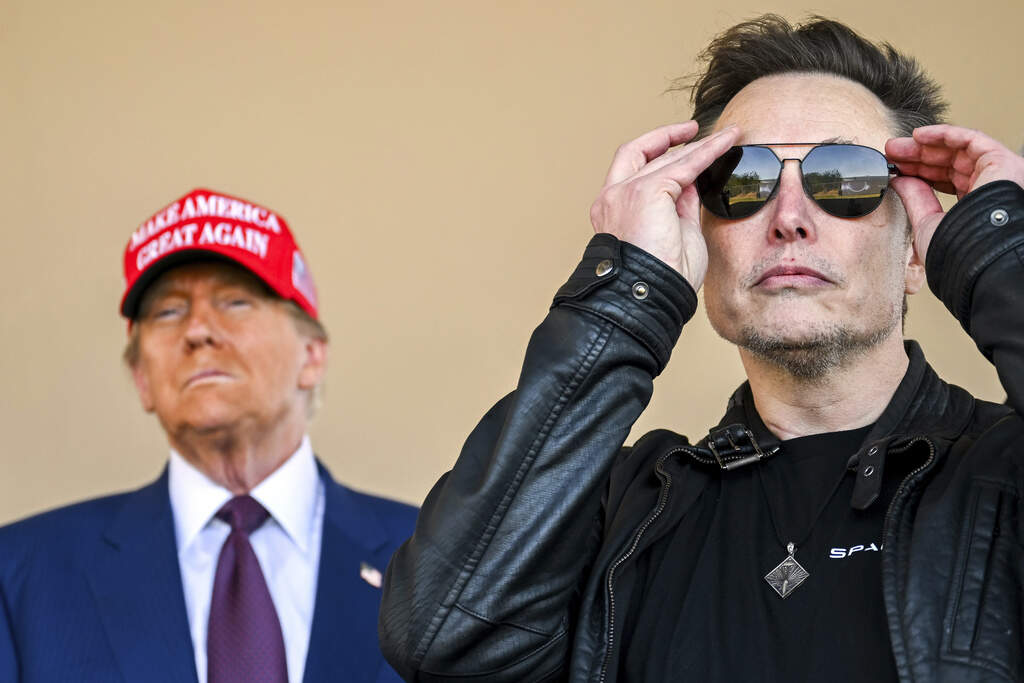
Who are America's new oligarchs? They're pouring billions of dollars into politics, have the ear of the president-elect and control an endless stream of your data. Now that confluence of tech, money, and politics is making Silicon Valley tech titans the most powerful people in America.
Guests
Adam Segal, chair in emerging technologies and national security and director of the Digital and Cyberspace Policy Program at the Council on Foreign Relations.
Marietje Schaake, fellow at Stanford’s Cyber Policy Center and at the Institute for Human-Centered AI.
Also Featured
Nur Laiq, Research Fellow in Technology and Geopolitics, and an Ernest May Fellow in history and policy at the Harvard Kennedy School.
Transcript
Part I
MEGHNA CHAKRABARTI: Elon Musk has president-elect Donald Trump's ear. He's part of the Department of Government Efficiency that Trump wants to create. Moreover, Musk's super PAC paid for the Trump campaign's ground game in swing states. But he's not the only tech billionaire in politics right now.
OpenAI CEO Sam Altman is on the transition team of San Francisco Mayor Elect Daniel Lurie. Peter Thiel has famously influenced the thinking of Vice President Elect JD Vance. And LinkedIn founder Reid Hoffman poured money, time, and his connections into the Harris presidential campaign. So the bros of big tech are no longer just wielding technology and wielding their money.
They're also rapidly gaining political power, too. They're becoming a, quote, 'broligarchy,' to borrow the phrase from Carol Cadwalladr, a reporter for The Guardian. In an essay this month, Cadwalladr writes, quote, 'We had eight years to hold Silicon Valley to account, and we failed utterly,' end quote. By the way, Carol Cadwalladr is one of the reporters who first broke the story of Cambridge Analytica and Facebook way back in 2016.
We'll talk about that a little bit later. But now, Cadwalladr is writing that we live in a world, quote, 'Where elections are downstream from white men talking on platforms that white men built, juiced by the invisible algorithms, our broligarch overlords' control. This is culture now,' end quote. So to borrow a phrase from the scholar Shoshana Zuboff, another way of putting it is that this is where surveillance capitalism fuses with American political power.
So how will this new oligarchy shape your world? Adam Segal joins us now. He's Chair in Emerging Technologies and National Security and Director of the Digital and Cyberspace Policy Program at the Council on Foreign Relations. Adam Segal, welcome to On Point.
ADAM SEGAL: Thanks for having me on.
CHAKRABARTI: Okay, so first of all, would you describe the kind of wealth and influence that folks like Musk, Thiel, etc., wield right now as a new oligarchy?
SEGAL: Yes and no. I think we definitely are seeing new centers of power reemerge. We should remember that the tech companies have interjected themselves into politics lots of times, but we're definitely at a unique point where the concerns of the tech companies seem to overlap with a lot of what the right wing politics is interested in.
And so we are seeing, I think that's right. A kind of a new source of influence, a new source of power, how long and lasting and how durable it is. I'm not sure.
CHAKRABARTI: Okay we can't predict the future, for sure. But the reason why I'm very specifically using this word oligarchy is because its simple definition is a small group of people having control over a country or an organization or an institution. And I think that by that definition, especially the institutional part, and I'd say the institution of the digital, institutions of the digital world that we live in, since they have become so consolidated, that a lot of these folks do constitute a kind of emerging oligarchy, no?
SEGAL: Yeah, that's definitely true.
How the social media algorithms are determined, what we see in our feeds, how that influences the public discourse, all of that, all those decisions for a while now have been made by a small number of people. And you have clearly cascading effects on other institutions, beyond just the tech platforms.
CHAKRABARTI: So have we seen though this kind of confluence around the direct participation of the Silicon Valley billionaires in government, the way that we're seeing with the Trump campaign? The transition and the kind of administration that President-elect Trump says he wants to bring into Washington, come next year?
SEGAL: Yes. We'll have to see what the DOGE, the Department of Government efficiency actually does. But appointing Musk and Vivek Ramaswamy to those positions and seemingly giving them direct influence on the size and scope of the federal government is a clear sign of the impact and power that they're going to wield.
CHAKRABARTI: Okay, so is that necessarily a bad thing, though? Obviously, I have set this up as something we should be, let's see, that should be scrutinized further. But I presume that there's a lot of people out there. Most notably the president-elect, who think that this is exactly the kind of world that the Silicon Valley leaders emerge from.
Donald Trump is saying that's exactly the kind of thinking that we need to bring into government. So it means, is it necessarily a bad thing?
SEGAL: So I think someone like Musk certainly has a track record of being innovative and delivering cutting edge technologies. The question is, are those same skills applicable to the federal government?
And I think you're right. There are lots of people who think that there are widespread government efficiencies that somebody with a business sense could come in and quickly cut out. I think in the past, that's pretty much proven not to be the case, and I think people are extremely worried with the example that Musk set when he took over Twitter, where he, over a very short period, fired, let go, close to 80% of the staff. And that is not going to work for the federal government.
That's not how the federal government managed to get things done. So I think there's a tension between, some who think, We just bring a new set of eyes in and some really radical thinkers and they can really change how the federal government works. And those who think the institution's procedure, as processes, protections exist for a reason, they both increase the accountability and transparency of the federal government.
And there's a reason why the government goes slowly.
CHAKRABARTI: Okay. Adam Segal, hang on here for just a second, because I want to bring Marietje Schaake into the conversation. She's a fellow at Stanford's Cyber Policy Center and at the Institute for Human Centered AI. She's also a former Dutch member of the European Parliament, where she focused on tech policy there, and she's author of the new book, The Tech Coup: How to Save Democracy from Silicon Valley.
Marietje Schaake, welcome to On Point.
MARIETJE SCHAAKE: Good to be here. Thank you.
CHAKRABARTI: You're right there in the middle of the lion's den, so to speak, being at Stanford. How would you describe if there is, how would you describe the new confluence as I see it? And you can feel free to reject this entirely, but of power between the billionaires that have emerged from Silicon Valley and the political, federal political power center of Washington, D.C.
SCHAAKE: Well, I think it's very worrying and it's the consequence of not intervening, not imposing more accountability mechanisms, oversight, checks and balances on this growing tech layer that is essentially controlled by a handful of companies and their CEOs on our daily lives. And so I analyze this as being a more systemic problem that has now ultimately led to a sort of synergy with Donald Trump's political views. We'll have to see how long it lasts. A lot of explosive characters in small spaces, we'll have to see how it goes. And we'll also have to see how other tech companies than X and Elon Musk's various companies, Tesla, SpaceX, will appreciate that Elon Musk is now so close to the president and presumably informing decisions about all kinds of policy, including on technology.
CHAKRABARTI: Okay. But the title of your book is The Tech Coup, which implies that you already see systemically that there's a much greater consolidation of power, of political power that these small, this few number of tech companies have. What examples would you point to?
SCHAAKE: So I indeed see Trump's role merging with that of Elon Musk really as making visible this power grab that's unaccountable by tech companies, large and small, by the way.
Because you mentioned before that they have power through the technologies that they develop, their algorithms, their platforms, their inventions, like spyware or facial recognition systems or weaponized drones, create new realities on the ground, upon which regulations and policies need to catch up. And they haven't, because political leaders from the left and the right have really trusted market forces, chosen a hands-off approach in the United States that got us to where we are.
And a number of tech companies are also incredibly wealthy. They have significant amounts of data, capital, are able to hire anyone that they want, and so they can also leverage that capital towards lobbying, shaping our understanding of technology through funding, think tanks, academia. And they're really now in a position of understanding the technology in ways that is very hard to compete with or to challenge from a public interest perspective.
So I think this is a threat to democracy, but also through the public interest writ large, when we have powerful companies expanding their power, integrating more and more functions. Without the kind of transparency and accountability that are normal and healthy and that we see in other sectors of our society.
CHAKRABARTI: Adam Segal, would you like to respond to that?
SEGAL: No, I fundamentally agree. I think especially over the last three to four years, we've seen tech able to push back against and divert a lot of the social civil society efforts to bring more transparency and accountability. Certainly, after the 2016 elections and the claims about Russian interference on social media, we saw an explosion of researchers and think tanks and academia doing work trying to understand how information was manipulated.
And now through series of political pressure, court cases that Marietje is going to know very well being at Stanford, a lot of those places now have either been shut down, or are afraid for their futures.
Part II
CHAKRABARTI: Adam, you had said earlier, and I'd love to dig into this a little bit earlier, that the presumption was that in the past if Silicon Valley had any politics, it probably leaned liberal, but now there's this turn towards Trumpism.
Can you walk me through that a little bit more and why do you think that happened?
SEGAL: Yeah, I think there was a strong tie to the Clinton administration. And in part, because the Clinton administration adopted a lot of the policies that shaped the internet for the next 20 years and got us into this situation, which was a hands off, market led, private sector led approach to governance and regulations.
And so the tech companies essentially saw their interests heavily aligned with kind of democratic politics and U.S. foreign policy more broadly. And I think what's happened over the last five years, especially as there's been a kind of a reconsidering of the hands-off approach to technology, and concerns about the size of the companies and their dominance of the markets.
And the Biden administration in particular seriously considered anti-monopoly and antitrust regulation, that the tech firms began to see the government as a threat. And in some cases being anti innovation and anti-progress, and so they have adopted the right-wing perspective on, the U.S. government gets in the way, that should be dismantled, as allowing them to move forward on artificial intelligence, on space exploration, and all of the cutting-edge technologies that they really think are going to shape U.S. national and economic security.
CHAKRABARTI: Okay. Marietje, let me be a little iconoclastic here, because I actually want to push back against the idea that there was a natural alignment between Silicon Valley and Democrats in this country. Because I think the true politic, the beating heart of the political belief system of Silicon Valley culture is libertarianism.
And back in the '70s, what it was a kind of purist Ayn Rand libertarianism, where it was just, we should be free to develop and innovate in any way that we want. It was not necessarily ideological, but it was more, this is a place that attracts great minds, and the only way to create great things is to reduce regulation down to an absolute zero.
What may be happening now is that libertarianism itself, at least as practiced at Silicon Valley, may be shifting towards the right. But I wanted to ask you about that, because I think that's really what's driving Silicon Valley's, and the billionaires seek, search for political power, is just to advance a view of the world where their beliefs, their abilities, their companies operate in a totally unfettered way.
SCHAAKE: So if we go back in time and look at libertarianism, I see a spectrum between a more progressive idea of what technologies could offer people, how they could empower, for example, offer better privacy protections through encryption, or an alternative financial system out of a healthy mistrust of big banks, for example, all the way to where we are today. Where we see that the convictions of the Peter Thiel's of this world, but also a lot of the crypto entrepreneurs, we should not forget their role in these elections and their ambitions for this next U.S. government, are very much more about being against state institutions, against a democratic system at all.
So being convinced that through technologies, better outcomes can be achieved, and that state institutions are pretty much inevitably in the way. And so the combination of that more radical libertarianism, and the power that these entrepreneurs have through the companies, they operate the billions that they can pump into campaigns, and what have you, creates a different reality.
One where initially, there was more of a sort of underdog sentiment in Silicon Valley, challenging the powers that be, the incumbents that were strangling markets and restricting competition, to being these incumbents and really challenging the system writ large. I think that switch among a couple of very powerful people in Silicon Valley is what explains their agenda, and they're merging with someone like Donald Trump right now.
But we shouldn't exaggerate. There's still a lot of wealthy donors from California supporting the Democratic party and Kamala Harris. I just think that there might be a difference sometimes between what are considered the corporate interests and what are the personal preferences of some of these CEOs.
And certainly, the employees who I do believe if you look at the amount of immigrants that work in these tech companies, if you look at people who identify as LGBTQI[A], a lot of them will not be happy with what Trump might bring. I know there's a lot of worry among these people, and they're not alone.
So we'll have to see how that whole dynamic of alliance plays out. California has, of course, been a bit of an island of progressive politics for a long time.
CHAKRABARTI: We're going to get to the role that the state of California and its particular politics has played in all this in a few minutes, but let's just listen to one of the folks we're talking about in his own words.
This is Peter Thiel, best known as co-founder of PayPal. He's very influential, sort of in the orbit, the intellectual orbit that now Vice President elect JD Vance has been circling in, and he's also donated a lot of money to campaigns. But here's Thiel himself on the TRIGGERnometry podcast back in July.
PETER THIEL: My policy intuitions are still broadly quite libertarian in terms of what one should do, and so I still think there is a lot that one could do by deregulating, having less severely regulated economy.
CHAKRABARTI: Okay, Marietje, though. I want to hear from you of an example that you've written about how that this particular 2024 version of Silicon Valley libertarianism is actually playing out when it comes to democracies. And to, you know, the ability of a government or a sovereign government to enact policies in its own country. Because you have written about what Elon Musk did when the government of Brazil asked Musk to make significant changes to X/Twitter.
Can you tell us about that?
SCHAAKE: Sure. We see more and more confrontations between powerful tech executives and lawmakers or in the case of Brazil, judges. So the judge in Brazil was investigating this attempt to challenge the outcome of the elections, basically a coup investigation in Brazil, similar to the January 6th storming of the U.S. Capitol in the United States.
Something like that happened in Brazil, as well. And the judge was looking into a variety of aspects, including the role of disinformation, and people who were drumming up violence online. And as part of that investigation, he requested that X take down a number of accounts that were being investigated, and Elon Musk called this censorship and refused.
And so a whole standoff between the judge and Elon Musk ensued where Starlink was brought in and there was a freezing of the assets of the companies, and ultimately Elon Musk folded. I think it's important to underline that. So ultimately, he complied with the law of the land.
CHAKRABARTI: They had to freeze his assets in order to get him to do that though.
SCHAAKE: It was definitely a standoff, a big arm wrestling. And we'll have to see what more there is to come, but in any case, it's just an illustration of how a number of tech executives seem to believe that the law is perhaps for everyone, but not for them.
CHAKRABARTI: But can I just emphasize something that you said earlier?
Because I want, you've written about it so clearly, I want people to understand this. As you said, so the Brazilian government, the president and the judiciary there was saying, take down this disinformation from certain accounts on X. And to be clear, the first thing that Musk did is he defied the order, right?
He defied the ruling. And then actually, directly, as you said, urged Brazilians to use VPNs to evade a government blockage of certain Twitter sites, Twitter accounts. And then, wait, how did he use Starlink as well?
SCHAAKE: So when people were no longer able to access it through their regular internet service providers, he encouraged them to go through Starlink.
So he evaded the order with his own technologies from another company. So he leveraged multiple companies together vis-a-vis the Brazilian judge. So it's the judiciary. It's not a direct government order. It's just a legal proceeding. And yeah, this is typical, I would say, for a sense of hubris, a big sense of entitlement and power vis-a-vis Democratic rules.
In my book, the Tech Coup, I make a big differentiation between orders from democratic states, or the role and legitimacy of democratic leaders, versus those who are in more authoritarian and repressive systems. Because I don't think they should be equated. But in general, I think the challenge is that more and more power has crept towards the private tech sector, that has not been accompanied by the necessary checks and balances and oversight. And it invites abuse.
It invites arrogance. It invites lobbying to go around the rules. We saw a company like Uber design software directly aimed at misleading lawmakers and regulators. The brazenness of these individuals and their companies is really quite excessive.
CHAKRABARTI: Okay. So Adam, I would love to hear your thoughts on this because I appreciated Marietje bringing up this.
Musk, X and Brazil example, because it's just a very concrete one about how one of these Silicon Valley billionaires not only said he was going to defy a request from another government, but actually told the people of that country, And here's how I'm going to help you also do a workaround.
That arrogance is, I think even, let's put it this way, I think it's a gentle way of describing the complete rejection of the rule of law in that country, right? And is there a possibility that now, when such examples, such things are done.
And it takes the freezing of assets to stop a man from doing it, that we could see even worse examples if Musk and other tech billionaires have greater power within the apparatus of the U.S. government.
SEGAL: I almost read the Brazil case as an example of something, of how states are going to react more in the future in the sense of, I agree that it's a high degree of arrogance, but I also think it may be some hubris in the sense of that it's going to cause the tech firms a lot of problems in the future. And so the lesson of Brazil and many countries is the tech firms are going to either ignore us or sometimes resist us. And so what leverage do we have? Sometimes that leverage is, do they have people locally that we can arrest? So now we see, more and more states saying, you have to have an office here.
So we can not only seize whatever assets we have, but we can make it extremely painful for you, for CEOs and others. And also last week, Brazil announced that it was developing an alternative to Starlink, with a Chinese state satellite company.
So I think lots of countries are going to say, we can't rely on Musk in particular, and what are the alternatives there?
And that, to go back to another point, in the Thiel quote, there's lots of people around Thiel. Alex Karp and others who are much more tied into the kind of national security complex. And their companies are going to be very reliant on the federal government and defense department contracts.
And let's not forget that Starlink and SpaceX is dependent on U.S. Government spending for satellite launches. And they're going to have a different view about what the government's role in technology is. And they're going to be much more focused on industrial policy and competition with China.
And going to be much less laissez-faire.
CHAKRABARTI: Okay, so that's a very important leavening or reality check here in this conversation. I appreciate that, but Adam, it makes me wonder about whether inevitably, we'll have a modern version of what we've seen in the past, when companies that either create a new technology or are wildly successful and get very big, and therefore have a huge influence on a country, that there ultimately is some sort of balance struck.
I'm thinking like, okay, the oil barons or the railroad barons in this country, that when the amount of power they had by virtue of the assets and technology and systems they were controlling, had influence in government, but ultimately government pushed back sometimes with trust busting, for example.
Does that sort of give you a sense that we will play through a similar routine now with Silicon Valley?
SEGAL: We seem to be in the starting stages of that possibility, right? Lina Khan the head of the FTC and in the Department of Justice under Biden, were pursuing anti-monopoly and cases, and we saw Google just lost this recent case, and Google may have to sell a Chrome.
But the problem with those actions are that the court cases take years and years, and the companies often move on and move into other products, and mass control and wealth in those spaces. Government regulation in the U.S. has been pretty ineffective. Europeans have been more effective in passing, maybe not as effective as they'd want to be in implementing, but they certainly, between the Digital Markets Act and the Digital Services Act, have tools on the books to be able to try and reign the market in.
I think, for the U.S. system, the best hope is quite honestly innovation and the rise of other firms that challenge the tech companies. And that's going to be one of the things that's going to be so essential around artificial intelligence. Is that right now, it's dominated by OpenAI and Anthropic and the other companies that can afford the compute, and the energy, and training the models. So the role that the U.S. government can play in ensuring that others have access to those resources is going to be critical.
CHAKRABARTI: Oh, that's interesting. Marietje, what do you think about that? That the very sort of essence of Silicon Valley churn in terms of ideas and generating, new concepts and new ways of thinking, might be the very thing that helps put a check on the current power that this handful of billionaires may have.
SCHAAKE: That hasn't worked so far. In fact, the opposite has happened, is that the power that a number of the tech companies assembled, put them in a jumpstart position to now also become successful AI companies. And I think we will not see regulatory intervention or even forceful antitrust cases coming out of the Trump administration.
If you look at the appointees that are now lined up, including Brendan Carr for the FTC, who is the opposite in his convictions, compared to Lina Khan.
Part III
CHAKRABARTI: Let's listen to some of these billionaires in their own words. We've been focusing on the ones who have been supporting now President-elect Donald Trump, but of course we mentioned earlier that Reid Hoffman, who is co-founder and executive chairman of LinkedIn, also a very influential Silicon Valley billionaire, poured a lot of money, time, and resources into the campaign for Vice President Kamala Harris.
Here he is on his own podcast called Possible in September.
REID HOFFMAN: I believe in the stability of the rule of law. I believe in the importance of truth telling and accuracy, when you looked at President Trump's debate performance, it was entirely a bunch of lies and slander. And the important thing about building the future is to be truth telling.
CHAKRABARTI: So that's LinkedIn co founder Reid Hoffman. Here's another one. This is Joe Lonsdale. He is a co founder of Palantir. It is a very influential data mining and defense technology company. In June, CNBC's Andrew Ross Sorkin asked Lonsdale what he would think if Donald Trump won the election and nominated two more Republican leaning judges to the Supreme Court, and here's how Joe Lonsdale responded.
JOE LONSDALE: Yeah, I think that would protect our country for a generation, to have originalist judges who believe in the Constitution, Andrew. We just, they just ruled 9-0 to protect the abortion drugs. These people are not activists. They're clearly trying to interpret the Constitution. And I think that makes us very safe.
They're gonna stop the unrealized taxes. They would destroy the innovation sector. And they're going to stop a lot of this nonsense. Jackson, who's the only person Biden put on, was the only one to very clearly say she wants a wealth tax. You do a wealth tax, you destroy our sector. So I think in terms of protecting the United States of America, we need originalist judges.
CHAKRABARTI: So that's Joe Lonsdale, co-founder of Palantir this past summer on CNBC. Marietje, I'd like to have you listen along with me because we have touched upon the emerging influence of Silicon Valley. Over time, and I wanted to dig into that a little bit deeper. Because major leaps forward in technology, basically, they always change human society, everything from the wheel to the printing press, the telegraph, internal combustion engine, the internet, it always has a massive change on how we live and what power is. And today's digital oligarchy, I would say, isn't just influencing politics in 2024, but that story, in terms of digital oligarchy goes back some 50 years.
NUR LAIQ: Tech policy at first is really driven by one key politician, and that's Governor Jerry Brown of California. So the Californian tech economy is thriving in the 1970s and in the early 1980s, even as the rest of the country is going through recession.
And it's really a pivotal moment when Jerry Brown embraces tech policies as a means for further economic growth.
CHAKRABARTI: Now this is Nur Laiq. She's a historian who researches how governments manage, or fail to manage, technological change in a globalized world. Now in the 1970s and '80s, that's when companies like Genentech and Apple begin their rise to prominence.
And the '80s in particular are the heyday of direct government support for free market entrepreneurialism under President Ronald Reagan.
LAIQ: But a lot of people in the valley, including Apple guru Regis McKenna, think that Washington is actually an absolute disaster, because what Silicon Valley wants is targeted measures aimed at the tech industry, and in particular an R&D tax credit, which they want to be made permanent.
And Reagan does not acquiesce in this freedom. Now this actually creates an opening, and Regis McKenna invites Jerry Brown to his farmhouse in this old Apricot Orchard area and introduces Brown to Apple chairman Steve Jobs and Bob Noyce who's the co-founder of Intel. What happens after this dinner is that Jerry Brown sets up a commission for industrial innovation, and invites people like Regis McKenna, Apple's Steve Jobs.
Dave Packard of the Hewlett Packard Company, to join this commission and for the first time, to draft an industrial policy for California.
CHAKRABARTI: And by the way, Regis McKenna is a Silicon Valley Marketing guru, who, amongst other things, helped market Apple's first personal computer. Now, Nur Laiq says that this commission that she's talking about pressed for increased investment, capital gains tax cuts, and deregulation.
And when some specific policies failed to pass at the federal level, for example, tech companies instead found policy success inside California. Like in 1982, when an idea from Steve Jobs led to the Federal Computer Education Contribution Act of 1982.
The bill was never made into law, because it never came to a vote in the Senate.
But a similar law passed in California, and that law gave a major tax break to companies like Apple for donating computers to schools. But it wasn't until the 1992 presidential election that tech company influence began to flow into national politics. Prior to '92, Democrats had suffered three presidential electoral defeats in a row.
And in 1992, Bill Clinton, facing incumbent President George H.W. Bush, needed funding and endorsements. So Nur Laiq says, he turned to Silicon Valley, and that's when former Apple CFO Dave Barram had an idea.
LAIQ: Barram suggests to Clinton that why don't we have these CEOs form a CEO policy team and get them to write a tech policy for the Clinton campaign.
And so that's when we really see for the first time that Silicon Valley writes a national technology policy for America.
CHAKRABARTI: Clinton pledged to change, quote, America's tax, trade, and regulatory policies in order to, quote, help restore America's industrial and technological leadership, end quote. After his election win, Clinton then appointed Dave Barram as Deputy Commerce Secretary.
Within his first month in office, he also unveiled a comprehensive technology plan based on the one drafted by the CEOs. Nur Laiq says that back then, the government did not have concerns about how large and influential these companies would grow.
LAIQ: At that point, the thinking was that in order to grow the economic pie, that actually the bigger and better these companies, the more fruitful it would be for the national economy.
Instead, we have people like Clinton saying already in 1992, the most important family policy, urban policy, labor policy, minority policy, and foreign policy America can have is an expanding entrepreneurial economy of high skill, high wage jobs. And essentially what he's talking about is the knowledge economy, which is the economy of tech and Silicon Valley.
CHAKRABARTI: So big tech shaping federal policy isn't exactly new. But how does Nur Laiq think about what she's seeing today?
LAIQ: To have the presence of tech billionaires in such close proximity to the present is problematic. Perhaps it's not a bad thing to have it so up front and center. As we do with Musk, where it's actually all hours in the open, as opposed to happening behind closed doors.
Of course, there is a huge difference between the power wielded at that time and this, simply because the power of tech itself has grown. And what we need to be thinking about as citizens is how do we create more transparency. And more accountability in this relationship between tech and government.
CHAKRABARTI: So that's Nur Laiq. She's a technology and geopolitics fellow and a fellow of history and policy at the Harvard Kennedy School of Government. Marietje Schaake. I wanted to go over that history. Because Bill Clinton wasn't wrong. The knowledge economy was going to grow in importance whether or not the United States federal government supported it, because that's just how new ideas work, especially when they're successful and change people's lives.
But again, to the difference between then and now, do you think that the way in which these tech companies are wielding their influence, is for the good of the economy as a whole, or does their sheer size prevent that from happening?
SCHAAKE: There's a lot of concentration of capital in the hands of a few.
That's one thing. But these are not companies that are advancing a knowledge economy necessarily. We're looking at defense. We're looking at infrastructure. We're looking at data and AI, decisions that are about our civil liberties, about the way in which we are treated as consumers. And all of those decisions are made without the proper oversight.
So that historic view is helpful, but we have to also appreciate the rapid scaling and growth of the major tech companies that now are also influencing politics, as we've discussed with Thiel and Musk. But what's the difference now is that Peter Thiel and Elon Musk's roles make visible how powerful these tech companies, the technologies they have, the capital that they've gained are.
But a lot of this power is actually wielded invisibly, outside of the direct relationship with politicians, but rather through the building of the technologies, through making critical decisions on our defense, on our information ecosystem. And I think we should not be distracted by just looking at the very visible and explicit ways in which power is being wielded by the Musk's of this world.
I hope it's an eye opener to a lot of people, but we shouldn't stop there. We should really look at the various ways in which these companies have gone from small, innovative challengers of the incumbents with a lot of promise that went along with the promise of the open internet, the World Wide Web in unlocking knowledge, connecting people, empowering the unheard voices and so on, to really be coming about consolidating, making a lot of profits, taking over entire markets.
And finding themselves in positions of increasingly important geopolitical and strategic nature. So think about satellite companies, think about drone companies. Think about the fact that tech companies are now building digital infrastructure, scanning it for risk, offering cybersecurity services, and all of this is, without sufficient access to information for the public or without proper scrutiny.
CHAKRABARTI: I have come to the belief that much of this was totally inevitable by virtue of one fact that when you have so much wealth concentrated amongst so few people, power, whether it be industrial, economic or political, will flow towards those people. Look, I think it was just this year where the roughly 800 billionaires that live in the United States, so 800 people, that their total wealth was more than six trillion dollars, right?
And that's more than the bottom half of all Americans. So these 800 people have more collected wealth than 180 million Americans. And that kind of lopsidedness is gilded age era inequality. And with that in mind, Marietje, I was wondering if I could share this quote with you that has stayed with me since 2017.
And it was in an interview that Mark Zuckerberg gave to Franklin Foer who was writing for The Guardian at that time. And in this interview, Zuckerberg was talking about the power that Facebook already had, okay, and he said, this is Zuckerberg speaking, he says, quote, 'In a lot of ways, Facebook is already more like a government than a traditional company.
We have this large community of people and more than other technology companies, we are setting policy within the world of Facebook.' That's the way the thinking already was. So is it not inevitable, then, that in order to make that real outside the world of digital infrastructure, the attraction would be to influence actual policy in Washington?
SCHAAKE: Sure, I do think that it was inevitable, without putting up more guardrails and oversight over these growing companies. But I also would encourage listeners to look at what tech executives do, not just to listen to what they say, because there's often a huge discrepancy between talk about democratizing, empowering, now free speech. Listen to how often we hear steps being taken in the name of free speech, we will see this commission of government efficiency take a lot of measures in the name of efficiency, but we have to really scrutinize all these words against the real people.
But there are more steps that are taken. So for example, Elon Musk loves talking about free speech defense, but he's actually suing NGOs. So he wants them to not enjoy that same freedom of expression if that expression leads advertisers away from advertising against far-right content on his platform, for example.
Similarly, we've heard Mark Zuckerberg talking beautiful words about democratizing, unlocking knowledge, and so on. And completely overlooking the harms think about the Cambridge Analytica scandal, that was really using Facebook's data and platform to manipulate voters in certain directions, something very anti-democratic.
We have to really hold these executives to account for what they do, much more than for the wonderful things that they say and promise.
CHAKRABARTI: So last question though in terms of a democracy protecting itself from undue influence from any one particular area, I think in the United States, at least, the government is really behind the eight ball here. Because look, they need the people from Silicon Valley to help write the policies, because that knowledge just isn't in government, in and of itself.
SCHAAKE: This is a huge problem, but it also underlines the urgency. And I would imagine that people, whether they work in national security or in the tax authority or in education, really don't want corporates to have so much decision-making power. Think about all the taxpayer money that is being used to buy tech products, for a lot of tech companies, governments are incredibly important customers. You mentioned Palantir, I'm glad you did, but also for Microsoft and Google and AWS, they are incredibly important customers. And so governments, short of regulating, can also set different standards, demand more accountability and transparency from companies just through the contracts that they have.
And so I think indeed this knowledge position should be one that is a goal to improve. And in fact, I would say reclaiming the primacy of democratic governance should be a cross-cutting policy objective throughout. And that whole goal has just gotten a whole lot harder with the Trump administration on its way.
This program aired on November 25, 2024.