Support WBUR
Should we farm octopuses for food?
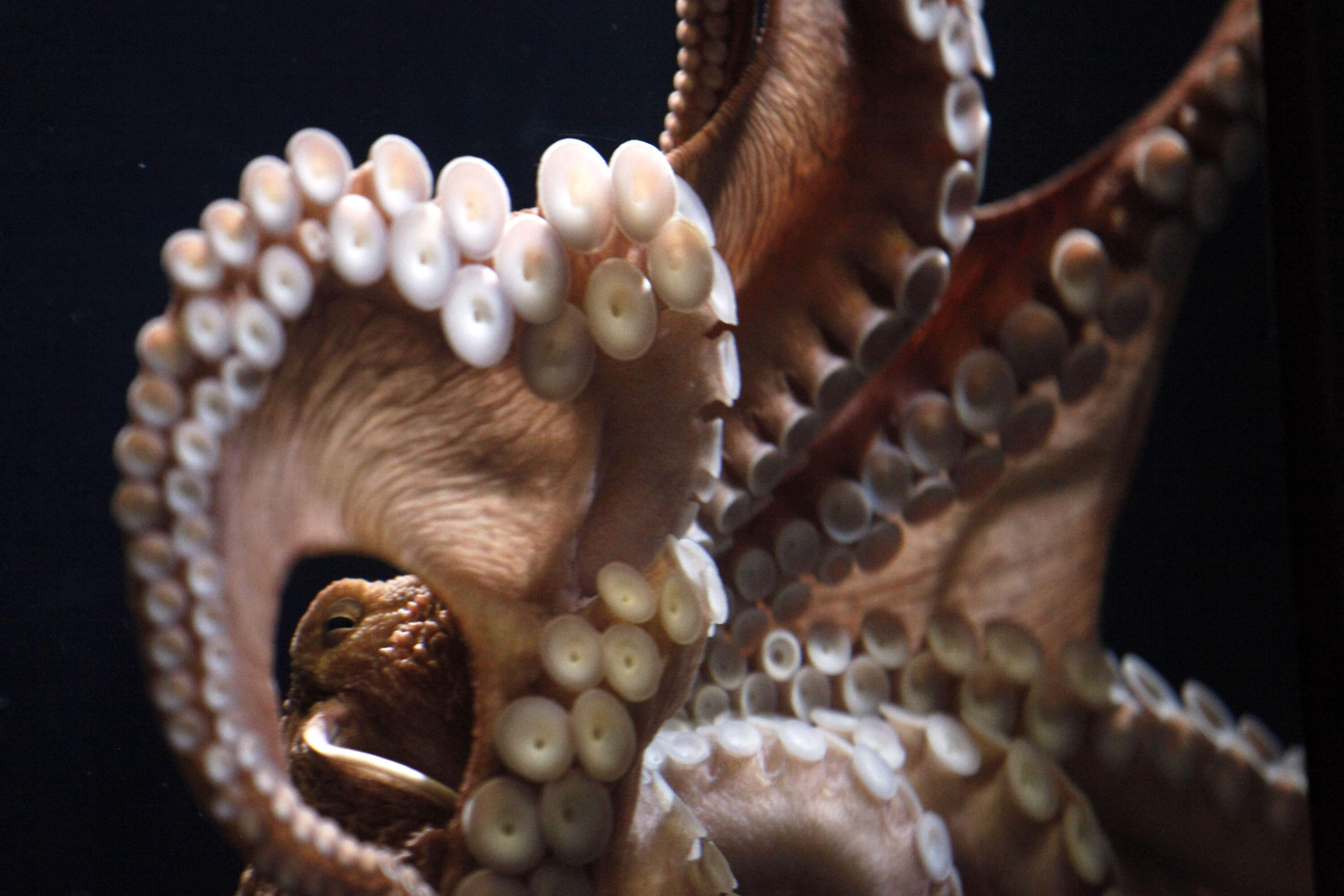
The octopus is highly intelligent. It’s also a favorite food of humans around the world. In Spain, a proposed octopus farm claims it could raise a million animals per year for eating. That's sparking protests, and possible bans here in the United States.
Guests
Laura Lee Cascada, Senior director of campaigns at Better Food Foundation. Founder of The Every Animal Project.
Jennifer Mather, Professor of psychology at the University of Lethbridge and a leading expert on octopus behavior. Co-author of the 2010 book Octopus: The Ocean's Intelligent Invertebrate. Scientific advisor to the Netflix film My Octopus Teacher.
Transcript
Part I
MEGHNA CHAKRABARTI: A few years ago, Spanish seafood company Nueva Pescanova announced plans to build a commercial octopus farm on Spain's Gran Canaria Island. The facility would be more than 560,000 square feet and raise about a million octopuses annually for food. That's according to proposal documents given to the BBC by the animal welfare organization Eurogroup for Animals.
For now, Nueva Pescanova's plans still exist, but they haven't moved forward significantly. But the news of a potential octopus farm immediately raised concerns from researchers, activists, and many animal welfare groups. And it sparked protest campaigns against the effort. Right now, even in the United States, there are state and federal level bans in the works.
The concerns range from the cephalopod's cannibalistic potential to their considerable intelligence. After all, octopuses are known problem solvers and escape artists. They're able to use tools, and they can recognize individuals outside of their own species, including human faces. So today On Point, we're going to talk about these fascinating creatures and the debate over octopus farming.
But instead of starting in Spain, we're going to start right here in the United States, because up until two years ago, there was, in fact, an octopus farm, in quotes. In America, it was in the Kona region of the Big Island of Hawaii. In practice, the Kanaloa Octopus Farm was closer to a petting zoo and a research center.
It had future ambitions to promote commercial octopus aquaculture. But for activists who say octopus farming is an immoral and harmful practice, what they saw at the Kanaloa Octopus Farm felt like evidence of the inherent cruelty in potential large scale octopus farming. So to tell us what happened, we're joined by Laura Lee Cascada.
She's the Senior Director of Campaigns at the Dietary Change thinktank Better Food Foundation. She's also founder of the blog, The Every Animal Project. Laura Lee Cascada, welcome to On Point.
LAURA LEE CASCADA: Thank you so much, Meghna. It's great to be here.
CHAKRABARTI: So can you first tell me the story of when you initially stepped foot onto the Kanaloa Octopus Farm.
Why you were there and what you saw?
CASCADA: Sure. So I heard about the developing farm in the Canary Islands, and I was very concerned because I knew that octopuses are really intelligent creatures. And so when I learned that there was an actual octopus farm in Hawaii, and it happened to be very close to where my parents live on the Big Island.
I knew that it was something I had to visit and to check out and see what was going on there, whether it was actually a farm where they were raising and selling octopuses for consumption, whether it was a petting zoo, whether it was a research facility. There were so many questions swirling around. And I really wanted to take a look and find out whether this beautiful place that my parents call home was hosting something as terrible as an octopus farm.
CHAKRABARTI: So we will tell the story a little bit later about what happened to the Kanaloa Octopus Farm because it's no longer in operation, but when you visited it, what did you see?
CASCADA: At first glance, it really did kind of look like a petting zoo for ocean animals. It was very bright and colorful, and it was a pretty small facility. So we went in with a tour guide and she showed us around and basically the first thing we saw was the tanks of octopuses.
There were maybe about 12 octopuses on display at the time and each of them was in an individual white tank that was pretty small, maybe half the size of a bathtub, and each one was separate. They each had a rock to hide under and just like a plastic ducky to play with, but nothing else. So it was very barren tank, and the octopuses were very curious and looked a lot like they wanted to get out and check out their surroundings.
CHAKRABARTI: You know what you're describing though, Laura Lee, it sounds a lot like what someone might see at an aquarium, you know, even an aquarium that's whose mission is conservation, invertebrate conservation specifically. So, given that, like, what was the problem at the Kanaloa Octopus Farm?
CASCADA: Yeah, so it did look a lot like that, you're right, but one thing I quickly realized was that there was astroturf lining each of the tanks, and as we were interacting with the octopuses, they actually would try to climb out of the tanks. And I think the astroturf was an attempt to keep them in, but they really wanted to get out.
And at one point, one of them was really trying to climb out a lot. And the tour guide actually had to tell us that he needed to be closed up, because he actually had escaped before and even the morning before that he had escaped. So I think that was one of the initial problems I saw, was just that they didn't want to be in those tanks.
They're very complex animals and they had basically nothing to do except go around some little rubber duckies. So that was the first immediate concerning thing.
CHAKRABARTI: And then what was, what were some other things that you saw that gave you pause?
CASCADA: Well, so I was really curious about what was going on behind the scenes.
Why were these octopuses there? Were they being farmed? And on the website, the facility talked a lot about its existence being for the purpose of conservation, to protect wild octopus habitats, so I asked them about that, and she said conservation so many times, but I kept asking. What does that mean?
What is your goal here? And she revealed that they have been doing research to figure out how to breed these Hawaiian day octopuses who had never been bred in captivity before. As of the time of my recording, they had only gotten them to live about 13 days, so they hadn't successfully reared them in captivity, but she said that their goal was to eventually do that to successfully raise adult octopuses who could then be sold for meat.
And they revealed that it was technology or research that they would be trying to give to other countries where octopuses are threatened, where their populations are declining. So that there would be an alternative to wild caught octopus meat.
CHAKRABARTI: I see. So here's what's so confusing about what happened at the Kanaloa Octopus Farm. Because, correct me if I'm wrong, Laura, but when you were there, did the guide say, yes, our goal is to eventually raise octopuses for consumption or not? Did they dance around that?
CASCADA: It was very vague, but they didn't claim that they would be doing it themselves.
They claimed more that their research would be used for other facilities in other countries to be able to raise octopuses for meat. And that was something she really was reluctant to tell me, but I did capture it on video, where she was talking about that. And she also talked about how they had an octopus catcher who they would pay to go out and capture octopuses from the wild, who were then used in these breeding experiments.
CHAKRABARTI: Okay, so let's actually play a moment from that. Because this is where it gets into the important issue of how Hawaii regulates, you know, it's vitally important waters and the flora and fauna that live in them. So here is the recording of your tour guide talking about where they're getting the octopuses in their care.
TOUR GUIDE: All of our octopuses are wild caught. They are local from out here in the Kona waters. We have a gentleman go out and catch them for us, and we love to call them the octopus whisperers. They know exactly where they will be and when they will be there.
CHAKRABARTI: So explain to me what's the problem with this. Was it in violation of Hawaii regulation?
CASCADA: Yes, so they actually needed to have special permitting to be able to catch Hawaiian day octopuses from the wild and also to have octopuses of a weight of less than one pound, which a whistleblower later revealed that they not only were catching them, but that they also did have octopuses under one pound.
So because of that reason that this was exposed, the state actually issued a cease-and-desist letter. That was kind of the first step in the facility being shut down, because they didn't have that proper permitting.
CHAKRABARTI: I see. OK, so they were running afoul with Hawaii state regulation. Then what else did you find about the treatment of the animals at the [farm]?
CASCADA: So the main thing that was concerning to me was that hundreds of octopuses at this point, ever since 2015, had been caught over and over again and subjected to these breeding experiments, which for both male and female octopuses are always fatal. So every time they would breed, the octopuses would die afterwards.
And all they had to show for it was the baby octopuses living 13 days, so it was definitely difficult for them to keep them alive in captivity as young octopuses. And I think that's just a testament to how complex these animals are, and how much space and special needs they need to thrive. And that's what they get out in the ocean.
A whistleblower later came forward, shortly after my investigation, and revealed that not only were they having octopuses who are way too small for the permitting, but they actually would sometimes kill octopuses who had been there for a while to replace them with new ones that they had caught. And they also were escaping often and sometimes they would find deceased octopuses who had escaped, and other times the tanks were actually leaking, and they would come in in the morning and octopuses would have barely any water left in their tanks. So there were a lot of problems behind the scenes that as a visitor, we just couldn't see.
CHAKRABARTI: Okay. So then what eventually happened, as I mentioned, the Kanaloa Octopus Farm.
Has been, at least it's shuttered now, right? Because the state of Hawaii did not renew the lease that the octopus farm needed to continue. You know, working on the property where it was located. How did that happen?
CASCADA: So a lot of people really got involved in this effort. I think so many people have been moved by the plight of these octopuses.
I mean, they're so complex. They actually can stake out their territories in the wild. There's a place called Octopolis in Australia, where the males will actually fight over territory by throwing debris at each other. And octopuses have also been documented to change color while they're sleeping, and it appears that they're dreaming.
So I think as people learned about these really remarkable animals, they were really moved to take action. And so many people, hundreds or even thousands of people were writing to Hawaii State, urging them not to continue the lease for this facility. And then several different groups got involved, including Harvard Law, and they were part of a big letter urging the state to not renew the lease. And that was signed by many Hawaii cultural practitioners, which I think was really important for them to see that the full community and Hawaii wasn't happy with this and didn't feel like it was respecting the natural environment there.
Part II
CHAKRABARTI: Laura, I'm sorry I had to interrupt you there, but you were telling us after this sort of outpouring of advocacy and the involvement of folks from Harvard Law School.
And as you were saying, critically, the input of cultural authorities in Hawaii about the importance of the octopus, that that convinced the state to do what regarding the Kanaloa Octopus Farm?
CASCADA: No problem. So the state actually decided not to renew the lease. They were renting a piece of land from this state-run technology park.
So after that happened, it was effectively forced to shut down.
CHAKRABARTI: Okay. And actually, I'm glad you mentioned that because this is an important aspect of this story. Because the Kanaloa Octopus Farm was in a location called the Hawaii Ocean Science and Technology Park which is supposed to be an ocean science innovation hub.
There was at least several other aquaculture startups there. Which you can, to me, it makes a lot of sense that Hawaii would want to support companies that would find new ways to sustainably, you know, use its ample marine resources. So Laura, once the Kanaloa Octopus Farm was, again, it's shuttered now because it does not have a lease at the Hawaii Ocean Science and Technology Park.
I mean, did you feel like, okay. That was a success and that, therefore, it was proof enough that the facility that's in the works in the Canary Islands wouldn't go forward?
CASCADA: So I think one important part of this story that also needed to be recognized was that this facility had been attempting to expand. They had actually put in a request with the government to do so, and they were planning on raising more and more money through their tours. And actually, I found some documents indicating that they did intend to eventually commercially sell octopus meat.
So this was kind of a farm in disguise. And I think by shutting down, it set a precedent that at least in the U.S., how we're starting to realize we don't want octopus farming here. There have been states that have been working on passing bans. And I think, you know, the more international momentum that there is against this industry, hopefully it'll pay off and the facility in the Canary Islands will eventually be thwarted.
That's kind of still an effort in progress by a lot of advocates around the world, but that's the hope.
CHAKRABARTI: I see. So the point, the important point here is that expansion, you found evidence, ample evidence from meeting minutes, in fact, from the company and associated groups, that expansion was the goal.
Okay. Laura, hang on for just a second here. Because I want to introduce Jennifer Mather into the conversation. She's a professor of psychology at the University of Lethbridge and a leading expert on octopus behavior. She's co-author of Octopus; The Ocean's Intelligent Invertebrate. And she was a scientific advisor as well to the Netflix film My Octopus Teacher.
Professor Mather, welcome to On Point.
JENNIFER MATHER: Thank you.
CHAKRABARTI: First and foremost, I want to just put to rest a debate, because I imagine a lot of listeners are wondering, is it octopi or octopuses?
MATHER: (LAUGHS) It's actually octopuses.
CHAKRABARTI: It's octopuses.
MATHER: If you say octopi, you're putting a Latin ending onto a Greek word because the Greek word is octopus and the actual completely pedantic correct would be octopodes, which nobody uses.
CHAKRABARTI: Perish the thought to mix up ancient Greek and ancient Latin. I shall not do that from this day forward. Professor, thank you so much for that. I want to actually play for you a clip from Jacob Conroy. He is the owner of the Kanaloa Octopus Farm, whose fate Laura described to us.
And here's why. Because from my understanding is, there is, of course, a global octopus trade. People around the world eat octopus. It's worth something like $2.5 [billion], if not more, $2.5 billion annually. And so therefore, one of the reasons why Conroy said that the Kanaloa Octopus Forum had existed was sustainability.
JACOB CONROY: Octopus culture is pretty important due to overfishing. You know, the problems with overfishing is pretty localized throughout the world, so there's quite a few populations that are doing great, but it really has to do with the culture that they are next to. So, California, people don't really fish for octopus too much, but over here in Hawaii and, you know, places in Asia they fished for pretty heavily. So if we can raise them sustainably and offer some sustainable seafood as opposed to wild caught.
CHAKRABARTI: Okay. So that was Jacob Conroy, owner of the Kanaloa Octopus Farm. Professor Mather, is there, you know, human based fishing pressure on the world's various octopus species?
MATHER: Well, the answer to that is two different ways of looking at it. First of all, there is indeed very, very high consumption of octopuses, but surprisingly, while there are local shortages, worldwide, the octopus populations are booming, and one of the reasons that they are probably doing so well is that we are overfishing their top predators.
The big fish, the sharks, the big mammals. So we're actually wiping out their predators and they're doing fine. So the idea that octopuses are threatened across the planet, and we should raise them sustainably, it's not correct.
CHAKRABARTI: Okay. Well, so then there's one claim that Nueva Pescanova is making, again, they're the company that wants to build this giant, you know, ostensibly giant facility in the Canary Islands that their goal is to conserve, to help octopus conservation, while meeting the increasing demand for octopus as a food source.
Is that even, is that necessary or even possible?
MATHER: Nueva Pescanova, which is in Portugal, I believe, is making a lot of claims that are not correct. And I could take you through them one by one, if you like.
CHAKRABARTI: Sure, and it's in Spain by the way. So but yes, go ahead. I'd love to, I'd love to sort of become, get some surgical analysis, yeah.
MATHER: The first problem. And there's many problems to raising octopuses. The very first problem is that when octopuses hatch, the species that they're trying to cultivate and also the species in Hawaii is actually the size of a rice grain. The result is it's very, very difficult to get them through this first period. Okay? And what generally happens in the wild is they float off in the ocean currents, and they eat larvae crustaceans, and they eat each other maybe, and eventually they settle to the bottom within a few months.
So it's very, very difficult to raise them. That's the first problem. Okay?
Now the second problem, which is the one that people are concerned about, in terms of welfare, is that these are not social animals. And if you want to raise animals in captivity to get a large number of individuals, of course you'll want to keep them together. The people who are speaking in Nueva Pescanova say that they have developed a strain of octopuses that is more social and more tolerant of one another.
And by the way, when I mean intolerant of one another, I mean they're cannibals. Okay. Now, the problem I have as a scientist is that when I first heard about this, I said, Oh, that's nice. Please show me the evidence. And they said, Oh, no, we can't do that. It's a trade secret. So my answer to anybody who's hiding behind 'it's a trade secret' is, I don't believe you.
CHAKRABARTI: Huh. Just to add to that, Professor Mather, in 2022 the managing director of the Pescanova Biomarine Center did talk to Reuters. They wouldn't talk to us, but we did reach out to them. But they did talk to Reuters. And what they said was they had optimized tank conditions that allowed the company to supposedly eliminate aggression between octopuses.
And they said, quote, We have not found cannibalistic behavior in any of our cultures. That's all they said, that they had somehow optimized tank conditions. I mean, could those optimal conditions actually exist?
MATHER: I'm a scientist. If you're going to tell me something and you don't give me any proof, I don't believe you.
It's nice and simple. And they hide from us, so how can we tell if they're correct?
CHAKRABARTI: Mm hmm.
MATHER: You see?
CHAKRABARTI: Mm hmm. Can I turn back to Laura here for a second? Since you had visited the facility in Hawaii, did they talk about any of these issues? About the inherent difficulties, if not impossibilities, of raising octopus in captive controlled tank situations?
CASCADA: They did talk a lot about how difficult it had been to raise the babies from eggs, basically. They had tried a bunch of different feeding methods, they were raising hermit crabs, they were trying different wild caught foods, and they still hadn't really cracked it, so I think that was really the primary problem, and why they couldn't get them to live past 13 days.
And to my knowledge, nobody has figured out with this species, how to do that. They also did host them, as I mentioned, in separate containers, basically they were like containers. And I think that was because they will naturally fight. They sort of stake out their territories and they have actually really complex social hierarchy.
So to stuff them together into multiple animals into one tank probably wouldn't have worked out very well.
CHAKRABARTI: Yes. Okay. So this, Professor Mather, let me put this next one to you. If we were going to be brutally honest about how modern-day farming, especially large-scale farming, occurs, a very common practice, right, is to take a high number of animals, put them in tiny, tiny facilities, I can't even call it facilities, right, tiny containers.
We do this to everything from, you know, chickens to, you know, pigs. And raise them that way. There's a lot of debate about the efficiency slash cruelty of this kind of corporate farming, but would an octopus survive in conditions like that? They'd be separated from other octopuses, so perhaps the cannibalistic aggression problem could be overcome that way.
But how long would an octopus survive in conditions like that?
MATHER: Well, but it strikes me that if you wanted to keep solitary animals and raise them in large quantities, you're probably not, it's not going to be economically feasible. Because if you have to keep them separate from one another, it's just not going to work.
There are other problems in octopus farming, which if you like, I can talk to you about as well.
CHAKRABARTI: Yeah, please. And it occurs to me that even the scenario that I put forward would still require the facility to overcome the considerable challenges in replicating the octopus reproduction cycle, which you explained a little bit earlier, why that would be so hard, but yeah, but go ahead and talk to me about the other.
MATHER: Well, one of the biggest problems is, what are they going to eat? Now, if you actually look at economically feasible farming, it's usually with herbivorous animals. Think of cattle, think of sheep, think of goats, think of chickens. But these are carnivores, okay? So you have to feed them other animals, which you have to purchase.
Now, it turns out that octopuses have a real thing for crabs. They really like crabs. They'll go out of their way to get them, even though they have less energy, say, than a clam. They'll choose the crab. But crabs are more expensive than octopuses. So you're not going to make any money that way. Clear.
CHAKRABARTI: Well, Nueva Pescanova had a response to that, because that, yeah, right.
And I'll just quote what they told NPR last year, that what their plan was, instead of, you know, taking wild caught seafood, they told NPR, quote, it would be a diet formulated based on byproducts or bycatch and discards from fishing, as well as raw materials of marine origin certified as sustainable.
MATHER: Right. Now, there are people across the globe, actually. There are several research institutes that are trying to figure out how to raise octopuses that have given them pelletized, essentially, fish meal. And there's a very interesting problem with this. The octopuses don't really like the stuff.
They eat it. But they don't eat as much as they would if they had wild caught prey. And the result is that they don't gain weight very well. And it's just completely self-defeating, because you say, okay, we're going to give them, you know, these fishmeal pellets, and they'll be fine, but they're not going to gain weight, so you're not going to make money out of having nice, fat, quickly maturing octopuses.
So it's a Catch-22 for them, and I don't know why they think they can solve the problem. Because other people have not.
CHAKRABARTI: Yeah, it's interesting, but they claim that they've found some kind of efficiency here, right? They also told NPR, quote, its efficiency and assimilation has already been demonstrated, and it's a circular economy solution that helps to avoid having to resort to fishing wild animals to feed the octopus.
Again, as a scientist, does that make sense to you?
MATHER: I don't take any of their claims seriously, because they have no evidence to back it up. Nice and simple. Okay? And there's no doubt there are other organizations in the world that are trying to figure out how to make a good diet for octopuses. But so far, it's not encouraging.
So far, it's not working very well, so why should they be any different? That's not the only problem they have, however, I can continue with the problems, if you like.
CHAKRABARTI: Sure, just hang on for one second, because I want to turn back to Laura on this. I mean, like, what are your thoughts about these other issues with octopus farming?
Because as Professor Mather points out, there are still efforts to sort of develop procedures that might make octopus farming a possible reality, whether or not it will actually come to pass.
CASCADA: Right. Well, like the professor said, I'm also concerned that, you know, we haven't seen any evidence to back up these claims. And companies, especially large factory farming companies are really good at greenwashing.
That's how they've convinced us that the chickens we're eating are roaming around on pastures when actually they're confined really tightly in barns. And so I would err on the side of this being another example of greenwashing. And even, you know, you mentioned that maybe getting certified sustainable seafood.
I would love to hear more about what those certifications are, because at the Better Food Foundation, we're actually learning right now about how many of these certifications don't really make that high of standards and some of them you can actually still engage in bottom trawling, which is devastating for our oceans and still get that certification.
So I would be concerned about their claims, because we know that they're trying to mass raise a million octopuses a year and do so in a cost-effective way.
CHAKRABARTI. Right. That's their goal. And in fact, just for full disclosure, we did contact Nueva Pescanova several times and the most we got back from them was a statement that said regarding your inquiry about the octopus farm, there are no updates on the project at the moment.
Part III
CHAKRABARTI: I did want to give you, Professor Mather, a chance to, you said there were a couple of other major difficulties or issues with the entire concept of octopus farming and tell me what they are.
MATHER: Well, one of them, of course, is are you being reasonable to an intelligent animal to keep it in a barren environment, but I'll leave that one till next.
One of the problems with keeping octopuses is that they excrete ammonia. In other words, they pee in their tanks. Now, what generally happens is the people will set up a facility near the open ocean. They'll pump in water. The water will go around the tanks, and they'll pump it back out into the ocean, right?
But where, in the way the Pescanova is set up, there is a bay. And of course, that makes sense, because it's sheltered for people to come and go. But that means that they're taking water in from the bay, pumping it around, filling it full of ammonia from the octopuses, and pumping it back out in the bay. Any facility has to have some kind of an environmental impact review.
What's happening to the bay, because of the proposal to put the farm in there and they've had such a review, and they failed. So they can't go ahead until we've figured out how not to pollute the environment that the tanks are supposed to be near. Of course that doesn't have anything to do with the octopuses.
And it is true, these are intelligent animals, they get bored quite quickly, and sometimes when they get bored, they leave, and as your other informant mentioned, they can climb out quite easily. It's very, very difficult to keep octopuses in a tank if they don't want to keep them in. And they die. So in terms of environmental enrichment, it's critical to get these animals environmental enrichment.
And I mean, this is a problem that we have with farmed animals everywhere. Think of chickens in battery cages. Think of pigs that are crowded in their own feces in some cases. So the problem is a universal one. How do we keep animals so that their lives are made reasonable? If we're going to keep them for food.
Yeah. And this is not a problem we have solved easily. We've made some progress. But the thought of taking yet another animal and dumping it into a bad environment is depressing, to say the least.
CHAKRABARTI: Mm hmm. Well, again, I want to just let listeners know that we did try to reach out multiple times to Nueva Pescanova to get their response to these concerns.
They did not respond to us except for saying there was no update on the farm. But now Laura Lee Cascada, let me turn to you because we're getting to what I think many people will find the moral and emotional heart of this debate. And that is, why should, what is the argument for, which we can't hear because Nueva Pescanova is not getting back to us, or against even just trying to farm these animals that do have kind of demonstrated intelligence.
Now, of course, there's an argument that we shouldn't be farming any animals, and the threshold should not be intelligence. I want to say that. But what's your thought? What's your thought about sort of the moral question around octopuses?
CASCADA: I view this entire effort would create a whole new version of factory farming, a version that's involving an entirely different species than anyone we have factory farmed before, and I've worked on factory farming issues my entire career, and I've gotten very familiar with the horrors that we inflict on animals by cutting off their beaks and cramming them in small areas.
And you know, there's something different about octopuses that I noticed, that I hadn't really thought that much about before, which is that potentially the psychological abuse that they would be enduring in these tanks could be worse for them than the physical suffering. And it really struck home for me, because at the time of my investigation, my dad had just been in the hospital. And as he was going through a state of delirium as he was recovering, he kept trying to get his legs off the bed and the nurses would keep putting them back on, and he kept putting them off again. And he was trying to get up and walk away, but he couldn't.
And the amount of distress he was in was just horrific to see. Because he couldn't understand why he couldn't get out. And so when I saw the octopuses with their arms over and over again, trying to get out, it was really distressing for me to see. And I think people there thought it was cute. They were trying to climb out, but I think for them, it was basically torture, living in that environment.
CHAKRABARTI: So Professor Mather, we know, I think that it's somewhat common knowledge, maybe I'm presuming a lot, that octopuses can use tools. Lots of species actually can use tools. ... But there's other sort of measures of, I think, how we humans recognize intelligence that octopuses have.
I think the most remarkable one that I only recently learned about is that they have the capacity to recognize individuals of species outside of their own species?
MATHER: Yes, that's correct. That was actually a study I did with Roland Anderson at the Seattle Aquarium. And they actually, he and an assistant dressed up, and they used aquarium t shirts so that there had to be more than just, you know, different color, different clothing.
And they tested octopuses. What they did is, one of them was what we call good cop and fed them, and the other was what we call bad cop. And touched them with a test tube brush. And they learned to recognize the two of them. So, I mean, that, indeed, that's intelligence. One of the interesting things that they do, which suggests intelligence to me, is that they play.
And again, this was Roland and I. Working at the aquarium, and we noticed that they would blow jets of water at a floating bottle. And, you know, kind of push it around the tank and it would come back, and they'd push it back again. And I remember Roland phoning me when we'd be doing this study and he said, she's bouncing the ball!
And it was exactly like bouncing a ball.
CHAKRABARTI: Well, can you also --
MATHER: another way in which we know about their intelligence is that they learn everything. There seems to be nothing that they don't get curious about, they don't explore, they learn what to do with. So they're a fascinating animal, and they're very, very interested in exploring their environment.
CHAKRABARTI: They seem to be capable of some pretty complex problem solving also.
MATHER: Yes, and one thing I should mention is that they do indeed plan for the future. And so it's not like you learn and you recall, and you use it. They do actually plan for things that are going to happen in the future. And that's really a very, very big sign of intelligence.
CHAKRABARTI: Well, so there's two more questions I have about how we understand octopus consciousness. The first, professor, is, I understand that they have, like, a kind of brain in each of their tentacles, so they have this sort of --
MATHER: No!
CHAKRABARTI: Okay! Correct me! No, go ahead! Go ahead! We're here to learn the facts!
The scientific facts, Professor! Go ahead!
MATHER: I spend a lot of time conjuring, so --
CHAKRABARTI: Please do! Go ahead.
MATHER: Okay. They have, it's true. Three fifths of the neurons of the animal are not in the brain. But the way to think of it, a fairly good way to think of it is, that they allocate a lot of the programming of movement to these ganglia along the arms.
It's like subroutines, okay? So that the brain makes the big decisions, tells the arm to go ahead and figure out the program. So, what I've used as an analogy, if you think about it, we're like Putin, the dictator who makes sure everything is just exactly the way he wants it to be and who makes sure he has complete control of everything.
Whereas the octopus is much more like a democracy. There's a central brain that makes the decisions, and it tells the periphery what to do, okay? So, in your case, the president would say, Okay, I'd like Homeland Security to do this kind of thing, and Homeland Security would figure out how to do the bits and pieces.
But they're not brains out there in the arms, okay? And I'd spend a lot of time trying to counter that.
CHAKRABARTI: I mean, the current state of the U.S. government provides a very large asterisk to what you just said, professor, but I appreciate the correction, because what I was trying to understand is, okay, given the subroutine analogy that you've given, though, it's almost as if, I don't even know if it's worth asking this question, but does an octopus experience consciousness in the physical world in a completely different way than humans?
And can we even, like, begin to understand what their experience is? Given all those subroutines that are independently acting to meet the goals of the central command that's given by its actual brain?
MATHER: Well, here's a horrible way to put it, because I used to teach human perception, okay? And we used to say the brain is senseless, because it doesn't actually know what the senses are picking up.
And the senses are brainless, because they don't actually do anything with it. They pick up the information, but they don't actually make the decisions. Okay, so the senses are brainless, and the brains are senseless. So we would say, the arms are all about action, and the brain is all about decision.
And we're much more integrated than that. Our brain has a lot more control over deciding what the senses should be doing, and monitoring the interaction between, you know, the peripheral touch, for instance, than the brain deciding what to do about it.
CHAKRABARTI: Can I just jump?
MATHER: There's no brains out there.
CHAKRABARTI: Okay. Okay.
I actually really appreciate that correction, because I was completely misled for years. There's a lot of sort of public literature and media out there that absolutely says they have brains in their tentacles. So --
MATHER: Well, you see, we find this very interesting, because then, if you think about consciousness, there's no doubt they don't have the same kind of consciousness that we do.
For one thing, we're very, very, very visually dominant. And with all those arms out there, the octopuses do an awful lot of exploring of things that they can't see. Okay? And they can't see color. But color is very important for us. So there are things in which, there are ways in which they're different, in terms of the senses.
There are ways in which they're different in terms of motor control. But there's no consciousness out there at the end. It's consciousness in the brain, but it's probably not the same kind of consciousness that we have.
CHAKRABARTI: Well, we're rapidly heading to the last sort of minute and a half of this conversation here, which is unfortunate. Because Professor Mather, we [have] so many questions for you about like the emotional state of octopuses.
But Laura Lee Cascada, I want to give you the last word here. Because, so the octopus farm in Hawaii is closed. Nueva Pescanova's facility hasn't made a ton of developmental advancements yet, although, theoretically, it still exists. Nevertheless, there has been a few state level bans on animals imported from octopus farms in the United States.
Plus, there's potentially one in the works at the federal level. I mean, what do you think about that? Do you think if the United States did, you know, sort of did pass a nationwide ban, that that would have an influence on global efforts for octopus farming or not?
CASCADA: I think certainly.
We are obviously a big importer of seafood, and if our country was not going to participate in buying from that facility, I think it could take a chunk out of their profits. But I do think it's going to take a global effort. And I think one thing that people can do is look towards shifting away from eating octopus and other seafood, because they'll have a lighter climate impact.
And overall, just healthier diet and a smaller planetary footprint. So that's one way that we can all kind of take action and move away from supporting the octopus trade.
This program aired on February 4, 2025.