Support WBUR
Are Chinese commercial drones a threat to national security?
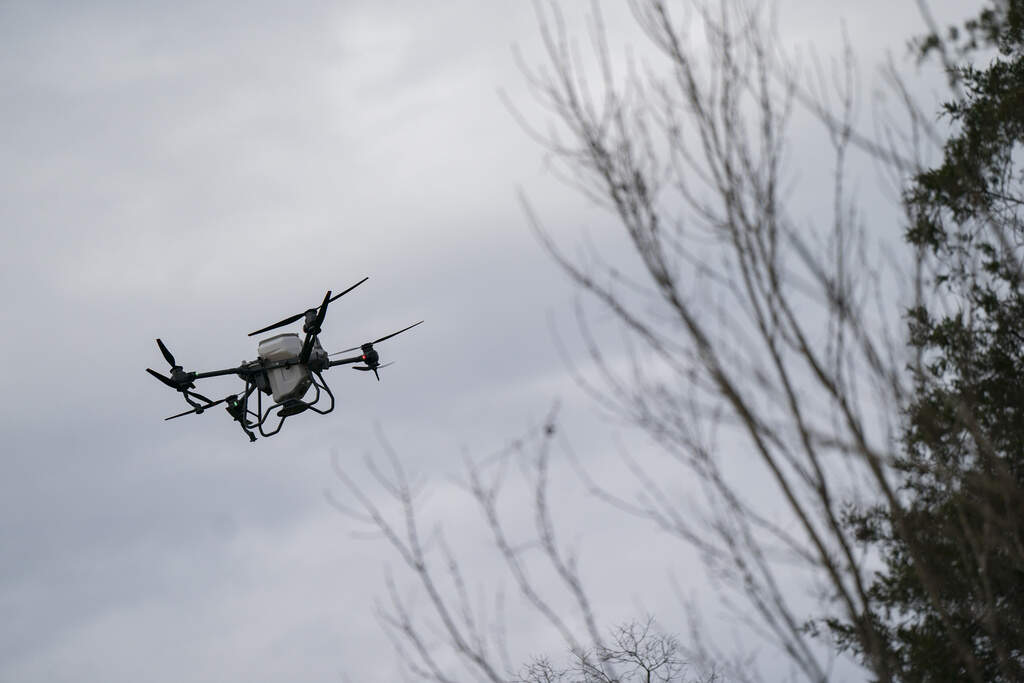
The Chinese-owned drone company DJI controls over 75% of the commercial U.S. drone market. Lawmakers say that its presence in the sky threatens American national security.
Guest
Faine Greenwood, research consultant on unmanned aerial vehicles (UAV), commonly called drones. Contributor to Foreign Policy and Slate, among other outlets.
Peter Harrell, nonresident fellow at the Carnegie Endowment for International Peace's American Statecraft program. Author of the recent paper "Managing the Risks of China’s Access to U.S. Data and Control of Software and Connected Technology."
Also Featured
Adam Welsh, head of global policy at DJI.
Transcript
Part I
RUSSELL HEDRICK: I think that's one of the best kept secrets right now in agriculture is drone technology.
MEGHNA CHAKRABARTI: Russell Hedrick is a farmer in North Carolina. In December, he spoke with the Associated Press about the growing importance of drone technology in his work.
HEDRICK: Just looking at the small mapping drones, we use one with NDVI, which we can fly over a cornfield in season and we can see, is there a problem area?
Is it fertility? Is it somebody messed up with chemistry? Do we have soil biology issues where that crop is not growing as well in one area? And we can essentially take that one section out and we can scientifically test it in the laboratory to see what the problem is and actually grow better food.
CHAKRABARTI: NVDI stands for Normalized Difference Vegetation Index. It's a common metric used to measure the density and health of vegetation. And Russell Hedrick says, today, farmers use smaller drones to map out their farms and monitor crops. Larger agricultural drones can help do things like spray pesticides and seeds, reducing the need for hard human labor.
Some units can carry a payload of up to 110 pounds and spray up to 50 acres. Al Staley owns a vineyard in San Diego, California, and he spoke with NBC News.
AL STALEY: The computer controls the rate per acre, which is very important to us when we're putting on nutrients or pesticides. There's not the trip and fall issues.
There's not the knee injuries, all the things that we worry about with hand application.
CHAKRABARTI: Clearly, drones are an increasingly important tool in U.S. agriculture. The ag drone market, in fact, is an estimated $500 million or half a billion dollars. That's according to market research firm Grand View Research.
Drone technology, obviously, is no longer just the province of, say, the military with its specialized drones, or, at the other end of the extreme, just the province of hobbyists, enthusiasts, YouTubers. Drone usage is very widespread now, and growing even more. And almost all of those drone pilots, say, from farmers to filmmakers to kids, are likely flying drones from one company, Chinese owned DJI.
Now, DJI is massive. This one company currently has 70% of the entire global drone market. In the United States, DJI sells 75% of all the drones purchased here. Most other companies can barely crack 4% of the U.S. market. Now, for years in fact, U.S. lawmakers on both sides of the aisles have said that's a reason for concern.
RICHARD BLUMENTHAL: Chinese manufactured drones are a real and present threat to the security of this country. We ought to stop using them, use American drones instead. Drones manufactured in China are a source of surveillance, data collection, other kinds of security threats.
ELISE STEFANIK: Allowing artificially cheap DJI drones to monopolize our skies has decimated American drone manufacturing and given our greatest strategic adversary eyes in our skies.
CHAKRABARTI: That's New York Republican Representative Elise Stefanik, she's now in the Trump administration. And before that you heard Connecticut Democratic Senator Richard Blumenthal. That's why, so this fear of Chinese government and DJI and U.S. national security, that's why there's a growing movement in Washington to clamp down on DJI specifically, possibly to go so far as banning DJI sales in the United States.
But for Americans like North Carolina farmer Russell Hedrick, these drones may have become too valuable of a tool to ban without clear evidence.
HEDRICK: The lawmakers haven't given us a valid reason yet. And I'm not saying they have to divulge all the details, but if there is a true security issue, just say it.
If they're gonna ban it, if they're gonna say that they're bad, tell us why, because every time that I've talked to a lawmaker, it's always, they could. If they're going to make a law that affects farming, they better think at the end of the day that they might be crippling our farm economy.
CHAKRABARTI: So today, we're going to take a deep dive into how DJI came to dominate the drone market.
And what we know about whether or not there are potential national security threats of these Chinese manufactured drones. And we're going to start today with Faine Greenwood. She's a research consultant on unmanned aerial vehicles, or UAV, they're also commonly known as drones, and also a contributor to Foreign Policy and Slate, amongst other outlets.
Faine Greenwood, welcome to On Point.
FAINE GREENWOOD: Hi, it's great to be here.
CHAKRABARTI: I actually want to start with some full disclosure here. My family, my son actually, is the owner of one of the sort of lowest end consumer grade DJI drones. So we are one of that 75% of the U.S. market. And I wanted to disclose that first and foremost, just to be completely transparent.
But secondly, I was thinking just today that the fact that my elementary age school child can actually fly this drone and fly it really well, and it's awesome, is that one of the reasons why DJI has such a lock on the U.S. consumer drone market?
GREENWOOD: Absolutely, and that's one of the things that really got me into drones in the first place.
I first became interested in drones back in 2013. I was getting a degree at Stanford, and I happened to see one flying over the quad. It was a DJI drone. It had that really distinctive kind of white design. It's very design-y. And I thought it was super cool, the way it moved. And that's really how I got into drones.
And I actually bought a drone out of the back of the, out of the garage of one of the early drone innovators, Eric Ching, who posted some of the first really cool footage of surfers in Santa Cruz with a DJI drone on YouTube back in 2013. And yeah, I learned to fly it. It was really easy. And that's, I think, is a key aspect of that question.
DJI produced the first drone you could pull out of the box, you could fly, didn't require special expertise, special skill, and they've just become better and better at doing that.
CHAKRABARTI: Yeah, they make it extremely easy, and that doesn't mean that the drones are not capable of doing much, right?
They're easy and they work really well. You know what this reminds me of? And also, the white design. ... It reminds me of Apple.
GREENWOOD: Yes, absolutely. Yeah, there's definitely a similar design ethos. And that's why I do believe there is something of a Chinese Apple equivalence, DJI.
It's got that similar started in the dorm room vibe. It's got a similar kind of really producing a pretty revolutionary product that is geared towards consumers in a way that really takes into account what consumers want. And that is why some of these narratives that are claiming that DJI, the Chinese government, has really the kind of sinister cause of its success.
It's a little inaccurate, I think DJI is the cause of its success, they genuinely make really good products.
CHAKRABARTI: Can you tell me more about the founding of the company then if it's got those Apple vibes?
GREENWOOD: Yeah, so Frank Wang, who is the founder of DJI, founded the company in 2006 in Shenzhen. He was a student at the time, but here's a really important point about the rise of drones that I try to really emphasize.
These small drones did not come out of the military community. The small drones we know and fly today came out of a hobby community. So there's always been a big group of model helicopter enthusiasts around the world since the 1970s. And around the 2000s, around 2006, a lot of sensors had become really small.
And Shenzhen is a hub of electronics manufacturing globally. And it happened to be the case that it became feasible to put really tiny computers and really tiny GPS sensors and really tiny other electronic components onto a mile helicopter. And that's really how we got drones. That's how we got, and by the way, we also, that's how we got the four-armed quadcopters that we know of today as drones.
They're not possible without computers. Humans can't really fly them, unless you have the computer to synchronize the motors. That's where that came from.
CHAKRABARTI: Yeah, it's so interesting because I was just thinking I'm old enough to remember back when they were called quadcopters. And so this is an important distinction, in terms of military versus hobbyist and consumers.
So then, Frank, as you said, the founder, or the person who started DJI, from the start though, like what made, how did they get so big and so successful? Was it just a matter of timing, their location, like you said, in a really important manufacturing center in China, plus the design?
Because the reason why I'm asking for more information, Faine, is there are very few companies out there that I can think of that both in the United States and globally have 70% to 75% of the market. That's just almost unheard of.
GREENWOOD: Yeah, it's a fascinating story. So it was a combination of multiple factors.
So they weren't the first people to make a consumer drone. For example, in 2010, Parrot actually produced this consumer drone that was, it premiered at some toy fairs, you could fly it indoors, you could take some photos, that came out before the DJI phantom, which was the first DJI drone. That's often the case, the first mover in an industry doesn't necessarily win the whole game.
I think what DJI was, but DJI really was the first producer grown. You could actually do really cool stuff with like flyover surfers, the GoPro on it. And so I think their timing was great. Their designed aesthetic was great. They were plugged into the hobby networks. They actually got started before they produced this out of the box drone by selling to hobbyists.
And that's the scene I was involved with. I got really involved in building drones in 2013. I joined the, Stanford had a drone club. I was the only non-engineer in the club. And they were really nice. They showed me how to build a drone. I remember being shocked at how easy it was. I was like, wait a minute.
You guys are just duct taping stuff to like, to balsa wood. They're like, yeah, that's it. I was like, Oh, it really blew my mind. And I thought it was super, that's what I thought was so cool, that this is so cheap and so easy to do that pretty much anybody can do it. And that's something I'm a big fan of hitting on, is drones democratize the aerial view in some really cool ways, but I'll return to that.
And so that's really how DJI thinks special sauce. They hit at the right time; they had the right product. And I should emphasize, there were a number of U.S. competitors to DJI, and it was not at all clear back in 2013 that DJI was going to win this thing, since they did. For example, we had 3D Robotics, which was founded by the former editor in chief of Wired Magazine, Chris Anderson.
And Chris Anderson had founded back in the 2000s this website called DIY Drones. It was really huge. It was one of the first websites to really bring together people who are building drones as a hobby. Chris got into it because he was using Mindstorms Legos with his kids. So it came out of this hobby community and 3D Robotics was doing quite well for quite a while.
A lot of, there were a number of other American companies in the space. There were a number of kind of failed attempts, so it's interesting to think about.
Part II
CHAKRABARTI: Faine, so can I just, you mentioned that there was no guarantee that DJI would become the behemoth in the commercial drone space. So at the same time, what was happening specifically with U.S. makers that seemingly set them behind DJI? I'll give you an example. Our producer, Jonathan did some really great research on this and found a post from Chris Fink, who's the CEO of a drone dealer called Unmanned Vehicle Technologies, and in his LinkedIn post, he wrote that his company had ordered two blue UAS drones from an American manufacturer on January 3rd, 2024.
And those drones were not delivered to him until May. So five months later, 142 days, for just two American made drones. But in that same 142-day period, the company had ordered and received 270 Chinese made drones. So what's going on there?
GREENWOOD: Yeah, so there's a couple issues going on there. One is that economies of scale, so these American drone manufacturers on the blue sUAS list, which are drones that have been specifically authorized by the defense intelligence units which has some programs related to using Sumer tech. So these drones are made by smaller companies and DJI. They just can't churn drones out quick enough to satisfy demand. And that will be an even bigger problem if Chinese drones are banned to the United States, let me tell you.
And the other issue is Chinese electronic components. So obviously, a lot of these U.S. and European drone manufacturers still use a lot of Chinese components. They're relying upon Chinese batteries. They're relying upon Chinese electronic parts. So that means there is a bit of a gray area around American and European made.
That's come up a lot in conversations about this over the years. Like, how are we defining, is it Chinese or American made? Depending on where you're assembling the components, where the components come from. All that stuff gets pretty complicated. So yeah, it's a combination of, it's hard for them to keep up with demand because they're smaller companies. And two, they're still using Chinese electronic parts.
This does all feed into China's inherent advantage of the fact they've got Shenzhen, and we have been outsourcing a lot of our electronics capability to China, willingly, for a really long time.
CHAKRABARTI: Interesting. Those are the exact reasons why some U.S. lawmakers call DJI basically having an unfair advantage over U.S. manufacturers. What do you think?
GREENWOOD: I find that problematic because personally, I think this is a little too late. I think that the time to really start raising the alarm about this was five years ago, even 10 years ago when it became apparent the drones were going to become a really important technology.
I think that was pretty darn clear. Even 10 years ago, and certainly five years ago, and the fact of the matter is that the U.S. has not done a lot to encourage or help drone manufacturers with this. There have not been a lot of efforts to shift electronics manufacturing to other places, and unfortunately, the current administration's hostility towards Mexico is also going to create problems. Because for a while there, one of the ideas a lot of people had was, let's do a little more electronics manufacturing in Mexico.
And that may become less realistic. So that's another issue, that's a big problem. I think this is trying to retrofit something, where honestly, we should have been aware of this and doing something about this and doing it now when so many people rely on Chinese drones. It's going to cause a lot of pain that didn't need to happen.
CHAKRABARTI: Faine Greenwood, hang on for just a second, because I want to now turn to Peter Harrell. He's a nonresident fellow at the Carnegie Endowment for International Peace's American Statecraft Program and author of a recent paper called Managing the Risks of China's Access to U.S. Data and Control of Software and Connected Technology.
Peter Harrell, welcome to On Point.
PETER HARRELL: Meghna, it's great to be with you.
CHAKRABARTI: Let me just reference back my own personal experience in watching one of these DJI drones fly. And again, we own a very sort of low-grade consumer model. We actually bought it retrofitted so it wasn't even like brand new out of the box.
But as Faine really rightly pointed out, it's quite remarkable how easy it is to fly. So my kiddo, who's in elementary school, pulled it out of the packaging that we got from the reseller. And pretty much immediately flew it, and I was amazed. This little drone could fly a kilometer away from the operator, right?
It was capped in terms of its altitude that it could reach. The elevation that it could reach. It's 249-gram drone, which is an important thing. But the pictures it was sending back were remarkable. They were high def. If you lose sight of where the drone is, it can automatically return back to the pilot.
It was, it feels very, it felt very professional. So we know with that in mind, I got his firsthand experience of wow, like even a ten-year-old can have eyes over parts of, any part of a city, practically. Is that not, in and of itself, a potential security threat, Peter?
HARRELL: Let me begin by making a disclosure similar to yours.
I actually maybe five, six years ago now bought my then elementary school aged son, a DJI drone and had exactly the same experience you did. This is just a remarkable piece of technology, that a then maybe seven-year-old could fly right out of the box with his grandfather.
And it certainly brought home to me the appeal of these things and why we see so many people using them, whether hobbyists or for agricultural or industrial use. But it is the very ease and ubiquity of these things that as they have spread, and as policy makers have begun to dig into the security risks, I think, bring home how serious the security risks are.
There's a camera on that drone, as your son knows, as my son knows, that is taking live video shots of everything. It's looking at and feeding that onto a server somewhere. And while DJI and other drone makers may say we have security procedures in place to keep that data localized and not have access to it.
They could always change that at any time. They can fix the software. They could do a software update and begin to get access to that data that's flowing through that drone sensor, through that drone's camera, much less the risk that actually somebody could begin to take remote control of that drone and potentially drive it into an area where it shouldn't be.
So I do think that as we've seen these things spread, the very ease and ubiquity of them have really heightened the potential security risks we face.
CHAKRABARTI: Yeah. I have to admit, I was slack jawed when I was like, wow, this drone is literally a kilometer away from us and it's just high enough that it's out of earshot.
And we were looking right down on a baseball game. It was quite amazing. But let's take a step back here. And Faine, I'm going to turn this one to you. Generally, the general concern with any large-scale Chinese company is its relationship to the Chinese Communist Party or the Chinese government.
How would you describe what that relationship is between DJI and the CCP?
GREENWOOD: I do want to touch on that first point around the security threats. And yeah, I agree, it's absolutely a concern around data collection from drones, and something that I do want to emphasize is that we do not understand the risks that flow from drone collected data adequately at all.
This is an area I've done some research on professionally and academically. I'd really like to do more. We really need to do a lot more work on better understanding harm that stems from drone collected data. Because we have a lot of theoretical ideas about how harm might be created. We don't have a lot of proof.
We don't have a lot of scientific or academic research directly linking drone data to harm. I believe we really need that, because we can't mitigate that risk, which I absolutely believe exists, and is very serious, if we don't understand those dynamics. So I just wanted to put a pin in that.
But to return to yes, the Chinese government connection again, I think it's a little unclear. Obviously, we can assume that companies in China have some connection to Chinese government. And I should note, I'm not a China specialist. This is not my area of, literal area of expertise. But again, we don't really have a clear sense of how directed this is.
We do know that there have been allegations that DJI drones have been used in camps for the Uyghurs, which is a very serious allegation. And that has also been behind some of the U.S. efforts to control the technology.
CHAKRABARTI: Yeah. Let me just, sorry for interrupting, but let me turn to Peter then more specifically on that.
Again, broadly regarding any company that operates out of China according to a January 2024 report from CISA, which is the cyber security and infrastructure security agency out of the Department of Homeland Security, they do cite a 2017 Chinese law that says Chinese companies are effectively required to provide access to the data they collect to the Chinese government.
Is that not true?
HARRELL: So that is true. And let me make two points here, Meghna, building on the point Faine was making. And the first point is, We know for a fact the Chinese government and the Chinese Communist Party are very aggressively trying to increase their surveillance capabilities here in the United States.
There's some news over the last couple of months about major hacks the Chinese government had made of U.S. telecommunications networks. And we've seen pervasive hacks in the United States by Chinese cyber threats over the last several years. So we know the Chinese want to get more access to data here in the United States.
And then the other thing we know is that going back a little over 10 years now, the Chinese have begun systematically developing a very expansive legal regime in China. That gives the Chinese government very broad authorities to compel Chinese companies to share information with the Chinese government, share data with the Chinese government, and also to cooperate with the Chinese defense intelligence apparatus.
So there's some data security laws. They call them data security laws. It's really partly about data security, also about ensuring that the Chinese government has access to the data. And then there's a set of national security laws that give the government authority to, again, push Chinese companies to cooperate with them.
And you combine these two facts, the known fact that China is trying to increase its espionage capabilities here in the United States, with the fact they could then compel a Chinese company that has these millions of marvelous surveillance platforms of drones here in the United States to share that data with the Chinese government.
And you can really see the risk I think are running here in the U.S.
CHAKRABARTI: Okay. So we did actually speak with someone at DJI about this specifically, the threat or the concern that DJI would have to hand over whatever data it has collected by drones flown in the United States to the Chinese government.
So here's how DJI responds to those concerns.
ADAM WELSH: We really dealt with a lot of this when it first arose in 2018. So we created what we call local data mode. That is where you can literally turn off all data connections on your drone, but still fly it. So you could unbox a DJI drone, never connect to the internet throughout its entire lifetime, put everything onto it in terms of map updates and everything else, using an SD card, take all the data off using an SD card.
It just does not connect to the networks or the Wi-Fi at all.
CHAKRABARTI: So this is Adam Welsh. He is the head of global policy at DJI, and he spoke with us from China. He tells On Point that DJI has already worked to enhance the security of its devices in response to U.S. lawmakers concerns.
WELSH: The second thing we did was we opened up our entire architecture to other developers.
So unlike a lot of other products in the market, you don't have to use our software. You can use software from U.S. firms to fly the drone, to collect all the data that the drone collects, and you don't have to touch our servers. And then the third pillar to our data security really is that we've had all of this audited.
The Department of Homeland Security had Idaho National Labs audit our products, the Department of Interior audited our products, and even the Pentagon has an office that looks at consumer off the shelf products. They looked at two of our products and approved them for use. In terms of data security, we really feel like there's no evidence of wrongdoing on our part.
In fact, the evidence is on our side.
CHAKRABARTI: Welch says that while DJI is open to scrutiny from the U.S. federal government, what he really sees at play are political forces that are leading to these concerns.
WELSH: I do think that you have to take into account, one, the tensions between China and the U.S. have been ramping up, pretty much, over the past six to eight years in an increasing fashion.
And it's not just DJI that has been caught up as collateral damage in that, there are a number of companies. And the second thing you have to recognize is that there's market dynamics behind this. These allegations don't just arise on their own, there are people lobbying to remove a number of Chinese companies, not just us, from the marketplace.
CHAKRABARTI: Back in 2024, then Congresswoman, or Congresswoman Elise Stefanik, Republican of New York, sponsored the Countering CCP Drones Act, that would have placed some restrictions on DJI drones. That legislation passed the House in 2024, didn't make it much further. So as of this moment, no bills calling for an outright ban of DJI drones have passed into law.
But Section 1709 of the 2025 National Defense Authorization Act does include language about drones. The NDAA is the annual legislation appropriating funds for the Department of Defense, and it calls for DJI to prove that its products do not, quote, pose an unacceptable risk to the national security of the United States, end quote.
If DJI fails to do, the Act instructs the FCC to add DJI's products to its covered list under the Secure and Trusted Communications Networks Act, meaning that DJI would no longer be able to produce and release new items into the U.S. market, even if it sells them everywhere else. Again, Adam Welsh, DJI head of global policy.
WELSH: It calls for at appropriate, intelligence agency must do a review within 12 months. Now that doesn't seem fair to us. If an intelligence agency doesn't do the review, why are we the ones that pay the penalty? We embrace the scrutiny, but there's no way we can force an intelligence agency to do the review within those 12 months.
It's up to them to decide to do it. The second point is it doesn't name a specific agency. If there's five entities that it could land on, they're all going to point the finger at each other and say, you take the job, so we would prefer if one agency had been designated. And again, that one year onus was on the agency and not on us.
CHAKRABARTI: So that's Adam Welsh, DJI Head of Global Policy. He spoke with us from China. Faine Greenwood and Peter Harrell, stand by for just a second because we're going to take a quick break. When we come back, I want to hear your responses to what DJI says about its belief that it is not a threat to U.S. national security.
Part III
CHAKRABARTI: Faine, we heard quite a bit from Adam Welsh, head of global policy at DJI, just before the break there. Let's go through a little bit of what he said and respond to the first point he made. He basically asserts that DJI is not a national security threat at all because they don't, you don't even have to fly the drone connected to the internet.
It can be all local. So there's no data being transferred to DJI servers. So therefore, there could be nothing for the Chinese government to even request DJI hand over.
GREENWOOD: I think one thing. So turning to what Adam said, he did mention the word evidence. And I think that's a really important point.
I do think, in returning to what the North Carolina gentleman said earlier, we don't have a lot of evidence in the U.S. government around what exactly these risks are, what they're seeing. I think having more information, and of course, again, we don't need everything. I think having more information about those risks that is being revealed to the public is really key.
Because I do want to emphasize, I've worked in the drone industry for 10 years as a practitioner, I've flown drones, I've done mapping consulting, I've written about them, researched them, you name it, and it's a huge industry, a ton of people, including academics, disaster responders, who I do a lot of work with, humanitarian aid workers, fire responders, you name it, are going to be unable to do their jobs if Chinese drones are taken away in one fell swoop.
And I'm really afraid it's going to lead to a scenario where the only people who can afford drones are the wealthy, police, and the military. I think that might replace one problem, one very serious problem, which is Chinese dominance of drones, with another serious problem, which is police and military dominance of drones.
Taking it away from citizens and from normal people. And drones are also very important tools for journalists and activists, among others. So I'm really afraid of this dynamic kind of inadvertently restricting the technology to police and military and creating a whole other set of security and privacy problems, which we have also seen with police use of drones and many occasions in the United States.
CHAKRABARTI: Okay. We're going to talk in a few minutes in more detail about what could end up being an effective ban if what's in the NDAA passes. But let me just stick with, again, Adam Welsh's assertions about what he says DJI collects and doesn't collect. He told us that he, that DJI has never received any request thus far from the Chinese government to hand over data collected by the drones.
And that even if the CCP did, Welsh says DJI does not hold on to private data from the drones operating in the U.S.
WELSH: If you are using one of our consumer products, you can opt in to share videos and pictures on SkyPixel, which is a social media platform. Now, that is not even an option for our enterprise products.
They can't share anything to SkyPixel. We used to allow our enterprise users in the United States to upload flight logs to our cloud. It was free storage space, but we got a lot of questions about it. And to be candid, the questions were from members of Congress. They would ask, how many people opt in to share their flight logs on your servers or store them on your servers?
And it was pretty obvious that the only answer they wanted was zero. And so we removed around June of last year, even the potential to upload your flight logs there.
CHAKRABARTI: Peter Harrell, what do you think about that?
HARRELL: I want to pick up on a point I heard Adam make earlier, where I think he said that, he thinks part of what's happening here is the growing geopolitical competition and tension between the U.S. and China. And that is absolutely a big piece of what's going on. And in my mind, what is happening and the reason this growing geopolitical competition matters, is that increases the risks.
If we had German drones in our skies or Mexican drones in our skies, I wouldn't actually be that worried that the German government or the Mexican government would try to direct the manufacturer of these drones to give them access to data or to take over the drones.
But I do think we have to worry about that with China, given the tensions that are so high already and seem set to only increase further between the U.S. and China.
CHAKRABARTI: Peter just a few minutes ago, just to remind folks, you did say that China's doing everything it can to increase surveillance in the United States, right?
HARRELL: Exactly.
CHAKRABARTI: It's common sense, would say, why not eventually turn to these hundreds of thousands, if not millions, of drones that are like in Americans hands already as a source of that information?
HARRELL: Completely. I completely agree. And that's just a worry we have about Chinese drones that isn't going to be true of a German drone in today's geopolitical environment. Or a Mexican drone in today's geopolitical environment.
I take the point Adam makes that DJI says that it is trying to limit its own ability to collect American user data. That's the assertion he makes. The challenge I have back to him is that even if that is true today, even if that is true today, there's nothing he and DJI are going to be able to do when the Chinese government comes knocking in three months or six months and says, Hey, we actually want you to now build a backdoor into this software to begin to give us access.
And oh, by the way, you can't disclose that publicly. You have to cooperate with us on a sort of intelligence community type basis. So even if they are taking some efforts and even if those efforts today are good faith, they just under Chinese law can't do anything when the Chinese intelligence agencies come knocking in a couple of months.
Now, I take his final point. Okay. In some world where some operator of this drone literally isn't connecting it to the Internet ever for the entire life cycle of the drone, but let's be honest --
CHAKRABARTI: Nobody's gonna do --
HARRELL: Who does that? Everybody puts these things online. So that to me is a kind of a hypothetical response that isn't how people use these things in the real world.
CHAKRABARTI: To set it up, you at least have to connect it to your phone. So exactly. Faine, I want to hear your thoughts on this.
GREENWOOD: Yeah. And I should know, I don't want to represent myself as being the cheerleader for DJI or China. Yeah. I completely agree with the appeal points that Peter's making.
It's a real security risk. And I agree that there is little recourse DJI will have in these cases. My main thing I'm pushing back on a little is the idea that we should therefore ban all DJI drones in the United States. I think there's levels of risk here. I think we could probably find ways to evaluate, okay, what is the riskiest ways these drones are being used?
How do we reduce that? But, for example, there's other things, including in government, for example, the Department of the Interior using drones for wildfires or for researching rare ferrets, a real thing apparently. I just don't know if that's a huge security risk. Unless the Chinese government really cares about the rare ferrets, so that's why I really advocate for taking this very seriously, taking DJI very seriously, certainly not letting them off the hook, but also not necessarily saying we're going to ban all Chinese drones tomorrow.
Because that will decimate huge numbers of people doing really important work in disaster response, academia, scientific research, you name it. A lot of people I know will be completely, they will have to stop flying drones, programs will end, jobs will be lost, lives will [not] be saved. It will be a really bad thing.
CHAKRABARTI: I want both of you to help clarify one thing, just that very recently raised a lot of eyebrows.
And that was a decision that DJI made to remove geofencing from its drones. Now, the popular understanding of that is that in the United States, DJI software was preventing its commercial drones from flying into certain sensitive areas near airports, power plants, et cetera, or at least giving a warning, but they were geofenced outside to stay outside of those areas.
And DJI recently announced that it was removing that geofencing. So we asked Adam Welsh, again, head of global policy at DJI, why they did that. And he says the announcements timing was not great for the company's optics, he admits that. But what he says is that DJI, with its geofencing, had actually been over complying, right?
They weren't actually ever required to do that, he claims. And now, by removing the geofencing, he says DJI is simply following the FAA's own rules.
WELSH: We processed about a million unlocks last year. And every one of those, we had to look at documentation to show that somebody had an FAA permission to fly in that area.
And then a human being had to process an unlocking license for that drone. That had become incredibly unwieldy. Sometimes these permissions had specific time windows. And we wouldn't be able to unlock in time for that individual to fly within that time window. And so they were losing commercial opportunities.
But much, much worse, we even had law enforcement and first responders who couldn't fly when they needed to. That's a real problem, that those people can't do those flights, because they use our drones to keep their firefighters safe, to know whether the structure is still secure, things like that. The FAA and other national aviation authorities have long held that the operator is responsible.
They have had plenty of opportunity to actually mandate geofencing if they thought it was necessary. We've decided to meet the regulator where they are and provide people accurate data and the right to fly.
CHAKRABARTI: Peter Harrell, do you want to respond to that? Because here's DJI saying nah, FAA, it's your lax rules that we're following now.
We're actually not going to go above and beyond anymore.
HARRELL: I actually want to pick up on the how they did this. So they, via an over the air, over your Wi Fi or cellular network software update, unlocked the geofencing that had previously been on these drones. And I think that really illustrates the power that the software connectivity and the potential for updates has.
And there's really no technical reason if they can, via software update, unlock the geofencing, why they couldn't also do a software update that began to give them more access to data. So I think actually it illustrated the way in which they did this, in fact, illustrates the risk that they post.
I do also want to pick up on a point that Faine made, where I very much agree with Faine, that if we are, and as the U.S. potentially moves towards restricting DJI drones, we absolutely do need to think about ways to build up an alternative industrial base to make these things, because I agree they're incredibly valuable for research.
They're great for hobbyists. I have a friend who's a TV producer, uses these all the time for the TV shows that she makes. And right now, there just isn't an effective alternative industrial base. So I do think that as policymakers and folks in Congress talk and move towards these potential bans, they need to be thinking, as invested in figuring out what the alternative industrial base for actually making some non DJI alternatives is.
CHAKRABARTI: How are you going to get your viral Twitter clip by talking about that instead of railing against the CCP?
HARRELL: (LAUGHS)
CHAKRABARTI: But so just to be clear sorry, sometimes I need to work harder at holding back the snark. But the NDAA that we talked about, the 2025 National Defense Authorization Act is the place right now where there is this language that would require DJI to prove that its products do not quote, pose an unacceptable risk to the national security of the United States.
We'll see what happens there, right? If DJI utterly fails to do anything in the NDAA as it's written right now, could see potentially a ban of at least new drone sales in the U.S. I want to just draw both of your attention, both of your attention to the fact that we have been through this before, right?
With Huawei, because back in 2017, this exact same path was followed. The 2018 NDAA included language about barring the DOD at that time from procuring telecommunications equipment from the Chinese telecom giant Huawei. Because thinking that it was a national security threat, that eventually got made much more broad.
And by November of 2022, the FCC essentially banned the sale of Huawei communications equipment and restricted the use of some Chinese made video surveillance system, saying it was just a total unacceptable risk to national security.
Faine, I'm going to start with you. It's not impossible to imagine that something similar could happen with DJI.
GREENWOOD: Oh, I think it's absolutely possible. That's the scary part to me, because the issue is that the whole Huawei, I cannot pronounce that, incident is different because there were a lot of substitutes for those products.
If you remove their products with the market was not a huge deal. You could still buy a laptop. There were other people that make good affordable laptops, but with DJI, if you remove it from the market, as Pete was saying, there's no equivalent substitute. There's nowhere else for people to go.
They're going to have to stop using drones. So that's, I think it's going to have a much bigger impact if it goes that way. And a lot more people. In ways that extend beyond buy a different laptop. I do want to return back to Adam's comments to state that Adam was correct. The FAA does not mandate geofencing on drones.
In fact, a lot of, a number of U.S. made drones do not have geofencing. Chinese drones do not have geofencing. This was something DJI was doing voluntarily. So he's not incorrect there. So yeah, I think, but I do agree with the point that illustrates the power. They can just turn it on or off.
CHAKRABARTI: So we're in a situation here where it looks like the preferred policy solution from lawmakers in Washington is a very heavy hand, right? Like a potential ban on DJI drones if what's in the current NDAA actually passes and DJI doesn't prove that it's not a national security risk. But we got here for a specific set of reasons.
And one of them is; to put it bluntly, the U.S. was out competed on this. How are we going to get over that, Peter? It's going to happen over and over again with different kinds of products, different sectors, and especially given the backdrop of the considerable political tensions, I feel like we're going to just go through this dance again and again and again.
HARRELL: Yeah, so I agree with you that this issue we are facing today with DJI drones that we faced, five, eight years ago with Huawei network telecommunications network infrastructure is indicative of a broader challenge we face, where China has over the last five, eight years, 10 years, not only been successful kind of manufacturing products on behalf of American companies, the laptops.
Phones we buy from U.S. companies, but actually building up its own national technological companies. And I absolutely agree. We are going to face this issue across a range of different products. And we're going to need to see some strategic investments on the part of the U.S. and our allies to help rebuild our own industrial base and building savvy tech hardware.
We have a great tech sector building software, and I think American companies are going to need to get back into the hardware business. And I personally think what that is going to mean is that over a couple of years, in addition to a focus out of the regulators and that kind of thing.
We are going to need to see some policy support, frankly, probably the way we have on semiconductors over the last couple of years. Where there's been a big effort by the U.S. to help get us back in the game of building computer chips, we're actually going to need to broaden that out into microelectronics a bit more generally.
This program aired on February 14, 2025.