Support WBUR
Lauren Ober was a juror on a Jan. 6 case. Then, she learned her new neighbors supported Jan. 6 insurrectionists.
A conversation with journalist Lauren Ober about her experience on that jury, her podcast 'We Live Here Now,' and what Trump's pardons mean.
Guest
Lauren Ober, journalist and podcast creator. Co-host and executive producer of “We Live Here Now." Author of recent Washington Post essay “I was a Jan. 6 juror. What I learned surprised me.”
Transcript
Part I
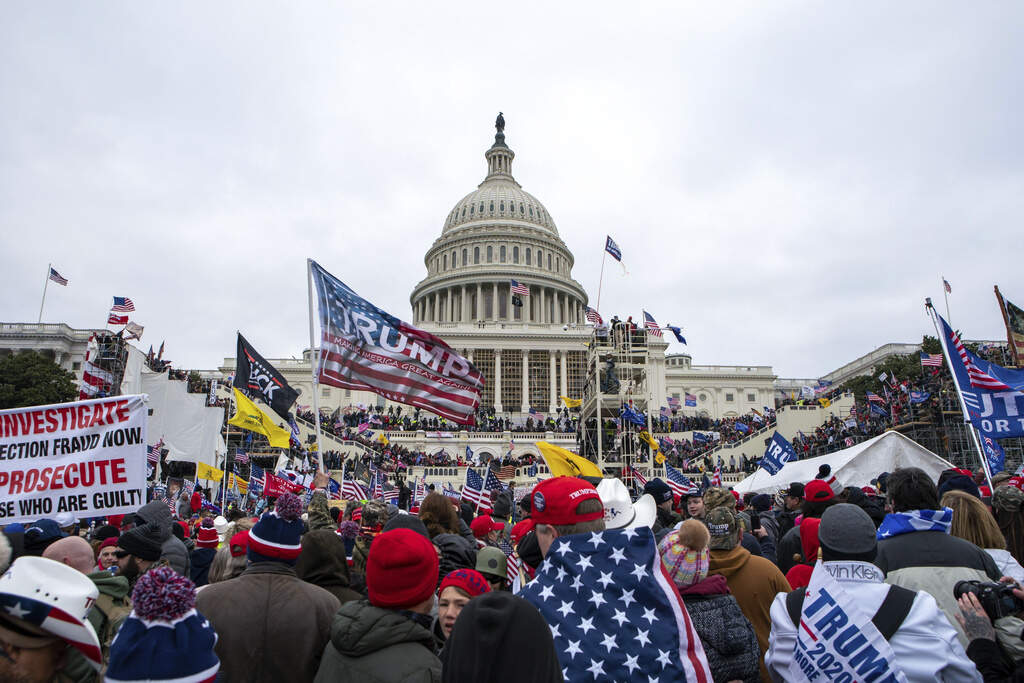
DEBORAH BECKER: January 6th. Just say the date. You don't even have to mention the year. And the significance is understood. But there are different storylines surrounding that day of the riot at the U.S. Capitol. One is from President Trump, who claims that many of the rioters were unfairly prosecuted.
Political prisoners, even. And, just hours after he was sworn into office last month, Trump pardoned the more than 1,500 people who were convicted on charges related to the January 6th riot.
DONALD TRUMP: So this is January 6th, and these are the hostages, approximately 1,500 for a pardon.
BECKER: Now this was a touchy subject, even among Republicans.
After all, some people were convicted on charges of assaulting law enforcement and trying to disrupt official government proceedings, those of Congress. Just about a week before the inauguration, then Vice President Elect JD Vance was on Fox News. He didn't use the word hostage like the President did.
What he did say was that there might be a more nuanced approach to any presidential pardons.
JD VANCE: Look, if you protested peacefully on January the 6th and you've had Merrick Garland's Department of Justice treat you like a gang member, you should be pardoned. If you committed violence on that day, obviously you shouldn't be pardoned.
And there's a little bit of a gray area there, but we're very much committed to seeing the equal administration of law. And there are a lot of people we think in the wake of January the 6th who were prosecuted unfairly. We need to rectify that.
BECKER: Of course, the President's blanket pardon was not nuanced at all, and there are lingering concerns about its ramifications.
Our guest today has an incredible story about how her life intersected with January 6th on several levels. Not only does Lauren Ober live in Washington, D.C. and felt the aftermath of the storming of the Capitol firsthand, she also came to better understand a new neighbor. A prominent J6er, as they're called, who moved to Washington, D.C. to help fight for the rioters.
And, on top of that, Ober was a juror in a January 6th case, so she had to wrestle with her newfound empathy for those caught up in the emotions and politics of January 6th, with a president describing it as a day of love, and a criminal legal system that called it a day of violent, domestic terrorism. Lauren Ober, a journalist and podcaster who most recently created We Live Here Now, a podcast for The Atlantic that tells the story of her relationship with her neighbors and her jury service. Lauren, welcome to On Point.
LAUREN OBER: Thank you so much for inviting me, Deborah.
BECKER: Let's start with Inauguration Day, right?
This is the day that you learn that President Trump has, in fact, been sworn into office after you've spent a lot of time wrestling with this January 6th issue and how it was going to be handled politically. Where were you and what were you doing Inauguration Day?
OBER: My partner and I, who I made the show with, Hanna Rosin, we invited some friends over to watch all of the events of the day.
We had a brunch. We tried to build community, create community with our friends, and it's a hard thing in D.C. To know that the incoming president said that the day that you view as an insurrection and a riot and an affront to your city was actually a day of love and peace, and everybody who took part in that day should be freed.
BECKER: So you had mixed feelings on Inauguration Day, but it was just hours later that you then hear that President Trump issued these pardons for more than 1,500 folks who were convicted in the January 6th riots. And you also had a lot of personal involvement there, but what was your feeling then to hear about these pardons which surprised a lot of people, including members of the Republican Party?
OBER: I think I was surprised. I didn't think that a full 1,500 people would get pardoned. There were horrendous crimes that day. Police officers getting tased in the neck and beaten with hockey sticks. And so I couldn't imagine that a political party that was so Back the Blue focused would pardon people who did real harm that day.
I figured they would make some distinction between violent and non-violent offenders, and people charged with misdemeanors and not felonies, but it turns out that none of those things were taken into consideration. So I was really surprised. And maybe I'm naive, but I did feel genuinely surprised.
BECKER: Because, of course, the president did say that he would pardon folks involved in January 6th. We just, of course, didn't know the extent of it until shortly after the inauguration. But also, I think your involvement in this is not just living in D. C., having a neighbor who is a prominent J6er, but you were on a jury that ended up convicting J6er, if you will, 40-year-old Taylor Johnatakis of Washington State, rather, sentenced to more than seven years in prison for what happened on January 6th.
How did those pardons make you feel as a member of a jury, a J6 jury?
OBER: I think that I had never served on a jury before. I wrote an op ed for the Washington Post kind of explaining this. I was new to this. I would never as a journalist normally get picked for a jury, particularly a criminal jury.
But this particular defendant didn't mount any sort of defense. He represented himself. There were no jury challenges. And so the prosecution built this tailor-made jury. And I felt like I was carrying out some civic duty, that we've watched juries on TV.
We understand the gravity of what it means to be on a jury. And I think all of us took it really seriously. And then to see that the will of the people in this case, hundreds, thousands, actually, of jury members in D.C., their opinions were upended and nullified was disappointing.
But more sort of points, I think, towards a scarier reality that the rule of law doesn't mean as much now, as it did last year, perhaps.
BECKER: Why did you decide to go public with the fact that you were a juror?
OBER: I don't know that I was going public necessarily, because I don't think it's something that I should hide or be ashamed of.
This is a thing that we all get called to do. And if we're good little citizens, we show up at the courthouse and most of us get dismissed, as I have, on many occasions. But I think that there has been so much misinformation about coming from the right about jurors and how the courts were biased.
And I just wanted to a little bit set the record straight, that was not my experience at all. That I watched 12 people, or 11 and myself, really faithfully and thoughtfully deliberate real issues. Even though I think that if you just looked at the evidence, you'd say, of course, there was so much video evidence of this defendant saying, I did this. It wasn't Antifa. I stormed the Capitol. Don't believe the hype. That it was the FBI or whoever. I did it.
So it was pretty clear cut, as most of these cases have been, but people were really thoughtful about talking things out, because it's a really serious thing. At least in my mind, and I think the minds of the people who I was on this jury with, to convict somebody of a crime. Especially when you know that it comes with a potential prison sentence and confinement, that was not our job, we didn't do any, we had no part in the sentencing, but I still think that it's a sort of awesome responsibility.
And I don't mean that hyperbolically, it really feels intense to render judgment against a fellow citizen.
BECKER: Of course. And in the podcast, you describe initially feeling a little guilty about convicting him. Why do you think that was?
OBER: I think it's not so much that I felt guilty, as I understood that in any kind of normal situation, a person who was a first-time offender would have, they probably would have pleaded out.
They wouldn't have gotten prison time. There are all these mitigating circumstances. This was such an unprecedented day. January 6th was, and understanding that if we were in a normal circumstance he wouldn't have been charged with multiple felonies, and he would have pleaded out and he probably wouldn't have gotten any prison time.
But he didn't plead not guilty, or excuse me. He didn't plead guilty to a lesser charge. He wanted to go to court, even though he offered no defense. So it was, I felt in listening to the defendant, I felt bad. I thought, Why are you here and not the people who orchestrated this sort of Stop the Steal rally? Why aren't the people who are telling these lies standing where you are? Instead of a foot soldier here or a loyal Trump supporter, especially, this was a guy who had, by all accounts, a nice life, in Washington state. And he had five kids, and he was involved in his community.
And there was no reason why somebody like that, in normal circumstances, should be where he was sitting, but he came to Washington. He did the things that the prosecution said he had done, and then it was up to the judge to decide how he should be punished. And it's hard to, I think it's hard to see that.
When you're a juror, you're following the strict letter of the law. There's not a lot of wiggle room. And so my feelings don't matter when the facts are in front of you.
BECKER: And we have to take a break in about a minute, but were you ever frightened at all after these pardons, that someone might look at you as the person who got in the way and did not believe that this was a day of love at all? And perhaps you should be targeted?
OBER: I think it crossed my mind, as it probably crossed everyone's mind who has ever had any dealings with any of these cases. Cops, FBI agents, prosecutors, judges, but at the end of the day, what I know to be true is that all of us were just doing a job that we were invited to do, and I feel okay about that.
Part II
BECKER: Lauren, I guess I want to talk about your meeting with your neighbor Micki Witthoeft, the mother of Ashli Babbitt. Babbitt was the woman shot by police inside the Capitol building on January 6th. So can you tell us the story of how you came to know Micki?
OBER: Sure. So I live in a very residential neighborhood in Washington, D.C. Neighbors know neighbors. Everybody knows everybody's dog's name. We, my partner and I, were walking our dog past a car that was somewhat unfamiliar to us. It had Texas license plates, and it had these militia stickers in the window.
A Three Percenters militia sticker, and then a big sticker that said Justice for J6. And we kept seeing it in the neighborhood. But on this dog walk I said something in politic about it. And it turns out that there was somebody sitting in the car. Who said, we live here now.
They shouted, justice for January 6th. And I said, you're in the wrong neighborhood for that. And they said, and they shouted, we live here now. And then also said something in politic.
BECKER: That we won't say on the air. We definitely won't say on the air.
OBER: We won't say that on the air.
BECKER: Thank you very much.
OBER: (LAUGHS) I know how to censor myself. But we were stunned. Oh, my goodness. What do you mean you live here now? Who lives here? Washington, D.C. is a more than 90% Democrat leaning city. And so the idea that there would be some type of latent J6 presence was bizarre to us.
We come to find out that there are two women who are living in this house. Nicole Reffitt, the woman I had an interaction with, whose husband Guy Reffitt had been a member of the Three Percenters militia and was one of the first people who was put in prison for his actions on January 6th.
And then the other woman was Micki Witthoeft, the mother, as you noted, of Ashli Babbitt, who was shot and killed at the Capitol that day. And we learned that they were there because they had been hosting this vigil outside of the D.C. jail, where a number of January 6th defendants were either awaiting trial or awaiting sentencing.
And so every single day they had been sitting out there with a sort of motley crew of people, chanting and singing patriotic songs, and the prisoners would call out to them, and they would broadcast these calls on live stream on YouTube. And we had no idea that this was happening in our city.
And of course, we're both nosy journalists and we wanted to know more about what drew them to the city, what they were doing here. And we got more information than probably we ever wanted to know about these folks in the process.
BECKER: So basically, what they were doing was showing support for the folks involved in January 6th.
We have a little clip here from actually, you going to the vigil and joking with Nicole Reffitt, who Reffitt, who you mentioned, was living with Micki at the time and they were joining forces to show support for those who were convicted in January 6th. And here's a bit from your podcast as you go to this vigil outside of the jail, you're actually joking with Nicole after you mixed up the militias, the Proud Boys and the Oath Keepers.
Let's listen.
REFFITT: Oh, that was the Oath Keepers.
OBER: Oh, I'm sorry. (LAUGHS)
REFFITT: I know, you've got to get your militias straight. If you're going to come down here --
OBER: You've got to get your militias straight.
(CROSSTALK)
REFFITT: You've got to know your militias straight.
OBER: I can't, there are too many splinter groups --
REFFITT: There's factions, there's levels.
OBER: Listen.
REFFITT: There's color coding.
OBER: Listen. When the gay militia happens, I'm there.
BECKER: So Lauren Ober, that's a bit.
OBER: You have to let me explain that. You can't just float that clip.
BECKER: Going to ask you to explain. Go ahead. You can explain. (LAUGHS) But it really does show a very friendly relationship between you and Nicole.
OBER: Sure. And you have to understand part of that is, what do you use to break the ice? Humor. They are very skeptical of mainstream media. I don't work for anybody. We made this for The Atlantic, but I've been an independent journalist for a long time, and so they're very skeptical.
And I think it was helpful to come without any kind of guard up to visit them, to talk with them and to really try to understand where they were coming from. Nicole is a very funny person. She has a real keen sense of humor. She loves to joke. And so there is a certain the point where you're meeting people on their level.
I certainly got more than a few critiques about being friendly with January 6th folks. But these are folks who, what we try to say in the show, is they are our neighbors and it's a fine line that you're trying to walk where you're trying to understand what brought people here.
You're trying to understand their motivation. And also be somewhat protective of your space, of your neighborhood, of your city. So it wasn't easy. But at one point my partner, who I made the show with, asks me, you know, what are you friends with them?
And I'm like, Oh, I guess it depends on what your definition of friend is, because I'm friendly. But, we're not like girlfriends going to get manicures together.
BECKER: So did you ever feel that you could say to them, or did they just know your position that what their narrative was about this was a lie, right?
That's what you said at the beginning, that this was not the truth of the situation of what happened on January 6th, and yet these were the folks who believed it and were fighting for it. Did you ever say that to them explicitly.
OBER: Oh, absolutely. Absolutely. Many times. And we had many candid conversations.
At one point, I said to Micki Witthoeft, I said, Micki, you're too smart to believe this. You're too smart to believe these lies. And she said, no, you're too smart to believe what you believe. And we had a sort of friendly detente, but I think that we were able to, I hate to say this, it sounds real Pollyannaish, but disagree without being disagreeable.
Because there was a certain amount of trust that I had built up with them over many months of reporting and going to Capitol Hill with them and going to the Supreme Court with them and going to San Diego to visit where Micki was from.
And there was a lot of leg work that went into them trusting that I would be fair and honest. They didn't have to like everything. And in fact, they didn't, but they appreciated being treated fairly. Now I've gotten a lot of emails from people saying you shouldn't have treated them fairly.
They're harmful and they're liars and they're destroying this country and that is a perfectly valid critique. It wasn't my, it wasn't our approach in the show. I wanted to understand. I don't need to have a sort of binary us vs. them. There's plenty of that in the marketplace.
If that's what you're after. But I was after understanding this neighbor dynamic. We see them, I cannot express enough. We saw them every day. They were on our dog walking route to our coffee shop. And so they'd be sitting outside having a cigarette, and they'd wave. And hello, how are you?
And once the show came out, Micki would say, Oh, I'm surprised you want to wave at me when you think that I'm some kind of crackpot cult leader. I said, I didn't call you that. There was a sort of I guess a type of acceptance between all of us.
Not an acceptance of views, I would say.
BECKER: Okay.
OBER: An acceptance of a person, of a person's humanity.
BECKER: But, as you say in the podcast, Micki and Nicole were very instrumental in helping to shape this narrative about January 6th, one that you don't agree with, right? And I really was struck by how President Trump really changed his sort of stance, his position, his description of what happened on January 6th, and you play some of this tape in the podcast.
I want to play some of it now. The day after January 6th, 2021, President Trump talked about the incident in a recorded video saying that what happened was a heinous attack on the U.S. Capitol. Let's listen.
TRUMP: The demonstrators who infiltrated the Capitol have defiled the seat of American democracy. To those who engaged in the acts of violence and destruction, you do not represent our country.
And to those who broke the law, you will pay.
BECKER: And then six months later, Trump changed his tone. In July of 2021, Trump called for the officer who shot Ashli Babbitt to be identified.
TRUMP: The person that shot Ashli Babbitt, boom, right through the head, just boom. There was no reason for that. And why isn't that person being opened up?
And why isn't that being studied? They've already written it off. They said, that case is closed. If that were the opposite, that case would be going on for years and years, and it would not be pretty.
BECKER: Of course, we should say, the next month Capitol Police Lieutenant Michael Byrd was identified as the officer who shot Ashli Babbitt, and Trump's claim that Babbitt was shot in the head is not correct.
She was shot in the neck, but we're talking with Lauren Ober about her podcast about this right now, and I think that switch on the part of President Trump from saying this was a heinous act to the person who shot Ashli Babbitt needs to be held responsible is a big shift. And I wonder what you think about Ashli's mother, Micki, and her role in helping to change this narrative of President Trump.
OBER: So Micki was not very public until about a year after her daughter died. However, there were certain Congress people talking about this pretty early on. And I think that if we know anything about Donald Trump, it's that he's pretty persuadable when somebody says this is bad, and he thinks, yeah, this is bad. He'll sort of change his tune without any information. The reason why Michael Byrd's name wasn't out there was a safety issue because you had thousands of people marauding the Capitol. And so if you identify this person early on before you have all the information, it's a real safety hazard.
But also look, was everything handled perfectly in the months after this? No, because it was unprecedented, and nobody knew what to do and what was going on. But I will say that over, once Micki came out of, I call it a grief hole. I don't mean to make light of it, but she talked about feeling underwater for about a year.
She was very influential, and this is a person who, you know, prior to this was a classroom aid for a kindergarten. She had no political organizing experience, but she was a very angry mother and figured out how to whisper in the ear of a president through her elected representatives, or any elected official who would listen.
And in the beginning, there weren't that many, it was a very unpopular position to take. But she fought and she wanted the truth to come out about what happened to her daughter, which, there are many videos online of what happened to her daughter, so the truth actually is out there, but they have always felt that there was some kind of cover up. Or that the FBI started the riot. And, but these might have seemed at the time fringe ideas, but they filtered up to the halls of power and in an extraordinary way that just one or two people can have that type of impact.
BECKER: I'm Deborah Becker. This is On Point. We're talking with Lauren Ober, she's a journalist and podcast creator, and we're talking about January 6th and her relationship with the mother of Ashli Babbitt, who was a woman shot and killed in the Capitol that day. And I wonder, Lauren, how did Micki feel about the pardons of the January 6th rioters?
Was Micki surprised, or did she expect a blanket pardon of all 1,500 people? I don't think that she expected a blanket pardon. I have had many conversations with her since the election and the inauguration. She felt like she fulfilled what she called her daughter's wish. She always said that her daughter came to her in a dream and told her that she needed to fight for all of these imprisoned January 6ers and release them.
And so that was Micki's goal, and she felt like she achieved that goal. The sad part, though, for her. And I think something she'll have to reckon with, is that all of these people who were pardoned and who came out of, who left prison, they went back to their loved ones, and her daughter is still dead.
And she has to live with that. That doesn't go away with a pardon. And so she still has a lot of grief and pain and feels like she accomplished something. But still, there's that empty hole for her.
BECKER: And did she leave D.C. and go back to San Diego where she had been before and where Ashli was raised?
OBER: She did as of about two days ago, she moved out.
She moved back home. She told me that she wanted to start a new chapter of her life. She felt like her politicking was done and she wanted to move on.
BECKER: That make you sad?
OBER: I came to have a lot of affection for Micki, but also, I was furious at her all the time. And so I feel deeply for her loss and for the difficulty of her life. But I also know that she has been a harmful force in D.C. and in our national politics. So I feel mixed, mixed emotions.
Part III
BECKER: Lauren, before the break, we were talking about your feelings about Micki Witthoeft, mother of Ashli Babbitt, who was fatally shot inside the Capitol on January 6th and how there's mixed feelings.
On the one hand, she was a neighbor who you talked to frequently as a neighbor and also as someone who you were talking to for this podcast, that you ended up creating. And you were eventually able to find common ground. And I want to talk about that a little bit, but I also want to start by saying, were you ever worried that perhaps Micki and some of the others who were living in the house in your neighborhood, as they were fighting for the January 6th rioters.
Were you ever worried that they maybe weren't being completely truthful with you, that they understood the importance of this narrative, maybe even needed it as part of their feelings of grief and loss?
And maybe it's difficult to tell a story that way, if you don't trust the folks you're speaking with.
OBER: So tell me, what do you mean when you say that I didn't trust that they were being truthful? About which part of their narrative?
BECKER: Do you think that they were being completely truthful when they explained to you their backgrounds?
OBER: Oh, sure. Sure. Yeah, of course. Also, we can do lots of fact checking. It was fact checked to the hilt. So we talked to many people for this story. I knew their backgrounds inside and out. I knew all their family issues, and there were many family issues.
Neither of them had any easy go of it, or smooth family relations. And I very much understood how they got to the place that they were. And for both of them, it was a pandemic story to be quite honest. Nicole told me that, when her husband was out of work during the pandemic, he went deep into internet rabbit holes, right wing rabbit holes, her son, Jackson, actually, who turned his father in to the FBI, went down left leaning rabbit holes.
And she felt like she lost the two men in her life to the pandemic basically, that they were not the same after. And Micki, similarly, Ashli had been a Trump voter, but they had also, at some point, voted for Barack Obama. But during pre-pandemic and during the pandemic, Ashli got very invested in QAnon conspiracies and went whole hog on those and posted on social media about it and made videos.
And so both of those women lost their families to the internet chatter, the partisan chatter.
BECKER: And how was it that Micki and some of the other women who stayed with her in this house in Washington, D.C. to help support the January 6th rioters, how, you say that there wasn't a lot of money here.
How was that funded?
OBER: Most people think that they're grifters. I can tell you that at least by the standard that I saw their home, they were not grifters. They were not making loads of money, but they did have a pretty steady stream of true believers donating to them. They had some big-ticket donations, including from Patrick Byrne, who was the founder of Overstock.com, who had become quite a big right wing funder conspiracy theorist. And, at one point he gave them $50,000. And they just got this these donations over time and lived on a shoestring budget in Washington, and they had a lot of people donate furniture to them, food.
I was there one time when a fellow from Washington, from the Eastern shore of Maryland or Virginia down on the Chesapeake Bay brought them up a bunch of fish that he caught, that they could make. And other people supply them with bed frames and mattresses and all that. So they did have this community rally behind them.
BECKER: Now, you mentioned that Micki moved back to San Diego just two days ago. So you've been in touch with her. She heard the podcast. What does she say?
OBER: Oh, yeah, she was listening in real time. Every episode that came out, she listened on the day, even though she told me in no uncertain terms that she would not listen to it.
In fact, one time I was walking past, walking my dogs past their house and she shouted out, oh, we're listening to the episode now. They were listening on the porch, and it was the most surreal thing. Listeners can judge for themselves if they felt like we were fair and honest.
And I think that we were, but it's a real weird thing to be in conversation with people like that, who you're actively reporting on. And you're not saying — we were truthful. We were honest about who they were and who we thought they were and what they represented to us and to the country, so we didn't pull any punches.
I would say.
BECKER: Yeah. Yeah. A lot of this, so much of this is so fascinating because it's really about finding a common ground, right? And I wonder if that was such a big draw for you. Of course, this is a good story to any journalist. You're talking about January 6th, right? But there are so many other things that happened for you here.
And I wonder if a big part of the thread that continued to pull you to this, aside from it being a good news story, was that human story of really finding the humanity in a person who believes something completely opposite from what you believed.
OBER: Sure. Look I am not any kind of saint.
When I saw that car in the neighborhood, I was like, how can I vandalize this?
BECKER: (LAUGHS)
OBER: Like how can I get this vehicle out of my neighborhood? I was not thinking kind thoughts like, Oh yeah, let's welcome them. I was like, no, let's drive them out of town on a rail. However, cooler minds prevailed.
And I think that, look, there's this quote from Simone Weil that kind of guided me through the making of this, which is, something to the effect of, what it ultimately means to be a neighbor is to ask a person, What are you going through?
And providing a certain amount of attention. And I think that is what we did. And I learned so much and I it really, I think, through the process of reporting, really helped temper a lot of the feelings I was having. At least, if I understand you better, if I know where you're coming from, it's less scary.
It's sort of like the devil you know kind of situation. And also look, we aren't just one thing, we contain multitudes, all of us do. And so I think that part of this was an exercise in trying to find that, and again we were, I got hammered on social media by people who said, Why are you celebrating them?
And I said, if you listen to the whole thing, there's not a celebration. There's an effort at understanding. And I don't, I personally don't want to live in a binary world where it's us vs. them. And maybe I'm alone in that, but I really don't want that kind of strife in my life.
And this was a way of at least we can come to some understanding of each other.
BECKER: Right. But of course, you do have to balance how much attention am I going to give to this theory, this ideology that I don't believe in?
OBER: Absolutely. I wasn't holding it up on a pedestal at all.
You know, any chance we got in the show we would say this is outrageous and wrong and misinformation, disinformation, any which way you could say it. The election was not stolen. January 6th was not an inside job. How many different ways can we say it? This is, I never said, oh, yeah, tell me more about your conspiracy theories.
I'm really interested in that tell me more about like pizzagate. I was not. I didn't give them airtime to, I think, to voice their suspicions necessarily about government. I tried to understand why they were here and what they were trying to accomplish. You know in one part of the show, Hanna, my partner and I get into a huge fight.
Our producer slipped that in at the last minute. It was an accidental hot mic moment, and we have a huge argument, really savage argument, about whether they're harmful or not. And I relistened to it recently. And Hanna, who took the position that they were harmful, was correct, in that they helped get all these people released. Now, had Trump lost, maybe I would have been right, but we were constantly battling internally, externally, how to present these people who we fundamentally disagreed with.
BECKER: You didn't think they were harmful.
OBER: I thought that at that point there was not proof that what they were doing was harmful. Like, I had this view that they would go home with their tails between their legs when all was said and done, and think that they had achieved nothing.
And I was so very wrong. And you know what, but that was how I was viewing them. And Hanna had a little bit of distance because she wasn't spending as much time with them as I was. And she had a different perspective. And that's often what happens when you're reporting, you lose a little bit of perspective, but it's good when you have a partner who will check you on that. But. Yeah.
BECKER: During the podcast, your partner, Hanna, spoke with Marie Johnatakis, the wife of Taylor Johnatakis, who you as a juror voted to convict, on charges related to January 6th. And I want to play a little bit of this moment of what Marie Johnatakis says, because I think it shows what we're talking about here and what we see in your series.
This is after Hanna tells Johnatakis that you were a juror in her husband's case and this is what Marie Johnatakis says.
MARIE JOHNATAKIS: You know we went to the sentencing, and I watched the judge up there, you know, playing his role and the prosecution doing their role. And it just, I don't know, I just felt a lot of compassion towards them all. Because everybody is playing the part that they have been asked to play, including your partner. And I think that we all just do our best.
BECKER: Lauren, what did you think when you heard that?
OBER: I think it's incredibly gracious. There is a way that she could have been rageful and furious and kicked Hanna out of her house and said, forget all those people. They ruined my life.
They ruined my family's life. I think that she understood that her husband's actions had consequences and that there was a system set up to deal with that. And there are actors in that system, and everybody is playing a part, including a jury. And I think it is true. When I look at all of these FBI agents and prosecutors who had something to do with January 6th prosecutions and lost their jobs. I can't even believe it, because it's not like you're in a position to say when your boss at the U.S. attorney's office says this is your case, handle it. You don't say no, thank you. They're just doing their job. And we all, I'm glad that she feels that way.
She could have a lot of animosity, and I don't think that she did. We haven't spoken to her recently, I'm grateful that she extended that compassion.
BECKER: A lot of strong emotions from potentially vandalizing cars to all kinds of strong emotions. So really, it's difficult to bridge those kinds of things.
And I wonder, how you would describe this? I know you talked about it a little bit, but how do you describe this about finding, and not asking you to be Pollyanna here, but about finding common ground and overcoming the tribalism, right? That is so prevalent today. And what does, did you hope that this podcast might also help with that message as well?
OBER: I think we did. It wasn't what we went, it wasn't what we set out to do. We set out to document these people's lives. I do think that one of the outcomes was at least people hearing folks who don't get along at all or don't agree with each other at all, get along.
But I understand that we were in a privileged position. I spent a lot of time with them. We were inching towards a conversation with them. It was a really slow burn effort to get to know them. And it also required a certain amount of vulnerability on our part. You know, in sharing part of your life and that can feel dangerous sometimes.
But it was a lot of trust built up and it was, you know, a genuine, it was guided by this genuine feeling of understanding. But it doesn't mean then that you're still not tied up in knots about your relationship with them.
It's incredibly complicated. I think it's similar to how people feel when they disagree with their parents about something politically. It's hard, but we have to keep trying.
This program aired on February 27, 2025.