Support WBUR
America's new Gilded Age
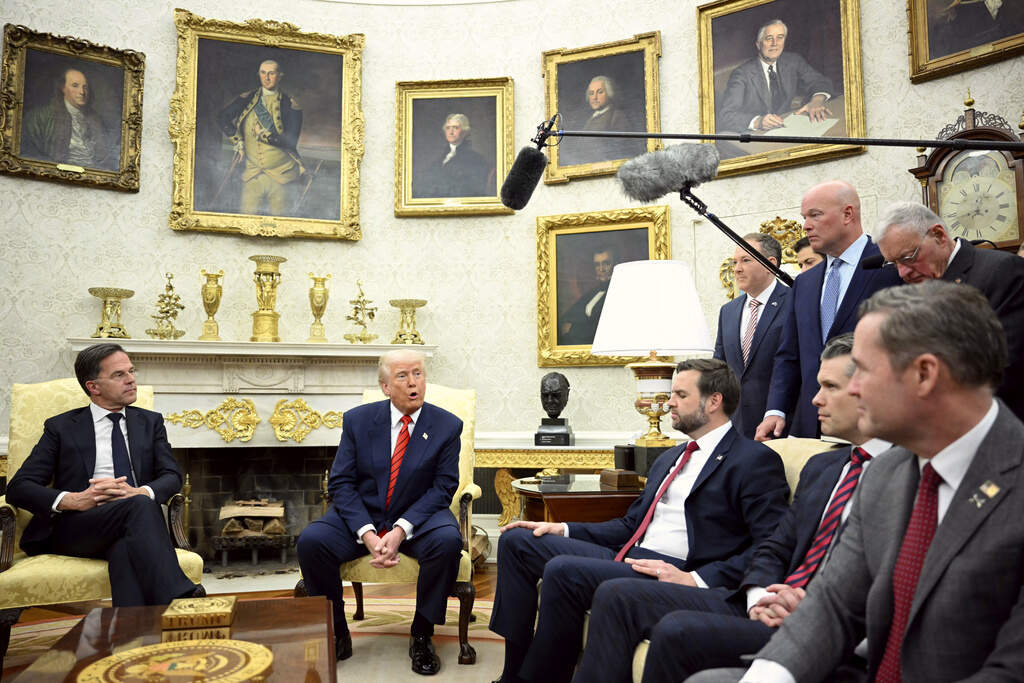
President Donald Trump declared America is entering a “Golden Age” on Inauguration Day. But as inequality grows, some historians say that the country is in a new Gilded Age.
Guests
Jack Beatty, On Point news analyst.
Edward T. O’Donnell, associate professor of History at College of the Holy Cross. Author of "Henry George and the Crisis of Inequality: Progress and Poverty in the Gilded Age."
Mark Zandi, chief economist of Moody's Analytics.
Transcript
Part I
MEGHNA CHAKRABARTI: In his inaugural address in January, President Donald Trump declared:
DONALD TRUMP: My fellow citizens, the golden age of America begins right now.
CHAKRABARTI: Trump added that in his golden age, America will, quote, 'flourish and be respected again all over the world.' And that it will, quote, 'be the envy of every nation.'
TRUMP: During every single day of the Trump administration, I will very simply, America first.
CHAKRABARTI: Seated just behind Trump that day were the titans of technology. Met as Mark Zuckerberg, Amazon's Jeff Bezos, and the richest man on the planet. Elon Musk. The three men in combination have a net worth of almost $750 billion.
That's according to Forbes. And yes, that is the same as three quarters of a trillion dollars. So if those men were a country, they would be the 22nd richest country on the planet. So when Trump speaks of a golden age for the U.S., is he really talking about a return to the Gilded Age? Trump himself hasn't shied away from the comparison.
Just days after inauguration, he mentioned the Gilded Age specifically, as he defended his major tariff plan.
TRUMP: We were at our richest from 1870 to 1913. That's when we had, we were a tariff country.
CHAKRABARTI: By the way, if you factor in inflation and the cost of living, and adjustments made for that, GDP per capita today in the U.S. is nearly six times higher than it was in 1913.
President Trump isn't wrong when he talks about the richest back in the early 20th century, because the Gilded Age, after all, was the era of a tiny but vastly wealthy number of robber barons. It was an era of extreme poverty for so many more, and of political corruption at the highest levels. Is the United States in a new Gilded Age?
And what does that mean for you? Joining us now is On Point news analyst Jack Beatty. Hello there, Jack.
JACK BEATTY: Hello, Meghna.
CHAKRABARTI: I know many daily On Point listeners are probably wondering, where have you been, Jack?
BEATTY: Prognosticating.
CHAKRABARTI: Prognosticating in the most delightful way. I want everyone to know who misses Jack and doesn't go to our podcast feed that you need to go there right now. Because for the past year and a half, Jack has had a special weekly podcast feature that appears in the On Point feed.
It's called The Jackpod. And there, Jack and I have much longer, richer, and deeper discussions that bring the whole flowering of Jack's historical and literary analysis to listeners. So go to the On Point Podcast feed and look for The Jackpod, it drops every Friday, which means there's a new one today for listeners.
And by the way Jack, the reason why I really wanted you back today in the live show, of course, is because I think I don't know anyone who knows more about the Gilded Age than you. You've written a lot of books about it including Age of Betrayal: The Triumph of Money in America, 1865-1900.
So everyone put that on your reading list. Joining us also now is Edward O'Donnell. He's an associate professor of history at the College of the Holy Cross and author of many books as well, including Henry George and the Crisis of Inequality: Progress and Poverty in the Gilded Age. Professor O'Donnell, welcome to On Point.
EDWARD O'DONNELL: Great to be here.
CHAKRABARTI: I would also wax lyrical about you, but we'll wait until the end of the episode, so I feel like I know you better, Professor.
O'DONNELL: My track record on this show is far less than Jack's, to be sure.
CHAKRABARTI: We'll close that delta a little bit today. So first of all, let me ask both of you, and Professor O'Donnell, I will start with you.
If you had to pick two or three of the hallmarks of the original Gilded Age, what would they be?
O'DONNELL: To start, I always try to point out that the Gilded Age was on some level a golden age. It truly was, it's an age of just wondrous technological breakthroughs, tremendous wealth expansion.
The GDP, it goes up every year, except when the economy occasionally crashes. So it's an age of wonder. And the big word that everybody is using, particularly politicians at ribbon cutting ceremonies, is progress. So there is a lot to be optimistic about, excited about, enamored with, but beneath the surface, are a series of roiling social problems, discontented workers, robber barons basically acting without any kind of restraint and all sorts of other social problems.
And that's really the great conundrum. It's an age in which a lot of people are excited, but those very same people are often harboring a lot of --
CHAKRABARTI: Jack, why were they called robber barons, and who were, like, one or two of the ones that we should most be thinking about?
BEATTY: I think the metaphor came out of the Rhine River, the view of medieval barons who put chains or blocks across the Rhine River, and they would hold up people coming down the Rhine to get tributes. That was the sort of model for the robber baron. And the quintessential robber baron, we don't talk much about him, but he was a much-execrated man, was Jay Gould, a financier who shows up again and again throughout the era. Someone, it might have been Henry George, I don't know, said that he is, quote, the worst man to alive since the birth of Christ.
There was no proving that and he's had some stiff competition since, but he shows up everywhere, fixing politics, suppressing strikes, running railroads and running them into the ground and impoverishing whole areas by taking away the railroads.
In short, he's a Mephisto of the whole period.
CHAKRABARTI: Professor O'Donnell, was it Henry George who said that about Gould?
O'DONNELL: I don't believe he did, but if he was pressed by a reporter, he probably would have said something along those lines, that Gould represents all that is wrong and all that is dangerous about the trends of the Gilded Age.
CHAKRABARTI: And so tell me a little bit more. What did he represent that was so dangerous?
O'DONNELL: He's for one, he's a person that largely is manipulating the economy. He's not actually producing anything. He is a Wall Street wizard, and all of his machinations are basically through financial instruments and stock and watered stock and hostile takeovers and so forth.
So he's not actually producing anything, at least in the eyes of most people, but he's making a staggering amount of money. And he's very much on the lips, as Jack says, he's the villain of the age. Almost every time you interview or see a worker, giving testimony about what the problems are in the Gilded Age, they say, they referenced Jay Gould, Jay Gould earns an awful lot, but he doesn't do anything to earn it.
CHAKRABARTI: So he's a financier and a speculator, really, is what you're saying.
O'DONNELL: And that's a big theme in the 19th century, especially in the Gilded Age, that the producers, the hardworking farmers and workers of this country are working harder than ever, they're producing more than ever, and they are getting less and less of a share of that wealth.
And somehow, People like Jay Gould and Rockefeller and Carnegie and all the others have found a way to subvert what they think is a good system. Capitalism is something they believe in, but not this kind of roguish, out of control, manipulated, corrupted version of capitalism where despite their hard work and their ingenuity and their sacrifices, they are falling further and further behind.
CHAKRABARTI: Okay. So Gould, and you mentioned some other names, Carnegie. Vanderbilt, Rockefeller, of course, now I think most people who have a passing knowledge of them know them by the foundations that they left behind, which actually I want to talk to you guys about a little bit later. But Jack, Professor O'Donnell said something interesting about here we have the titans of 19th, late 19th and early 20th century capitalism benefiting from the capitalist system. But at the same time somehow subverting it, or at least politically subverting it. Can you talk to me more about that?
BEATTY: It was an era of political capitalism. That is, you paid government, and you got something. Collis P. Huntington, who was the empresario of the Southern Pacific Railroad paid off politicians and in his yearly write up of his expenditures, he would put notes down how much he gave each politician, and they contributed to the politicians not even their campaign accounts, into their pockets, to get rights of way for railroads.
That was the key. You bought them off. And they would give you rights away. They'd pass a law saying, yes, the Southern Pacific can take this line of country through Arizona. Or, so it was within the gift, if you will, of legislators to pass laws opening up their states to railroads.
And you paid for that privilege. And of course, you can see the tariff similarly as political capitalism, right? The tariff protecting Northern manufacturers. They paid money. They kicked in lots of money to the political, to the essentially the Republican party.
And in return, they got their tariff. You paid your money. You got what you needed. It was political capitalism. All roads in a way led to Washington.
CHAKRABARTI: I see.
BEATTY: Or to state capitals.
CHAKRABARTI: Professor O'Donnell, I keep hearing you say, go ahead.
O'DONNELL: That's precisely what was happening.
And if you look at any of the third parties, the labor parties, sometimes they're small local ones, sometimes they're major attempts at national ones the People's Party, the Populist Party. They all say the same thing. Both parties, Republicans and Democrats, are equally corrupt, and both of them have completely shirked their duty of taking, putting at the forefront of public policy the well being of the great mass of Americans, the farmers, the workers, et cetera.
They are catering exclusively to Wall Street, to big corporations, to big business, and leaving everybody else behind. And what really irks workers and farmers is that, as Jack points out, the government is perfectly willing to do all kinds of things to facilitate big business, rights of way.
But also, just giving away massive amounts of land to railroads, to the tariff to the gold standard, the government is perfectly willing to do all kinds of things intervening in the economy. But when it comes to workers saying we demand an eight-hour day, we demand a living wage. And we demand the right to strike, the government says, no, absolutely not.
Part II
CHAKRABARTI: Jack, let me turn to you, because you and Professor O'Donnell really talk quite in detail about the political power, right?
The political capitalism of the small number of wildly wealthy men during the Gilded Age. Can you tell me a little bit more about Gould? Because he seems to be a really interesting example. I understand that he was really wrapped up with the Democratic Party and particularly Tammany Hall.
Is that right?
BEATTY: Whatever was going on, he was, that was brutal, he was involved in it, for sure. And he was a big backer of Grover Cleveland. He wrote to Cleveland after his 1884 election saying, Oh, the country is in good hands with you, and Cleveland wrote back saying, yes, and I'm going to look after you.
And he did. So he was whatever was profitable, whatever was going on, Gould took a piece of it. Now, some people, as I note in my book, some people see him as a kind of force for progress. This gets back to what Professor O'Donnell was saying, that for all his manipulations, he moved money from where it was dormant, to where it would be active.
He had an eye for the main chance, and so capital moved and he was in that sense a kind of, if not quite an industrial statesman, that's a title that was conferred on John D. Rockefeller, rather inappropriately, but he was, if you get far enough back from him, he can look like a progressive figure.
But there's actually a funny remark about him that somebody made. He wasn't known as a wit. When a former partner shook his finger in Gould's face and vowed he would live to see Gould earning a living, quote, 'By going around this street with a hand organ and a monkey.' Jay Gould replied, 'Maybe you will Henry, and when I want a monkey Henry, I'll send for you.'
CHAKRABARTI: Oh, my goodness. Wow, Professor O'Donnell then tell me a little bit more about this because obviously the political entanglements, both of you have made clear, and then how those enriched the wealthy class even further.
But they also had a direct impact on the overall economy of the United States as well, positively, as you've said, in terms of the technological breakthroughs and the rise in GDP, but also not so positively. I think there's some direct connection between some of these robber barons and Black Friday of 1869.
Is that right?
O'DONNELL: One of the great conundrums of the Gilded Age was that it was this great exploding economy, but it would literally overheat and crash. So there's two, the two great depressions of American history before the 20th century were in the mid 1870s and in the mid 1890s. And we're talking something fairly similar to what happened in the 1930s, 25% unemployment, tens of thousands of businesses, banks, farms foreclosed, really hardcore suffering.
And these are always triggered on Wall Street. So there's the Black Friday panic in 1869. But four years later, also triggered on Wall Street is the panic of 1873. And most Americans blame these Great Depressions on Wall Street because they emanate out of Wall Street. And they're seen as the sort of product of all this wheeling and dealing and the term of the day, watered stock, there's no regulations on Wall Street.
So you can just issue unlimited amounts of stock, make all kinds of backdoor deals, do secret plots to crush your competition, which was what Rockefeller was so great at. So there's a lot, Gould represents that, not only that he doesn't seem to make anything, but he makes tons of money, but he also is part of that system that is driving millions of Americans every 20 years or so into tremendous levels of suffering and poverty.
And Gould also represents another aspect of these robber barons who like to call themselves captains of industry, of course. Which is that these may not be actual quotations, but they are stuck to them. These robber barons all have a moment where they say something that betrays their total contempt for the American people.
And Jay Gould is quoted in this era as saying, I could kill one half of the working class to kill the other half. And this is in response to a question about whether he was worried about the rise of the Knights of Labor Union among his workers on the railroads that he controlled. And the other robber baron say, the public be damned and so forth.
So it's not just that they're super wealthy, and that they manipulate the economy, but they are haughty, and they are arrogant, acting in ways that seem very un American to a lot of people.
CHAKRABARIT: Wow. Jack, was that same arrogance or contempt for working class Americans in the first Gilded Age, was it expressed by politicians themselves or were they wise enough not to say the quiet part out loud?
BEATTY: They didn't have to worry much about catering to the Average voter. Politic, you ask what was different about this age. A historian at Harvard, Morton Keller, uses the phrase, the weight of the war. The weight of the war, of the Civil War, on politics.
In the North, it meant that campaigns weren't run around, issues of social justice, or we need a break for the working man. It was the bloody shirt. It was, vote as you shot, you were against the rebels then and now you get a chance to be against them today, now. And the rebels were all in the Democratic party in the south and in the south, instead of talking about the immiseration of sharecropping and so on.
No, it was enough to run on, we're going to white supremacy, and we can't have a return to, quote, Negro domination, which was the reaction to Reconstruction. And so it was all, the war structured politics. It was like a cultural issue, if you will, today that kept workers from, even politics, even from articulating what the subject of social justice would be because they had these cultural issues to throw, the bloody shirt, Negro domination, forget about issues of social justice.
CHAKRABARTI: Oh, that's interesting. Okay. Professor O'Donnell, then, and we've been, it's very understandably focusing thus far on that mind, that tiny slice of wildly wealthy robber barons from the first Gilded Age. But I'm wondering if you could tell us in some more detail then, but what was life like for the vast majority of Americans at that time?
The impoverished Americans who were really, whose lives were at the whim of the markets as you described, or working-class Americans, farmers, et cetera. What was it like?
O'DONNELL: It's different everywhere, but largely there's a really pervasive sense among American workers in the 1870s, '80s and '90s that they are losing ground, that they are falling behind.
And if you look at the lives of people in, say, New York City in the large and growing, expansive slums, and this is a word that becomes part of the American lexicon, the slum, and it's treated as something very dire. And because we associate slums with Europe, and this is another one of these themes of the Gilded Age, is terror of Europeanization that we are, we broke away from Europeanized societies dominated by aristocrats and kings and queens and all that in 1776. And we've spent 80 years building this Republic and now it seems we're backsliding into that kind of world.
There's a famous, there's a image on the cover of Harper's Weekly, which is the nation's most popular magazine in 1876, that shows a wealthy family walking down the sidewalk and a poor family gathered around a steam grate. And it says the hearthstone of the poor. And if you show that image to people today, they say, Oh, it's a scene out of Dickens.
And that's exactly what the artist is trying to convey. But is saying, no, this is New York City. We are sliding back into this kind of Europeanized society. And so both political commentators. But also, workers speak in that language, that we are hard won republican, small R citizenship is being undermined.
It's not just that we're poor. It's that we're being driven below a basic standard of Republican citizenship where we could live well, not fancily, but we live in a house. We provide for our families, our fruits we receive, portion of the fruits of our labor and more and more of us are unable to do that.
More and more of us are being forced to live in squalor and to pull our kids out of school before, when they're young, so that they can support the family and keep food on the table, thus destroying their chances at a better life. And that's a pervasive feeling among so many people, that this system that was designed to reward hard work and honesty and decent, appropriate levels of risk taking, has now been taken over. And that the real Americans, farmers and workers are being defrauded through this system that allows the powerful to reap all the benefits of their labor.
CHAKRABARTI: It sounds like they weren't wrong. Go ahead, Jack.
BEATTY: I was going to say, defrauded and also shot. One of the things that the rich pay, the robber barons paid for was state militia and national guardsmen. At least 150 times, state militia were called out and guardsmen called out in the 15-year period.
The great railroad strike of 1877, guardsmen killed at least 69 people and wounded 100. And the passage, here's a passage that shows just the feeling of sadism towards ordinary working people. This is in a journal called The Independent, a journal of religion. And here we go. If the club of the policemen knocking out the brains of the rioter will answer, then well and good.
But if it does not promptly meet the exigency, then bullets and bayonets, canister and grape, with no sham or pretense in order to frighten them, Napoleon was right when he said that the way to deal with a mob was to exterminate it.
CHAKRABARTI: Wow.
BEATTY: That happened in America. That was written in this country in the 1880s.
CHAKRABARTI: Professor O'Donnell, with all of this background, do you think the United States is already in a new Gilded Age? There's no perfect analogy. I get that, but I'm hard pressed to find screaming differences between a century ago and now.
O'DONNELL: So historians typically would reject the idea that, quote unquote, history repeats itself.
But there is a quote attributed to Mark Twain, the person who gives us the term Gilded Age. He may or may not have said it, but the gist of the quote is spot on, which is that history doesn't repeat itself, but it rhymes. And we are, this Gilded Age that we are in is definitely, we see a lot of rhyming, a lot of themes that were very prominent, troubling themes in the late 19th century that are almost identical in different form to what we're experiencing right now.
The talk of so many people right now is the power of, you know, billionaires like Jeff Bezos and Elon Musk and so forth, and not only their wealth. But what that wealth gets them, which is massive political power and even indirect political power, but their ability to write legislation to manipulate the markets and so forth.
That is straight out of the Gilded Age.
CHAKRABARTI: Feels like every other syllable is rhyming Professor O'Donnell. Okay. So with this in mind, I want to turn to a specific thing that was recently published about our current economy, and how much the nation right now is depending on a small slice of wealthy Americans. In order to do that, I'm going to bring Mark Zandi into the conversation.
He's chief economist of Moody's Analytics. Mark, welcome to On Point.
MARK ZANDI: Thanks, Meghna. Good to be with you.
CHAKRABARTI: Moody's published not that long ago, a study which caught a lot of people's eyes and it had to do with the spending power or the economic reliance of the U. S. economy on the top 10 percent of U.S. earners. Tell me a little bit about that.
ZANDI: Yeah, that's right. We did a bit of work trying to understand spending patterns across different demographic groups and the kind of the headline statistic is that the folks that are in the top 10% of the income distribution. And just for context, that's at this point somewhere around $275,000 a year. So if you make over 275k, you're in that top 10%, account for almost half the spending that's done across all Americans. So just soak that in for a second, the top 10% account for 50% of the spending. So that means the bottom 90% account for the other half.
And since the pandemic hit five years ago, people in the top 10% of the distribution have been really driving the train, driving the economy's growth. Their spending has been above the rate of inflation. And as you, as everyone knows, inflation has been very high.
Their real purchasing power has improved, continued to improve and they continue to spend very aggressively. Whereas folks in the bottom 90%, their spending has just barely kept pace with inflation. So they're spending, their incomes are up and they're spending, but over the past five years, it's just up consistent with the rate of inflation.
So that kind of gives you the gist of the study. There are a lot more detail there, but that's the headline.
CHAKRABARTI: I am still trying to soak this in, Mark, honestly. Because when I first read about it. I was shocked. But should I have been shocked? Because does that top 10% in terms of spending in the United States, does that roughly match what the income distribution is in this country?
Are the top 10% earning 50% of the nation's income? Or are they earning even more?
Yeah, go ahead.
ZANDI: No, their income isn't nearly a skewed and interestingly, over the last decade or so, the income distribution hasn't, it's skewed, but it hasn't gotten worse.
Most of the skewing of the income and distribution, that meaning the folks in the top part of the distribution, gaining a higher share of the income, most of that skewing happened in the '80s, '90s, early 2000's, what's really going on now is wealth. The wealth is getting a lot more skewed.
Stocks and real estate and crypto and bond portfolios, they're just becoming more concentrated in the hands of a few. And that's powering the spending. So the wealthier, the well to do are powering spending. So it's less about income. More about wealth.
CHAKRABARTI: When these numbers first were put in front of you, when you saw the results of the analysis, what did you think, Mark?
ZANDI: Ha! I've got 200 economists that work for me, in one form or another, and I said to the 200 economists, obviously I'm exaggerating, I said, let's go check this and make sure that we got the programming right. The coding right. Because it took a little bit of work, used a couple of different, three different data sources, and then they came back again.
I said, go check it again, because really, because I was surprised to what degree. Now, I think it is important to point out, this probably overstates the case. Cause this period since the pandemic is bizarre in every respect, one thing happened during the pandemic was that wealth, the wealthy couldn't spend right.
They were sitting, I don't know where, but on their back deck and they weren't spending. So that allowed them to save a lot of cash and a lot of that's still sitting in their checking account. And of course, until very recently, the last few weeks, the stock market's been straight up.
And that's also helped a lot. So it's overstating the case.
Part III
CHAKRABARTI: Professor O'Donnell and Jack, I wanted to get your quick responses on what Mark and Moody's had found about this vast spending power of the top ten percent of Americans.
Jack, does that rhyme with the Gilded Age? And if so, what lesson should, or what warning should we take from it?
BEATTY: It does indeed rhyme. Indeed, that's the theme of Thorstein Veblen's The Theory of the Leisure Class, published in 1899. This is the book where he advanced the notion of conspicuous consumption and leisure.
Conspicuous consumption, the showy use of wealth to signal status. Conspicuous leisure, the showy use of time to signal social status. Pecuniary emulation, that's one of his coinages, the desire to compete with others for status and wealth. Veblen was essentially talking about the pattern of consumption and display of the rich, of the gold, of the Gilded Age, which sounds quite like, tracks with what Mr. Zandi is seeing today.
And that Veblen was very, was always an anthropologist of this because he saw that this was acting out primitive instincts, that to see, that the rest of us got a kind of thrill out of seeing the rich disport themselves, that our atavistic longing for triumph and to be, and to put everybody else down was somehow satisfied in the conspicuous consumption.
And the conspicuous consumption channeled the kind of ferocity of feudalism into new into new rivers and tributaries and indeed oceans of inequality and excess. Yes, very much like the Gilded Age.
CHAKRABARTI: Do I get an atavistic thrill from watching a crypto bro spend $6 million dollars buying a banana duct taped to a wall?
No. I do not.
(LAUGHS)
But, Jack, I take your point. Professor O'Donnell, same question to you.
O'DONNELL: I would agree with everything that's been stated. Conspicuous consumption was one of the driving forces of the first Gilded Age and it was manifested itself in all sorts of ways, But the two most, the most obvious ones were these lavish parties that the rich would throw, so the big ball. You know, the Vanderbilt ball in the early 1880s really set the standard. Actually, there are two things here.
One is they built a palace not a mansion, a absolute Versailles like palace on Fifth Avenue, and then they held a threw a housewarming party, invited the elite, the 400 of New York to come, and they spent millions of dollars on this party, and the press covered it, and this is when, as Jack was pointing out, there became, you know, the celebrity, wealth and celebrity, we began to see the emergence of society pages in every single newspaper that would breathlessly tell what all the rich and famous were up to and who was opening a new mansion and who was summering at what resort and so forth.
So the conspicuous consumption was very much a driver, and it very much shocked a lot of people. Because up to the Gilded Age, it was considered it was no problem being, becoming fabulously wealthy, but you had to exhibit what we would call Republican restraint. You'd live in a nice house, but not a palace.
You would never, you would have people drive you around in a horse and buggy, but you wouldn't put them in uniforms like Europeans. And this is this aristocratic aping that the wealthy begin to do in the Gilded Age, is shocking to people. It strikes people as profoundly un-American. Other people also get a bit of a thrill out of it, too.
CHAKRABARTI: I'm thinking right now about Mark Zuckerberg wearing Benson Boone's sequined jumpsuit to perform at his wife's 40th birthday party. It's that shocking, bizarro land excess that you're talking about. It's been all around us with the ultra-wealthy for a while.
But Mark, so, again, to understand how things are rhyming here, you had mentioned something earlier that I want to just dig into a little bit deeper. That we're talking about wealth right now, not so much income, but there have been a series of policy decisions, what, over the past 30, 40 years that sort of set us on this road to a bulge in that right end of the wealth distribution, right?
ZANDI: Yeah, I assume you're talking about like the changes to the tax code.
CHAKRABARTI: Tax code, deregulation, et cetera.
ZANDI: Yeah. Yeah. Yeah. I think that's fair. The Tax Cut and Jobs act that was passed under President Trump's first term provide a tax cut to everybody across the entire income distribution, but the bulk of the benefit of that tax cut has gone to higher income households.
But I think the thing that's really driving this is stock wealth. That's the surge in stock values. If you look at the S&P 500, which is a broad measure of stocks, and I'm abstracting from the last couple, three weeks, Meghna, because a lot's going on here, with the trade war and everything else, but it's up 100%, meaning it's doubled in the last five years.
And a lot of that's been concentrated in these technology companies, you've heard the phrase, the magnificent seven, that would include companies like Mark Zuckerberg's and so that has really supercharged this skewing. And I don't know that I trace that back to policy.
There's a lot of other dynamics at work here. Obviously, some that ultimately could benefit us more broadly in the artificial intelligence, the AI, that should improve productivity growth. So the policy certainly has played a role, but other factors as well.
One other thing I'd say though, you talk about rhyming. One big, I think, important difference between now and then is all the reforms have been put in place because of the excesses of the Gilded Age, right? We got, in subsequent history, including the Great Depression, but we got Social Security, we have Medicare, we have Medicaid we have a Federal Reserve Board that was stood up in 1913 to try to smooth out the ups and downs in the economy, which really, when it's down, it really hurts low-income households.
So a lot of things have been put in place. So it's not the same, we've got a lot of problems, a lot of issues and a lot of things to be concerned about, but it's not in the same kind of position, that low-income households aren't in the same kind of position now that they were a hundred years ago.
They're in a much better spot.
CHAKRABARTI: Yeah, no, point well taken. We'll talk a little bit later about whether those exact programs, how much they might change in the second Trump administration. But one more question for you, Mark, because I did hear you earlier when you said that this is a somewhat unusual time, right?
Because of all this, let's call it pent up demand from COVID amongst those top 10% of earners. That makes a lot of intrinsic sense to me, but then at the same time, and tell me if I'm oversimplifying here, after that pent up demand is met. It should slack off after a little bit of time, but that doesn't necessarily mean that the bottom 90% of earners have the same purchasing power that the 10% do.
So overall, it doesn't seem like that it's good for the economy to have such a lopsided spending power.
ZANDI: Totally agree. In fact, this is a very significant vulnerability in the economy. Think about it for a second. Suppose the stock market's now down 10% from its peak because of this trade war.
Suppose it goes down another 10, 20%, right? These folks are going to be a lot less wealthy. $6 trillion of wealth is evaporated in the last three weeks. So you can see things can change very rapidly. And then these very wealthy, to do households, may very well pull back on their spending, and if they do and they're key to the growth, then they're also going to be a key to the weakening that's going to follow.
So I do think this is a very significant vulnerability to the economy, particularly at this juncture, given all the things that are going on.
CHAKRABARTI: Mark Zandi is Chief Economist at Moody's Analytics. Mark, thank you so much for joining us.
ZANDI: Yeah, anytime. Thanks for having me.
CHAKRABARTI: Okay, so you Professor O'Donnell and Jack, you heard Mark mentioned some of the reforms that came out of the Gilded Age, and of course, following the Great Depression after 1929 as well.
He mentioned Medicare, Medicaid, Social Security as a safety net that did not exist in the very early 20th century. Seems like a good moment to play what Elon Musk thinks about social security. This is from just late last month. He was on the Joe Rogan Experience, on the podcast, and here's what he described social security as being.
ELON MUSK: Social security is the biggest Ponzi scheme of all time. People pay into social security, and the money goes out of social security immediately, but the obligation for social security is your entire retirement career. If you look at the future obligations of social security, it far exceeds the tax revenue.
CHAKRABARTI: Now, Musk isn't wrong about the future obligations exceeding tax revenue, but it is actually very fixable, which a Ponzi scheme isn't necessarily. All right, let's move back in time once again. This is 1912. You're about to hear the voice of former President Theodore Roosevelt when he was running as a third-party candidate.
He recorded a number of campaign speeches, and this is one of them, where he criticizes political parties for becoming, quote, the tools of corrupt interests to serve their selfish purposes, end quote.
THEODORE ROOSEVELT: Behind the ostensible government sits enthroned an invisible government owing no allegiance and acknowledging no responsibility to the people. To destroy this invisible government, to befoul the unholy alliance between corrupt business and corrupt politics is the first task of the statesmanship of today.
CHAKRABARTI: To destroy this invisible government, to befoul the unholy alliance between corrupt business and corrupt politics is the first task of the statesmanship of the day. Teddy Roosevelt in 1920. Professor O'Donnell, how did the United States unwind from the vast negativities of the Gilded Age.
O'DONNELL: Well, Roosevelt is a good place to start. He's not the only progressive, but he's the most widely seen progressive. He becomes president in 1901 and quickly embraces a progressive agenda. And at the heart of that, one of the key things is reigning in the unchecked, Wild West big business scene and Wall Street.
And when you, if you were to read people, quotations from Roosevelt in this era, like the one we just heard, and say who said it, many people would say some socialist, some radical, it's not. It's a mainstream progressivism, Roosevelt says in 1902 and is one of his annual addresses in so many words, we have created the corporations.
They are the creatures of the state. Like we, they don't actually exist in nature. So therefore, we have the right, and furthermore, the obligation to regulate them in the public interest, and that is in many ways the essence of progressive attempts to regulate Wall Street, regulate big business.
Break up big trust. Roosevelt was not a radical, but he was more radical to certainly than the titans of Wall Street. And one thing that the progressive era is centered on is restoring the common good. We had this obsession in our political culture of individualism, and individualism is a cardinal American principle and virtue.
Up to a point. And it's always been challenged by the common good. They are not opposites. But there's always this tempering thing. And so we go through these phases and certainly the last 50 years, starting with Reagan this obsession with, it's all about the individual, only the individual counts. Free markets will liberate the individual and the heck with the common good or common institutions like public schools or parks, and that sort of thing. And that is really what difference is.
That's really what progressive thinking is about. And that's what we see today being chipped away at or being hacked away at by Musk and his team of DOGE dudes, they are going after the most fundamental common good institutions, whether it's public health, public schools, parks, it's all, social security, Medicare, Medicaid, it's all on the chopping block, and they're justifying it as this is going to liberate the individual.
CHAKRABARTI: Yeah, Jack, I also am mindful of the fact that, as with any complex system, this wasn't a quick fix, right? Professor O'Donnell's point about regulation is well taken and that took time as well. And in the interim, we also had the First World War, right? Then we had 1929. We had the crash, the stock market crash and The Great Depression.
Then we had the Second World War. It wasn't until a couple of decades later and major cataclysms economically and geopolitically, that the very things that form that common good that Professor O'Donnell is talking about came to pass. With that in mind, what are the other lessons of getting the nation on the road to refocusing on the common good that you can draw from the Gilded Age, Jack?
BEATTY: One way to look on it is that I mentioned the phrase, the weight of the war. And how that weight of the Civil War on politics, on the economy, on society hung over everything and structured politics in terms of sort of cultural issues, not economic issues. And that was a, it sectionalized politics.
It awaited, history awaited a second cataclysm, the Great Depression, to nationalize politics again, so that the Southern Democrat and the Northern Democrat could create together a coalition that could get through Social Security and so on. It took, the cataclysm of the Civil War divided the country even further on sectional lines.
The Great Depression joined it, joined, essentially, the poor or the out of luck in the North and the South and regional differences were forgotten. And of course, since then, they have come to the fore with great, especially since the Reagan era, sectionalism has returned.
But one thing, Mark Zandi mentioned how we have these reforms that make a difference between us and the Gilded Age. It's true, but look at this. In 1907, the Tillman Act banned corporate giving to campaigns. That was effectively repealed by Citizens United in 2010. We've returned to the Gilded Age in that campaign finance respect.
This program aired on March 14, 2025.