Support WBUR
Trump v. higher education
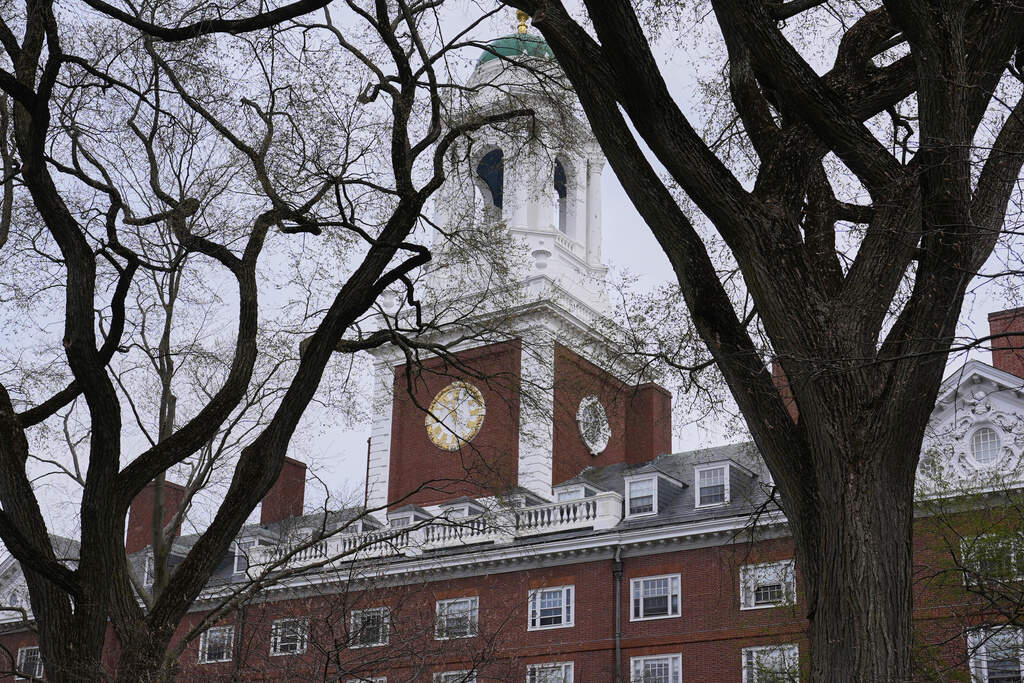
Harvard University is suing the White House. What the university’s clash with the Trump Administration means for the rest of higher education.
Guests
Sarah Brown, senior editor at the Chronicle of Higher Education.
Ryan D. Enos, professor of government and director of the Center for American Political Studies at Harvard University.
Also Featured
Don Ingber, founding director of the Wyss Institute for Biologically Inspired Engineering at Harvard University.
David Walt, professor of biologically inspired engineer at the Harvard Medical School.
Kim Lane Scheppele, professor of sociology and international affairs at Princeton University.
Transcript
Part I
DEBORAH BECKER: In universities throughout the U.S., scientists conduct vast amounts of research that is now under threat as the Trump administration seeks to quote reclaim elite universities. One example of this is Harvard's work on a microchip the size of a USB thumb drive that can simulate a human organ system. It's called a human organs-on-chips, and it promises to accelerate drug discovery and help personalize medical treatments by imitating human organs.
DON INGBER: If it's a lung, we could have air and breathing motions. If it's intestine, you have peristaltic like motions.
And these devices, the cells, the way we position them, recreate the structure of the living tissues in our organs, and as a result, we mimic human organ level responses to drugs, toxins, and radiation.
BECKER: That's Don Ingber, founding director of the Wyss Institute for biologically inspired engineering at Harvard University and a professor of vascular biology at Harvard Medical School.
He helped develop these chips. Recently, he had been using them to study radiation exposure during cancer treatments, and Ingber says the federal agency overseeing the work was enthusiastic.
INGBER: Just the week earlier, they were so positive about the advances we were making, developing ways to identify drugs to prevent radiation injury, that they were asking us to come up with a small proposal or what they call an add-on with additional funding to expand what we were doing to another area.
BECKER: When he says they, professor Ingber is talking about the Biomedical Advanced Research and Development Authority, or BARDA, as it's called. That's the federal agency that helps fund his work. But last Monday, amid Harvard's high-profile fight with the White House, his two contracts with BARDA suddenly ended.
INGBER: One of the people who works for me, who is a project manager for me, and the key point of contact with the team at BARDA received an email just about five hours after Harvard published its rejection of Trump's demands. And in that email were two attachments to PDFs that simply said, this is a stop work order to cease all activities on these two contracts.
There was no explanation at all.
BECKER: Harvard had refused to comply with the Trump administration's demands, requesting that the school agree to a series of steps that would give the federal government more oversight of the school's hiring, admissions, and governance. Immediately, the White House then fired back and froze more than $2 billion in research grants for work done by Professor Ingber and his staff at the Institute.
INGBER: It was pure punitive lunacy. That is how I felt about it.
BECKER: Ingber points to the White House recently honoring work done at his institute by Professor David Walt. That work focused on new tools to test for neurodegenerative diseases such as ALS and Parkinson's.
Walt, who's a professor of pathology and bio-inspired engineering at Harvard Medical School says he received a stop work order that said it went into effect immediately.
DAVID WALT: The consequences of that were fairly significant. I had three people that were assigned to the project and because we had to stop the project immediately, I was forced to move them over to other projects, which is not the ideal situation.
And having to stop that without any warning was very disappointing.
BECKER: And Walt says, funding freezes like these will have consequences.
WALT: There are things like cell lines where patients had donated tissue. Those kinds of things can't just start up again. They have to be stored properly at very cold temperatures.
They have to be rejuvenated and propagated and when you have a stop work order, if you don't have the resources to be able to properly put those kinds of materials away, in some cases it jeopardizes the entire prospect of being able to restart that project in a timely fashion. So there's a lot of work that the government had paid for, that taxpayers had paid for, that ended up being completely wasted.
BECKER: And the battle lines in this fight between the president and perhaps the most well-known university in the country seemed to deepen every day. The White House is threatening even more actions against Harvard, including taking away its tax-exempt status.
Here's what President Trump said when asked about that at a press conference last week.
JOURNALIST: Why are you considering changing the tax status of Harvard?
TRUMP: Because I think Harvard's a disgrace. I think what they did was a disgrace. They're obviously anti-Semitic.
BECKER: So today On Point, Trump v. higher education and the clash between the White House and Harvard University.
Joining us first is Sarah Brown. She's senior editor at the Chronicle of Higher Education. Welcome to On Point, Sarah.
SARAH BROWN: Hi, Deborah. Thanks for having me.
BECKER: So we have a lot of volleys here in this fight between Harvard and the White House. And we may not get to all of them this hour, but let's start with this federal funding and let's talk about exactly how much this will affect universities like Harvard and universities throughout the country and what the consequences might be here from this fight.
BROWN: So the federal government has enormous power over higher education. More than half of undergraduates receive federal financial aid, and the government funds more than half of all academic research. So this is a lot of money, right? And even for an institution like Harvard or some of the other universities that have been singled out by the Trump administration for mass funding freezes.
They don't have, they might have large endowments. They don't have billions of dollars in the bank necessarily to just fill the gaps in this funding. And so the impacts are really significant, and as the researchers who were just cited on the show noted, right? You can't just turn research on and off. If the funding is on hold, that might mean long running clinical trials have to end, or animals have to be euthanized.
And sometimes studies follow patients for years and you can't just stop that work for a few weeks or months. And Harvard officials have said, with these billions of dollars being frozen, we're already seeing grants devoted to cancer drugs and Alzheimer's and acute radiation syndrome, and lots of other really important issues.
They're all on hold. And that the challenges here with the funding will throttle research and discovery.
BECKER: And what about the claim? First, the claim that the basic question of should the government be funding this much research? Why should the government do it?
What does the government get in return? What would you say to that? And then I would like to ask you about the accusations of antisemitism against Harvard, which is the premise under which the White House has done some of this. So first, why should the government fund this research?
BROWN: So there has been growing government support for research since the mid 20th century. So we're talking about many decades here. In 2023, American universities spent about $60 billion in federal money. And those initial investments in the sort of mid 20th century were made at a time when the government was placing a lot of value on university research.
It was closely tied to national security interests around World War II. And that federal role in research has continued to grow. More recently, it's supported major medical breakthroughs on, again, on cancer and other diseases. And the government has historically viewed grants as an investment in a public benefit.
Like we all want cures for cancer. And I will say, scientists were concerned. Decades ago, as this federal role in research funding was growing, about, they were concerned about government interference and they were concerned, would higher education become beholden to federal influence?
But in general, there has been bipartisan buy-in for the research and innovation that universities do, and the government generally let the universities work independently. That there's this idea of academic freedom in the U.S., that universities should be able to do teaching and research without sort of external influence and that's really important for the pursuit of knowledge. And that has generally been, that has been the practice for a long time, and that's what we're seeing change right now.
BECKER: And of course, this fight began with the accusation, and we heard a clip of President Trump saying this at the start of the show, that there's antisemitism that needs to be addressed on Harvard's campus. And there's actually an antisemitism task force that has really been the lead agency for the White House in a lot of these letters to universities that they haven't addressed, allegedly haven't addressed antisemitism, particularly after protests on campus following the Hamas attack on October 7th, 2023. So what do you say about those allegations from the White House that are underlying a lot of this?
BROWN: Yeah, so big picture, the Trump administration is enacting an agenda that's grounded in the idea that universities have been captured by progressives and that conservative values need to be imposed on campuses, from the government.
There's an effort to refocus college curriculum on Western civilization. There's an effort to get rid of diversity, equity, and inclusion programs. And then there's also this crackdown on pro-Palestinian protests, the Trump administration sees those protests as anti-Semitic, and they have used the fact that they argue that colleges have failed to combat anti-Semitism.
That has been their justification for freezing. And in fact, even canceling in some cases, a lot of federal funding. And the Trump administration argues that these steps are necessary to force colleges to make changes that will keep Jewish students safe. I think a lot of people in the academic community believe that this isn't really about antisemitism.
This is about the Trump administration trying to assert a greater level of control over universities.
BECKER: You mentioned some of the demands that were made by the White House, and there was a very lengthy letter that may have been sent by mistake according to reports now, but regardless, this letter that the White House did send to Harvard had some demands that seem incredibly onerous. Did Harvard have a choice here? Did it have to reject these demands from the White House?
BROWN: People in higher education, college leaders and academics across the board, say that effectively Harvard didn't have a choice. Because the demands that were being made of the university were inappropriate for government to be asking the university to do these things.
For example, the document that the Trump administration sent to Harvard, asked them to share all hiring and admissions data for audit for years. These are just steps that are a little bit further than a lot of people think is appropriate.
Part II
BECKER: Before the break, Sarah, we were talking about some of the demands that the White House had listed in a letter to Harvard in its decision to have negotiations with Harvard over alleged antisemitism. And you mentioned some of them, but there were some things in this letter that I thought were very interesting and really send a signal to the whole higher education ecosystem in the U.S.
Among them, talking about reforming international admissions at Harvard and ensuring that there is viewpoint diversity on campus. Can you explain what those, why Harvard reacted the way it did to those things and what those would mean for higher education in general?
BROWN: You mentioned that there was a demand to reform international admissions, and the government demanded basically that Harvard no longer admit students who appear hostile to quote American values. That was it. It was not defined further. There was also a demand to conduct an audit of quote, viewpoint diversity among all students and staff, and submit it to the government.
By the end of the year, there was also a demand to review, quote, all existing and prospective faculty for plagiarism. And a demand to commission an external review of programs that quote, most fuel antisemitism, harassment, or reflect ideological capture. And so from Harvard's perspective, this would have really threatened the independence and the academic freedom of the university, again, to pursue teaching and research as it sees fit.
And I think, you know, what's important, too, is that the Harvard Demand letter went quite a bit further than a similar demand letter that was sent to Columbia University. Now, Columbia reacted differently.
They made concessions to the Trump administration in order to preserve some of their federal, try to preserve some of their federal funding. They'd actually already had $400 million canceled, and Columbia did make some changes. They changed their student disciplinary processes. They did put an academic department under the supervision of a vice provost, increasing oversight. And so there were differences in what Harvard was asked to do versus what Columbia was asked to do here.
BECKER: But Harvard did appear to be starting to make some changes. And there were some who were concerned that Harvard was going to do the same thing that Columbia did.
But then this letter came, which seemed to go further from the White House. What does that suggest to you?
BROWN: I think universities are in a really difficult position right now, because as we were saying, federal funding is so essential to how universities operate. And so there is this question about, how, if I'm an institution and I am trying to ensure that my federal funding is preserved, that my researchers are able to do research, that students are considering, continuing to receive their financial aid. What do I do in this situation? And we've seen, for example, at Northwestern University, they have now been targeted for a funding freeze.
Right before that, they announced a bunch of changes that they had made in recent months to try to combat antisemitism, to reform student discipline, everyone is walking on eggshells trying to figure out, to what extent do I try to negotiate with the Trump administration, or if it seems like those negotiations are not being made in good faith, do I take a stand? And of course, that's what Harvard has decided to do here.
BECKER: And then of course there have been other things that have come out because of that. Such as the IRS possibly ending Harvard's tax-exempt status. What would that do and even could that happen, what are your thoughts about that?
BROWN: So the vast majority of public and private universities are tax exempt.
And that has been the case for quite some time, because universities provide a public good, right? They provide education, they provide research, they support students, they do community engagement, if Harvard lost that status, they would be taxed on endowment earnings. They would be taxed on revenues from tuition and housing costs.
Donations would no longer be tax deductible for the donor. It would be a huge change for institutions. Now, to be clear, the White House has said that they are not pressuring the IRS to do anything, because these are supposed to be independent processes. But college finance experts told us when we've done reporting on this, that this move seems well outside normal, legal and regulatory bounds.
And it feels like another issue, frankly, that could end up in court sort of judging. Did Harvard engage in some kind of political activity that would've violated its tax-exempt status? That's the core issue here. And Harvard of course, says it has not.
BECKER: And then we've got the targeting of international students and the world has watched, right?
As we've seen two students, one from Columbia, one from Tufts University in Massachusetts who are now being held at an ICE detention center in Louisiana. These international students were here legally, but they were targeted for their speech essentially, and they now face potential deportation.
What does that do to the environment in higher education when there's this threat of potential deportation of some of your students if they say or do something that the government may not like?
BROWN: So there are over a million international students in the United States. It is an enormous part of higher education in this country.
It's not a surprise that the Trump administration is taking steps to potentially deport international students, especially those who protested the war in Gaza. Trump talked about that on the campaign trail. I think what's quite shocking to some people is that sometimes the actions don't match the rhetoric.
And in this case, they do. And in fact, the Trump administration has effectively canceled the legal status of hundreds. We've actually tracked over 1,200 international students, recent graduates in campuses across the country, since the beginning of April. Harvard has had a lot, at least 12 students and recent graduates affected, and again, international students are a huge part of higher ed in this country. If they are told to leave the country immediately, if they are, prospective students are incentivized to go seek education elsewhere, that would have major impacts and frankly, reshape higher education in this country as we know it.
I think a lot of international students, in the global context, international students view the U.S. is the best in the world. And in that, in large part, that's because the U.S. has academic freedom. And because of free speech and because people come to American universities to teach and research free from government interference.
That is not the case in many other countries. And again, these impacts on international students would have major implications for the sector, financially and otherwise.
BECKER: Now, you mentioned other universities, and I just wanna get to this briefly, because we did see a letter from dozens of university presidents this week, actually supporting what Harvard has done.
And you also mentioned Columbia and the fact that it did agree to a lot of the White House demands. I'm wondering what you get the sense is now among many university leaders, regarding this standoff with the White House against Harvard and other schools really.
BROWN: Yeah, so I think that since President Trump took office, he started enacting his higher education agenda pretty much right away.
And there was a lot of reluctance in the early weeks of the Trump administration among college presidents to say anything. They did not want to be made a target, as we've been saying, they did not want their federal funding to be at risk. That is a huge problem. And so I think for a while, college presidents were really reticent to speak out. We've started to see that change, because, as we are now at three months, nearly a hundred days into the administration, I think some college presidents are just seeing that their communities are asking for them to stand up and say what the Trump administration is trying to do in higher education is inappropriate.
It's interference. It violates academic freedom. And now that you mentioned that letter, more than 200 academic leaders have now signed on to that statement. And they wrote in the statement that they are open to constructive reform, quote, and do not oppose legitimate government oversight, but they oppose intrusion into the lives of those on campus.
And so we are seeing more college presidents and leaders in the academic community who are saying the Trump administration has gone too far. And frankly, it is a risk, because it could put a target on their back.
BECKER: You mentioned pressure being put on university leaders to take a stand and to do something and fight back against some of these proposals from the White House, demands from the White House, among those who were calling on Harvard to do that was Ryan Enos, a professor of government and director of the Center for American Political Studies at Harvard University, and he joins us now to talk about what's happening specifically at Harvard. Thanks for being with us.
RYAN ENOS: Hi. Thanks. I'm glad to be here.
BECKER: So what's it like now on campus at Harvard?
In the middle of all of this fighting, this week there was a lawsuit that Harvard filed in response. So really, it's a heated fight here going on with the White House.
ENOS: Yeah, it is a heated fight, and I'll tell you, it's been a real seesaw on campus. Professors and I think a lot of students were people that like to keep our sort of heads down and concentrate on our research or our studies or whatever it might be.
But this whole time, essentially since Trump took office, it's been like there's a sword hanging over the head of the campus, just waiting for something to fall. And those of us that were paying attention to the situation knew that Trump was coming for Harvard. It was very, it was very obvious from the get-go, and when his demands finally started coming, it was really a feeling that what is gonna happen, is Harvard gonna capitulate like Columbia did?
And then they did not. They pushed back eventually. And that really, in some ways, was this moment of joy on the campus and this moment that we're finally fighting back. And so I think the emotions have really been back and forth on this thing.
And then of course, now, we see the pain that we knew was coming from these grant cancellations and the threats to our international students and all the other things that are coming as the Trump administration is now trying to punish Harvard for its stance.
BECKER: Right? That's one big enemy, right?
That can make things very unpleasant for a university. Are you concerned about that? That maybe there are consequences here that you're not seeing at the moment, and it could be damaging for Harvard.
ENOS: Of course I'm concerned about it. Trump is playing out the authoritarian playbook, as we said over and over again, and a lot of authoritarians have been successful in taking apart the higher education systems in their country, or at least bringing it, bending them to their will. And that's what Trump is trying to do. And the United States government is a powerful entity, and the Trump administration is using it arbitrarily and capriciously to attack students and scholars, and that's going to inflict pain.
I think a big picture, the larger question is whether taking that short term pain is important for the role, for preserving the role of higher education and not just higher education, but concepts like free speech in this country. And personally, I think it is. And if any place can take a stand to try to preserve those things, it would be Harvard.
BECKER: One thing I wanna ask you about is we were just, Sarah Brown and I were discussing some of the demands that were made in this letter to Harvard from the White House. And I'm wondering could there have been some compromise? And there are reports that the White House has been trying to open up negotiations again with Harvard.
Do you see areas where there might have been room to compromise between these two sides?
ENOS: So I never want to be somebody that would say I would reject compromise. That would be a foolish way to go about life and I would never want to be somebody that said that universities can't find ways to improve the way they do their business.
I'm somebody that actually has been very critical of a lot of things at Harvard during my career there, but I would be very cautious to say that what we are entering into with the Trump administration was something that was trying to achieve any kind of compromise. I think the better way to c characterize it would be something like where a bully comes and says, okay, compromise.
I'll give me your lunch money, and I won't punch you in the face. And then of course, as we saw with Columbia, you give them your lunch money and they keep coming back. And back again and again.
BECKER Keep punching.
ENOS: They keep punching and that's the way bullies work. We all know that. And so I think trying to reach compromise with something like that would be a fool's errand.
And I'm glad that Harvard didn't try to do I think Harvard maybe made some moves that looked like they were gonna do that and that concerned a lot of us. But I'm glad that ultimately that wasn't the direction they have gone.
BECKER: Clearly there is hostility against Harvard and other universities and many folks who are supporters of the president think that maybe Harvard had gone too far.
Maybe Harvard and other elite universities did not make room for free speech expressions of conservatives, maybe, or those who maybe didn't adhere to a prevailing ideology, that viewpoints were silenced. Do you think that there's some truth to that, or why do you think there is this hostility against elite universities like Harvard that would really fuel the president's supporters and really prompt him to do what he's doing right now?
ENOS: This is a really great and complex question, and we could probably do a whole show on this. Because it's something that's really hard to cut to unpack. But I think there's a couple things I would say about it. And one is when I answer this question, of course I don't want to lose sight of the fact that all of this fits a pattern of these authoritarian attacks in higher education.
So thinking about whether it fit conservative ideology or whether Harvard was out of step with what some people in the country wanted, I think is very much a pretext. And in that sense, we have to always hold that in mind when we think about any sort of ideological imbalance that Harvard had or has, that would've come one way or another, these attacks would've come one way or another.
Now that being said, I do think this is something that is very much worth thinking about. And as a complex issue, there is no doubt that Harvard is a institution like most elite higher education in the United States, that is overwhelmingly liberal among its faculty and its student body.
I'm somebody that in the past has said that I think that does a disservice to our learning at Harvard. Because we should try to hear from as many diverse viewpoints as we can. And I think Harvard should think about ways that it can bring in more ideological diversity. But I think even when we take a step back from that, and this is something that a lot of my colleagues and I have spent time discussing, is understanding what ideological diversity we're trying to reach for is a really complex thing.
Because of course, there are no perfectly balanced institutions in the United States. The Trump White House doesn't have ideological diversity. Goldman Sachs doesn't have ideological diversity. Disney doesn't have ideological diversity.
We tend to be unbalanced in this country, because of the way people sort into these different institutions. Now, colleges and universities may have a reason they want to achieve more ideological diversity than, let's say, these companies that I mentioned in the White House, right? But it's not something we're going to fix by coming in with the kind of sledgehammer that the Trump administration has taken, and it's certainly not what they ultimately care about.
What they care about is control.
Part III
BECKER: Before the break, Ryan, we were talking about ideological diversity on campuses and whether there does need to be some kind of effort to increase diversity. But I also wonder what about the federal government's role here?
If it is providing funding, does the federal government have some, or should it have an oversight role to ensure that there aren't violations, that laws are being followed? If it is, in fact, if it does have a financial stake in that particular organization, where does that oversight begin and end? Do you think that this case raises those questions?
ENOS: Of course, it raises them, because in many ways the Trump administration is using violations of laws as a pretext for these attacks they're making. And I don't think anybody would doubt that the federal government should have an oversight role in universities, just like they have an oversight role in a lot of institutions to prevent things like discrimination.
The question that we have to ask then is, are they exercising that oversight role properly? And if you look, for example, at the lawsuits that Harvard has filed. And Harvard professors separately have filed against the Trump administration, they all contend, and I think very rightly, that they're not exercising that oversight role properly. Because they are skirting, I don't even think skirting is the right word.
Totally avoiding the processes that are in place to make sure that oversight is not arbitrary and capricious. I think when you see something like the Trump administration telegraphing, before Trump even got in office, when he was on the campaign trail, that he's gonna punish these universities, and then he comes in and actually starts doing that.
It's not really a matter of oversight, but it's using the law in order to enact one's political agenda or to punish their political opponents, and that's not oversight in the way that we think it should operate.
BECKER: Sarah Brown, I wonder what you would say about that question in terms of, I wonder if there's a historical perspective here. Has this ever been done before? Has there ever been this kind of fight between the White House or other federal lawmakers and universities?
BROWN: What we're talking about with these immediate funding freezes and cuts to grants en masse that we have not seen, but it is important to note that the federal government has leveraged civil rights laws and the implied threat of federal funding cuts to try to get universities to take certain steps.
So the best recent example of this is Title IX, the law barring Sex Discrimination in Higher Education, the Obama Administration, 15 years ago, leveraged that civil rights law in order and the implied threat of, we could pull all of your federal funding to force universities to take campus sexual misconduct more seriously.
And the federal government steps on that front have led to a whole Title IX bureaucracy that has appeared on campuses. There are new offices and staffs and new investigative processes that all stemmed from the federal government saying, we believe in order to comply with this civil rights law, that you need to take steps to combat sex discrimination in the form of sexual harassment and sexual assault.
And so there are precedents for the government trying to enforce civil rights laws via this implied threat of pulling funding. The mass polling of funding has not happened before.
BECKER: I want to bring up something that both of you have mentioned here, and that is regarding authoritarian practices, and what we have known about them from the past and what we've learned.
And so bear with me for a minute because we also spoke with Kim Lane Scheppele, a professor of sociology and international affairs at Princeton, and she sees parallels, very clear parallels here between President Trump and the Prime Minister of Hungary, Viktor Orban. Let's listen to what she says.
KIM LANE SCHEPPELE: When Orban first came to power, he was worried that he would not have a loyal civil service.
So he suspended the civil service law and just mass fired huge numbers of state employees who we didn't trust, that weren't in his camp. And the other big part that's really similar is that Orban, while he was out of office, had done a really close study of the national budget and he realized how much of the forces that might be oppositional to him were actually funded through the state. And so as soon as he came into power, he immediately just cut without warning lots and lots of these little funds that sent everybody into a tailspin.
BECKER: And Scheppele says another area where Orban made cuts. Hungary's universities.
SCHEPPELE: So in the first two years he was in power, he cut university budgets by 40%. And so we're seeing that here, again, a different mechanism, because in Hungary, the national budget didn't fund all the science grants. A lot of that money was coming from the EU, but everything he could control, which was almost all the universities in Hungary or state universities.
And he just slashed the budget. And then, lots of faculties stopped working. Lots of departments had to close.
BECKER: And why does she think that leaders like Orban target higher education?
SCHEPPELE: The cynical thing that we used to say about Viktor Orban was that people of university degrees didn't vote for him, so therefore he wanted to produce fewer people with university degrees.
That's a long-term project, but I think many autocrats see that universities provide a home base for criticism and critical thinking in general, which is something that they really don't welcome.
BECKER: That's Kim Lane Scheppele, professor of Sociology and International Affairs at Princeton. Professor Enos, I wonder if you might elaborate on that a little bit in terms of, because you did bring this up, but authoritarian governments and their attacks on higher education. Why does that happen and what effects have we seen it have?
ENOS: Yeah, I think we can understand why it happens. If we also look at the other things that authoritarians attack, which have happened at the United States under the Trump administration as well, they tend to attack judges and other people that are involved in legal system. Lawyers, for example, and they tend to attack the press. And this is a pattern that is so stark that it's almost a one for one event, where this happened in Turkey when democracy was being taken apart. It happened in Hungary. Happened in Russia, happened in Venezuela, and here we see it happening in the United States.
And I think that if you think about what all those institutions have in common, these judges and the press and universities, is they provide this voice for people speaking out or challenging the government, challenging the executive in the government. Some do it more directly than others, in the sense that judges can actually block things through laws.
But universities historically have been places of dissent and it's a pattern of crushing that dissent, because that's something that authoritarians don't like, that we see play out over and over again. And should really raise these alarms in the United States, when we see it happening here, as well.
BECKER: And do you think the U.S. judiciary would be able to fend off those types of things that perhaps in other countries if they didn't have as strong a judiciary, they could not?
ENOS: That's a really good question, and I wish it was the case that I said we could just say, okay, the judges will take care of this, and we can sit back. And some people have argued that, and I think it's because we're used to the system of law working in the United States.
We think that we have this robust judiciary, but even now we're starting to see that shake. We see reports of judges being threatened. We know that they're threatened with violence, and we know that there's members of Congress. We've seen multiple media reports that members of Congress are changing their votes, for example, because they're afraid of violence from Trump supporters.
It's easy to imagine that would extend to judges, as well. Many influential people in Trump circles have essentially said that Trump should ignore judges when they try to block some of his actions. And once that happens, that rule of law essentially crumbles. It's all held together by this assumption that people respect these systems and these rules.
And so in that sense, I think what that tells us is we can't sit back and wait for judges to save us. That is just not going to, it's not gonna work. It's not gonna preserve our democracy, and therefore we need civil society, which includes places like universities, it includes Harvard, includes businesses, it includes the free press.
We need all that to stand up and push back and provide support for these judges and push back from these sort of authoritarian demands that are coming in.
BECKER: But I wonder if another thing here that might be an obstacle to the White House's proposals here and the White House demands, is the effect that these institutions of higher education have on the economy.
And I wonder, Sarah Brown, if I could ask you about that. We have thousands of colleges and universities in the U.S. And of course, you mentioned the stature and the respect that higher education in the U.S. has, and why so many international students do seek to study here. So I wonder, would the potential economic fallout also be a concern for the White House, that it may try to negotiate something a little bit more softer? Because it might need these universities to not only carry out research, but to be the economic engine that they have been.
BROWN: Take Harvard University out of it. There are thousands and thousands of colleges across the country, and in many cases, they are the primary economic engine.
Jobs, they are the primary source of jobs in their communities. And I think even early on when the Trump administration started to go after colleges funding, there were a handful of Republican lawmakers, for example, Senator Katie Britt in Alabama, who stood up and said, we're a little worried about this.
If the University of Alabama is not able to do the research that it needs to do, that really harms my state. And at this point, it's hard to know where we're headed with this. It's all been quite a chaotic a hundred days so far for higher education. But I do think it is important for people to recognize that on a very local level, including in very Republican areas, the local college or university is a major employer and economic driver. And, even, and many Republicans do not want to harm their constituents in that way.
BECKER: And what effect do you think this has on all of higher ed as this fight plays out?
Do you think that there are more schools and universities that are willing to fight because Harvard is fighting? Are they thinking that's an example, or do you think they're frightened and they just wanna put their heads down and be quiet?
BROWN: I think it's gonna be really interesting to see. Because on the one hand, I think a lot of people in the academic community see what's happening with Harvard and the fact that they're fighting back as a turning point where universities are going to take a stand, but taking a stand is really expensive.
At this point, Harvard already had initially $2.2 billion in research grants frozen. It's now potentially another billion dollars frozen. That's on the table. And we're talking about massive impacts. Most universities do not have the funding to fight in the way that Harvard is.
And for example, I talked to a small college president in the Midwest a couple of weeks ago, and they were saying, we don't think that the Trump administration is gonna come after us right now. We don't see that happening. But if he did, we would immediately capitulate. Because we do not have the resources to litigate this prolonged fight in the courts over our federal funding.
And our students need their financial aid. And I think it remains to be seen whether this is going to be a turning point, or whether we're gonna continue to seek concerns about trying to not put a target on individual institutions backs.
BECKER: And Professor Enos, I would like to ask you also the same question. What effects that you think this has on all of higher ed? But first, because Sarah mentioned the vast resources of Harvard and there's been a lot of talk about the size of Harvard's Endowment, which is the largest of any university in the country.
So a lot of folks think Harvard has the resources, it can afford to do this. It's not really going to be hurt as badly as some of these other schools. So not only, can it withstand this type of threat, but it also should be the leader in this fight. What do you say to that?
ENOS: I think there's some truth to it, and it is of course true that this is painful for Harvard.
There's people that are gonna lose their jobs. There's people that are having their status as students threatened, and all those things are gonna bring pain and potentially affect what we're doing, already affecting it. We've cut admissions to our graduate students. We've frozen hiring, we've done all those things.
But I'll tell you, this is something that I have been trying to rally Harvard to for months, to take this fight. And when myself and mainly my colleagues, Steve Levitsky, were making this point in the press and otherwhere, other places. We would hear from other academics and actually just people out there in the world, over and over again, we'd hear from them, and they would ask, when is Harvard gonna stand up?
They would say, we're waiting for Harvard. If you don't do it, nobody will. And we made this point, that we think that if Harvard does speak up, that people rally to it side. Because we had heard people saying this to us privately. And I think in many ways, that turned out to be true.
When Harvard stood up, it seemed like that's what higher education was waiting for. And in many ways, I think that's what civil society was waiting for. You heard praise for Harvard from people like Barack Obama. Steve Kerr, the basketball coach, was talking about how Harvard was doing the right thing.
And I think Harvard in many ways was the first major institution to stand up and say no to the Trump administration, and it showed that civil society more largely was waiting for something like that to happen.
This program aired on April 23, 2025.