Support WBUR
Why some are calling Tesla vandalism 'domestic terrorism'
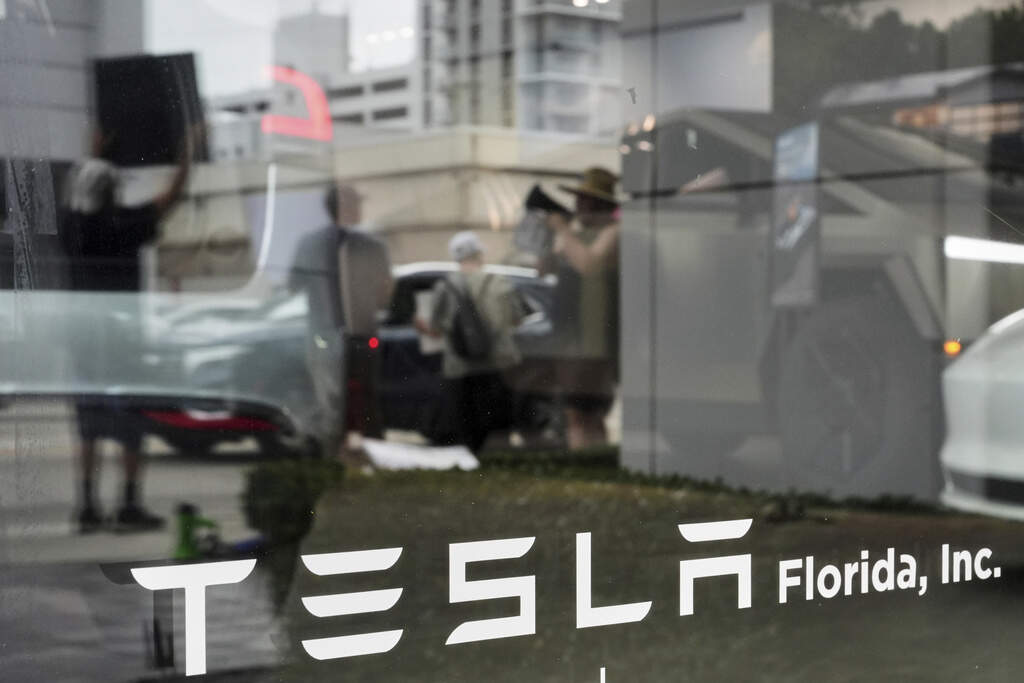
The Tesla Takedown protests have been mostly peaceful, but there have been a few incidents of vandalism and even property destruction. Now, Elon Musk and his allies are calling the entire protest movement "domestic terrorism." Is that a fair label?
Guests
Jon Lewis, research fellow at the Program on Extremism at George Washington University, where he studies domestic terrorism.
Also Featured
Edward Martin Jr., Interim U.S. Attorney for the District of Columbia.
Eddie Zipperstein, owner of Richard’s Body Shop in Chicago.
Ron Mishko, Tesla Takedown participant in Michigan.
Morgan Boyer, Tesla Takedown organizer in Pittsburgh.
Transcript
Part I
MEGHNA CHAKRABARTI: The protests are called Tesla Takedown protests, and they're taking place outside of Tesla dealerships in the U.S. and now in some places internationally. Quote, "Sell your Teslas, dump your stock," their website says. Quote: "Elon Musk is destroying democracy around the world, and he's using the fortune he built at Tesla to do it."
End quote. Morgan Boyer is a freelance writer in the Pittsburgh area, and Ron Mishko is a semi-retired business owner in northern Michigan. They've both joined the protests.
MORGAN BOYER: There have been some harsh words said on both sides, but we have not touched any Tesla cars. We have not touched foot on any Tesla dealerships,
RON MISHKO: And you're not gonna change anyone's mind by damaging their property or scaring them.
That's not the way you wanna proceed and that's not the way to lead.
CHAKRABARTI: Mishko actually owns multiple Teslas, but he still got involved with Tesla takedown. A few weeks ago after Elon Musk joined the Trump administration, he attended one protest with 200 people outside a Tesla dealership. Mishko is concerned about Musk's impact on the federal government, but he is not selling his personal Teslas. And does not want the company to suffer.
MISHKO: Back in the old days when a president won, that was it. The political season stopped and then we moved forward for better or for worse, whether you agreed or not. And I want Trump to succeed. I want Elon to succeed. I want everybody to succeed in America. But policies that hurt regular Americans, I work in a rural area up in northern Michigan, and I think those policies are going to hurt them. And I don't want to see people hurting. There's no reason for that.
CHAKRABARTI: The Tesla Takedown movement stresses that it is a peaceful protest movement and that it opposes violence, vandalism, and destruction of property, and the protests have been vastly and mostly peaceful.
Nothing though is 100%. Eddie Zipperstein grew up around cars. And when he started as a mechanic, he was into those loud, high horsepower hot rods, and he was skeptical about electric vehicles when they first came out.
Zipperstein now owns a body shop in downtown Chicago, and because it was good for business, he got certified to work on Teslas a few years ago, and he got curious and eventually started driving customer cars around the shop. That got him hooked.
He says he doesn't mind how quiet the Teslas are. He likes the torque on the car and he loves the technology inside. And so Zipperstein got his own Tesla sedan and eventually a flashy cyber truck to advertise for his business.
EDDIE ZIPPERSTEIN: I was one of the first ones to get it in the city. So people would be like jumping at it, can I see it?
Can I take a picture with it? It has cameras. So literally all day long it would show me people posing next to the car. So in the beginning, that was roughly June when they came out around here in Chicago, everyone wanted to take a picture. Little kids screaming and yelling at you. Thumbs up.
Zipperstein now works on a lot of Teslas. He says there are 50 or 60 in his building right now. It's the city, so he's used to patching up dings and scratches here and there on automobiles. But in the last few months he says he's been seeing a lot of Teslas riddled with key scratches and spray paint.
One piece of graffiti directly slurred company owner Elon Musk, but Zipperstein says it could be a lot worse. Multiple customers tell him they've been rammed into intentionally because of their car choice.
ZIPPERSTEIN: He was in his own driveway, so he wasn't even on the street. And these people slow down with a big passenger van, line up so they can get him right at the right spot, reverse, and then drive right into him.
He showed me the video, it's crazy. And then another customer also about two weeks ago, had a brand-new Model 3, the new body style, the Highland. And he shows me someone just behind him. And the lady taps it. So I'm like, okay, so you got tapped. You know, it's Chicago and it's a city. It's a bump and tap.
That's how they park here. He's no, wait a second. Then you see the lady reverse back like 15 feet and like gas it right into him again. She gets out, she looks and she walks away.
CHAKRABARTI: In the past few months, Zipperstein has had customers ask to remove the Tesla emblem from their vehicles, or he is seen bumper stickers that say, quote, I bought this before Elon went crazy. End quote. When he cruises Chicago in his cyber truck, he's not getting the thumbs up anymore.
ZIPPERSTEIN: I've gotten the finger and yelled at and stuff like that. People just, and it's not my driving, I'm just driving normally, and people just yell at you and they think that it's a political statement, is what I always say.
A car is not political statement, it's just what you drive.
CHAKRABARTI: But the point is that not everyone feels that way right now. Some dealerships and charging stations have in fact been hit with Molotov cocktails, even gunfire, and these are the stories that have been all over the news.
(NEWS REPORT MONTAGE)
We're seeing more reports of vandalized Teslas from all around the country.
The latest one happening in the Pacific Northwest. Law enforcement swarming this Austin Dealership police finding and removing several incendiary devices.
This college student is under arrest, accused of fire bombing two Tesla cyber trucks in Kansas City.
Police say many of the vehicles are being targeted in New York City.
People in Southern California are getting notes on their Teslas. Calling them complicit Nazis for owning electric cars.
CHAKRABARTI: So far, at least six people face federal charges for allegedly vandalizing Tesla vehicles, charging stations, or dealerships. That's six people so far out of the hundreds of protests and thousands of protestors, again, mostly peaceful. Attorney general Pam Bondi, though, has called for harsh penalties for people who harm Tesla. She's even gone so far as to call these incidents domestic terrorism.
PAM BONDI: I've made it clear if you take part in the wave of domestic terrorism against Tesla properties, we will find you, arrest you and put you behind bars.
CHAKRABARTI: Okay, so this is why we want to do this hour today, because post January 6th, post the attempted assassination on Donald Trump in the last campaign, the question of what legally constitutes domestic terrorism has become and continues to remain more important than ever.
And that definition relies not just on case law or legal statutes, but it also relies on our now ultra-polarized politics and on norms in a very non-normal time. So let's talk about that. Jon Lewis joins us. He's a research fellow at the program on extremism at George Washington University, and he studied domestic terrorism movements from both the left and the right in the United States.
Jon Lewis, welcome to On Point.
JON LEWIS: Hi. Thanks so much, Meghna.
CHAKRABARTI: So first of all, just give me your initial analysis of what we have seen so far regarding this Tesla Takedown protest movement. Again, I want to emphasize that it has been, by far, mostly peaceful, but as the TV headlines tend to focus on, and I will admit, we are too, some cases of vandalism or attacks on Teslas are occurring.
Is this sort of just part and parcel of what protests looks like in America these days?
LEWIS: Yeah, absolutely. Look, we live in the greatest country in the world, and we have robust First Amendment protections on speech and assembly. We can also at the same time call out violence against people, violence against property and more broadly call out political violence when we see it.
At the same time, I think it's very important to disaggregate, again, largely peaceful protest movements that are increasingly mainstream, with what appear to be lone actor, isolated cases of vandalism.
CHAKRABARTI: Yeah. But the thing though, is of course, it's just not cut and dry in terms of how the law is interpreted around protest anymore.
Perhaps it never has been. But to be clear, when an action moves from a peaceful protest, even if that protest might get tense, that happens. But if it's peaceful, nonviolent, that's, as you said, totally legal, First Amendment protected, but then when, if someone maybe associated with the protest or not, we'll talk about that in a second.
Does something else, how would you draw the line in terms of when it turns into a criminal act?
LEWIS: Yeah. And look, I think that's when you really have to take a nuanced look at the facts in each of these criminal cases. And again, based on the court proceedings to date, there have not been any allegations that there is some widespread, George Soros funded, Act Blue, globalist attempt to take down Elon Musk, despite what his posts online might say.
Again, we can absolutely look at individual criminal conduct, right? Throwing a Molotov cocktail at a Tesla dealership. Luckily, we have a very robust criminal code that covers that exact situation. And so you can prosecute the individual who threw a Molotov cocktail without creating the conditions for what would appear to be these allegations of, again this nationwide, far left, Marxist insurgency based on some reporting.
CHAKRABARTI: Yeah. But criminal conduct, though, is one place on the spectrum of potential charges that can be brought. We're hearing, as you heard attorney General Pam Bondi say, this is domestic terrorism, so let's get right to it. How is domestic terrorism defined statutorily in this country?
LEWIS: Yeah, it's a great question. We could probably spend most of the hour going down that rabbit hole. It's tricky, because there is a definition that you look at, whether it's FBI, whether it's the code of federal regulation. And effectively what it boils down to is domestic terrorism is conduct that is dangerous to human life.
That are a violation of our laws that occur in the U.S. That appear to be intended to either intimidate or coerce civilian population, influence the policy of government in some way, or to affect the conduct of that government by some kind of destruction, assassination, kidnapping. Now, I think where it gets blurry is the fact that unlike with foreign terrorist organizations where we can criminalize the material support to a designated terrorist group overseas like Hamas, Hezbollah, Al Qaeda, ISIS.
There is no domestic analog to that, right? Because, again, of those very robust protections on speech and assembly. And so what you're left with is a situation where members of this administration, of previous administrations, can look at an act and can label it as domestic terrorism.
The FBI can put it in their tracker of the number of domestic terrorism cases they investigate in a given year. But what you will never see is a standalone criminal charge in a case that says, this person violated this statute, which is domestic terrorism. There is no policy for that.
Part II
CHAKRABARTI: Jon, you had mentioned just before the break that we almost never, in cases, criminal cases that are brought to court, see specific language in the charging documents that say for X, Y, and Z reasons, this person committed acts of domestic terrorism. Can you give me more detail on that and clarify?
LEWIS: Yeah, absolutely. So when you look at, a case like Dylann Roof, right? He was charged with murdering numerous people at the church in South Carolina. There was no standalone domestic terrorism charge. It was a simple case of state murder charges.
And I think that usually when we look at domestic individuals who are operating in the U.S. without direction or inspiration from one of these foreign terrorist groups. So when we look at domestic ideologies, right? White supremacy, anti-government extremism, anarchist, violent extremism, those charges are very often really kind of ticky-tacky, right?
You'll get gun charges, you'll get drug charges, you'll get felon in possession of firearm charges. And that's again, because there is no domestic terrorism statute, right? You can't criminalize domestic support for a domestic group, and that's right and left as well.
You can't criminalize support for a domestic group like the Proud Boys or the Oath Keepers in the same way that we can't designate Antifa as a domestic terrorist group, because there simply is no constitutional mechanism to do.
CHAKRABARTI: Let me ask if that's okay though, because if we have robust potential charges that fall short of specifically domestic terrorism, doesn't that, in terms of the outcome, if those people are found guilty through legal proceedings, doesn't that essentially bring us to the same ends as a domestic terrorism charge would?
LEWIS: Sure. And look, I think what we've created here in this post 9/11 counter-terrorism framework is almost this two-tier system, right? Where if you have someone operating in support of the Islamic State trying to shoot up a synagogue, you can charge them, arrest them, prosecute them for materially supporting the Islamic state, and that's usually going to be a 13, 14-year prison sentence, pretty open and shut.
Where at the same time, if you have a neo-Nazi who's trying to plot a mass shooting in support of a white ethnostate. That individual may get, again, a gun charge, a drug charge, but will not be called a domestic terrorist in legal filings, will certainly not be prosecuted as a domestic terrorist for plotting that mass shooting.
And so again, I think that goes back to the question at the top of, the government is responsible for adjudicating and just deciding who is a terrorist and who's not. And I think we should be care very careful about that.
I promised that in a few minutes we will get to the left-wing, right-wing question here. But I want to push on this a little bit. That what you're saying is if the person when doing these heinous acts is saying that they're doing it in on behalf or due to beliefs ascribed by a foreign entity.
That therefore, it's very easy to put the domestic terrorism charge on there. Simply because it's foreign. And so therefore the presumption is that it's to affect the U.S. government. But you can't make that assertion if the act is done, due to beliefs of, for example, white supremacy in the United States.
LEWIS: Yeah. So look, it comes down to a really straightforward legal situation, right? Secretary of State can designate specific foreign groups as foreign terrorist organizations, right? And so we, again, we talk about the big groups that the UN are familiar with Isis, Al-Qaeda, groups like that.
We can charge an individual in the U.S. with trying to materially support, whether in the form of their body, money, guns, provisions, anything like that, with trying to materially support that foreign terrorist group. So again, that charge, 18 US code 2339 B, material support to a foreign terrorist organization.
There is no domestic analog to that. So there is no U.S. code, there's no charge in the U.S. code that pertains to material support to a domestic terrorist organization, or material support to a domestic ideology. And again, because if you look at the domestic cases that we're talking about here, the ideology can really almost never come into play, because the ideology is not at the core of the criminal conduct, right?
It's not illegal, for better or worse, right? In the United States, it's not illegal to be an extremist or to hold views that you or I might consider abhorrent.
CHAKRABARTI: It's interesting though. So then basically what you're saying is that the choice of whether or not to call something domestic terrorism, once it becomes an act that you can't just say it's Al Qaeda, it becomes a political choice. Because I'm looking at a report from 2023, so it's under the Biden administration. From the GAO, right? You probably know this report really well. And in this report, it says that domestic terrorism investigations, and that's what they call it, domestic terrorism investigations, have doubled since 2020.
And that was according to the FBI. And the GAO found that cases of domestic terrorism grew by 357%, from 1,981 to 9,049 by the time we hit the year 2021. So at least under the Biden administration, they were saying there's this like mushrooming of domestic terrorism in this country.
LEWIS: Again, getting into the weeds of that, it's so interesting. Because the FBI would count every single January 6th case under their domestic terrorism bucketing.
Now again, I think it is an important distinction here. What you didn't see in the Biden administration is, you didn't see head of the FBI, head of DOJ coming out and saying that every single January 6er is a domestic terrorist. You didn't see January 6th defendants prosecuted as domestic terrorists.
They were very specific criminal charges for assaulting law enforcement, for seditious conspiracy, in isolated cases for Proud Boys and Oath Keepers. Bu you didn't have political pressure to paint every January 6th defendant as a domestic terrorist. Which I think is an important distinction here as well.
CHAKRABARTI: Okay. So this gets us back to what Attorney General Pam Bondi said in that clip that we played earlier. Because she said if you take part in the wave of domestic terrorism against Tesla properties, we will find you, arrest you and put you behind bars.
But she didn't specifically say, we will charge you with domestic terrorism.
LEWIS: Yeah. And look, it's a nice TV clip. It's a good soundbite without a doubt. But look, there was another case I think when you look at the press release from Ed Martin, the D.C. Attorney General nominee. He's talking about this one case that's domestic terrorism, and we have to protect Tesla.
And when you look at the charges, it's a misdemeanor offense and the guys, it's gonna end up in no jail time. Probably like a probationary period. Some fine or something like that. And it's hard to comport that with this kind of claim that there is this big shadowy, again, far left, attack on Teslas going on when the charges themselves simply don't reflect that.
CHAKRABARTI: Okay. So since you mentioned Ed Martin. We're gonna hear a little bit from him. Because we spoke with him yesterday. But first, let's get the voices of some of the peaceful Tesla takedown protesters back in this show. You heard a little bit from actually, let me say, this is Morgan Boyer, who lives in Pennsylvania, and as you'll hear in a second, she does not like Elon Musk, to say the least. She wants federal workers who have been fired by Musk's Department of Government efficiency to be rehired, and she does want to see Tesla feel the financial consequences of its founders' political actions in the Trump administration.
BOYER: It's a scary time. And I understand why people are angry.
I'm angry, but by taking it out on the cars themselves. It's not about the cars, it's about Elon. So don't take it out on the cars themselves. They're just a symbol. We want to hurt Elon's bottom line, which is his money.
CHAKRABARTI: Boyer organized a Tesla Takedown protest outside of Pittsburgh, in what she considers to be Trump country.
And she says about 30 to 40 people joined her, but also 20 counter protestors and some of them with guns. It was tense, she says, and at one point, threats were made. The police were called. She had to get on a megaphone to deescalate things. She had received some advice on training on how to do that.
Now, as we've been talking about, conservative commentators, including Elon Musk are claiming that protest organizers are paid to cause trouble.
But Boyer says in her case, at least, that is not true.
BOYER: No, we did not get any money.
We hate Trump for free. Trust me, we hate Trump and Elon for free. And if anything, I've spent more money doing these protests, getting signs, getting equipments, like markers and fresh water for everyone.
I have not been paid. It's ridiculous to suggest that. A lot of the protestors are older. They've already retired. They're not even working anymore.
CHAKRABARTI: That's not stopping, I should say, some people from calling the protests, and again, specifically when property is damaged or attacked, as domestic terrorism.
So here we go with Ed Martin Jr. Because as Jon Lewis noted, this story comes as some attorneys are bringing charges against people who are accused of committing acts of vandalism against Teslas. And Martin is the Trump appointed interim U.S. attorney for the District of Columbia. He announced last week that he is pursuing charges against a man who allegedly defaced the private property of several Tesla vehicles.
49-year-old Justin Fisher has been released on his own recognizance and will face a misdemeanor initial status hearing later this summer. Now, Martin told us he's concerned about the treatment of Tesla and vehicles and dealerships in his district and will continue to investigate acts as potential domestic terrorism.
ED MARTIN JR.: To be honest, maybe make a little news here. We are looking at the organizations that have put this together. You don't, just because you're an entity that says we're going to organize a protest, or should have known that the protest would lead to violence and targeting, you got a problem.
And there's a number of entities now that are bragging about being involved in these Tesla protests or Tesla takedowns. I think that's pretty clearly domestic terrorism, it's pretty clearly meant to terrorize the community and terrorize owners of vehicles. And so we're not gonna stop short in identifying that.
CHAKRABARTI: Tesla Takedown describes the protest movement very differently, and here's what Martin told us when we pointed out to him that the Tesla takedown protests have been almost exclusively peaceful and that the website itself condemns, excuse me, condemns violence. It's been a day for me. Sorry. Condemns violence, right at the top.
MARTIN JR.: That's the same thing that we had experienced when the Mafia said that they were just doing, they were in organizing communities and they weren't about violence. When the actors of an entity and actors of a movement act in a violent way repeatedly, you could say what you want on your website, the question is whether there's an expectation that this is what's going to happen.
Clearly there has been, it's very clear, this didn't happen one weekend, this didn't happen one day. This happened over a period of weeks. And again, we wanna be very careful that the right to assemble is protected. Of course, in America, the constitution says that, the right to free speech, even ugly speech is protected.
But there is a point where you're watching systematic actions.
CHAKRABARTI: Martin did also bring up allegations that an outside entity was supporting financially Tesla Takedown, but he did not have evidence to support that claim. Now, we spoke with Martin yesterday, and we should briefly note that he was also questioned this week in the Senate over his previous praise for a pardoned January 6th Capital rioter.
That Capitol rioter is Timothy Hale-Cusanelli, who is an overt Nazi sympathizer. He has dressed up as Adolf Hitler. He was prosecuted for being involved in the January 6th attack on the capital. Martin himself was an organizer of the Stop the Steal rally. Martin told the Senate he did not know about Hale's extremist views. But yesterday, according to new reporting from CNN, in a previous podcast, and we have a tape from it here that CNN had discovered, Martin basically said Hale was his friend.
We will miss her, but she subbed out with a great friend of ours, too. Tim Hale, the only thing you did that was really egregious to me was at one point on camera you were dancing in one of the base, one of the areas as celebrating America.
It wasn't your best dance moves. Our next guest is my friend Timothy Hale. He's an amazing guy who has gotten through all that and has a great perspective. So welcome back, Tim. How are you?
CHAKRABARTI: Okay, so that is Ed Martin in a previous podcast, professing that Timothy Hale, Nazi sympathizer and January 6th rioter is a good friend.
Okay, Jon, we wanted to play all that, because Ed Martin did agree to speak with us yesterday and just your response to what you heard.
LEWIS: Yeah, look, given Ed Martin's background as a Stop the Steal activist, someone who's promoted some of the most outlandish and easily debunked January 6th conspiracies, who has fought now for, to get reparations for January 6th defendants who assaulted law enforcement on that day, it's not a surprise, unfortunately.
And I think what's concerning here is the veneer of legitimacy. That someone like that can give these conspiracies. We've already seen the far right response to these claims, right? We had pardoned January 6thers showing up at Tesla dealerships with firearms to protect them.
We had Proud Boys and white supremacists showing up to Tesla counter protests. And look, unfortunately we've seen how this kind of vigilante call to arms ends, right? We've seen cases like Kyle Rittenhouse and others. The conditions here are pretty clear. And I feel like unfortunately, it's only a matter of time before this kind of situation continues to deteriorate as these far conspiracies continue to get this kind of mainstream attention.
CHAKRABARTI: Martin said though, in that first clip that we played, that he wanted to make a little news here with us and say that they are, his office is looking at the organizations that are presuming Tesla Takedown, organizing these protests. What exactly would they be looking at, you think?
LEWIS: And again, look, this is, I think, very similar to a lot of the right wing outrage around the BLM protests in 2020, right? There are going to be claims that George Soros and Act Blue and any other left-wing organizations that have caught the ire of this kind of right-wing rage machine.
And look, I think it's, again, it's a good soundbite. I'm sure there'll be official letter on letterhead that Ed Martin sends out that's leaked to right wing news stations beforehand. But, yeah, it seems like a lot of noise at this point.
Part III
CHAKRABARTI: Jon, I kind of want to get straight to the politics of this now. Because I heard you say a bit earlier that the right really focused on some of the acts of vandalism or arson that happened in association with or during the time of the Black Lives Matter movement in 2020.
But as I remember that time and the coverage of it, I have to say, mainstream media, including NPR, left wing commentators tended to really minimize some of the more violent activities that happened. I'm not saying they happened by BLM activists. But there's no doubt that there were acts of arson, there were acts of vandalism that happened in many cities across the country.
And by diminishing, that, in fact, made the Black Lives Matter movement really subject to a lot of criticism from not just the right, but even Americans in the center. Is there not the same risk here? With the Tesla Takedown movement?
LEWIS: Yeah. No, it's an important question.
Look, I think, again, two things can simultaneously be true. Like you said, individual acts of violence, of property damage should be called out whenever we see them. At the same time, yeah, there's a massive chasm here between lone actors who, again, are clearly inspired by these mainstream narratives. Who are mobilized to violence or towards some criminal conduct, for some reason. But who are not connected in any tangible way to any organized group or movement. And what's being painted here already, as again, as has been the case before. This interconnected web of kind of George Soros funded globalists who are trying to take down Elon Musk.
CHAKRABARTI: But I guess I'm wondering if people who ascribe themselves as being on the left should be quite honest with, as human beings, their possible ability to sympathize or at least not condemn acts of political violence when those acts are done in concert with beliefs they hold.
And let me give you an example. This is an obvious one. When United Healthcare's CEO was murdered, I still have to say, allegedly, by Luigi Mangione, one of the more kind of disturbing things was a lot of people online who say they're from the left, were cheering him on.
LEWIS: Sure. Now, but what I would say to that is, despite, I think, a lot of the reporting, a lot of the hair on fire commentary. We didn't see a copycat impact, right? We didn't have a wave of health care CEOs being gunned down in the street across the country. We didn't have some kind of organized, anti-institutional, anti-capitalist mob outside the United Healthcare building. We had some online posts from some terminally online leftists. And look, that's what the left wing's gonna do, right?
They're gonna be very loud, very mad online. In much the same way that the reactionary right is going to be very angry online. And I think that's the echo chamber that we live in, right? That's gonna happen. I think it's, again, it's a question of nuance.
It's a question of what is the call and response here? Do you have mainstream politicians, individuals with massive platforms, calling for violence? Because again, when we look at any of the far-right conspiracies here, the Great replacement theory, this invasion rhetoric, we can see a very clear causal link there, right?
I mean we look at the string of mass shootings, right? Pittsburgh, Poway, El Paso, Buffalo, Charleston, very clear through line there. White supremacists who are motivated by this idea that the Jews and the globalists are conspiring with the left to replace the white people in this country.
And that's something that's being repeated by Elon Musk, by Donald Trump, by politicians with massive platforms. I have yet to see a left wing, a Democrat, anyone who is actively call calling for violence against Elon Musk, violence against Teslas, and I think that, again, it's very important that we recognize and call out political violence when we see it. That we look at these individual actors who are committing criminal conduct and call it what it is, again, which is criminal conduct.
But again, I think it's a very slippery slope here if we concede to this kind of red pilled kind of brain rotted set of conspiracies that have everyone to the left of Bernie Sanders as some kind of threat to national security.
CHAKRABARTI: Point taken. Because that, so that's why we wanted to start with this,
What is domestic terrorism? The definition of it. We wanted to start the program with that. But it does get us to something deeper, which I think potentially has changed in the United States. And that is an overall acceptance, an increase in the acceptance of political violence as an actual tool in this country.
Because it was just, what, last year I believe, or maybe 2023 and 2024, there was a series of polls I'm looking at Marist/PBS NewsHour Poll that was released in 2024. That found that one in five Americans had indicated at that time that violence could be necessary to secure political objectives that year.
And that one in five included roughly equivalent portions of Democratic and Independent respondents saying that they saw violence as an option. And 28% of Republicans agreeing. It's not just exclusively a right wing thought anymore.
LEWIS: No. And you're absolutely right.
And look, I think when we look at the societal factors here, right? COVID isolation, the increase in discontent with society, people feeling rightfully or wrongfully that liberal democracy has failed, the government's not working in their best interests. All of these things conspire to create these conditions for political violence.
And I think, look, when we look at the mobilization, folks who actually have gone offline to try and commit this violence, whether it is the Trump assassination attempt or any of these other cases, we see a common profile, right? Which is someone who is barely ideological.
Who whether either has some sort of mental health issues or something in their background that has them primed for violence. And they're just looking for the right justification, right? That secret sauce that can get them up off the couch and convinced them that this is their moment to achieve whatever they're hoping to achieve.
And that has spiked in recent years. On the left, on the right. Everyone in between, because of this. They call it salad bar, but like this kind of picking and choosing, right? Looking for the right mixture there. But look, I think there's a reason that we're not sitting here talking about a mass wave of mass shootings related to Tesla Takedown.
It's because we simply, it simply isn't there, right? There isn't a wave of vigilante violence that's seeing Tesla owners get swatted and doxed and there aren't mass bombings at Tesla stations. This is petty vandalism. This is lone actor, anarchist extremism, if you wanna call it that in some cases.
But, to try and paint it as if it is a mass mobilization event, or if this is something that's sweeping across the country and that every Tesla station in the country is, all of a sudden, in a war zone, I think just fuels that fodder.
CHAKRABARTI: Yeah, no point taken completely. I can't take issue with anything you said about that, but I consider part of our job here at On Point is try to look around the corner, right? And if we have more and more people across the political spectrum saying in order to enact the policies that I want, I don't necessarily think violence is off the table.
That's both disturbing and compelling to me to try and to understand better. But given what you said. Let's take this back to the domestic terrorism question. Because yes, Ed Martin hasn't yet charged anyone with domestic terrorism. Pam Bondi is not cleared on what she would actually charge people with.
But going back to your original definition of obviously it's an act of violence designed to coerce a population or influence government policy. Okay. So with that second one in mind, let's just listen to what Elon Musk has said recently regarding Teslas financial nosedive that it's taken recently.
And I'm not saying that's because of the Tesla take down protest. I'm not ascribing that correlation at all. But it just, it's happening at a time where Musk himself, his actions at DOGE, perhaps Tesla sales and the protests are all coming together. That's led to a drop in profits of 71% in the first quarter of 2025.
So Elon Musk said basically in an earnings call, that he will be shifting his focus from political work back to business.
ELON MUSK: I'll have to continue doing it for probably the remainder of the president's term, just to make sure that the waste and fraud that we stop does not come roaring back. But starting next month, I'll be advocating far more of my time to Tesla. Now that the major work of establishing the Department of Government Efficiency is done.
CHAKRABARTI: Jon, the reason why I wanna play that is obviously in a certain, to a certain sense, the protests plus all the other negative focus on Musk's actions right now are working. The Tesla Takedown is saying that they want to push Musk to stop doing what he's doing at DOGE by hitting him where it hurts, which is in his wallet.
But when you said that that domestic terrorism needs to also have an impact on influencing government policy, do a thought experiment here with me, okay? If Elon Musk, who's running DOGE says, I have to go back to Tesla and spend less time working on this government policy, in part because of these protest movements.
Could a Pam Bondi as AG use that as evidence of the protest influencing government operations or policy, and so therefore qualifying as domestic terrorism?
LEWIS: Yeah, I expect they will. And where I think you will see that is in, so again, as we discussed, there's no domestic terrorism statute.
Where the government can try and put their thumb on the scales a bit here is when it comes to sentencing in these cases. And so the government can seek at sentencing an upward departure. They can seek what they call a terrorism sentencing enhancement. And they, I'm sure, will argue, much like you did, that these have been designed to damage Elon Musk.
Again, his historic unpopularity and the white House advertisement for Tesla notwithstanding. I'm sure they will try and connect these two things together as you did there. And again, fortunately, at the time of recording, we have an independent judiciary, and so that will come down to it, it will be put in front of the judge, or I mean, in some cases, the jury, but mostly the judge to rule on whether that enhancement will be accepted or not at sentencing.
Again, I think it remains an open question, and I am, as you are, eagerly awaiting those court documents.
CHAKRABARTI: Yeah. But I like to think through these things so that we're not caught off guard. When decisions are made, I just wonder, overall, Jon, do you think that because politics is so much infused in the way that domestic terrorism is even conceived of in this country, that do we need statutory, I'll say that specifically. Do we need statutory guardrails to be sure that the definition of domestic terrorism isn't mutated to become a weapon, simply just a political weapon?
LEWIS: Yeah. Absolutely. And look, that's the reason why there is no domestic terrorism statute at this point.
Previously, I've argued in favor of it, in very limited specific conduct, but it is a slippery slope, right? I think when we look at the history of what we call terrorism in this country, the government has a monopoly on state violence, and they also are the ones who will tell us, the American people, who is in our in group and who is not, right?
Who's the other and who's not? And I think far too often in this kind, again, in this post 9/11 framework, we've just been conditioned to accept that we are patriots, we love America, and anyone who is a terrorist surely must be someone inevitably, in this case, someone scary from outside this country who doesn't look like us, who doesn't sound like us, who hates apple pie and democracy and baseball and our freedoms.
And I think, again, it's a very tough reckoning that I think we all have to face now, which is, what do we do when the call is coming from inside the house? What do we do when domestic terrorism has an American flavor to it? And I don't think we've ever had an answer to that, in the last 20 years or so.
And I think, yeah, cases like this certainly show why it is such a complex puzzle to unwrap.
CHAKRABARTI: You have said something a couple of times, which just flew by me, but I wanna repeat it. Post 9/11 framework. So actually, it's getting hard for me to believe that it's been, we're close to a quarter century, right, away from 9/11/2001.
What was the sort of pre 9/11 framework for conceiving of domestic terrorism?
LEWIS: Yeah, look, it's really interesting. Look, obviously the immediate thing that comes to mind is the Oklahoma City bombing. I think that's when we think about domestic terrorism and that led to legislation that, I think, became what we would call the material support statute, which was obviously amended with the Patriot Act shortly after 9/11.
And I think we've never really looked back from that, we got really good as a government, as a country, at prosecuting what we would call foreign terrorists, international terrorists. We began calling them homegrown violent extremists around the time that the Islamic State came into the play.
But look, it's really, it's always been about deciding who were acceptable labeling as a terrorist and in many ways, almost dehumanizing, right? Setting at a layer that is lower than us, because they are terrorists. They are not Americans because they're terrorists.
And I think that framework, that conceptualization has, I think, haunted us a bit as we sit here today with domestic terrorism.
CHAKRABARTI: Yeah. That Oklahoma City bombing, I'm just refreshing my memory on it. Timothy McVeigh was charged in the federal trial only with the murder of federal agents were killed in the bombing.
And it took, it was upon the state of Oklahoma to bring charges against him and Nichols, Terry Nichols for the death of the 160 other people. That were killed in that bombing, but still no domestic terrorism charges, as far as I can see.
This program aired on April 29, 2025.