Support WBUR
Did 'An Abundance of Caution' during COVID do more harm than good for America's students?
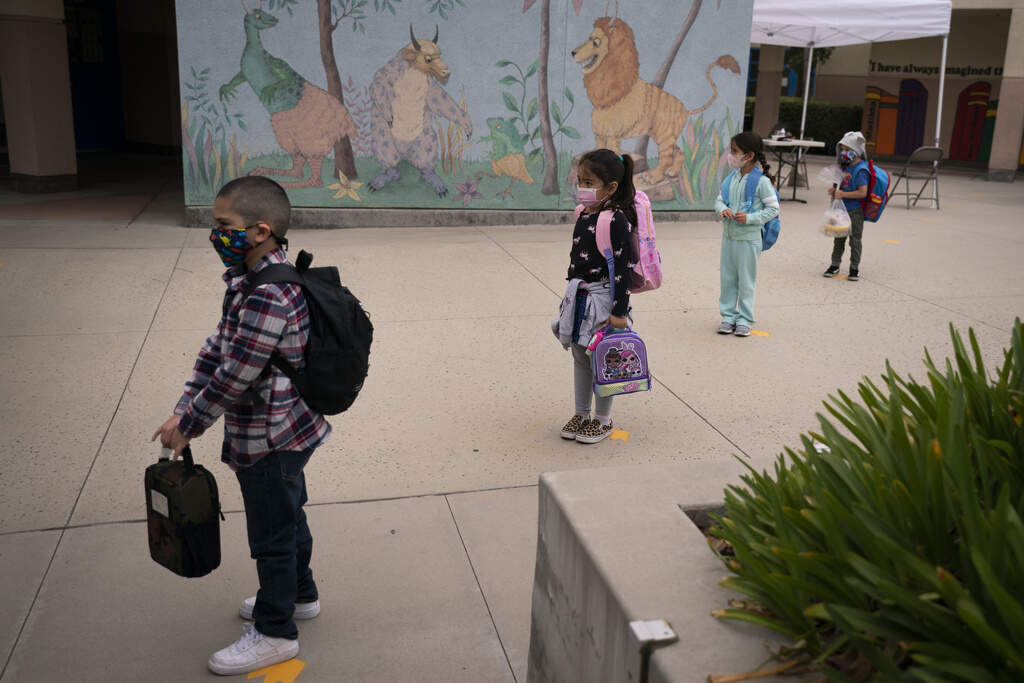
Millions of healthy children didn't set foot in a classroom for more than a year during the COVID pandemic. Journalist David Zweig says those school closures may have done more harm than good.
Guests
David Zweig, investigative journalist based in New York. Author of An Abundance of Caution: American Schools, the Virus, and a Story of Bad Decisions.
Transcript
Part I
MEGHNA CHAKRABARTI: It is Monday. So I feel like kicking off the week with a little bit of a thought experiment. Okay so engage with me for just a moment here. Imagine that you are an extraterrestrial intelligence. Okay, I'm going there. I'm using aliens in this thought experiment.
So you're a very far away, extraterrestrial intelligence and you are that species version of an anthropologist. And you have been studying across the galaxies. This one beautiful, belligerent, utterly unsophisticated and unevolved, yet somehow magnetically interesting species that resides on the third planet from the star in what that species calls the solar system.
Alright. So in this species infantile measure of time, it is spring of 2020 and you, extraterrestrial explorer, have been watching as this species struggles mightily with the threat of a very simple life form known as a virus, and you laugh, whatever this extraterrestrial intelligence version of a laugh is. Because you also watch this species decades earlier when they released a radio program that put them into a panic because of what they call aliens.
And those fictional aliens were eventually done in by microbial life. Ha. So who's vulnerable to a small tangle of DNA now? Okay. Sorry. This thought experiment's getting a little bit off the rails. Anyway, so you're watching Homo Sapien in the spring of what they call 2020, and suddenly you are pulled out of your alien reverie.
When you notice something specific on the third planet, there is a moment where every single one of the species' younger organisms are not where they belong. They are not in school. Across the entire planet, for this blink of an eye, there isn't a single child in school. And this has never happened as far as you know in your alien life.
This has never happened in this species of this species short history on planet Earth. And as a much wiser alien intelligence, you know that if there's anything that's ever helped pull Homo Sapien out of troglodytic ignorance, it's school, it's education. So why would every child on the planet be out of school?
In this particular part of planet Earth called the United States, there are many children out of school for very long. And that doesn't really make any sense to your extraterrestrial intelligence. Now, of course, long time On Point listeners will know that I'm a sci-fi super fan because I basically believe the genre teaches us everything we need to know about ourselves as humans.
But I actually love this thought experiment specifically because, for me, it pulls me out of that 21st century American human being frame of reference and just simply asks with cold, hard logic, How can we explain to someone very far away why so many American children were denied the chance to step foot into a classroom for so long during the COVID pandemic?
Five years later, this still remains an urgently important question, not only because of the long-term impacts of being out of school for so long, but yeah, whether we like it or not, another pandemic will eventually happen. That is simply the way nature and science works. So back here on Planet Earth, journalist David Zweig is the latest person to try to take a stab at an answer to those questions, and he does so in his new book. It's called An Abundance of Caution: American Schools, the Virus, and The Story of Bad Decisions. David Zweig, thank you for entertaining my desire to do that thought experiment, and thank you so much for joining us today.
DAVID ZWEIG: I love it. That's the most novel setup I've heard out of any, so fantastic.
CHAKRABARTI: I just figured that we've done so much COVID coverage that a lot of people probably just check out, and so I wanted to find another way to pull people back to this really important question. Because like it or not, as I said, there will be generational impacts from so many kids in specific parts of this country not being able to go back into school building. So let me just ask you, David, first of all take us back to that time in 2020. What was your experience of COVID that got you interested in looking more deeply into the school closures?
So if we rewind the clock and look back at early spring 2020, I was like most people in the New York area where I live, and probably most of your listeners. I was following along with all the instructions. I am a little embarrassed to admit, we were wiping down our groceries when they arrived and everyone was locking down.
And part of that, quote, lockdown was my kids who were in third and fifth grade at the time were kept out of school and attempting what was referred to as remote learning with not much success. And, but I went along with everything. This is what we were told needed to happen. We needed to, quote, flatten the curve to prevent hospitals from being overwhelmed.
So that's where things kicked off, but very quickly, I observed that this wasn't going to work long term very well for my kids.
CHAKRABARTI: How old were they?
ZWEIG: They were in third grade and fifth grade at the time. Again, this seemed okay, this is not great for them, but sure we need to do this to save lives and flatten the curve.
So we went along, but not too much later, I began to observe some things that didn't quite make sense, and that's what set me off on my path. And what I'd love to chat with you about today is that what most of us in the public believed to be the circumstance was not actually what we were told was happening.
And that's what I try to explicate in my book, is that we were living in a very misinformed sort of media bubble in much of the United States.
CHAKRABARTI: Okay, so you actually said three really important things there. What we believe to be, was happening, was not what we were being told. This was specific to certain parts or certain media bubbles in the United States.
Those are, so are you saying that outside those particular bubbles, and you can identify them in a minute, people had a more accurate sense as to what was going on?
ZWEIG: Yeah, I think that's right. Absolutely.
CHAKRABARTI: Okay, so let's start off with the fact that you were actually doing reporting, what, for Wired and other outlets during this time, what is one of the first things that you discovered in your reporting that led you to start to wonder about this conflict between what people thought, and what people were being told?
ZWEIG: So very early, I guess in April, I began to wonder what exactly was happening with the schools. There didn't seem to be a long-term plan, and similarly, I began to poke around to try to get more evidence to figure out what actually was the risk to children, what actually might be the benefit of some of these interventions.
I wasn't seeing enough evidence being printed in the media, so I have a lot of experience with science journalism, with reading academic articles, with talking with scholars. So just for my personal benefit, I was working on another book at the time, totally unrelated to this. I just needed to try to poke around and figure out what was going on.
I began talking with experts, most of them in Europe. And what became very obvious, very early, was that one, children were at incredibly low risk, not zero, but a risk on par with many things that they face in any given day. It wasn't an unusual risk to them.
And number two, and this is the real turning point for me, at the end of April and beginning of May, countries throughout Europe began reopening their schools. And 22 of them began reopening. We're talking about millions of children here. This is not a small one room schoolhouse in the mountains of Tibet. We're talking about millions of kids. The EU education ministers met virtually in May.
And they said, after these schools that have been reopening, millions of kids, we've observed no negative consequence of reopening these schools. I want everyone to just pause on that for a moment. Millions of kids in countries that are very similar to America in many regards, no negative consequence.
This was not in an obscure medical journal. This was not in a blog post. This is the EU. And this information was virtually non-existent, unavailable in America. I remember listening to the video feed of this meeting, and it was almost like a mirage, like I couldn't believe what I was hearing. Why wasn't I seeing this splashed across the headlines everywhere?
This was the news, ostensibly, we were waiting to hear. Because there was a large concern, once it was acknowledged that kids weren't at great risk. The other thing is kids may be putting teachers and then more broadly, the community at risk. Yet here we had empirical evidence, millions of kids in school, no observable increase in cases in the community or among teachers after schools opening.
And this information was basically ignored in America.
CHAKRABARTI: Yeah. We did more than 100 straight shows on COVID. I, at that time, David and I will say that, I usually don't use this language, but I'm quite proud of our coverage because what we talked about is as soon as this information started coming out of places like Europe and then and Asia also, we talked to scientists who said, really the strongest correlation between changes in the COVID infection rate and school openings has nothing to do with the schools.
It has to do with the endemic infection rate in that community. And if the community was already having higher infection rates, the schools, as you said, didn't change that, didn't increase it or decrease it, and if it had a lower infection rate, didn't increase it or decrease it, which I thought was a really powerful thing for Americans to know.
But let me ask you just quickly. Were you in, you were in New York at this time when you were doing this reporting?
ZWEIG: That's right. I live right outside New York City.
CHAKRABARTI: Okay. And New York City was one of the hardest hit initial places. So I wanna also ask you about the emotional fragility of the time in places like New York where you know so many people were dying.
And so that's what we'll do when we return from a break.
Part II
CHAKRABARTI: David, let me ask you where you would pinpoint the first set of bad decisions because you had mentioned earlier and very correctly so, that when schools closed in the United States in just what March 2020, there wasn't a plan about how to continue education in this country.
And I fully agree with that, but part of the reason why there wasn't a plan is because the Trump administration had thrown out whatever pandemic preparation plan had existed during the Obama administration, they literally threw it out. President Donald Trump repeatedly stood up in front of cameras and says, we're going to beat this thing.
We're just going to get around the corner. This is just a two week pause. Don't worry. You'll be able to get back to your lives. There wasn't necessarily any sort of signaling from the highest levels of government in this country that we should have a plan for what to do if schools need to remain, and I put quotes around need, to remain closed for more than two weeks.
So I think that's an important part of the context here. In terms of, you said the U.S. is like Europe in many ways, but in a certain way it was not, meaning President Donald Trump brought chaos to leadership in this country.
ZWEIG: What you're saying is both true but not really exculpatory.
That Trump, of course, was viewed as such an odious and unserious figure throughout his tenure, specifically at the beginning of the pandemic. But let's not forget. Deborah Birx was a serious person, as was Dr. Anthony Fauci, and they very much were platformed in leading the American response to the virus.
They, of course, initially, Trump, as you may recall, went along with this. We had 15 days to slow the spread, which was the official slogan. So despite all of Trump's failures, and there were many, the people who run the public health establishment in our country, they are the ones who set us on a path where there was no plan for the schools.
We did have plans from the CDC that were mentioned, explicitly, by people from the CDC. There was one made in 2007 and then a revision in 2017, that we were ostensibly following. It had nothing to do with Trump. This is what Deborah Birx and others, that people within the CDC were saying, these are our guidebooks.
This is how we're going to go along with things. Moreover, there were models from places like Imperial College of London, IHME, which is in Washington State and other places that we were basing our pandemic response on. So one of the things that I think is really important to get across, that I talk about in the book a lot, and that I want your listeners to understand, is that Trump becomes a very convenient kind of foil here, where, you know, the villain in the story, but those may be contextual reasons, but not excuses for the decisions that were made by our public health experts.
CHAKRABARTI: Yeah. I personally believe there is not simply just one villain in this story. There are many and we'll touch on them all, but just one more thing. Apropos to the president of the United States and, okay, perhaps, in a sense, when it came to opening schools, he was on the right side of history here. Because he demanded that schools be open much more, much sooner than they did in a lot of different, in a lot of places in this country. But there is, and you reported on this, there was this Trumpian effect, right?
That for people, let's say just outside the White House circle, outside the federal level, doctors, school administrators, superintendents, public health officials at the state and local level, if some of them in certain states risk saying, I think that Trump administration is right. There really isn't an evidence base to keep kids out of school now, they risk something very specific. Can you talk about that?
ZWEIG: Yeah. You touch on a very important point, which is that, again, as I mentioned before. The view of Trump, he was maligned and reviled. That for anyone to agree with him within certain circles, really meant being cast out. That anything he said, anything he favored, immediately became radioactive and as I heard in the bumper before the segment aired, where we talk about the American Academy of Pediatrics came out very aggressively in favor of schools opening in the early summer, for the fall, they said, this is incredibly damaging what's happening to children. They even said, don't worry so much about six feet of distancing.
If it's three feet fine, just get the kids in school. There's not likely to be a great benefit of keeping them out just to maintain precisely six feet. After Trump tweeted, Open the schools, as is his way, in all caps, with exclamation points, the American Academy of Pediatrics reversed its guidance.
NPR indeed reported on this, and this was immediately thereafter, gone was the idea of don't worry about six feet of distancing, gone was the idea of, no matter what, let's get kids into school. Instead, it was, listen to the experts and we need an enormous amount of money. Nothing had changed epidemiologically between the two statements from the American Academy of Pediatrics.
The only thing that changed was Trump's tweet that, and I have lots of examples in the book. Just further to your point, I had, once I started writing articles, that were challenging to some of the establishment views, which I should add, were, where I wrote them, I occupied a pretty rare lane. I was and am part of the legacy media, but I was able to put these articles through, and they gave permission to a certain segment of the population to acknowledge certain things that were happening, from the places that they were being reported from.
And doctors around the country, along with lots of regular people, and even former CDC officials, began reaching out to me, after some of my articles were coming out. And they would say, thank you so much for writing this. I want you to know, I agree with you. I think this is really harmful.
Having schools closed, I don't think there's strong evidence that this is beneficial, particularly not over a long period of time. I don't think masking two-year-olds is beneficial. They're not doing it elsewhere and on. But all of this is off the record. And people were afraid. And I asked a prominent pediatric immunologist at a top university hospital, one of the people who had reached out to me and said, what are your colleagues saying about this?
And he said, oh, I don't talk about this at work. Total third rail. And on top of them self-censoring, many of them were explicitly told by their administrators, you are not permitted to say anything that goes against the CDC or Anthony Fauci or others within public health, other public health officials.
So we had an information environment. In some ways, there was this manufactured idea of a consensus. We were told over and over, this is what the, quote, experts believe. Oftentimes in New York Times articles, it was unattributed. It would just say, experts believe, and that's why when we go back to what I mentioned about the millions of kids in school in Europe, I suspect some of your listeners may be saying, that's Europe.
They controlled the virus over there. No, that's not the case. When you look at it on a city by city, town by town basis, which is the way to look at this, not on a continental basis or countrywide basis. There were zillions of cities that matched the demographics and population density of cities within America, and they had case rates that were above, below and the same as their counterparts in America.
There was nothing, it had nothing to do with, quote, controlling the virus. Moreover, they weren't, they did not have mask mandates across the board on the kids. They did not have barriers on the desk across the board. They didn't have HEPA filters. All of these things we were told that were needed.
Although you guys, which I'm glad you did, report on schools being open in Europe and the New York Times, and plenty of other outlets reported on it. The context often given was, that's happening there, but we need to dismiss it for one reason or another. But as I just noted, each of these reasons were specious.
They weren't doing the things we were told needed to happen here, and their case rates were all over the map, both literally and figuratively.
CHAKRABARTI: Yeah. For the record, we never actually said we should dismiss it on this show.
ZWEIG: Good on you. Good. I knew I could count on you for that.
CHAKRABARTI: (LAUGHS) But yeah, I wanna actually just so that people hear the voices of some of the folks that you're talking about.
David, I just want to play for a second Dr. Sally Goza, who in the summer of 2020 was the president of the American Academy of Pediatrics. And here's just her talking about what their guidance was pre that Trump tweet that you talked about, and she was on NPR's Morning Edition.
SALLY GOZ: Our guidelines reflect what we know right now about COVID-19 and its effects on children, as well as our own expertise and understanding of the benefits of in-person education for children's mental, emotional, and physical help. And we reevaluate these guidelines regularly, since the pandemic changes so rapidly.
But our latest guidelines articulate that our main goal is for students to be physically present at school this fall. But we also recognize that COVID-19 remains a very real, active threat to community health. And we really believe that decisions on when and how to reopen, need to consider a variety of factors. But mainly, a big one is the level of virus in the community.
CHAKRABARTI: So that was Dr. Sally Goza in the summer of 2020, and you told the story of how the AP's guidance quickly changed after that. Who in your reporting or which groups in your reporting were most influential in creating this politically punitive environment that made it difficult for, again, this sort of apolitical database analysis to really breakthrough in the United States?
ZWEIG: It's a good question and so a central thread within my book is trying to figure out what happened, what was this dynamic? That led America, somewhat uniquely, to basically have a divorce from what we call evidence-based medicine, or evidence-based public health.
And instead, we followed theory. We followed this intuition, where it seems like keeping schools closed would be beneficial. That makes intuitive sense to a lot. It made intuitive sense to me, initially. It seems like having a piece of cloth in front of everyone's face, that seems like it should work, right?
There should be some benefit, but the history of medicine is littered with examples of where our intuitions are often wrong. And that's why we do science. That's why we have evidence-based practice. And the reason why we were able, by we, the public health establishment, ignored what was going on in Europe and then later in much of, quote, red states or red areas in America.
Was, there is such a tribal environment within our country. There's such an acrimonious, and it goes in both directions. Acrimonious environment politically, that again, when Trump and Republicans were viewed as the quote, open everything up party, it became literally impossible for public health experts and many others to go along with anything they said. There's a cliche, even a broken clock is right twice a day. I'm not familiar, I don't know what literature Donald Trump was reading or not, but he happened to have been correct on this particular point about schools.
But as I noted, people were self-censoring, and they were explicitly told, you cannot disagree with the guidance coming out of the CDC. That is a deeply dangerous and I think un-American way of conducting our country during a crisis, any crisis, to not have robust debate.
CHAKRABARTI: David, I just want to add a little transparency-based anecdote here from our own experience about like this feeling that you just can't have certain conversations in 2020 because there was a point in time where I wanted to actually do a show on the Great Barrington Declaration.
ZWEIG: I was there.
CHAKRABARTI: Yeah. And I wanted to do a very just a rigorous analysis of what the basis of the recommendations from the Great Barrington Declaration, what the basis was and do what you said, try to bring some evidence to scrutinize it positively or negatively.
And for folks who don't remember, I guess David, you could actually explain even better, but the Great Barrington Declaration was this, was a group of professionals who met and said there's a different way to approach pandemic control. But the key thing is Francis Collins very quickly, it was discovered later, wanted to squash the declaration, saying it was like a bad idea.
The reason why I bring it up is these political pressures. There was one person in particular that was a colleague of mine, who just said, we cannot talk about it. That even talking about it in a rigorous objective manner is spreading misinformation.
I'll never forget that.
ZWEIG: Hairs on the back of my neck just stood up.
CHAKRABARTI: But this person is someone I deeply respect and admire, and their decisions are top notch, highly, highly intelligent. I wanna bring up this story. Feel free to answer anything you want, but I wanna bring up this story specifically because fear.
Not just political fear, but fear of the virus and being part of any decision that would potentially increase its lethality was very real in people, not just in policy circles, but in the media as well.
ZWEIG: That's a really good point. And so why was there so much fear, we should ask?
And part of the answer is that the American public was deeply misinformed about the risk profile. When you think about, and this goes back to the Great Barrington, their idea, and people can and should argue about whether it was applicable or not, they said we should focus protection on the people who are most vulnerable.
There was a thousand-fold or more difference between the risk to elderly and vulnerable people versus children in America. It's hard to even statistically articulate what that means. A thousand-fold difference. There are polls about Americans, they overestimated the proportion of children who accounted for COVID deaths not by 20% or not even by 100% overestimated, but a 40-fold estimate.
Again, it's like hard numerically to even articulate how wildly off most of the American public was in understanding the risks from the virus. None of this is to say that COVID wasn't horrible and that it wasn't killing people, and that we needed to try to protect those people the best we could, but people already as a launch point had a deep misunderstanding about the risk to the general population.
On top of that, the other risk on the flip side was a deep misunderstanding about the effect of these various non-pharmaceutical interventions, what we call NPIs. And when you go back to the Great Barrington Declaration, what they were talking about was, things that were very common knowledge and commonplace, mainstream beliefs within epidemiology. A guy named D.A. Henderson who was like, one of the most celebrated epidemiologists, he helped eradicate smallpox. This is like super mainstream thought, was these types of interventions where you are attempting to close down aspects of society are not effective over a long period of time.
Moreover, they can cause incredible harm. There was lots of academic literature on this, that said this before the pandemic. None of this should been a surprise. Yet in America, as you noted, Francis Collins in a private email exchange with Anthony Fauci said, who are these fringe epidemiologists?
And by the way, they were from Oxford, Stanford, and Harvard. Not exactly fringe places. He said, who are these fringe? And we need a quote, devastating takedown. So that idea then, spread throughout the media as well. When you think about who are members of the legacy media generally, who are members of the public health establishment, generally? They tend to lean in one direction politically, and it made this sort of groupthink and tribalism incredibly hard for people to break out of.
But because of that dynamic, tremendous harm was done to our children. More than 50 million kids in America attend K-12 schools. And they were kept out of school, some of them for unnecessarily, for more than a year.
David, hang on for a second because when we come back, there's one particular group that you haven't actually pinpointed just yet, and we're gonna talk about them in a moment.
Part III
CHAKRABARTI: This is one of those conversations that I wish we were one of those like podcasts that could do a three-hour long episode, because there's so much to wade into. It's breaking my heart.
ZWEIG: That's what the book is for.
CHAKRABARTI: (LAUGHS) That's what the book is for. But I do wanna play a little bit of tape, because this gave us the impetus to go back to our own On Point coverage from 2020 and 2021 to reexamine what we did, both good and bad.
And I want to resurface some voices. Speaking of the fear that we talked about all through that period, we heard from teachers. Because we've got to refocus on schools here, right? Who shared their experiences, their concerns for their students, for their own health, their own families.
So here's one. This is Catherine Vaughn. She is, at that time, was an arts teacher at Brighton Elementary in Brighton, Tennessee. And she left us this message in 2021 right after her school reopened.
So coming back the first day of school, I cried the entire way in. It's overwhelming, the thought of going into a building where there's a disease that can cause death.
I would really like to have a requirement for staff to be vaccinated, as teachers working with children, I really feel that's on us. I also would like a mask mandate, especially until our students have reached the age or the vaccine is available for them.
CHAKRABARTI: So that was in 2021, but even more recently, namely just this week, Dan, who listens to On Point in New Hampshire, left us this message.
DAN: I realize that there have been some major setbacks for children regarding the quality of their learning. But at the same time, it also feels like people have forgotten that people were dying in large numbers. And people out in public, including children, even if they weren't getting sick themselves, they were bringing the disease home to parents, grandparents, friends, other people were getting terribly sick and many not surviving.
CHAKRABARTI: Okay, that's an On Point listener from the late 2020, 2021 period. Here's one more voice. It's from a podcast with Axios from February of 2021.
AXIOS PODCAST: This is not a binary choice. We know in-school learning is really important and it has to happen safely. And what the AFT is doing and we are doing is we are trying to make sure that districts all across America actually don't just say they want in-school learning.
Which is really important, but they do it safely and that's what we're trying to do. That's been our, that's what we've tried to do since last April, and that is what we're trying to do right now.
CHAKRABARTI: So it's February 2021. You know who that last voice is.
ZWEIG: I do. That's Randi Weingarten.
CHAKRABARTI: President of the American Federation of Teachers.
And that, I wanted to bring that up because I was actually quite interested that in your book. You don't talk about the influence that teachers' unions had. You don't talk about it very much in terms of the prolonged closing of schools in certain states.
ZWEIG: I do talk about it. They get their fair share of critique.
But you're right, they're not the central focus of my book. And the reason is, and listening to those clips just makes me very sad. Because, and I suspect a lot of your listeners may be thinking the same thing. I'm often met with the response, people were dying. And what about the teachers?
Again, let's go back to the beginning. Millions of kids were in school in Europe, and they observed no negative consequence. And you can look at the data itself. Cases actually went down in Europe after they closed schools. Now, of course, I'm not suggesting that opening schools causes cases to go down, but what that does show is that opening schools did not.
Lead to this super spreader catastrophe that we were warned about. Moreover, hearing Randi Weingarten talk about I want schools open, and Anthony Fauci said this too. I've always wanted the schools open. But they always had the qualifier of when it's safe. But safe was a made-up term. Safe means different things to different people.
CHAKRABARTI: The presumption then was safe with zero COVID, let's be honest. In a lot of communities.
ZWEIG: But that's absurd.
CHAKRABARTI: A lot of communities, the people were saying, and I'm just, I wanna, you've brought the reporting here, but I want to put the clear conclusions on it.
In a lot of places, it was like until we have no one in the hospital, it's not safe.
ZWEIG: But here's the thing, we face all sorts of risks in our society. Exactly. Think about the highway system. We could have the speed limit set at 35 and fewer people would die in car accidents if their national speed limit was 35 on the highway.
But we have it at 55 and at 65. Why? Because we're willing to tolerate some degree of harm to ourselves and to society. Because we want to get places faster. There are a zillion things in our culture that we do that are not simply about trying to maximize the protection against death.
That's not how a society functions. And most of us, I doubt your listeners, all of them are riding 35 miles an hour in the right lane. It doesn't make them bad people. Similarly, there was this monomaniacal focus on trying to stop a highly contagious respiratory virus.
And again, the literature before the pandemic had shown this, and the data very early showed this as well, supported it. That was never going to work over the long period of time, shutting everything down for a week or two, perhaps could have been beneficial in some areas like New York, there was never evidence this was going to be beneficial over the long term.
Why? Not because people are jerks, but because they're humans. And they have trouble keeping a mask on their face all day. And the cellular data show that people started moving about long before the restrictions were lifted. Human beings don't stay isolated. And by the way, a significant portion of the country, not just volunteering to move about, but they had to.
These were the frontline workers. What happened with their kids? They were mixing with other kids all over the place. I recognize people's intuitions tell them, people are dying. This is scary. It's reasonable to keep the school's closed, but that's why we have science. That's why we follow evidence, because our intuitions are often wrong.
CHAKRABARTI: Yeah. My master's degree is actually in environmental science and risk management and public health. And so I wish I could talk to you about the many papers that you mentioned in the book, but you're pointing out something very important. And that is, there was this emotional, social and political perfect storm around schools that made them persist in certain places in being closed. Even as, in those very same communities, as you just pointed out, kids were going with their parents and grandparents to the grocery store, right? Outside of school --
ZWEIG: Bars were open, restaurants were open.
CHAKRABARTI: There was total mixing in communities. Exactly. But we had this like mental framework that was impervious to actual good data on that particular, on this particular pandemic. And I do want you to spend a minute talking about one of the sources of the sort of, again, that imperiousness to real data.
Because this was one of the things that really opened my eyes in your book, and that is some of the models, one of the models that was used to justify the continuation of school closures. There's one that you say were developed, that was developed by epidemiologist Neil Ferguson and Robert Glass.
And it was used to help, say, talk about why schools should be closed for longer periods of time. Can you talk about that for a minute?
ZWEIG: Yeah. I spend a lot of time toward the beginning of the book talking about the models. These are those graphs. Everyone can probably picture it in their mind where it showed, if everyone listens to instructions, then we'll have this nice, gentle slope of case rates.
But if you don't listen, there's gonna be a spike of them. And we were told, 2 million people are gonna die within a span of an X number of months and this was all based on models. Models are not studies. A model is a projection. And the researchers take various inputs, and they plug them into the model.
And if they don't like what the model says, they can change the inputs and what we need to understand about these models. Is that they were built on very dubious information. I have a lot of quotes in my book from a researcher named Jennifer Nuzzo who's very prominent in the field now. She's the head of public health school at Brown.
She was at Johns Hopkins at the time, and she explained how the idea of keeping things closed over the long term doesn't work, and how a lot of these models are built on assumptions that people are going to do certain things that human beings are believed to behave like a robot. And this goes back to some of the mask studies, were done on mannequins where the mask was glued to their face.
It's obviously going to perform differently from a mask on a human's face out and about in society. The models, and I know this might sound dry, trust me, it's very engaging in the book. It's a fascinating story to learn how we develop evidence. How do we think about what is true? And what I found digging down and down, and I liken it to the Russian dolls, where you just keep opening a doll after a doll, it wouldn't stop, was that the models have citations.
So where do we get this assumption from? Let me read the citation. And then I noticed, oh my gosh. This citation is another model, and then it's another model. Finally, all the way down, one of the citations led me to a study where deep in the supplement, it said, this number and this was what they presumed transmission in schools would be, something like 37%.
CHAKRABARTI: Is this the Glass model specifically?
ZWEIG: It's not Glass, but it's part of the Neil Ferguson. Which it's all intertwined. And it said, this number is an arbitrary number. And I want people to really think about that, that the models that our pandemic response were based on, in part, at least this one piece, related to schools, was made up.
I know it's really hard for people to take this in. It's hard for me, as a journalist, as I went through reading this stuff, I kept rubbing my eyes like a cartoon character. Looking at a mirage, I know it's hard, but we have to reckon with what actually happened. So during the next crisis, and it doesn't even need to be a pandemic, but that we are thinking critically that we don't get stuck in our own ideological bubbles.
Again, I wrote For the Atlantic, for the New York Times, for New York magazine, Wired, we need to reckon with how we as a culture behaved, including people on the left, who I'm sure all had the best intentions, but we weren't following evidence. People were blinded by things. And what I try to show is how the gears of society turn. And the interplay between the media and various establishments.
CHAKRABARTI: David, but about the Glass model specifically. Because I did not know this. Okay. I'm just reading that you found that this model was important in terms of, it came to the conclusion that youth are the grimy, snotty, backbones of viral spread.
That, it's considered common sense. But he had a model that supposedly proved that. Can you tell me what the basis for that assumption was or that conclusion was? What simulations did he use?
ZWEIG: In part, he worked with his daughter who is 14 at the time, and she was doing a science experiment in school, and they just modeled it out, that these, again, go back to that citation I was talking about this.
These things were based on assumptions. They were also based on influenza, which operates differently from a coronavirus, and we had lots of information about coronaviruses and how they typically are pretty benign to kids. But for years, coronaviruses, this is what the common cold often is, is a coronavirus, they can be really dangerous to older people in nursing homes.
There often are deaths related to coronaviruses. All these things we were told that were novel and that were crazy and different and strange, were actually part of a narrative, a contextualizing of things that wasn't true necessarily. And this model was based on these ideas. Sure, a bunch of snot-nosed kids running around.
Again, this might make sense if everything in society is closed. And if this lasts for a week or two, this does not make sense, and I talk with this researcher, Westyn Branch-Elliman, who's at Harvard Medical School, who's an expert in implementation science, and they study the effects of how do people comply or not comply with guidance?
If you're told to take a bunch of giant pills that give you a headache and a stomachache, you're probably not gonna keep taking them. Or they know some portion of patients will stop. It's the same thing with these types of interventions. People simply, we're not capable of staying home and locked away.
Moreover, we knew, on the flip side, that doing so to kids would be incredibly harmful. So much attention has been paid to learning loss, and rightfully, and the damage from that will be long lasting. There's so many harms that aren't quantifiable in that way. The poor kid in the Bronx, and I spoke to a guy who did football programs for these kids, underprivileged kids, who was depending, he was going to be the first kid in his family to ever go to college.
What do you think happened to that kid when the football season was terminated? His life trajectory is permanently altered because that scholarship evaporated. There are so many things and harms we inflicted on kids, and I want to be really clear about, this was not a tradeoff. This was only harm.
There was, sadly there was no benefit. You look at California versus Florida, wildly different responses to the pandemic. There was no benefit.
CHAKRABARTI: David, can I just jump in here?
ZWEIG: In overall deaths and overall death rates, I don't for California versus Florida.
CHAKRABARTI: I don't mean to be rude in jumping in, but we only have ahead two minutes left.
ZWEIG: Sure. Go ahead.
CHAKRABARTI: And I have to say, I appreciate ... you have the energy right now of a man who's been waiting a long time to talk about this.
ZWEIG: (LAUGHS)
CHAKRABARTI: I know you've done other interviews here, but what I want, we just have two minutes and I want to take a step back here, because what I think is really important is, first of all, we need to have conversations like this more because as I said at the beginning.
Look, another pandemic is going to happen. That's just the way of things. We have to learn as much as we can. And I don't necessarily want to engage in some finger pointing. And you don't do this either.
ZWEIG: No.
CHAKRABARTI: But like finger pointing, Monday morning quarterbacking. Because we talked about the really toxic mix that was happening in this country.
We had massive political polarization that set us up for failure from the start. We did have a scientific establishment that oddly was not ready to be able to talk clearly and honestly about what they know, knew or didn't know about COVID. We had the politics of school unions, et cetera, or teachers' unions, et cetera.
What I wanna hear from you, and again, we only have a minute now, is with all of this thinking that you've done before, I still, in writing this book, I still fundamentally believe that good science, and I'm going to emphasize the word good science, is worthy of the public's trust and it's essential.
An important decision making for a nation. How do we regain that trust?
ZWEIG: Of course. Yes. That's the most important thing, is how do we trust these people who are giving us guidance. I think one of the slight positives potentially is Jay Bhattacharya, who's now in charge of the NIH.
He was one of the Great Barrington guys. One of the things he wants to do, one of his priorities is replication, and that means studies that have results that a lot of our policies are based on. He wants to do this, some studies, again, there's a thing called the replication crisis, that you're probably aware of. Where so many of our famous medical studies, particularly in psychology, can't be replicated.
Things that we think are true might not be true. So that's one thing that's really important. And I'd say the broader thing is exactly what you're doing, which is, let's have a conversation about this. We need to reckon with what happened as, and I assume your listeners are critical thinkers. If you want to think critically about things, you need to actually address what happened.
And that's what my book does. It's not about Monday morning quarterbacking. It's about, let's look at what these kind of big pieces in society and how they operate and understanding how things work behind the scenes. And that's what my book will bring to people.
This program aired on May 5, 2025.