Support WBUR
The Israeli government’s true goal in Gaza
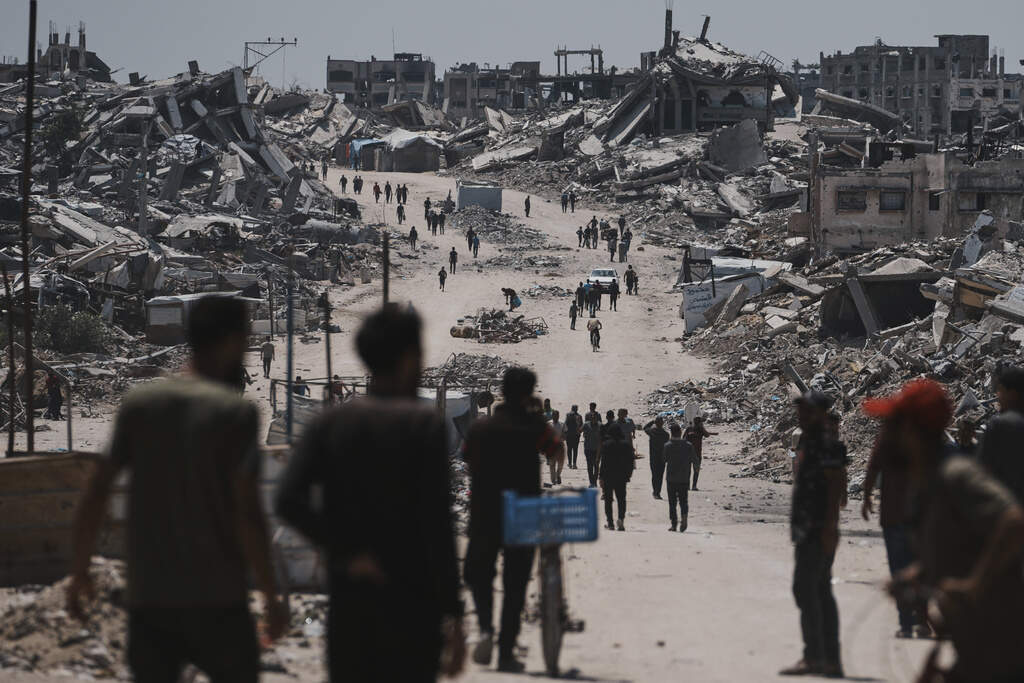
Israel's government recently voted to ramp up the war in Gaza. A food blockade starved Gazans for months. And critical voices internationally, and within Israel itself, are rising. What do Israel’s government and its people want now in Gaza?
Guests
Simcha Rothman, member of the Knesset for the Religious Zionist Party and the chair of the Knesset's Constitution, Law, and Justice Committee.
Tehila Friedman, Israeli lawyer and politician. She served as a member of the Knesset for the Blue and White alliance from 2020 to 2021.
Sara Yael Hirschhorn, senior researcher at the Comper Center for the Interdisciplinary Study of Antisemitism and Racism. Lecturer in the Ruderman Program in American Jewish Studies at the University of Haifa.
Transcript
Part I
MEGHNA CHAKRABARTI: Last month, Israel launched Operation Gideon's Chariots, a major new offensive it says is aimed at destroying Hamas and freeing hostages.
In late May, the Israeli military estimated that within two months, the IDF will have taken control of 75% of the Gaza Strip.
Quote: "Concentrating around 2 million Palestinians into three areas, Gaza City, the central refugee camps, and the Al-Mawasi zone." That's according to reporting from Haaretz. The new operation arrives on the heels of a months-long total blockade around Gaza.
Between mid-March and mid-May, more than 430,000 additional Palestinians have been forcibly displaced in Gaza according to the UN. Philippe Lazzarini, UN Relief and Works Agency Commissioner, told the BBC that, quote:
"There's absolutely no doubt that we are talking about massive atrocities." End quote.
On May 11th, Israeli Prime Minister Benjamin Netanyahu told the government's Foreign Affairs and Defense Committee that, quote: We are destroying more and more homes and Gazans have nowhere to return to, end quote. He added, quote, the only inevitable outcome will be the wish of Gazans to emigrate outside the Gaza Strip. End quote.
U.S. President Donald Trump supported that idea when first taking office earlier this year. So what is Israel's true goal now? Is it destroying Hamas, removing all Palestinians from the Gaza Strip? Exactly what is it and how far will it go to achieve these goals as international condemnation rises?
So we'll hear from multiple voices today, and we'll begin with Simcha Rothman. He joins us from Jerusalem, and he's a member of the Israeli Knesset, part of the far right religious Zionism party. And he's chairman of the Knesset Constitution Law and Justice Committee. Simcha Rothman, welcome to On Point.
SIMCHA ROTHMAN: Hello. Hello. And I'm as far right as in the eye of the beholder. I think my views are quite centric, but let's not argue about that.
CHAKRABARTI: Okay. We can actually talk about that a little bit later. But first, let me start with practicalities. Specifically, and concretely, what criteria would have to be met for the IDF, for Israel, to consider Hamas eradicated?
ROTHMAN: First and foremost, and today is a very good day to talk about it. The IDF returned from Gaza the remains, sadly, the remains, they were murdered in October 7th and were kidnapped, their bodies were kidnapped Judy Weinstein and Gadi Hagi, from that they were kidnapped.
And the hostages were brought to, their remains were brought to Israel by the IDF today. That's lowering the number by two of course of the hostages are held by Hamas, and in this case, it's the Hamas related organization and other terrorist organization.
The same organization that kidnapped the Bibas family, the Bibas children. Kidnapped and murdered. We know and that's one goal that we must remember and must talk about, returning all the hostages back. Either the hostages that are alive to return them to Israel safely, the hostages that were murdered by Hamas.
And by the terrorists that joined Hamas in their efforts to destroy the state of Israel and the Jewish people.
CHAKRABARTI: Yes. I actually completely agree with that, Mr. Rothman. And it is something I want to ask you about, and thank you for noting the returns of the remains of those hostages.
It is terrible that they didn't, were not able to come, they did not come back to Israel alive.
So we were talking--
ROTHMAN: They were not taken from Israel alive. They were murdered in Israel. And their bodies were kidnapped by Hamas.
CHAKRABARTI: Okay. So we will talk about the hostages in a moment.
But to return to my initial question again, concretely and specifically --
ROTHMAN: So this is one. We will know that Hamas has been eradicated, one good sign for that will be that we have all the hostages. Another sign for that is that Hamas will have zero either there civil or military control of any part of Gaza. And the Gaza Strip would not have any weapons aimed. It should be de-militarized.
It should be without any weapons that can go against the state of Israel, the Jewish people, to reenact October 7th in different scenario. So when we'll have those two outcomes, we will know that Hamas, we eradicated Hamas and we are safe. This is very important. It's very important for the people of Israel. It's very important for the state of Israel, and it's very important not only in the Gaza front. But also, with other enemies.
And Israel does not lack enemies in the surroundings of Israel. And within the borders, we have to make sure that they all understand that you cannot attack the state of Israel.
And live to see the next day.
CHAKRABARTI: It's clear that demilitarizing Hamas is a measurable and concrete and important goal, but you said also making sure that Hamas does not have civil control over Gaza.
What does that mean? They are, they do constitute the Gazan government. And so does that --
ROTHMAN: So they shouldn't, it's the same idea with the Nazi regime in Germany in the Second World War, the allies won the war when the Nazi regime was no longer the government of Germany.
CHAKRABARTI: And so that required, what? War, long-term occupation and a rebuilding of Germany. Is Israel really to do that in Gaza?
ROTHMAN: At first you eliminate the evil, then you try to make sure that the good things come there. But first you eliminate the evil. That's when the soldiers, when the American soldiers on D-Day were passing from Britain to France in order to take over what was under the control of the Nazi regime in Europe.
No one asked the soldier or the even the commanders. Okay, so after you beat Germany, who will be in control of Berlin, first they did not have an answer at the time. And second, I don't think they could even imagine the outcome that actually happened afterwards, that Berlin will be divided and you will have this, and part of it will be with Russia.
No one knows, you have an evil, you have an evil entity.
CHAKRABARTI: Yeah. You know another example that comes to mind--
ROTHMAN: That its goal is to destroy. They teach the children from day zero that they have to kill every Jew that they see. It's in their charter. That what they say. You receive this evil, you eliminate it and you help anyone that works in order to eliminate it.
After you do it, then you think, what will come instead? You don't oh, I can't eliminate the evil because I don't know what will happen afterwards.
CHAKRABARTI: So are you saying that the Israeli government does not have a plan for what it will do?
ROTHMAN: No. I'm saying that's good enough plan. Win the war, to make sure that Hamas is no more and there are no weapons in the Gaza strip. It's a very good plan --
CHAKRABARTI: I think of another example, I actually --
ROTHMAN: It'll take some time to achieve.
CHAKRABARTI: No doubt about that. And actually, you bring up an interesting point because I think of another example in terms of the United States invasion of Iraq. The goal was to remove Saddam Hussein from power, remove the Ba'athists from power to eliminate a kind of evil that President George W. Bush saw in Iraq. The United States military and the coalition was very successful at that, but there was not a cohesive plan thereafter, and it led to 20 years of occupation.
A trillion plus dollars spent, hundreds of thousands of Iraqis killed. Thousands of U.S. soldiers killed and maimed. The lack of a plan was worse than the original intention of the war. Is that what Israel may be marching into that?
ROTHMAN: So if I would ask you, so I don't, some of the wars United States conducted were successful, the attack on Nazi Germany and on Japan and some other places. Some of them were not so successful. Maybe Iraq is one of them. I don't know. We can talk about what are the alternatives. It's a good, it's an interesting conversation, but you choose the example that you don't like the outcome so much. By the way, I'm not sure that having Saddam Hussein stay in power was a better alternative. I'm not sure. You could have gotten maybe better result, better results in Iraq but I'm not sure that because that, if you will have, if I'll have to choose whether to have Saddam Hussein, maybe with atomic weapons threatening Kuwait, threatening, destabilizing the area.
Like Assad. Assad stayed in power for many years. I don't think Syrian people were so successful and better off than the people in Iraq. So I'm not sure that, even if I have to choose the example of Iraq and Syria, choose the example. See, Syria, you did not remove Assad from office, despite the President Obama saying there is a red line, and Assad crossing the red line.
You did not remove Assad from office. You did remove Saddam Hussein from office. I don't think the outcome was any different. Maybe people in Syria even suffered more than the people in Iraq. It's a close competition. Let's agree that it's a close competition. But so who wants to be the judge?
What do you prefer? Do you prefer to be an Iraqi or Syrian guy? What do you prefer?
CHAKRABARTI: Mr. Rothman, what I prefer is actually to keep our focus on Gaza here because --
ROTHMAN: Oh, you brought Iraq. I did not brought Iraq up.
CHAKRABARTI: Given that you had spoken about the Second World War in Germany, which I actually think was an appropriate, it was not an inappropriate example, but as you pointed, as you agreed, there's multiple examples and I'm just trying to draw lessons of when Israel, or to see what happens.
Like again, what does Israel consider to be success? And you say, yes, eradicating the evil that Hamas represents, that would be considered a success. But then there is a day after. And for Israel to truly, for Israel to truly achieve long-term security, certainly must have a plan.
ROTHMAN: I think Trump, I think Trump's plan, I think Trump's plan for the day after is a good plan to start on, to start talking about. I think most of the Gazans. And it's a reality, it's not a question. Most of the Gazans want to leave. They don't have so much where to return. If you hinted in the beginning when, in the introductions that you've made, that this is the declared goal of the state of Israel by demolishing the houses and the places in Gaza.
I think you are wrong.
CHAKRABARTI: That was what the Prime Minister himself said. But Mr. Rothman, hold on for just a second. I have to take a quick one-and-a-half-minute break, but when we come back, we'll come, we'll pick up this conversation in just a moment.
Part II
CHAKRABARTI: Mr. Rothman, I just want to play a little bit of tape for you from some other people in the international community. This is German Chancellor Friedrich Merz last week in Berlin, expressing concern over Israel's actions in Gaza.
FRIEDRICH MERZ: (TRANSLATION) What the Israeli Army is now doing in the Gaza Strip. I no longer understand, frankly, what its objective is. To cause such suffering to the civilian population, as has increasingly been the case in recent days, can no longer be justified as a fight against Hamas terrorism.
CHAKRABARTI: The German chancellor there last week. Also in the last few weeks, former Israel Prime Minister Ehud Olmert has come out sharply against actions of the current Israeli government. On CNN last week, he said this about what he believes Netanyahu's government is doing in Gaza.
EHUD OLMERT: This is not a war against Hamas. This looks more and more like a political war of the Israeli Prime Minister and the cabinet, and the group of thugs, which are now representing the Israeli government inside Israel, and of course, the world, are committing actions, which can't be interpreted in any other way.
CHAKRABARTI: Mr. Rothman, would you respond to that please?
ROTHMAN: If I will have to spend my, I'm not responding to Ehud Olmert. It's actually, it's sad. By the way it might be a good idea to tell the audience who probably don't know. Prime Minister Olmert, a felon, sat in prison, was kicked out of office, enjoyed 3% of the public support when he ended his career, and basically sitting today envy of Benjamin Netanyahu and the government.
And sometimes when people are in this situation, you don't judge them on the stupid things that they say. But about the goal and about the way to eliminate Hamas, and it's connected to what I said, which before we went to the break. You mentioned what Netanyahu said. And if you see it as a goal, I understand why people might be worried. Because you explain it as the goal of the war is to demolish the houses.
No. If you hide, if you're Hamas and you are hiding your terror tunnels, the tunnel that you are using to bombard Israeli communities and cities and towns from to, where you hide the hostages you kidnap, where you train your troops, where every piece of land is being used by you to hide explosives.
Just last week, one pound of an explosive in a community, in a civil area, in a neighborhood in Gaza, there are tons and tons of explosive in hidden, under ordinary homes. Under kindergartens, under mosques, under hospitals. Now the evidence are out there. We gave it to the world.
No one cares because apparently people care so much and talk so much about what's happening in Gaza, despite the fact that I think from the beginning, we are talking for 10 minutes. How long? We're talking almost for 20 minutes. In the last 20 minutes that we're speaking to each other. I believe more people died in Africa from hunger and wars than in Gaza from the entire war. I'm talking about civilians. I'm not talking about terrorists. So people are very worried.
CHAKRABARTI: I'm not sure, I'm not sure how quite, how you come by that number, but also, I would like to, I would hope, I hope that a race to the bottom isn't really Israel's goal here..
(CROSSTALK)
ROTHMAN: No, it's not the race to the bottom, it's not the race to the bottom.
CHAKRABARTI: But actually, Mr. Rothman, you mentioned that we have been talking for 20 minutes and that is accurate. I need to leave time for the other voices who are going to join us from Israel today, but there's one --
ROTHMAN: Okay. So just let me, let me finish with this.
CHAKRABARTI: Actually, there's one last thing I did want to ask you because you had very clearly said earlier that, okay, I'm still speaking in terms of goals, but that the desire for Israel is to eliminate the evil that Hamas represents.
And to that point, I just wanted to play something that you yourself have previously said. This was just last month, you were on the UK's Channel 4 news. And you said that Gaza is a combat zone and Palestinians in the territory by virtue of being the combat zone should be able to leave. And here's a little bit more of what you spoke about with Channel 4's Lindsey Hilsum.
LINDSEY HILSUM: I've got an idea. Why don't you let them come over the border into Israel? Why don't they flee into Israel?
ROTHMAN: Because they're our enemies. Because they are our enemies.
HILSUM: The children are your enemies?
ROTHMAN: They are our enemies. And according to international treaties about refugees in the time of war, you don't let them conquer your country with refugees.
CHAKRABARTI: Mr. Rothman. I know that prime Minister Netanyahu has also pointed out that other nations surrounding Gaza are not letting refugees in in large numbers as well. That is true. But when you responded to her question about the children also being your enemies, what is the logical conclusion to that if children in Gaza are considered enemies of Israel.
ROTHMAN: First of all, the war between the Jews and the Arabs in the land of Israel is not, it's not something coincidental. It has been going on for about 150 years. And the children and the adults in Gaza were taught from, again, from age zero in kindergarten, in school, in honor school, by the way, some of them paid by American taxpayers, that you have to kill every Jew that you see. That every Jew in Israel is the enemy, that from the river to the sea Palestine should be free of Jews. ... That's what this ideology means.
And to say that people that come from there wants to see Israel and the Jews in Israel eliminated, it's common knowledge. It's not a question. That's the reality. Now we have to deal with it, and if we will try to deny it, we will get more and more October 7th. There was a saying in the beginning of the war, that the same children, if you heard this recording, if not, if you letting your audience hear recordings, I urge you to put this recording on the air. Please listen to the recording of the terrorists in October 7th, calling his family in Gaza.
Bragging, I just killed 10 Jews.
And the phone moving from the father to the mother to the younger brother. To all the family. Proud was of their son, by the way. I think he was a minor too.
Killed 10.
CHAKRABARTI: Yeah. Mr. Rothman. I do not dispute that. I definitely do not dispute that --
ROTHMAN: When I talk about those are our enemies.
CHAKRABARTI: So this is what I'm trying to understand. This is exactly what I'm trying to understand.
ROTHMAN: You're arguing.
CHAKRABARTI: I'm not arguing. I'm actually trying. I'm actually trying to understand. I don't dispute that. Because what happened on October 7th was unspeakable, but for Israel to achieve long-term security.
Given what you just said about the eradication of evil, is not the logical conclusion, and you correct me if I'm wrong, that if we're talking about eradicating this state of mind of evil, does that require removal of all Palestinians from Gaza? I'm just trying to get a concrete answer.
ROTHMAN: I think it means, I think it means that all, it's not about Palestinians or not Palestinians. Any, because that's a good question. What is a Palestinian for that matter? But it means one thing, that the entire area, in the entire area that is near our borders. Anyone who wants to live in peace with us is welcome to be, anyone who is our enemy, anyone who wants to kill us, anyone who threatened us. Should not be here.
It's just clear like that. If someone, we have a lot of Israeli Arabs living in Israel in peace. It's not about Arabs. It's not about racism. It's not about anything. If you want to stay here in any way, you have to commit to peace and prosperity.
If you want to teach your children to murder Jews, just because they're Jews. You cannot be near the only Jewish country in the world.
CHAKRABARTI: Mr. Simcha Rothman, member of the Israeli Knesset and Chairman of the Knesset Constitution Law and Justice Committee, and a member of the Religious Zionism Party.
Mr. Rothman, thank you so much for joining us. It's much appreciated.
ROTHMAN: Thank you very much.
CHAKRABARTI: And he joined us today from Jerusalem. Let's turn now to another voice from Jerusalem. Tehila Friedman joins us. She served as a member of the Israeli Knesset for the Blue and White Alliance from 2020 to 2021. Tehila Friedman, welcome to On Point.
TEHILA FRIEDMAN: Hi, Shalom.
CHAKRABARTI: So you heard Mr. Rothman at the very beginning of the show saying that he considers himself in his views rather centrist in Israel right now. Would you agree with that?
FRIEDMAN: No, not really. I think. But I must say, that part of what he said? I think a broad component of society in Israel in terms of the wish to destroy the Hamas, to live in peace and to be sure that we're not gonna have another October 7th.
And the desire to have our hostages back. It's something that unites the Israeli society and you feel it everywhere in Israel. That's something that keeps us awake in night. It's really, people treat the hostages as if their own kids of all of us. So that's two things that we all share.
CHAKRABARTI: Can I just actually follow up on that for a minute and forgive me for interrupting. But I do wanna just stay with the issue of the hostages for a little while, because one thing that many family members of the hostages have been very critical of is the government of Prime Minister Netanyahu.
They have been critical saying that they don't think the government has actually done enough. Or let's just put it that way, done enough to actually bring the hostages home. So while it's uniting Israeli society in that desire, do you think the government of Prime Minister Netanyahu has actually done what it could or can to bring them home?
FRIEDMAN: I think the big question that the Israelis are asking themselves is what's a way to bring them home? Is it only pressure of the army, like the government is now promoting, or is that better or even achievable by agreement? And this is a question, because just last week, Witkoff said that Hamas gave a negative answer to his last offer.
And it's not always clear. What is the situation? Not like Simcha Rothman, I'm not part of the government. And I don't represent the government. I think I represent the majority of is the Israelis, even 40 percentage of the coalition supported, would prefer to have the hostages even if it means stopping the war.
And that's something that is like a broad agreement. But I think at the same time, the questions say, okay, so how are we gonna ensure ourselves that we're not gonna have Hamas recovered and have the ability to attack us again? Because no doubt that if they have that ability, they will, because Hamas, that's the aim. It's like endless war. Hamas doesn't desire to have independent Palestinian state. They never did. That's not part of who they are. They are Jihadist organization. But so it's hard for me to answer because I feel I don't always know what's the reality.
And what is really happening in the negotiating room and what is, things that the sides are saying to put pressure while negotiating. So it's hard to say.
CHAKRABARTI: Lemme ask you this. A couple of years ago when you were in the Knesset you gave a speech that caught a lot of people's attention.
When, where you discussed finding strength in the center and coming together as an Israeli people. So first of all, what did you mean by in the center then? And do you think that vision or that dream can still come to fruition?
FRIEDMAN: So what is it to center, be able, to be committed to Israel being both Jewish and democratic liberal democracy, both fully on without denying the tension between those two values, set of values.
But with holding the tension, instead of either/or. Trying to say, okay, we can't do both, so we need to decide over one side. And also understanding that instead of having internal war, deep state and this kind of political discourse. And we need to join forces and to see what every part of the population is bringing on to the Israeli society and the Israeli conversation. Now, what that polarization in Israel, which become dangerous. As I say, that's not something typical only to Israel. I think most people are, democracies in the West is going through this kind of polarization and this kind of internal war
CHAKRABARTI: Without a doubt.
FRIEDMAN: And yeah, and this is, for me, I think, this is the biggest danger to our future. And also, I think this is one of the things that it doesn't help us win with Hamas. Because if you have war, if you have long war, so one thingyou need to have is trust and solidarity.
And this is a government role to gain trust, to build trust, and to build solidarity. And you can't both fight outside and inside at the same time. So for me, to have United government, the government of the center government to see uniting the people and not creating walls between them.
That's part of Israeli recovery.
CHAKRABARTI: Is that happening now with the government of Prime Minister Netanyahu?
FRIEDMAN: No. That's I think my biggest, that's, it really is painful. And that's my hope for the next government. Hopefully we'll have, we are supposed to have election next year. I hope it'll be sooner. And I know that in the words people are viewing Israel as the one and only issue in a conflict and the war.
But as Israelis, this is one issue that we are bothered with, maybe is the most important, but really not the only one.
And internal questions are as important.
Part III
CHAKRABARTI: Let's listen to Prime Minister Benjamin Netanyahu on May 22nd. He had this criticism for those who are criticizing Israel.
NETANYAHU: For those who say that Israel stands alone, I say, we're not alone. Justice stands with us. The truth stands with us. History stands with us and so do countless people around the world who could tell the difference between right and wrong, between good and evil.
I want to thank all of them and I especially want to thank President Trump and the American people for their forthright stand with Israel and with the Jewish people. Together we stand, together we'll triumph, and we'll see the victory of civilization over barbarism.
CHAKRABARTI: That's Israeli Prime Minister Benjamin Netanyahu.
On May 22nd just this past Tuesday, former Israeli Prime Minister Ehud Olmert was on the PBS NewsHour. He had a very different view of the government's prosecution of the war in Gaza, and here's what he said.
OLMERT: The majority of these Israelis think that enough is enough. We have to stop the war. We have to bring back all the hostages that we can.
We have to try and see how we can change the realities on ground so that Hamas will be prohibited from any further control on Gaza. With the cooperation with the Palestinian Authority, Egypt, Jordan, others, and hopefully, in the near future, also embarking on peace negotiations with Palestinians for two-state solution.
CHAKRABARTI: So that's former Israeli Prime Minister Ehud Olmert on the PBS NewsHour earlier this week. Joining us now from Jerusalem is Sara Yael Hirschhorn. She's a historian at the University of Haifa and Senior Fellow at the Jewish People Policy Institute in Jerusalem, an author of City on a Hilltop: American Jews and the Israeli settler movement.
And she's currently at work on a new book, that is tentatively titled New Day in Babylon and Jerusalem: Zionism, Jewish Power and Identity Politics from 1967 to October 7th. Sara Yael Hirschhorn, welcome to On Point.
SARA YAEL HIRSCHORN: Thank you so much for having me with you.
CHAKRABARTI: So you've been listening patiently to the conversations that we were having earlier in the show, and I'm wondering what you think important points are or your responses to what, either what Simcha Rothman said, or what Tehila Friedman said.
HIRSCHORN: I think it's correct that you had two opposing viewpoints on the show, but Tehila Freeman is also, I think, astute in observing that there is also an Israeli consensus about some of the issues that Simcha brought up.
Whether or not he really is considered a centrist or an ultra-ultranationalists within the Israeli political spectrum. Some of the fundamentals about the war are things that are widely shared by many members of the Israeli public, including the over 70% of the Israeli public that would like the war to stop yesterday.
CHAKRABARTI: So tell me more, because I think what we don't often in the U.S. hear enough about is that stat that you just brought, the 70% of the Israeli public wants the war to end quickly.
HIRSCHORN: Yes. We're really facing a crisis, both of manpower as well as of moral authority in the region.
From a practical perspective, the war is basically being prosecuted by reservist soldiers who've now spent 300 or even 400 days away from their families, their businesses, and their lives. And that simply just can't continue at this pace. So Netanyahu's desire of a total victory has to be weighed against the ability to actually achieve that with a standing army that simply just doesn't have the manpower to go forward for very much longer.
But from a moral point of view, obviously many Israelis are deeply troubled by the humanitarian crisis in Gaza. The ongoing accusations, although not all of them ... in the international media and amongst the chattering classes. And further about the prospects for the hostages who remain alive, surviving very much longer in Gaza without some kind of negotiated ceasefire agreement or exchange of prisoners for hostages that will allow them to come home.
CHAKRABARTI: It seems to me that multiple truth can exist at the same time, or let's say multiple opinions can exist at the same time and be in tension with each other. What is your view on this latest operation, the Gideon's Chariots Operation? Because I will still use this language, because it's how the Prime Minister himself stated it.
That the goal is, once again, the eradication of Hamas and returning of the hostages with this new big push. Just your thoughts on that.
HIRSCHORN: I thought it was very apt that you brought up the parallel with the Iraq war earlier, with Simcha Rothman, because I think that the Gideon's Chariot Operation could very much be likened to the Surge Strategy in Iraq and to some extent in Afghanistan many years ago.
Because 19 months have passed and Israel has not been able to achieve both of those goals. The return of the hostages and the bodies, which we should mention, is very important to the Israeli public, even though many of them have not. Like Judi Weinstein and Gadi Haggai were actually murdered on October 7th. They haven't been alive for 19 months, but still, this is very important to the Israeli public, as well as the disarmament and decapitation of Hamas as both the civil and military authority. Both of those goals are very important to Israel.
But we're 19 months in and that has not been achieved despite Israel's overwhelming political. And military force. You can almost liken Hamas to be fighting a guerilla war without a jungle. But they are prevailing. And we can discuss the reasons for that. Many people might point to the Biden administration's prohibition.
About entering Rafah as being one of the reasons that Israel had been fighting this war with its hand behind its back for some time. And the escalating consequences for the civilian population. Because of that, maybe this, maybe a total victory could have been achieved much earlier or could have been achieved at all had that not happened.
But here we are in 19 months in and Israel hasn't achieved those goals, and it's not clear that it will be able to achieve those goals. To me, Hamas is something of a hydra for every senior fighter killed another takes their place. They don't seem to be having significant problems with the recruitment.
They obviously are suffering from problems of re-arming themselves. But it's not clear to me that Israel is in a position to actually win a guerilla war 19 months into this conflict.
CHAKRABARTI: Yeah. Mr. Rothman talked about it in terms of eradicating evil and again, this brings to mind the U.S. war in Afghanistan this time, or actually also even Iraq. Because you're right about Hamas and its ideology being a hydra. Because there comes a point in which military solutions aren't going to eradicate an ideology. So with that in mind, is there a different way, is there a better way to move forward for the long-term security of Israel and as you pointed out, an end to the humanitarian disaster in Gaza?
HIRSCHORN: Look, I just want to be clear that I have no doubt that Hamas and many of its affiliates are a deeply evil terrorist organization that kidnapped nine-month-old babies and the elderly, have slaughtered men, women, fathers, and mothers, brothers and sisters, grandparents and grandchildren.
So I don't think we should be naive about, as Netanyahu actually, I said earlier, that I think that ultimately history may acquit Israel as being on the side of truth and history and good and evil. But yet at the same time, we have a practical problem of how can an ideology be eliminated?
And frankly, how can a fighting force that is full of many young men and women in Gaza who after seeing 19 months of death and destruction are actually even more inspired to fight against Israel than ever. So Israel's really in a bind here, and I'm not sure that the history of guerrilla warfare necessarily bodes wealth for this particular case study, there are very few guerilla wars that have been won.
And those that have been come at a very significant cost. This is different, I think, than fighting World War II, where there was at least a sense of soldiers in uniform. These are plain clothes, members of terrorist operations who will use humanitarian spaces, hospitals, humanitarian aid delivery points.
And tunnels underneath schools and mosques and family homes to prosecute a war of terror against a nation state. So it's a very difficult war to win. And I think the only way to win it truly is not by Israel's continued waging of a military offensive, but actually through the Gazan people rising up and saying they've had enough of Hamas.
And regional partners including other urban and Muslim states being supportive of the Gazan people and trying to throw off the yoke of Hamas, which has certainly devastated the lives of Gaza and civilians not only in the last 19 months, but over the last 20 years.
CHAKRABARTI: But it's not, point well taken. It just doesn't seem realistic that as Israeli bombs reign continue to reign down on Gaza, that's going to happen.
HIRSCHORN: I think that one of the very effective roles that the media can offer is there have been small scale protests by Gazans and civilians against Hamas.
And amplifying the voices of those who are dissidents before, in fact, they are killed by being thrown off buildings by Hamas operatives is, I think, a very powerful tool in our arsenal to try to empower Gazans to be able to better their own lives.
CHAKRABARTI: Yeah. I keep thinking about how in Afghanistan, the United States after 20 years simply ended up with the Taliban back in power in Iraq.
Yes. Saddam Hussein and the Ba'athist were removed, but then came ISIS. You're right, history's track record is not in Israel's favor here regarding a successful guerrilla war. But I am curious about what you, can you help us a little understand a little bit more about views of the Jewish people in Israel. Because I don't know if you've seen this, but late last month there was a poll that was published by Pennsylvania State University.
And in this poll they found that there was overwhelming majority of Israeli Jewish support for the transfer of Palestinians from Gaza, 82% of Israeli Jews in the poll said they supported the forced expulsion of Palestinians from the Gaza Strip. How do you respond to that?
HIRSCHORN: First, I just want to respond to your earlier point about what the best-case scenario is.
And I think that something like 70% of the Israeli population is actually trying to, I guess, acquiesce to a reality that it is most likely that Israel's going to return to what I might call a 10/6 reality, a reality with Hamas still power in Gaza, and, basically an Israel and a Palestinian population that is older, wiser, and frankly a lot deader than they were on October 6th.
But that's probably the best-case scenario. The likelihood of a total victory here is very slim despite what politicians may hope for. Regarding the polls about forced transfer. I did see that poll, but I have to say that it doesn't seem to line up very well with other statistics that I have also seen.
I believe Israelis are very much in favor, however, of voluntary migration from the Gaza Strip as Simcha Rothman himself alluded to in his interview with you. I don't think that should be a preferred policy by the international community, but I also believe that nation states around the world have to be supportive of Gazans who themselves have actively and voluntarily chosen to leave.
Every refugee in the world is entitled to seek a better future somewhere else legally and lawfully as long as they come legally and lawfully to another country, and I don't see the Gazans are any different, but certainly the future needs to be assured for those who want to remain in Gaza and have their homes and lives rebuilt rather than those who simply want to leave.
CHAKRABARTI: I have two more questions in just the three minutes that we have left quickly. How does the current corruption trial that Prime Minister Netanyahu is undergoing is going through right now? Literally at this same time, factor in all of this?
HIRSCHORN: Today.
CHAKRABARTI: Yeah.
HIRSCHORN: Look, I think it's noise and chatter in the background.
The details of that case, which seemed so pressing a few years ago, and even in the judicial reform that Simcha Rothman himself was a major architect of, are in the background of this conflict. Because it's part of a larger polarization within Israeli society that doesn't necessarily only have to deal with the details of the prosecution of the war, but just a sense that the Netanyahu government is on the wrong track and is following deeply unpopular policies and is itself, frankly, deeply corrupt.
And the war is only one more piece of evidence in this, I guess you could say, public trial of the Netanyahu government. So it continues and it's important, but I think many Israelis have frankly lost interest in the details of what's happening in the day-to-day court sessions.
CHAKRABARTI: I'm glad you mentioned the judicial reform, because prior to October 7th that was bringing out tens of thousands of protestors against that judicial reform in Israel. Last minute that we have here. What impact do you think all of this is having on the Jewish diaspora in the United States or around the world?
Not just there's the moral outcry that's come, that's rising in the international community. You talked about the internal exhaustion and tension regarding reservists in the IDF, et cetera. Just your quick thoughts on that.
HIRSCHORN: I think just Israelis are very polarized about the future of the state of Israel.
So are American Jews. But they are much less proximate to the actual day-to-day of the conflict. And when I speak with American Jews, I think the psychological, economic and really spiritual toll, the war is still somewhat more remote for them than it is for me living here, living and working here in Jerusalem.
I also think that there is a distinction between American Jews who obviously are suffering a quantitative and qualitative leap in antisemitism, the likes that have really never been seen before in American history and the attitudes of other smaller diaspora communities, many who have seen antisemitism, and I think frankly because of the history of World War II and the Holocaust in Europe, understand the necessity of the state of Israel as a place of refuge, as a place of escaped far more viscerally than American Jews have, up until the last several months. So I think they've understood October 7th and its aftermath in somewhat different ways.
Only because their historical experiences have been different. But American Jews, I think, because of the crises that we've seen the last few weeks are certainly going to be taking that into account.
The first draft of this transcript was created by Descript, an AI transcription tool. An On Point producer then thoroughly reviewed, corrected, and reformatted the transcript before publication. The use of this AI tool creates the capacity to provide these transcripts.
This program aired on June 5, 2025.