Support WBUR
Hong Kong, 5 years after mass protests
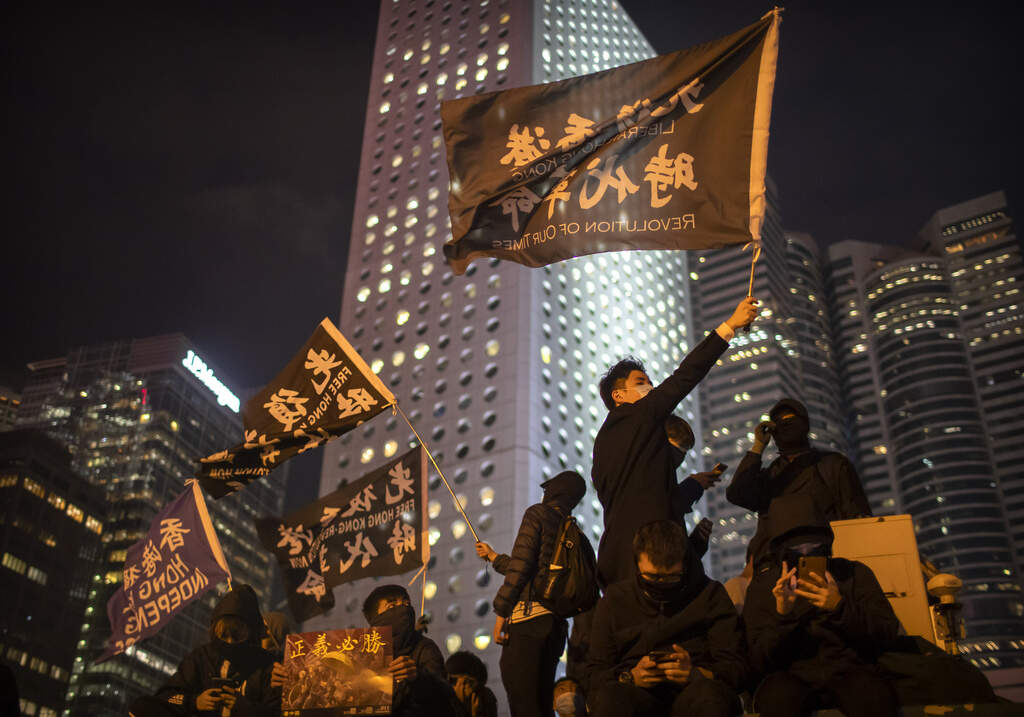
Between 2019 and 2020, nearly 2 million people took to the streets of Hong Kong to fight legislation that could give Chinese authorities the power to criminalize dissent. It's been 5 years since China passed the so-called national security law. How has Hong Kong changed?
Guests
Dennis Kwok, former Hong Kong pro-democracy lawmaker now in exile. Founding member of the Civic Party, Hong Kong’s pro-democracy liberal political party founded in 2006 and disbanded in 2023.
Also Featured
Mark Clifford, president of the Committee for Freedom in Hong Kong. Former editor in chief of Hong Kong-based English-language papers The Standard and the South China Morning Post.
Transcript
Part I
MEGHNA CHAKRABARTI: Six years ago, the streets of Hong Kong were flooded with protesters, nearly 2 million people, opposed to a controversial proposal that would crack down on democratic rights in Hong Kong. The bill altered Hong Kong's extradition laws. And would allow police to detain and transfer people wanted in other countries, even if they're not convicted of a crime in Hong Kong.
The mutual legal assistance described in the bill sounds entirely commonplace and potentially even familiar to American listeners, were it not for one specific thing.
China.
(MONTAGE)
You don't even have to do anything bad. What is to stop China from making up evidence?
I think that all the things Xi did is to obey the Chinese, the China government and I don't think Xi is serving us.
I think there's no hope, but we still need to continue to fight against the Beijing government and protect our city and our future.
Protesters speaking to CBS News in June of 2019, Hong Kong's Chief Executive Carrie Lam had argued that the new law was essential in order to prosecute one Hong Kong man who had murdered his pregnant girlfriend in Taiwan.
He was wanted there in Taiwan, and the law established a transfer mechanism for Taiwan, Macau, and Mainland China. Now it's important that we take a second to make note of history here. Hong Kong was established as a British colony in the 1840s. China's Qing Dynasty ceded Hong Kong after losing the first Opium War.
And Hong Kong remained under British control for the next 150 years and grew into one of the world's most significant financial centers and trading ports. It is one of the world's most highly developed places. On July 1st, 1997, the British relinquished control of Hong Kong to China with the agreement that China would maintain the one country two systems principle, allowing Hong Kong to keep separate political and economic systems from Beijing for at least 50 years.
The 2019 extradition law put that political independence in jeopardy. According to protesters, they feared there would be nothing stopping China from demanding the extradition of political dissenters, lawyers, journalists, and others who would no longer have the protection of Hong Kong's legal system.
The protests grew, leading the Hong Kong legislature to take the extraordinary step of suspending the extradition bill in June of 2019, but protesters demanded that it be completely scrapped, not just put aside temporarily. Then in October, then leader Carrie Lam made the announcement.
CARRIE LAM: The government will formally withdraw the bill in order to fully allay public concerns.
The secretary for security will move a motion according to the rules of procedure when the legislative council resumes.
CHAKRABARTI: The end of the controversial bill satisfied only one of the protest movement's five demands. They also called for an inquiry into alleged police brutality against the protesters, the retraction of labeling them as rioters, pardons for protesters who'd been arrested, and the ability to vote for both the city's legislative council and the chief executive.
In effect, Hong Kong's protesters wanted a fuller democracy with even less political influence from Beijing. On June 30th, 2020, China had enough. President Xi Jinping signed and enacted the National Security Law. It immediately criminalized dissent, established new crimes of secession, subversion, terrorism, and collusion with foreign organizations, and it made it a crime to speak about separating from China.
It opened the door to more surveillance and gave Beijing, not the Hong Kong government, the power over how to interpret the law. Its effects were immediate.
NEWS BRIEF: In Hong Kong, police appear to be cracking down on the opposition with the arrest of two high profile activists.
Hong Kong Police have placed a bounty on a former Hong Kong politician.
Multimillionaire, media mogul escorted by police.
Jimmy Lai, the owner of Hong Kong's main opposition newspaper.
Police deploying water cannon against protesters along with tear gas and rubber bullets.
Rounding up outspoken Beijing bashers to moderates, and that really suggests that the tolerance level for any criticism of the government is very low.
CHAKRABARTI: It's been nearly five years since the National Security Law passed and changed life in Hong Kong. Hundreds of thousands of Hong Kongers have since left their city to flee China's crackdown, and many of them say Hong Kong is no longer the same place it used to be. So today we're gonna take a look at what the long-term effects are of this particular crackdown on democracy.
What is life in Hong Kong like now, five years later? What is it like for the people who had to leave Hong Kong, and what can people in other fragile democracies learn from Hong Kong's experience? So we're going to speak with Dennis Kwok. He's a former pro-democracy lawmaker in the Legislative council of Hong Kong.
He has been in exile since 2020 and now advises democratic governments and think tanks on geopolitical risks and policies related to China. Dennis Kwok, welcome to On Point.
DENNIS KWOK: Thanks for having me, Meghna.
CHAKRABARTI: Why don't you first start by taking us back to your experience, even prior to 2019. What was Hong Kong sort of daily life like under that one country, two policies system?
KWOK: Yeah, so I was first elected to the legislature in 2012. I was the representative for the legal profession in Hong Kong, and our mandate was to defend the rule of law, the freedom and one country, two systems in Hong Kong in order to make it work, basically.
But starting from 2014, we're beginning to see more and more of a pushback from Beijing in not honoring its promise to the Hong Kong people. The most important promise that was made under the Sino-British Joint Declaration, an international treaty registered with the United Nations that would protect the freedoms of the Hong Kong people, and also a guarantee for universal suffrage, full democracy for the Hong Kong people.
It began to be quite clear in 2014 that Beijing had no intention whatsoever to honor that promise. And what's more is that it began to push back on all the promises of freedom that was made to the Hong Kong people. And we began to feel that one country two system was breaking down from that point onwards.
CHAKRABARI: From 2014 onwards.
KWOK: That's correct. And the gradual deterioration then became much more rapid as a result of the protest in 2019. When it decided to completely change its policy towards Hong Kong, that it no longer is one country, two system, but one country only. And the two systems merely became just a facade to the international community, which no longer has much credibility as a result of what happened.
CHAKRABARTI: May I ask Dennis, though, if the belief in the one country two systems principle, was it an act of hope against reality? As a Hong Konger, did people really think that Beijing would adhere to this for the at least 50 years that was initially promised.
KWOK: The Hong Kong people have always been very skeptical about this one country, two system idea.
But the Hong Kong people were never given a choice because when the British signed the deal with China in 1984, between Great Britain and the People's Republic of China, the Hong Kong people were never consulted. We were never given the choice. We were just told by the British back then to accept the deal because there is no other alternative.
So the Hong Kong people have always been reluctant in accepting one country, two system as their political future, but we had no choice. And we, as the Hong Kong spirit, is that Hong Kong people really made the best of it. We tried to believe that Beijing had every intention to honor one country, two systems.
And we made sure that our freedoms and our democratic rights are defended with vigilance. And that is what politics is about for, at least for the pro-democracy camp, people like myself. It is to defend what we have as a people, our freedoms and our democratic rights, and based on the rule of law, and this is what really Hong Kong people have been fighting for.
CHAKRABARTI: Yes. If I may say, the British have a long track record of not giving people a choice when they decamp their former colonies.
KWOK: Oh yeah. I think you guys would know everything about it. And yeah, there's a saying that British will always do every single thing wrong until at the last resort they have to do the right thing.
But in this case, I'm afraid they really shouldn't have signed that deal. And it was a mistake looking back.
CHAKRABARTI: I would like to actually just take a minute to compare what democratic rights were like in Hong Kong versus in China. Like even prior to 1997, actually, I think that's the important part here. Because like Hong Kong has a Bill of Rights, for example.
KWOK: Yes.
CHAKRABARTI: What are some of those things in that Bill of Rights?
KWOK: Every single fundamental right that you would expect to see in the United States Constitution were pretty much in the Bill of Rights in Hong Kong, except that the Hong Kong people were never given full democracy under the British. The British never, was too afraid of angering China, so they kept pulling back on granting the Hong Kong people full democratic rights.
It did in other former colonies, but it never did with Hong Kong. The unfortunate thing is that democratic system never fully took route in Hong Kong prior to 1997 and when Chris Patten came, who is the last British governor, when he came to Hong Kong in 1992, he did try to introduce more democracy to Hong Kong.
To his credit he did try very hard, but it was a little too late. because after 1997, the Beijing controlled legislature and government basically pushed back on all the reforms that was made.
By the last governor, Chris Patten. And we had to fight with one hand high behind our back.
Part II
CHAKRABARTI: Dennis, just a little coda to our conversation about Hong Kong's Bill of Rights. I'm looking at it right now. Very interesting that first and foremost, it was passed not long after the crackdown in Tiananmen Square in China. And I'm looking at the document here and it contains, as you said, rights that should be very familiar to Americans.
No torture or inhuman treatment. Everyone gets the same treatment. To the security of your person, due process, freedom of assembly, freedom of speech, equality before the courts. And interestingly, there's another one I see here that says right of peaceful assembly and right to basically not be extradited to other countries where there is no agreement, which is very interesting, because that's what we're talking about now.
So tell me what happened to you. Or what was your life like? What decisions did you have to make after President Xi signed and enacted the national security law in June of 2020?
KWOK: As one of the leaders of the opposition, life became very dangerous for many of us starting not in 2020, but in 2019 when the protests got going.
And we were heavily targeted by what we believed to be the Ministry of Security agents who were in Hong Kong. So my car, I found tracking devices under my car. Not once, but twice and thereafter keep happening. And then we were subject to physical assault. Many of us were attacked by thugs and we were subject to arbitrary arrests.
A lot of us were arrested for a whole range of offenses. And our job as pro-democracy lawmaker became more and more impossible, I would say. And we had to basically go into work one day. You don't know whether you would actually be able to go home and not be arrested by the authorities.
So by 2020 when they enacted the national security law, I said at the time, this is the end of Hong Kong. This is the end of once great international city. Unfortunately, that became true. And I was disqualified by Beijing as a lawmaker directly by the National People's Congress, which has never happened before, in November 2020.
And the reason why they had to do that is because the last Democratic election we had in Hong Kong was November 2019, where the Democrats won 90% of the local council seats. And Beijing decided that we, since they can't get rid of us through elections, which is by the way, an election system that was designed by Beijing, they had to use other means to get rid of us or to jail us or force us into exile.
CHAKRABARTI: Can you tell us the story of how you ended up in exile?
KWOK: So after I was disqualified by Beijing, I realized it's not gonna end there. I told my colleagues that they will continue to persecute us, every single one of us. And that was already when my, a very good friend of mine, Jimmy Lai, who's the owner of Apple Daily, one of the few independent news outlets in Hong Kong, was already arrested. I remember one of my last dinners in Hong Kong with Jimmy together with Martin Lee and Anson Chan, other pro-democracy leaders. And Jimmy told me that he expected to be taken away at any time. And that's exactly what happened.
I left Hong Kong in late November, 2020. Realizing that my safety is no longer guaranteed under the rule of law, and that I had no choice but to leave Hong Kong. Unfortunately, about a month after I left Hong Kong, all my colleagues in the legislature were arrested. Some of them are still in jail today, facing the criminal charge of a subversion under the national security law.
And some of them have been locked away, will be locked away for a very long time.
CHAKRABARTI: Subversion by virtue of simply being a member of the Pro-Democracy Party.
KWOK: That's a great question, Meghna. So the crime which they accused them of having committed is that a lot of my colleagues organized and participated in a Democratic primary election where they asked the Hong Kong people to choose who they want to be their representative to run against the pro-Beijing camp.
In the legislative council election, that was due to happen in July of 2020. So a lot of them participated in primary election, promising to use their powers if they were elected to force the Hong Kong government to respond to the demands of the Hong Kong people. And what were those demands?
Universal suffrage as promised under the Hong Kong constitution. So they were basically vowing to use their position as a Hong Kong legislature to force the Hong Kong government to respond to the demands of the people, which in most democracies, exactly what the lawmakers are supposed to do. But the authorities then use the national security law to say that, ah, this is a subversion of state power.
... And some of them got 10 years, seven, eight years imprisonment, and a lot of them are still in jail today.
CHAKRABARTI: For standing for election and saying, if I win, I will do what I can to preserve democracy in Hong Kong.
KWOK: And that's exactly what they promised to do, exactly what they did. And that is a crime under Hong Kong today.
CHAKRABARTI: Dennis, can you describe to me how are these democratic crackdowns being actually like physically enacted on the streets. And I hope this doesn't sound like a too naive of a question, but given Hong Kong's long history as having had mostly independence from China and this sudden change, is it that the legislature has been completely defanged?
Is it that there are actually like Chinese officers running the National security services in Hong Kong? How are these, even just these arrests taking place, who's doing it?
KWOK: Yes, you're exactly right. In fact, as we speak, we just witnessed the Office of National Security in Hong Kong making the first round of arrest of people
CHAKRABARTI: Just today.
I was seeing that.
KWOK: Yeah. Just, yeah, just today. This was, again, five years down the road, they're still making these arrests using more and more legal powers that it granted themselves. And these are, there's no longer a proper legislature in Hong Kong. Basically, it became whatever rubbish stamp Beijing wants it to be, and all kinds of laws are now being passed that will enable people's Republic of China government ministries and agents to make all sorts of arrests in Hong Kong without any transparency.
You can't even report on the details of it. I still remember when they enacted the national security law in June 2020, they deliberately kept the text of the law from the whole of Hong Kong people. And as a lawmaker, I was only reading it for the very first time in midnight on the 30th of June when they promulgated the law into enforcement.
And I was reading it for the very first time in my life and realized that Hong Kong is no longer free. If you read the provisions of the law is extremely vague, extremely unclear what amounts to criminal offense and what you can say and not say. And I still remember that distinct feeling of, it's like having the oxygen sucked out.
Having freedom snuffed out right before your eyes, from free to unfree. That feeling is suffocating. And I then basically said the words that I said, that Hong Kong is over and that we can no longer, I can no longer do the job as a lawmaker because I can no longer be sure what is legal and what is illegal.
And that became true for the rest of the Hong Kong people, even though at the beginning they say, oh, don't worry, we will only use the law against a very small minority of people. But after the law was enacted, became clear that was not the case. Because you're seeing like young people who were wearing t-shirts.
With a slogan, free Hong Kong, for example. Being arrested and taken away by the police. And Hong Kong used to be one of the few places in China where you can openly commemorate the Tiananmen Square Massacre in '89. And Hong Kong used to have a tradition of where hundreds of thousands of people would carry a candle and a flower to go to Victoria Park every year on the 4th of June to commemorate those who were killed during the Tiananmen Square Massacre in 1989.
And that was really one of the biggest traditions in Hong Kong, and that was no longer allowed to take place after 2020. And nowadays when you go to Victoria Park on that sensitive date, you would see thousands of police stationed there. And anyone who's just loitering around, anyone who's wearing a black t-shirt or holding a flower just standing there alone will get taken away by the police.
And that is life in Hong Kong today.
CHAKRABARTI: Wow. As you mentioned, Dennis. Literally today, there is yet another example of how life has changed in Hong Kong. I just want to clarify a little bit of it. I'm seeing the reporting thus far from the Associated Press that six people have been arrested on quote, suspicion of colluding with foreign forces, which is an explicit part of the national security law. And it's China's national security authorities in Hong Kong and city police that have undertaken, I think this is the first, at least it's been called by the AP, the first publicly known joint operation, but it's not being said yet what the six people are being arrested for.
There's no elaboration on the details of the accusations against them or even what organization they purportedly belong to. Is this a significant moment or is it simply just now more of the same since 2020?
KWOK: It's both more of the same, but also a significant moment because this is the first time we hear of reports saying that mainland authorities are now in joint operation with Hong Kong police in arresting people.
That means that since the passing of another major legislative change just last month, that allows mainland agents to come to Hong Kong and enforce PRC criminal laws in arresting people. And they could take them to detention centers in Hong Kong, where basically it is a no-go zone for anyone and you can't report on it because if you report on it without the consent of the authorities, any reporters or journalists could be committing a crime.
Basically, people can be taken away without any explanation, without any due process. And this is a further step up of what they did in 2020 in enacting the national security law, is that you can see that the legal pressure is being raised all the time, without any end to it. And you wonder why, because after 2020, after the enactment of the national security law, most of the protests, if any, were gone anyway. Most Hong Kong people say, okay, fine. You want to silence us, you want to deny us democracy. A lot of Hong Kong people decided to leave. Basically, more than half a million Hong Kong people have left Hong Kong since 2020.
A lot of them immigrated to the UK, to Canada, to the United States and Australia, et cetera. A lot of people have left. There's no protest to speak of. There's no real election to speak of. Basically, Beijing has completely tamed the place, if you will. And I don't know why they still feel there's this almost paranoia obsession with national security and that every year they have to put up a show to arrest people and to put bounties on people in exile like me and to continue this crackdown when there's really nothing more to crack down.
Because the whole place is basically completely silent and there's no protesters to speak of. But they keep saying that there's a national security danger here. There's a national security threat there. But it really reminds me of how authoritarian regimes in the past, like the Nazi regime, they're just constantly obsessed with national security, constantly have to find the enemies from within or outside the country.
And to say that the national security of Hong Kong and China is constantly under threat, which is not the case as far as I can see.
CHAKRABARTI: I think we know the answer, right, Dennis, because in order to prevent a seed from germinating, the boot has to be standing upon it all the time.
KWOK: Yeah, I think that is the greater story that when I advise democratic governments and think tanks and multinational corporations about Hong Kong and the China region, Hong Kong is not an isolated incident.
I know with Meghna we've been talking about Hong Kong, but Hong Kong is really a symptom of where the rest of the country, i.e. China is going. If you look at the events in Xinjiang, what's happening to the Uyghurs in Tibet, the naked aggression over Taiwan and the South China Sea and the Wolf warrior diplomacy, the aggressive foreign policy against other countries like Japan and the United States.
You can see that the country is really changing direction from what it was 10, 15 years ago. Not that 10, 15 years ago, China was a democratic and free place. No, it wasn't. But at least the leaders back then were more focused on economic development. They were more focused on developing good relationship with the west, especially the United States.
And they were on friendly terms with at least most democratic countries. Now China has completely changed from a country where it was focused on economic developments to now this rising nationalism, the kind of aggressive nationalism that we have not seen since the 1930s. And this was driven very much by the new leadership in Chairman Xi who believes that he wants to take China to the next level of development, but is a kind of development that raises, I don't think a very pretty side of nationalism, which is driving Chinese politics these days.
Part III
CHAKRABARTI: Let's get back to our conversation about what has changed in Hong Kong, for the people of Hong Kong, since China passed its massive crackdown on democracy there, the national security law back in 2020. As our guest, Dennis Kwok mentioned earlier, one of the first victims of that law was Jimmy Lai, entrepreneur and founder of the Pro-Democracy Newspaper Apple Daily.
MARK CLIFFORD: And the first time I met him was 1993. It was a year after I'd moved to Hong Kong from Seoul, South Korea, where I'd been for five years.
And he actually cooked lunch for me the first time that we met and talked to me about his vision for a newspaper.
CHAKRABARTI: So this is Mark Clifford, president of the Committee for Freedom in Hong Kong. And he mentioned 1993 because at that time he was a correspondent for the Hong Kong based business magazine, Far East Economic Review.
CLIFFORD: It was incredible because the British colonial government and Chinese businesspeople had always said Hong Kong people didn't care about democracy. All they cared about was making money. Jimmy knew that wasn't true and he was determined to start a newspaper that would reflect the aspirations and the hopes of Hong Kong people who wanted freedom.
And he talked to me about the business opportunity, and one of the reasons there was such a big business opportunity is that all of his potential competitors were backing off. They were scared about the Chinese Communist coming in. They were worried that Beijing would do to Hong Kong what it had done to Shanghai after Mao took power in 1949, destroyed one of the great commercial centers of the world.
Jimmy was fearless.
CHAKRABARTI: Now recall. This was back in 1993. And the fear or the scared feeling that people had, that Clifford talks about was in anticipation of the British handover of Hong Kong to China in 1997, but just two years after their conversation, Jimmy Lai did indeed go on to found Apple Daily.
It was a tabloid that The Atlantic once described as quote, inflammatory and sensationalist, racy and unabashedly pro-democracy. End quote. Over the years, Apple Daily faced China's pressure on Hong Kong's press. The paper was hit with advertising boycotts, firebomb attacks and threats to its journalist.
But Apple Daily never stopped reporting to expose corruption and human rights struggles that were going on in China. And by 2019, when those mass protests began that we talked about at the beginning of the show, Apple Daily had become one of the most circulated newspapers in Hong Kong. And a source people trusted.
CLIFFORD: Chinese authorities, basically, they just they didn't know what to do, so they threw Jimmy in jail, and I was on the board of directors of the parent company, and they froze our bank accounts, which made it impossible for us to pay the almost 1,000 staff we had, pay our electricity bill. Our phone bill made it impossible for us to take credit card payments from the 600,000 digital subscribers that we had.
So it left us with no choice but to shut down.
CHAKRABARTI: Clifford adds though that Jimmy Lai's story matters, not just because it matters for Jimmy Lai, but because it reflects the way Hong Kong fundamentally changed after the National Security law was passed and the beginning of China's political persecution, which has now extended from Hong Kongers at home to even Hong Kongers abroad.
CLIFFORD: Hong Kongers, they saw in this law a real threat to their way of life.
They saw the long arm of the Chinese Communist Party reaching into Hong Kong and potentially plucking out people that it didn't like. Something like 150,000 Hong Kongers moved to Britain. Since the National Security Law came in five years ago, and many of those people are harassed and intimidated, I have a colleague there, Chloe Cheung, who at the end of last year, Christmas Eve, she got one of these bounties on her head, a million Hong Kong dollars, that's about $130,000 U.S.
She moved to England, which she was 15 years old. The Hong Kong government is trying to reach out and punish her for her peaceful, free speech protected political activities in the UK. And they're saying basically to Chloe and to hundreds of thousands of other Hong Kongers around the world, we're going to try to get you no matter where you are.
CHAKRABARTI: That's Mark Clifford, president of the Committee for Freedom in Hong Kong, and author of the Troublemaker: How Jimmy Lai became a billionaire. Hong Kong's greatest dissident and China's most feared critic. Dennis, we've heard this word bounty a few times now. This million Hong Kong dollars. Or, what, $130,000 U.S. dollars for Hong Kongers outside of Hong Kong.
You mentioned there's a bounty on you.
KWOK: Yeah. This word bounty, makes it like a western, right? I never thought that Hong Kong authorities would do that. Because, if you look back in the 1989 Tiananmen Square Massacre. Even the student dissidents didn't have a bounty on their head.
This is a completely new thing that was created by the Hong Kong authorities. Most democratic countries would say to Hong Kong, okay, it's fine if you want to put arrest warrant on these people, according to your laws, that's your prerogative. Of course, we would protest, and we will object to it, but putting a bouncy on people's head means that there is a transnational element to it.
That you're almost inviting people in other countries, including the U.S., to say, look, if you somehow get this guy back to Hong Kong, we will pay you money. And that became something that law enforcement authorities in the West cannot accept, because they cannot openly have this invitation.
CHAKRABARTI: Dennis, can I just jump in because I wanna be very clear about something. We're not talking about, established, familiar, one gets arrested and gets extradited. We're literally talking about someone could find where you are. Any person. If they did happen to find where you are, stuff you in the trunk of a car, get you to Hong Kong and the Hong Kong government would pay them.
KWOK: That is the idea. We're not talking about extradition of people through a legal process. We're talking about people using other means. It could be gangsters; it could be anyone who wants to make a quick buck and have people like us arrested and put into a bag or somewhere on board a ship.
That is the kind of things that this bounty could potentially instigate. And I think that is the ruthlessness of this whole scheme, which we're seeing in Hong Kong today.
CHAKRABARTI: And obviously to just make it clear to listeners, this is why we're not identifying where you are. Perhaps, so clearly you fear for your physical safety, the bounty is enough to do that. But have things like the bounty also made you rethink just how much you want to continue your pro-democracy work. Perhaps that's the longer and more sinister impact of something like that.
KWOK: I think everyone in this situation will have to think about not only their own safety, but the safety of their family, because looking at my colleagues who are in jail today, we don't know when they would actually be allowed to leave jail or to leave Hong Kong.
But I think it also makes me think more about the importance of protecting Western civilizational values, like democracy, freedom, rule of law. These things are essential to our way of life. And we're seeing the rise of authoritarianism not only in China, but in Russia, in the Middle East.
We are extremely concerned with how the western way of life, when I say western way of life, I don't mean to impute any imperialistic undertone to it. What we mean is that people like us who believe in democracy, freedom, the rule of law, these values extremely important, and they're now being threatened on a global basis.
This hasn't happened before, and not even during the first Cold War. We haven't seen this scaled of threat to Western way of life. And I think that is the most concerning part. It's not just about us, the few of us who are exiled from Hong Kong, but rather, I think this really poses the fundamental existential question about the kind of future we in the West would face if we don't stand up for our freedom.
CHAKRABARTI: Would you say that the similar, a similar threat exists in the United States?
KWOK: I would say that, when people talk about authoritarianism, when I see the left and the right in the United States talk about authoritarianism. I think they need to put things into context, although I would say that the constitutional system is probably under severe challenge and stretch at the moment, with the protests that we're seeing in LA and the deployment of National Guard. But I think we still have to fundamentally believe in the U.S. Constitution at the separation of powers, the independence of the judiciary. I think these things are being put to test right now, and the one lesson that I've learned from my Hong Kong experience is that the price of freedom is constant vigilance, and that is so true no matter whether you're on the left or the right.
That you need to go back to the system and protect the system and the institution and believe that those institution would at the end, defend the freedom of the people. I speak to people, my friends, on the left, on the right in the United States, and I see there's actually a lot in common.
I know it's hard to believe at this point when I say that, but there is a lot of people do believe in the same things, but they have different interpretation of how it should be applied. But when I look at the U.S. politics from a semi outsider status I see there are still a lot of things in common.
And the system ought to be protected. And we need to try our very best to do that.
CHAKRABARTI: My mind is still stuck at a point earlier when you said that basically between one breath and the next, when the true sort of depth of the national security law was revealed, you felt Hong Kong was totally changed, right?
And democracy basically was, had crumbled in such a short period of time. You still have family there? Yes?
KWOK: I don't keep in touch with them. And it's really for their protection that a lot of people like us do not contact people in Hong Kong just to protect people who are there.
CHAKRABARTI: So you can't even speak with them.
KWOK: I don't, it is very difficult situation for a lot of people. And you're right. I think that feeling of law coming down makes me think about historical events like the Nuremberg Law when it was enacted.
And the National Security law is very much like that. It is a law that was imposed by Beijing 5,000 miles away. And it just got enacted overnight. And it is an event that one would never forget. The feeling of, as I said, it's like having oxygen sucked out of a place.
And if you look at Hong Kong today although the authorities still try to claim to the international financial census status of Hong Kong and that how business is back to normal. Everyone knows it's not business back to normal. Everyone knows that the energy that Hong Kong used to have as an international financial center has been sucked out.
A lot of businesses have left, a lot of people have left, and people don't, no longer have that kind of confidence about Hong Kong. One of the great things about Hong Kong is people, you have people like Jimmy Lai, you have people like Li Ka-shing. You have people who are very successful, makes a lot of money, but also, free, are left alone by the authorities.
And nowadays you even have people, the Pro-Beijing press threatening to go after Li Ka-shing because he wanted to sell his ports around the world to BlackRock, which is worth $2.2 billion U.S. dollars. And that deal is still up in the air right now.
And it shows you that the NSL, the National Security Law is not only affecting political life or civil society, is now actually interfering into commercial life of companies. And that really, I think, is the crossing of another red line. It is that people thought, oh, the NSL is really going after people like Jimmy or myself. But now it is interfering into commercial transactions, which they say touches on national security, when Li Ka-shing is basically selling his ports around the world.
That is not even in China. And that is, he's being accused of having breached a national security law. So that really shows you how far things have gone.
The first draft of this transcript was created by Descript, an AI transcription tool. An On Point producer then thoroughly reviewed, corrected, and reformatted the transcript before publication. The use of this AI tool creates the capacity to provide these transcripts.
This program aired on June 13, 2025.