Support WBUR
What 25 years of CDC data on autism tells us
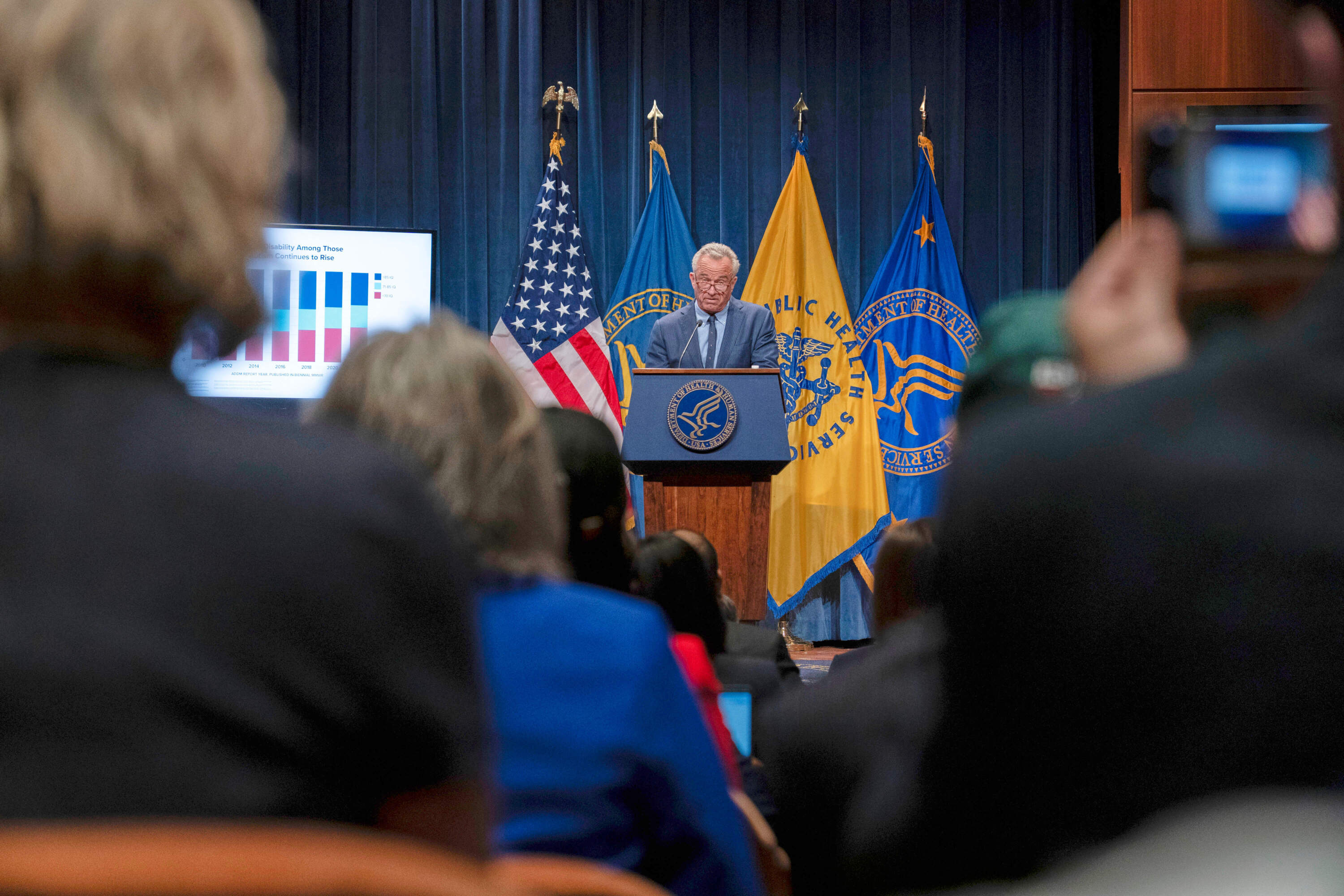
One in 31 American children have autism spectrum disorder, according to the CDC. Health Secretary Robert F. Kennedy Jr. has vowed to find the cause. But experts are skeptical.
Guests
Elise Pas, research professor, Johns Hopkins University, Bloomberg School of Public Health. She co-leads CDC’s Autism and Developmental Disabilities Monitoring (ADDM) Network in Maryland.
Suzanne O'Sullivan, neurologist and writer. Author of "The Age of Diagnosis: How Our Obsession with Medical Labels Is Making Us Sicker."
Transcript
Part I
MEGHNA CHAKRABARTI: In April of this year, the CDC released its latest autism and Developmental Disabilities monitoring Report. CDC has been tracking autism rates among children in this country since the year 2000, so it's been a quarter century.
This latest report concludes that on average, one in every 31 8-year-olds have autism spectrum disorder.
It found that boys were three and a half times more likely than girls to get the diagnosis, meaning that almost 5% of American 8-year-old boys are likely to have autism. Now, these autism rates are not anywhere as high as the rates of, say, pediatric chronic disease in this country, things like diabetes and obesity.
Almost 30% of American kids suffer from some kind of chronic disease according to the National Health Interview Survey, but the autism rates are significantly higher than say, pediatric cancer rates. The National Cancer Institute estimates that approximately one in 285 children will be diagnosed with cancer before their 20th birthday.
Compare that to the one in 31 number for autism. And since CDC's latest report came out, Health Secretary Robert F. Kennedy, Jr. has talked about it every chance he gets, for example, last month on News Nation with Chris Cuomo.
ROBERT F. KENNEDY, JR.: Today is one in every 31 children, and it's actually probably worse than that. Because California, which has the best collection protocols in its state is reporting one in every 19 children, one in every 12.5 boys, so something is causing it.
CHAKRABARTI: Then the secretary added --
KENNEDY: You don't see autism at one in every 31 people my age. I have never seen somebody my age, 71 years old with full blown autism. That means profound autism. That means nonverbal, non-toilet trained, headbanging, the stimming or the stereotypical features of the disease, you don't see that. And there are, these are not people who are locked in some institution somewhere.
CHAKRABARTI: Now we will check that later in the show, but also later that same month in August on the 26th, President Trump held a cabinet meeting open to the press.
Kennedy repeated his statements almost verbatim to the president.
KENNEDY: In 1970, the biggest epidemiological study in history was done in Wisconsin. They looked at 900,000 children and they were looking for autism. They knew what it looked like. And they were very precise about it, and they found an incident rate of 0.7, in other words, less than one for every 10,000 children.
Today, our most recent numbers are one in every 31 kids. It's probably actually much worse than that. Because California, which has the best collection system, is reporting one out of every 19 children, American children has autism. One in every 12.5 boys. So it's gone from one, less than one in 10,000 in 1970 to one in 12.5 boys.
TRUMP: Think of those numbers.
It's there has to be something artificially causing this.
CHAKRABARTI: Again, that's Secretary Kennedy and President Trump just a couple of weeks ago. Now, we will talk about those Wisconsin numbers also later in this show. But for now, note that in April when CDC released its report, Kennedy also promised to make public findings on the causes of autism.
By September, that would be this month. We'll talk about that too. But today, really underneath all of that, what we really want to do is focus on that number: one in 31.
Now, out of context and without background, that number can mean absolutely anything to anyone. So how did CDC come up with that number and understanding that, what does one in 31 actually tell us about childhood autism in America?
And perhaps more importantly, what does it not tell us? For that, we are going to go to Elise Pas. She's a research professor at Johns Hopkins Bloomberg School of Public Health, and she co-leads the CDC's Autism and Developmental Disabilities Monitoring Network. She's with us from Baltimore, Maryland, and she was one of the authors on this most recent CDC report.
Professor Pas, welcome to On Point.
ELISE PAS: Thank you so much for having me.
CHAKRABARTI: So first of all, let's start with the most basic question. That one in 31 number, do you believe it represents an accurate overall average of autism rates in eight-year-olds in this country?
PAS: Yeah, so the intention of our reports that come out every two years is to really give a snapshot in time of what we know about diagnostic rates amongst eight-year-olds across sites in the United States.
So this most recent report had 16 different sites across different states in the U.S. and in Puerto Rico. And this is the best possible estimate we can gather based on the information that we have at this time.
CHAKRABARTI: Okay, so let's talk about what those sites are, because I'm hearing a lot of both almost understandable scientific hedging here.
So let's talk about those 16 sites. How are those sites determined? Because site is not the same thing as a state reporting, like on average across the state, we're seeing X. So how are these 16 sites determined?
PAS: So there's an application process, where groups can come together and write an application to the CDC to be a part of the network. And those are selected based on the qualifications of the scientists at those sites and their ability to be able to access the types of data we need to, in order to make an accurate count. The 16 sites, it's best to think about this as a community level assessment, and that's important. Because community practices are what drive our understanding of autism diagnoses.
That's to say, those people who are living in a specific community are accessing the resources they have in their community to potentially seek out diagnosis to begin with. So the sites that we had, they're all, like I am part of, as you said in the introduction, I co-lead the Maryland site, specifically, that's one of the 16.
And we work with five counties in the Baltimore area. That's what we're looking at. Population-wide estimates for five counties out of the 24 in our state.
CHAKRABARTI: Five counties out of 24, and they're clustered around Baltimore.
PAS: Correct.
CHAKRABARTI: Okay.
And for example, another one, say let's talk about the most populous state in the nation, California.
They have a site, what site is that?
PAS: So they're based in an urban jurisdiction. So it's part of one county in metropolitan San Diego, specifically. Obviously, California is an enormous state, and San Diego is a quite large jurisdiction, so it's important to note, one of the things that is a parameter of the work by the CDC is that the total population of eight-year-olds in that specific year should not exceed a particular number, because you couldn't possibly do this work.
So the total populations that are being looked at, so we're thinking about all the kids who are born eight years prior to the work that we're doing. So in 2022, those are kids who are born in 2014. We're looking at that full population. In Maryland where I am, it's over 21,000. The smallest population this year was about 4,000.
And those range up to about 35,000. So you can't look at the entire state. The work that we're doing is pretty comprehensive and robust and quite challenging. Just to give you a sense, when we're looking at eight year olds, we also look at four year olds and 16 year olds. Not everybody looks at 16 year olds, but in Maryland we do, and we've reviewed 7,000 records just for this set of reports that were coming out for 2022.
CHAKRABARTI: Okay. But to be clear though, again, sticking with California, because not only is it so big, but it is so diverse as well, right? That the overall rate for that California community, was what, one in 19? Do I have that number right? One in 19. Okay. But so strictly speaking, what the report is saying is in that community, in and around San Diego, as of 2022, 1 in 19 eight-year-olds were concluded as having autism spectrum disorder.
PAS: That's correct. And partly when you think about California and also Pennsylvania, which had the second highest rate, there are some pretty substantial practice differences in those two states compared to any other state in the U.S.
So in California there's an initiated called the Get SET Early that's trained hundreds of pediatricians to screen and refer children for autism assessment.
And that will inherently yield higher estimates, because they're doing the best job of finding children who have autism. There are also regional centers throughout the state that provide evaluations and service coordination for people with disabilities and their families and their records. That are part of that regional center and through their department of disabilities is part of their data collection.
So there's two things that are happening in California. Number one, they have an incredibly robust training system that allows for the type of screening we would love to see in every community. And their data collection in this report is tapping directly into that infrastructure.
In Pennsylvania, they have a Medicaid policy that provides all children with physical, mental health, developmental, and intellectual disabilities, regardless of their income with Medicaid coverage for services.
And that's a pretty astonishing difference from a lot of different communities. So I started by saying, it's best to think about this as snapshots of community practices across the United States, and this variability that we see is really a result of the way in which the services are available for families to find out that their child has autism.
CHAKRABARTI: Okay.
But, and I'm just leaning on my own background in environmental science and risk management, professor. So hear me in good faith. I'm looking at a national map that's on CDC's website that's generated by the data from this latest report. And to your point, it only highlights 16 states because we have only 16 communities and 16 sites.
Meaning --
PAS: Actually, technically we have one less. There were two sites in Texas this year.
CHAKRABARTI: Okay.
15. Got it.
PAS: And one of them is Puerto Rico, so it's 14 states, two sites in Texas and Puerto Rico.
CHAKRABARTI: Good. I appreciate the correction. It being accurate about this is vitally important. 14 states in the United States.
Puerto Rico also, but I'm looking at this and that means that Oregon, Washington, Idaho, Wyoming, Colorado, Nebraska, South Dakota, Alabama, Mississippi, Florida, New York State, you name it, the majority of states are not part of these communities. And then of the 14 states that are on this geographic prevalence.
Oh, you know what I'm getting so wrapped up in the data, Professor Pas, that I'm losing track of time. We only have 30 seconds before our first break here. Instead of blazing to the break, what I'm going to do is I'm going to pause right now, we'll pick up this geographic question when we come back.
We are talking about one in 31. What does the CDC's estimate about autism prevalence in kids in this country actually mean? How does it get that number? What does it tell us? What does it not tell us?
Part II
CHAKRABARTI: Professor Pas, getting back to this geographic question and the 16 total communities, not necessarily full-blown state averages that go into this number. Again, I'm looking at this U.S. map on CDC's website, and I see that 1, 2, 3, 4, 5, 6, 7, 8, 9, 9 of the communities out of the 14 have autism prevalence rate of one in 33 or higher. Only two. Only three or four of them are lower than that, and Texas is the only one that's significantly lower. So given that to me, there seems to be the risk of overestimating the prevalence if nine of the communities are showing these unusually or significantly higher rates.
PAS: So your question is really, I think, around the variability in the estimates and where that comes from. And as I was saying before the break, there's just a variability in the way in which access and diagnosis is happening in these different communities. And that's one driver of the variability that you see.
There are slight differences as well across the different sites in terms of the infrastructure within the community, within the state for the way that data are available and collected, and then therefore can be counted within this study. I want to, if I can, really make sure I can hammer home this point around what we are able to count is what is diagnosed in the moment in these communities.
At the time, and that does vary. And the way in which that happens is a result of many different factors, different policies that exist, as I mentioned with Pennsylvania, different practices and training activities that are happening. Just because we have a diagnosis framing as we currently do in the DSM-5, the Diagnostic and Statistical Manual for Mental Disorders. That's the psychiatric manual for how we even diagnose autism. I think what's hard for the public to really understand is one who even assesses and diagnoses autism.
And two, if we have it as a set way isn't it that everybody gets diagnosed exactly the same way. And the answer to that is, is no, it takes a lot of time. There's an entire field of research called implementation science around how do we actually get evidence-based practices into practicing in the real world. I mentioned California.
I want the listeners to really understand. That just because we have a set of, say, pediatric standards around screening early doesn't mean it's happening all the time. Just because we have certain guidelines on how you diagnose autism doesn't mean that it is happening.
And then certainly families in different communities don't have that access. They might not live near somewhere that diagnosis, it's not that every single clinician out there is well equipped to diagnose autism. I myself, actually am a school psychologist by training. And the CDC you mentioned has been doing this work since 2000, that came out of the Children's Health Act of 2000.
Which was really focused on building a workforce that understood autism and can diagnose and could help address and support the needs of children. And you would hope that just meant we turn the faucet on and now everything works, but it takes a really long time. It never works that time, for that water to drip out the faucet.
And so my own training clinically, I actually came into school psychology because I worked with children with autism as an undergraduate. Around the same time of this Health Act, and the training I received, we've received a broad range of training in testing, but autism training was pretty sparse.
In a very high rated program that I went to. And I'll say there's research even in 2017, showing school psychologists who are a frontline diagnostic support for families in schools. And part of our data collection, by the way, education sources, are still not totally ready for being able to assess autism.
CHAKRABARTI: So professor, if I may, point taken in terms of disparities in data collection, obviously disparities in diagnosis, disparities in access. I am not quibbling with any of these things. I'm simply, again, approaching this from a sheer dispassionate research point of view, because ultimately, CDC does generate a number. And as you and I know, that number percolates its way almost instantly into policy and the public conversation around autism and children's health in general.
So I do want to just continue to dig in into how this number is generated. Is it fair to say though, that of the 36 states for which there are no communities or no sites from which data is coming, that is not to say that they do not have robust access or collection systems.
PAS: Our best hope here is that these 16 sites represent the rest of the country as best they can. You know, not to be Maryland centric, but we often talk about Maryland as being this microcosm of the U.S. in terms of just demographic characteristics of people from a standpoint of like race, ethnicity, the languages they speak and countries of origin that they might have.
But yeah, you make a great point. The CDC network would be, is always benefited by a robust set of sites, and this is our biggest yet. 16. I don't think anybody in the network would disagree with you in wanting to advocate for more sites to be able to be included. That's just a financial reality of how much money is being allocated for this study.
CHAKRABARTI: Financial reality. Okay. Okay.
PAS: That's really what it comes down to. How much money is allocated to this.
CHAKRABARTI: So if more funding were allocated to it, you would be able to access more or identify more communities in the rest of the country. Because what you're dealing with here, I'm just gonna put it bluntly, is an incomplete data set.
No?
PAS: Sure. Yeah. Actually the 2022 surveillance year started out, interestingly, we actually didn't have 16 sites at first and more money was allocated. So the money was awarded in January of 2023 to 11 sites, and then there was additional funds allocated, and five additional sites were added and are part of this.
Those newer sites include some of our lower prevalence rates like Texas. And so some of it we'll have to see. We're in the midst of doing the 2024 surveillance. We had one site, for example, that wasn't able to get access. Other than just administrative data, which is slightly different than the other sites.
And as we continue to see in 2024, I think this could look a little different for some of those sites. So I would caution you in thinking, are the lowest sites the ones with the most accurate count?
CHAKRABARTI: No, I'm not. I'm just gonna be clear. I am not presuming that, I'm simply presuming we don't.
I'm not presuming, I'm asserting we don't know because that data just isn't part of the community's data set that you and your co-authors are working with. We don't know is different than, oh, I'm just presuming that it's going to be lower. Because I'm not, but what I also want to say, what I also want to add and learn from you is, it sounds like you were pretty positive about if we had more funding, we would get more data and that would be very useful.
PAS: We actually saw that happen. Just a couple years ago. We had more money and we had more sites added.
CHAKRABARTI: Okay. Yes.
So let's move forward a little bit. I keep saying data in the generic. Where what data are the communities actually providing? Are they providing doctors records?
Are they providing school records? What are you looking at?
PAS: Yeah, so we're trying to get health records and education records. We call them sources in our study. So we are looking at things like, who are the children who receive special education for autism specifically? We're looking at who has a medical code in a record.
I think that this idea of medical record people are thinking about. I just want to go back to this earlier point about who diagnoses autism. Health sources can be a range of things. Some are Medicaid records specifically. So a child that has Medicaid services and has an autism code in their Medicaid record.
It can also be the health centers that are doing diagnostic work, that have a code based on a diagnosis that's made. These diagnoses are being made largely by psychologists, sometimes developmental pediatricians. And that's why I was saying the school psychologists are really on the frontline.
They're the ones by special education law who do the assessment to determine if a child receives services for autism. And then the other 13 categories for which a child might qualify for those services.
CHAKRABARTI: Okay. But tell me a little bit more about that, because especially as that relates to autism, special education eligibility flags, that contribute to the numbers you're looking at.
PAS: Yeah. So that does, we also look for a diagnosis, a written diagnosis of autism. So I'll give you the example of schools. Schools are unique in the sense that this is not to be thought of as completely the same as a clinical diagnosis, and to say that if a child doesn't receive special education, it's because they don't have a clinical diagnosis.
What I mean by that is special education qualification is contingent on an educational impact. So it could be the case that you have a diagnosis of autism, but you do not have an educational impact, and you don't receive services that happens with other mental health conditions. Frequently, like a child might have a depression diagnosis, but that might never result in any sort of special education services.
So when we talk about special education eligibility, it's both that they qualify for autism in a more clinical sense, and there's an educational impact also sometimes. The other thing about those qualifications is that you are taking the main diagnosis thought to be linked to the educational impact. So if a child has two or three diagnoses, clinically, maybe only one, this differs in states, how they handle this.
But they might say, for example, not qualify under autism, but under something else.
CHAKRABARTI: Okay. So is the opposite possible, that a child can qualify for the special education of eligibility without having a formal clinical diagnosis of autism.
PAS: Correct.
CHAKRABARTI: It can?
PAS: Correct. And then they become the front.
That's why I was saying they're a really important frontline. This is a really important piece for access, because if a family wants to go get a neurological assessment done privately in a health center, that can cost thousands of dollars, and not everybody has that money or is willing to spend that money.
Whereas if you are identified in need in a school, those services and that assessment is free. And I just, if I may, Meghna, make just a little plug for kind of a PSA for families. That is part of our rights in the public education system, is if a parent says they have a concern about a disability that is leading to educational impact, it is mandatory that the school investigates it.
If a parent says they have a concern about a disability that is leading to educational impact, it is mandatory that the school investigates it.
Elise Pas
That does not mean that they have to do the full testing, but they at least have to consider it and have a good reason to rule it out. If they do the testing, they have to go through a qualification process. And it's actually true for kids who are younger than five who haven't made it to kindergarten yet.
If you reach out to your local school system and say, I have a concern about my child's development, they too will work with that family. That's part of law. And so that's an enormous part of access. And I'll say historically, education records weren't always available to the network for assessment of a prevalence.
So that's one of a few different places where we can start to look at data and explain why has the number changed so dramatically.
CHAKRABARTI: Professor Pas, your point about getting a clinical diagnosis can cost families a prohibitive amount of money, that is very well taken.
At the same time though, I think I also heard you say that a kind of an eligibility can be determined in schools. But sometimes the schools don't even do the testing, quote unquote. But it ends up in a child's record, that they have received an autism special education eligibility determination.
PAS: No. I'm sorry I'm not sure if I didn't, I probably didn't speak clearly on that. So I was just saying if a parent initiates and says, I have a concern about my child, it is mandatory that they at least explore whether testing is appropriate.
Once they test a child, for any disability. This is not just for autism, but for any disability in a school setting, then they have a period of time in which they must make a determination as to whether there's an educational impact, whether there's a presence of a disability and an educational impact to determine that a child is eligible for services.
CHAKRABARTI: Okay. Would you say that this is as robust as a, okay, cost aside for a moment, that's as robust as the kind of testing that goes on in a clinical environment to determine an ASD diagnosis.
PAS: That's a really hard question to answer because practices are so variable within schools, between schools and then clinically, too.
There are places, when I was working as a school psychologist, I saw the practices of different, local school systems in the state, and I've got reporting from other jurisdictions and private that they vary so much. The way in which, that comes back to my earlier point about this training piece and how well-equipped people are to do autism testing.
So that was one of the areas we reported on this year. We did actually, in 2020, publish a separate paper specifically about testing practices, but in this report this year, that came out in April, for the first time that testing information was bundled in. And you can see the different types of autism tests that are being used.
And that varies a strong bit. So I wouldn't land on a place to say who's doing more robust or comprehensive assessments, because I think that varies based on where you are.
CHAKRABARTI: Okay.
Looking at the trajectory of the prevalence rates that CDC has published since 2000. In 2000 it was that big overall number was one in 150, right?
And now the latest number is one in 31. If I'm completely frank with you, again I'm not questioning the methodology. What I'm questioning is, given all the things that you said about the variability of sites, adding on sites when there's funding, the fact that even from site to site, it's like a subset of a subset, in terms of the records that you're able to analyze and that the means of diagnosis within each of the sites is also highly variable to be really rigorous about this.
Not value judging, but just rigorous. I don't see how we can call, say that any of these are an apples-to-apples comparison longitudinally from year to year. It seems like the entire basis of the analysis is changing from year to year.
So can we actually say that really there's been this like radical, and especially since the diagnosis criteria has changed, that there's been this like giant increase in autism rates in this country.
PAS: I think that it is not where we should be focusing our attention, because to all of your points, what we're measuring has changed.
So most notably, when you look at 22,000 to 2025, we had a change in diagnostic criteria for autism in 2013. So you have reports that are prior to that and the reports that come after that. Interestingly in the 2014 report, which I was not a co-author of, I was not yet co-leading in Maryland.
So I'll just give that caveat, but they looked at prevalence in the six sites that had --
CHAKRABARTI: Professor, I do not actually mean to interrupt you. The clock is determining this. We have to take a quick break. I'll let you finish when we come back.
Part III
CHAKRABARTI: Professor Pas, please go ahead and finish your thought about this trajectory issue that I was asking you about.
PAS: Yeah. So I just want to start with one point. I think what I want to highlight from what you've asked here is that the reality of this is we're in an imperfect world trying to measure what exists in terms of autism diagnosis.
And so we're working within the confines of that. The methodology itself is as rigorous and comprehensive, both with balancing the cost and the efficiency. And being able to get out timely information as possible, but it's an imperfect system. We have imperfect information about autism.
I think the point that you make about whether we should be really thinking about these dramatic changes, I think the numbers themselves are reflective of a change in the way that we diagnose autism, the way in which people now even seek out to have a diagnosis of autism. Raised awareness by practitioners, clinicians, educators, families.
All of that is evolving and complex. And we're a snapshot in time that gets us the best possible number that we're going to land up with. In terms of why these changes, we don't study that explicitly. But there are some key data points. Some of the ones I got at with the policies and the practice variability that help us to think about this, but I would say the most notable one is the way in which we even define autism at all.
CHAKRABARTI: Can you just pause right there, because on that note we actually have a little bit of tape because in the late 1980s and 1990 psychiatrist Dr. Allen Frances led a task force that created the fourth edition of the Diagnostic and Statistical Manual of Mental Disorders. The DSM-4 — considered the Bible in psychiatry.
And over the, this past summer, he wrote a New York Times op-ed that was titled Autism Rates Have Increased 60-Fold. I played a role in that. And he spoke to NPR in June.
ALLEN FRANCES: What happened was in 1994, we added a condition that was called Asperger's disorder. That was a very mild form of some of the same symptoms that occur in classic autism.
Classic autism is absolutely unmistakable. The onset is before the age three. Severity and disabilities are tragic and lifelong, and you cannot mistake classic autism for anything else. Asperger's is a very mild version of classic autism, and therefore much more common and much more easily mistaken for other mental disorders or for normal eccentricity and social withdrawal.
So the 60 fold increase was largely started by the change in definition in DSM-4.
CHAKRABARTI: He also talked about then the consequences of that change in definition.
FRANCES: Doctors, first and foremost originally was the fact that educational services were geared to getting the diagnosis, and anytime there's a benefit related to a psychiatric diagnosis, rates jumped enormously.
Secondly, the internet spread the idea of autism like wildfire, and many people incorrectly self-diagnosed themselves as autism. In some places it became almost a badge of brilliance, and so the differences in the definition and differences in the application of the definition, and the fact that educational benefits have been associated with it, that's what caused the 60-fold increase, not vaccines.
We know from very conclusive studies that vaccines do not cause autism.
CHAKRABARTI: So that's Dr. Allen Frances. Professor Pas. Hold on here for just a second, because now is the time for me to introduce Dr. Suzanne O'Sullivan into the show. She's a neurologist and author of the Age of Diagnosis: How Our Obsession with Medical Labels is Making Us Sicker, and she joins us from London in the UK.
Dr. O'Sullivan, welcome to On Point.
SUZANNE O'SULLIVAN: Thanks for having me.
CHAKRABARTI: I do appreciate your patience in listening to all of this. I just thought it was extremely important to hear, again, frankly, and without judgment, the methodology that goes into this number that's emerged in the United States. So first of all in the UK, just really briefly, have you seen also a similar sort of increase in the prevalence rates of childhood autism?
O'SULLIVAN: Absolutely. We have an equally escalating prevalence of autism, and in fact in Northern Ireland, the prevalence in children is had to be one in 20, whereas in the rest of the UK, it's one in 36. So we're also seeing that sort of patchy, different diagnostic rates in different places, as you are.
We have an equally escalating prevalence of autism [in the UK].
Suzanne O'Sullivan
CHAKRABARTI: Okay, so you heard Professor Pas very understandably say, look, the datasets actually significantly different from year to year. It's not a complete dataset. And also most importantly, how we diagnose autism has significantly changed over time. I guess my question to you, Dr. O'Sullivan, is, has there been a kind of mission creep in autism diagnosis, the very way we define the spectrum, and is that a good or a bad thing?
O'SULLIVAN: Yeah, so I believe that the increase in the diagnostic rates of autism, so what Professor Pas said very clearly, this is a snapshot of diagnostic rates. It's not a snapshot of number of people with autism necessarily.
What we're seeing here is a gradual increase in the number of people being diagnosed with autism. Based on multiple factors, the biggest of which is that we have softened and expanded the diagnostic criteria for autism to make them more and more inclusive. And we've done that for very good reason, because somebody felt that we were under diagnosing, we could help more children if we made the diagnosis more inclusive.
We have softened and expanded the diagnostic criteria for autism to make them more and more inclusive.
Suzanne O'Sullivan
So that's the primary reason why these diagnostic rates are rising, but then also for the reasons that Professor Frances has said, where people are more aware of the diagnosis, they're seeking it. But to come to your second half of your question, is it a good thing? I would have to really question whether or not it was a good thing.
The difficulty with diagnosing medical conditions in milder and milder forms is that when you're diagnosing someone with a very mild form of a condition, what they stand to benefit from treatment is quite small. The benefits are small from the treatment. So you imagine a person with severe autism, they're so disabled, you can see the benefit of the diagnosis to them.
But someone whose difficulties are quite minimal, what they stand to gain is quite small. But there are harms of diagnosis. Diagnosis is not inert. If you give a young person a diagnosis that says your brain is neurodevelopmentally abnormal, then you are saying to that person that there is something wrong with you and there are things you cannot do because your brain will not allow to do them.
That's the kind of a labeling effect. If you tell a child that they cannot do something and you give a biological explanation to it, that might actually reinforce their difficulties. So rather than maturing out of a difficulty, it might get worse and become a self-fulfilling prophecy.
CHAKRABARTI: Can I just go back to something you said a little earlier?
That first of all, the scientific process by definition is one of constant reevaluation, right? And that's what it should be like. If we're finding new aspects of a disease, we need to incorporate that into our understanding of a disease. But at the same time, you said that these are conscious, you see the expanding edges of an autism diagnosis as being conscious decisions in part to be more inclusive. That isn't, that's not a strictly scientific or medical approach to diagnosis.
O'SULLIVAN: There's nothing terribly scientific at all about the way we expand diagnosis around the fringes of normal. We do the same thing with blood pressure. Where does high blood pressure begin or end?
Nobody knows. So we choose arbitrary cutoffs that seem sensible. In the field of autism, there is no objective test you can do to say, this person definitely has autism, and this person definitely does not. It is a collection of behaviors. On the balance of kind of the assumption that the more people you diagnose, the more people you can help, a very conscious decision has been made to adjust the criteria in order to deliberately find more people with autism.
This is happening with women at the moment. So traditionally autism has been a male predominant disorder, and in recent years, scientists and researchers have said maybe we're missing it in women. Because we aren't looking for the right things, and then someone literally comes along and says perhaps autism looks like this in women.
Now that's not coming from science. That's a sort of a speculation on the behalf of the researcher. They create a new set of symptoms that are female autism, and then they go and look for them and they find them. All of this is a very deliberate and conscious way of seeking diagnosis with good intent.
CHAKRABARTI: With good intent, but doesn't all research begin with some kind of speculation, which then should be tested by whatever data you collect. I don't see a problem with that.
Yeah, no, you are right. This is how we practice medicine and this is how we develop medical concepts.
It's particularly difficult with problems like blood pressure or autism, for example, because these things don't have objective evidence where normal begins and ends. But this is where I think the expansion of the autism diagnosis has fallen short. We've done quite a lot of altering of diagnostic criteria to find more people.
And when we change the criteria, apply them to the population and find more people. Often that's the end point. We say, brilliant, these diagnostic criteria are working great because I have found even more people with autism. What often falls short is to ask the question, what has happened to all those newly diagnosed milder people with autism?
And that's actually quite a hard thing to say, and I think that's where the attention should be now.
CHAKRABARTI: But it seems to be a vital, important question. Professor Pas, I'm going to come back to you in just a second, but. Dr. O'Sullivan, are you saying that you believe there's a kind of confirmation bias that's been going on in the expansion of the autism spectrum over time?
O'SULLIVAN: I'm saying that there are assumptions that haven't really been properly tested. The assumption was that if we expanded the criteria to find milder subjects with autism, that we would help them. And we have certainly done the first half of that. We have sought out people with potentially milder forms of autism.
I feel that's gone too far and we haven't tested the assumption that it would work.
CHAKRABARTI: Professor Pas, I appreciate you listening along and I'm just wondering what your first response is to Dr. O'Sullivan.
PAS: I would just say that this is part, as you described, as well, part of the scientific process and it's data like what we've been collecting on prevalence that helps us to even understand that maybe this is a question to be asking.
So we've been tracking prevalence through these changes over time, and we are seeing that we're identifying many more. There's data to suggest we are in fact identifying more people with more mild presentations of autism in that group. And then that does allow for the scientific process to continue where we can say, wait a minute, did we maybe over adjust?
I'm not here to say whether we have or we have not. And certainly, that is not what we're assessing in this report, that the CDC led in April. But I would say that it has an important role in the ability to be able to continue to even think about this question.
CHAKRABARTI: Okay. Dr. O'Sullivan, let me turn back to you then.
At the very beginning of the show, you heard Robert F. Kennedy, Jr. The health Secretary, say back in 1970, Wisconsin did this huge study, and the autism rate was like virtually non-existent. Now it's one in 31. Based on all we've heard this hour, it seems to me that comparing those two numbers is an utterly meaningless exercise.
O'SULLIVAN: I think the first thing I'd say is at the beginning of the segment I heard Robert Kennedy say that he didn't know anyone in his age group with severe autism. I think he's just mixing in the wrong circles, because we have been aware of severe autism for a very long time. It was first described in the 1940s, so there's no doubt whatsoever the severe autism is a very significant medical problem.
But there is a difference between severe and mild autism. And the big difference is severe autism isn't increasing in number, whereas mild autism is increasing in number, and that's a real hallmark of overdiagnosis. Where you're seeing gradually building numbers of people with milder diagnosis, but not a large amount of evidence of gain from that.
CHAKRABARTI: Okay. But as a physician as well, you're a neurologist, certainly you understand that when people feel that something's not right and something's not working in their lives, and they seek help for it. That's actually what we want them to do. And in this case, why would it be any, why is there a problem with that and potential autism diagnosis, especially if they could get help?
Following the diagnosis, an even more critically important issue in the United States when private insurance comes into question.
O'SULLIVAN: Yeah. Don't get me wrong. I wouldn't want to turn to ask anyone to give up a diagnosis that they have found helpful. I think that autism has become sort of culturally intelligible way of expressing distress and asking for help, and just as you say, what's wrong with that? If it communicates distress effectively and gets you the help you want, perhaps then that is okay, even if we cannot say exactly where autism begins and ends. But my concern is that people don't understand the harm, particularly in young people, of explaining one's difficulties through brain mechanisms and brain diseases.
The difficulty there is if you, particularly for example, in a teenager, if you say to this teenager, you have social communication problems and you have certain types of behaviors because there is something biologically wrong with your brain, then it potentially focuses a person on the things they cannot do. And stops them doing the examination of their life to see what could they do differently, and can potentially prevent them from maturing out of their difficulties.
So I think we have to really remember the harm of, people, if you turn a person into a patient, they may start behaving like a patient.
CHAKRABARTI: We just have two minutes left and I have one quick question, but for both of you to wrap up, Professor Pas, what's one thing that you would like in order to reduce the kind of variability that you talked about in your ability, in the ability to really accurately gauge autism rates in this country?
PAS: For us to be able to accurately gauge autism, we have to have good access to diagnostic services. We have to have, as you mentioned, the support financially around that. Whether that's through insurance or through better systems in place for our behavioral health system and our education systems, to find these kids accurately and to provide the diagnostic services that so many are not able to get.
For us to be able to accurately gauge autism, we have to have good access to diagnostic services.
Elise Pas
If I might just respond to one of Dr. Sullivan's points, I agree. I think stigma is very real and can be and should not be underestimated. But it is the job of the clinicians to determine that symptoms cause clinically significant impairment in social, occupational, and other important areas of current functioning.
That is part of the guidelines in the DSM. So it might be true that there's a lot of work to do to ensure that those guidelines are being abided by, but I don't think that's worth saying that the parameters themselves are problematic and need to go.
CHAKRABARTI: Okay. Dr. O'Sullivan, that leads me to my last question for you, but I hear, do you think that we are at risk of, on the edges of the diagnosis, of medicalizing, just human eccentricity and variability.
O'SULLIVAN: Yeah, and if I say that I would like to make it clear. I don't mean that a person is not suffering. And that if a person seeks a diagnosis, it means that they're just imagining their problem. But I think when you medicalize problems that are not very severe, then you potentially reinforce those problems and get in the way of better social solutions.
The first draft of this transcript was created by Descript, an AI transcription tool. An On Point producer then thoroughly reviewed, corrected, and reformatted the transcript before publication. The use of this AI tool creates the capacity to provide these transcripts.
This program aired on September 8, 2025.