Support WBUR
Will TrumpRx actually lower drug prices?
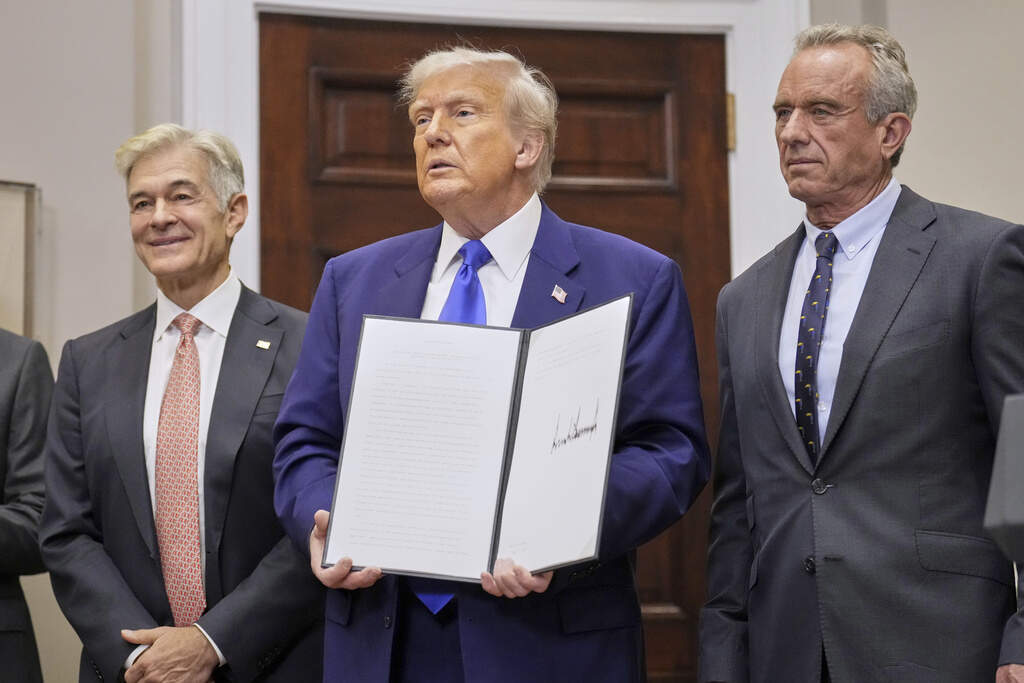
Discounted prices will be offered at TrumpRx – a new direct-to-consumer website launching next year. It's a result of deals President Trump recently cut with pharmaceutical giants like Pfizer and AstraZeneca. But who really benefits?
Guests
Dr. Jerry Avorn, professor of Medicine at Harvard Medical School. Author of Rethinking Medications: Truth, Power and the Drugs You Take.
Sarah Emond, president and chief executive officer at the Institute for Clinical and Economic Review (ICER).
The version of our broadcast available at the top of this page and via podcast apps is a condensed version of the full show. You can listen to the full, unedited broadcast here:
Transcript
Part I
MEGHNA CHAKRABARTI: On September 30th, President Trump made an announcement at the White House that he said was one of the biggest medical announcements that this office has ever made.
DONALD TRUMP: The American consumers have been subsidizing research and development costs for the entire planet.
They put all of that on us, and yet they were the beneficiaries too. So it's being changed as of today.
CHAKRABARTI: The president announced that one of the world's largest pharmaceutical companies had struck a deal with the Trump administration.
TRUMP: Today, Pfizer is committing to offer all of their prescription medications to Medicaid, and it will be at the most favored nation's prices. It's gonna have a huge impact on bringing Medicaid costs down like nothing else.
CHAKRABARTI: Trump announced that Pfizer will be offering medications at discounted prices, to quote the president, between 50% and even 100%. End quote.
Currently, Americans do pay the highest prescription drug prices in the world. In some cases, triple the price paid by people in other countries.
Beyond the broad announcement, though, the details of the Pfizer deal have not been made public yet. So what exact drugs will be offered, to whom exactly and at what discounts is unknown. Pfizer's CEO, Albert Borla, who was at that same White House press conference late last month called the deal, quote, historic.
ALBERT BORLA: The big winner of this deal clearly will be the American patient; there is no doubt about it. They are the ones that will see significant impact in their ability to buy medicines.
CHAKRABARTI: And last week, another major pharmaceutical company, AstraZeneca, also cut a deal with President Trump. Both companies have agreed to sell their prescription drugs on a new U.S. government website called TrumpRx.
It's a direct-to-consumer website launching this January. According to President Trump, as early as next year, Americans could pay lower drug prices.
TRUMP: Now, drug prices are going to be going down 100%, 400%, 600%, 1,000% in some cases.
CHAKRABARTI: To be clear, any consumer end price dropping more than 100% suggests that not only would a consumer pay nothing for the prescription, but maybe perhaps the pharma companies would be paying patients to take the drugs.
It is highly unlikely that this is the case. And that uncertainty around the details of TrumpRx is exactly why we seek to understand as much as we can about the deal. Because two huge companies did in fact come to an agreement with the government after all. So will the realistic parts of the agreement benefit cost burdened Americans?
So we're going to begin today with Dr. Jerry Avorn. He's a professor of medicine at Harvard Medical School and author of Rethinking Medications: Truth, Power, and the Drugs You Take. Dr. Avorn. Welcome back to On Point.
JERRY AVORN: Thank you, Meghna. It's very good to be with you.
CHAKRABARTI: I actually want to start with the recent background for how we got to this deal that Pfizer and AstraZeneca have struck with the Trump administration.
It began, what, this spring in May with an executive order from President Trump that demanded that big pharma lower prices, correct?
AVORN: Let me start out by saying something a little different, which is, it did not begin this year. It began many years ago when we developed all of our policies about what drugs cost.
And I think to understand what's happening we really need to go back and to the question you really opened the segment with, which is, why do Americans pay twice what per capita amounts everybody else in the wealthy industrialized world pays? Because in medicine you need to make a diagnosis before you can think about what's the right treatment. And so I would love to be able to just ask, where did this come from?
Why do Americans pay twice ... per capita amounts everybody else in the wealthy industrialized world pays?
Jerry Avorn
This crazy pricing. And then, because if we want to fix it, it helps to understand where it came from and this problem did not begin in 2025 and we're, I think, not going to fix it if we only think about 2025.
CHAKRABARTI: No. Understood. And in fact, we don't wanna just talk about the symptom, right? We wanna talk about the cause.
AVORN: You got it right.
CHAKRABARTI: So let's go to the cause, the assertion is, first of all, factually, we know Americans do pay more than just about anybody in the country. So what policies do you look to as the as the genesis of that?
AVORN: We got into this problem with up to maybe 20% to 25% of Americans saying they cannot afford to fill the prescriptions that we doctors write for them.
Over a number of years. And without getting into gory detail, we are the only country on earth that says a drug costs whatever its manufacturer wants to charge. And that it's illegal for the government to push back on what those charges are. Until very recently when the last administration introduced a small attempt to negotiate drug prices for a very limited number of drugs in Medicare.
But mostly we're in this fix because we've said, unlike any other marketplace transaction in our economy, the price of something is whatever the seller, i.e. the drug companies, want it to be. And then the government and most of us then have to end up paying whatever they want to charge.
We are the only country on earth that says a drug costs whatever its manufacturer wants to charge.
Jerry Avorn
CHAKRABARTI: Let me put it more bluntly, what you're saying is that the United States is the only country where the single largest purchaser i.e. potential negotiator for drug prices. AKA, the government does not, in fact, do that. So both the government and as a regulatory body doesn't exercise its power in in support of American patients.
AVORN: That is perfectly right. And if nothing else the government buys, does it say the federal government will pay whatever, whoever is selling stuff to the government, whether it is cheese or soybeans or tanks or guns. Those are usually negotiated prices, but drugs are an exception.
CHAKRABARTI: But Dr. Avorn, let me, since you took us here, so I'm going to push back a little bit.
AVORN: Okay.
CHAKRABARTI: Yes. The United States is the exception here, but we also have a for-profit health care system. And under the terms of American capitalism, having the companies that are developing, at least doing the end stage development, and hold the patents on these drugs, charge whatever they want, is, as you said, perfectly in line with how American markets work.
So what's the problem?
AVORN: The problem is that as you said a couple of minutes ago, most drug bills, at least half are paid for by some governmental entity, whether it's the federal government through Medicare or the state governments through Medicaid or the Veterans Administration and its enormous drug benefit program.
So these really are our public dollars and normally there might have been a negotiation that was possible, but actually when the Medicare drug benefit got written into law in the early 2000s, part of that law said, and there cannot be any negotiation, it's illegal to question any of these prices.
And that's unusual.
CHAKRABARTI: Okay. Do you recall? I actually have to say I remember that happened, but I don't remember why. Do you recall why?
AVORN: Yeah. There was an enormous lobbying effort. As we know, the pharmaceutical industry has got either the largest or one of the very largest lobbying presences in the country, which is not surprising.
It's a half a trillion dollar a year industry. And as that landmark negotiation was taking place, such that, because before that, older people on Medicare couldn't afford their drugs. They had their hospital bills and their doctor bills paid, but not their drugs.
So when that was put into place, a congressman named Billy Tauzin set up a program in which not only would the government put in many billions of dollars to pay for drugs. But part of the legislation that he wrote said, and there shall be no negotiation.
And shortly after that bill was passed, he left Congress early and became head of the pharmaceutical industry lobbying organization.
CHAKRABARTI: Sometimes you get a really big golden parachute.
I have to say that we did reach out to pharma, the main lobbying organization for the pharmaceutical industry. They did not agree to join us today, but we put a lot of effort into that. Because I would've liked to ask them a bunch of questions about this deal.
Okay. So we have, first of all, just the basic market economy, market-based economy of the United States. We have this, as you said, deliberate legislative effort in the early 2000s to prevent the government from negotiating drug costs with pharmaceutical companies. These are basically the two biggest factors as to why Americans find themselves in the place that we do, in terms of paying so much.
AVORN: One more factor. ... There's a third piece, which is that law also required that for many of the most important and costly drugs, Medicare had to cover everything. So in another marketplace transaction, one might've said, you get to charge whatever you want, drug company.
But we don't think that it's worth it, so we're just not going to buy it. And this other drugs just like it that we would rather use that seem more cost effective to us here in the government. But part of Medicare's legislation also requires that companies, that Medicare cover drugs in a wide variety of classes such that you can't not pay for it.
And Medicaid, there are similar provisions that Medicaid essentially has to pay for all drugs that are FDA approved. So that takes out the other leg of the stool of any kind of marketplace negotiation.
CHAKRABARTI: Okay, so here's the drug. You have to take it. It's FDA approved, and the government has to pay for the whole thing.
Okay. So that seems --
AVORN: At whatever price the manufacturer seeks to charge.
CHAKRABARTI: So there's no incentive to control prices in that case, is what you're saying.
AVORN: Right.
CHAKRABARTI: Why would you, if you're a pharmaceutical company and you know that you have the nation's largest buyer being mandated to have to pay any price that you set.
There's literally no incentive to cost control. Okay. So those three factors are really important. At the same time, as you noted, we've been having a couple of generations of Americans saying this is untenable, right? And there have been fits and starts in various administrations to do something about it.
We'll get to what the Biden administration did a little later in the show, Dr. Avorn. But now I think it's a good time to just quickly go to President Trump's May executive order. Where he said in the EO that should drug manufacturers fail to offer American consumers the most favored nation, lowest price, my administration will take additional aggressive action.
Now, when that came out, did you think that it would precipitate some change?
AVORN: Yeah. I think we all were very interested in what that was going to result in. And actually, I think President Trump did two very good things for this debate. One is reminding the American public that we do pay about twice per capita what people in other wealthy countries pay.
And I'm not sure that was universally known. So I thank him for raising that to people's consciousness. And the other thing that he has spoken about that I think is also useful is this notion of most favored nation. And by that, of course, he means that if Europeans are being able to get the same drug, made by the same company, in the same factory, for a price that is substantially lower than what Americans pay.
We want to get that price too. And I think that also was useful to just let people know that there are countries, i.e. every other wealthy country, that has figured out a way to get lower drug prices. And if he wants to call it most favor nation, that's fine, but that also I think, help the debate move forward.
Part II
CHAKRABARTI: Let's listen to white House Press Secretary Karoline Leavitt on July 31st announcing that President Trump had sent 17 letters to the world's largest pharma companies, demanding that they lower drug costs for Americans.
And here is the press secretary reading one of the letters President Trump sent.
KAROLINE LEAVITT: (READING LETTER) Most proposals the Trump administration has received to resolve this critical issue, promised more of the same, shifting blame and requesting policy changes that would result in billions of dollars in handouts to industry. Moving forward, the only thing I will accept from drug manufacturers is a commitment that provides American families immediate relief from the vastly inflated drug prices. And an end to the free ride of American Innovation by European and other developed nations.
CHAKRABARTI: So that's the White House Press Secretary on July 31st.
Then, as we mentioned earlier, on September 30th, so just a couple of weeks ago, came that big announcement from President Trump and Pfizer CEO Albert Borla. He stated quite clearly why he made the deal.
BORLA: Tariffs is the most powerful tool to motivate behaviors, Mr. President, and clearly motivated ours, right? (LAUGHS) So by this agreement that we did, we commit to onshore the production of our medicines that are consumed in the U.S. and are made outside the U.S. And for that we are ready to unleash our investment portfolio in this country. And the president graciously gave us a three-year grace period that we will not be subject to the 232 tariffs as long as, of course, we move the products here.
CHAKRABARTI: So tariffs being the motivating factor there. Okay, Dr. Avorn again. As far as the details that we know, which are not complete in terms of what TrumpRx would be. Let's take a look at them. So I have the executive order here in front of me from September 30th. And the first point is that Pfizer agrees to provide every state Medicaid program in the country, quote, access to most favored nation drug prices on Pfizer products, resulting in many millions of dollars in savings and continuing President Trump's historic efforts to strengthen the program for the most vulnerable, end quote.
Okay. So two things there. You mentioned the most favored nation drug price, which is the lowest price paid by a comparable developed country. And then also it's Medicaid here we're talking about, but it also, there's no, it doesn't say specifically all of Pfizer's drugs.
So what do you, how much do you think will actually change here?
AVORN: It is very hard to know, Meghna, because as you pointed out very little actual in the way of details or numbers have been provided about this. So I'm really scratched in my head about President Trump's statement that you played earlier that there will be discounts of 50% to 100%.
And then later he said up to 1,000%. And as you pointed out, you get above 100%, well at 100%, the drugs are all free. And above 100%, as you pointed out, the companies pay you to take the drug. So it's hard with that as a baseline to understand how the numbers are at all going to work. Because the prices that are being discussed are confidential. And in two ways.
One is that what Medicaid pays for drugs is already legislated and has been for decades as having to be the lowest price that any drug company offers to any other payer in the U.S. And they are deep discounts. How deep?
We don't know because it's a secret. And so how that's going to relate to paying what other countries pay, they also keep their prices secret in many national health systems. So it's one secret competing with another secret. And so it's hard to know about that and how you get to over 100% percent discounts, makes me wonder how can anybody proposing that actually know anything about what the prices are gonna be.
CHAKRABARTI: That could just be Trump being Trump and saying whatever comes off, the tip of his tongue. But let me focus on Medicaid here for a second, because it does explicitly say state Medicaid programs. Which mean not Medicare and not people who have private health insurance.
Exactly. Those are the state-run programs of health care for the poor. And one striking fact is that what is really going to impact Americans' abilities to pay for drugs, particularly poor Americans, is that as a result of the One Big Beautiful Bill that passed earlier this year, there are going to be millions of people that are going to be kicked off the Medicaid roles.
And so what drugs would've cost becomes a very small amount in the life of somebody who's lost all their health care coverage because they got kicked off of Medicaid. And as we know, there's also a lot of worry about people not being able to afford their premiums under Obamacare. That's coming to a head, which is why we're having our shutdown at the moment.
So those are, those loom much larger than unknowable numbers about discounts, especially since we know that Medicaid's already getting a great deal on drugs, that just won't help the people who lose their Medicaid coverage. And in fact, their copays are close to zero already. That's because they are poor.
CHAKRABARTI: Yes. That was what I was going to ask. Because I just want to focus on the potential benefits for the tens of millions of Americans who are on Medicaid right now. So on average, they have very low copays to begin with. Yes? Okay.
AVORN: Yeah. Low or zero because by definition they are poor enough to be on Medicaid.
CHAKRABARTI: Okay. So then, but the administration says that there will be a cascade of cost savings to American patients more broadly. I mean, the second part of the EO says today's actions will result in tangible cost savings to American patients and the health care system as a whole. Now, let's give the administration the benefit of the doubt a little.
How would that actually work, if whatever new prices state Medicaid programs would be paying, let's say they are significantly lower than they're paying now. I understand your concern about the secret prices, but imagine with me, how could that then cascade to greater health savings across the health care system as a whole?
Is that possible?
AVORN: If it were the case that Medicaid prices for drugs went even lower than they are, that would be good for the state Medicaid programs, which are under enormous financial pressure at the moment. But I'm not understanding how the cascading would work. Because we have a very compartmentalized system for paying for drugs.
So what Medicaid pays, which as we've said, has always been very low. I don't see how lowering it further, which would be nice for the states, is gonna help people who are getting private health insurance or are in the VA or on Medicare. Those don't generalize or cascade as we've heard.
CHAKRABARTI: But is this possibly where TrumpRx comes in?
Because this is this new, as of what, January 2026, the White House says people will be able to buy, it's a direct-to-consumer website, which will be offering some Pfizer drugs at discounted prices there. It, they say that Eucrisa, it's a topical ointment for atopic dermatitis made by Pfizer.
It will be made available at 80% discounts to patients purchasing directly. So this does seem like a cost savings for people who don't have prescription drug insurance.
AVORN: And again, I think you raise an important point, Meghna. This will only be relevant to people who don't have health insurance, which sadly will be a much bigger number.
[TrumpRx] will only be relevant to people who don't have health insurance, which sadly will be a much bigger number.
Jerry Avorn
This, next year, this time than it is now. But if you've got health insurance of any kind, Medicare, Medicaid, VA, Blue Cross, Blue Shield, United Health, whatever, you will not get a better deal from TrumpRx because you can't use your health insurance on TrumpRx, at least as currently defined.
You've got to be somebody who does not have health insurance that covers drug benefits. Now what about those folks who are going to rise in numbers? Again, it's very hard to know because you go to TrumpRx.gov and as of the moment, what it mostly has is an enormous picture of President Trump and then another picture of an American family walking through the sand toward an American flag.
But we don't yet know, and again, it's fair, this is just early days, but if you contrast that, let's say with Mark Cuban's cost-plus drugs business, which was a real boon, where he just said, let's make drugs available for the lowest price and then charge a dispensing fee in shipping. And he's got real numbers on that website.
And it really does make a difference. And there's other companies like that where you know what you're getting. It's not clear what one is going to get yet just because it doesn't yet exist. But there is this trend, as you mentioned, for there to be direct-to-consumer sales of drugs and a lot of drug companies are doing that.
There is this trend ... for there to be direct-to-consumer sales of drugs.
Jerry Avorn
And we heard from a couple in the last few weeks that they're doing it directly. And it's an attempt, and I think an understandable attempt, to get rid of the middleman, the pharmacy benefit management people who take their piece of flesh off of the drug price and it makes everything more expensive and bypassing them could be a good thing if that's what happens.
CHAKRABARTI: Yeah. Dr. Avorn, let me just jump in here with one more question. And then I want to return to this idea of how do other countries actually get lower drug prices for all of their residents and citizens. But this direct-to-consumer idea, as you just said, is gaining popularity.
I know of many primary care physicians for even their patients who do have health care insurance, they say check out the prices at GoodRx because you actually may get a lower out of pocket cost at a place like GoodRx than you do with your health insurance coverage if you get it from the local pharmacy.
So again, with that example in mind, is it possible, just we don't know the details, but is it possible that even if you had health insurance or have health insurance, that you could go to TrumpRx in January, like you can go to other direct to consumer sites now and find lower prices for you as a patient?
AVORN: Yes, I think that is true. And as you mentioned, GoodRx is already doing a very good job with that and companies are beginning to get into the business of selling things direct to consumer, selling drugs direct to consumers as well. So this is an ongoing trend, and I guess in the spirit of having as open and free a marketplace as possible, it may be a good thing.
But what I worry about as a doctor is that it potentially gets rid of the pharmacist as the kind of learned intermediary that ideally would be involved in filling the prescriptions for all of a person's medications and could say gee, this anticoagulant you're taking is gonna interact with this other drug you're prescribing.
And we don't see as much of that as we'd like, but there still is that common person who's a health care professional in the middle, and I worry if we balkanize the purchasing of drugs where somebody gets their arthritis medicine from TrumpRx and their medicine from migraines from a direct to consumer source and something else because GoodRx has a good deal at a drugstore across town. We've lost that whole idea that you have a learned health care professional helping to manage all of your meds.
Now I recognize that we are in this fix because we have such a Balkanized system. But it's not like Amazon where if you buy your shoes in one site and then you go to another website to buy your pants, there's no great loss of coordination. But I still think medications are a little different.
CHAKRABARTI: Yeah. By the way folks, if you want to understand more about what pharmacy benefit managers are, we did a whole show that sort of went through the flow chart of how those PBMs work. So go to the On Point podcast feed or our website and look for pharmacy benefit managers. You will get an education with that episode.
CHAKRABARTI: Dr. Avorn, hang on here for just a second. Because again, I am keenly interested in understanding what it is that every other developed nation is doing that the United States isn't still quite doing yet. And so to understand that, I want to bring in Sarah Emond into the conversation.
She's president and Chief Executive Officer at the Institute for Clinical and Economic Review. It's also called ICER. It's an independent nonprofit research institute that reviews health care interventions such as prescription drugs, et cetera, in order to measure their value and suggest fair pricing.
Sarah, welcome to On Point.
SARAH EMOND: It's a real pleasure to be here. Thank you.
CHAKRABARTI: So pick a nation that you think is a good example and quickly describe to us what is it that this nation does in order to get that 50, 75% lower cost for people.
EMOND: The biggest thing that other countries do is they purchase drugs.
As a country, right? So they are in many cases a single payer system, or at least all government funded. So they have a reason to be thinking about what they're getting for what they're spending. So in a lot of those countries, they also have a government agency that does something called health technology assessment.
Kind of a nerdy term, but the idea is we can use a set of methods to know how much better this new drug is than what we're already using, and how much we should pay for that health benefit. So a country like England. They have an organization called NICE Quasi-Governmental Agency. Every drug that gets reimbursed by the UK has to go through NICE and get a positive assessment through their health technology assessment body.
And then there's sometimes a negotiation, if there might be a difference of opinion between the country and the manufacturer. But then that's how much that country will pay for access for that drug, for everyone.
CHAKRABARTI: Oh, okay. So the positive assessment then would mean that NICE in the UK had determined that this new drug is more effective than what's currently available, and therefore it's worth it for the British government to pay for it.
EMOND: The underlying math is cost effectiveness. Often. There's other parts of determining the value of a new medicine, social and ethical priorities, contextual considerations. The underlying math says, how much better do patients feel and how much longer do they live if it's a life limiting condition, and how much are we paying for that health gain?
[H]ow much better do patients feel and how much longer do they live if it's a life limiting condition, and how much are we paying for that health gain?
Sarah Emond
And we can scale how much we pay for a health gain in a way that contains costs and keeps things affordable for everyone. Because as we've talked about already today, when we have costs that rise at a very high rate, we have things like people dropping out of health insurance.
CHAKRABARTI: Ah, okay. So the countries are actually saying, this is how much it's going to benefit our people and therefore this is how much we will pay.
EMOND: You got it.
CHAKRABARTI: Ah, so that's how they come at their pricing.
EMOND: That's right.
CHAKRABARTI: Got it. But that also leaves open the possibility that they do not want to pay for a new drug.
EMOND: Absolutely. And so what can happen in some of these countries, because they're making the decision for the entire country, is they decide that the new drug isn't worth it at the price being offered by the manufacturer, and then that country doesn't get access.
That's an important consideration when we think about the differences between our system and other systems. We technically have access to everything here. There's a lot of cost sharing there that can get in the way, but drugs are, there are more drugs available in the U.S. than there are in other countries.
CHAKRABARTI: But what you're saying though is if we take a step back here in the United States, we have a market price for drugs.
EMOND: So I think that one of the reasons I like to refer to it as our hilariously American health care system, right? With all of the different payers doing all sorts of different negotiations and the aspects of our drug pricing market that don't fit a classic economic model, right?
The insurance mandates that were mentioned earlier, the fact there's asymmetric information. The person making the decision on the drug is not the person paying for it. Those are all things that don't help you have a real functioning market, so it's convoluted. And the middlemen, which we talked about, and so that makes it so that it's hard for us to just say, sure, there's a functioning market for price here in the U.S.
The person making the decision on the drug is not the person paying for it. Those are all things that don't help you have a real functioning market.
Sarah Emond
Part III
CHAKRABARTI: Sarah, there's one other sort of big picture way of looking at drug pricing that I want to run by you, because as you said in the last segment, other countries, basically, when they set the prices they're willing to pay, it has to all do with this is the price we think it's worth paying for, the health benefit that this new drug will give the people in that country.
So the thing of value is the health benefit. Now, that is a different value set than every pharmaceutical company has, right? Because the pharmaceutical companies, they're saying that cost doesn't include things like the cost for us, the R&D cost to develop these drugs.
It doesn't include things like the fact that we're publicly traded companies and our shareholders do need some kind of return. It doesn't include any of those. Basically the cost of doing business. At all. So in that case, the pharma companies may brightly say, we have to recoup those costs from somewhere.
EMOND: They do say that, and they also say that they're pricing to value, and so it all becomes part of how they're communicating what they think the price should be. I think there's one area where it makes a lot of sense to talk about the cost of development and recouping costs, and that's in drugs for rare conditions.
That's just math. Sometimes it is going to be the fact that they'll need to charge a higher price in order to get a return on an investment for a small patient population. What we put forth in the math and the way that we do things at ICER is, but you should still be developing drugs that deliver a lot of benefit for patients, and in that case, you can actually command a pretty high price, so that could incentivize the innovation that we want to see.
And so then your R&D investment is worth it because you develop something that patients want, that make them feel better, that help them live longer, and then you can charge a higher price.
The reason we don't think about only R&D costs in this paradigm is that if we incentivized them spending a lot of money on R&D in order to then be able to charge a higher price, wouldn't we be incentivizing them taking a long time and spending a lot of money to develop new drugs? It's not necessarily the way that we want to incentivize the development of new medicines.
We want them to be developed quickly to address urgent public health needs. And so why don't we just reward the companies that are developing drugs, that help patients the most.
CHAKRABARTI: Except again PhRMA, the big lobbying group didn't agree to join us, but I imagine they'd say that drug development is such an uncertain process that hundreds of billions of dollars going to drugs that never even make it to market.
EMOND: And that's absolutely true. I spent a decade in the pharmaceutical industry. I saw it firsthand. There was a high rate of failure. One thing we talk a lot about is there are times when the decision to continue with a particular development program or not could be made earlier.
That's one way you save money on your R&D costs, is if you know earlier on that this drug, you know what? It's gonna be just as good as every other drug that we have on the market. So maybe our R&D dollars are better spent in a different place where there's still a need for patients.
CHAKRABARTI: So Dr. Jerry Avorn, let me come back to you.
And the reason why I wanted to dive into this particular sort of difference is that we've heard it from President Trump repeatedly, and in fact, in that September 30th executive order, there is a bullet point that says the United States has less than 5% of the world's population, yet roughly 75% of global pharmaceutical profits come from American taxpayers.
And here is what was said at the White House Press Conference on September 30th, where Pfizer CEO Albert Borla, similarly to President Trump, the Pfizer CEO also stressed that Americans were paying for drug innovation for the rest of the world.
BORLA: It's an historic day because I think today, we are turning the tide and we are reversing an unfair situation for years. Other rich nations refused to pay the first serve for the medical innovation. As a result, Americans had to assume disproportional cost on their shoulders. This situation we all knew is not sustainable. This situation is a situation that many wanted to change, but no one could. This is changing today with this agreement.
CHAKRABARTI: Dr. Avorn. This is feeling like we're in bizarro land right now. Because I cannot imagine a pharmacy CEO having said anything like this until forced to by President Trump. Because Borla's saying ... quote, the situation we all knew is not sustainable. They certainly behaved like it was totally sustainable until this year.
How do you read this moment?
AVORN: A couple of important points. One is that neither Sarah nor I wants to penalize or bankrupt the pharmaceutical industry. They're an important piece of the health care system and they ought to be rewarded. Even generously when they actually discover an important new drug.
And we want to encourage and not discourage that. On the other hand, work in our group at Harvard from Dr. Kesselheim and his colleagues has shown that if you look at the cost of drugs and compare it to the determination of whether those drugs are really better than what we had before, there's a remarkable mismatch between what the drugs cost and whether they really add anything new.
There's a paper address this month from our colleagues at Yale that found the same thing. So the high price and medical advantage not only are not highly correlated, they're often utterly unrelated. So that's one point. The other is we need to keep remembering that the source of innovation for new drugs often starts and goes quite far at the National Institute of Health.
Yes. And so if we're worried about drug innovation and where the new [drugs are] going to come from, maybe it would be a good idea for us not to slash NIH funding, because that is really the wellspring of a lot of drug discovery. And just the last point quickly in terms of whether this agreement with Pfizer the other day is really the administration getting tough and really sticking it to the drug companies and making them come to heel.
Pfizer's stock price went up by about 10% in the two trading days after that announcement at the White House. So clearly the market and some very smart people who understand the economics of this much better than I do. Looked at the deal and said, this is not going to hurt Pfizer. And in fact, drug companies, stocks are up since this whole approach has come forward.
If we're worried about drug innovation and where the new [drugs are] going to come from, maybe it would be a good idea for us not to slash NIH funding.
Jerry Avorn
So this is not going to hurt the drug companies.
CHAKRABARTI: I'm imagining that it's possible that a lot of those traders were like, thank God Pfizer gets a three year reprieve from tariffs. Which would definitely influence the share price. But let me just get straight down to a question which I should have asked both of you earlier.
Do you agree or not? This assertion that American patients are subsidizing lower drug costs in other countries. And even the White House says subsidizing foreign drug manufacturer profits by the high prices we pay here. Dr. Avorn.
AVORN: I was gonna have Sarah take that on.
CHAKRABARTI: No. No, you're right, Sarah, you go first.
EMOND: I'm happy to go first. The answer is it's really hard to know what would happen in a different hypothesis. So if we were pricing drugs to value here, meaning that probably about 75% of the time we would be having prices lower than what's picked by the manufacturer to tie it to how much it's helping patients, would that mean they would be not as willing to accept lower prices in other countries.
Because they'd want higher prices in other countries to balance the revenue, right? That's theoretically possible, but these are companies that are willingly signing contracts with these countries to offer those prices that they're offering now.
So they're a party to that negotiation and to that decision. To say that they've been ripping off Americans by getting lower prices, really misses the fact that we've missed an opportunity as a country to do this type of analysis ourselves. And so instead of using their social priorities, their financial considerations, we could be doing that here. And in some cases, it would mean higher prices than are charged in other countries.
CHAKRABARTI: So you mean not using the most favored nation pricing that the White House is saying, like picking the lowest price that an OECD country is paying and using that here. You want us to do our own analysis.
EMOND: I'd love it if we were doing it reflective of our, again, hilariously American system. The way that we think about financial considerations, the way that we think about social values, most of our math shows that it would be higher prices here than in other countries because we're a wealthier nation. So why don't --
CHAKRABARTI: And an unhealthier one also.
EMOND: And an unhealthier one too, and there's some connection there.
CHAKRABARTI: Yeah. No but --
AVORN: And less wise, just to finish the triad of healthy, wealthy, and wise, we are not doing great on any of those fronts right now.
CHAKRABARTI: But Sarah, you're making an important point that the White House has made some changes here, but they're not going as far as they could in terms of instituting what Dr. Avorn said, we don't have in the beginning, which is the government doing its own analysis about the actual value for Americans of drugs and therefore creating a willingness to pay on that.
EMOND: And what I would put forth as a policy option, again, to reflect the system that we have, because we can't just burn it to the ground and start over, at least not this week. Is we could actually start having voluntary commitment to independent assessment of value as a way to deescalate this arms race.
And so it would be outside of this most favored nation approach, it would be, and we've had companies do this. Pick the price at ICER or another independent group says is fair. Put pressure on the health care system, meaning payers and PBMs to make sure patients are getting access at a very low-cost share.
That's a way that you can continue to drive innovation and have higher prices than you might get in other countries and have a more affordable system.
CHAKRABARTI: Okay, so Dr. Avorn, actually two questions for you. First of all, I just would love to hear your take on the US. patients subsidizing the rest of the world.
... Go ahead and give, tell me what you think about that.
AVORN: Sure. Okay. And again, the most important way the U.S. has been doing that subsidization has been by funding the best biomedical research in the world through the National Institute of Health. And when we talk about what Americans are paying for. We're paying for that, and we should be very proud that we've been paying for it, and we should be very scared that we're not gonna be paying for it. That's one piece.
Secondly, companies, yeah, companies should be able to do well by doing the right thing. We just don't feel that there ought to be prices that are so high that patients can't afford to take their medications.
CHAKRABARTI: So once again, getting to the lack of detail in terms of how TrumpRx and the deals with Pfizer and AstraZeneca are going to actually roll out. We don't know if it's going to be all Pfizer drugs. We don't know if it's going to be some of them. We don't know how the pricing is going to, we just don't know.
But again, just with that in mind, Sarah brought up an important point. I just want to get your response to it really quickly, Dr. Avorn, and that is presuming that the pharmaceutical companies want to continue to make in the same ballpark of money that they have been. Do you think that they're going to go to other countries now and say, actually in our negotiations, we're not willing to pay, we're not willing to sell at the price that you want UK Health Service anymore.
AVORN: The best way to incentivize companies to continue to innovate and be rewarded for doing so is paradoxically the opposite of what we've been doing, which is a category I talk about a bit in the book. Is Drugs for muscular dystrophy. If you lower the bar and you pay for drugs made by a local biotech firm here in Boston, that don't hardly work at all. You then actually disincentivize innovation and the creation of better drugs, because it's open season. We'll get the FDA to say this drug is acceptable in muscular dystrophy, it does not help patients. But you then set the field going backward and set it forward.
So I like Sarah's thought about the way we can look at how much does this bring to the patient's benefit and pay generously for it. But at the same time, the way we can do that is to not pay generously for drugs that are just same old, and yet are still coming in at a very high price.
CHAKRABARTI: Okay. Sarah, I'm gonna, we have just about a minute and a half left. I wanna give you the last word here because as Dr. Avorn mentioned earlier, in the Biden administration, we did have a move to allow Medicare. Huge drug buyer, to negotiate some prices for, it started with a group of 10 drugs, and I think after that it's another 15 that may come down the pike.
That was a huge change, especially given the history that Dr. Avorn told us about, and now we have, TrumpRx and these deals with two specific pharmaceutical companies. That's something, these two things together are actually quite different than the past 25 years of medicine, of pharmaceutical drug pricing that we've had in this country.
Are we in a situation where we shouldn't let the perfect be the enemy of the good and just use this as another moment to build upon some kind of momentum to bring about the reforms that you're talking about in how much Americans pay.
EMOND: That is an entirely optimistic and welcome way to be thinking about this.
And I think all of us who've been working in this space for a long time, these are watershed moments to, as you pointed out in the show, the statements coming from pharmaceutical CEOs, the advent of more direct to consumer, which does help a patient population, it's not going to solve everything.
And then having a conversation about, should Medicare negotiate, what kind of prices should Medicaid pay? I think it opens up the opportunity for us to be having even more conversations about policy options that center affordable patient access.
So yes, I think there's a way to look at this as a positive for a continued conversation about how we can have a health policy system that helps patients.
The first draft of this transcript was created by Descript, an AI transcription tool. An On Point producer then thoroughly reviewed, corrected, and reformatted the transcript before publication. The use of this AI tool creates the capacity to provide these transcripts.
This program aired on October 16, 2025.