Support WBUR
Can math equations solve inequality?
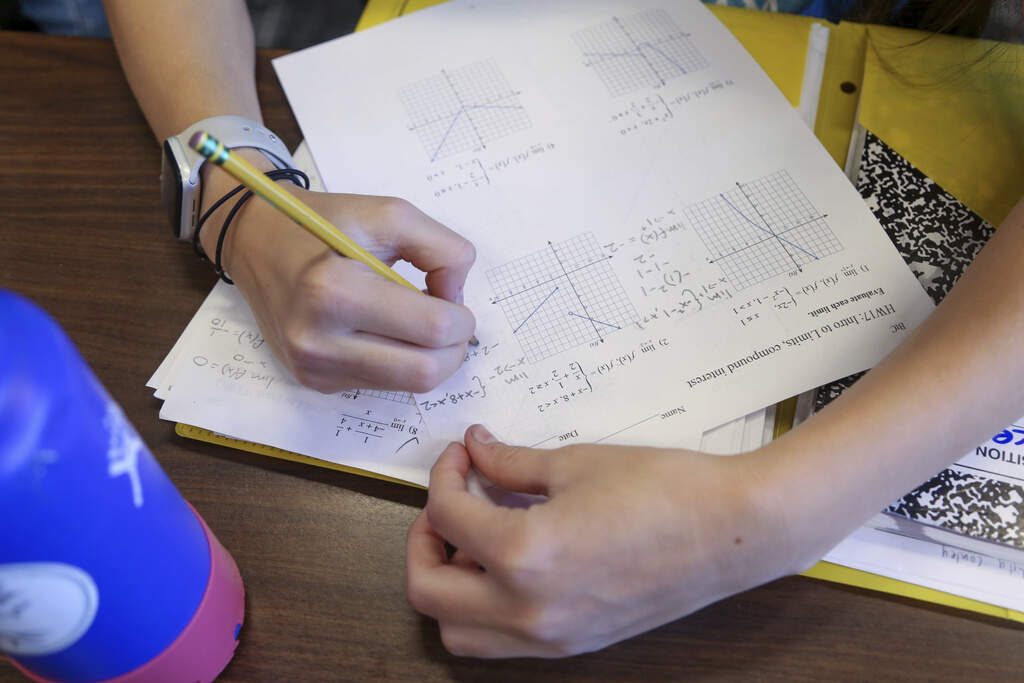
Mathematician Eugenia Cheng wants us to rethink our relationship to math — and equality. We hear how different paths lead to identical outcomes in math, and how that can help us all in real life.
Guests
Eugenia Cheng, mathematician. Scientist-in-residence at the School of the Art Institute of Chicago. Her most recent book is "Unequal: The mathematics of when things do and don't add up."
The version of our broadcast available at the top of this page and via podcast apps is a condensed version of the full show. You can listen to the full, unedited broadcast here:
Transcript
Part I
MEGHNA CHAKRABARTI: Eugenia Cheng already loved math by the time she was in kindergarten, she went on to specialize in math, in category theory specifically, and she earned a tenured position teaching math in England. But then she had a change of heart. She now teaches math to budding artists at the School of the Art Institute of Chicago and writes books to help non-mathematically inclined people understand how math fits into their everyday lives.
She's out now with a new book. It's called "Unequal: The mathematics of when things do and don't add up." Eugenia Cheng, welcome back to On Point.
EUGENIA CHENG: Hi. Thank you so much for having me.
CHAKRABARTI: Let me first ask you let's go straight into some of the math and then we'll talk more about your own mathematical history.
CHENG: Okay.
CHAKRABARTI: So things being unequal, 1 equals 1. Fairly straightforward, yes or no?
CHENG: Pretty straightforward. Yes.
CHAKRABARTI: Okay. So we'll increase the complexity a little bit. ... So is like 2 + 3 equal to 3 + 2?
CHENG: 2 + 3 says, I'm going to take two things and then I'm going to take three things. And 3 + 2 says, I'm going to take three things and then I'm going to take two things.
And you may be so used to the fact that just equals 5, that you haven't noticed anymore, that those were two different processes. And if you've ever helped small children learn how to add things up. And I love helping small children with things. Then it takes them a while to understand that is definitely going to produce the same total number of things, because there really is something different going on.
It's a different journey, a different process that happens to lead to the same outcome.
CHAKRABARTI: What are the different journeys, then, for 2 + 3 = 3 + 2?
CHENG: One way of thinking about it, which is often how we explain it to small children, is if you line up two things, say two blue blocks and then two red blocks. Then the blue ones may be on the left and the red ones are on the right, showing 2 + 3. But if you actually walk around to the other side, then you can see that none of the blocks disappear. But now they've switched sides so that the three are on the left and the two are on the right.
And I love thinking about it like this because you are literally changing your point of view on a situation. And actually, equations in math are all about changing our point of view from one side to the other.
Equations in math are all about changing our point of view from one side to the other.
CHAKRABARTI: Okay, this is fascinating. Suddenly it occurred to me that is part of our default notion of how to just even read 2 + 3.
Does it come from the fact that in the English language, we learn reading from left to right? And I just wonder if the default starting point for people whose native tongues or native written language is from right to left, do they start, do they like, look at a mathematical equation and read it in the opposite direction of English speakers?
CHENG: That's a really good question. And do you know, I don't know if they do, but I would imagine that they do. I don't know if math is written that way around for languages that read from right to left. Yeah, that's a great question.
CHAKRABARTI: Oh just, it just occurred to me. Because I thought about the relationship between language and math.
But, okay, so let's increase the complexity ever so slightly. Because actually I think in terms of teaching my own kiddos basic mathematics, it really came home to me when learning multiplication, right? So because 4x2, when you draw it out in pictorial form is actually different than 2x4.
But we don't think about that as adults.
CHENG: And when you say it really is different. Do you mean that 4x2 is you put two things and then you put another two things? And do you make a kind of grid so that you've got four rows of two, whereas when you do 2x4, you do four things and then four things.
So you've got two rows of four. And again. You can just change your point of view on that, because if you rotate yourself, walk around to the other side, not all the way around to the other side, but just to see it as the rows switch, the rows and the columns around, then they do look the same.
They're just rotations of each other. So again, we've changed our point of view.
CHAKRABARTI: In our case, we used Legos. (LAUGHS) And I would put out group, so for 4x2, what I'd do is I'd do one group of four red Legos, for example. And one group of blue Legos. And then I was like how much is that?
At first, both of my kids were like there are two groups of four. And then on the other side of the equation, I'd put out four groups essentially of two Legos in different colors. And when I saw that, ah yeah. Do you see it? So they actually continued to see it as different groupings rather than just jumping to the sum of these groups on either side is the same.
CHENG: Right. Yeah. And that is very profound. And actually, when we teach children to see them as the same, we're almost moving them away from a more profound point of view, because in abstract math, we start by saying, okay, those really are different. There is some sense in which we can match them up with each other.
We can make a kind of, we can pair up the things on the left with the things on the right in such a way that each, one thing on the left is paired up with one thing on the right. But they really did start off being different. And when we teach equations, we tend to focus on the aspect that is the same.
And just forget about the aspect that was different, but I think it's really important that they're different and the same at the same time. Because everything is apart from 1=1. And 1=1 is completely useless. And so anytime we are talking about equality, and this is really important in life as well, when we're talking about equality between people or equality between situations or whatever, that we're not really talking about things being the same.
We are talking about things that are different, but yet we have it in us to see them as the same in some way.
CHAKRABARTI: Ultimately for my kids they really understood the end point sameness when we would just mix up the groups of Legos and they would see two similar piles on each side, but then that eliminated, as you said, the actual profound difference between what was happening on either side of the equation sign.
You might have just answered my next question, which is why does this matter for 99.99% of people who really the utility of math in their daily lives is just knowing that 4x2 is equal to 2x4.
CHENG: I'm very interested by your word utility because utility is one aspect of math that is really pushed. We're supposed to learn math because it's really useful. But I think that there are different kinds of usefulness. There is the direct utility where we very directly use something, a technique specifically to solve a specific problem.
Oh, how many more apples do I need if I'm making a recipe that requires 10 apples and I've only got six. But there's something much more interesting to me, which is the usefulness of training our brains, because we use our brains all the time for all sorts of things. But if we've trained them to work really well, deeply, then whatever we've trained might not be a direct use of the math that we have trained it to do.
But our brain has become generally stronger and more flexible, that kind of strength enables us to change our point of view, but see things as the same, at the same time as different. And it's that training that I think is much more interesting. It's not when am I the kind, when am I ever going to use this in my real life? But it's about general mental strength and mental training. And that's why I think these techniques in this point of view is relevant to everybody.
CHAKRABARTI: Okay. So we're going to talk about that more a little bit later in the show.
But you have early in the book, you have a delightful example of the kind of thinking that you're presenting here and it's very early, and you give an example of how you once tried to learn Russian.
CHENG: Oh yeah.
CHAKRABARTI: Can you talk about that?
CHENG: (LAUGHS) I did once try to learn Russian. I'm also a musician and I love Russian music.
There are loads of gorgeous Russian operas and Russian songs, and so I wanted to learn Russian so that I could understand those songs. And the poetry directly, rather than having to read it in translation all the time. And I had this teacher who was so determined that I should pronounce everything exactly correctly. And I got completely stuck because there's the letter and I think it's something like [noise sound].
And I just couldn't get it right. So I know I didn't get it right then, but she would make me repeat it over and over again. And sometimes she'd go, yes, that's right. And sometimes she'd go, no, that's wrong. And I couldn't tell the difference between them. And so when I did it, I couldn't tell what I had done differently from when I did it wrong.
And so I just got very disheartened and gave up, because I couldn't hear any differences, and she could hear those differences. And it's often the case when you're learning another language that there is some subtlety that we don't count as different in our own language, but in that language, it makes a really big difference.
And so we're seeing things as the same that somebody else is seeing as different. And that's one of the hard things about learning the sounds of other languages.
CHAKRABARTI: So true. My mother speaks a kind of minor language. Her native tongue is a minor language from India. It's called Konkani. And my father couldn't even speak it because it has so much tonality in it.
So what I tried to learn a little bit I had this exact same experience. Like I would try to say one half of a syllable, for example. And my mom would be like, no, that's not right. Try it. Move your tongue in this place in your mouth. And I'd try again. And she'd be like, you literally said the same thing as before.
It didn't change it at all. And you know what that got me thinking about was that, is the problem there that learning in adulthood, this is going a little bit away from mathematics or maybe it's not. We have certain presumptions or limits in our ability to understand differences within similarities, or is it that just like physically we're incapable of learning more tonally complex languages?
I would like to say it's not that we're physically incapable, and I also don't want to call it a limitation. Because I think what it is that as we grow up, we develop the skill of seeing past differences and accepting differences as part of sameness.
If you offer a child a treat and you take them and you say they can have a cookie, and they may point at one specific cookie in the display, and they want that exact cookie. And if you give them the other one that to you looks exactly the same, then they may get very upset because that was the exact chocolate chip cookie, not that other chocolate chip cookie.
And then we grow up and we think all of the pile of chocolate chip cookies is more or less the same. It doesn't matter. And so part of becoming an adult, I think, is accepting those differences. And so when we learn a language as a child, then we are maybe more attuned to all the differences. And then we accept differences as being the same.
So then we have to relearn that if we are learning a different language. And that's tricky.
Part II
CHAKRABARTI: Eugenia, if you don't mind, I'd like to broaden out this discussion of what constitutes different paths towards inequality in the world that you are teaching in.
Which is art. And one of the things that, it occurred to me actually over the break was that artists themselves are masters of perspective, right? Like their whole reason to be is like to figure out what new perspective to bring to an issue, to a subject, to even just a simple object.
Is that similar to what you're saying regarding equality in mathematics? That one particular outcome, depending on your perspective, can be seen in an infinite number of different ways.
CHENG: Yeah, I think so. And it's all about what you are choosing to focus on in that moment. And we're not saying that the rest of it isn't there.
We're saying what aspects do we really care about right now? And those are the ones that we are going to focus on, and the rest of it doesn't matter that much. And so if we are just counting things, then we're saying all we care about is how many there are. We don't really care about what shape they are.
So in that moment, if something is round or square, and perhaps if you're using Legos, you try to use ones that are all the same shape in order to focus on the number. But if you run out of ones that are set the same shape, you can use one that's a different shape and the counting will still come out the same.
But then if you're talking about shape, then of course suddenly shape becomes important again. And then those things don't count as the same anymore. And yes, I think that it is very much relevant to artists and how artists pick something to focus on that don't focus on the other things, just for that particular moment.
CHAKRABARTI: Yeah. I want, I was wondering if you've ever done an experiment with your students and picked up, let's say, two different drawings of a simple cube, but one is drawn in two-point perspective, another one's drawn in three-point perspective. And maybe you could throw in a third one that's just completely two dimensional. And told them, what if I told you all these three things were equal?
What kind of response would you think you'd get from your students?
CHENG: I think it depends when during the semester I did it. Because I think by the end of the semester they've pretty much got used to the idea that I am asking them to see things as the same and different at the same time, and they pick it up pretty quickly. Because actually the students I have at the School of the Art Institute were never really comfortable with math having these very rigid right and wrong answers.
And that's one of the reasons they were put off it, because they weren't interested in things that had right and wrong answers.
Sometimes people find it very reassuring and I accept that. But my art students are interested in things that are ambiguous or that have gray areas and nuances or that have different possible, as you say, perspectives where they can think about different ways of looking at it. And so they find it exciting often when I say, 'Actually there are lots of different points of view on this. And let's talk about all of them.' I'm not going to legislate which one is correct. I want to hear all of them.
My art students are interested in things that are ambiguous. ... And so they find it exciting often when I say, 'Actually there are lots of different points of view on [math].'
CHAKRABARTI: Okay, so let's clarify something you're not saying though, that, to go back to our original example, that 4x2 is not equal to 2x4.
There is an answer. They are actually equal.
No?
CHENG: It depends. It depends. It depends what context you are in. And so if you are in the world of ordinary numbers, then those outcomes are the same. Yes. If you are in a world of say, music, then those things aren't the same. Because 4x2 is 1, 2, 1, 2, 1, 2, 1, 2, and 2x4 is 1, 2, 3, 4, 1, 2, 3, 4.
It's a bit more obvious if you're doing 2x3 equals 3x2. And those are different as rhythms. Now that is a completely different example, but my research is in a higher dimensional part of mathematics where those things don't count as actually equal, because we really care about the processes involved and not just the end points.
So it really does depend on the context that you are in.
CHAKRABARTI: So let's go back to music for a second. Because the example you just gave was absolutely beautiful. Music in a sense, even broadly, encapsulates exactly this unequal equality, right? Because just at the sheer paper level, when you're looking at a piano piece, for example, everyone's looking at the same notes.
But the outcome can be extraordinarily different, even if they're all playing the same notes.
CHENG: Yes. Yeah, and I think that gets a little bit lost because I know that there are some people who think that Western classical music is boring because everyone's playing the same notes. And so from that point of view, someone is only seeing the notes.
Not registering the differences in performance, whereas I think that the differences in performance are really profound. But if you're not listening out for them, just like in language, if you're not listening out for tonal sounds in languages, then things will sound the same to you. That sound different to somebody else.
And so somebody who is not listening out for differences in interpretation will only hear the same notes and will not hear the differences in performance.
CHAKRABARTI: There are many people listening right now who would object to what you're saying. And there's been a debate going on in at least the popular discussion of equality and mathematics that I've been able to track down that just pushes right back and says, no mathematics is still rules based. And that when we talk about interpretation, we're actually stretching out beyond what mathematics actually is and making it, I don't know, fuzzy, politically correct. You've heard these criticisms?
CHENG: Yes, I have. But none of them come from mathematicians. Not that I've seen anyway. Because mathematicians all know that math is not contextless, and that every mathematical world, yes, it is rule based, but it's rules in a context.
So each mathematical world has its own rules, and the outcomes are only true inside that world where those rules hold. Inside another world, there are different rules, and then different rules can hold. It's just that the one that we are most used to, because it's everywhere around us, is the world of ordinary numbers.
Each mathematical world has its own rules, and the outcomes are only true inside that world where those rules hold.
But there are worlds of numbers in which different things hold. For example. When we just tell the time we on a 12 hour clock, say, then if we add one to 12 o'clock, we don't call it 13 o'clock, unless we're doing military time or in French, they definitely say 13 o'clock. But then we get different answers.
So for example, 11=two at that point is one. And that is a part of mathematics that is called modular arithmetic. Where the numbers don't just go in a straight line. They go round and round in circles, and that is a totally valid, perfectly valid branch of mathematics.
CHAKRABARTI: That is so fascinating. My brain, I'm still like, they're just the same thing.
13 and one are the same. But how did you come to be teaching artists Eugenia?
CHENG: I love teaching artists and what happened is I had this tenured job in the UK, and I was not happy. The short story is I wasn't happy. I didn't feel like I was making a good contribution to society. Because I was teaching people who already liked math, and I honestly was also feeling bullied in my department. I felt that people were either being sexist or racist or ageist or maybe all three things, and I didn't really want to hang around to find out. And so I thought, what can I do to make a better contribution? And I wanted to reach out to people who've been put off math in the past.
Because I think it's such a shame that so many people are put off it for bad reasons. And so I came back to Chicago where I had previously been a postdoc and love, I loved it in Chicago. I always wanted to come back. It seemed like a place with such great possibilities for making things up. I didn't want to do things the old ways.
I always want to make things up and try and do things better, not just differently for their own sake, but try and improve. And so I came back to Chicago, and I taught for a year at the University of Chicago. And then it was just a fluke. This job came up at the School of the Art Institute, and I had no idea that they did math there.
A lot of people have no idea they do math there, but it's a liberal arts school, so they do some of everything and it was only a one semester job and I thought, wow, this sounds like my dream job. I thought, teaching math to art students sounds like my dream job. And so I became a scientist in residence there for one semester.
It was supposed to be one semester, and I thought I have one semester to make them never want me to leave. And that was 10 years ago. So that worked.
CHAKRABARTI: The Art Institute of Chicago is a truly remarkable place. I will never forget the first time I've walked in there and was looking around.
I turned a corner. And there on the far wall was Hopper's Nighthawks. And it just took my breath away. I'd never seen it like in physical reality. And that particular painting seems really appropriate to bring up in this context because when you look at it, it's full, now that I think about it, it's full of mathematics.
It's just beautiful choices in perspective and color and warmth against coolness and the gradients between those. It's just brilliant. But the other thing I was going to ask you is, do your students start telling you after a while that not just like they see math in art, but their attitudes about mathematics start changing or they see the relevance of it in other parts of their lives?
CHENG: Yes, they do. And they often tell me about something that they have taken from class and used to do something in their own art practice, and I absolutely love it when they tell me that. And one of my favorites was after I had talked to my students about all the other things that 1 + 1 could equal under different circumstances.
And yes, I know that makes a lot of people cross. Because they really want 1+1 to just equal two. But we were talking about the fact that 1+1 can be 1 under some circumstances. If you mix a color of paint with one color of paint, then you get one color of paint, you don't get two colors of paint.
And sometimes people say, that doesn't count. And I think I say, you know what? That's a valid point of view, but it's not the point of view that abstract math takes. Math says, okay, this is a situation, let's investigate it. And one of my students went away and made a stained-glass window of 1 + 1 = 1. Using all sorts of different color overlaps of stained glass to produce other colors.
And I loved it. I thought it was great.
CHAKRABARTI: Wow. I'd actually never thought about that. In terms of combining 2=1. Can we go back to one thing that you said about your time academically in the UK. Would you care to say where that was in particular?
CHENG: It was it the University of Sheffield?
CHAKRABARTI: It was at Sheffield. Okay. Because you said some things about how you felt like you were treated within your department. That it was sexist. You felt it was sexist, racist, ageist. And I'm wondering, that's not specific to mathematics, of course. But I had always also, let's start with the ageist part.
I'd been under the impression that it's commonly held that, I don't know, by the time you're 40, if you're in the world of mathematics you should have done your best work by then. Is that right or wrong?
CHENG: It depends who you talk to. The Fields Medal, which is the big prize that is sometimes called, it's something like the Nobel Prize in mathematics.
There's an age cutoff at 40, and I don't think that makes much sense because if you think people do their best work before 40, then you don't need to impose an age cutoff. Then everyone who does great work will be under 40. But there are plenty of mathematicians who keep doing really spectacular work.
Way into their retirement. And I think that the idea that math is a young person's thing comes from an old idea that it's about making giant leaps and solving huge problems that you need tons of stamina to work on. Because you're going to sit in a room by yourself in the dark and not talk to anyone for 10 years.
And that's ridiculous. It makes for interesting movies and it captures the imagination. And it also reassures people that to do math, you have to be a real weirdo and that therefore, the reason that everyone else can rest assured that at least they're not a weirdo. And I don't like that point of view at all because you don't have to be a weirdo to do math.
But if we keep portraying it like that, then everyone who thinks that they have a social life and friends, they'll think, oh, I'm not cut out to be a mathematician. Because to be a mathematician, you have to be weird. But actually, there are plenty of very nice people who are very well socially adjusted, who keep doing lovely, wonderful mathematics and they have such a vast knowledge from their years of working in it. That they can see connections between things that other people can't see because of their vast experience.
So they keep doing it until their seventies, eighties, even nineties.
CHAKRABARTI: Talk about the racism for a moment. Because I had hoped that math would be one discipline, at least, that by definition would transcend issues of racism. Because we write in Arabic numerals, right? The concept of zero comes from ancient India.
There's just this transcultural aspect of the development of modern mathematics. And also just, again, I'm idealizing this, but just the purity of numbers. They don't have anything to do with skin color. That's what I would hope a math department would be like.
CHENG: Yeah, I know. It's a shame, isn't it?
So I will stress that I think in my research it's been very different. And that when you write a paper, there are still things that come in. Like I think that sometimes I really think that my papers have been refereed much more stringently because of who I am. But the thing is that math is still done by humans, and when you are a tenured professor in a department, the running of the department is a very human activity.
That isn't math. And that's where I ran into all the problems. At meetings, during discussions, just in the general day-to-day life, the kind of side comments that people would make towards me, it wasn't about numbers. My research isn't about numbers anyway.
But people also did attack my research and I can't prove, of course, one of the problems with indirect or structural biases, you can't prove. It's not like people said to me, I think your research is terrible because you are a woman. They would just be very rude about it, very dismissive, be very rude about every idea that I ever had and when I was starting out. I think a lot of young women have this, that they think, oh I'm just young. I'm inexperienced, I'm very junior.
And then you hang around for a few years, and you realize that you're not getting any more respect, even though you're now more senior and that actually the new people who come after you. So when I realized it is when there were younger, maler, whiter, new professors who got way more respect than I did and who did that thing where they proposed an idea that I had already proposed and they got celebrated for it.
Whereas I got squashed down for it and I thought, huh, maybe it is some kind of prejudice against me. And of course I can't prove it.
And so I didn't want to prove it, so I left.
CHAKRABARTI: I can't prove it either, but right now my intuition says there's a lot of nodding heads. Listening to what you just said, Eugenia. And also, quite frankly, in any environment, but especially in an academic environment, the isms are so stupid to me.
They are so profoundly stupid because the goal is to enhance the sum of human knowledge. And to just dismiss someone for these superficial reasons. It's just dumb.
Part III
CHAKRABARTI: How old were you when you first realized you were in love with math and how did you fall in love with it?
CHENG: I definitely remember already loving math when I was five and first went to kindergarten and my mother is mathematical and so she talked to me about fun math things all around us all the time at home, and it wasn't, Do your time tables. It was, I can't even remember what it was exactly. She told me about, but she definitely talked about patterns and shapes and logic, and she taught me things like ways, the way you can add up the numbers one to 10 without having to sit there and add up the numbers one to 10.
And she told me about how you can draw the graph of something. And I thought it was so amazing that you could turn numbers into a picture. And my head, my brain felt like it was exploding out of its skull, and I loved that feeling and my mother worked in a very male dominated environment in those days. And I thought it was just great that she was the only woman going to work on the train with all these men, and I wanted to be like her. And I think that is one of the things that made me love math before I even got to school.
CHAKRABARTI: You say was, regarding your mother, is she still alive?
CHENG: Oh, yeah, but she's retired.
CHAKRABARTI: Okay. Good. Yeah. But so she's seen the development of your mathematical passion and your career. I'm wondering what does she think about that? Do you know?
CHENG: Yes. I hope she doesn't mind me saying, I think that she is quite excited about it. Because she was set to do a PhD herself when she finished university, but then she didn't go because it was back in those days. And my father's career took precedence and so she gave up on the PhD and worked to fund him through medical school instead. So she went to get a job so that he could go to medical school. Because his family didn't have the money to pay for it. And she always hoped that maybe one of her children would do a PhD, as she hadn't.
But she didn't tell me that until I got my PhD. And it actually makes me tear up a little bit when I think about it. Because she didn't want to put pressure on us to, she didn't want us to feel that we had to live out her dreams that she hadn't lived out. So she told me this when I graduated.
CHAKRABARTI: Wow. But clearly, she's a fantastic mother. Because just the example of her own life provided you with all the motivation that you needed.
CHENG: Yeah. Yeah.
CHAKRABARTI: So I would actually like to take the last chunk of the show, Eugenia, to talk about what I think is fair to interpret as a mathematical educational crisis in this country. And you are the person I want to talk to about it. Because obviously ... you're a mathematician, but you are teaching students as well.
So here's why I want to bring it up. And that is, it's been very well reported that in the most recent National Assessment of Educational Progress. The quote-unquote nation's report card that's come out, math scores in this country, are reaching like an all-time low. The 2024 NAEP scores for 12th graders dropped to the lowest level ever.
Now we can debate a lot about why that is. COVID, et cetera, et cetera. But I am actually most disturbed, not so much that they're the lowest score ever, but that kinds of problems that students were unable to solve. Okay. So let me give you an example. From one of the high school tests recently, there was a problem, and it was, it provided basically a replica of a receipt, a restaurant receipt. And on one side, it said burger, fries, soda, what have you. And then on the right side there were the prices or the cost of each of those restaurant items.
And the question was, sum up or add up the total cost of this restaurant bill and find out what a 20% tip, how much that would be. 75% of the high schoolers who were faced with that question could not answer it correctly.
CHENG: That doesn't surprise me at all.
CHAKRABARTI: It's very shocking to me.
And maybe it's just because I didn't realize how far back mathematical education had dropped in this country. But, first of all, you are not surprised by that. Tell me why.
CHENG: Because percentages absolutely baffle people. That's why I'm not surprised. I've seen it so often and also because of the quantity of times when I go out to dinner with friends and they all say, you work out the tip.
You are a mathematician.
CHAKRABARTI: Really? Yes. Because, to me, maybe it's because I came from a scientific family and my undergraduate, et cetera, was all in the sciences. But at the same time, what is going wrong in schools when you don't even have to understand the why. I know we want that to happen in education, but you don't have to understand the why.
In doing a simple 20% calculation, like all you have to know is move the decimal point over one space to the left and multiply what you get by two. I have to say, I'm really disturbed that students can't even do that.
CHENG: I think what's going on is that if you don't understand the why, then you remember there's a rule.
And then if you don't remember the rule, then you're really stuck. And then all you know is that there's some rule that you are supposed to know and you're fishing around in your brain for rules. And you don't know which one it is. And so for example, sometimes when I'm doing things with my students, we're not doing arithmetic, but we're just, we are drawing something that involves relationships between numbers and they get to a point where they need to do 1 x -1. And some of them freeze.
Now I think if you understand what one means, then one of anything is just it. But I think what's happening with them is that they remember there's some rule about negatives and that they remember getting completely confused by it at some point in their past, and they can't remember that rule and so they can't do it.
And this makes me really sad. Because I think this is what happens when math is taught by rules rather than understanding. And teaching by understanding is definitely slower, but it lasts longer. So if you achieve the result faster, but then it immediately exits a student's head as soon as they leave the room, then you haven't actually achieved something faster.
You've achieved something quickly that then disappears. Whereas if you take a bit more time to get some understanding through, then it is slower, but then it lasts longer and I think that's a much better outcome.
CHAKRABARTI: Okay. So let's get to then, how would you teach a couple of concepts?
Because the 1 x -1, I think the first stumbling block is how to teach a student what -1 actually means. Because it's a very weird concept, right? That numbers can be negative. What does that actually even mean?
CHENG: I'm so glad you said that because I think we don't stress enough that it's weird.
And so then the people who find it weird think they're bad at math. Because some other people just take it in their stride and they seem to be the ones who are successful at math. And then the people who find it weird go, Oh, I guess I'm not a math person. I'll become an art student.
I think that there are a lot of different ways and there's never one way to teach something. Sometimes people say the way to introduce negatives is by debt, and I think if you're teaching this to 11-year-olds, then they've never experienced debt, and so that's not going to help. Or you teach it by turning around, or you teach it by changing direction.
The main thing is that there are so many different ways of thinking that teachers, one of the reasons teaching math is hard is that you need to have so many different ways of explaining things for everybody, and then when people are stuck, there's even more ways of being confused. So you have to be able to get people out of any possible confusion that comes from anywhere.
And I think we don't give math teachers enough credit for just how difficult it is, even at very early levels. And in fact, teaching elementary school math is one of the hardest things, I think, and it's one of the most important. Because it's the very first experience of math that children have.
And I think that it's really the wrong way round. That the status in society we give is two math professors at universities who do research, instead of two elementary school teachers who are at the front line of education.
CHAKRABARTI: Yeah. Okay. So how would you teach, let's say, a middle schooler?
What -1 even means?
CHENG: I would show many different things. And so I'll tell you how I talk about it with my art students, which is we talk about inverses as a general concept. And so we talk about freezing and thawing, and we talk about undoing processes. If you sew something together and you sew it wrong. Because many of them are fashion students, can you undo it?
Whereas if you weld something together, some of them work with metal. If you weld it together, can you undo that? So we get ourselves just thinking about the general idea of undoing a process, and then we talk about some life situations as well. If somebody has no house to live in and you give them a house.
In what sense does that undo their experience of being unhoused? Or if you pardon somebody who is in prison, or if they were wrongly convicted and you overturn their conviction, does that undo that? And so we go very slowly through thinking about inverting a process. And then we go to numbers and we go, okay, in life you can't ever genuinely undo a process because time only goes in one direction and our human experiences can't be wiped out.
So you can't ever undo the human experience of having been wrongly incarcerated, for example. But with math, you can genuinely undo things. And so then we think about what it would mean to undo the addition of one. So if you add one and you want to undo that, what is it that you do? And that's how we get there.
That's how I get there with my art students. Now some people go, oh, that's what negatives mean. And some people prefer the idea of going backwards, that doing a negative is going backwards.
But it's really the same concept. Because if you're going backwards, then what you're saying, it's like, you leave your house and you walk up the street by one block and then you realize you forgot your phone.
So what do you do? You go backwards the one block and then you get back to where you started. So I just try to provide as many different ways as possible and actually talking about it via inverses gives me a way to explain to them why -1 is 1, in a way that for some of them is much more understandable than just being told that negatives cancel out.
CHAKRABARTI: Eugenia, this might sound silly, but I just had in my body felt the same things that I felt when I first learned certain mathematical concepts, when I was a kid. Like this thrilling sensation of, oh, this makes so much sense. Oh my God, no, because, granted, I learned about negative numbers in the Jurassic era. But the concept of undoing, I don't think I've ever heard that word applied to explaining what negative numbers are. And I had great math teachers, so it's not, that's not on them. But it just made so much sense so quickly. I don't know if you're already doing this, but you should launch Eugenia Cheng's Math Concepts YouTube stream. Because you could touch millions of people this way.
CHENG: I actually started my whole math outreach career on YouTube way back when YouTube was first out there in 2007. Because I just wanted to reach more people and where there was suddenly this way that we could just make videos and reach anyone who was out there. And it was so low tech in those days, I just pointed a webcam or to chalkboard and now it's so high tech.
I think it's beyond me. I think I have to leave that to the people who are more high tech than I am.
CHAKRABARTI: Oh, they need to come to you then and support you because your power of explaining what initially seemed like very abstract mathematical concept is really remarkable.
So give me another minute here. Because I'm still obsessed, frankly, with this restaurant bill problem. And the calculating of 20%. So how would you introduce the percentages concept to people that would help them solve this problem, even if they don't remember, quote-unquote, the rule?
CHENG: I think that it stems from probably a fundamental problem with fractions, because percentages are really about fractions, but it's about normalizing all your fractions so that they're out of a hundred. And using it as proportions. And so I would probably start by just doing a lot of thinking about proportions and what proportions mean.
And it's one of the things I have found baffling teaching art students. Is at one point I realized that they didn't understand that if you want to scale a picture up, then you change every length by the same proportion. And I don't know if that's because they scale things up now by just pinching and zooming on a screen, rather than by taking measurements.
But that kind of fundamental thing, I would spend a lot of time just getting an intuitive, visceral understanding of what a proportion is in the first place and then say if we want to compare proportions and we've got one thing that's out of one thing, one thing that's out of eight, and another thing that's out of 23, then that's really difficult.
So then I would spend some time probably focusing on how hard it is to compare fractions that have different numbers on the bottom. And because students struggle with that. And I think we should say yes, that is completely valid. It's really difficult to compare numbers that have different fractions, that have different numbers on the bottom.
It's hard to add them. It's hard to do anything with them. And the first thing you have to do is get them to have the same number on the bottom, and that's hard. It's laborious. It's tedious. So look, here's a way that we've done the work for you already, which is we're just going to put everything out of a hundred, and that's what a percent is.
Now, that may sound laborious and it is a bit laborious, but as I said earlier, taking longer to build up an understanding of something makes it go in more deeply. And I think that can make things stick. Now, I haven't actually taught, I will say, I haven't taught percentages to my art students.
So I haven't tried this specifically, but that's what I would start trying to do. And often teaching is an iterative process. You try something and then you see what works and what doesn't work, and you try something else. And you can also learn from what other people have done, but clearly something isn't working at the moment, as you say.
CHAKRABARTI: So we only have 45 seconds left, Eugenia. Speaking of hard and fast rules, the clock rules my life. The power of mathematics is, I think, is its sense making power. It makes the world make more sense. And you introducing your book, this idea of the ambiguities of sameness. How is it that understanding those ambiguities helps make more sense of the world?
CHENG: Because the world has ambiguities and we can't make them go away by ignoring them. So the best we can do is have ways to understand them better.
The first draft of this transcript was created by Descript, an AI transcription tool. An On Point producer then thoroughly reviewed, corrected, and reformatted the transcript before publication. The use of this AI tool creates the capacity to provide these transcripts.
This program aired on November 20, 2025.