Support WBUR
Venezuela's leader is out. Now what?
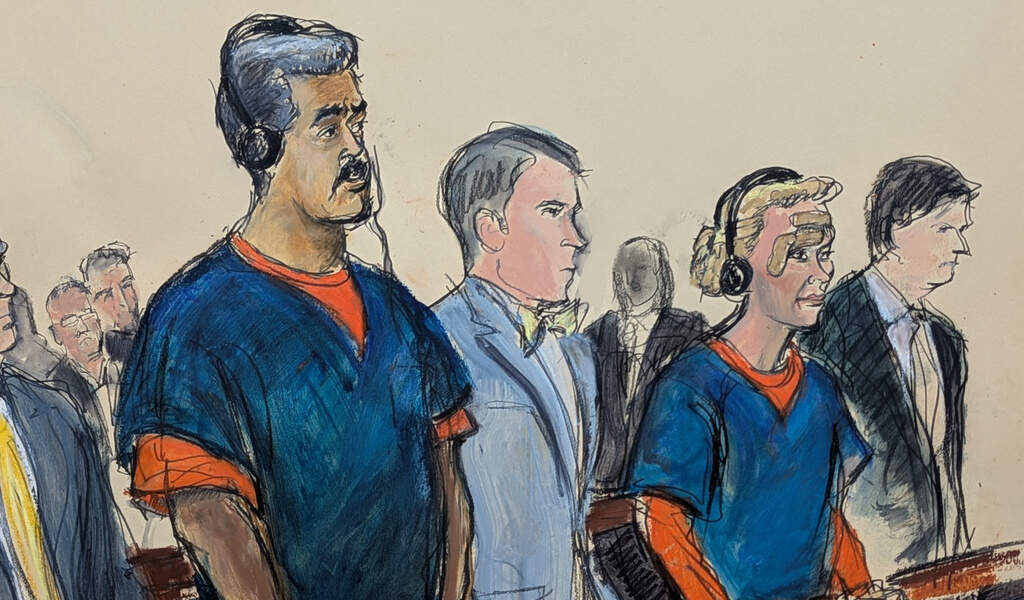
With ousted Venezuelan president Nicolas Maduro in a New York jail, President Trump says the U.S. will run his country now. The legality, practicality, and morality of regime change in Venezuela.
Guests
Freddy Guevara, former VP of Parliament in Venezuela and now exiled to the U.S.
Todd Robinson, former Ambassador to Venezuela.
Rep. Jake Auchincloss, U.S. representative for Massachusetts's 4th congressional district.
The version of our broadcast available at the top of this page and via podcast apps is a condensed version of the full show. You can listen to the full, unedited broadcast here:
Transcript
Part I
MEGHNA CHAKRABARTI: Venezuela's former president Nicolás Maduro is imprisoned in New York and awaiting trial. Of the many questions remaining in the wake of the U.S. military seizure of Maduro is this, who is running the country now? President Trump immediately addressed that on Saturday at Mar-a-Lago.
DONALD TRUMP: We're going to run the country until such time as we can do a safe, proper, and judicious transition.
CHAKRABARTI: The vague answer prompted follow up from reporters who wanted to know who is the 'we' and what is the plan.
TRUMP: It's largely going to be for a period of time the people that are standing right behind me.
CHAKRABARTI: And standing directly behind the president and squarely within the camera's view, Secretary of State, Marco Rubio.
He followed up by warning the international community that Trump is a president who does what he says, and that nations should not be "playing games with him." But the question of what's the plan now persists. On Sunday's Meet the Press, Rubio answered the question this way.
MARCO RUBIO: Let’s be realistic here. What we are focused on right now is all of the problems we had with the – when Maduro was there, we still have those problems in terms of them needing to be addressed. We are going to give people an opportunity to address those challenges and those problems.
Until they address it, they will continue to face this oil quarantine, they will continue to face pressure from the United States.
CHAKRABARTI: Again, Secretary of State Rubio did not specify who are the people he talked about. Thus far, the administration has given few details beyond that, members of Congress in fact, are still waiting clarity from the administration. Senate Majority leader John Thune, a major supporter of Trump, has said that he does not know what Trump meant by the U.S. is running Venezuela, and that he needs more information from the president.
On Monday, that quote was put by CNN's Jake Tapper to White House Deputy Chief of Staff for Policy, Stephen Miller. Stephen Miller provided one of the clearest answers to date.
STEPHEN MILLER: What the President said is true. The United States of America is running Venezuela. By definition, that's true. Jake, we live in a law, I'm sorry, we live in a world in which you can talk all you want about international niceties and everything else. But we live in a world, in the real world, Jake, that is governed by strength, that is governed by force, that is governed by power. These are the iron laws of the world that have existed since the beginning of time. The United States --
TAPPER: But are you saying — but in terms of day-to-day operations in Venezuela, that is president, Acting President Rodríguez, right? It's not some sort of American emissary.
MILLER: No, what I'm saying is ... by definition, we are in charge. Because we have the United States military stationed outside the country. We set the terms and conditions. We have a complete embargo on all of their oil and their ability to do commerce.
So for them to do commerce, they need our permission.
CHAKRABARTI: That was Stephen Miller on CNN on Monday. So really, what is the plan for Venezuelan now? Who and how should be running it, and how might Venezuelans, perhaps most importantly, themselves, want the U.S. to "run the country?" We're going to start today with Freddy Guevara.
Currently he's a visiting fellow at the Ash Center for Democratic Governance and Innovation at Harvard University. He is Venezuelan. He co-founded the Venezuelan Progressive Party, "Popular Will" in 2010. He was vice President of Venezuela's Parliament in 2016. He also was held as a political prisoner and has been living in exile from Venezuela since August of 2021.
Freddie Freddy Guevara, welcome to On Point.
FREDDY GUEVARA: Welcome and thank you. Thank you very much for raising the voices of Venezuelans.
CHAKRABARTI: Yes. That's actually why I definitely wanted to start with you, because I know you support the ouster of Maduro. We'll do a later show about that, about the legality or illegality of that.
But I wanted to directly put the question to you about in your view, what actions would be in the best interest of Venezuelans? Who should be running it and how? Over the next three, four weeks, six months even.
GUEVARA: Who should be running in general should be the people that Venezuelans selected.
That's Edmundo González who won the election in July. However, we also understand that we are in a very critical moment in now. Still the Maduro leftovers have control of some key institutions in the country. And of course we don't at all trust these people that are there. And, but we're hoping with a lot of distrust that this can end into a democratic transition in which the Venezuelans can run their country with people that they elected.
CHAKRABARTI: Okay. So on that point of people who they elected, as you and everyone know, in the actual last election, some 70% of Venezuelan voters supported the opposition, and yet the President Trump himself and even Stephen Miller and others in the administration have said, despite that there's no basis by which to, perhaps, bring back Machado or immediately install a government made up of the Venezuelan opposition.
GUEVARA: Yeah, of course I'm not in their heads and I don't have all the information that the United States government has. What I can say to you is what I interpreted and analyze of their decisions, and for what I see as a Venezuelan and of course a member active in the opposition movement. So my analysis is that they decided to not go full scale against these guys and then trying to follow a path of reforms.
Of course, we will like a different, I have to be very clear with this. I have to be very, we will like a different outcome by this moment. However, at the same time, I also have to be very clear with you. That now, the ones that made this possible were the American governments, and we wouldn't been able to do this without this action.
And I know that this might sound something complicated to understand many Americans that are concerned about this. And we as Venezuelans, of course, we understand and we support like your right, we envy your right to criticize your government and scrutinize and make accountability. But for us, this is really not a discussion about geopolitics, legality or not.
This is a matter of survival. So for now, we understand that the ones that can make this transition to end in the best way are sadly the American government. And what I mean, sadly, it's not because I don't like Americans. Venezuela has a lot of history of good relationship with United States. Sadly, because A, we wanted to do it by ourselves.
This is a matter of survival. So for now, we understand that the ones that can make this transition to end in the best way are sadly the American government.
Freddy Guevara
However, the Maduro regime and the military and everyone, dispatched, every political solution. We wanted the support of the international order. We attended to the United Nations. They failed. China and Russia always between. We went to International criminal court, they failed. The Attorney General was also disband because his sister-in-law was a lawyer of Maduro and he's also, in addition to this was accused of sexual harassment for one of the members, of colleagues.
Then we tried to go to the American organization, the state of the organization of American States. And sadly, also, they didn't do anything. And we tried a mediation with three progressive government from Latin America led by Claudia Sheinbaum of Mexico, Gustavo Petro of Colombia, and Lula da Silva of Brazil. And sadly, they also failed.
And sadly, they say at the end, the problem of Venezuela is a problem of Venezuela. So now we are in this position in which all freedom relies on what the American government does, and we are hopefully supporting all the actions that are required in order to get from point A that it's Maduro out to point B, which is democratic transition with respect of the popular will.
CHAKRABARTI: This is, your point is very well taken because the reality is what it is right now on the ground, both in Washington and in Venezuela. First, just as a small aside, since you have been important in the overall development and growth of the Venezuelan opposition, to the point where you were exiled from the country.
I don't know, has anyone from the Trump administration reached out to you?
GUEVARA: No, that's not my role. I am more engaged in things related to strategy and to inside the country. Like my role, I don't want to say too much, but like I'm more related to actions in the terrain. But we have a lot of people from the coalition and the opposition that are specifically dedicated to work with the Trump administration.
But that's not my role, no.
CHAKRABARTI: Okay. So when you speak of actions within the terrain of Venezuela, was the Trump administration in contact with you regarding that before Saturday?
GUEVARA: No. I am not in contact with the Trump administration. My role is basically what we're trying is to what we've working on is despite all the repression and all the hardships.
Organizing sales and movements and people underground that can resist inside the country and do a lot of intelligence and do resistance and things like that. That's more my role.
CHAKRABARTI: Okay. Understood. And I appreciate the clarity, Mr. Guevara. So you said something critical, right?
That the overall hope is to get from point A, where we are now, with actually Maduro's deputy now being the acting president of Venezuela, to point B in terms of a free and democratic Venezuela. The thing that everyone is struggling with is that there's then an A.1, A.2, A.3.
There's an infinite possibly. Possibly infinite number of steps in between. So this is why I'm very grateful that you could join us today. In your opinion, what should the first step be? How do you convince the still extant Maduro government and even the Venezuelan military to be partners, if I even dare put it that way, in a Democratic transition?
GUEVARA: This is a very important question. For sure, I have a very short answer and then a little bit more. The first short answer, the first answer is the freedom of political prisoners. That's step one. You know, that's the first, that's a no-brainer. There is no democratic transition with political prisoners. And more persecution because it's not just the federal political prisoners, because these guys always do this, right?
They release 100 political prisoners and they put. Two, 200 more behind bars. So I think for sure that's the first step. Between that first step and the last one. That should be a free and fair election, in which I have no doubts that the opposition will win. And to be very clear, and if we don't win, we don't care. But if we're in opposition, but we can be doing opposition and not being imprisoned. That's fair. That's democracy, right? So we are not doing this because, oh, we want to be in power. We want Trump or anyone to put us in power. We just want to have the capacity to do politics, to compete, to win, and to lose.
And that if we lose, it doesn't mean that we lose our life or freedom. So for sure what we're saying is this, is that there's an infinite thing that can happen. I'm gonna tell you my opinion and my point of view, right? I'm gonna very clear that this is my personal opinion.
We just want to have the capacity to do politics, to compete, to win, and to lose. And that if we lose, it doesn't mean that we lose our life or freedom.
Freddy Guevara
Part II
CHAKRABARTI: Mr. Guevara, you were telling us about the next steps as you'd like to see being taken in Venezuela. You had talked about freedom of political prisoners as being number one, and then just before the break you started talking about what you do not trust.
So please pick up there.
GUEVARA: I don't trust that the Rodríguez brothers, the Rodríguez siblings, I think that's the right translation in English. And it's a team. Okay. I have to be clear; Delcy now is like everyone who knows her. Delcy is the acting president. Quote-unquote, because she's not really a president.
That's a dictator too. But that's a team of her and his brother. His brother is now the second one in command that runs their parliament. I know it's confusing saying their parliament, but in Venezuela we have two parliaments, the one that people elected and they closed and then they did another election in which they didn't allow us to participate and they just competed with themselves and some people they appointed anyway.
CHAKRABARTI: And her brother is [Jorge] Rodríguez. Yes.
GUEVARA: ... Jorge Rodríguez. Yeah. This is very interesting. So Delcy and Jorge both are the daughters and son of a former left guerilla guy that was tortured and killed by a previous government, right?
That's true. That happened, right? And it was in the era of democracy. The difference is that in that era, that crime, because it was a crime, their father actually, was a victim of a brutal interrogation. Those people were punished, were investigated.
... However, they have this thing in their head, and I deal with them many times. I've been in part of negotiations with them when I was in Congress and I was in other positions, and I have to tell you, for sure. They are not planning a Democratic transition. I hope that I'm wrong. I really hope really, I really want to be wrong, but I would say that their plan is different than Trump's plan.
I think their plan is A, trying to convince them that the United States support a kind of a China or Saudi Arabia in Latin America. With this, like, free economy with American investments and oil and capitalism and all of this, but no political freedom. I think that's their plan A, their plan B, I am sure, is trying to confuse, delay and gain time waiting to know whoever's, you know, waiting to see what happens in the world.
Because they don't have to have the plan now. They've been very smart in the past just trying to survive. Because they will bet, I don't know, that Trump loses the midterms or that geopolitical problem happens or that Putin invades Europe or whatever, they will try to do that. My hopes are not in their political will. My hopes are A, of course, in the American administration, and I know that this sounds complicated for many Americans that are concerned about the Democratic or different points of policies with this administration. I understand that.
However, for us, Venezuelans now imagine that we are like in a hostage situation in a bank, and we are with the robbers inside. The people that are inside, the SWAT team that can rescue us. We have to try, right? This is what is happening now, and the SWAT team is the American government who sadly were the only ones willing to go and try to rescue us. For also probably, no, very blunt they've been saying it too, also for oil.
But we have to say very clear, freedom has no price for us. And if we have to sell oil to the Americans instead of the Chinese, Russia, Cubans, and Iranians. Be our guest. We're happy with that.
CHAKRABARTI: Interesting. Okay, so Freddy, let me follow up then. You're right to point out, there's been a lot of discussion about oil.
In fact, every administration official, let me put it this way. Every White House official, or member of the cabinet that's been officially quoted in the media thus far, has almost immediately gone to the question of oil. Just today, the U.S. says it seized a Russian flagged oil tanker that has business related to Venezuela.
The president has said I think in the past one or two days that some 50 million barrels of oil might be sent from Venezuela to the United States, and he personally may decide what gets done about it. Do you have a concern or a fear that if, as you said, Delcy and Jorge Rodríguez end up setting up a Venezuela that has economic freedom, but no political of freedom, that might just be good enough for Trump, that he might say, yes, that's fine, because we still get the oil.
GUEVARA: No, for sure. That would be hell for us. That would be hell. And we are all working against that. But I have to say that we trust and we're hopeful that this is not the path, at least that the American government wants to follow. And I think what the American government, I think also about the American institution and the American society.
We also trust, and I know that you have complex situations, that we also trust that you have a history, that you have institutions, that it's not just one person, that you have bipartisan consensus in that Venezuela should be free. So we believe, and we also believe, and quite frankly, of course many things can be true at the same time, and you don't have to agree with every position of one person to agree with others.
But I agree, I think Trump had said it many times that he also wants to see a free and fair Venezuela. And Marco Rubio is the Secretary of State. He's also said also that he wants that, and he wants freedom for Cuba and Nicaragua too.
So for me, it's hard to imagine, and I hope that I'm not wrong with that. The Americans supporting dictatorship in Latin America, just doing that. However, we are also, we are not naive, and we understand that there's a lot of work to do in order to prevent that to happen.
CHAKRABARTI: But of course, you know better than anyone else that the United States has supported dictators in Latin America. For the past century if not more, but they just didn't have as much oil as Venezuela does. So Freddy, hang on here because I do want to come back to you about other potential steps that you would like to see happen in Venezuela, but let's turn now to Todd Robinson.
GUEVARA: For sure.
CHAKRABARTI: He was the Chargé d’Affaires in the U.S. Embassy in Venezuela. He was ousted by former president Maduro in 2018. Mr. Robinson served under the first Trump administration. He's also been Assistant Secretary of State for International Narcotics and Law Enforcement Affairs between 2021 and 2025.
Mr. Robinson, welcome to On Point.
TODD ROBINSON: Thanks for having me.
CHAKRABARTI: My question to you Mr. Robinson, is given your experience in Venezuela and in the first Trump administration, I know we're asking folks to look into a little bit of a crystal ball here, what do you think are the likely next steps that a Trump-led administration, may take in the next couple of weeks or months?
ROBINSON: I think there's as I'm sure Freddy noted, I think there's a lot of confusion. Because the messages coming out of the White House are all over the place. They've clearly decided, at least for the immediate term, that they're going to work with Delcy and Jorge Rodríguez. But I think even that leaves open a lot of questions. Including where is Diosdado Cabello in all of this? Has he signed on to this agreement? What about General Padrino López? Those two are also major players in all of this. And it's not clear, to me anyway, where they are. And I have to say, I'm just stunned that there has been zero talk about a Democratic transition.
Zero talk about how to get president-elect González back into the country. Zero talk about how to get and support the coalition that María Corina Machado put together. And that really worries me.
CHAKRABARTI: That question about how the United States might foster or support or even lead a Democratic transition in Venezuela has been put, again, to many members of the administration who have been talking.
They've been talking a lot, actually, I have to say, over the past three days. So I want to just return briefly Mr. Robinson, if I may, to this CNN interview that Jake Tapper did with White House Deputy Chief of Staff Stephen Miller. And he basically asked him like, how are you going to get to a Democratic election?
And Stephen Miller said actually that's not the real objective. And here's what Miller said is the real objective.
MILLER: This is sort of foundational. The United States is using its military to secure our interests unapologetically in our hemisphere. We're a superpower. And under President Trump, we are going to conduct ourselves as a superpower.
CHAKRABARTI: And then Miller pushed on accusing Jake Tapper of having a neoliberal worldview for even asking the question about how and when might Democratic elections take place.
TAPPER: No, that's not what I think. But you invaded the country. We went into the country, and we seized the leader of Venezuela.
MILLER: Damn straight we did.
TAPPER: And I'm saying --
MILLER: Because we're not going to let --
TAPPER: So is the U.S. going to have new elections?
MILLER: The point, Jake, is that we're not going to let tinpot communist dictators send rapists into our country, send drugs into our country, send weapons into our country.
TAPPER: OK.
MILLER: And we're not going to let a country fall into the hands of our adversaries. The future of Venezuela, working with America, is going to be so bright and so incredible and so positive. And we'll have a conversation about everything that you raised. But the priority right now, as the President has made clear, is a judicious, thoughtful, careful transition process to secure a great future for Venezuela and to secure a great future for America.
CHAKRABARTI: Stephen Miller on CNN on Monday. Mr. Robinson. He did end there with saying, Hey, we're going to want to get to a quote, judicious, thoughtful, and careful transition process. What would be the first step there?
ROBINSON: I don't know what he's talking about. For the last practically century, despite ups and downs in how we've done it, the United States has been fostering this idea that the countries in the hemisphere should want democratic institutions and a pathway towards democracy. We have not been perfect in trying to implement that, but the fact is that's where the hemisphere has been moving. Now, we are not going to get cooperation long term in this hemisphere by deciding who should be the leader of X country and who shouldn't be the leader of X country and going in and snatching them.
This to me is just, I don't even know where to go with that.
CHAKRABARTI: People are pointing to Panama, for example as a time where the United States did that.
ROBINSON: Noriega was never the president of Panama. He was a leader. And he might have been behind the scenes, but he wasn't the president of Panama.
And he had been indicted and convicted in the United States.
CHAKRABARTI: ... I'll ask you both to just hang on here for just a second because joining us now is Rep. Jake Auchincloss. Representative Auchincloss, welcome to the show.
JAKE AUCHINCLOSS: Thanks for having me back on.
CHAKRABARTI: Congressman, about a couple of weeks ago, actually about a month ago you were here at our home station, WBUR, doing a public event, and you said clearly then that this is war for oil, it's not about narcotics. And you were so clear in your analysis then that we actually did a show following up, saying what is actually going on in Venezuela? And now here we are again. And you had said a month ago, it clearly isn't about narcotics, it's about war. But you hadn't, no one in Congress had received a request for authorization of use of force. We've since found out that maybe nobody in Congress knew what was going to happen over the weekend.
What kind of role, if any, does Congress expect to play in the question of who is running or how is the U.S. running Venezuela now?
AUCHINCLOSS: You are right that months ago I had tried to lay out that this is blood for oil. And it is indeed being executed on that playbook. It's not about the people of Venezuela.
It's not about a transition to democracy. It's certainly not about drugs. If the president was serious about drugs, he'd be tackling fentanyl exports from China, which he's not. This is about 300 billion barrels of crude oil, the world's largest proven oil reserve, sitting offshore of Venezuela, and the president wants it, and he wants it for Chevron and the other U.S. oil majors.
This is about 300 billion barrels of crude oil, the world's largest proven oil reserve, sitting offshore of Venezuela, and the president wants it.
Rep. Jake Auchincloss
Congress has three responsibilities right now. With regards to this chaos, the first is prevent boots on the ground in Venezuela, my boots have been on the ground in Latin America, no American should want jungle warfare for our troops, certainly not in service of oil extraction. Number two, we've got to prevent nations in Latin America from accelerating their drift towards China as they try to grapple with an erratic United States, ironically, which is contrary to the Monroe Doctrine that this president evokes.
And finally, we need to protect our alliance with NATO. Because the president's talking about Greenland. I hope at this point, people finally realize that you got to take him seriously when he says this maniacal stuff. NATO is facing a threat on its Western border now, which I never thought I would have to say.
We gotta underscore this Congress that he has no authority whatsoever to use the military in any way, shape or form in regards to Greenland.
CHAKRABARTI: And what good would, frankly, Congressmen, what good would that do? Because voices like yours have been saying that from Congress for a long time, and yet we have the U.S. military attack on Caracas and the seizing of a president. Why would it stop? Why would more vocal pushback from Congress, how could that possibly stop the Trump administration from doing it once elsewhere?
AUCHINCLOSS: It matters to get Republicans on bipartisan resolutions regarding use of the U.S. military.
For sure. If we, let me give you a concrete example. I don't think Republicans are going to stand up to this president on Venezuela. I've tried; I've been talking to them. They are buying hook, line, and sinker. This idea that he has the authority to use the military. Because it's part of a law enforcement operation, which is a raiseable claim, but one that they are complying with.
CHAKRABARTI: They're not saying anything different to you behind the scenes, behind closed doors.
AUCHINCLOSS: No, they basically, I think it would be different if you were trying to deploy boots on the ground to Venezuela and as armed guards, oil extraction, and we should press that point. But let me use as an example, the Greenland one, which I think is even more salient, which is a resolution, a congressional resolution that says that no appropriations can be used for military operations against the Kingdom of Denmark for the purposes of taking Greenland by force, that would put Republicans in a really tough spot. There would be a ton of Republicans in the House and the Senate who would feel like they wanted to be on that resolution, and that would matter.
That would box in this administration. So that's the goal.
CHAKRABARTI: Okay. Representative Auchincloss, there's one more question I want to ask you. We've got about a minute, so if you can't finish the answer, I want to hold you for over the break, and we'll come back to let you finish. But you're also a veteran of the United States Marine Corps.
You actually led anti-narcotics efforts in Latin America. You served in Afghanistan as well. Now, I'm not saying at all that Venezuela is the same as Afghanistan, but given your experience, is there any way to help Venezuela transition to a Democratic government, which Afghanistan had for a heartbeat, without a long-term occupation, without boots on the ground.
And actually, Congressman, forgive me, we have to hit this break right now. I will let you answer that question when we come back.
Part III
CHAKRABATI: Representative, so that question of, given your experience in Afghanistan, will it be possible at all to have the United States help usher in an election or a fully democratic Venezuela without long-term military involvement?
AUCHINCLOSS: Yes, I think there's three elements of this, and the analogy actually is better with Iran, I would argue, than with Afghanistan. In both situations, we're dealing with a brutal, toxic regime that has commiserated its own people and threatens its neighbors. Maduro's a bad guy. The Ayatollah is a bad guy.
Nobody should be weeping for either of them. And I think it's a three-part playbook. One is, any military action needs to have congressional authorization and be done collaboratively with our close allies. This unilateral action from the executive is totally unacceptable and it's dangerous. Number two, no boots on the ground, period.
The American public does not want open-ended nation building exercises. As Colin Powell said before Iraq, you break it, you buy it. We're not doing that anymore. And then finally, empower civil society and the respective countries and use a series of carrots and sticks, defection incentives, cyber-attacks, to take out the thugs and the gangsters who are running the regime.
CHAKRABARTI: Can those three things happen with this administration?
AUCHINCLOSS: No they've been very clear it's not happening with this administration. And I was listening to Stephen Miller, and I really wish on behalf of the American public and people globally that this guy had been picked on less in high school. Because you can just see, he's just like screeching about being a superpower and pounding his chest. And it's dude, the thing about being a superpower is you don't actually have to flex about it. It's like people know you're strong.
If he had been George Marshall after World War II, he would've plundered Germany and Great Britain and Japan and all of our former enemies and allies who were exhausted from that war, as opposed to building them back up and making them our core allies, the 21st century.
His approach is so counterproductive. It's so transactional. It's so zero sum. It promises nothing for the Venezuelan people and only to enrich this tight-knit crew of the Trump family Incorporated.
CHAKRABARTI: Congressman Jake Auchincloss, Democrat of Massachusetts. Thank you so much for being with us.
AUCHINCLOSS: My pleasure.
Freddy Guevara and Todd Robinson, I'll turn back to you, but because the representative just mentioned Stephen Miller again, and his worldview, influential within the White House. Here is an exchange between him and Jake Tapper of CNN on Monday.
MILLER: The Monroe Doctrine and the Trump Doctrine is all about securing the national interests of America. For years, we sent our soldiers to die in deserts in the Middle East to try to build them parliaments --
TAPPER: But Stephen --
MILLER: To try to build them democracies, to try to give them more oil, try to give them more resources. The future of the free world, Jake, depends on America being able to assert ourselves and our interests without apology. This whole period that happened after World War II, where the West began apologizing and groveling and begging and engaging these mass reparations schemes --
TAPPER: I don't even know honestly what you're talking about right now.
CHAKRABARTI: That was on Monday, Freddy Guevara. I wanted to go through that with Representative Auchincloss, because what you just heard from Steven Miller is the philosophical background of what's driving the White House. I guess I'm wondering, as you said earlier, we are very, you are very concerned with the immediate truth on the ground in Venezuela, but if U.S. self-interest is central and nakedly exposed by Miller, some people might appreciate that honesty.
How does that, in fact, intertwine with what's best for the Venezuelan people?
GUEVARA: No, thanks for the comment. And first I just wanted to say something, ambassador. I really appreciate the work you did in Venezuela. However, I just wanted to be precise that Maduro was not also the president of Venezuela.
He not just stole an election. ... And also, he has been accused of many of the charges that Noriega was accused of. So with this direct question, what I would say is I truly believe that we can align American interest and Venezuelan's interest. I don't think that it's a contradiction that we can work on the development of the Venezuelan oil industry with the Americans and the restoration of democracy of Venezuelans. In an ideal world, I would like that we will be self-sufficient and that we will be open to all the markets in the world. However, in this world in which the only country that were able to help us to do what it was needed to do.
I don't think that it's a contradiction that we can work on the development of the Venezuelan oil industry with the Americans and the restoration of democracy of Venezuelans.
Freddy Guevara
In order to get us free, because these guys were also having support from Cuba, Iran, China, and Russia, as it was proof, I don't know. I think it's important to remark that 32 Cuban military officers were killed during the operation. And that was confirmed by the Venezuelan regime and the Cuban regime, what I'm saying here is that I don't think this is a contradiction, and Venezuela can be a very good partner. And of course, why do I think this is possible?
Because A, there's no possibility for stability or for investment if we still have the regime. So we're going to keep pushing for Democratic transition while aligned with American interest in order to also, because this is a very good question. How do you think, how much will you be willing to pay for a ransom for your kids? How much will you be willing to pay for freedom? Freedom has no price.
And if we have to use our oil instead of being used for make the regime to buy guns and kill our people, and we have, we can use our oil to buy our freedom, damn, we're gonna do it.
And we believe that's the right thing to do. For all of our, all the citizens that are kidnapped there in the country.
CHAKRABARTI: Todd Robinson, let me go back, go to you then on this because you served in the Trump administration as the last Chargé d’Affaires in Venezuela. Do you think that under President Trump, that there can be this long-term alignment between U.S. interests and Venezuelan interests?
ROBINSON: Of course, there could be, if they went about this the right way. And I should just say Freddy is right. Maduro did steal, certainly stole the last election. Probably stole the election before, he's absolutely right. And Jimmy Story was actually the last Chargé.
CHAKRABARTI: Okay. My apologies.
ROBINSON: And ambassador. I think the long-term interests of the United States is to be surrounded by countries that are democratic, that have strong institutions, that have a rule of law philosophy. And what we have seen since World War II is the hemisphere moving that way. If we were serious about, if they were serious about our long-term interests, that's what we would be focusing on.
The long-term interests of the United States is to be surrounded by countries that are democratic.
Todd Robinson
We could buy all the oil we want from a free and open and democratic Venezuela, that's where we should be moving towards.
CHAKRABARTI: I hear your point about Latin America, central and South America moving, trying to move in the direction of greater democracy. But again, I just must insist that history also says the United States has been the impediment towards that, in that direction many times.
ROBINSON: You're absolutely right. And I'm not saying that all of the strategies, all of the policies, all of the tactics that the United States has used over the years have been perfect. In fact, they've been imperfect. But the arc of the hemisphere has been moving towards governments that are elected every so many years.
Legislatures that legislate over so many years justice systems that are based in the rule of law.
CHAKRABARTI: Yeah. Your point is really well taken because Freddy and the people of Venezuela are the, right now, the primary example of that. But Freddy, let me get back to you here. Because again, the reality of how to get to a democratic, free and democratic Venezuela still has to face what's truly happening there.
And I would like to hear a little bit more of the next thing that you would say needs to happen. We talked about the freedom of political prisoners first and foremost, but then Todd Robinson also mentioned there's the Venezuelan military leadership as well. In your mind, how important are they in this picture and who should the Trump administration specifically talk to be sure that the military cooperates with efforts towards a greater or more democratic Venezuela?
GUEVARA: To be clear or to be honest, I think that issue is not the entire military. I think we have a very small group of sadistic and crazy people who has been not only killing, harassing civilians, but also militaries. We have 800 political prisoners, almost half of them are military people.
If you see the results of the last election ... in the places in which most of military votes, we also won by a landslide, too. However, what we've witnessed, and this is what I was trying to explain with the Cuban participation is that the Venezuela military also was kidnapped also by the regime. Because you don't need to have all the military on your side.
You just need to have a few people who are loyal enough to control and oppress others before they act. And that's what is happening in Venezuela. And I have to say, being very honest, I've been involved in engaging with militaries in Venezuela, trying to work with them to achieve a transition.
And many of them fail because of Cuban and Russian espionage. So what I think with this, what my answer is, the second step is dismantling the Iranian, Russian, Chinese, and Cuban security control of our armed forces and removing the key sadistic people that are running the intelligence, security, and military apparatus.
It's not about all of them. It's about a key a group of key statistic people that we need to take care of.
CHAKRABARTI: Freddy Guevara, co-founder of the Venezuelan Progressive Party Popular Will. Thank you so much for joining us today.
GUEVARA: Thank you so much.
CHAKRABARTI: So Todd Robinson, we could actually do tabletop exercises for hours about what should happen next in Venezuela for the good of the Venezuelan people, but I want to turn to fundamental truth on the ground in Washington.
In terms of genuine care for a democratic Venezuela, I actually think that Secretary of State Marco Rubio is at the center of that. Because what, for more than a decade and a half, he has been advocating for some kind of U.S. involvement to get a free and democratic Venezuela.
But he's also working for President Trump, and here's what John Bolton, right? A very hawkish former advisor of Trump. He was one of the architects of the Iraq war. He's been around for decades, and he was kicked out of Trump's first administration. But John Bolton recently said is that Donald Trump has no actually set worldview or any policy position in the traditional sense.
Bolton was recently quoted: He doesn't do grand strategy, quote. It is very hard for people to understand. It was hard for a Bolton to understand. Because you think in government that's what it's about, policy, but that is not what Donald Trump does. And then he went on in this quote. Saying: A Trump doctrine in international affairs is a complete fantasy. It's all through the prism of what benefits Donald Trump. He does what he wants to do.
So I am curious. There can be a concrete strategic plan to get to a free and democratic Venezuela. But it all depends on how long President Trump remains interested in doing that.
As soon as he doesn't feel like he has anything to gain personally, it almost feels like the Venezuelan people will once again be on their own. Is that a concern for you?
ROBINSON: That's a huge concern for me. Look, the policies are the umbrella. And I think, I don't agree with John Bolton often, but I do agree with him on this point.
It's not the policies, the policies are like the philosophy, what happens under that is what's more important. They should be focusing on a security assistance package. They should be focusing on economic recovery, not for the United States, but for Venezuelans.
Ordinary Venezuelans. People seem to forget that just a few months ago, thousands of Venezuelans, at the risk of their lives, went to vote for change in Venezuela. And now we appear to be putting that, setting that aside and going in and doing what we want to do. And the other thing I would add is that all of those things that I mentioned. Security assistance, economic recovery, transitional justice support for the democratic opposition. All of that is what the State Department and USAID used to do.
And all of the experts or many of the experts that could be doing that now, that could have been strategizing about how to get that done after Maduro leaves the scene, could have been happening and is now not happening because where's AID?
CHAKRABARTI: Yeah. I also, to be fair, I have to say that it's possible that the administration has some form of plan to achieve all of the things that you just said and just aren't talking about it right now. I want to leave that possibility open.
ROBINSON: I hope.
CHAKRABATI: But it also seems to be that none of those things can even begin to happen for as long as Delcy ... and Jorge Rodríguez, as Freddy said, are still sitting at the core of the Venezuelan government.
We only have about a minute left, Mr. Robinson. Could anything move forward for as long as those folks remain in power, or does the United States have to do something to remove them now or soon in order to even take the first steps towards a better Venezuela?
ROBINSON: I think we certainly need more clarity about where Diosdado Cabello and Padrino López are in this picture, because it's not clear to me. Delcy Rodríguez does not control the military.
And she does not control the intelligence network. So that's a problem. Short term, maybe you can have some stability, but long term you need the democratic opposition. You need the president elect. People need to see that we're working on getting the president elect and María Corina back into the country. I believe, in order to have any kind of real future for Venezuela.
The first draft of this transcript was created by Descript, an AI transcription tool. An On Point producer then thoroughly reviewed, corrected, and reformatted the transcript before publication. The use of this AI tool creates the capacity to provide these transcripts.
This program aired on January 7, 2026.