Support WBUR
Following the money on the Biden-era infrastructure bill
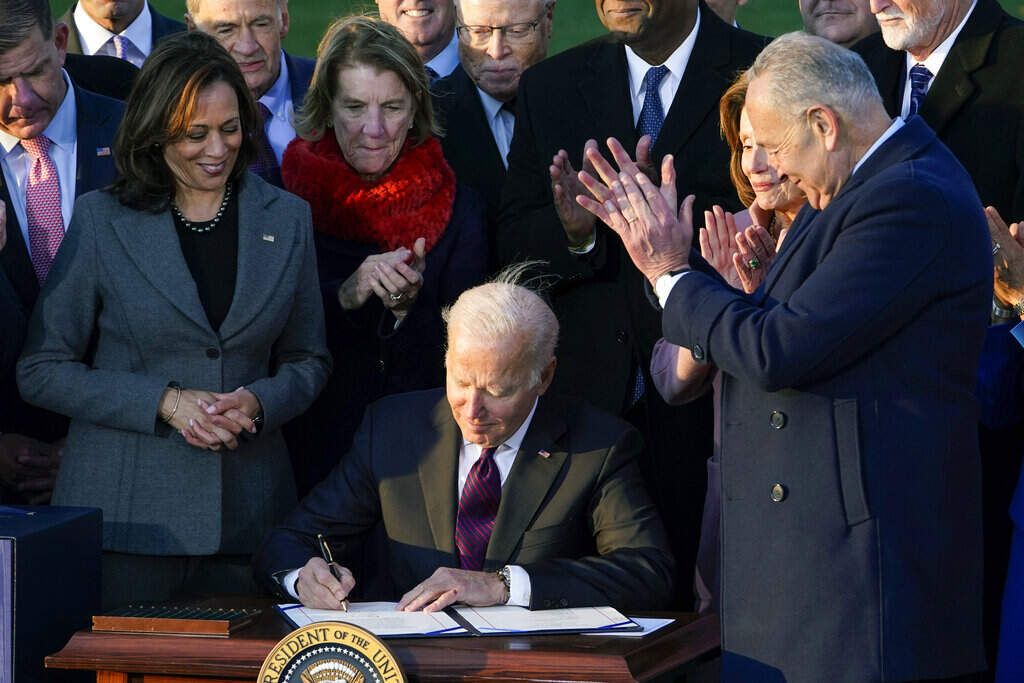
The Biden Administration's infrastructure act promised more than $1.2 trillion dollars to build up the country. More than five years later, what was built and what never got started?
Guests
Adie Tomer, senior fellow at the Brookings Institution.
The version of our broadcast available at the top of this page and via podcast apps is a condensed version of the full show. You can listen to the full, unedited broadcast here:
Transcript
Part I
MEGHNA CHAKRABARTI: On November 15th, 2021, then President Joe Biden gathered industry leaders, lawmakers, and the press on the White House lawn, they were there to witness the signing of the bipartisan infrastructure deal, H.R. 3684, also known as the bipartisan infrastructure law or the Infrastructure Investment and Jobs Act.
The trillion-dollar bill was one of the largest dedicated to infrastructure in modern U/S/ history and the mood was congratulatory. Donneta Williams is president of the United Steelworkers, local 1025. She's an optical fiber maker and was the first to address the crowd.
DONNETA WILLIAMS: Investments in infrastructure are critical to workers like me. My brothers and sisters in other industries, and I was so proud to join them to help pass this bill ... signed today, President Biden.
CHAKRABARTI: Acquanetta Warren, mayor of Fontana, California said the Infrastructure Act would change lives in her city.
ACQUANETTA WARREN: This bill will invest millions and produce countless jobs for cities such as Fontana.
It will improve roadways, transit systems. Our access to clean water. And millions of Americans, their ability to access high speed internet and bridge the digital divide.
CHAKRABARTI: the celebration continued with then Senator Kyrsten Sinema of Arizona.
KYRSTEN SINEMA: How many times have we heard that bipartisanship isn't possible anymore, or that important policy can only happen on a party line?
Our legislation proves the opposite.
CHAKRABARTI: And then President Biden stepped to the podium.
JOE BIDEN: Here in Washington, we've heard countless speeches and promises and white papers from experts, but today we're finally getting this done.
CHAKRABARTI: President Biden went on to celebrate the effect the bill would have on wastewater treatment, increased broadband access, local ports, essentially bringing America's dated infrastructure into the 21st century.
BIDEN: This law makes it the most significant investment in roads and bridges in the past 70 years. It makes the most significant investment in passenger rail in the past 50 years and in public transit ever. So what that means is you're going to be safer and you're going to get there faster, and we're going to have a whole hell of a lot pollution, less pollution in the air.
CHAKRABARTI: That was four years ago. The question now is how long is it going to take for that vision to become a reality? Where has the money gone? What was built? What is being built and what never even got started? What is the fate of that trillion dollars, that once in a generation or even once in several generations opportunity to make the nation's physical infrastructure so much better?
Joining us today is Adie Tomer, senior fellow at the Brookings Institution, where he studies infrastructure and urban economics. Adie, welcome to On Point.
ADIE TOMER: Thanks for having me, Meghna.
CHAKRABARTI: So I want to ask a question, which I'm not sure we're capable of answering, but if you had to say how much of that $1.2 trillion has actually been turned into bridges, roads, power stations, et cetera. Now, is there a way to quantify that?
TOMER: There are some ways we can quantify it, but I think it's okay to be candid here. It's impossible to give you the plain-spoken answer that folks want. Which is exactly how many roads got repaved, right? How many homes are now connected to broadband internet?
And it just speaks to the longevity of passing not just a bill like this, but actually to get shovels in the ground. Tie off projects, the proverbial ribbon cuttings, right? That elected officials and private sector colleagues always love. And then actually seeing impacts on the ground.
What I can say for sure, per federal data from when the tracking was maintained at its most transparent pace, which is just to be transparent here, is the last day of the Biden administration. There was basically $600 billion in what we call awards, meaning actual money ready to go out the door from the federal level. But that still requires states, locals, private infrastructure owners and energy and broadband to actually move into construction. So exactly what that pace is, we're not totally sure yet.
CHAKRABARTI: Okay. So that $600 billion was then basically tagged to specific projects, or was it federal grants to states and then states could figure out how they want to use it?
TOMER: Ah, that's a great question. Yeah, so it's a bit of both. It's mostly the former, meaning those are awards we know exactly where that money is going to what kinds of projects.
Now the specifics there is the federal government doesn't actually pick most of those. About a quarter of the bill was what we call competitive grants. That's the stuff you probably heard about in your local area where, hey, we're making an application to Uncle Sam, if you will, proverbially, to say, please give us that money.
75% of it though, it's guaranteed, and it went mostly directly to states, primarily for roadways, transit systems, airports but also water systems, both drinking water and storm water. So that money, we know it was going to go out there, we know it's going to get put in the ground. And those projects are frankly, typically, the fastest to move too.
CHAKRABARTI: Okay. So those, that money was intended for those kinds of projects, but now it's hard to keep track of it.
TOMER: Yeah. Yeah. When you say it like that, it doesn't sound great.
CHAKRABARTI: (LAUGHS)
TOMER: Look, what much of what this speaks to is just how big of a country we are. We sometimes forget this. The infrastructure systems we have in the U.S., they are valued at $14 trillion.
So as big as a one plus trillion-dollar bill sounds, we actually need to continue to make constant investments in all kinds of these physical systems across the country, and tracking every little project is extremely difficult, and we rely on these kind of aggregations of it. And because the projects take so long to deliver, it's really after not just five years, but really 10 years, we get a sense of what these big bills delivered.
CHAKRABARTI: I will be completely transparent, Adie. I'm very frustrated, like I would presume millions of people, with the sloth-like pace of infrastructure development in this country. Anytime any American travels overseas to any number of nations, frankly the difference in infrastructure, sophistication and modernity is shocking.
Okay. It's shocking. I was just in Italy, not a nation known for being the Singapore of Europe. Okay, if I can just put it that way. But I rode a train. It was beautiful, on time. Easy to get a ticket, just went hundreds of miles in just an hour or two. That one little experience from two weeks ago reminded me of how, yes, this is a big country.
We have a lot of infrastructure. There will always be that state and federal tension, right? Between how and where money gets spent. But something's still really broken here. Five, more than four years after a trillion dollars is set up to assist the modernization of U.S. infrastructure.
I would think a lot of people might be hard pressed to say, there's been differences made in my life by this money.
TOMER: It's a fair point. Where I'm going to lightly push back --
CHAKRABARTI: You can push back heavily, please.
TOMER: No, because look, like all these things, it's not black and white.
There's a lot of grays here, huge amounts of gradation in those grays. But let me first tackle the international side of this. Because the personal experience you have that many of our friends and families who get the good fortune to travel abroad see, and we could have given other examples there, right?
Like high-speed rail in East Asia. There's this constant experience I think of seeing communities that seem to glisten, especially in their airports when you first land. Some of that experience reflects actual investment levels, so we tend to spend less on infrastructure than our peers in Western and Central Europe and East Asia.
So these are our international contemporaries in terms of economic development. And some of that shows itself in the physical quality, especially the newness of much of the infrastructure. So that is not an illusion. We actually invest less as a percentage, and to the president Biden's comments, I'm one of those people that writes those nerdy white papers.
And we see it in that data, that we're actually investing less, right? So it's in that way, we, that argument won the day in Washington. It's won the day more and more in states capitals and at city halls and county commissioner offices to spend more. And we are seeing, generally speaking, not just bills like the IIJA.
Also continued investment through gas tax increases, higher water rates that are meant not just for inflationary purposes, but actually to invest more in systems. So there is a need of catch up. The other part though, is that where I push back, is that America's infrastructure is not falling apart. And the example I like to give is people just want their infrastructure to work.
They want to just wake up in the morning, turn on the faucet, right? Flush the toilet. And those systems just work. That they walk out of their home, apartment, condo and whatever their route is to work or to errands or to see friends, that, you know, their car can drive safely on the road. That the bus arrives on time.
And for most people, that is their daily experience. Our challenges are how do we make sure we invest in the levers that are going to make us not just more competitive in terms of growing industries, creating jobs, et cetera. But also that we're more prosperous at a household level, that everyone can afford internet, that our electricity rates are affordable.
That it is safe to walk down the street, we have a scourge of pedestrian safety crises in the country, and so as much as the glistening infrastructure's important, and don't get me wrong, for anyone who's traveled through LaGuardia five years ago and today, you have seen the difference, right?
And it feels better, right? Of course it does. But the most important thing that infrastructure does is it lets us actually do something else. And so when we can't do those other things safely or at all, that is where my concern is greatest, and we have real investment needs.
CHAKRABARTI: Yeah, no point taken, honestly, an infrastructure optimist. Adie, you're my kind of guy. I love that. But I will also leave the door open to the fact that a lot of people may have rolled their eyes when you said, most of the buses are on time and I can get to work on a mostly functioning road when I drive there.
Maybe I'm just too traumatized by my life here in the Northeast. But so would you say though, and I'm going to put you on the spot and you allow you to expand your thoughts when we come back from a quick break here, but so you, it sounds like you wouldn't say yet that the $1.2 trillion, even though we can't necessarily track where all of it is gone, that it wasn't squandered.
TOMER: No, absolutely not. Definitely not squandered.
Part II
CHAKRABARTI: Today we are looking back and then also trying to look forward at what has happened and what should happen with the $1.2 trillion that were meant to invest in the United States infrastructure. That bill, that big infrastructure bill passed under President Joe Biden.
It's been more than four years. We're trying to do some accounting, and Adie Tomer is with us today. He's in Cleveland, Ohio. He's a senior fellow at the Brookings Institution, and I will allow some good news in this hour. Because some stuff has been built and it's been significant, and there's a particular bridge, I believe, right where you are.
That's one of the examples of how the money has been put to work for people's benefit.
TOMER: Yeah. Down the literal pike, I guess in I-71 the Brent Spence Bridge, which for folks who may remember, there was a big news story back in November 2020 when this major bridge, which is the junction of Interstate 71, interstate 75 in metropolitan Cincinnati set on fire due to an accident. And one of the trucks had obviously some combustible chemicals. And very different fortunately, no loss of life. I remember correctly, very different than that Minneapolis Bridge collapse that folks might remember on I-35 many years back.
Really helped spark much of what I think inspired this bill. The bridge is now getting rebuilt. Now, for folks to proverbially sit down, the total cost is $3.6 billion to rebuild that bridge. It received $1.6 billion in federal funding. But what I like the most about this bridge as a symbol of how our infrastructure, from a governance or a politics perspective, can actually truly bring us together.
The signing of, or I shouldn't say the signing. The representation that investment was going to be made. There's a really easy photo to find where it isn't just President Biden speaking. It's also Senators Portman, Senators McConnell, Senator Sherrod Brown at the time there at the signing for the two states, Ohio and Kentucky, plus the president.
Quite literally a bipartisan assembly of some of the top figures in federal politics all coming together to say whatever their differences might be, that this bridge is a place of agreement. And that's something that can really help move infrastructure projects forward. And ideally provide a beacon honestly, for candid conversations about what does it mean to build a better country going forward.
And that bridge, eventually when it's constructed, and again, it'll take many years longer than even the lifetime of this bill being authorized in federal Washington. Eventually it's going to make a big difference for the one of the busiest trade corridors in the country.
CHAKRABARTI: But we can't just accept this long timeline for construction.
I really I insist on that. Why will this bridge construction take so many years? How many years are we talking about?
TOMER: Many years is the technical answer. If you had the engineer on, they would know exactly. It's going to take a while. And you and I both know, yeah, there's time overruns, right?
They happen.
CHAKRABARTI: But here's the thing though. This is, again, I am going to be your average American's advocate today, hardcore. Isn't this part of the problem? That we just accept the fact that these construction projects, yes, they're large, they're complicated, they're technical. You have to be precise because you're dealing with potentially with people's lives as they travel over the bridge.
All understood. To be perfectly transparent, my undergraduate degree is in Civil and Environmental Engineering. So I understand the technical demands of these big projects, but these same big projects are done much quicker everywhere else. And the reason why I'm pushing on this is because the longer something takes to build anywhere, but especially in the United States, the more expensive it becomes.
So you can make the argument that part of that $1.2 trillion is going down the drain because of construction delays.
TOMER: You're absolutely right. We need to be able to build faster in America. And the larger the project gets, it's not exponentially faster, but it takes relatively longer than it should.
We need to be able to build faster in America.
Meaning, if you're just filling potholes, if you're just improving fiber optic cables under your regular street or even on a electric pole, right? Those are easy projects. We can deliver those typically on time. And by the way, often done by local governments or done with local permitting, it's these big mega projects.
And Meghna, while you're hitting this nail on the head, so importantly for the American public, no one really sees the repaving. They barely see, even if it's for your own home, 'Hey, turn off, you know you're going to have water shut off today. Because we're repairing the water main, it'll take a couple hours.'
But honestly, when you think about it, no big deal. Meanwhile, whether it's the Brent Spence Bridge, actually like the LaGuardia airport that we talked about before the break, which was a beacon of success by the way. Those take years and it makes people feel like, why is this taking so long?
There is, it's probably an unsatisfying answer except to say, the applied research community, the experts, the stakeholders in private industry, they are trying to do something about this to figure it out, but it's been a really, really thick problem to unpack. There's multiple factors that are feeding into it, but I'm just here to say I share your frustration and it's an area of motivated action among experts.
CHAKRABARTI: Okay. But when you say multiple factors, and I concede actually, you're more up to speed on this obviously than I am, but what are some of those factors that people are trying to improve?
TOMER: Yeah, totally. So one of the biggest ones is permitting. It's a major word. It's a word in in federal Capitol Hill debates, basically typically focused on energy projects.
But not exclusively. It's been dissected already on transportation. I'll give you an example of one of the ways that permitting and community involvement ends up actually slowing down projects. State departments of transportation, whether folks like these or not, are really good at repaving and building new lanes of highway, especially when it's just your basic kind of, the land is there.
In other words, it's not going over a bridge or something. As a civil engineer, those are really complicated. But the issue is we've suburbanized so much. We've built up so much housing near these highways that people want sound barriers. But the question is, who pays for those sound barriers?
How do you design them? How do you deliver them? And not only does it inflate the project cost, which I'll get to in a second, it actually changes the whole permitting process too. So there's a bunch of permitting elements. I talked about the other second big factor, which is just pure cost in figuring out how we bundle this money together.
Inflation has been eating into what our purchasing power is. So those two factors plus some labor related issues, it tends to make our work really expensive.
CHAKRABARTI: Yeah, okay. Honestly, we could just talk about permitting for six or seven episodes of the show. So we'll put that aside for the moment.
I want to go back to something. Because I've billed this episode as like, we're going to be doing some accounting here, but to your point about, let's go back to that $600 billion that was ready to go out the door from the federal government to the states.
Once they reach the state, once that money reaches the states, are you saying that short of an individual group keeping track, since the federal government isn't doing it anymore, of an individual group keeping track of what's happening at the state level across 50 states, that we have no way of knowing what happens to this money? We can't even do the accounting.
TOMER: Right. No. Let me say it a little bit different. I think I answered your question in a certain way, so I want to make sure I'm clear on the record. Like I'm testifying here or something. There's actually a federal database at usaspending.gov. Anyone can go there. It is still being updated and maintained. It will tell you where not just the awards went, but mostly where contracts have been executed. But a contract does not tell you the progress of the project.
You would actually have to go, and this is where it starts to get byzantine, if you will, the State Department of Transportation, the state environmental agency, which actually then delivers further grants and loans down to your municipal water authority or utility. That's the person you pay your bill to, by the way. And they're all keeping track of their projects and the progress.
But to actually see it in one place, we don't have that. So in your neck of the woods, where, and obviously we've got listeners across the country, you can go. To your, where I would mostly recommend is your State Department of Transportation. They probably have a website up for bipartisan infrastructure law spending, right?
And they'll talk about the awards they got and the projects they execute. And if you want to go down that rabbit hole and typically a monster spreadsheet somewhere at the end of it, that's your reward. You can see exactly what's being done. But it won't be this kind of satisfying, like you're downloading a file and here's like the progress bar, it's not reported that way.
So I think part of my answer is it's a dissatisfying, hey, it's highly disaggregated. It's really difficult to track. What we know, and I do want to be clear really quick, is that there is great accountability in the United States. Even if we're overspending, even if it's taking longer, we can track the dollars.
We know where the money's going. There's no corruption here in that sense. So these projects will get delivered, but the speed by which they do it, the ability to see them, it's just, it's tough. It's obscured a bit.
CHAKRABARTI: Okay. So in thinking about how to improve the whole financial and then construction process for American infrastructure, especially when we're talking about federal dollars.
Perhaps let's, I won't call it a lost opportunity, but the next time, whenever that may be, that a big federal spending bill for infrastructure comes along. Would it not be advisable for the government, the federal government, to require, I don't know, an easier and more transparent means by which the states can send their information to the federal government, and then maybe the American people can see more easily.
It might still be a spreadsheet, but in the age of AI, maybe not. But some sort of more visual and easily accessible means to understand where the money is going.
TOMER: We were doing that and it stopped.
CHAKRABARTI: Okay. Okay.
TOMER: And this is honestly a source of frustration. And I say this in an apolitical way with the Trump administration versus the Biden administration. And folks can search this on their own, if you search Biden White House, because it's been like a retired website if you will.
Biden White House Invest, and it used to be called invest.gov. And there was a beautiful map. That made it really easy to zoom into communities to see exactly where these awards were going. So even if you didn't know the exact progress of the project, you at least knew where the money was going, what it was building.
And by the way, it bundled in, we're not even talking about today, understandably. But the Inflation Reduction Act, which was also basically a massive infrastructure bill name excluded. And they had all of those spending amounts on there. So this visual element is something that we do think the federal government should continue to do.
Again, it should be apolitical. The nice thing about infrastructure is every elected official loves it. It's always money going home. I've never bought the critique particularly of, at the time, Republican, both Congress people in the House and the Senate.
The critique of them, they voted against it. They shouldn't get to go home and try to do the groundbreakings. I think the exact opposite. You vote with your conscious, but once the program is real, it's their job to try to bring that money home. It's good for their communities.
So elected officials typically love infrastructure, so it's in the best interest to make these kind of visual tools, like you're talking about, build trust with the public. So next time you need to go ask them for more money again, which by the way, federally that's coming up this November again, that trust level buys you trust in what their next vote will be.
CHAKRABARTI: It's interesting, again, you are an infrastructure optimist, and I love that. Because as you're making the point that many Republicans, essentially all of them, voted with their conscience, but their conscience was saying, don't hand the Democrats a win.
But then they got the money because the Democrats got enough votes and they're going home and celebrating, shovels going in the ground. To me, this also, in the United States, it talks about a huge divergence between political timelines. And infrastructure timelines, like you were talking about then.
That seems to be a big problem here, that lawmakers, when they're facing their next election could either have a keen amount of interest in helping build up their communities, or once they win that election, just forget it and move on.
TOMER: I'm so glad you picked up on this. When I say selling infrastructure, I mean that as an idea.
At the federal level, it's really tough. Because it's this ephemeral, some bridges over there and some broadband over here and it doesn't feel tangible. But for listeners who've experienced this in their communities, we've had this big push over the past few decades where we want to improve public transportation systems.
Los Angeles, Seattle, Charlotte, Salt Lake, Denver. These are prime examples. And they go to voters and say, look, this is what we're going to build. We're typically going to do some highway repaving, let's say too, some sidewalk improvements, and overwhelmingly voters support it.
Why? Because they can tangibly feel those projects, they understand what's being delivered, and it takes a leap of faith on the case of an elected official to say exactly to your point, Hey, I might not be there for the ribbon cutting, but I know this matters for our community, so I want to be there on the kind of the groundbreaking right?
The shovel going in the ground. And you're betting on America's future, whether at the community scale or the national one and that's why I get goosebumps even talking about it. I understand. I'm deep in this stuff and not everyone's like that, but that's what investment looks like, right? It's not so different than rehabbing your kitchen, or putting a roof back on your home. It's the right thing to do to protect the asset that means so much to you.
And that's what these investments are. Yes. We need to be faster. Like you point out, we need to save money. Absolutely. But to say we shouldn't invest at all, that's a pathway to losing competitive power and would have a negative impact on every American household and business.
CHAKRABARTI: Okay. So now I want to discuss with you some of the like headline grabbing projects that were promised in the infrastructure bill.
But as far as we can tell, have not yet come to pass. One of them, which is really important, and it links back to your critical point earlier about good infrastructure should help Americans live better lives. Okay? Broadband access is a huge part of that, right? In this day and age. And in the infrastructure law, there was the broadband equity access and deployment program.
There was $42 billion tagged to that to expand broadband internet across the country, and particularly in rural America. But I think by the end of 2024, the program had distributed no money and supplied broadband to zero additional households. And there were things like federal affordability requirements that telecommunications companies were saying that was too tight.
States were in disagreement with Washington over their funding applications. The whole process was very, was overly complex. And I'm reading, this is from testimony that Misty Giles, who was the director of Montana's department of Administration, which she testified before a House subcommittee in September 2024.
There were things built into this bill that made it hard for what the bill wanted to achieve to even happen.
TOMER: Yes.
CHAKRABARTI: You're waiting for my question. And my question is, once again we are making things harder than they need to be to do something as what should be straightforward or possible as helping Americans get broadband access.
TOMER: This is, first of all, hitting the nail on the head, bringing up this program. I'll go back in some ways, seem thematic, as my first answer, it's back to the grace. Two things can be true at once. The need is overwhelming sometimes, if you really think about it. Just by pure population shares, right?
Most folks live in metropolitan areas, whether city, suburb, what we call exurb. It's even the place beyond it, right? And that density of households makes it a lot easier to build broadband, and that, of course, connects us to the modern world. In rural areas, it's really hard to deliver there.
So it's really expensive. We've got to think about different ways to deliver it. The problem is we didn't have the governance infrastructure to actually deliver that money quickly, and that became a big debate among how to set it up. And of course it slowed down the money going out. But I think there is a positive story coming around the corner.
Part III
CHAKRABARTI: Before I let you get to the good news about broadband expansion in rural America especially. I want to go through, in just a little bit of detail, some more of the complaints regarding this particular part of the bill. Okay. Because we've had, what, four years now to understand what's hampering the expansion of broadband access.
So folks at the state level have been saying the federal government or the bill itself didn't necessarily provide guidance on how to implement operations and work better with telecommunications companies. Some of the requirements or rules in the bill itself said in order to get the money or states that accepted the money, had to make sure that broadband providers planned for a climate change and used unionized workforces hired locally.
There was a provision in there that required low-cost options make sense, and fast connections also make sense, but for quote, middle class families and at quote, reasonable prices, which didn't really give states guidance on how do we define those things? And one more thing about the timeline.
So I think about a billion dollars a year were supposed to be injected into this broadband access effort. And even Senator Jeff Merkley, who's a democrat in Oregon, he called that protracted timeline, quote, A vast administrative failure. I think the implication is it's just too long. There isn't the motivation to get this work done quickly.
So again, I'm pointing to these things about why we set up hurdles to achieve something that, as you've rightly pointed out, strongly bipartisan.
TOMER: I've been an optimist so much today. You're really scratching the area where I'm not.
CHAKRABARTI: I found it.
TOMER: You are really good. No, this was a major complaint from certain quarters, and I just want to state out loud that I agree with this.
When you take these programs meant to deliver a certain output for a certain outcome in this case, right? We're going to build better infrastructure, which helps with prosperity. Oh, by the way, we're going to bundle all these other goals we have for society too, into it. I think it makes it administratively impossible, and the burden on that is shared both by the Congress who wrote this bill, specifically the senators who did.
So it's rich for certain senators to then later critique it. But then the executive branch who wrote even more detailed rules, I won't get into that process. It is a true snooze fest, but they put these stipulations on it. And broadband was not alone here. We might get a chance to talk about electric vehicle charging infrastructure.
They had some of them. There was elements on competitive grants for safe streets in some places, other kind of highway designs that had them. They were all over the place. And I know it came from a good place. I think many folks would agree with that. But it doesn't matter if it comes from a good place, if it makes a procedural headache, slows down the money moving, and now you've lost the trust of the public to a certain degree, that's a loss.
And it's really important for us, and this is just my personal beliefs, for us to reflect on that, to internalize it for the next time we write these kind of bills. To say, let's make the main thing the main thing. And not worry about those other elements. Those are other areas of public policy to deliver.
In other words, to give you another example, this came up in the Chips and Science Act. Around why are we focused on infrastructure and industry facilities being the place that we solve? America's childcare problem. It's just to me there are other ways for public policy to do that. So that's one of my concerns.
CHAKRABARTI: I think, let me just say, I think you know the answer. It's because they can't get it passed any of course childcare expansion. They can't get it passed in any other way. You gotta slip it into a trillion dollar bill.
TOMER: And then, and of course the right way to respond would, I think would be actually to play the long game and say when we build trust, then that gives us the space to do other big bets, even beyond, in this case, infrastructure.
But you asked about rural broadband, and this is why you scratched an itch. Look, they had to set up a ton of agency-based structures that didn't exist at the state level. And then they had to do exactly as you pointed out, a bunch of procedural features that they weren't prepared for.
So that learning took considerable amount of time. Now the quiet inside the beltway and inside the state capitol conversation was, this is going to take a while. But no one wants to hear that, and you certainly aren't going to tell the public that as a sales job for the elected officials. So this caused an information, a knowledge gap among people and it really caused questions to come out.
So I think it's fair to talk about this. It was, maybe to summarize, it was not designed to move fast. So sure enough, it didn't move fast.
CHAKRABARTI: Okay. You mentioned electric vehicles. This one's been covered a lot, but it's again, very instructive. So there was the National Electric Vehicle Infrastructure Program, NEVI, right?
Which, by the way, it made a mistake. Senator Merkley was talking, he was bemoaning NEVI's protracted timeline, not broadband. So that's my correction of myself there. Let's see if I can recall the facts here. About $5 billion going to NEVI to build a national infrastructure of electric vehicle charging stations.
I think by the end of 2025, a whole whopping 44 stations across America had come online. Come on.
TOMER: Yep. This one's also an area where it's tough. And the similar arguments. And again, I don't want to make it sound like I'm overly defending this. It's trying to explain why has this happened.
In other words, rather than, there's some malfeasance here. it is really hard to start new programs. The transportation folks in federal Washington State Capitol say, look how fast we can spend our money. They have a seven decade head start on understanding the procedures, having organizations set up, knowing where to hire their people, large scale firms that already are prepared to work with the federal government.
All of that is being built from scratch when it comes to rural and non-rural broadband often. And then especially on this electric vehicle charging, ironically, in the same space. So those offices that were set up, it wasn't just in the federal government, they had to set up new offices.
At the state capitals they did too. And something that you're probably familiar with, right? Is we, electric vehicles, is this weird political lightning rod among relatively speaking the person affiliation of a state, right? So to say it more plainly, blue states are pro and red states are skeptical at best often.
But no one's turning down that money. So all of a sudden, insert your proverbial red states, they've got to scramble to set up offices to be ready to move quickly on EV charging through the federal pass through of money. It's just, again, this gets boring quick. It's just, it is a procedural nightmare to spend this money quickly, and sure enough, you don't get stations and dollars moving fast.
CHAKRABARTI: Okay. So again. I don't mean to put you in the position of dumping all my criticisms of the federal government on you. But like we're thinking through this together here because, you said it, you got to build all that stuff from scratch. My first question is, why not leverage the experience and contracting knowhow from the transportation department to assist in starting up these new kinds of infrastructure projects.
And second of all, I think you're making, if not intentionally, a very strong argument for the private sector here, because in the same time that the federal government managed to build 44 charging stations across America, Tesla doubled the amount, doubled the number of charging stations they had to almost 7,000.
So I can't believe I haven't brought this up yet. Maybe a way to get past all the red tape within the federal government or the administrative and bureaucratic hurdles that come up because of our politics. Should we be looking to the private sector more to help accelerate the modernization of our infrastructure?
TOMER: The short answer is yes, and we already do. So the public sector doesn't actually build infrastructure. We work with private contractors to do all of it. So no matter what you're doing, there is some element of what we would call a public private partnership. Now those look very different, for telecommunications or broadband, but also other systems, like what we're talking about right now. The energy systems, they're predominantly privately owned, so they're heavily regulated by the state, they're built and managed primarily by private actors. On the transportation water side, they're actually publicly owned, but they still don't do most of the construction themselves.
They really work with outside expertise to help them design and build. The stipulations on particularly EV charging as we were talking about. And I'm familiar with some of the individuals that were involved in those offices. They were constantly meeting with the private sector to help them to design standards, to think about how they could be interoperable.
And the momentum that has actually slowly started to build, and this is part of the problem of the timelines of an infrastructure bill and the narratives versus the actual construction timelines, including if you had to set up new systems like this. And again, I hear you on borrowing it, but we didn't have the expertise.
That was the whole point. We had to build it up at the federal and the state level. They just basically regulated gas stations, right? It's a whole new form of charging. That by doing that and working with the private sector, now, they're ready to gain momentum. I think folks are going to be surprised in about four or five years how many of these charging stations actually get delivered at the state level and start to supplement what's already out there by firms like Tesla.
CHAKRABARTI: Is that, was that your good news?
TOMER: There's good news on rural broadband too, that money's about to move. Louisiana's been way out in front. And even though it's taken this long to finalize these agreements. And I know folks can't just forget, if you will, four plus years, if you start it now, when the money's actually ready to move.
I actually think it's going to move quite fast. And to connect it to your last question on rural broadband, Louisiana, that's many private sector internet service providers who are actually going to be doing the construction.
CHAKRABARTI: Okay. So tell me more because if Louisiana is providing us an example by being out ahead on this, what are they doing that maybe could be scaled or used by the federal government or other states?
TOMER: Yeah, so it just in general, Connect LA, which is the name of their office there. They've been like the shining or the star pupil, if you will, this whole time for that rural broadband program you mentioned. And so they've had plans ready, they've got them approved fastest, and now just in the last few months, they've actually been the first one to sign contracts with the actual providers.
They will be connecting 130,000 unserved and unserved locations across the state. It will spend part of what will eventually be $1.35 billion. That's Louisiana's portion of the bill that was predetermined at the time of the signing. It'll support jobs along the way.
There's a bunch of boilerplate here. I think the key is back to that competitiveness and helping communities prosper in the future. You're now going to have high speed internet that you and I have probably just been enjoying for a decade plus. Our whole lives are oriented around it.
That's going to change daily life, both for work and personal pleasure, if you will. Those in those towns and communities, 130,000 locations. So that's a real difference in people's lives.
CHAKRABARTI: High speed internet. Absolutely. I feel super, every time we talk about the lack of broadband access in rural America, I feel very fortunate.
But it's not even, I live in the Northeast. It's not a perfect situation here because of weird ownership rules like I use cable broadband now. People are gonna laugh when they hear that I was on DSL for a long time until Verizon said that my, literally my copper wire broke. And they're like, we don't even fix wire anymore.
So you're stuck. They're like, you can drop a physical copper wire out your window and connect it to the box in the basement. But anyway, I've actually wanted to go on to fiber. Which runs through my street, but I can't because it's owned by the wrong company. Okay. It's Verizon vs. RCN here in my area.
So there's those weird, there's other weirdness that prevents the easy expansion of broadband for even people in urban America where I am. But so one last thing ... we've got about two or three minutes here. Again, as it's been obvious to all listeners today.
I sigh wistfully when I think of infrastructure in other countries and we've done shows about the literal lightspeed pace that China is building up its infrastructure. For example, here's one fact that in, this is according to the World Economic Forum, that in 2024 alone, one year, China installed 360 gigawatts of wind and solar capacity just in that part of their energy sector.
But on the other hand, I wonder if a lot of what we're talking about in terms of impediments, obstacles, red tape, building from the ground up here in the United States, is it the infrastructure version of democracy is the political system that we value, but it can be really messy sometimes.
Because Washington isn't China. So in terms of command and control, maybe it's not still yet. Is that part of, we just learn to live with that.
TOMER: Really good infrastructure investment requires patience and foresight. And there is no question that there are some advantages when you're delivering big projects, right, Meghna. Where it's a, let's call it in the nicest of ways, like a centralized government with few limits on the power of those central authorities, right? They can build that stuff fast. Because where they wane build it. Now, by the way. I thought you were going to say the high-speed rail lines. They have miles and stations that are so underused and being grossly subsidized.
In the U.S., what it requires and my wife and I are idiots right now and going through a home remodel. But I say this for you and listeners, think about for folks who have done projects like that, the patience it requires, you're building something better for the future.
It's going to require that, not just of our elected officials to be willing to invest. Because by the way, they like it. They're bringing money back. They're cutting rivets on projects. It also is for the American people. To say be honest with themselves, right? If you think it takes always a few months too long to do a house remodel, right?
Actually, our remodeler is on time, that's typical. Then imagine building these mega projects, but once it's done, you forget that time and all you think about whether it's the Brent Spence Bridge, the rural broadband in Louisiana, new passenger rail lines in Virginia and elsewhere. All those comments you really did hear from former President Biden.
In 10 years, they will be here and they will change life going forward. They will make us more optimistic. And we need to keep investing. Because otherwise folks are going to try to pass us. And that's the key to infrastructure investment. It requires something different, it's not immediately satisfying, but just like that money you put away or investing in your roof, pays dividends in the long run.
The first draft of this transcript was created by Descript, an AI transcription tool. An On Point producer then thoroughly reviewed, corrected, and reformatted the transcript before publication. The use of this AI tool creates the capacity to provide these transcripts.
This program aired on January 13, 2026.