Support WBUR
The teachers pushing back on screens in schools
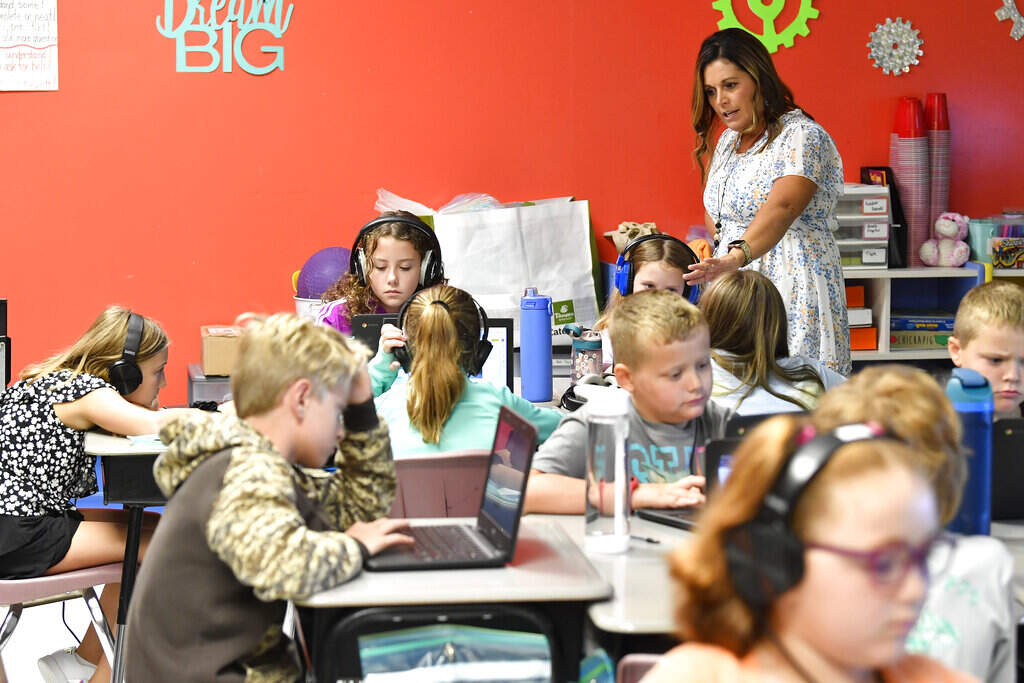
It's not just phones anymore. More teachers and even entire U.S. school districts are cutting back the time students spend on laptops and other screens. How do students really learn — and do screens help or hurt?
Guests
Inge Esping, principal at McPherson Middle School in McPherson, Kansas.
Jared Cooney Horvath, cognitive neuroscientist who specializes in the science of human learning. Author of the book The Digital Delusion: How Classroom Technology Harms Our Kids' Learning — and How to Help Them Thrive Again.
Also Featured
Sonja Santelises, CEO of Baltimore City Public Schools.
Dylan Kane, 7th grade math teacher in Leadville, Colorado.
The version of our broadcast available at the top of this page and via podcast apps is a condensed version of the full show. You can listen to the full, unedited broadcast here:
Transcript
Part I
MEGHNA CHAKRABARTI: In just the past few years, a remarkable revolution has happened in American public schools. More than 30 states have passed laws either curtailing or fully prohibiting cell phone use in schools. Those are these bell-to-bell rules. Now, the bans are driven by increasing concerns over kids' mental health, their ability to focus and reduced learning.
Now that backlash is spilling over to all screens in classrooms, not just phones.
DANA: It's affecting his social and emotional wellbeing, I feel. And it's affected his habits, his attention span. He used to love reading and really spent a lot of time outside and I have seen a dramatic like cliff he has fallen off of in terms of prioritizing screens, feeling glued to his laptop.
And it's not even like doing schoolwork. There's like games on the school laptop.
CHAKRABARTI: That's On Point listener Dana, who has a middle schooler in Lincoln, Nebraska. Here's Natalie. She's a mom of four in Oregon.
NATALIE: We've made little progress in getting the school district to take these concerns seriously. When the school district installed a student facing AI app onto students' iPads in grades as young as third grade, which is eight-year-olds, parents organized to push back. A coalition of concerned parents put together a parent and community sign-on letter to the school board, demanding that the district remove the generative AI app.
Other concerns parents brought up was YouTube videos being increasingly used in classrooms for behavior management, even in PE. And a new requirement that all elementary age kids bring an iPad to the library for browsing and checking out books.
CHAKRABARTI: A teacher in Winston-Salem, North Carolina also reached out to us and says that the mandatory use of laptops in the classroom is keeping kids from learning even the most basic skills.
TEACHER: Unless I walk around the classroom the whole time, I won't know exactly what they're doing on their computers. And then when it comes to doing manual work, they don't want to do it. And sometimes they don't know how to fill a paper out. Sometimes if it's notebook paper, they don't know which side of the paper to write on.
So it's very disheartening.
CHAKRABARTI: Today we're going to talk about the rising concern over any screens at all in U.S. schools, and we'll hear from people who think they should be banished and from those who think that tech can be a powerful learning tool when used wisely. But this is such a present issue in American schools right now that I want to start by going a little deeper into a few examples of the kinds of shifts that some districts are starting to make.
Sonja Santelises has been the CEO of Baltimore, Maryland Public Schools for the last 10 years. Her tenure ends this June, but she's making a huge change before leaving. Next year, Baltimore students in kindergarten through second grade will have screen time limits of just 15 to 20 minutes per day in class.
That's a first for Central Maryland school districts.
SONJA SANTELISES: To me, this is a no-brainer. We see what it's doing to the neurological patterns of young people. Teachers are experiencing the differences in classrooms. We already have young people who are using devices at home. I felt it was important to send the signal to our teachers, to our families, to our young people that we know that learning with an over-reliance on technology is really harming the long-term academic capacity and outcomes for our young people.
CHAKRABARTI: Baltimore City Public Schools did not give every child a laptop or iPad prior to the COVID pandemic, but of course, that changed during school shutdowns and remote learning. But now back in the classroom, Santelises and her team have noticed that screens are reducing learning, contributing to limited attention spans, executive functioning issues, and even behavioral challenges. Maryland recently banned cell phones at the high school level, and Santelises says, now's the time to reduce digital distractions for younger kids.
So gone will be the one-to-one devices. Screens will have to be shared.
SANTELISES: They'll go back to cards. They won't have their device. The teachers will still have their devices. So a lot of the early reading screenings still happen and are technologically based. But young people having iPad time for two of their centers, that's part of what we'll be phasing out. Like there won't be that. And frankly, that's how our pre-K classrooms are. And it's almost like our pre-K has been a detox, right? From all of it, because it's device free. There's none of that. It's wooden toys, it's plastic food, it's bugs and huge magnifying glasses. And it's circle time going through letters and sounds, like that's what our pre-K is and our kids are better for it.
CHAKRABARTI: There are 77,000 students in Baltimore City Public schools, roughly 70% of them are Black, 20% Latino, and 15% or so are multilingual learners. 85% of the students are on free and reduced lunch, and roughly 50 out of the city's 130 schools have poverty rates high enough that they've been designated to receive additional state funding.
So as with everything in education. The question of equity looms very large when it comes to technology in the classroom. Some argue that removing screens will set back students who will otherwise not have access to the tech and apps, but Santelises says that's a flawed way of looking at equity in education.
SANTELISES: I think that when we don't pause, take a look at what the evidence is saying and turn, then that really becomes the equity issue. Because my goal was never one-to-one devices for Black, brown, low-income, first-generation kids in Baltimore City. My goal was equal educational opportunity, equal access to high learning opportunities, equal access to quality teaching, to rigorous coursework.
Extracurriculars. That's the end goal. You need to pressure test the equity argument, to wallpaper over with this argument that the goal was one-to-one devices for me is a limited, stunted, uninformed definition of equity.
CHAKRABARTI: Now, the use of technology in the classroom may have once been seen as a silver bullet to achieve better learning, but Santelises says her on the ground experience does not match that, and it's her responsibility to make the right decisions for the district's 77,000 children.
SANTELISES: We like quick, easy answers. We like to check the box. We need to have this conversation and the action that results from that, which is why I said we have to, at least in Baltimore City, make this first step because I've got families who are worried about whether they're going to be sent out of the country. I have families who are worried about if their rent, they're going to make rent this month and they don't have time, nor should they have to. So I as CEO, I'm gonna say, you know what, yeah, I'm gonna make the decision that your 5-year-old is not sitting in front of a device all day.
So why don't you go attend to making sure your family is fed? This is one less thing you have to worry about, at least during school hours.
CHAKRABARTI: Sonja Santelises is the CEO of Baltimore City Public Schools. So that's one example. Let's go to an entirely different part of the country. Let's go to Kansas where Inge Esping joins us.
She's a principal at McPherson Middle School in McPherson, Kansas. She's been principal there since 2022, and by the way, in 2025, she was named Kansas Principal of the year. Principal Esping, welcome to On Point.
INGE ESPING: Thank you so much for having me.
CHAKRABARTI: Now, I know that you became principal in 2022 there, but you were an educator before that.
I understand that in McPherson Middle School, they first had this widespread adoption of Chromebooks roughly around 2016. Is that right?
ESPING: Yes. Yes. We've been one-to-one for 10 years.
CHAKRABARTI: So what was going on in education back then that made educators believe, hey, this was a powerful new tool, be a good idea for every kid to have one.
ESPING: As I was listening to the previous person, that's exactly it. This was supposed to be the great equalizer. This was going to be the reason that students have so much more engagement. Because we're offering them technology. And how exciting is it for students to be able to learn on a device that's going to automatically increase their engagement?
It's going to automatically increase equity across socioeconomic backgrounds. This is going to be the way to really prove that data is moving forward. Teachers are going to have that information in real time. And so that's really where that came from, was that excitement. Also, the thought of, I think a big shift in education was why would I teach them anything that they can look up? And so that was part of the shift towards technology. Let's work on deeper problem-solving skills and things like that. And we don't necessarily need to teach things that they can just Google. And truly, haven't we now seen how flawed that thinking is.
CHAKRABARTI: But I've asked you about this background because it's important to remember that at that time, you're exactly right.
My kids are still in school, so I remember this time clearly. That the idea really was like they have access to the entirety of human knowledge, through computers. So what students really needed to learn were those skills, as you said, on how to be more critical thinkers.
And the other part, which I just want to emphasize that I remember hearing is important, is okay, we can personalize learning, maybe. We can track kids and use the data to help better education. All of these things. It seemed like this paradigm shifting technology for classrooms.
But what did you see as an educator? And then of course, from 2022, when you joined McPherson Middle School, what did you see actually happening on the ground?
ESPING: Yeah, absolutely. All of those things were true. This is going to be the next greatest thing in education. And it has certainly fallen short.
Our test scores have not improved. And they certainly haven't improved due to technology. Teachers in my building, the reason that we made changes is our teachers came forward and said, I'm frustrated. I am constantly chasing the technology; I'm constantly chasing that students are on the correct site.
Or on the correct application and that they're not being distracted by so many other things that are exciting online. They're not being distracted by the social piece. And so it really became a management issue within the classroom. Our teachers were spending so much time making sure kids were on what they were supposed to.
We couldn't make sure that we were teaching them what they were supposed to be learning.
Part II
CHAKRABARTI: Principal Esping, before we get to the change that was recently made, I'd love for you to tell me a little bit more about the kinds of things that teachers were seeing. You mentioned behavior. Was there like online bullying that was going on too?
ESPING: Oh, absolutely. Students were using their school issued email or Google Docs to bully one another or even just to visit with one another during the day and be distracted from their learning. We saw students that were so invested in gaming that when a teacher would redirect them off of their device for the lesson at hand, we'd see an increase in different behaviors.
Another challenge that we saw was just the misinterpretation that this device that is from the school, that it belongs to that student. That it belongs to that family versus being a tool that the school has issued. And then parents were reaching out expressing frustration that they were struggling to understand how to parent with a device that they didn't want for their child and that they didn't ask for. And really where are those lines as well? So that's really what led us to rethinking our approach to Chromebooks.
CHAKRABARTI: And then ultimately at the end of the day, you had also mentioned that at least one measure of learning, it's not the only one, but one measure of learning being test scores, that you didn't see any upward trajectory with the screens in the classrooms.
ESPING: Yeah, absolutely. We didn't see the increase that really was touted when we went one-to-one in 2016. We were promised this is going to be a huge surge in test scores because kids are going to be so much more engaged, and that just fell flat.
We were promised [with Chromebooks], this is going to be a huge surge in test scores because kids are going to be so much more engaged, and that just fell flat.
Inge Esping
CHAKRABARTI: Okay, so then you make this big decision in December. So just a few months ago, almost in the middle of the school year. No more one-to-one issued Chromebooks. Were there tears in the hallways of McPherson Middles School?
ESPING: Really not as many as you would think. We definitely had some students who were upset.
And interestingly they would point to all of the reasons that we were taking them away. This was how I would plan to meet up with my girlfriend outside of the restroom during class time. This is what I used at home to game. So all of the reasons that we were given, even from students who were frustrated, were reasons ultimately that we chose to remove them. Coincidentally though, most of our students have been very pleased with the decision. They've really appreciated. I've had students even point out there is so much less bullying going on within our school because we don't have the one-to-one Chromebooks.
I've had students even point out there is so much less bullying going on within our school because we don't have the one-to-one Chromebooks.
Inge Esping
That's a huge win.
CHAKRABARTI: Wow. Okay. So hang on here Principal Esping. Because I definitely want to hear more from you on how the school made the transition and how learning looks different now. But this is a good time for us to actually bring in Jared Cooney Horvath. He's a cognitive neuroscientist who specializes in the science of human learning, and he's author of The Digital Delusion: How Classroom Technology Harms Our Kids' Learning, and How to Help Them Thrive.
Again, Jared Cooney Horvath, welcome to On Point.
JARED COONEY HORVATH: Thank you so much for having me on.
CHAKRABARTI: Alright, so give me the data here. Like how do we quantify or how do you measure the difference in learning on a screen versus off a screen?
HORVATH: Oh, you've got two main angles you can take. The first is going to be these international and national tests.
These things we've been giving for 30, 40 years, so we can track kind of progress over time, what's happening. And when you look at those scores, so that could be across reading, math, science, doesn't matter. Those have always been going up since the late eighties, early nineties to about 2012, those scores always go up.
And right around 2012, in every country we study around the world, they start going down. Now that's where you get to now get a little, have a little bit of fun, and you can start to align that with how often are kids using tech in schools in these different countries, including the U.S. And that's where you'll see a very strong line between the more kids use tech, the more their learning goes down.
And as the years progress and more schools use more tech, learning goes down even further.
CHAKRABARTI: So there's a strong correlation there.
HORVATH: Massive correlation. And that's where a lot of people say correlation isn't causation, which is a really, that's an important thing to consider. In single data sets, when you see the exact same correlation across countries across years, across topics, across ages, that's when you really start to push towards causal inference and say, okay, it's going only in one direction. But that's where to keep going on the question, you then can do research. You can flat out just say, all right, let's do some research comparing tech to non-tech methods.
And in those instances, as well, tech almost invariably comes lower than analog teaching and learning methodology, and we've had that data since 1962, believe it or not. It's all going in the same direction.
CHAKRABARTI: Okay. Wait, so tell me more, give me a little bit more detail. Because of course there's this huge question looming over all this, which is what is learning? But so specifically, these tests that you're saying that are tracking this global decline in learning, what are those?
What do they test for?
HORVATH So those will, most of those academic ones will look at reading skills, math skills, and science skills. But beyond that, we also have cognitive testing, which has been peppered in throughout as well. So we're also looking at critical thinking skills. We're looking at creativity skills.
We're looking at executive functioning skills, and if you even want to get even deeper, we've got IQ data stretching back decades as well that we can tap into. And in all of these instances, I was just talking about this with someone this morning. In every single cognitive measure we have, Gen Z is going down compared to their parents except for one.
There is one where they consistently do better than anyone in history, and that is rapid visual scene interpretation. Basically, they can watch TikTok really well. And you know what, if that's a good thing, go for it. But other than that, everything is going in the other direction.
CHAKRABARTI: Okay. Principal Esping, let me come back to you.
I'm hoping that you can play the role here of ground truth, okay? So reflect on whether you've seen evidence in McPherson Middle School of the kind of decline in basic reading and mathematics skill over a period of many years as screens were introduced.
ESPING: Absolutely.
I wouldn't say here at our school it's necessarily been a rapid decline, but it sure has not increased. And so it feels like no matter what we've done to really increase our math and reading scores, they've been pretty stagnant throughout these years. And so when we consider what really need to do to start increasing our math and our reading skills.
We recognize that less Chromebook time was one of the things that we can do to really focus on improvement of our scores.
CHAKRABARTI: Okay. So Jared, I kind of want to, when I say screen, that's like such a generic term that let's break it down a little bit more. Because there's the physicality of the screen itself and how information is transmitted.
On a LCD display. There's of course also the actual technology and the apps. So let's start with the first one. I don't know, is there any, are there any studies that can help us understand why learning is different through an actual physical screen versus a book or I've got 50 sheets of paper here in front of me.
HORVATH: Absolutely, and that's a great one. So let's just take the reading example. So this is just one of many mechanisms. When we read, our brain loves space, spatial location. Where in three dimensional space did something occur? That becomes a strong part of your memory that you can use later to access that learning.
Think about a book, until a book burns into dust, that book has a static, unchanging, three dimensional location. Like for instance, like the word 'the' will be 10 pages in, left page, top left-hand side. It ain't going nowhere, and that becomes a part of what you learn. That's why if you're an avid reader of books, you'll recognize when you're done reading a book. You might not know verbatim everything you just read, but you will know exactly where in the book everything occurred. Like you can flip right to that quote that you were looking for.
Now, when we read on a screen, there is no three-dimensional location, the same word 'the' will start at the bottom of the screen, go through the middle, pass out the top. There is no three-dimensional location, so an entire aspect of human memory just gets dumped. So this is why when we read from screens, everyone, not just kids. This is across the board. After about two or three minutes, we just start skimming because our brain basically tells us we're not actually locking any of this down.
So you might as well just look for keywords and get a gist and then get out of here.
CHAKRABARTI: Wait, hang on for a second. Hang on.
HORVATH: So that is a biological issue.
CHAKRABARTI: That is huge. So all of us just naturally, our brains shift to skimming mode when we're reading from a screen.
HORVATH: That is, and most of us can feel it.
We can track it. So when we read, our eyes will move in these very predictable about nine letter chunks across a page. And so if I can track your eyes, I'll just see the same bang, bang across a page. We track that same person on a screen. After a couple minutes, the eyes just go vertical.
Instead of going across the page, they just start going up and down, which means they're basically just looking for anchors. And then they'll look for one or two words and off they go. No one reads well from a screen, unfortunately.
No one reads well from a screen, unfortunately.
Jared Cooney Horvath
CHAKRABARTI: Fascinating. Okay. Principal Esping coming back to you. Starting this January when there were no more one-to-one Chromebooks, and I should say they're still used in certain ways at the middle school.
We'll talk about that, but how did that change how teachers were actually presenting information or having kids, put their own ideas down?
ESPING: Yeah, absolutely. Previously, note taking a lot of times was done either using a Google Doc or using a Google presentation. So just what Dr. Horvath was saying, like we're just hunting and pecking for information, hunting and pecking where to put it within this presentation and not taking the time to actually read what the information is, to understand what that information is and why this is an important note to take that we're going to apply later.
So now, note taking is done on paper. Teachers are helping students learn some of those executive functioning skills of how and why note taking itself is important. Here's different note taking strategies and why they work even more for different subjects versus others.
Here's different strategies and what they do. Also, just the physicality of handwriting. And how that just deepens knowledge versus typing something that feels the exact same way. Writing the word 'the' feels different. It implants in your brain differently. And our students are note taking.
They're doing physical worksheets. They're doing physical work for math. Rather than using a computer program to help and assist. So it really has been a game changer. Something --
CHAKRABARTI: Do they like it? Do they like it when you're like, you can either choose to do an exercise on the Chromebook or on paper.
What do the kids they do?
ESPING: They do. So when teachers have given an option, you will largely see most of the students choosing paper. For certain items, let's say they're typing a report, some students will choose to type, but I've been shocked at how many students have said no, I prefer to hand write.
I feel like I can understand what I'm doing better. So by and large, more than half of students are choosing paper if given the option.
By and large, more than half of students are choosing paper if given the option.
Inge Esping
CHAKRABARTI: One quick thing about that, because of course not every student is the same, and I imagine, and speaking, the question I'm about to ask you comes from personal experience.
I happen to be the mom of a kid who really struggles with handwriting. Like it's a major challenge for him and the way he's able to get his ideas down better are through typing. So like how do you make those accommodations or how do you deal with kids who have different kinds of needs in terms of how they can get their ideas down?
ESPING: Yeah, absolutely. We certainly have students who do struggle and require text to speech to text options and absolutely. We allow that. We've helped students learn how to become independent using those different options. But then we're also really focusing on, let's continue to teach you handwriting skills and let's find ways and situations where we can hopefully make that be a little less laborious.
Help you understand some of the why, help you understand how to get that down a little bit differently. My son's in that exact same boat where handwriting is almost painful for him in some ways. And we're still enforcing in him the practice. And here's the why. But then here's a tool that you can use in these situations to help provide an accommodation if need be.
CHAKRABARTI: Okay. So Jared, Principal Esping brought up two really other huge areas of what constitutes learning. Let's stick with handwriting, or at least in terms of how there's maybe some kind of physicality to learning that helps deepen knowledge or at least deepen how we hold information in our brains.
HORVATH: A lot of us think that, yeah, we were a brain hitching a ride inside of a body. Like you are nothing but grey matter, just coasting along while these things move you. And we forget that, no, you are as much your body as you are your brain. It's called extended cognition. The reason why we haven't found consciousness in the brain is because it doesn't exist there. You are as much your heart and your lungs and your knee and your toe as you are your brain. You're all of it. Which means when the entire system is doing something, that contributes to the learning as well. So take something like typing, the most gross motor skill, which is consistent across the table, basically.
Anyone can do it. And it's once you learn it once, you can do it everywhere. Versus handwriting where every single tool you pick up, is it a crayon, is it a pencil, is it a pen? Everything you write on, is it hard paper? Is it graph paper? Is it cardboard? Everything is so subtly different. It forces you to think differently as you're doing it.
And the speed issue in physicality of writing basically forces us to think. Writing becomes thinking, whereas typing basically becomes transcription of either previously thought thoughts or words coming at you. So by all means, the slow, deliberate physical nature of writing changes how we actually think and learn through that process.
CHAKRABARTI: Slowing things down deepens the learning. That is so interesting.
HORVATH: Absolutely.
CHAKRABARTI: Okay. There's another one here that the principal mentioned. When I was growing up, I can tell you no one in my cohort or the parents of all my friends, no one really heard of the term executive functioning. But now I feel like every parent or many parents are deeply concerned about it because they're seeing their kids not being able to do stuff that they could do when they were the same age. So how would you define executive functioning Jared and how does that play into again, the tech and the classrooms issue?
HORVATH: You make a great point. The reason why we never really talked about it in the past was because we never really had to.
It's very similar to before we dive into that, consider something like resilience. We never had to teach resilience because you earn resilience through life, whether you have a word for it or not, it's how you live, it's how you develop it. It's the same with executive functioning. This is your ability basically to control your own thoughts, your own behaviors.
If you think about education, it's the ability to remember, I have to do some homework tonight. I have to schedule my time accordingly. I have to bring it in and hand it in the next day. All of these little things that forced kids to take control of their own behaviors and thinking. And in so doing, we failed.
How many times did we forget our homework? All of that is what builds executive functioning. Cut to the modern world where we use digital technology to offload all of that. I have an LMS system that pings me. Remember to do your homework. Now, all I have to do is press a button, it will submit my homework for me online.
All of these little mini things that were teaching us this ability to control and recognize our own behaviors are going out the window because tech is basically taking it over for us.
Part III
CHAKRABARTI: We received a lot of feedback from you. Let's listen to another teacher here. This is Jim from Austin, Texas. He's a parent and also sometimes a substitute teacher.
JIM: Teacher directed screen time can be powerful in the hands of skilled, motivated teachers and engaged students, but that's rather the more the rare case.
Too often it becomes a crutch, especially for less motivated or less prepared teachers. Platforms like Google Classroom end up replacing real instruction rather than supporting it. The result is a more passive classroom. Minimal effort. Very little critical thinking, widespread cheating, and frankly, a real erosion in student character.
Screen time isn't the problem, but how it is used too often is.
CHAKRABARTI: So that's Jim from Austin, Texas, principal Esping. Let me ask you, when he mentioned Google Classroom there, we haven't talked about the actual software yet, and I'm just wondering, before this year, how ubiquitous was things like Google Classroom or any number of the other million educational apps there are out there, how ubiquitous were they in your classrooms?
ESPING: We have certainly used Google Classroom. That was definitely something that we used much more heavily starting with COVID. We have all of our curriculums are able to have a strong online component. Something that I think is misinterpreted sometimes though is there is a difference between a Google Classroom and some of the other online curriculums.
There are curriculums out there that do a fair amount of the teaching for that teacher, then they're not able to get in and really do what they've been passionate about. Google Classroom, however, is much more of a management system and that's where as we talked about previously, Google Classroom really takes away those executive functioning skills.
That's where teachers can place, here's your assignment and here's the due date. And it emails you auto reminders of here's the due date, here's the due date. You don't have to physically hold onto a copy to turn it in. You can't lose it because it's there on Google Classroom for you.
So really where we see a struggle with a platform such as Google Classroom is it's not given students the chance to become responsible for their learning, for their materials and for investing further.
CHAKRABARTI: Let me ask you about the business side of this, because Google was one of the earliest to try to get its technology into classrooms, obviously, well before the pandemic.
And then we also have the multi hundreds of billions of dollars of business of ed tech here. When you decided to stop using the Chromebooks or the apps, I don't know if you know this, but were there any sort of contractual obligations that the school had to fulfill or were potentially breaking in terms of having this stuff and then not using it?
ESPING: Thankfully our district, no. But I know that there's a number of districts out there that do have contractual agreements with different ed tech apps and things like that. Thankfully in my district, they were forward thinking enough that all of our curriculum had both an online and a physical component, which made our transition very easy.
And it's really been sad to me to connect with educators across the country to hear all of the challenges that they may face if they would like to lessen tech in their own classrooms.
CHAKRABARTI: That is a really good point, right? Because what do you do when you take away the screen-based curriculum?
Okay. Jared, let me ask you this. Google has said that in terms of some of the behavior and security concerns that both educators and parents have, that there are tools that schools can use to lock down Chromebooks, screens. They can restrict content. They can even shut off access to all of YouTube.
Or they say they've done that by default for K through 12. Why aren't these things enough to mitigate? No, I'm asking you genuinely, to mitigate the harms of screens in classrooms.
HORVATH: I love that. That's the use tech to cure tech. I'm going to invent a new cigarette to help you get off the old cigarette.
I guess these things could work, but you gotta remember, human beings have a drive within them to break systems. That's what we do. If anyone listening right now has ever played a big open world video game, you'll notice the first thing you do is you try and break it. You go as far as you can into the game to see what happens if I get to the edge of the map, can I punch this person?
Can I climb this tree? We are always looking for the edges to see where can we push beyond it. So kids are no different. If the second you put a tool in place that tries to block them from something. Guarantee you 20% of them are going to spend nothing but the next two hours trying to get around that block.
And they'll find a way, best example of this, I won't name the country. I lived in a different country for a while, and they took their national test online. And so all the kids had to do it at all the same time. Everyone is in their classrooms. Everyone logs on, they say, we have this thing, it's locked and loaded.
Five minutes. It took some kids somewhere in that country to hack that system and completely shut it down. So there was no score that year. No one could take that test. It's cute. It's funny. It's just that's not the world that we actually live in, unfortunately.
CHAKRABARTI: Okay. Principal Esping, Jared just mentioned their testing.
Do Kansas students take standardized tests on computers?
ESPING: We do. And that's actually been one of the reasons that we've been told we need to continue a lot of online education, so that they are prepared for their tests. But that's not what prepares them. We just need them to understand a basic use of technology.
They need to know how to use the tools on the test. They need to know the content. And that's not a tech thing. I'm just giggling at what Dr. Horvath just shared. We actually had our tech company that we partner with to help support our system. We had a student that we knew was not using their Chromebook appropriately this fall.
But they were so crafty at getting around everything that we had in place that honestly, we watched them for two and a half weeks just to learn from them how to get stronger at setting restrictions before we addressed the problem with them. Because they, golly, that child was such a hacker. Just such an incredible hacker. Anything we had in place they were just, like you said, within five minutes, able to get around it. So we learned a lot from that student, but that's not what we want teachers to do. We don't want them to be chasing tech issues all day long. They've got too much content to give to students to help prepare them.
CHAKRABARTI: You have your own in-house white hat hacker. Wow.
ESPING: We do. And every school across the nation has their own, at least one.
CHAKRABARTI: Okay. I want to just hear from one more educator because it occurs to me that the way we've been talking about learning, people might think that maybe the absence of screens in classrooms is particularly good for, say, the humanities, for reading.
But it turns out that lots of teachers in other subjects are saying that taking laptops away from the classrooms has had a positive impact. One of them is Dylan Kane. He teaches seventh grade math in the Leadville, Colorado Public School District. He's been teaching for 14 years, both middle school and high school math.
DYLAN KANE: A couple years ago, I was using a lot of technology in the classroom. I would say maybe 50% of class time students were on Chromebooks for all sorts of different websites, practice tools, different things. Like I actually made my own like math fluency practice website. Because I was just a big believer in technology, in the instant feedback and the personalization that you can give students.
And over time I became a little disillusioned with that. I just realized that a lot of the tools were very clever and very cool, but weren't getting students to think hard in the way that helps them learn.
CHAKRABARTI: So he began reducing tech time in his classes, dropped it to about 20% of class time this past fall, but he still wasn't satisfied.
KANE: What I was seeing was students who just couldn't tear their eyes off of the screen. And so when I tried to get students to do something on a screen and then talk about it with each other or to talk about it as a class, it was like once the screens were out, there was this gravity that was just pulling them and keeping them from focusing on each other and focusing on kind of talking about the math that I wanted them to learn.
I saw screens cause students to turn into video game mode. Like their goal was to like beat the level rather than to think about the math and learn something from it.
CHAKRABARTI: So that's when Mr. Kane decided on another more drastic experiment. For the entire month of January, his math students got zero screen time, none at all.
And he says it worked.
KANE: For some reason it's easier for students to hide when they're behind a screen. Walking around, glancing at students' work on paper, I can get a much better sense of where students are at. Who needs support? I think students are more willing to ask for help. And so I think that like social relationship was the biggest change.
Like I think students really benefit from the, like, human to human interaction and human to human accountability that motivates them to learn.
CHAKRABARTI: So that's Dylan Kane. He's a seventh-grade math teacher in Leadville, Colorado. ... Jared, this gets me back to this question of how ubiquitous is the impact of screens and then also how consistent is the impact of removing them. We actually started the hour talking about the equity issue and I realized I hadn't heard from you on that. Because it's such a big one that, you know, for people out there who still say, look, I want my child to be able to get access to higher level math, say, through these apps, because we can't afford to send them to supplemental math education outside of school.
What do you say?
HORVATH: Yeah, that's where the equity issue becomes tricky because there's a very narrow definition of it, which says, where there was no access before, I now have access. And in that case, yeah, tech is great. If the debate is something versus nothing, you always take something. But that's where you got to then blow out and realize ed tech isn't really talking about something versus nothing anymore. They're talking about boosting learning and narrowing, learning gaps through their tools, and that's where you see in every country we've looked at.
So just start in the U.S. from 1992 to 2012, the gap between the highest performing kids and lowest performing kids on national tests decreased about 10 points, so about one point per cycle.
Since 2012, it has increased almost 20 points. We're now looking at a four-point swing per cycle in the other direction. And then that's same across if you look at 50 different countries, even though tech use goes up in all these countries, as soon as tech use increases, the gap between the highest performing and lowest performing starts to widen.
And this is because if you want tech to be useful for learning, you already need to know how to learn. That's one of the weirdest things we've ever found. The only people who succeed learning on tech basically don't need any more support. They have what are called self-regulated learning skills. Now, where do you develop that?
The only people who succeed learning on tech basically don't need any more support. They have what are called self-regulated learning skills.
Jared Cooney Horvath
You develop that traditionally through a K through 12 general education. So the kids who need the most support are being thrown onto screens and they have the least prep to be able to succeed on it. And the kids who probably can succeed on screens, they're the ones who most schools are like, we're going to focus mostly on you.
And so we've got this whole system backwards and the equity issue has been getting worse and worse since 2012.
CHAKRABARTI: Wow. Okay. Unfortunately, we're running out of time here and I have so many more questions for both of you. But I'll limit myself reluctantly to just one each for both of you. And Jared, you get first crack here. I would become automatically skeptical of any solution that seems so simple and yet so potentially transformative, right? Could it really be as simple as reducing, if not eliminating screens in schools to improve kids' happiness? How much they're learning, how much they're retaining.
I guess what I'm saying is, almost seems too simple.
HORVATH: Yeah. But if you go and look back, 2010 was about the peak education around the world and what were we doing then? It's one of those things where we started to do something wrong, and it doesn't mean we can't get better, but this is an issue of just backtrack.
Things will get better, and then we can decide what's the better way to push forward after that. I always say, here's my favorite stat. I know many schools that have instituted some cell phone policy or some soft, you can only use computers during class, but not between class. Most of those schools go right back to their original tech policy.
Didn't really work. I have yet to meet a single school that has either banned cell phones or taken away one-to-one devices that has ever gone back. As soon as they take 'em away, they go, oh, why didn't we do that earlier? So I don't say they don't exist, I just say, I haven't found 'em. I have yet to find a school that said that was a bad choice going back to analog methods.
CHAKRABARTI: Principal Esping, my last question is I suppose in terms of if learning is improving, you're going to, you're going to measure that through the testing metric at least one way, as you talked about how you saw the decline in learning earlier. But I also wanna know.
In these first few months of doing this, do the kids seem more engaged? Do they seem happier?
ESPING: Absolutely. And the best part is hearing them say that out loud. I notice myself that I'm more engaged with my teacher. I notice my classmates are as well. I've seen, I have students who have pointed to, we're bullying one another less because we don't have the ability to do that online.
If we're going to say something mean, we have to say it in person. And many of us are not brave enough to do that. So truly by and large our students are happy about this decision. They appreciate having more engagement with their classmates and more time on paper.
The first draft of this transcript was created by Descript, an AI transcription tool. An On Point producer then thoroughly reviewed, corrected, and reformatted the transcript before publication. The use of this AI tool creates the capacity to provide these transcripts.
This program aired on April 14, 2026.