Support WBUR
Why you’re thinking about the Supreme Court in the wrong way
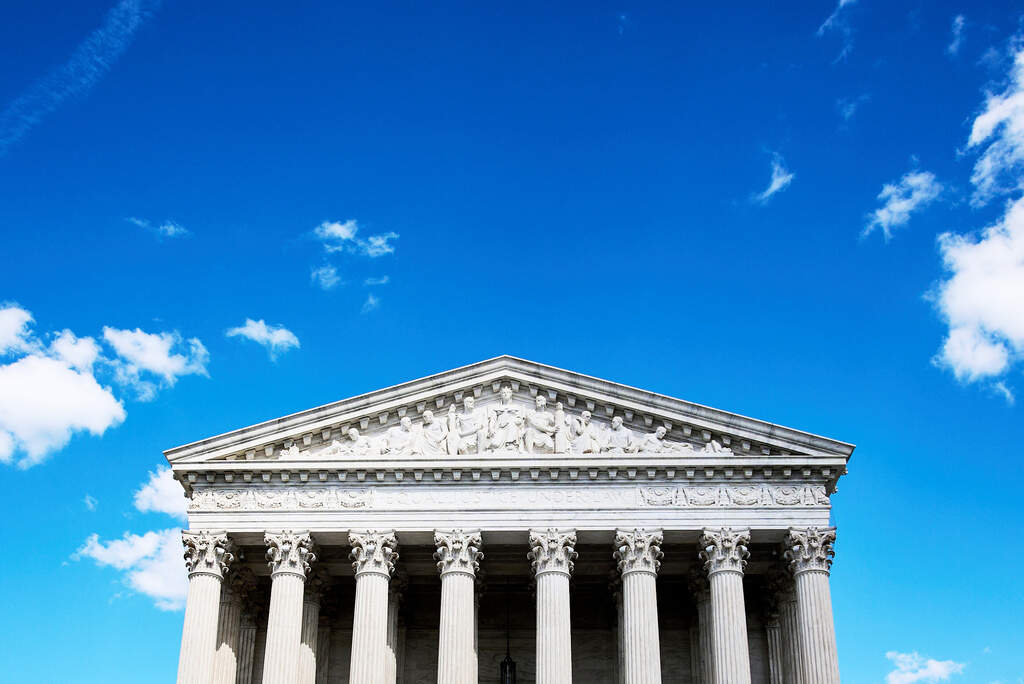
Political partisanship is one way to measure how the Supreme Court justices think about how their rulings affect the nation. SCOTUSblog editor Sarah Isgur says another, she believes more important way, has to do with their tolerance for change, with the justices ranging from order-loving institutionalists to true chaos agents.
Guest
Sarah Isgur, senior editor at SCOTUSblog. Host of the podcast Advisory Opinions.
The version of our broadcast available at the top of this page and via podcast apps is a condensed version of the full show. You can listen to the full, unedited broadcast here:
Transcript
Part I
MEGHNA CHAKRABARTI: In 1787, at the Constitutional Convention, James Madison suggested that the newly United States should be ruled by three co-equal branches of government. Of course, the legislative, the executive, and the judicial. The idea was, and I know you all remember this, that no single branch could become too strong and that each would serve as a check on the others.
Okay, so here we are 200 plus years later on the 250th anniversary of the birth of this nation, by the way, and we have a legislative branch that is basically self-paralyzed by partisan politics and untrusted by the American people. In the presidency, we have years of effort to maximize executive power coming to fruition.
Those two reasons are why many people and groups are now looking to the federal judiciary as the place where Americans can continue to place their faith in the rule of law. And of course, the last stop there is the United States Supreme Court. Sarah Isgur has a provocative take on the high court, and she knows it well.
She's the senior editor at the highly respected legal journalism and analysis site, SCOTUSblog. Her new book is titled Last Branch Standing: A Potentially Surprising, Occasionally Witty Journey Inside Today's Supreme Court. Sarah, welcome to On Point.
SARAH ISGUR: Thank you so much for having me. I've been really looking forward to this conversation.
CHAKRABARTI: Same. Okay. I have so many questions for you, Sarah, that I just want to jump right in.
ISGUR: Let's do it.
CHAKRABARTI: Let's go. So you want to completely reorder how Americans understand the Supreme Court, and the whole first section of your book presents us with three new groups that you put the justices in. Three buckets, the deciders, the conservative honey badgers, and the lonely liberals.
Let's, who goes in what bucket?
ISGUR: Yeah, maybe we should think of this as like lunch tables in the high school cafeteria. So the deciders are maybe the ones we should start with. This is the Chief Justice, and then Justices Brett Kavanaugh and Amy Coney Barrett. These are the justices most likely to be the fifth vote in any case. They are in the majority more than 90% of the time in any given term. Justice Kavanaugh has been in the majority since he got on the court more than any justice in modern history, including the swing justice that he replaced, Justice Kennedy. So if you want to be able to predict how a Supreme Court case is going to turn out, you've really gotta understand those three, what they're into and why they decide things the way they decide them.
CHAKRABARTI: You've got all, you've got Polymarket hopping right now, I have to say.
ISGUR: (LAUGHS) That's the goal of any podcast really.
CHAKRABARTI: (LAUGHS) No, but go ahead.
ISGUR: Then we've got our conservative honey badgers, that is Justices Thomas, Alito and Gorsuch. So while they sit together at the same lunch table, they're like the Dungeons and Dragons crew that is doing their own thing while sitting together.
They actually are the least likely of any of these groups to agree with one another. But they are all, what we'll get to, I think, which is low institutionalists. Meaning they're not that into precedent. They think their jobs are really to speak just for themselves and their views of the law. Not really interested in what the consequences might be.
There's good parts and bad parts to that, by the way. And then the last group. The lonely liberals, that is Justices Sotomayor, Kagan and Jackson. Yes, they are liberal ideologically. But it's really interesting to think about how Justice Kagan is much closer to Justice Kavanaugh on these institutionalist concerns.
Whereas Justice Jackson, much closer to Justice Gorsuch as a non-institutionalist. What I refer to as a YOLO justice.
CHAKRABARTI: Okay. This book was so great and folks, you're getting a sense as to why, you actually answered what was gonna be my last question, which is this dichotomy between institutionalism and I think another phrase I read in your book was chaos agents.
How that plays out amongst the liberals. So thank you for that. We'll come back, we'll come back to those lonely three in a minute. But with the first two groups, the deciders and the conservative honey badgers. By making that the way that you're dividing the lunch tables here, why do you think that's more important than the conventional way that we, in the media and maybe most Americans look at it, which is that 6-3 partisan divide?
ISGUR: Yeah. The 6-3 partisan divide, and I'm gonna include in here 6-3 and 5-4 cases, okay? Where all of the liberals are in dissent, so still ideological. Even if one conservative is peeled off, only accounts for 15% of the cases from last term. So if you think it's a conservative court, you're gonna get close to 90% of the cases wrong in any given term.
In fact, last term, the exact same number of cases had all of the liberals in descent, again, whether it was 6-3 or 5-4. Exact same number had all the liberals in the majority and only conservatives in descent. Again, 6-3 or 5-4. And then of course that means 70% of the cases were cats and dogs living together, mass hysteria, liberals, and conservatives on each side of the V, so to speak, which means you're missing something if you're only thinking ideologically. That is not, by the way, to say that ideology plays no part. Of course, some of these guys are conservative, some of them are liberal, they have different judicial philosophies, but that's about 30% of the cases. The rest you have to understand on this institutionalist spectrum or again, we can come up with different terms of how to describe it, but it's more about how they view their job as a Supreme Court Justice as one of nine.
CHAKRABARTI: Okay. So talk to me then about some examples. Let's take the conservative honey badgers, Thomas, Alito and Gorsuch. Do you have particular rulings in mind or things they've said, or, decisions that they've helped that you think really highlight this like individualist take on the role of a justice.
ISGUR: All of the above. And we've got an hour. So let's do this. So, if you don't mind, I want to start with Kavanaugh and Gorsuch, because they're twins, right? They were the sons of powerful D.C. mothers back in the '70s.
Before that was even a thing. They go to the same high school; they have the same history teacher. They clerk at the Supreme Court for the same justice on the same term. They are both senior members of the George W. Bush administration. He appoints both of them to circuit courts and then they're appointed to the Supreme Court by the same president. They are Federalist Society, Petri Dish molds that have been grown for 50 years.
They are as conservative as one another, but last term, they were only on the same side of decisions 50% of the time. Which is crazy. Kavanaugh was more likely to agree with Sotomayor and Kagan than he was with Justice Gorsuch. Only Justice Jackson was lower on the list. So if these guys are such conservative twins, how come they never agree with one another?
And my argument goes back to sports. Justice Kavanaugh's favorite sports. Baseball, basketball. He calls it a team of nine at the Supreme Court. This is like his view of the world. This is a team, it's a middle school group project, if you will. And at the end of the day, you're turning in one diorama on the Cretaceous period to your teacher.
And so that may mean that you want to take out that paragraph if another justice will join the opinion if you do, maybe we don't take that case. Maybe we wait a few years. Again, you're thinking of it as like, how can all nine of us work together? Justice Gorsuch, on the other hand, he's very into skiing and running.
These are very solo activities. In fact, a fun fact, it was very hard for them to find U.S. Marshals like the protective service that could keep up with him on the ski slopes. My understanding is they actually had to put out a national like APB of who are the best skiers in the world in the United States who are interested in being U.S. Marshals.
Very solo.
So his view is I'm just here to tell you, you know, what I think of this case, it doesn't really matter what the other eight think. I only speak for, me, Just Neil, if you will. And so it doesn't matter what previous courts thought, we're not, this isn't some single court over 230 years. It's just me sitting here now saying what I think of the case.
CHAKRABARTI: Oh man. Sarah, you've got my stare decisis questions. Just really bubbling here, but I'll hold off on that for a second.
Okay. So we're talking about the court as it is today, but this division. Or separation between the institutionalists and the YOLO justices. Has that had, speaking of precedent, has that had precedent in the history of the court itself or is this a relatively new phenomenon?
I think we've always probably had justices that are along that spectrum in different ways. A question I often get asked from lay non-lawyer people is, oh, is one good and one bad? And my answer is no. I think like in all good marriages, you want people with different perspectives coming in.
And we need probably a couple non-institutional on the court, like Gorsuch and Jackson, and we want a lot of institutionalists. We want team players for sure on the court. But hopefully listeners are hearing in my description something good and maybe something bad about each one of these descriptions, right?
And so whether it's precedent or consequences or it's just me or I'm trying to amalgamate, from all of these nine minds, institutionalism, moderation in all things, including moderation.
CHAKRABARTI: Okay. I'm not sure, sorry, I'm only stumbling on my own words here because I'm about to disagree about the court with someone who's the editor at SCOTUSblog.
ISGUR: Let's do it.
CHAKRABARTI: And I do not have a law degree, Sarah, so I'm stepping outta line here. But I'm thinking about how I introduced the open here in that, when the Constitution was created, we're talking about three coequal branches of government, three institutions essentially. Having justices, in this case, you've only put three of them.
So a third of them who are strident individualists. That does somewhat undermine the concept that this is an institution, an organization with a long history that actually has a purpose as an institution, doesn't it?
ISGUR: So I would say that right now it's 5-4 institutionalists versus non-institutional.
Because Justice Jackson also is one of those non-institutionalists. And yes. So let me give you good examples of why we want both. Precedent, right? Precedent is important for the court because we don't want the law to change every time there's a new justice every few years.
And for example, just take bankruptcy law, right? Even if maybe our bankruptcy laws aren't perfect, maybe we would design them differently if we were starting over today. Consistency over time is way more important to the economic stability of the country, that people know how they can remove debt.
So we want that.
Part II
CHAKRABARTI: Sarah, so you were talking about how having institutionalists on the court is important for legal consistency, for economic consistency, to be able to run the country with some predictability, which is also ideally one of the reasons why precedent really matters in the judicial system.
But let me push this a little more and maybe make the argument that you're about to make as well, which is on the other hand, consistency and the endless honoring of precedent could also lead to things like. The Dred Scott Case standing until 2026, which we don't want either, right?
There are some, there are times in which the justices need to step in and say, previous rulings were wrong.
ISGUR: That's exactly right. To borrow a phrase, consistency is the hobgoblin of little justices. Sorry. That NPR joke maybe. A couple cases to point out of our low institutionalist justices; Justice Gorsuch wrote the majority opinion in a case called McGirt back in 2020.
And this was a question of whether large swaths, about 45% of Oklahoma was actually still Native American tribal land. And the federal government could not enforce federal criminal laws on Tulsa. And Justice Gorsuch was like; I'm going to look back at these treaties. Oh yeah. You guys didn't actually say anything about turning this over to the federal government.
And I know for 120 years we've allowed the federal government to enforce federal criminal law, but that's what the treaty says. Not my problem that Tulsa now here in 2020 is very used to being part of the state of Oklahoma. And, sorry, I misspoke. I meant under state criminal laws, not federal criminal laws, not my fault that Tulsa's used to being part of the state of Oklahoma. I'm just gonna read what the law is. Congress can always sign a new treaty if they want. Not my problem, not my monkeys, not my circus. And so we have this McGirt case that is, by the way, still good law today that says the state of Oklahoma does not control about 45% of Oklahoma right now.
And that's a very non-institutional decision. But hopefully you'll see that that doesn't mean that it was bad or the wrong decision. If that's what the treaty says, I think we do want someone on the court saying, that's Congress and the tribal lands issue to work out. I'm not here to rewrite a treaty for them.
CHAKRABARTI: Okay, so two points that we're going to come back to. One is Neil Gorsuch and his rulings on tribal law. Very interesting. I want to come back to that. Second is you mentioned Congress. I will come back to that branch of the government as well. But sticking with this institutionalist versus individualist dichotomy. I think the issue that a lot of people who are concerned about justices who are YOLO as you said, is that some of the individualist tendencies are coming out, not so much because of a fair reading of the law, as in the Oklahoma case, as you said, but more because they just don't like certain things.
And let me give you an example. One of my favorite cases from several years ago was the Janus Case. Yes. And I'm sure you remember that was the case where it was found that public sector unions in using dues from employees may be violating other employees' First Amendment rights. It was a First Amendment case essentially, and the majority ruled that yes, public sector unions cannot be able to use this money because it violates people who don't want it to be used that way, violates their first amendment. Okay. The reason why I bring this up is Justice Kagan's dissent.
Because she like set the page on fire and was so angry. I don't know if you remember, but basically her argument was, Hey, the majority in this case is absolutely ignoring a long history of precedents that the high court itself had put out over many years.
And here's what she writes. She says: The majority's road runs long and at every stop are black robed rulers, overriding citizens choices.
She says the justices wanted to pick the winning side and what it should be, and basically one of her most powerful arguments is that she looked across the 50 states and was like, Hey, 22 states have laws that have, that say X about what public sector unions can do. And 28 states have laws that say Y of what public sector unions can do.
But this majority today, just because they don't like unions, they decided to ignore all precedent. I think that was, the reason why that ruling has stayed with me is because I think it's hard to argue against her when you read what the majority's opinion was.
ISGUR: I am so glad we're, oh, this is such a fun conversation.
Okay. Let's talk about precedent for a moment. Just like what it is and what it's not. And let's start with some data. You go back to the Warren court. Where in like the 1950s, 1960s, they were overturning about three precedents a term on average. This court, the Roberts Court as a whole, is overturning about 1.7 precedents a term.
So actually the number of precedents per term overturned, that's a lot of turning, has gone down with every subsequent court from Warren to Burger, to Rehnquist to Roberts. Each time the number has ticked down a little bit. And interestingly, if you break up the Roberts court into, I don't, for lack of a better phrase, Roberts one and Roberts two.
So you know Roberts one being the Kennedy as the swing vote 5-4 court and Roberts too being the 6-3 court. The 6-3 Roberts Court is overturning even fewer precedents than the 5-4 Roberts court. Okay. So that's like level setting of where we are. But what is precedent.
I love this case called Ramos. This was on non-unanimous jury verdicts. And I like it because it is not in our culture of war, high emotion stuff. Can states allow people to be convicted of major felonies if only nine jurors think they're guilty? And it was about a precedent called Apodaca, which is really fun to say.
Highly recommend bringing it up in cocktail parties, just to say it. And Apodaca said, of course, states can decide this. It's up to them. All nine justices on the court thought that Apodaca, the precedent, was incorrectly decided. But the question in Ramos was, okay, Apodaca is wrong. What are we gonna do about that?
Do we keep the wrong precedent in place for the sake of stability and the reliance that these states have had on it? Or do we overturn it because Apodaca was wrong? So when we talk about precedent, you have to actually find that you disagreed, like you think the previous case was wrong. Otherwise, the precedent itself isn't what matters.
I went back and read a bunch of the briefs in Plessy, sorry, in Brown v. Board of Education that overturned Plessy v. Ferguson. This is segregation, the heartland of why we talk about precedent. Nobody in Brown v. Board of Education was like, Plessy was wrongly decided, but we should keep it on the books anyway.
We've built these separate water fountains, like we wouldn't want to get rid of those. And so when we deal with precedent, I think we get confused oftentimes because people just agree with the previous case. Roe v. Wade is another example where I didn't hear many people saying, Roe v. Wade was wrongly decided, but we should uphold it anyway. So that brings us to the Janus Case. That was 5-4. Like you said, I don't think that case was much about precedent on either side. I don't think that Sotomayor thought the previous cases were incorrectly decided. She agreed with those previous cases.
The majority disagreed with those previous cases. They were having a debate on the merits of the First Amendment and union dues, and so very few debates we're actually having are about precedent or stare decisis, if you wanna get all Latin. But I do have this great quote from Justice Kagan, and she talks about stare decisis being the doctrine of humility.
And I love this because frankly, I think we need more doctrine of humility in all of our lives. And especially when we talk about politics. So if you don't mind, I'm gonna read this from Justice Kagan.
It's easy to get on the court and think, what were they thinking? And that's just got to be wrong, and my perspective is better.
And so I'm going to do things my way. And one of the things that Stare Decisis does is to tell judges, don't be so fast. There's a kind of wisdom of the ages. And if a lot of different judges have seen something differently, you should ask yourself and then ask yourself again, Are you so sure that you have it right?
And I love that, because again, this is the most institutionalist thing a justice can say, right? Kagan is one of my high institutionalists right there with the Chief and Justice Gorsuch, Justice Kavanaugh. That's what precedent is about. It's about that doctrine of humility.
CHAKRABARTI: Okay.
Let me just jump in here because let me go back to Kagan's dissent in Janus then, because she said it used almost this exact same language. She says, quote: There's no sugarcoating today's opinion. The majority overthrows a decision entrenched in this nation's law and its economic life for over 40 years.
So she's accusing the majority there of throwing out the whole stop and think purpose of stare decisis, the humility purpose.
ISGUR: Yeah. And Janus is a fun case because of that actually, it's a sort of hard case, I think, to dig into all of the legal intricacies of, but let me broaden it out to this.
Over time conservatives and liberals have taken turns expanding the First Amendment and then not wanting to expand the First Amendment, including the justices on this current Supreme Court. And unenumerated rights are similar in that way. So you go back to the turn of the previous century, and you had the conservative justices, and by the way, conservative-liberal on court, in court world doesn't line up perfectly in partisan world. It really literally means conservative versus liberal. Whereas our politics, I don't think those words mean much anymore. But anyway, so go back to the 1900s. The conservatives on the court were like, the Bill of Rights says that it doesn't list every right.
So we know there are rights that are not listed. One of those rights that we think should be in there is economic rights. And so they said that all of these people have the right to contract their own labor, for instance. So they struck down child labor laws and various work time protections because of that economic unenumerated right.
And the liberals hated un enumerated rights. Then comes the Warren court. Now the conservatives are like, yeah, maybe that unenumerated rights thing had no real limiting power. We're ditching that and liberals were like, aha, unenumerated rights. This is great, but not economic unenumerated rights.
Let's do civil rights. Social rights that aren't listed in the Constitution, but we think the vibe is there, if you will. And then of course, the pendulum swings back after the Warren court. Conservatives react to that and are like, no, these unenumerated rights for those purposes are bad.
But maybe there's unenumerated rights to parent your own children without interference from the government. And my point in this is that to understand the Supreme Court. Every justice, every current iteration of the court is a reaction to what came before it, right? Politically, legally, culturally, all of the above.
And so you've gotta dig into that history. Not just a case that you might disagree with the outcome of or agree with the outcome.
CHAKRABARTI: Okay, so let's look at recent history a little bit more because I completely agree with this, these new axes as you talk about them in the book of how to understand the court.
But as a layperson and not a legal scholar, I can't help but to still have my mind drift back to partisanship still is a major issue. In the very least insofar as how America, the American people see the court now. Okay. Whether or not it's a real issue on the court that may actually be less important than how we as Americans see the court.
And let me give you an example. So several recent cases that are essentially about race. The affirmative action case, the case that killed affirmative action, the court says, no, you cannot have factor or you cannot have admissions with any race as a basis for the college admissions. Okay, so race bad there.
But then later on, actually much more recently, the court ruled in California, federal agents wanted to use race as a means of or a legitimate means to stop and search people essentially. So racial profiling. Court says, yes, that's okay. Race can be a basis. Okay, then we move on.
Let's talk about gerrymandering. The court very recently, I think just last week, said gerrymandering based on race. No, that is bad. Race cannot be a factor, but gerrymandering based on partisan gerrymandering, that's okay. But the way of course America works in real life is, especially in southern states that, you know, used to be under the, well, ostensibly or under the Voting Rights Act, the way race and partisanship overlap is pretty strong. So look, a lot of liberals, I'll just come out and say it, look at here. Look at those four cases and say the justice are, basic justices are basically saying, if it's good for white people, we're gonna rule that way.
How is that not seen as being, gosh, even worse than partisan?
ISGUR: So first of all, I love this question because I literally just got this question from a listener to our legal podcast. And this is what we're going to answer on the legal podcast today. So thank you for letting me practice on your listeners.
CHAKRABARTI: Oh, by the way, it's called, that legal podcast is called Advisory Opinions. I forgot to mention that earlier.
ISGUR: I think this is a really interesting and smart criticism of the court. There's a defense of it, but I agree with you that you have to get into six layers deep to really get to the defense, and at that surface level, I think that's just a worthwhile criticism, in the Voting Rights Act case that they just decided this is Callais, it deals with the state of Louisiana.
I do think, by the way, that the answer for the consistency point is that the California case about stopping people for their immigration status, that one's the one that's wrongly decided. Not the affirmative action case and the Voting Rights Act case, because the idea of using race as any factor.
Like the court was like, this can't be the predominant factor, it can be a factor in stopping someone. That, to me, seems incorrect. But it has been precedent for a long time. So that seemed like an area where like we should look at that, decided that precedent was incorrect and not uphold it, just because it's precedent and, law enforcement has relied on it.
But the Voting Rights Act case is an interesting one. Because it divides people so much and it brings up these like really painful parts of our country's history. People feel like the Voting Rights Act is being chucked out the side of the car as we're driving towards a bad place. It's worth mentioning, I think. So the 1965 Voting Rights Act did not include redistricting. District lines did not, there was no such thing as racial gerrymandering back then. This really comes after the Republican Congress amends the Voting Rights Act during the Reagan administration, and district lines being drawn with race taken into account doesn't happen until after the 1990 census. It's a relatively new phenomenon, like within my lifetime. And I think again, we could get to this after the break maybe, of how to think about this court, like it's important to go and read these decisions as well.
Part III
CHAKRABARTI: Sarah, pick up on your thought of why you think it was really important for us to recognize that the racial gerrymandering question really only came into to effect in the nineties, as you said.
ISGUR: Yeah, so we're dealing with about 30-ish years of precedent of using race to determine which Congressional district someone is in.
In this way, it looks a whole lot like the affirmative action case, right? It's the idea that we're using race to end racism. And what you've seen time and again is the conservative court say no. Justice, the Chief Justice Roberts at one point, about 20 years ago at this point, said the best way to end discrimination on the basis of race is to stop discriminating on the basis of race.
CHAKRABARTI: Except if you happen to have brown skin in California and federal agents think that you may have an immigration violation. This is the exact inconsistency that we're talking about.
ISGUR: Yep. I think that's just inconsistent. I agree. Incorrect. But on the Voting Rights Act case, you had all of these states trying to gain partisan advantage over the other political party.
So in New England, for instance, it's about 60-40 Democrat to Republican. There's no Republican members of Congress. And in the South, you had obviously Donald Trump put pressure on Texas to try to redistrict, to squeeze out more red districts, then California responds. And in both of those cases in Texas and California, they're immediately sued arguing that those are racial gerrymanders.
And the problem has been in a world in which you are required to take race into account when drawing the districts, but if you take race too much into account drawing the districts, then you can throw out the districts. The courts got pulled into all of these partisan fights that were dressed up as racial gerrymandering claims, and so the Supreme Court and both Texas and California said, at least on this, for this midterm election.
Sorry, like these are partisan gerrymanders and we're out of that business. We are not here to say when something gets too partisan or isn't partisan enough or whatever, you, voters are going to have to deal with this. You Congress can pass a law tomorrow banning partisan gerrymandering. Requiring states to have bipartisan or non-partisan commissions to draw their districts.
And the idea of requiring states to use race to draw those districts simply treats someone as part of a group instead of an individual voter, something we don't allow. At least, if we're being consistent, as you point out, maybe they're not always consistent on this in any other part of our world, and we have to start, it's this group versus individual rights issue.
That was the Declaration of Independence, right? This was Wilsonian progressivism, this tension that we've had in American history. Are we treating you as an individual or are we treating you as part of a group? And there's no particular always right answer to that question.
CHAKRABARTI: Yeah. Okay. Okay. Let's talk about Congress because --
ISGUR: Oh, Congress.
CHAKRABARTI: Because obviously you're not the first person to say. Look, part of the problem here is that a lot is that people are pushing what effective forms of legislation onto the court because Congress isn't doing their job. Okay. I think that's, let's just presume, Sarah, between you and me, that's just a hard fact.
Because I agree that Congress, I mentioned earlier that they have an approval rating. I think they have, their approval rating now is lower than the percentage of people in this country who believe in the flat earth theory. So there we are Congress.
ISGUR: It really makes you wonder who's approving of Congress, right?
Who are the people who are like, yep, two thumbs up. Love their work.
CHAKRABARTI: Yeah. And so Congress absolutely has paralyzed itself into kind of oblivion almost. And we've done a zillion shows about why that is. So I don't want to probe that too deeply. But what I did want to ask you, Sarah, is that on the one hand, I can understand why the court says, go pass a law, guys. Go do your work. But on the other hand, people, like the American people, and I'm not just talking about conservatives or liberals or any one particular advocacy group, because of their frustration with Congress. It's those folks who have looked to the court in some place, as a place, or the last branch standing where things can actually be pushed a little.
Like we're just getting really impatient with failed governance in Congress and the court seems to be the last place where at least fair ideas can be given a fair hearing.
ISGUR: Yeah. And on the one hand that's great. And on the other hand, I think it's incredibly dangerous and can't last very long.
Because the courts are supposed to be counter majoritarian. They're supposed to say no to the current majorities, political majorities, elected majorities, whatever. Or else we wouldn't have a First Amendment or rights for criminal defendants. Majorities don't tend to like unpopular speech or people who commit heinous crimes, and they're not responsive to those majorities. And LBJ said this back in the 1960s, it takes two thirds of the Congress and three quarters of the states to amend the Constitution, but Justice Douglas can do it in an afternoon. And it was a really funny line to say in front of Justice Douglas, by the way, I'm sure he puffed up quite a bit at that.
But that's a really dangerous thought, right? This idea that we don't need to go through that messy compromise and elections and voting to get things done in Congress. We just need to fight over who those nine justices are and let them decide for all of us, even though we don't vote for them, can't remove them from office, can't pressure them through the voting process.
And so I think if we think of them as Congress isn't doing its job and this branch looks pretty competent. We're heading towards a not self-governing republic at some point in the relatively near future, because people will just get more and more frustrated. The fights over these justices, who they are, who's appointing them, will become untenable.
CHAKRABARTI: Agreed. But Congress's complicity in this is, it's beyond the pale. And I'm thinking back to when Mitch McConnell was like, oh, President Obama, you want to put someone on the court in your last year in office? We're just not going to meet with him. Merrick Garland. We're not going to do anything.
We're not going to even meet with him in our offices, let alone start his confirmation hearings. And I come back to that. Not, well, I can pick on members of Congress all day long, but as the complicity that Congress has in bringing us to a world where it's disempowering itself, it's maximizing the power in the executive, and it's politicizing the court as well.
ISGUR: So I have a whole chapter in the book on the confirmation wars. The point of which is not to convince you that one side started it or that one side is better at it or good or bad, but almost to show that both sides created this and in equal measure. If we want to stop it, we're going to have to stop like finger pointing because it won't do any good.
Each side has their long list of grievances. This is like the war of the roses over who's going to be judges. I think the only thing that solves it is making the judges less important because we have a functioning Congress. Your Mitch McConnell point is incredibly well taken. I think that was a really dumb thing to do, both for Congress, but to your point, more for the judiciary.
It pulled them into this political fight in this sense that we're not picking the judges fairly, but if you want to go 10 years before that, of why Mitch McConnell. You know, what his remember the Alamo rallying cry was? Harry Reed blocked a guy named Miguel Estrada from getting on the D.C. circuit because, and there was a memo that actually wrote this down.
Just fast tip to everyone. Don't write down your very bad ideas on paper. They can leak. The memo said, We need to make sure to block this person from getting a vote because he is Latino. And they did not want Republicans to be able to put a Latino on the D.C. circuit because they feared that then Republicans would get to appoint the first Latino to the Supreme Court.
So they blocked him because of his race. That, you know, and we can go before that of what Republicans did to make the Democrats angry, as I say, War of the Roses. But it's been really bad for the judiciary.
CHAKRABARTI: Now we're seeing why the flat Earthers are more popular than Congress. Okay. Ah, there's too much to talk about, Sarah.
I'm sorry. I wanna actually offer, I wanna offer a couple of other different axes that I see on the court. And then I wanna spend the last five minutes of our conversation talking about the future of the judiciary. Okay. So these are axes, which I don't think I remember seeing in your book, if you have them in there.
My apologies. But I'm picking axes that I think are actually showing how lopsided the court is in several different ways. Alright? Now, the reason why I wanted everyone to remember Gorsuch, Justice Gorsuch and his views on tribal law is that I think we have a lack of geographical diversity.
And a lot of legal scholars have said one of the reasons why Justice Gorsuch actually does do painstaking work on tribal law is because like he's from the West actually. And also, that's one of the reasons why he's probably a great skier, but his awareness of the law regarding the tribes in this country is higher simply by virtue of who he is and where he came from.
Okay. There's another axis, and that is the, what I'd call the legal experience axis. And again, I'm just pulling from other people who are smarter than me about this, but that, I think it's only, it's Justice Jackson right now who is the only justice with any legal experience as a public defender. And none of the other eight have that.
They've come from corporate or prosecutorial backgrounds. And then here's what I think is the most important lopsided axis, and that is, it's the education axis. It's the Harvard-Yale hegemony. It's only Justice Barrett right now who is not a law school graduate of Harvard and Yale.
She's Notre Dame. And that was very recently. Beforehand, it was like all nine of them. That's a big problem.
ISGUR: The diversity problem on the Supreme Court is enormous. I do write about this in the book as being a real threat, I think, to the court's ability to do its job. You look at the Brown v. Board of Education Court, you know, that unanimously overruled Plessy. Five of them had held elected office. Two had been attorneys general. Five had gone to public law schools. One hadn't even gone to law school. Eight had served in the military. They just had a very diverse set of experiences. This court, three of the current justices clerked for the justice they replaced.
The diversity problem on the Supreme Court is enormous.
That's how lack of diverse they are. Six of the justices clerked on the Supreme Court as a whole. Almost all of them worked in the executive branch which is a version of what you note on the prosecutorial side. So we don't have representation of people who understand how Congress is supposed to work or does work.
We are, you're right. We're missing public schools. We're missing public defenders. We're missing solo practitioners who just spent their life representing plumbers whose contract wasn't paid. All of that I think is a real problem. We have so narrowed. I call it the great professionalization shift because I think it narrows how the justices see their jobs, including what types of justices we pick, what types of cases they take, how many cases that they take, or how few, as it turns out, all of that bad for the court.
CHAKRABARTI: Yeah. Okay. So in talking about the future of the court, I actually wanna take a quick second to give a shout out to one of the podcasts that we have in our On Point podcast feed. And that is the Jackpod, which regular listeners know well. That's our weekly conversation with On Point News Analyst Jack Beatty, and for everyone who is subscribed to the On Point Podcast feed or about to Monday's the day where you can hear, where everyone can hear Jack connecting history, literature, and politics in his unique way. And this week Jack has an episode that's very apropos of what we're talking about. He's been paying very close attention to President Trump's nominees to the federal judiciary.
Jack spent a lot of time on this and he recently did account that at least 38 of these nominees will not directly answer questions at their confirmation hearings about the January 6th attacks on Congress, or even about whether, or they wouldn't even acknowledge that Joe Biden won the 2020 election.
Instead, they basically gave verbatim replies, and here's a little taste.
The Electoral College cast their votes in December of 2020. In January of 2021, Congress met to open and count those votes, and as a result of that process, Congress certified Joe Biden as the president.
Who won the popular vote in 2020?
Senator in 2020, President Biden was certified and served four years as President.
Joe Biden was certified the winner of the 2020 election and served four years.
President Biden was certified the winner and served four years.
CHAKRABARTI: Okay, so everyone run to the On Point podcast feed and get the Jackpod today.
Because it really has everything to do with the federal judiciary and Sarah, Jack called those sock puppet replies essentially. We've also heard recently nominees who are basically unwilling to say what the 22nd Amendment is and that President Trump cannot actually serve a third term.
I want to raise this because when we're talking about the last branch standing, what's undergirded our entire conversation is this, I still think noble belief that the court, as you said, has this counterweight, or the judiciary has this counterweight obligation, right, to the excesses and vagaries of the other two branches. But if we're getting nominees like this, who can't even say what is on the face of it true, that Joe Biden won.
Not that just he was certified, but that he won. Do you have concerns about the integrity of the federal judiciary as a whole moving forward?
ISGUR: Yes. Yes. Serious concerns. An alternative name for this book could have been Last branch Standing ... For now? Because the judiciary is a lagging indicator of our politics.
And our politics are so unhealthy right now. So when we, when Harry Reid got rid of the filibuster in 2013 for lower court judges. Mitch McConnell of course got rid of it in 2018 for Supreme Court Justices. We moved from a general election model where judges had to have votes from the other side to become judges, to a primary election model where now they only need votes from their own side.
And it has pulled the judges who are getting nominated to the extremes. Joe Biden's nominees were more liberal than Obama's, President Trump's nominees are more conservative than Bush's. This is bad for the judiciary. It's bad for the rule of law. And you're seeing part of the results of that.
Add into that forum shopping. The idea that people can pick which judges that they get to have their case heard from, that is so easy to fix. By the way the circuits can fix this, Congress can fix that. But it's changing, the confirmation process that you're seeing without the filibuster is not only changing how those judges behave at their confirmation hearings, it's changing who wants to be a judge in the first place.
It is a huge threat. We have got to solve it, or it will not be the last branch standing for long.
The first draft of this transcript was created by Descript, an AI transcription tool. An On Point producer then thoroughly reviewed, corrected, and reformatted the transcript before publication. The use of this AI tool creates the capacity to provide these transcripts.
This program aired on May 4, 2026.