Support WBUR
Is Trump taking a chainsaw to the Forest Service?
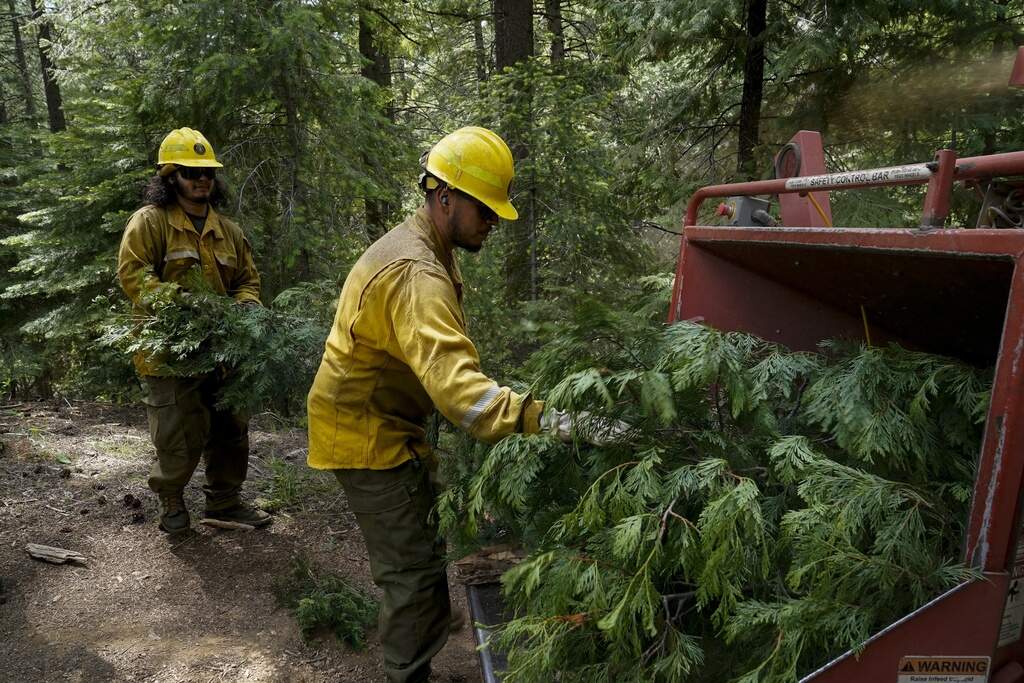
The Trump administration has made dramatic changes to the U.S. Forest Service — closing nearly every regional office and axing its research budget. Some say it's overdue reform. But critics say public lands won’t be protected.
Guests
Vicki Christiansen, 19th chief of the U.S. Forest Service. She served in the agency from 2018 to 2021.
Char Miller, professor of environmental analysis and history at Pomona College. Senior fellow at the Pinchot Institute for Conservation. Author of Burn Scars: A Documentary History of Fire Suppression, from Colonial Origins to the Resurgence of Cultural Burning.
Chris French, associate chief of the U.S. Department of Agriculture's Forest Service.
Also Featured
Randy Newberg, hunter, conservationist and advocate for public lands.
Paul Hessburg, former senior research ecologist with USDA- Forest Service.
The version of our broadcast available at the top of this page and via podcast apps is a condensed version of the full show. You can listen to the full, unedited broadcast here:
Transcript of Full Broadcast
Part I
MEGHNA CHAKRABARTI: Earlier this spring, the Trump administration announced a massive set of changes to the United States Forest Service. That's the federal agency that oversees nearly 200 million acres of American public forests and grasslands. The plan includes closing research facilities, moving the headquarters of the Forest Service from Washington, D.C. to Salt Lake City, and condensing nine regional offices down into one.
The Trump administration says this is a long overdue overhaul of the agency. Critics are calling it an evisceration and a threat to America's national forests and public lands. So today we're going to talk about these overhauls and this change, and we're going to talk about the role that the Forest Service has played in American history.
So let's start with Chris French. He's Associate Chief of the USDA's Forest Service, because the United States Forest Service is within the United States Department of Agriculture, and he joins us now from Washington. Chris French, welcome to On Point.
CHRIS FRENCH: Hi, Meghna. I appreciate being with you.
CHAKRABARTI: I'm really glad to have you today. So first of all, tell us what is it about the current operation of the Forest Service that USDA and the Trump administration thought was in need of significant overhaul? I think over time in the past 20 years, we've seen a significant decline in our non-fire workforce, a drop of almost 40%.
FRENCH: This is a result of increasing wildfires and us having to staff up our fire organization. And so we were coming to a point where it's well-known throughout the agency that we needed to put more resources into our field operations of the agency, our districts, our forests, and we had just gotten top-heavy.
And because we've been needing to move people to those, to the field, to the field operations of this agency, this move is intended to consolidate our upper management layers so that we can hire more people on the ground.
CHAKRABARTI: How does closing the majority of the research facilities that U.S. Forest Service has better protect the forest from wildfires?
FRENCH: Meghna, we're not closing a majority of our research stations. We've got about 1,100 people in our research organization, incredible scientists doing things from fire science to forest products science, and all of that will continue. In fact, what we're trying to do here is actually bring more resources to bear.
What we are doing is evaluating the facilities where they are. There's about 150 facilities for those 1,100 people, and what we're doing is going through and looking at places where we might have 14 buildings but only be staffing it with four people. As that evaluation continues, some of those facilities we've looked at, say that needs to remain.
Others we need to consolidate. Our intention is to keep our scientists in the area where they're working and to consolidate other Forest Service facilities that we have along with those research labs.
CHAKRABARTI: So you're not closing, you're not shuttering research going on in the Forest Service? Because many other people who are close watchers of the Forest Service see the exact opposite in USDA's announcement.
FRENCH: I think it's a common misconception, and I understand it. The president's budget, the proposed budget came out with significant cuts to the agency, including no longer funding research.
But that's not what this reorganization is. This reorganization is tiered and aligned with our congressional budget, which they did cut our facilities budget by $37 million. We're looking at facilities across the agency, including our research and development facilities. Some of those underutilized facilities, the facilities themselves we may close, but the scientists and the staff that are a part of it, our intention is to keep them within their commuting areas and to continue on with all the important work and science that we do as an agency.
CHAKRABARTI: And how will they do that with a proposed budget that has zeroed out all the research funding for the Forest Service?
FRENCH: Our final budgets come from Congress, and I've worked for this agency for more than 30 years, and I've worked here nationally for four different administrations, and I haven't seen a congressional budget or a president's budget that fully funded all the mission needs of this agency.
And so essentially what we align to is what Congress is giving us. They have funded research this year. In fact, they've increased some of the funding that we have in research, specifically around what we give to universities. And so our reorganization is aligned with what our actual budgets are.
CHAKRABARTI: Let me ask you, Mr. French, the new model that the Trump that USDA has announced also includes 15 state directors, right? Rather than having really state-focused facilities wherever the Forest Service manages public lands. Now, lots of people are looking at these state directors and saying, are these going to be political appointees who are essentially embedded in, I don't know, state houses or near state houses where they will be, quite frankly, cheek by jowl to, let's say, timber lobbyists or other kinds of groups that are seeking to use public lands for profit rather than for the overall benefit of the public?
FRENCH: Yeah, I don't know where that's coming from. What I can tell you is that we're consolidating our nine regions in our Washington office into a single oversight organization. That was well over 3,000 people, and so the new state director offices are about 150. We're locating them either on existing Forest Service facilities or we are locating them in the city where we have an existing facility, if possible, where the state foresters are.
We've advertised these positions already. They're advertised as career reserve positions, not political positions. We've advertised them in the same series, in the same way that we do our regional foresters, our forest supervisors, and our district rangers. The positions are career senior executives.
So I'm not sure where that speculation's coming from, but it doesn't match the actions we've actually taken.
CHAKRABARTI: Chris French, do you mind if I ask, you said you've worked for the Forest Service for 30 years?
FRENCH: I have, over 30 years.
CHAKRABARTI: Over 30 years, okay. And in the course of that considerable career, where have you been located?
FRENCH: I started out, I think, as a GS-3 or 4 in Southeastern Arizona in recreation and fire. Actually, my first position was as a volunteer through the Student Conservation Association. And then my first permanent position was operating a seasonal fire crew. And I have worked my way throughout the agency and throughout the Forest Service in multiple states, and finally ending up here in D.C.
CHAKRABARTI: So then without a doubt, with a career like that and relationship to public lands as you've had, I'm going to guess, I think it's a pretty good guess, that you have a great deal of love and affinity for what's out there.
FRENCH: I think we have the greatest mission. I think we're incredibly lucky to conserve this legacy of national forests across the country.
They're an absolute jewel. The people that serve these lands and the people that use these lands are our greatest asset. I love this agency, and I love our national forests. And I have also watched over the years that there is not nearly enough staffing or funding at the very level that serves our customers and serves those forests and that's part of what we're trying to shift here.
The people that serve these lands and the people that use these lands are our greatest asset.
Chris French
CHAKRABARTI: Okay, so yeah. Look, there's a very clear and actually sometimes bipartisan criticism of a lot of federal agencies, is that they are too top-heavy, and I take your point on that. But are you truly on board with this plan? Do you think that this plan will actually increase the service and the benefit and what Forest Service employees can do to protect our public lands?
Are you actually truly on board with this?
FRENCH: I think over time it will. So here's what I would say to you, is any reorganization that we do is going to be driven by multiple things. There's the budget realities that we're getting from Congress, so I have to align our staffing to that. Do I think that there's enough funding there? I don't. The second thing is we have to align to the policies that we're given from any administration that we work for. Secretary Rollins has instructed us that we need to move our headquarters and be closer to the majority of lands that we serve. So we're going forward with that.
What I can tell you though, and the third part of this, is that we've been looking at this problem for a couple of decades. We have over 40 different analysis that I've looked at starting from the early 2000s that are trying to address the shifts and changes that we see in this agency, the last we were doing under the last administration in 2024.
The reality is that over time, we haven't made some of the key shifts that we need to make. Now, the reason I said it's going to take a little time is that you can't just flip a switch. We're trying to keep our people remaining where they've chosen to live with their families, but we're going to ask them to do some different work. And so that's going to change --
CHAKRABARTI: But can I just jump in? Because respectfully I totally get that you can't just flip a switch, but organizationally, that is exactly what USDA's plan for the Forest Service seems like. It seems like it's a massive flipping of the switch of the managerial structure of the Forest Service.
I'm just wondering if, and frankly speaking Mr. French, were there worse plans that were floated by USDA for the Forest Service, and this is in your mind the best of the plans?
FRENCH: I've seen multiple scenarios over the years, both internally and externally, that I would say are worse.
I've seen multiple scenarios over the years, both internally and externally, that I would say are worse.
Chris French
What I would tell you is that the majority of employees are going to be able to stay where they live right now, and we're just going to ask them to serve the agency in a different way.
CHAKRABARTI: Meaning what though?
FRENCH: So if you look at our nine regional offices, six of them, we essentially have told our folks that you don't have to move.
You can stay where you're at. But we're essentially going to take the majority of those employees and reorganize them so that they're either supporting, let's say, direct authorization or permitting projects on forests. They may be part of a specialized team that we help support all the authorizations for our downhill skiing and national ski area permits.
We're calling these service centers. And so instead of working at a management level, we have them focusing working at a production level directly for forests.
CHAKRABARTI: Okay, I have a quick question for you. Last one Mr. French. I appreciate your patience. I will, I'll ask this question, but if we don't have enough time for you to answer it, when we come back from the break, I'll let you answer it before I know I have to let you go.
So the Trump administration also similarly reorganized the Bureau of Land Management, and in that reorg, which also involved positions having to relocate, there were 328 positions that were ordered to relocate. 287 employees left the BLM. Okay. The agency then lost some 87% of its Washington-based workforce.
A lot of knowledge that they had went with them, and it's never been recovered. So I guess the question I'm going to ask you, Chris, when we come back, is could the same thing happen to the Forest Service? So we'll do that in just a minute. This is On Point.
Part II
CHAKRABARTI: Mr. French, as I was asking, in the first Trump administration, the Bureau of Land Management underwent a very similar and extensive reorganization.
And by some measures, because of that, the BLM lost, what, almost 90% of its Washington-based workforce, which included a lot of scientific expertise, legal acumen, research experience. Could the same thing happen to the Forest Service?
FRENCH: I don't think so and I'll tell you why, Meghna. So we looked at those reorganization efforts, and specifically what came out of the BLM.
I've talked with employees that went through it. Some of them now work for us. I've also looked at reorganizations that we've done in the agency, when we consolidated all our business functions to Albuquerque. And what I learned from that and why people left was I would say that it was really about a very quick decision made for the organization rather than leading with people first.
What we're trying to do right now is give people plenty of heads-up. We're working to provide them multiple choices for the types of work they do. What we found out in the BLM approach and others is that folks basically got a letter saying, "Here's your new job. You have 24 hours to make this decision."
We're not doing that. We are giving our employees choices of the type of positions they take on. We're offering voluntary rounds of positions that are on forests and on districts. And then ultimately, when we get to a point when we may have to make those shifts, again, we're trying to work directly with our employees to give them multiple options. Now, the last thing I want to do is lose expertise, and I know how hard this is for the families and for the people that have chose to live there, and that's why the majority of folks that are a part of this reorganization, they're going to be able to stay right where they are, and that includes the majority of our folks in our research and development in our regions.
The last thing I want to do is lose expertise.
Chris French
And there's going to be about a third of the folks here that are part of our National Capital Region that will stay right here in D.C.
CHAKRABARTI: Chris French, Associate Chief of the United States Forest Service, thank you so much for joining us.
FRENCH: I really appreciate it. Okay. I would like to now turn to Vicki Christiansen.
She was the 19th chief of the U.S. Forest Service. She served in that position from 2018 to 2021. Prior to working at the Forest Service, she spent more than two decades in state leadership, including appointments as Arizona State's forester. Excuse me, the forester for the State of Arizona and the Washington State forester, and she joins us from Tacoma, Washington.
Vicki Christiansen, welcome to On Point.
VICKI CHRISTIANSEN: Thank you, Meghna. It's great to be here.
CHAKRABARTI: So I'd actually like to start with something that Chris French said is in the realm of Congress. Because I see both funding and organization being part of the same, let's say, river of change that's coming to the Forest Service.
To be clear, it's the Trump administration's proposed budget that hasn't gone through Congress yet, but the Trump administration's proposed budget that has zeroed out $0 of research for the United States Forest Service. How do you see that having an impact on what the Forest Service does?
CHRISTIANSEN: Yes, I totally agree that the administration is speaking with some, in my opinion, some incongruencies. There's a major reorganization proposal which Chris spoke to and then there is the administration's proposed budget, and they don't really align. The reorganization proposal keeps the whole function of the Forest Service, meaning the mission to sustain the nation's forests and grasslands, intact.
It creates extreme uncertainty, chaos, and quite frankly extreme concerns.
Vicki Christiansen
Now, are there questions about the delivery of that with the reorganization? Yes, there is, and we could probably get into that. But bigger than that is the administration's proposal to not only zero out all of research and development, but the critical function of state, private, and tribal forestry, that's to sustain the nation's forests. There are public benefits that flow from all forests, clean air, clean water, carbon sequestration, wildlife habitat, and so much more, and there's a small role for the federal government to assist states and tribes to sustain those public benefits that flow from all forests.
And additionally, then, which was not mentioned in your conversation with Chris, it also completely zeros out the wildland fire budget from the Forest Service and moves it all to the Department of Interior. So to take the totality of the administration's proposals, to completely eliminate or do a major shift of a large part of the agency's mission and to do a major reorganization.
It creates extreme uncertainty, chaos, and quite frankly extreme concerns.
CHAKRABARTI: Okay. So I want to just put a pin in the wildland fire budget and the move to the Department of Interior in just a second. Because I want to come back to that, in fact, because Chris French first, his first words when speaking about the need for the reorganization were increasing wildfires.
So obviously we'll have to talk about that. But Vicki, if I may you said create significant concerns. In plain language, what are those concerns? Given, this reorganization and if any form of the Trump administration's proposed budget goes through, will the Forest Service be able to do what it has been charged with doing with America's public lands for 120 plus years?
CHRISTIANSEN: No, they won't. And Chris mentioned this. I will, because I can, be a little bit more direct. The Forest Service is severely underfunded from what the administration asks them to do, what Congress asks them to do, and what the American people expect. These are beloved lands, the direct national forest lands that the Forest Services manages, but also the incredible science and the keeping public benefits, urban community forestry and significant watershed management for private lands.
So much more that the agency does in whole is in extreme jeopardy because of the administration's budget proposal, but also there are severe questions in my mind about the reorganization as well.
CHAKRABARTI: Okay. So let me ask one of the questions that pops up in my mind. Because I have to say, frankly, it's a little unclear to me what is going to happen with the research and development facilities that already exist across some, what, 31 states that the Forest Service runs.
Those are going to be consolidated into, what, a single location in Fort Collins, Colorado. Now, Chris French seemed to imply that researchers, not managers, but researchers in these 31 states would still be able to stay where they are and do the research that they're doing. Does that make sense to you?
CHRISTIANSEN: Chris is doing everything he can with the charge that he's been given, both by the administration and Congress. I feel for Chris and the position that they're in. I've been there. I do believe that there's a lack of detail and, quite frankly, some miscommunication just specifically about these research facilities, as an example. Where some materials say they will close, and now they're going to be evaluated. And it's the administration cut the facilities' budget. So these leaders of this agency have no other choice but to look hard at how they can live within the budget.
Chris mentioned that. So it's a whole picture look, and it does not make sense to say we're going to close down 57 critical research facilities where no other nation in the world has the amount of information, data, research about the complexities of our natural resources.
It does not make sense to say we're going to close down 57 critical research facilities where no other nation in the world has the amount of information, data, research about the complexities of our natural resources.
Vicki Christiansen
CHAKRABARTI: Because Vicki, if I may just jump in here, it's impossible for me to imagine how the kind of research that the Forest Service does can continue if those facilities aren't there, right? Because you have to be in the location of the forest that you are studying. If you're doing, I don't know, a 20 or 30-year study on the observations of forest rehabilitation post-fire, you can't do that if your researchers or the way that you're collecting data is not actually rooted in the place where the fire was.
This is what I'm trying to understand. Like, how can the same quality of research be done, when physically, as you said, some of these facilities may not exist soon?
CHRISTIANSEN: Absolutely. Totally agree. Couldn't say it any better, Meghna. The question is the confusion, and quite frankly, the trust factor that comes with we are evaluating this.
And to say that the scientists may not reside in the exact facility that they have been, but they'll be five miles down the road at the national forest, they'll be co-located, that could be acceptable. But there's a lack of trust to really understand. Because the analysis and the data that the agency and the administration is using to propose this reorg has not been made available.
The data that the agency and the administration is using to propose this reorg has not been made available.
Vicki Christiansen
I know they're still working on it. The details matter, especially when you create such fear just in the reorg proposal, saying 57 facilities could be or will be, they've said both things, eliminated, and then you have the same administration proposing to completely defund all research and development.
You can see how there's a lack of trust and uncertainty.
CHAKRABARTI: And to use a horrible pun, but I'm going to do it anyway, when there's smoke, there's very likely fire. Okay. Vicki, hang on here for just a second because in a minute I'm going to bring in someone who knows deeply about the history of the Forest Service and why it even exists.
But first, on this note about research, we also spoke with an ecologist. His name is Paul Hessburg. He spent decades studying the forests of the American West, things like how have they changed over time, the very questions that we were just asking Vicki. How can they be made more fire-resilient and climate-resilient?
Now, he recently retired from the United States Forest Service. He'd been working there for more than 40 years, but he does continue his research through partnerships with the University of Washington and Oregon State University. And Paul Hessburg says the Forest Service has been instrumental in facilitating long-term research to protect the nation's natural resources.
PAUL HESSBURG: An important relationship between university laboratories and government research laboratories like Forest Service and USGS and National Park is that we have the ability to do long-term studies over a really big space, really big time, and to collect data over years to decades, and that's not the province of master's degrees and PhDs and post-docs at universities.
That time span is shorter for them. And so part of the partnership that gets revealed when you have a high-functioning cross-fertilization among these organizations is that we're each picking up the main bits that we need to understand so we can plug in how all these learnings fit together.
CHAKRABARTI: And that is why Paul Hessburg is so concerned about the radical cutting back of Forest Service research labs and agency funding.
HESSBURG: What happens when government research gets shattered is many niches no longer get filled, and given how climate change is changing and how it's changing fire regimes and forested conditions, there's never been a more important time under this rapid warming, drying, windier climate to understand how together we can actually put enough knowledge on the shelf to keep forests around.
Many forests aren't coming back after big fires. What do we do? How do we rearrange that landscape in ways that give us options for the future?
CHAKRABARTI: It's Paul Hessburg. He worked for the United States Forest Service for more than 40 years and is now continuing his research through affiliations with the University of Washington and Oregon State University.
I'd like to bring in Char Miller into the conversation now. Char is a professor of environmental analysis and history at Pomona College, and he's also a senior fellow at the Pinchot Institute for Conservation, and he joins us from Claremont, California. Char Miller, welcome to On Point.
CHAR MILLER: Thank you, Meghna. This has been a fascinating conversation.
CHAKRABARTI: I also want to note that you've written extensively about America's public lands and forests.
MILLER: Yeah, sorry about that.
CHAKRABARTI: No. Don't apologize. That's why we have you here today. I just want to note some of the books include Gifford Pinchot and the Making of Modern Environmentalism, all the way to your forthcoming book, which is going to be called Regenerating the Land.
Okay. So Professor Miller, I'd like to actually just spend a minute or two looking backwards at the history of the Forest Service, because just to be clear to folks who may not know the difference, the Forest Service is not the National Park Service. And the history of why the two exist is quite interesting.
Can't get into all of it, but tell us a little bit more about the creation of the Forest Service and what its mission was from the start.
MILLER: So its mission from the start was really defined less by Washington politics and Congress at one level. It was founded because the citizenry of the United States wanted it to be created.
[The Forst Service] mission from the start was really defined less by Washington politics and Congress. ... It was founded because the citizenry of the United States wanted it to be created.
Char Miller
That's the first thing. This is a public lands agency that was created by the public, and it happened in the 1870s and 1880s post-Civil War, as people were beginning to recognize two things, one of which is the Industrial Revolution was producing extraordinary economic benefits, and at the same time, just chewing up the landscape, both the timber and minerals and the like.
And there were these wise folks who said, "Maybe we could do both and do it better," drawing off of European ideas and the like. And the agency was created in 1876 as a small shop, one-person shop, that has now grown to be one of the most proficient and professional agencies of its kind in the world.
But it was always a public creation aimed at public lands. But unlike the Park Service, whose mission is preservation, the Forest Service's position, given its birth, was really much more utility-driven in the sense that you could do many things. You could cut timber, yes, but you could cut it in a way that was regulated, so you did not clear-cut, although they would do that after World War II.
You would regenerate lands. You would do all sorts of things. As Vicki mentioned, there are a thousand different options that the agency pursues in terms of wildlife and water and all of that. But it has always been a can-do organization in that it can do things and is not bound by simply preservation of landscapes, though that is crucial.
[The Forest Service] has always been a can-do organization, in that it can do things and is not bound by simply preservation of landscapes, though that is crucial.
Char Miller
CHAKRABARTI: And we've just got a minute before our next break Professor Miller. But this sort of more than simply conservation mission of the Forest Service, does that also, if memory serves, stems from a slightly different point of view between Gifford Pinchot and John Muir?
MILLER: Go read the book.
CHAKRABARTI: (LAUGHS)
MILLER: That is the black-and-white version of it. They were actually very close friends who tangled. I actually, the part of what I describe is they were in a dance, and both of them wanted to lead. And that doesn't work very well. So some of this is overblown. But yes, there are hard lines in terms of how one manages resources that are fundamentally different, and yet they coexist. And I think that's the key.
Part III
CHAKRABARTI: Vicki, I'll just turn to you to start with this, I did want to ask you about some of the criticisms that the Forest Service has been subject to over the years. And specifically, from conservationists, for example. I know many who have said, Look, the problem with the Forest Service is that has too many masters to serve, and by virtue of being within the United States Department of Agriculture, one of those masters is the logging industry.
And as critics have always said, the Forest Service has been too beholden to the logging industry. First of all, your response to that, and second of all, could we actually see an increase in logging because of the restructuring that we've been talking about?
CHRISTIANSEN: Yeah, that's a good and complex question, Meghna.
As Char said, and I just have to reiterate, the Forest Service is a conservation organization, all right? Versus preservation, where you just don't use it. The Forest Service was set up for the wise use of our resources. And it has evolved into a multiple use mission. Is it easy managing under multiple use?
The Forest Service was set up for the wise use of our resources.
Vicki Christiansen
Not always. And it does not mean multiple use on every acre of land. So let me just break that down. Multiple use means watershed protection. It does mean a flow of forest products. Those were the two major reasons why the public said we need to have these forest reserves, which became our national forests.
But also, an important habitat for wildlife, sequestration of carbon, and an incredible amount of recreation experience, just to name a few of the benefits. So it is about the wise use of the resources. And I would say no, the agency is not beholden to just one lobby. There's plenty of interests from wilderness to recreation to hunters and anglers, and all the rest that want their share of the goods, the services, and the products that flow from these lands.
And that's why these incredible professionals, whether they're researchers, they're biologists, they're sociologists, they're leaders and managers, need to listen and hear and know what the lands can, but listen and hear from the public and the communities they serve, but know what the lands can sustain for, as Gifford Pinchot, the founder and the first chief said, "The greatest good for the greatest number for the long term."
And that is both the art and the science of providing these multiple benefits to all Americans.
CHAKRABARTI: Okay. So let's stick with logging here for just a second. And Professor Miller, I want to be completely transparent with both of you but where I'm coming from on this with my personal experience, as I love to tell listeners as often as I can, I grew up in the state of Oregon.
Recreational use of Forest Service lands was an intricate part of my growing up. But so was also the importance of logging, right? There's just so much logging that happens in the Pacific Northwest, and much of it is on Forest Service land. So I see all sides of this.
But what I'm wondering is the direct concern that many people have about the potential radical increase in logging, even verging into basically the potential supremacy of private interests over the public mission of the Forest Service, and here's why. Two things.
One is I've been reading a lot of Forest Service employees who can't actually give their names right now, but they've been speaking to other media, about we're concerned that if the actual amount of research that we're able to do is cut because of not just the facilities closing down, but also the funding, as we've been talking about with Vicki, then the absence of that research makes it harder to say, "No, don't log in this particular watershed."
Your thoughts about that, first of all.
MILLER: I think there's a long history that beginning in the post-World War II era, in which getting out the cut was the thing that drove the agency. It drove its budget, it drove who hired and who moved up in the agency. So people have that in mind, and they are deeply worried about it.
But it was also, it's also true that the research that the agency produces, has produced, was one of the key ingredients that helped slow that process down. Outside lobby groups also helped enormously in that regard. And I just got, let me jump in on Chris's point about leading with people first.
When DOGE eviscerated the agency, as it did with so many others in January 2025 and began at that point, you can't lead with people first when the people have been just taken out of the project. I really object to that notion. When too many of my friends, colleagues, and collaborators were forced out or chose to leave because they could not stand the working conditions anymore, you're not leading with people first.
And so with research, which I'm deeply worried about, the Forest Service, as Vicki said, has been doing the best research on climate change from the very beginning. We have 125-year records. So we have a problem in that regard. But I would add this piece. Because of the slowdown in cutting in Oregon and Washington and elsewhere, we do not have large milling facilities in the western part of the United States that could actually handle the timber sales that I would be deeply worried about if I thought the mill structure was there.
It's not. It would take trillions of dollars to replace it, and that part is that's not being talked about, and I think it needs to be.
CHAKRABARTI: Yeah. It's interesting. Vicki, I'll turn this one to you, is the reconciliation bill from last year called for the U.S. Forest Service to increase its volume of timber sales pretty dramatically, by 250 million board feet per year, starting this year in 2026.
So as of 2024, the Forest Service had sold 2.8 billion board feet, and if the increase under the reconciliation bill goes on, that could raise the volume to almost to more than five billion board feet over the next nine years. We haven't seen those numbers since the 1990s.
CHRISTIANSEN: Yes, you're absolutely right.
And I think you're asking me is that feasible? And there's a couple things I want to say. I want to really echo what Char said. That the feasibility just for the milling of the structure is in question. And it should be, how do we create a product, innovative forest products that are going to serve us in a better way, meaning create the resiliency on the landscape.
And without getting into a complete biophysical conversation here, there's a propensity for the administration and even many in Congress to say, "Just harvest more timber, and that will solve the wildfire crisis that we have." And let me tell you folks, it is not that simple. It is not that direct a direct line.
Will harvesting timber in some areas help in some of the wildfire? Yes, it could. But think of our forests. They're, we've had 100 years of aggressively putting out fires, and we have the small woody biomass buildup, small materials on the forests. Those are what need to be treated. We call it hazardous fuels treatment.
Yeah. But how we move through wood products innovations, mass timber, cross-laminated timber, even nano technology that takes cellulosic material and makes fenders for cars and whatnot, all comes out of our science, our forest products lab. That's what we need to really focus on so that we can, yes, remove products that truly creates the resiliency, not just the traditional, dimensional timber products.
Now, I'm not saying that's bad. There's plenty of rural communities that need the forest products to flow to preserve the mills that they have, but we have to think bigger. And to Char's point, the evisceration of this agency, when they did those mass buyouts and layoffs, did not do it in any kind of strategic way, even for the priorities that this administration was espousing. And so the agency is really on their knees on how they can go about in this innovative approach.
CHAKRABARTI: Interesting. Okay, so before we run out of time, I also want to just give voice to another group of Americans who has a lot of interest in America's public forests, and that is hunters, actually.
We've talked about the conservation mission of Forest Service. We've talked about the public recreation that our lands create. But also, hunters are very invested in preserving the forest, and we spoke to one of them. His name is Randy Newberg. He's based in Bozeman, Montana, and he spends much of his time out on Forest Service land.
RANDY NEWBERG: I hike them just about every day. I have a Forest Service trailhead a half mile from my house. I hunt on those lands, as do hundreds of thousands of people living in Montana and the Rockies, and it's where a lot of Westerners go every fall. They go hunting, get a lot of high-quality protein, and they're mostly hunting deer or mule deer and elk.
But for a lot of people, this is just their culture of what they've done, what their parents did, what their grandparents did. I just think about here in Bozeman in late October, the question is, "You get your elk?" You're in the checkout line at the grocery store. Someone you don't even know is "Hey, you get your elk?"
And it's just part of the culture.
CHAKRABARTI: Last summer, Newberg was instrumental in opposing a proposal from Utah Republican senator Mike Lee. Lee wanted to sell off Forest Service land for affordable housing. He had claimed that most of the United States Forest Service land has, quote, "zero recreational value or any conservation value," end quote.
That's what Lee had said. Newberg galvanized people to push back, and they were successful, and Senator Lee pulled the proposal. And Newberg now says that defending public lands should not be a partisan issue.
NEWBERG: It causes me to laugh a lotta times when I go to D.C. and some people are like, why do people get so worked up about these public lands out there?
There's obviously a disconnect where they don't understand that public lands in the West are nonpartisan. Nobody cares if you're an R, a D, an Independent, or in between. You're here helping on a public land project. You are here advocating for public access. It's the most binding, nonpartisan binding thing I know of in America yet today.
Public lands in the West are nonpartisan. Nobody cares if you're an R, a D, an Independent, or in between. You're here helping on a public land project.
Randy Newberg
CHAKRABARTI: Randy Newberg grew up in a logging family. He worked as a logger in college, and he says people in other parts of the nation don't always understand the extent to which communities are economically tied to these public lands, obviously hunting, logging, grazing, recreation, outfitting businesses, pack trip businesses, the immense tourism that happens around public lands.
They're major economic drivers for thousands of communities. And Newberg believes that even if you're not directly tied to these forests, the lands should still be important to you because they play a central part in our shared American story.
NEWBERG: I don't think it's fair to expect every part of the country to view these public lands the same.
But one thing we do know that even if you're an urban suburban American not living out here, they still care about them. They want to know they are there. They know the value they have. And even though they don't have the benefit of walking a half-mile out their front porch like I do, and can hike all, there's a trail that goes all the way to Yellowstone Park from my house. They may not have that as a daily opportunity, but they still know that these public lands have a lot of value. The fact that they exist is important to them. It represents something more than just a balance sheet item that some want to claim.
CHAKRABARTI: That's Randy Newberg, hunter and public land advocate out of Bozeman, Montana. Vicki Christiansen and Char Miller, we only have just a minute and a half left, and I know that we didn't get a chance to talk about the movement of funding on wildfire research. So Vicki, I want to just give you a quick second, and then I have a final question for Char.
But you were talking earlier about moving wildfire money to the Department of Interior. Can you just take a quick second to describe why that's important?
CHRISTIANSEN: Yeah. You said wildfire research, and it's the whole wildland fire operations.
CHAKRABARTI: Operation. Forgive me. Sorry for getting that wrong.
CHRISTIANSEN: Yes. And it's that saying when you know better, you do better. For since 1910, Gifford Pinchot put out the 10 a.m. policy that said every fire will be aggressively suppressed. And we have created now 100 years of fire exclusion. And most fires do need to be suppressed, but we need to use our land management capability and our fire management capability together. And not create this super fire suppression agency within a whole separate part of the U.S. government.
By pulling fire out of the land management, we are severely putting ourselves backwards in this wildfire crisis. We need to have them both together.
CHAKRABARTI: Char Miller, just about 15 seconds here, but if you look at the funding question we've raised, the reorg of the Forest Service, overall, are you concerned about the future of the nation's ability to protect its public lands?
This is a disaster in the making, particularly because it concerns our common lands, our common heritage, and the love that we share for these lands.
Char Miller
MILLER: I am deeply concerned. This is a disaster in the making, particularly because it concerns our common lands, our common heritage, and the love that we share for these lands. That's just been eviscerated.
The first draft of this transcript was created by Descript, an AI transcription tool. An On Point producer then thoroughly reviewed, corrected, and reformatted the transcript before publication. The use of this AI tool creates the capacity to provide these transcripts.
This program aired on May 18, 2026.