Support WBUR
Boston Mayor Michelle Wu on why her tax proposal died on Beacon Hill
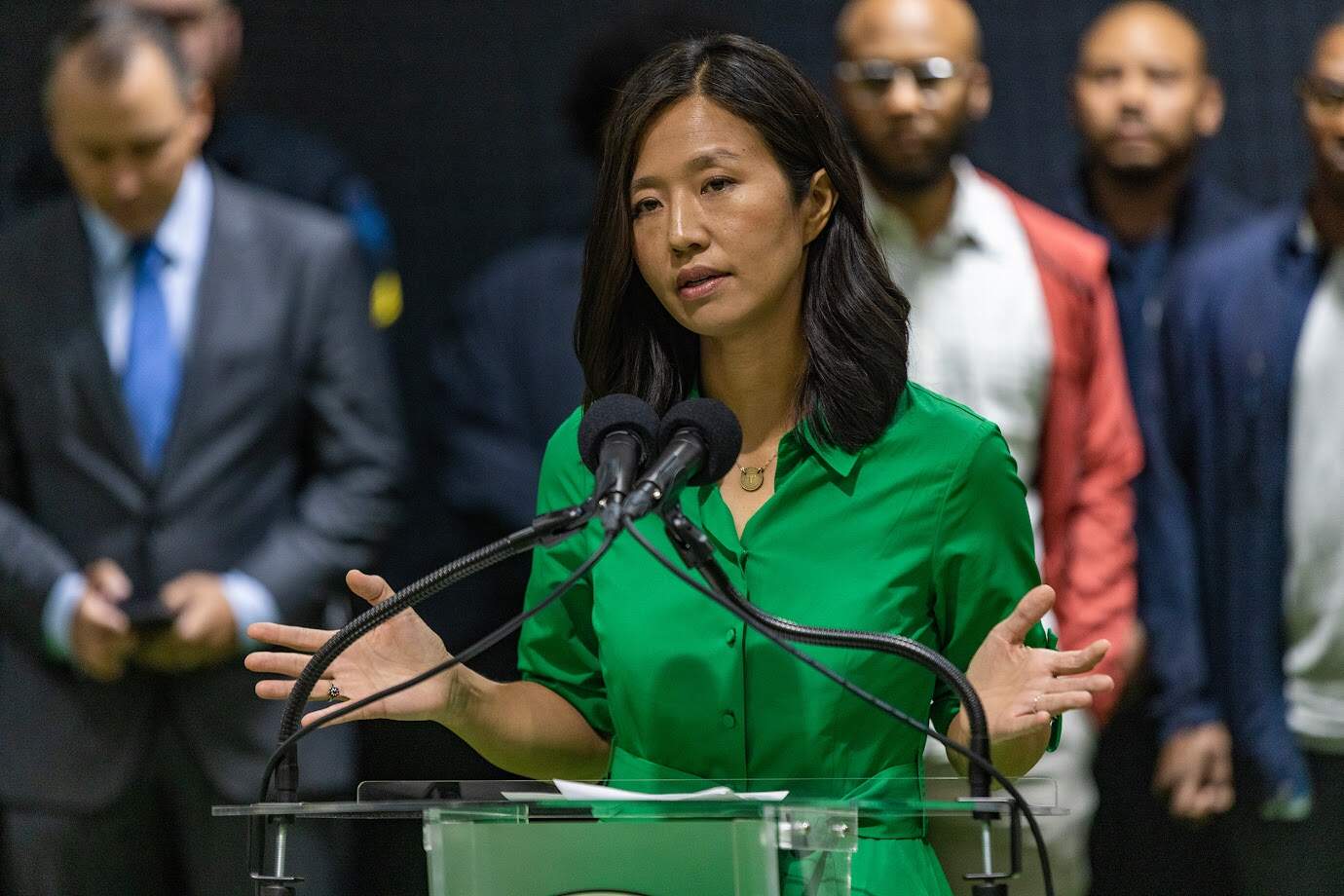
Boston Mayor Michelle Wu's property tax plan has gone through a lot of ups and downs these past few months.
The plan would have blunted an expected spike in homeowners' property taxes by raising the tax rate on commercial properties.
Some members of the state Senate threw cold water on the proposal after updated data from the city showed the increase in taxes for homeowners wouldn't be as large as initially expected.
Now, the plan is apparently dead on Beacon Hill.
To discuss what happened from her point of view, Wu sits down with WBUR's Radio Boston.
(Read the interview with Wu below, lightly edited for length and clarity.)
Interview highlights
Earlier this week you said that people did not honor the results of the process and it felt like there was one goal post after another. What's the process that you're referring to?
"It's been a long eight months of having this conversation... We started this process with a filing as soon as we knew that this could be an issue, went through the city council, had passage of that, went through the House of Representatives had passage there. And then when it got to the Senate, there was just a little bit of, um, lack of feedback on what the Senate wanted to see to make it better. Eventually, we were invited to a meeting with the Senate president and the Boston senators, with four business groups at the table, and we were told by the Senate to work it out with these groups come to a deal — because these were the groups that were most opposed to it.
"Over the course of the next month or so we worked extremely hard and in good faith, you know, negotiating back and forth, providing more numbers, providing the range of what we could reasonably expect... And when we came to a deal and everyone put their names on it, then we were still asked to wait longer, restart the process through the council and the House votes again, and then call every senator, reach out to everyone. We had many more briefings, huddle with the Republican caucus, huddle with many legislators from outside the city as well.
"Then eventually when the numbers did land at the point in time of the year, when we said they would land and exactly within the range that we had originally predicted, although thankfully not the worst case scenario, people walked away from that deal. And we never even got a vote at the end of the day from the Senate."
What's the reason that you think that they ultimately walked away from that deal? Why did this fail?
"I think it's complicated in terms of who is really sort of shaping decision-making in a state process that puts cities under a lot of restrictions. And so for many, many things that municipalities have to do, we need permission from the state Legislature and state government, unlike other parts of the country — tax law, or certain types of contractual issues, or liquor licenses. These are all examples where cities don't have full control...
"I think what I heard expressed publicly at the end of the process was that people didn't believe that the burden on residents was as bad as would be necessary to make any changes to state law — which I would like to get into a little bit more of how we see the numbers and why I strongly disagree with that.
"... By the time the number shifted and it wasn't so dire for businesses — they would have had even less of a burden than at the point where we agreed to the deal — and yet their feeling was well, residents should be able to absorb a 21% bill to bill increase on average. That was coming from some folks who live outside the city and were not connected, and some folks who represented the city, but we're not putting the needs of their constituents at the top of the list, whether it's because of a belief that other parts of their district, much wealthier parts of their district, had had tax increases recently as well, or because the commercial real estate industry should have primacy over the some of the concerns here.
"We saw that the Legislature acted just last year to approve a very similar tax shift for Watertown, where there was a shift from residential onto commercial and this year, Watertown's residents saw a tax decrease. And so there's precedent for it. We really believe that this was needed, and it's very disappointing that this is the way the process happened."
Massachusetts State Sen. Will Brownsberger joined WBUR's Radio Boston on Tuesday to explain why he ultimately decided not to back the tax proposal:
"This would have helps taxpayers in the seaport and back Bay and Beacon Hill and every place where you live. You know, people tend to have more income and tend to be able to handle a tax increase as a relatively small part of their overall budget. What I would much rather do is target relief to that person who, you know, inherited their house from their grandmother, you know, 40 years ago, never had a lot of income, now is struggling to pay their property tax bill. That's the person I'm worried about.
What's your reaction to his comments, and this idea of a targeted relief approach?
"I think it's a very valid pathway to focus on. What I would say is that the time for this conversation about what the senator wanted to see or what the Senate as a whole wanted to see was when we sat at the table with each one of them from the Boston delegation in late September, four months ago...
"What I know is that regardless of the other alternatives, with each one having merit of different degrees, come January, residents of the city of Boston in every neighborhood will see an increase in their taxes that they didn't need to, and I believe shouldn't have had to because for every taxpayer even in the neighborhoods that were just mentioned, they've borne a burden over the last several years. ... This increase in January will be the second highest that residents will have seen in the last 10 years, the highest since 2018, the second highest since 2010."
Boston has one of the lowest residential tax rates among big cities, and commercial tax rates are already two and a half times higher than residential ones. So, Sen. Brownsberger also expressed concerns that hiking tax rates further on commercial real estate is bad for business and could do more harm to Boston's economy than good. Does he have a point there?
"It's important to play all the numbers out to the real world impact that they have. If you look at nationwide comparisons of tax rates. The Lincoln Institute of Land Policy puts out a 50 state comparison of tax rates, and it is true that in that report, Boston ... is listed as having one of the lowest residential tax rates in the country. But that same report highlights that because property values have increased so much in Boston recently, over the last few years, we are still among the highest tax bills for residents in the country, given the fact that what you end up paying is your tax rate times the valuation of the property you have.
"Many of our property owners are homeowners, who have purchased their property a while ago, and would be what's sometimes described as 'house rich, cash poor.' So they're actually still struggling to pay those taxes because the value has gone up, and they're not capitalizing on that value because they're not selling their homes. They wanna stay in their neighborhoods, and so their taxes have gone up significantly because of that.
"On the commercial side, that same report says that even though the shift is significant in Boston. The rates of commercial property owners are still below the national average here in Boston. And so we have a situation where the system that we have, which is again state law that cities can't control on their own, sets it up so the only way to try to offset what is already a very difficult housing market for residents is to do this shift.
"So when that happens, it is meant every generation or so, there is an event that that kind of destabilizes situation. This tool would have just stabilize it over a period of three years. Commercial taxes would have still gone down. Residential would have still gone up, but by a much smaller margin on either side."
As you think about next year and your mayoral run, are you also thinking about a potential need to pivot in your approach to issues like tax policy, or a pivot in the balance of power between City Hall and Beacon Hill even?
"I've always been guided by the same sense that what is uniquely powerful about city government is that we're closest to the people. And so we can be that proof of what's possible — that no matter what else is happening at any other level of government or around the world, we can be the place to show that people can still come together to get things done that are needed to improve the lives of everyone in our community.
"So our approach from day one has been: we are working to make Boston a home for everyone, in every sense of that word. And so I don't, you know, in terms of a pivot or whether, you know, a certain setback completely changes everything, it is all on the same agenda. We are going to do whatever it takes to make sure residents can afford to stay in Boston, have access to the greatest opportunities where each generation has the chance to be in the safest city in America, the greenest city in America, the most family friendly."
This article was originally published on December 13, 2024.
This segment aired on December 13, 2024.