Support WBUR
'Is it OK to record your visit?' What to know about doctors and AI scribes
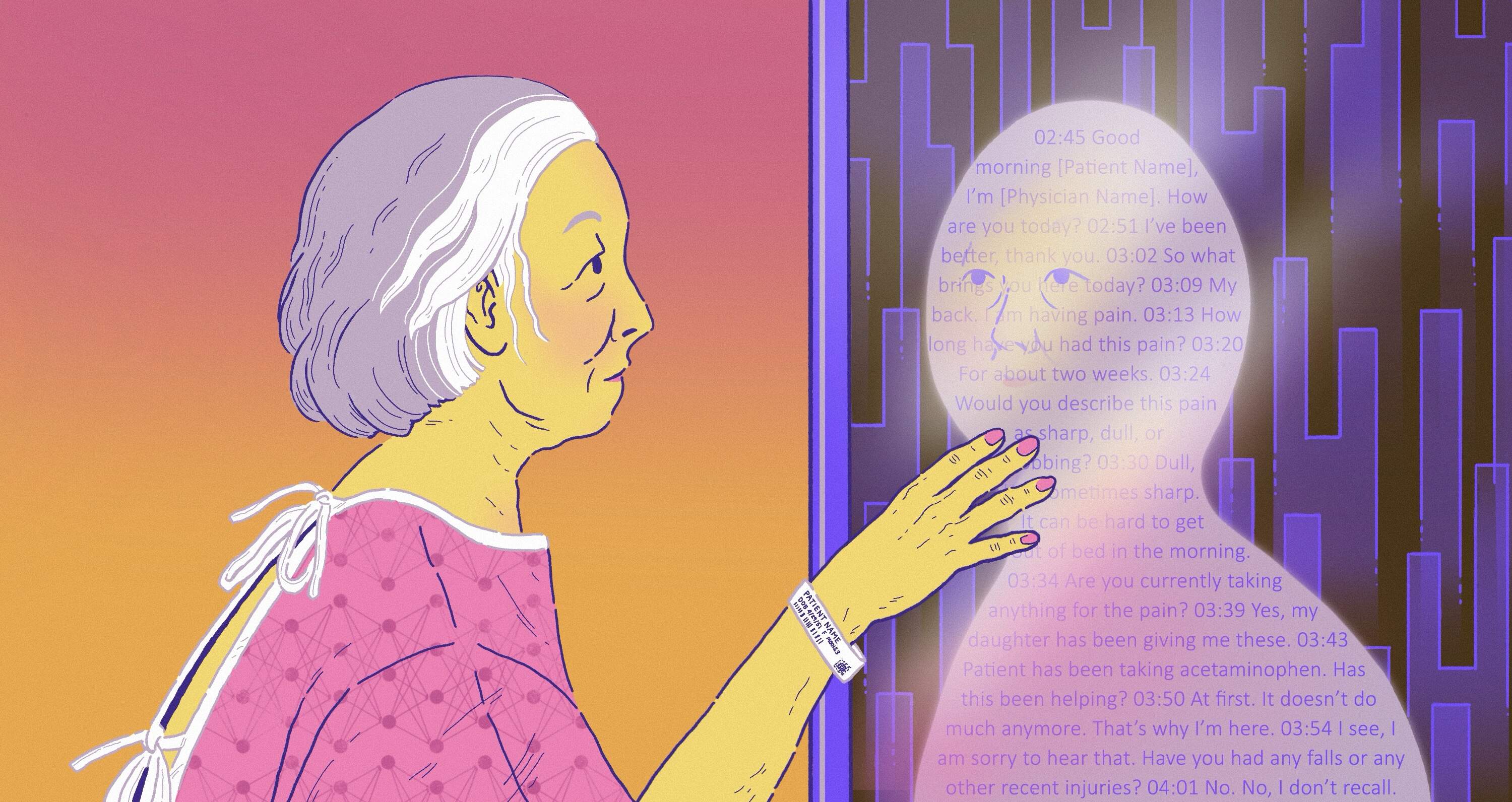
More doctors in Massachusetts are using artificial intelligence to take notes during their patient visits. If the patient consents, an AI app will record, transcribe and summarize the appointment for the person’s medical record and may also assist in billing.
About 28% of U.S. physicians use AI for clinical documentation, medical charts or visit notes, according to the American Medical Association. In its survey of nearly 1,700 doctors, most said they expect the technology will rapidly become more common in the medical field.
At Mass General Brigham, the largest hospital system in Massachusetts, about 3,000 providers use AI scribes regularly.
Dr. Rebecca Mishuris, a practicing primary care physician and chief health information officer at Mass General Brigham, joined WBUR’s Morning Edition to discuss what patients should know about these AI scribes.
Doctors say it puts them back in the room.
“It’s truly transformational technology,” Mishuris said.
She uses the AI assistant because it allows her to be more present with patients, she explained. It saves her from having to multitask — typing information into a computer while talking to a patient or trying to remember key data points to note later. There’s a “sense of security,” she said, that the visit is being captured by the generative AI program.
It might seem ironic, but the AI "removes technology” from the room, Mishuris said, because she’s no longer staring at a screen.
“I'm actually looking only at the patient now,” she said.
Research suggests AI scribes reduce physician burnout.
A 2025 Mass General Brigham study found AI scribes alleviated physician burnout. Of about 1,400 doctors from Mass General Brigham and Emory Healthcare surveyed for the study, researchers found a 21% drop in reports of burnout after using AI scribes.
Doctors who are less burned out provide higher quality care, Mishuris said. One theory is that AI reduces burnout by saving physicians time on paperwork.
“ We hear all the time, ‘I have my evenings back, I have my, my weekends back,’ ” Mishuris said.
But, the data turns out to be more complicated. An April study from Mass General Brigham and the University of California, San Francisco, found only modest time savings for physicians using AI scribes — about 16 minutes a day. There was more time saved for primary care physicians, nurse practitioners and physician assistants.
Mishuris said the underlying reasons for AI reducing physician burnout remain unclear.
But she isn’t deterred or surprised by the study’s finding. She said for her, it shows time savings are “not the only factor” in reducing stress. She thinks something much harder to study is at play.
“The primary driver to reducing burnout is actually that relief of burden and that relief of cognitive overload” that happens when the AI scribe provides notes from patient visits, she explained.
It may be that physicians are reclaiming their weekends, but it also may be that they are rediscovering the joy of focusing on their patients and medicine, rather than electronic records.
Doctors need consent to record you.
There are rules for obtaining consent. At Mass General Brigham, Mishuris said the physician must ask for permission from the patient to have the AI scribe record the visit and explain what the recording is used for.
“If [the patient] says yes, I hit record … patients can absolutely opt out,” she said.
(Editor's note: Under Massachusetts law, a person cannot be secretly recorded with few exceptions.)
At Mass General Brigham, the recording is deleted after the visit.
Once the recording is used to generate the note about the visit, it’s no longer available for review, according to Mishuris, and is destroyed after a period of time. It “literally doesn’t exist anymore," said Mishuris.
”We take our patient's privacy and the privacy and security of their data with the highest possible regard,” she said. “We use the same privacy and security controls with this app as we do with all of our other clinical systems at the hospital.”
At Mass General Brigham, staff mainly use an app called Microsoft Dragon Copilot, and Mishuris said it went through a full evaluation for information security and data privacy.
The patient’s note can be used to train the AI.
“ If we never trained these models in the first place, they wouldn't be very good,” she explained. “So we do need data to train them.”
If it is used to train the AI, Mishuris said the note is “de-identified,” meaning, any kind of identifiable information about you is scrubbed: things like name, birth date, date of the visit and where the visit took place.
AI makes mistakes. A physician must proofread the note.
AI can have hallucinations, misinterpret doctors or patients, and miss things entirely. A small 2025 study from the University of California, San Francisco found AI made more “unique” errors per note than humans — 2.91 errors per summary for AI-generated notes versus 1.82 for humans. Overall, the study found the quality of the summary narratives was similar.
Data like this is why Mishuris said she emphasizes that humans must remain in the loop.
“This is generative artificial intelligence technology, and it will inherently have errors," she said, "and so it is incumbent on the physician to review the documentation and edit it before they sign it."
According to Mishuris, Mass General Brigham has not experienced any significant incidents with errors since launching its AI scribe pilot program nearly three years ago.
Mass General Brigham is studying bias in AI scribes.
Racial and gender bias in artificial intelligence tools is well documented. But, Mishuris said, that’s not as much of a concern with scribes.
“With this technology in particular, we worry about it a bit less,” she said, “because it's just taking the information it's heard and summarizing it.”
But, she does worry about how scribes are being implemented across the hospital.
“The bias we worry about with this technology actually has more to do with whether we are offering it to all of our patients,” Mishuris said.
Mass General Brigham chose a vendor whose app can translate other languages, and Mishuris said it can be used in any setting, “noisy or quiet.”
Worried about AI? Patients should ask questions.
Artificial intelligence in healthcare is advancing fast. So, most importantly, Mishuris advises people not to be shy about pressing for more information.
“ Patients should feel free to ask about it and ask about what happens to their data, where their voice goes, what happens to the recording,” she said, “and what the provider's experience is with the technology.”
Editor's note: This post has been updated to clarify that after the AI scribe app generates a note documenting a patient visit at MGB, the recording is no longer available and is deleted after a period of time.
This series is funded in part by a grant from the NIHCM Foundation.
This segment aired on May 5, 2026.