Support WBUR
Cog's Weekly Newsletter
The Girls from Boston are back in the spotlight
Editor's Note: This essay appeared in Cognoscenti's newsletter of ideas and opinions, delivered weekly on Sundays. To become a subscriber, sign up here.
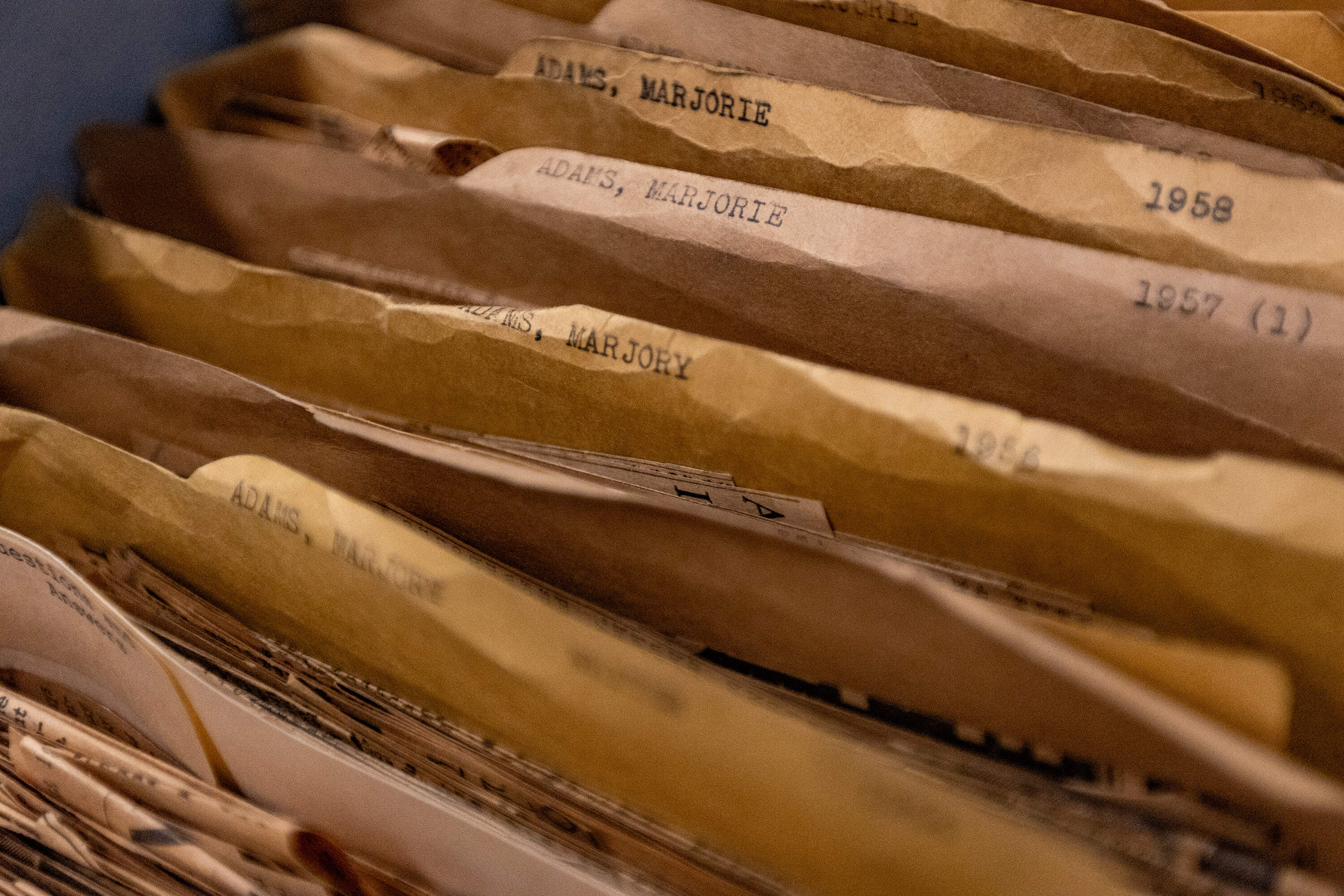
When Cog contributor Meg Heckman first learned about a group of five women journalists who covered Hollywood for Boston's major daily newspapers in the 1920s and '30s, she hoped they’d be the subject of her next book. Heckman stumbled upon these women when she found a box of clips of the work of Majory Adams, the Boston Globe’s first-ever film critic, at Northeastern University, where Heckman is a journalism professor.
Adams’ clips are only a very small part of a massive archive the Globe donated to Northeastern about eight years ago. The collection includes 1.65 million photographs, 4,012 linear feet of newspaper clips, 5.7 million photo negatives and more.
Though the “Girls from Boston” — as this group came to be known — rose to national fame and probably generated massive amounts of paper, little of it beyond the few boxes of Adams’ work that ended up at Northeastern was preserved.
Elinor Hughes of the Boston Herald is the only one who has an official archive. The work of the other three — Prunella Hall of the Boston Post, Helen Eager of the Boston Traveler, and Peggy Doyle of the Record American — can only be found in online archives like Newspapers.com and ProQuest. Much to Heckman’s chagrin, there aren’t enough letters, diaries or artifacts to inform the book she wanted to write.
Thin documentation is a familiar frustration for Heckman, who looks at journalism through a “feminist lens.” For much of history, women’s work has been seen as inferior or less important and was therefore less likely to be preserved, especially in male-dominated fields like journalism. This was particularly the case when the reporter worked a new beat, like film was in the first half of the 20th century. So, Heckman gave up on the idea of a book, wrote a short essay about Adams for a media history journal and moved on to other projects.
But she couldn’t stop thinking about these “girls.” It’s no wonder. Variety magazine named Doyle best “out of town” film critic and praised Adams — who eventually supervised 20 other film critics — as a fair-minded critic who “extols fine pictures and flays fast buck producers.” The same publication called Hughes “a classic reviewer with an encyclopedic mind” and an expert in “history, curiosa and performance records.” Hall, according to Heckman, was a one-woman IMDB, who answered readers’ questions about Hollywood’s stars on the pages of The Boston Post.
The Girls from Boston were especially interesting to Heckman because they were a very collaborative group even though they worked for competing papers. “That came through even in the incredibly thin source material,” she explained. “They were covering one corner of the media industry — Hollywood— and working for another corner of it — Boston — and running up against certain gender biases.”
The story, Heckman realized, wasn’t just about these five women and their work, but about how easy it is for some people — even well-known writers — to be lost to history. So she revisited her notes, spent a few more hours in the archives, re-opened those boxes and stitched together a story about the Girls from Boston that she could pitch to Cog.
At Cog, we take great pride in reading and responding to every submission we receive. And this one immediately appealed to us. “ALL THE WAY UP!” one editor replied in all caps to the team after reading Heckman’s email.
Despite our enthusiasm, however, it still wasn’t an easy story to pull off. It’s hard to put a puzzle together when you’re missing so many of the pieces. I was Heckman’s editor, and we went back and forth several times, reorganizing the complicated timeline and, in an attempt to adhere to Cog’s 1,000-ish word limit, debating how much we could omit from a story we were trying to restore and preserve. I kept telling Heckman to take her time, but she didn’t want to. “This feels like the only concrete thing I can do right now to protest the intentional erasure of women and other marginalized groups from public history,” she wrote in an email.
Finding images for the essay was another challenge. Adams, Hughes, Hall, Eager and Doyle are conspicuously absent from the photo archives of Getty Images and the Associated Press, our usual sources. We might have been able to get permission to reprint some of the clips from the Globe’s archive, but that would have been time-consuming and costly. In the end, we sent one of WBUR’s talented staff photographers, Jesse Costa, to the Snell Library to photograph Heckman with her primary sources. It felt very meta, as my kids would say: We were able to resurrect the work of a forgotten 20th-century woman journalist while documenting the work of a 21st-century woman journalist performing the resurrection.
Heckman’s story is, by her own admission, incomplete. But that’s what makes it so important, so compelling — and what makes us so happy to feature it here.
Follow Cognoscenti on Facebook and Instagram. And sign up for our weekly newsletter.