Support WBUR
Commentary
With ‘love and troublesome heart,’ Kendrick Lamar’s got us all watching
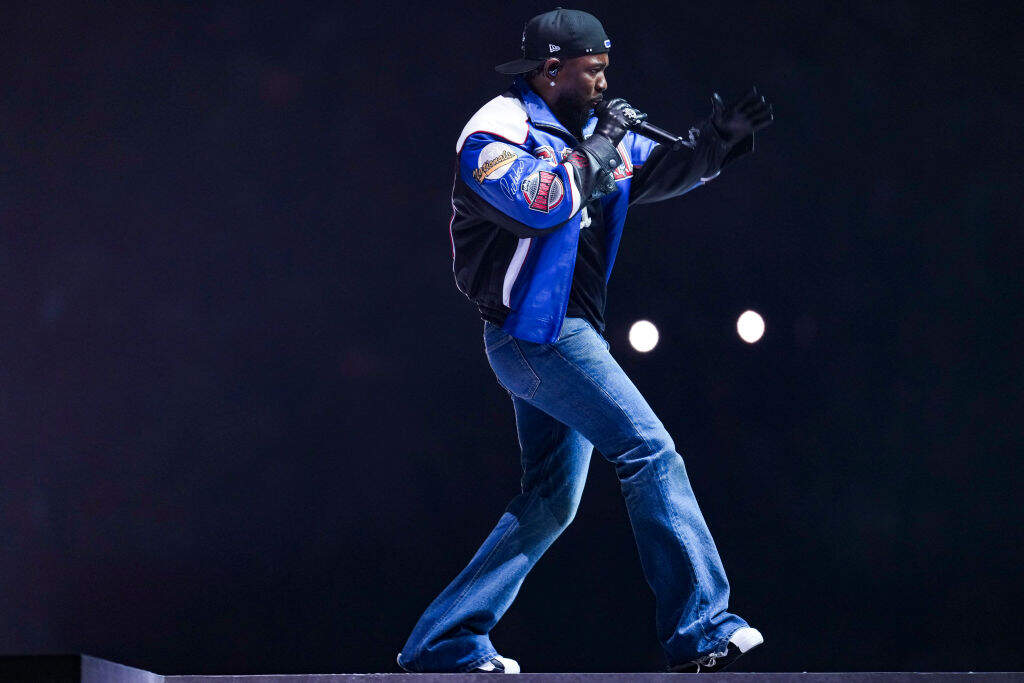
Believe it or not, I actually saw Kendrick Lamar perform live twice in one week.
I had tickets to the sold-out show at Gillette Stadium in Foxborough — the second time I’ve seen the rapper on stage in person. But I also caught him at Roxbury Community College a few days earlier, during my daughter’s recital with OrigiNation’s arts studio. Well, sort of.
This time, a young “Kendrick Lamar” — probably about 10 years old — performed a skit version of the rapper’s smash hit diss track “Not Like Us” (the Super Bowl version) flanked by several elementary school-aged backup dancers before a raucous crowd of parents and admirers.
In just the last year, Lamar inspired a cultural firestorm with “Not Like Us,” delivered a masterful Super Bowl performance and dominated Drake, a fellow artist/rapper, in an ongoing hip-hop duel — one that finally came to a head last spring after a decade of sniping and saw Lamar, a 17-time Grammy winner and Pulitzer Prize winner out-rhyme, out-scheme and outshine his hit-maker nemesis. Between the kids’ spirited imitation of the viral show, which has been viewed more than 126 million times on YouTube, and the real Kendrick Lamar bringing down the house at the home of the Patriots, it feels clear the Compton MC’s cultural moment is far from over. The man deserves all the accolades coming to him.
But Lamar’s victory lap is more than a vanity tour meant to stick it to his rival (though it definitely plays a role). It’s a hostile re-takeover of hip-hop, a genre with a profound history that’s often dismissed by critics as uncouth, violent, and trivial — unworthy of recognition as a true art form.
As forms of music, rap and hip-hop have existed for more than 50 years, born out of blues, jazz and a spirit of resistance brewing during the 1960s and ‘70s. The now-iconic 1971 song “The Revolution Will Not Be Televised” by Gil-Scott Heron was one of the earliest examples of putting spoken-word poetry over jazzy instrumentals, a few years before the genre’s “official” birth in the Bronx in 1973.
How fitting, then, that Lamar has frequently alluded to Heron’s seminal song as he sets out to bring hip-hop back to its intellectual, radical roots.
After all, Lamar didn’t “squabble up” simply to prove he was a better rapper than Drake and sell out stadiums. He did it because, in his mind, hip-hop has been led far astray from the spirit that birthed it — one of creativity, competition and pure expression of Black culture amid societal struggles. Instead, as he claims in his lyrics, too many rappers and influencers “only co-sign what radio does” and “parade in gluttony without giving truth to the youth.” If there’s one thing Lamar does more than many rap artists—sometimes to the detriment of commercial success—it’s speak to the heart.
But Drake, whose songs frequently flaunt his wealth, power and exploits, certainly fits the profile of the decadent music industry Lamar is waging war against — from Drake’s apparent vulturing of different cultural sounds to questions about his relationships with underage women like “Stranger Things” star Millie Bobby Brown. Lamar’s disdain for this perception of Drake — alongside hypocrisy within the industry — was palpable during and after the beef’s climactic peak, in tracks like “Watch the Party Die” and “wacced out murals.” With the line “cackling about — while all of y'all is on trial,” the latter song may also have smoke for the now-imprisoned rapper/mogul Diddy, who’s currently facing five criminal charges, including sex trafficking by force. When it comes to protecting the culture, nothing’s off limits. Just thinking about “meet the grahams” gives me the chills.
That’s Lamar’s magic: he has both “love and troublesome heart” inside his DNA.
Lamar, of course, doesn’t shy away from his own contradictions as a person and artist, acknowledging his see-sawing between his personal trauma and need for healing (see tracks like “Count Me Out”) and his mercurial, ruthlessly competitive nature and imperfect past. As such, his crusade for the soul of hip-hop casts him as more of an antihero than a pure-hearted savior — something he will actively tell you he’s not.
As someone who’s followed Lamar’s career for the past decade, his honesty in critiquing himself and the heart with which he tells stories make him special in spite of those flaws. Watching people clap their hands or wave phone flashlights as he performed the intensely vulnerable “Count Me Out” in Foxborough — a song most rappers wouldn’t dare play to a packed stadium — was as powerful a moment as everyone screaming “mustard” or “A minorrrrrrr” at the top of their lungs to two of his most popular songs. But that’s Lamar’s magic: he has both “love and troublesome heart” inside his DNA.
He’s the hero the culture deserves — and the one it needs right now. An avenging angel of destruction with the heart of a healer. A champion willing to war with anyone who doesn’t treat hip-hop with the respect he feels it deserves.
Not to mention that, as a Black man in Boston, it was surreal to watch seemingly the entirety of New England — an area with a complicated past regarding racism and one that generally celebrates Aerosmith and New Kids on the Block before Roxbury’s own New Edition or rapper Ed O.G., who literally had America’s No. 1 song at one point — descend on Foxborough for a show headlined by a rapper. It won’t exactly end racism and inequality, but it felt like a powerful statement for a Black artist whose upbringing in Compton, California is likely unimaginable to most of the attendees.
Then again, his ability to transcend those boundaries with music while uplifting people who look like him is part of why that 10-year-old boy in the OrigiNations show was cosplaying as Kendrick Lamar, not Drake or Diddy.
Lamar isn’t just one of the greatest rappers of all time anymore. He’s cementing himself as one of the most consequential artists ever — making even skeptics take notice and treat hip-hop with an elevated level of respect, as an art form.
One thing’s for sure: From Boston to Compton, he’s got all of us watching.
Follow Cog on Facebook and Instagram. And sign up for our newsletter, sent on Sundays. We share stories that remind you we're all part of something bigger.
This segment aired on July 2, 2025.