Support WBUR
Cog's Weekly Newsletter
Peeking through the window on “The Pitt”
Editor's Note: This essay appeared in Cognoscenti's newsletter of ideas and opinions, delivered weekly on Sundays. To become a subscriber, sign up here.
I have this strategy for watching “The Pitt,” the squelchingly realistic HBO medical drama starring Noah Wyle in an emergency department in Pittsburgh. I take out my contact lenses, and then I watch the show with my glasses half-way down my nose. This way I can move my head slightly up or down, and watch clear-eyed or blurry, depending on what’s happening on screen. The medical accuracy is stunning, and I spend 90% of the show in a defensive posture.
My husband Anil, a real-life ER doctor, has no such qualms. While I’m sinking further into the couch and pulling a blanket up near my eyes, he’s leaning forward like he’s playing a game of Super Mario Kart, talking over the characters on screen, calling out protocol and diagnoses.
When this season opened with a patient being wheeled into a trauma room after being stabbed in the chest with a kitchen knife, Anil said calmly, “They’re gonna open his chest.” I think I had the blanket over my head by that point.
The technical term for this procedure is clamshell thoracotomy (see also, “popping the hood”). Once the chest cavity is open, Wyle’s Dr. Michael “Robby” Robinavitch instructs his team to flip, or rotate, a lung, in order to clip the uncontrolled bleeding. As this was happening on screen, Anil said something like, “They’d actually call a trauma surgeon down to do that,” but then he added: “But remember that time in residency I stapled a guy’s heart to stop the bleeding? It was kind of like that."
Anil and I have been together since before he began practicing medicine — I’ve seen him through medical school to residency to working shifts as an attending physician. Now he’s the chief of an emergency department in Massachusetts, my own personal Dr. Robby, thank you very much. But in all these years, I’ve never once dropped in on him at work (except for the one time our 4-year-old slammed the front door on his middle finger). I don’t bring him lunch and he doesn’t take coffee breaks; it’s just not that kind of gig. But when we watch “The Pitt,” I kind of get to tag along.
Here are some things Anil likes about the show: The cases are rare and interesting, “weirdo stuff” you wouldn’t see frequently in your career, all packed into one day (that’s the show’s premise: 15 episodes shot hour-by-hour in an emergency department). It also shows healthcare workers in the ER as adaptable – they’re professional problem solvers. “The Pitt” is speaking “our” language, he says, even if the general public might not always understand, and he appreciates how Wyle as Dr. Robby connects with and advocates for his patients.
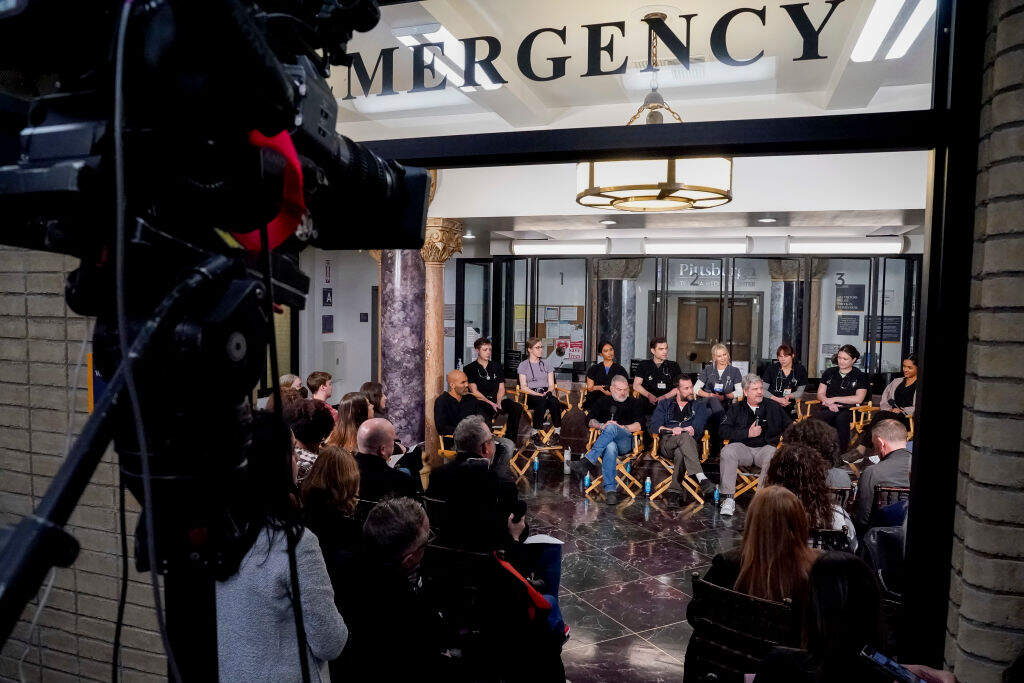
By design, the intricately choreographed scenes on “The Pitt” let us lean over the shoulders of the people who work there.
Dr. Joe Sachs, an executive producer and writer on the show — and an emergency medicine physician of 30 years — has said that when writing the episodes they always start with character needs, then they draw from a well of medical experiences they’ve collected. In showing that clamshell thoracotomy, for example, we see a maverick procedure that grabs our attention right away, but we also begin to understand the character difference and potential friction between Dr. Robby and new attending Dr. Al-Hashimi.
By design, the intricately choreographed scenes on “The Pitt” let us lean over the shoulders of the people who work there. And by filming in an hour-by-hour format, we see what they went through one, two, three hours or just five minutes ago. They leave one room in which someone is dying, and enter another in which someone is screaming at them. Next there might be a kid with a Lego up his nose, or a college student with blue legs (pro tip: wash new jeans before wearing). We see how they are, simultaneously, highly trained medical professionals – and people. Even Dr. Robby.
In the opening scene of season 2, the camera pans to Dr. Robby riding to work on a motorcycle, and he is not wearing a helmet. I did a triple take. But Noah Wyle has a plan. He knew people were holding Robby up as a hero. In a New York Times Magazine interview, Wyle talked about how Gene Wilder only agreed to play Willy Wonka if they let him first appear with a limp, hobbling down the stairs, before we see him leap into a somersault. From then on, we’re not totally sure what to expect from him. In Dr. Robby, Wyle knew he’d created a character that people met with a great deal of sentimentality, and he wanted to complicate that a little bit.
Narratively, I love this, because a hero is boring. But also, a hero isn’t real, and the ER doctors I know are real people, even as they do extraordinary work. They see things in real life that I can’t watch on TV, and they tell people things no one wants to hear. They are deeply, darkly funny. And, at least at my house, sometimes they leave whatever happened at work that day and still have to come home and make spaghetti and shovel the driveway.
Wyle has spoken about how much it means to him that healthcare workers feel seen by this show — how valuable it is that their work is made visible. We see that in Cog this week: Dr. Shannon CC Nedelka, an emergency radiologist, wrote about how Wyle’s roles as Dr. John Carter in “ER”, and now as Dr. Robby, have mirrored her own medical career. I’m looking forward to seeing how it all keeps playing out this season, even if I’m watching through my fingers.