Support WBUR
How wildfire smoke impacts birds
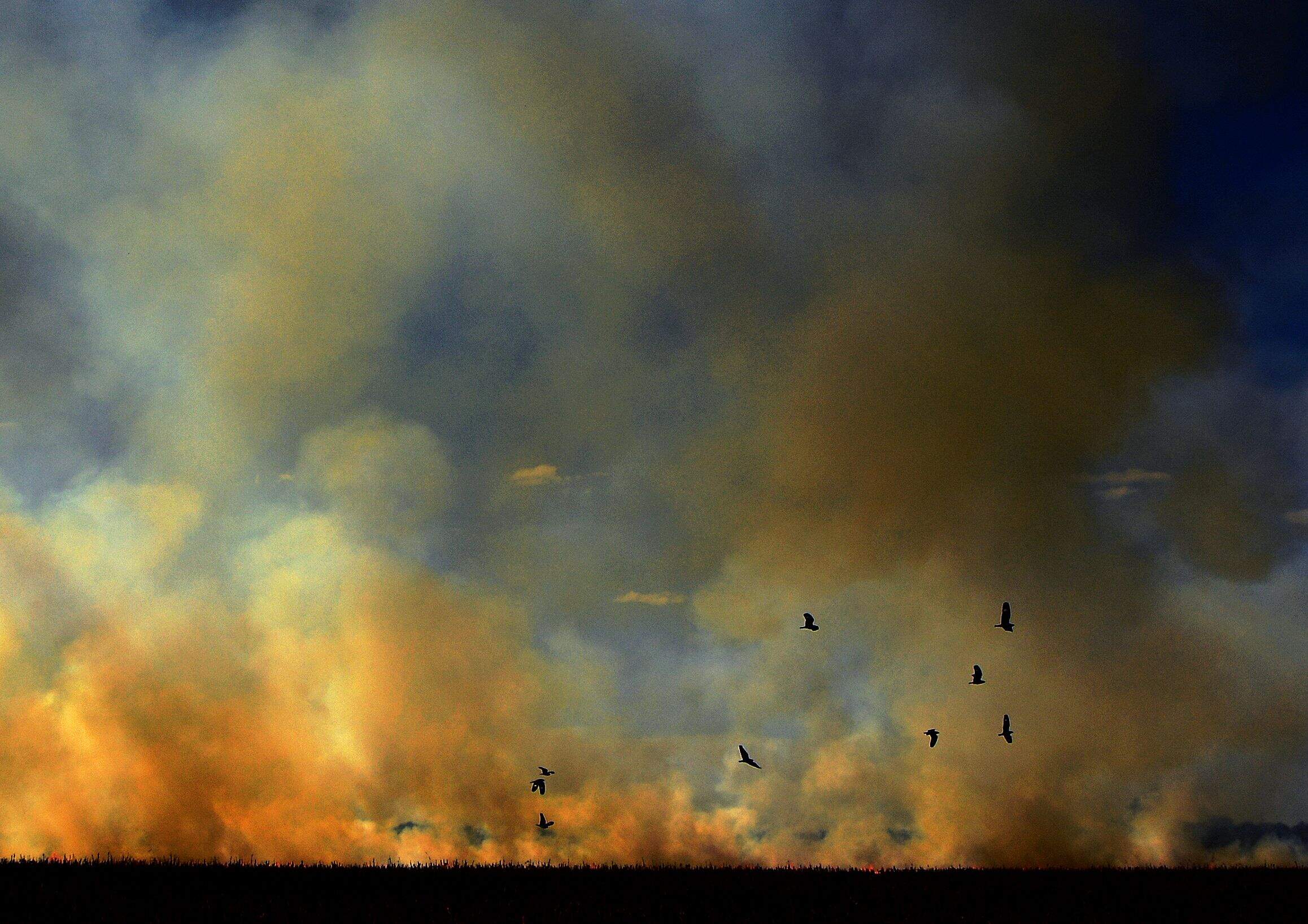
A new study investigates the impact of wildfire smoke on wildlife.
It's one of the first studies ever on how wildfires potentially impact birds. It measured activity based on bird sounds. The study found changes to the early morning bird sounds during and after smoky days in September of 2022, when the West saw heavy smoke and orange skies, Grist’s Naveena Sadasivam says.
“The researchers found that during this time, the soundscapes of that region in central and eastern Washington, where they had placed monitors, decreased,” Sadasivam says. “And they think that this might be related to changes in bird activity in the area.”
4 questions with Grist’s Naveena Sadasivam
What are bird soundscapes?
“The researchers placed about 200 acoustic monitors in about 200 locations in central and eastern Washington, and these monitors were sort of continuously recording the sounds during these early morning hours, which is when we typically hear birds calling out, bird songs, that kind of thing. And they noticed changes during those smoky days in September.”
Is noise necessarily a good scientific proxy for bird activity?
“That's a really good question. And the researcher that I spoke to, Olivia Sanderfoot, said that this is a really hotly debated topic in the ecological research community and the reason for that is that noise might not be the perfect proxy, right? These acoustic indices that they're using as a measure of the noise and sounds that the acoustic monitors are capturing. Some studies have found that they're not the perfect measure and that there may not be a correlation between wildlife activity, bird activity and what the index is telling you.
“But in this case, in this particular study, she felt fairly confident that it was a good use of this particular measure because there had been another study that was done sort of in a similar region that did find that there was a correlation between the acoustic index and bird activity.”
What do these authors or other scientists think might be happening to the birds during or after these smokey days when there's less sound?
“It's kind of unclear at this point … This is one of the first studies looking at the effect of smoke on bird health, bird activity. It's not entirely clear why bird activity might be changing during smoky days. Is it because birds are fleeing the area and moving elsewhere during these smoky days? Is it because birds are just less active and less vocal during smoky days? That could be one inference. And there is in fact some recent research that seems to suggest smoke is adversely affecting the quality of animal vocalizations. But this is an area that just requires a lot more study and research, and it's not entirely clear why these changes are taking place.”
What's your sense of the broader questions scientists in this space are asking and want to continue to ask?
“In the one hand, I think researchers are really interested in further using acoustic indices and trying to understand whether they may be used in certain circumstances, the instances in which they may be a good measure of bird activity, animal activity, wildlife activity, right? So, there's more research to be done to sort of better understand when these indices might be a good proxy and when they may not be. So there's research to be done on that front.
“And there's also more research to be done on how birds in other biomes, elsewhere in the country and elsewhere across the world, might be affected by wildfire smoke. So that's also, I think, an area of interest for researchers.”
Editor's note: An earlier version of this story misspelled the name of one of the study's authors. We regret the error.
Thomas Danielian produced and edited this interview for broadcast with Peter O'Dowd. Allison Hagan adapted it for the web.
This segment aired on August 21, 2024.