Support WBUR
The leaders behind the fall of Boeing
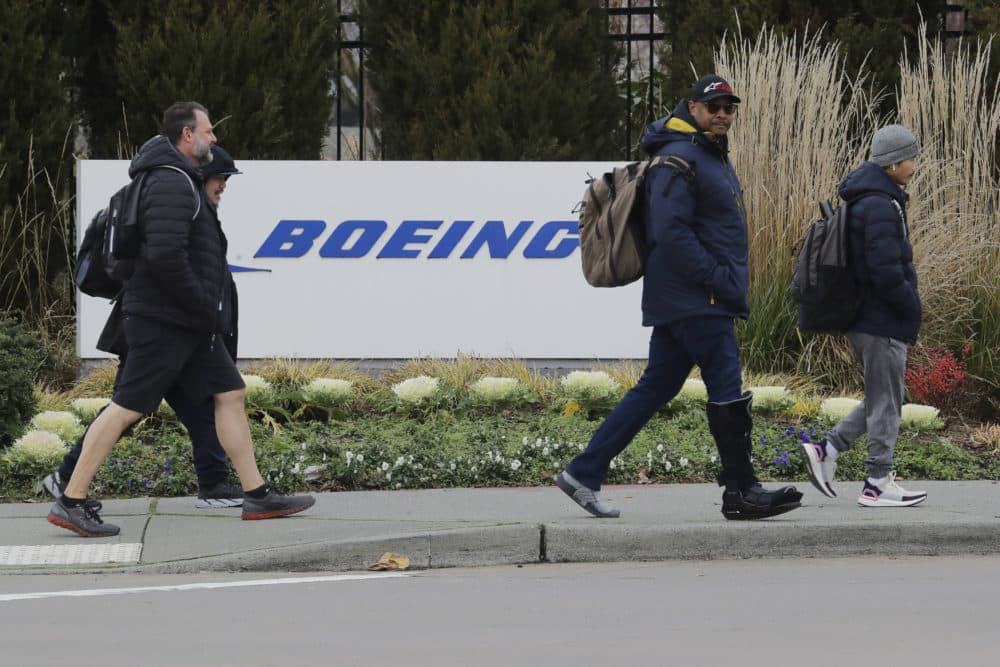
Boeing has pled guilty to federal charges related to two deadly 737 MAX crashes.
What went wrong in the Boeing C-suite?
Today, On Point: The leaders behind the fall of Boeing.
Listen: Our Past Boeing Coverage
- "A Boeing whistleblower speaks out": Ed Pierson is an aviation manager who used to work on Boeing's 737 Max production line. When a door panel blew off an Alaska Airlines flight, Pierson wasn't surprised.
- "How to fix America's aviation system": It’s been almost 15 years since the last deadly plane crash on a U.S. airline. But near misses are on the rise, up 25% in the past decade.
- "Whistleblowers, an executive shakeup, and the future of Boeing": Boeing whistleblower John Barnett was found dead in March, in an apparent suicide. He’d spent the last 7 years speaking out about Boeing’s declining safety and quality.
- "The 737 Max and Boeing’s unresolved issues": In this episode from 2020, we hear from a Boeing engineer and an aviation analyst about what’s at the root of the safety issues with the 737 Max, troubling the plane then and now.
Guests
Andy Pasztor, covered aviation safety for the Wall Street Journal from the 1980s to 2021. He's now writing a book on airline safety.
Peter Robison, investigative journalist for Bloomberg. Author of the book “Flying Blind: The 737 MAX tragedy and the Fall of Boeing.”
Also Featured
Ed Pierson, director of the Foundation for Aviation Safety. Former senior manager at Boeing's 737 Factory in Renton, Washington.
Nadia Milleron, Aviation safety advocate and candidate for Congress in Massachusetts’ First Congressional District. Her daughter, 24-year-old Samya Stumo, died in a 2019 Boeing plane crash.
Transcript
Part I
MEGHNA CHAKRABARTI: In the spring of 2011, the CEO of one of the United States’ largest and most famous airlines made a phone call to the head of one of the world’s largest and most famous airplane manufacturers.
American Airlines chief, Gerard Arpey, had some tough talk for Boeing CEO W. James McNerney Jr.
American was about to place an order for hundreds of new fuel-efficient jets from Boeing rival Airbus. This must have been shattering news to McNerney. American hadn’t been an Airbus customer in almost twenty years. And here was Arpey on the other end of the phone, telling McNerney, Boeing needed to act fast if it wanted a piece of what would become the largest new aircraft deal in commercial aviation history.
Well, McNerney did act swiftly. Incredibly so, for such a massive manufacturer. Just three months after that call, McNerney decided Boeing wasn’t going to design a brand-new airplane. Instead, it was going to turn back to one of the most popular jets already in Boeing’s fleet.
NICOLE PIASECKI: We are making a decision to invest in the 737 family. We are announcing the 737 MAX.
CHAKRABARTI: This is On Point. I’m Meghna Chakrabarti.
And that was Nicole Piasecki, Boeing VP of business development in a company video unveiling the 737 MAX, what Boeing called “a new engine variant of the market-leading 737.”
It seemed like a brilliant move. In July 2011, American Airlines announced that Boeing had won half its record breaking, 420 plane $16 billion deal. Airbus got the other half. Just two years later, March 2013, McNerney told the U.S. Chamber of Commerce that Boeing’s business was booming.
DENNIS MUILENBURG: Much more fuel-efficient planes. Much more responsive to the environment. And so I’d say more than half our growth, which is probably two or three times, about three times the GNP growth that we’re seeing around the world. More than half of that is driven by a replacement cycle, by innovation.
MUILENBURG: Just to give you a little factoid behind that, about every one and a half seconds, a 737 takes off somewhere in the world. So there goes another one. (LAUGHTER)
INTERVIEWER: So Airbus.
MUILENBURG: And another one. (LAUGHTER)
CHAKRABARTI: That was Dennis A. Muilenburg celebrating the 737 MAX at a meeting of the Economic Club of Washington DC in May 2018.
James McNerney stepped down from Boeing leadership in 2015, making Muilenburg CEO. The two men were of one mind on how to run Boeing. Muilenburg continued major practices McNerney had brought to Boeing. One was making and selling the 737 MAX. And the other: massive stock buybacks.
That boosted Boeing’s share price “parabolically, adding billions in market cap per day,” in the words of one CNBC analyst. From 2014 to 2019, Boeing repurchased $38 billion of its own shares, according to Bloomberg.
And on CNBC, Muilenburg gamely explained to an awestruck Jim Cramer where a lot of that cash was coming from.
JIM CRAMER: What is the cash flow as you go on? Because the leverage of being able to build three a month to five a month, must be extraordinary.
MUILENBURG: It is. Just to give you an example, our 737 production line, this year we’re at 47 a month. We’re gonna be taking it up to 52 a month. Next year, we’ll be going up to 57 a month. All that is driving top-line cash flow. So last year, our operating cash flow was a little over $13 billion. This year, we’re guiding to $15 billion. So you can see, this is a year over year cash growth business.
CHAKRABARTI: But could an already massive company growing that fast keep its head? Could Boeing stay true to its values? That question was put to Muilenburg’s predecessor, James McNerney, when he visited Rensselaer Polytechnic Institute in 2014.
MCNERNEY: I think the bigger the organization people get involved with, the more likely it is to lose their way. Now, having said that, I mean, when corners are cut at Boeing, airplanes fall out of the sky and we cannot have that happen.
***
ANCHOR: We begin with breaking news. The search for wreckage is underway after a passenger jet with 189 people on board crashed. Lion Air says it lost contact with Flight J T 600 a few minutes after its departure at about 6:20 a.m. local time.
CHAKRABARTI: On October 29, 2018, Lion Air flight 610 plunged into the Java Sea, killing everyone on board. The plane was a Boeing 737 MAX-8.
Then, just five months later, it happened again. March 2019, another 737 MAX-8. Ethiopian Airlines Flight 302 crashed minutes after takeoff. 157 people died.
NEWS BRIEF: The final radio conversation between the panicked captain of Ethiopian Flight 302 and air traffic controllers. “Break, break, request back to home,” the captain radioed. “Request vector for landing.” And the FAA says there are striking similarities with the Lion Air MAX 8 crash in Indonesia last October.
In both disasters, cockpit voice recorders would later reveal how hard the pilots had struggled to control the planes. The Lion Air pilots can be heard screaming “Up," and then pleading “Allahu akbar” the instant before the recording goes black.
It’s been more than five years. And this week Boeing agreed to plead guilty to federal fraud charges related to those two tragedies. If accepted by a judge, the plea agreement helps Boeing avoid a criminal trial.
Over the past couple of years, we’ve done several shows about Boeing. Its celebrated engineering history. Its merger with McDonnell Douglas. About the shift to a shareholder focused corporate culture.
Today, we are going to focus on the men who helped create that culture. Who led Boeing down this road. CEOs Dave Calhoun, Dennis Muilenburg, James McNerney. Who are they? And how did this happen?
Here with us is Andy Pasztor. He covered aviation safety for the Wall Street Journal from the 1980s to 2021. And he's now writing a book on airline safety. Andy, welcome back to On Point.
ANDY PASZTOR: It's good to be here with you to talk about such a timely topic.
CHAKRABARTI: So let's start with McNerney. He takes the reins of Boeing, what, in 2005, correct?
PASZTOR: Correct. Yes, that's correct.
CHAKRABARTI: Okay. So who was he? He was a pretty famous CEO already at that time.
PASZTOR: He came from the Jack Welch School of Management, Welch, who was the head of General Electric and was famous for focusing on quarterly financial reports and accomplishments and stock price.
And he lost the race to become chairman of General Electric, and so therefore he went to 3M, another big company for a couple of years, and then was chosen by Boeing as an outsider, which was unusual for Boeing, to run the company. And it should be noted that at the time he took over, the context was that Boeing had just signed a previous deferred prosecution agreement, meaning that they didn't plead guilty, but they acknowledged a lot of illegalities involving space and Air Force contracts.
And in fact, it was the largest Pentagon procurement scandal for that time ever, and they paid $650 million. But the point is that he took over at a time when Boeing already had serious issues with ethical and legal transgressions, and yet he pushed, as you very well put it, this quick and some would say questionable program to quickly develop this new 737 variant.
CHAKRABARTI: Your point about the preexisting ethical lapses in Boeing that actually date back, what, to the late '80s?
PASZTOR: To 19, to the late 80s. Yeah. Actually to 1990. Yes. Yeah.
CHAKRABARTI: That's a really good point. And we're going to come back to that. Cause it leaves the background for how, helping us understand this decision to update the 737.
I do want to say though, from my understanding, Andy, that decision at the time seemed somewhat reasonable. Because what Airbus had was offering American was an updated, what, A380?
PASZTOR: No 20. A320.
CHAKRABARTI: Okay. Okay. Thank you. Thank you for that. I'm getting all my plane numbers mixed up here, but and Boeing had previously updated the 737, yes?
PASZTOR: Many times. It was a decades old design and I would say looking at it historically, it did seem like it was a smart business decision, but it put into motion a whole bunch of mistakes throughout the history of the 737 MAX. And it's not just the individual chairman, of course, who were responsible.
They put in place a structure and a way of thinking and a way of operating inside the company, which produced the problems. And it should be noted that now, looking back at what happened, business schools around the world are looking at Boeing, which used to be, as you said, an iconic company, famous for safety, famous for design.
They're now studying Boeing as a textbook example, not only of the design issues and design problems it has, but also the terrible way it reacted to the accidents. And dealt with regulators, dealt with the public and dealt with their airline customers. So the problems permeated throughout three chairmen.
And it started with a design, but then it became much more pervasive and really much more dangerous for the company.
Part II
CHAKRABARTI: Today we're taking a close look at the past three CEOs of Boeing. The current one is on his way out at the end of the year, but we're taking a look at the decisions they made and the company culture that they both created and nurtured that led to this once great manufacturing firm pleading guilty this week to federal fraud charges related to the crashes of two Boeing 737 Max's about a half a decade ago. Andy Pasztor joins us today. He covered aviation safety for the Wall Street Journal from the 1980s to 2021. And Andy, let me introduce Peter Robison into the conversation. Now he's in Seattle and he's an investigative journalist for Bloomberg and author of the book, Flying Blind, the 737 MAX tragedy and the fall of Boeing.
Peter, welcome.
PETER ROBISON: Thank you.
CHAKRABARTI: Okay, so you heard Andy lay out very clearly how and why this decision to make the 737 MAX came about. I want to just quickly hear from you, Peter, about what is it that the MAX had to achieve on a short timeline in order to keep Boeing competitive with Airbus.
ROBISON: Thinking about the airplane business, it's slower moving and longer term than a lot of other businesses.
And so the time frame Boeing had to produce the MAX wasn't actually all that short. It was several years. It did have to respond very quickly to this commercial decision, as you laid out, that American Airlines had forced it into. But once it made this decision to update the 737 MAX, according to the people, the engineers I spoke to in reporting the book, it should have been a fairly simple process for Boeing.
And in previous generations, it might have been. It was well known how to manage these programs, but Jim McNerney, as Andy mentioned, came from the Jack Welch School and he was pushing for very fundamental changes in Boeing's business. He was pushing for cost containment. He was very opposed to unions in the company, and there were several moves that were made to move workers to disparate locations away from Seattle.
So at the time of the production of the design of the MAX, there were a lot of cross currents and there'd been very bitter union negotiations. And one, very, just to narrow down on one specific, one very fundamental change that had been made was that the designers who worked in the simulator with customers had been moved to Miami, partly in a cost dispute with the pilots in Seattle.
And so those people were not working closely with the test pilots who were looking at what was happening in the MAX during test flights and discovered this late squawk, as they called it, with MCAS, which was the system implicated in the crashes.
CHAKRABARTI: Okay. So this is really important because it helps us tie together a lot of issues here.
Of course, as you said, the MCAS is the system that was triggered in both of the Ethiopian and Lion Air flights. And the pilots didn't actually know what was going on, the planes crash because of that. ... So the Airbus plane that American had been considering that triggered all of this was, if I remember correctly, a more fuel efficient plane.
And so Boeing, what McNerney wanted Boeing to accomplish, was to update the 737 on this compressed timeline, as you're saying, with controlling costs. And having new, larger, more fuel efficient engines on it. That's the engine variant that they called it. Those particular engines are the thing that basically caused a cascade of other changes that led to the MCAS system, is it not?
ROBISON: It is true that there was a change made to the larger engines were put on the MAX. They were further forward and higher on the plane, so that changed the center of gravity. That necessitated the inclusion of the MCAS system, and all of the investigations done in Congress determined that the late change was not fully examined, and it was definitely.
CHAKRABARTI: Peter.
Looks like we're going to try and get him back. Andy, can you pick up on that thought? Because what I'm trying to do here is try to see if there's a relationship between the decisions that McNerney made and the fact that what seems to me to be a fundamental engineering challenge, if the plane is going to be pitching up a lot because of these new engines.
So they have to institute this fail safe system, supposedly fail safe system, the MCAS, but that didn't actually get communicated clearly to pilots. There was no additional training. I'm trying to understand the relationship there from the C suite down to the production floor.
PASZTOR: All of those things are accurate.
And ironically, the MCAS system that Peter mentioned was supposed to be a secondary ancillary system. The pilots weren't supposed to understand or even know when it kicked on. And therefore, Boeing decided you didn't need to tell them about it and you didn't need to train them in the simulators on it. And what happened was during the design process, Boeing lost control of its process. So the system became much more powerful than originally envisioned. The FAA wasn't fully informed. Some people inside the FAA knew about it, but Boeing never officially formally properly told the FAA about how much more powerful it was.
And therefore, the secondary kind of unimportant system, which the engineers really didn't pay that much attention to, unfortunately. Became a deadly system and pilots didn't understand what it was. I think it's also very important to note, and I remember Robert Sumwalt, who was the chairman of the national transportation safety board, testified in Congress.
And he was asked, could U.S. pilots handle the system? Even if they weren't fully trained on it, would they know what to do? And his response was very smart. I think, and right on point, he said, if you sell 60%, if a company sells 60% of its aircraft overseas. And those pilots are trained differently than U.S. pilots.
And those airlines operate in some ways differently than U.S. airlines. It's incumbent on Boeing to make sure that the planes can be flown safely under those conditions. And that's one of the fundamental things that Boeing basically didn't focus on, didn't understand. And even after the two crashes, there were repeated arguments publicly and on Capitol Hill and elsewhere by senior Boeing executives, including Dennis Muilenberg repeatedly, this is just a foreign pilot problem, a Delta pilot, whatever, would be able to handle it, without a hitch. That may not be true in many cases, it probably isn't true, but that's not the point.
The point is that they failed to deal with the realities of the world, of the flying world, of the aviation world as they saw it. And then once the crashes occurred, their reaction to them, arrogant, unwilling to discuss the issues. They kept the Justice Department away from documents for six months during the investigation, after the two crashes.
And they totally angered and enraged the FAA in their inability and unwillingness to engage meaningfully in sharing documents and in the investigation. And the last point I want to make is Boeing said something repeatedly to us. To the press, to Congress, to the public, they said there was nothing wrong with the design initially, and there's nothing wrong with the design of the 737 MAX, the MCAS system was perfectly fine because the pilots were the backup.
In other words, this was a single point failure. There was one sensor. If one sensor on the system went wrong, the plane would essentially become uncontrollable, unless the pilots knew exactly what to do. They said the pilots were the backstop. The safety. The safeguard, and that an undergraduate aerospace engineering student knows that a safety critical system cannot have a single point failure.
You have to have some kind of backup other than the pilots doing the right thing. And so that's one of the reasons why this MAX scandal has cost Boeing $20 billion so far. Not basically, not counting the roughly $700 million that they'll have to pay under this latest agreement.
CHAKRABARTI: Yeah. So Peter Robison.
I think we have you back on the phone here.
ROBISON: Yes. Hi. Okay.
CHAKRABARTI: Sorry about that. That technical glitch there. But let me ask you, I'm trying to, I want to check our, my own thesis here about the CEO leadership and CEO decisions, can be seen as, let's say, a precipitating event that leads to downstream decisions made by other managers and all the way down to the factory floor, that leads to a disaster like this. So let me ask you, Peter, do you think at any point in time if the problems with the MCAS system had been surfaced to higher level management. And even to the Boeing CEOs, to McNerney, for example, that they could have made a decision to make the plane safer?
ROBISON: The CEO sets the tone and anybody who's worked in a business or especially a large business knows that's the case.
And at the time of the MAX's development a repeated statement of McNerney's was more for less, Boeing needed to do more for less. When Boeing presented the MAX to the board, the tagline of its presentation was stingy with a purpose. Engineers that I talked to for the book said that they were told ideas had to buy their way onto the airplane.
I talked with one engineer who showed me his employee evaluation and one of the statements by his manager was, Ideas are measured in dollars. The people, the engineers that I talked to worked on the MAX said that in other airplane programs, they were encouraged to run problems to the ground, to look at every contingency.
But especially toward the latter stages of the MAX, there was a push to meet targets, this was, and this all fed back. That's all related back to the incentives that Boeing had set, that the primary incentives for the top executives at Boeing was to optimize net assets. And that meant it had to contain costs, minimize inventory, minimize taking those extra steps that might lead to additional costs.
CHAKRABARTI: Wow. Okay. Optimize assets versus making outstanding and safe airplanes. Okay, Andy, one more thing about context here, around McNerney's time as CEO at Boeing. We had talked about, he comes from the Jack Welch School. He had been CEO of 3M prior to being at Boeing. He also, he was well respected because what, he was an advisor in the Obama administration on import-export issues.
So even the President of the United States was looking to him to help shape trade policy in this country, and at the same time, I wonder if a lot of attention that might have been put externally on the 737 MAX was distracted by the debacle of the 787, the initial design of the 787, with its, what, its spontaneously combusting batteries, Andy.
PASZTOR: I think that's partly true. McNerney certainly was well respected and had all the credentials that you would expect, including, working at a big consulting firm, graduating from Ivy league college and having lots of experience managing big organizations. I think in looking at the mistakes made with the 737 MAX, similarly to what you mentioned, the batteries on the 787 Dreamliner, which ended up, the plane was grounded until they fixed the batteries that smoldered or were in danger of catching fire, but the similarity is between the two.
The similarity is that in both cases, those systems were considered, as I said, ancillary, secondary, the batteries on that aircraft were backup batteries. And essentially Boeing engineering said, not so important. We probably may not need them. And if we do need them, it's just a backup. We'll outsource some of the design.
We won't look at the design as carefully as we ordinarily would, because it's just a secondary system. And that's what happened to the MCAS as well. But to complete your timeline, when you switched to Dennis Muilenberg who succeeded McNerney. His issue, of course, he was there when the planes were delivered and when the planes crashed.
But after the first crash, the tragedy of this story, and I think Peter will agree, the tragedy of this story is that after the first crash, people inside Boeing and inside the FAA clearly understood after a little time, a couple of weeks, what the problem was, why it crashed, what the pilots did and didn't do, what they were told.
But Boeing and the FAA together made the calculated decision. We think we can fix this before we have another crash. They actually had projections that there would be half a dozen similar incidents over the lifetime of this aircraft, but they thought and hoped that they could fix the software, fix the system before they had another crash.
But, of course, it didn't work out that way, and that was one of the main things that Muilenberg and his associates were lambasted on the Hill and also criticized so heavily by the public and Calhoun took over then. And he had been inside, he'd been a lead director and he was a major architect of the strategy after the crash.
So there was no new management, really.
CHAKRABARTI: Okay, so here's the thing about Muilenberg that I want to focus on. And Peter, let me turn this to you. Because, we talked about the McDonnell Douglas Boeing merger and how that changed Boeing company culture. We talked about the Jack Welch school of basically asset inflation and financial engineering versus like actual aviation engineering and how that impacted on Boeing.
But Dennis Muilenberg is a very interesting character. On paper, his CV is the opposite of McNerney's, right? Muilenberg graduated from Iowa State with a bachelor's degree in aerospace engineering. His first job out of college was at Boeing as an intern in what, 1985? He got his master's degree in Aeronautical Engineering from the University of Washington.
He spent his whole career, until he was let go after the MAX debacle, at Boeing. He's an engineer by background. Shouldn't he have known better, Peter?
ROBISON: That, yeah, you've put your finger on it. That is one of the great ironies. He did come out to Seattle in the '80s. He's talked fondly about driving his '82 Monte Carlo and seeing the ocean and his love for Boeing.
But he took over at Boeing in a different era of its history. He took over a Boeing that rewarded financial engineering and rewarded people who followed the pursuit of stock buybacks. And the other important thing about his career is that he spent it primarily on the defense side. Which can be, if it's managed right, more predictable, and you can plan the returns better.
The commercial airplanes just requires much more flexibility, much more quick thinking, and a willingness to spend when needed. Mullenberg just proved to be the wrong person. And as Andy mentioned, Boeing knew within weeks of the first crash that its MCAS system was implicated in the crash, but Mullenberg stuck very heavily to this story that the pilots should have known, that the pilots had been informed about the system.
And that is something that he has been pilloried for at the Hill for, but it's not something that he's paid any other penalty for.
Part III
CHAKRABARTI: I just want to note that we did indeed reach out to Boeing with a request for an interview. Boeing declined our request. Instead, a company spokesperson said in an email, quote, We can confirm that we have reached an agreement in principle on the terms of a resolution with the Justice Department, subject to the memorialization and approval of specific terms.
End quote. That's in reference to the guilty plea that Boeing agreed to this week in relation to those federal fraud charges and the 737 MAX. Now I want to take a few minutes to bring this back to why this matters so much. Because more than 300 people died in those two days. crashes, including a young woman named Samya Stumo.
She was on Ethiopian Air Flight 302. And her mother, Nadia Milleron, spoke with us and told us about that morning, March 10th, 2019. It just so happened that someone in Nadia's house was sick. So she got up out of bed early in the morning, glanced at her phone and saw a text from her daughter, because Samya had just boarded the plane.
NADIA MILLERON: And then I went downstairs, and I turned on the radio and I was cleaning up in the middle of the night. And then the radio said that a flight flying out of Ethiopia at the exact time that my daughter's flight had just taken off had crashed. Six minutes and 40 seconds after takeoff, and I just started shaking.
NEWS BRIEF: Breaking news, an Ethiopian Airlines flight has crashed shortly after takeoff from Addis Ababa.
MILLERON: My daughter was 24 years old. She had just graduated from the School of Global Health in Copenhagen, Denmark. She was six feet tall. She wore four-inch heels.
She was a happy warrior. Last thing she told my mom is, I just want to do good in the world. She was on the plane to go and look at Gates Foundation funding in Uganda and to assess how much was it really helping individual people. She boarded the plane, she texted us, two more hours to Nairobi, and six minutes and 40 seconds later she was crashed into the ground on a new plane.
The crash happened at 8:37 in the morning in Ethiopia. It was 1:37 in the morning where we live in Massachusetts. We heard the news on the BBC on the radio.
NEWS BRIEF: The Boeing 737 MAX was heading to the Kenyan capital Nairobi when air traffic control lost contact just six minutes after takeoff. It's not yet known what caused this crash.
A recovery operation is underway southeast of Addis Ababa.
MILLERON: We just got in the car and drove directly to JFK Airport. We didn't know if there were survivors on the plane. We just knew that she did board the plane. We called her job on the parking lot as we were going down. We said, you have to get us plane tickets.
Our thought was, She's injured and we better help her. They bought us tickets. We didn't have any Visa. We didn't have any shots, any things you're supposed to have to go to Ethiopia. Somebody, my husband knows, talked to the State Department. State Department made it possible for us to enter Ethiopia. When we got there, there was somebody waiting for us from the American Embassy.
But we knew by that time --
CHAKRABARTI: Samya was dead. All 149 passengers and eight crew members were killed in the crash.
MILLERON: So we're in the hotel of Ethiopian Airlines and it was a big lobby and there were all these grieving families there and all sitting on suitcases and we were looking around and I heard Portuguese and I speak Portuguese.
So I went over to the family for help. From Mozambique and I started speaking with them and they spoke better English than I spoke Portuguese. And then we, they started making a WhatsApp group. And then we just kept adding people and we were able to add all of the 157 families to the WhatsApp group.
CHAKRABARTI: The families quickly became intensely active, seeking justice for their loved ones.
MILLERON: I started going to hearings and trying to make sure they were happening in the summer of 2019. And I went to over a hundred offices of representatives in the house to explain what happened, how Samya died and how it could have been prevented, to explain what it's like to lose someone in supposedly the safest mode of transportation that we have, which is aviation.
CHAKRABARTI: On October 19th, 2019, Nadia was in the second row of a Senate hearing room, along with other family members. They held large photos of their lost loved ones in their laps. The Senate Commerce Committee heard testimony that day from then Boeing CEO Dennis Muilenburg about why two 737 MAX planes, Indonesia's Lion Air and the Ethiopian Air Flights, had crashed.
Senator Roger Wicker began the hearing.
ROGER WICKER: We cannot fathom the pain experienced by the families of those 346 human beings who were lost. These families deserve answers, accountability and action.
CHAKRABARTI: Nadia listened as Muilenberg, who was under oath and under questioning from Senator Richard Blumenthal, tried to walk back the first statements Boeing had made in the wake of the crashes.
Then the company had initially blamed pilot error.
BLUMENTHAL: Boeing came to us and they said, it's the pilot, inexperienced pilots. You were lying to us as well.
MUILENBERG: Senator, if I could try to respond to your question. First of all, the premise that we would lie or conceal, it's just not consistent with our values.
CHAKRABARTI: Muilenberg also talked a lot about the values he learned growing up in Iowa. It was hard for Nadia to hear. After the hearing, she confronted Muilenberg. She was shaking.
MILLERON: The other thing that I don't think you understand is that when we're talking about your performance and like how you've done in this company and the mistakes that have been made, and then you start talking about Iowa.
When you talked about Iowa just like one too many times and the whole group said, Go back to the farm. Go back to Iowa. And it's because when you make mistakes like that, then maybe someone else should do that work. You're not the person anymore to solve the situation, and I'm not a person to talk about you behind your back.
But I want to say it to you.
MUILENBERG: I respect that. I really do. But I want to tell you that what I learned from my father in Iowa was when things happen on your watch, you have to own them. And you have to take responsibility to fix it.
MILLERON: That's why Calhoun and Muilenberg need to be incarcerated, because they knew after the Indonesian crash that this plane should not be in the air.
And they knew there was going to be another crash, and they risked it. And they risked all those passenger lives.
CHAKRABARTI: That's why Nadia is furious at the plea deal Boeing took this week.
MILLERON: There's no accountability in the plea agreement for 346 deaths. It doesn't even mention the deaths. Boeing has to be accountable for the fact that they killed all these people.
It is a sweetheart deal between Boeing and the Department of Justice. What we want is to go to have a trial where we would lay out the current behavior of the perpetrator, Boeing, and how that behavior continues to risk the lives of the public. That's where you put a fine that is actually a punishment for Boeing.
You can then have a proper monitoring team, monitoring in a way which is effective. What I really want is for there to be no third crash, and no other families grieving the way that we are.
CHAKRABARTI: Nadia Milleron, her 24-year-old daughter Samya Stumo, was killed on Ethiopian Airlines Flight 302. Nadia is now an airline safety advocate and is also running for Congress in Massachusetts' 1st District. Andy Pasztor, is the deal that Boeing took, the plea deal, that it made, is it a sweetheart deal like Nadia says it is?
And what do you think it says about Calhoun, even though he's on his way out as CEO, the deal was taken under his leadership?
PASZTOR: So I will answer that, but I'd like to preface it with a very quick comment. If you take the timeline, Dennis Muhlenberg and his arrogance. The first comments he made after the initial crash was it was an unfortunate incident, and he said that several times, and to continue further, Calhoun, when he became CEO, repeatedly called the Wall Street Journal, his people did. And I assume other papers as well when they were fixing the MCAS system.
We said it was a fix and his PR people called certainly The Journal and said it's not a fix. It's an enhancement, it's not correct to call it a fix. So that's the perspective. You have the look at this on. The plea agreement, unfortunately, is probably the best that the Justice Department could do under the circumstances. The previous plea agreement, the previous deferred prosecution agreement that the Trump administration signed with Boeing precludes essentially going after executives.
In a very unusual move, the Trump Justice Department put into the document explicit exoneration of senior executives, almost never done by prosecutors. It essentially meant that they said, we don't have any evidence that senior executives were involved. So therefore that's the end of the issue.
Prosecutors never do that. Almost never do that, because somebody can walk in with a box of documents the next day or the next week incriminating senior executives. You don't preclude that kind of investigation and prosecution. But in this case, they did. So I'm afraid that the Justice Department is constrained legally in going after individuals and on the fine, they also have constraints about how large a fine they can demand based on previous legal issues. Everybody's heart should go out to the families of the victims. It's a horrible situation, but the Justice Department probably could not have done much more.
CHAKRABARTI: But Andy, can I just jump in here for a quick clarification though?
It was, and correct me if I'm wrong, it was Boeing's violation of that Trump administration plea agreement, right? Because Boeing had agreed to make major changes in ethics and safety. They lied to the government about it. And that's what led to these federal fraud charges. Yes?
PASZTOR: That is absolutely correct.
And so now they're pleading guilty to misguiding and defrauding the government about the design and operation of the 737 MAX. But my point is, in terms of the size of the fine, and in terms of being able to go after individuals like Muilenberg and Calhoun, the Justice Department is legally constrained in what it can now do today, because of the language that Boeing's lawyers were able to put into this previous agreement that you mentioned in 2021.
CHAKRABARTI: Okay, so back to our thesis here. We've talked about the impact that the past three CEOs have had on Boeing. Of course, the question is, what can the next CEO, whomever that might be, beginning 2025, do to change this company, to get it back on track? Now, it will be a big lift, because we talked to Ed Pierson, he's a former senior manager at Boeing 737 factory in Renton, Washington.
He now directs the Foundation for Aviation Safety. We talked, we actually talked to him a while ago. He's one of the Boeing whistleblowers that have been speaking out in recent years. And you can go to onpointradio.org, by the way, to find that show. Now, when we just talked to him this week, he says the company's senior leaders focus on cutting costs and rushing planes out the door.
In fact, hasn't changed. In the Boeing of today, literally July 10th, 2024, and he doesn't think a plea deal is going to change that.
ED PIERSON: I was talking to an employee yesterday, and she was sharing with me that she said, look, nothing's changed. There's a lot of talk and there's a lot of promises. But she said, my world hasn't changed.
I have managers that are pressuring and bullying employees to get jobs done. There's pressure to sign off stuff that they feel is not right. And you're like, are you kidding me? You had two fatal crashes. You killed 346 people, over $20 billion lost to the company. You have harmed a reputation of a hundred-year-old company that has had this incredible reputation internationally.
And they will not admit mistakes. You saw it when the CEO was testifying, he was evasive and you're like, come on, this is not how we're supposed to build planes, and this is not America manufacturing.
CHAKRABARTI: Okay, Peter. So this is the company that the new CEO, again, whomever that might be, is going to inherit.
What do you think a new Boeing leader can and must do to return Boeing to its engineering excellence?
ROBISON: Return confidence to the flying public and I think some of the greatest pressure could come from Boeing's own customers. Clearly safety needs to be paramount, but just listening to these really affecting statements by Nadia Milleron. And just, you know, I just want to acknowledge the work that the victims' families have done under great stress, to push investigations and further disclosure. It might be helpful if the next CEO sat down with her and other victims' families and listened to the tape of the Indonesian pilots struggling to control the plane, and you could potentially make that part of the new employee training at Boeing.
CHAKRABARTI: You've written that the thing that got all this started back in 2011 when McNerney decided not to build a new plane and instead update the 737, Boeing has a chance to redeem itself here and build a new plane for the 21st century. Do you think the next CEO is likely to do that or would have the support from shareholders to do that?
It's always going to be tough to get shareholders to agree to it, but I have heard several, influential voices, even on Wall Street, saying shareholders won't like it at first, but they never like a new airplane. If Boeing doesn't introduce a new airplane, it's consigned to this permanent number two position against Airbus.
It's lost a lot of customer support that's going to further erode if it doesn't do more to restore its product line.
CHAKRABARTI: Andy, you get the last word here. We've got 30 seconds left again on this new airplane issue. ... Calhoun saying that it would cost Boeing $50 billion to do.
PASZTOR: Whatever the plane is, the most important thing is that Boeing has to institute a culture of voluntary safety reporting. People who come up with, see problems and talk about them on the production line and the engineering suites and at the executive level, they have to know that they can talk honestly.
Explain the problem. They won't be punished. They won't be fired, and they will be treated respectfully, and their issues will be handled. That's why aviation, commercial aviation worldwide and particularly in the U.S. is so safe. Because voluntary reporting from pilots, controllers, mechanics, identifies problems before they become crashes.
That is the culture that Boeing needs on the assembly line and in their engineering suites, they do not really have that now. A settlement cannot guarantee that it may be a catalyst for it. But there has to be a fundamental change in letting people say, there's a problem here, we really need to deal with it.
CHAKRABARTI: A lot of people say also that it would help if Boeing moved its headquarters back to Seattle so those CEOs could see with their own eyes those planes being built. This is On Point.
This program aired on July 10, 2024.