Support WBUR
New details in the special counsel's case against Trump
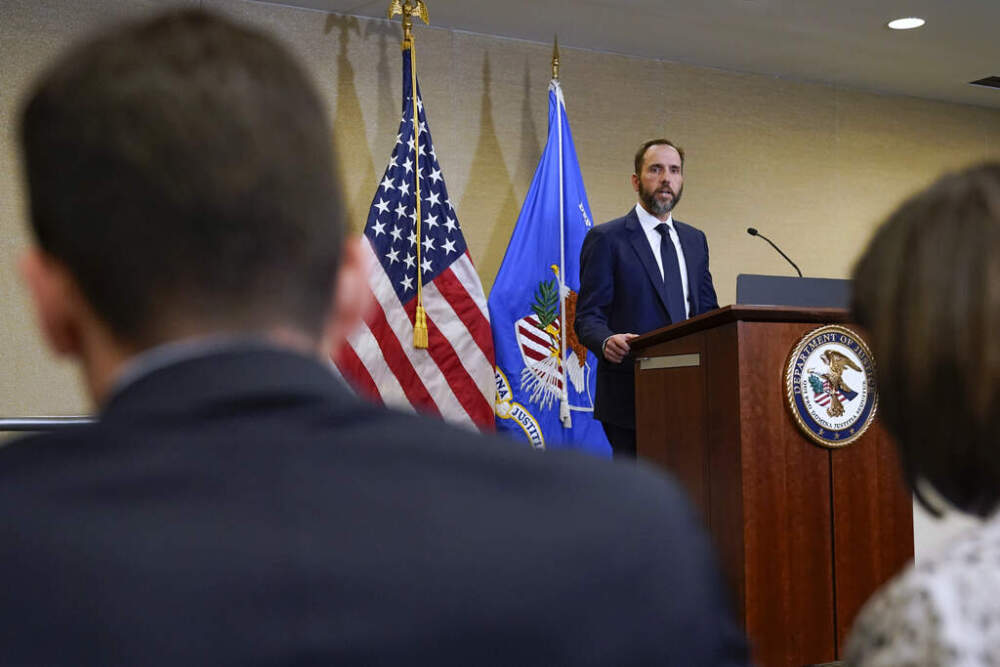
Plans to claim victory no matter how Americans voted. Personal briefings on the fake electors scandal. The latest on special counsel Jack Smith’s case against former President Donald Trump and his attempt to overturn the 2020 presidential election.
Guest
Kim Wehle, Professor at the University of Baltimore Law School. Former Assistant United States Attorney in the Washington, D.C. office. Her latest book is Pardon Power: How The Pardon System Works — And Why.
Transcript
Part I
MEGHNA CHAKRABARTI: This is On Point. I’m Meghna Chakrabarti.
Earlier this month, U.S. District Court Judge Tanya Chutkan unsealed parts of the Justice Department’s special counsel case against former President Donald Trump. Chutkan unsealed a motion from special counsel Jack Smith that argues why Trump’s actions on January 6, 2021 are not immune from prosecution, despite the Supreme Court’s ruling this summer that Trump cannot be held accountable for purported official acts during his presidency.
Though heavily redacted, Smith’s motion delves into details about how much Trump knew regarding the threat of riot posed by the January 6th rally he held earlier that morning, and about the scale of the effort to overthrow the 2020 election. On page 12 of his filing, for example, Smith shows that when told false voter fraud allegations would not hold up in court, Trump said, “The details don’t matter.”
And on page 142, Smith shows that as rioters broke into the Capitol building shouting “Hang Mike Pence," a White House staffer rushed into the Oval Office dining room to inform Trump that “[Trump] would have to take action to ensure Pence’s safety.” And instead, Trump looked at him and said only, ‘So what?’”
And on the very first page of the motion, Smith states his fundamental reasoning for continuing to pursue prosecution against Trump, despite the Supreme Court’s immunity ruling:. He writes, “Working with a team of private co-conspirators, the defendant acted as a candidate when he pursued multiple criminal means to disrupt, through fraud and deceit, the government function by which votes are collected and counted — a function in which the defendant, as President, had no official role.
And then he goes on, "The Court [should] determine that the defendant must stand trial for his private crimes as would any other citizen.”
Well, last week, the judge also unsealed a 1,900 page appendix to Smith’s motion. And they are very big documents that did rise to the top of the news cycle for a day or two, but then quickly faded away in the constant tumult of the final stretch of the current 2024 election. So today, we’re going to slow down for a moment and dig as deeply as we can into the ongoing case against former President Trump for his actions on January 6th.
And joining us to do so is Kimberly Wehle. She’s a professor at the University of Baltimore School of Law; a former assistant U.S. attorney in the Washington, D.C. office; and author most recently of Pardon Power: How The Pardon System Works — And Why.
Professor Wehle, welcome to the show.
KIMBERLY WEHLE: Hi, so great to be here.
CHAKRABARTI: Okay, so first of all, can you just remind us what the special counsel is charging Trump and why this case actually is even still in court? In these, I guess, pre-trial motions, because this isn't actually a trial yet.
WEHLE: Well, he's charging various conspiracies relating to what culminated in the January 6th insurrection, including that Donald Trump interfered with the official government function of collecting and counting ballots, and then took effort to stop Congress from engaging in its official authority to certify the election, then also conspired to basically take the vote away, the constitutional right to vote away from voters who chose Joe Biden.
And the reason we are here, as you indicated in the opening, is that the United States Supreme Court issued a stunning ruling in June that effectively added a provision to Article II of the Constitution giving presidents immunity from criminal oversight so long as they use the massive power of their office to commit the crimes versus private or unofficial power to commit crime.
So Jack Smith is now has reconfigured the indictment hasn't changed any of the charges, but it's emphasizing Donald Trump's role as candidate for office. And that essentially makes the case that when he realized he might not win, he triggered a cascade of crimes to stay in office.
CHAKRABARTI: Mm-hmm. Okay, so we'll come back to the complications around that Trump v. U.S.A. ruling from the Supreme Court. But as promised, let's dig into Smith's motion because quite frankly, were you surprised that it was unsealed even in its redacted form, professor?
WEHLE: Well, not necessarily. A lot of the information, with the exception of certain details, tidbits, has been public, of course, with the January 6th committee, the hearings, et cetera.
The appendix, there's four volumes. The first volume is almost completely sealed, which suggests there could be grand jury information in there, which is, under federal law, secret, unless it's presented to a jury or a federal judge decides to release it. But definitely, Judge Chutkan is not sort of dissuaded or stalled by the fact that there's an impending election, even though Donald Trump's lawyers have been trying to keep all of this on hold pending November 5th and the aftermath.
CHAKRABARTI: Mm. It's interesting because the motion is redacted in some critical ways, right? Names have been redacted. That the motion includes that "the defendant worked with private co-conspirators, including private attorneys, Co-conspirator 1, Co-conspirator 2, Co-conspirator 3," et cetera. We can talk about who those names might be. But what is the thing that stood out to you most in terms of what Smith is arguing, the new evidence that he provided in this motion?
WEHLE: Well, as I indicated, there's a few little details, but what stood out to me is really the story. We forget, you know, we're sort of, we're just numb to it, many of us at this point. We've heard it so many times. But it's really almost a play in three acts. And what stood out to me was how Donald Trump, according to the government, was behind each phase of it.
The first phase being the plan, essentially, to simply declare victory before all ballots were counted. And then Steve Bannon has a private meeting, they allege, and says, you know, "It doesn't mean he's the winner" — I'm quoting — "He's just gonna say he's the winner."
And meanwhile, Donald Trump was hearing from his private advisors, including Eric Herschmann, who was one of his senior policy advisors, that the election was not stolen. And he even told Trump, Herschmann, that if these claims are brought to court as Rudy Giuliani was encouraging, "They would get slaughtered."
And then Mike Pence has a couple of private lunches with Donald Trump, one on December 21, where Trump asks, "What do you think we should do?" And Pence says, "After we have exhausted every legal process in the courts and Congress, if we still come up short, you should take a bow." Yet Trump is reportedly overheard by a staffer telling his family that it doesn't matter if you win or lost the election, you still have to fight like hell.
So, he is, according to the government, the mastermind of all these stages, the second being the attempt to get fake slates of electors and to get Mike Pence to gavel in the fake slates of electors, that he gets really angry with Mike Pence when Pence files a brief, you know, saying he doesn't — he disagrees that he has the constitutional authority to do that. And Trump tells him, "Hundreds of thousands of people are going to hate your guts and people are going to think you're stupid."
And then again, Herschmann confronts Trump and says, listen, if we go forward with this, this plan to ignore the constitutional obligations that there could be "riots in the streets."
And then Act Three is the riot of January 6th where Donald Trump understands that Mike Pence is not going to go along with that plan and as a result of that rejection, knowing what's happening on the ground, he you know, riles up his supporters and then sits back while the Capitol is overtaken. There's a gallows built for Mike Pence and members of Congress are fleeing for their lives. It's really -- to read it again, laid out by Jack Smith in a different voice was what stood out to me.
CHAKRABARTI: Now about Pence a little bit more, I mean, I read that portion earlier in the introduction about Trump's reaction to the threat of danger and harm that the former vice president was under like in the time that that was the riot was going on. I have to be honest, I cannot remember if that specific detail was in the findings of the January 6th committee or if it's new in Smith's filing.
WEHLE: That does jump out to me as well. I haven't gone back, you know, and lined them up. But definitely the role of Mike Pence stands out. We knew that he did his constitutional duty, that he thought about it and determined legally — notwithstanding that lawyers John Eastman and others for Donald Trump had written memos encouraging him, I think, knowingly. When I say knowingly, Eastman seemed to acknowledge, and based on the information in Jack Smith's latest filing, that it would be illegal for Mike Pence to ignore the valid electoral count votes. But Mike Pence did his civic duty. And we've seen just in the last several weeks that he's standing by that decision notwithstanding the attacks.
And I should add, Meghna, the other thing that stood out to me in connection with, for example, Donald Trump's contacts with officials in seven swing states to try to get them prior to the certification or the fake slates of electors, to try to get them to — to buy into the false claims of election fraud, and they refused to do it.
And these were Republicans. These are not Democrats. These are Republican officials that Trump took to Twitter and started, you know, verbally attacking these people and threatening these people, or at least using threatening language. And some of them, obviously we know now in Georgia, two election workers, Ruby Freeman and Shaye Moss, were, they claim their lives were destroyed. And of course, Rudy Giuliani had a $148 million verdict against him by virtue of those efforts. He said they were surreptitiously passing around USB ports like they were vials of heroin or cocaine.
And meanwhile, all along the Trump campaign knew this was false. I don't think there's any sort of colorable, legitimate argument that this was not all a lie. And that's stunning four years later.
Part II
CHAKRABARTI: Now Professor Wehle, before we get back into the details of what's in the filing, I want to just sort of take a step back for context here. Because, as you said, Smith is trying to prove that Trump was a participant, and even in your words, the mastermind of three different conspiracies. But he's trying to do so in the face of this massive ruling from the United States Supreme Court, that Trump v. U.S.A. ruling, which basically granted sweeping immunity to a president in office. So regarding that as the obstacle that Smith has to overcome, what is it that he has to prove to Judge Chutkan about why the case should go forward?
WEHLE: Well, the Supreme Court basically created a multi-tiered standard for determining whether any particular piece of evidence could be used against a former president. Essentially, so long as someone is still in office, they get this presumption of immunity.
The highest tier is called, you know, core acts, like a pardon, for example, it's untouchable. But the court doesn't define that and even acknowledges from their perspective, the majority's perspective, it might not even be expressed in the Constitution. There could be core powers that are implied.
The second is this ballooned presumptive immunity for other official acts. And once there's that presumption, then Jack Smith has to overcome the presumption by basically arguing that, hey, you know, a president wouldn't be chilled from exercising their official power if they thought one day they could be prosecuted for it.
He acknowledges, for example, when it comes to communications with Mike Pence, to the extent to which he was acting as a member of the Senate for purposes of the electoral college votes, those communications might be presumptively immune. But Jack Smith argues, no, we can overcome that presumption because trying to corrupt the vice president to violate his constitutional duty would not somehow chill a future president from exercising their lawful authority, because that's not legitimately within the scope of the president's power would be to support the peaceful transfer of power. It's kind of a mind-bending analysis.
And I just want to be clear for textualists, these conservative judges, justices who claim to be textualists and originalists, there is no immunity for presidents. There's immunity for members of Congress. That's clear in the Constitution. And the impeachment clause also makes clear, even if you're impeached, you can be prosecuted and convicted for crimes relating to those acts. So the Supreme Court really went way out on a limb here. And arguably declared parts of the Constitution null and void in order to erect this very high bar.
But I should say, I think what Jack Smith did was use another decision by the DC Circuit, a lower court involving a civil claim against Donald Trump for January 6th, where the DC Circuit said, wait a minute, even if you're president, if you're campaigning to stay in office, that's not part of a sitting president's official duties. You're doing that as a candidate for your own political future. And I think that's what Jack Smith seized on in his big filing here.
CHAKRABARTI: But it may not be enough. I mean, we're hypothesizing here now, because it's the Trump v. U.S.A. case, or ruling, that has to be overcome here by Smith.
You know, I note that the Supreme Court ruling was, as we recall, was written by Chief Justice John Roberts, right? And in that Trump v. U.S.A. decision, I mean, he actually does state that determining which acts are official versus unofficial through the office of the presidency can cause be "difficult," right? And that they recognize that they're giving quite broad brush to what would constitute a president's official responsibilities.
And then, even more interesting than that, Roberts goes out of his way to say that when trying to determine that official versus unofficial, courts cannot consider the president's motive, nor can they designate an act as unofficial just because it violates the law. I mean, I think these are the parts that make people think that it's total carte blanche is what the Supreme Court has given Trump.
WEHLE: Sure. I mean, I think a question is okay, what if Joe Biden decided that Project 2025 is a threat to democracy and the Constitution? So as president — of course, it's all hypothetical, it wouldn't happen. And I'm not suggesting this would be a good idea. But he says, "okay, I'm going to have the Republican nominee and vice presidential nominee executed because it's really bad for democracy and bad for the Constitution. I'm making that decision as part of my official power over as commander in chief and as head of the Justice Department and federal law enforcement." I think arguably that would be immune from any oversight at all.
But I should add the bigger, I mean, an equally difficult problem here is that the Supreme Court majority has left it to themselves to decide one day what is and is not official. The test is so vague. They drew some red lines around unofficial conduct — or, excuse me, official conduct. They gave presidents kind of a safety net. But they weren't willing, even with all of what happened on January 6th, they weren't willing to put any safe harbor around unofficial acts.
And so I, you know, I think arguably the opinion was a power grab of prosecutorial power. The Supreme Court majority has now deemed themselves the super-prosecutors when it comes to presidents. And no one knows unless and until a particular case and the pieces of evidence go before those five justices or six justices, what, in their mind, the Constitution theoretically would say. Because it's not in the Constitution.
CHAKRABARTI: Right.
WEHLE: So it's not only deeply troubling for purposes of the power of a president, but it's also deeply concerning for purposes of a Supreme Court majority that's really drunk with their own unaccountable power in this moment.
CHAKRABARTI: Which includes the very textualists, you say, that would, should have ostensibly read the Constitution as not having anything to say about presidential immunity, right?
WEHLE: Or said, you know, Article Two says the law shall be faithfully executed. Faithfully executed doesn't mean committing crimes. And, you know, you don't need to be a constitutional scholar. If you've watched the musical Hamilton, or you remember Schoolhouse Rock from the 70s, "No More Kings." To take the separated powers and the checks and balances out from underneath the presidency is very dangerous.
And it's the official power that we should worry about. It's not unofficial power. It's not if a president pulls out his boyhood shotgun and kills a political rival. That's the kind of thing maybe would now you could, you know, there could be an indictment. It's when he uses the massive power of the office that's arguably unparalleled on the globe. That's the stuff we want accountability for. That's what the court just said there is no accountability for
CHAKRABARTI: Right. And so again, I'm thinking in terms of what Jack Smith has to prove in order to actually get his case against Trump to the trial phase. And forgive me for harping on this, it's just a part of Trump v. U.S.A. that I struggle with. That when the high court said, okay, well what constitutes a president's official responsibilities? They say it's basically all actions, so long as those actions are not "manifestly or palpably beyond his authority."
Now, you know, the Trump team is going to very vigorously argue that the power of the president includes the power to be able to campaign; the power to have a rally in Washington, D.C.; the power to have meetings with his advisers, legal and political, in the White House, in the Oval Office; that there's no distinction between that as acts of presidents versus acts of a candidate who also happens to be president at the same time.
WEHLE: Right. It's a sweeping ruling. And I think it's really important to think about incentives, right? I mean, why do we slow down for speed limits? It's not necessarily because the sign tells us to. It's because we're worried about a ticket. And where are the tickets for speeding in the White House moving forward?
John Dean, who was White House counsel under Nixon, who famously told the Congress "there's a cancer on the White House," he did the forward to my new book, Pardon Power. And his position is, listen, this immunity ruling would have immunized everything Richard Nixon did. Which to me suggests that this is a watershed moment in American democracy and the power of the presidency. And we have to ask ourselves moving forward, what's really left to stop now that there's this green light?
And this, to your point, it's hard to even see how you thread the needle to get a prosecution. And would a prosecutor even try? It's so difficult, right? What incentive does this give people in that role, when, you know, James Madison said, "If men were angels, we wouldn't need government? And "ambition needs to be made to counteract ambition." The framers understood that we can't just wait around and hope for a benevolent king.
And I think what the Supreme Court's done is left it to the American people to be voting based on integrity, somebody having their own stop signs internally that they're not going to, you know, grab power and start abusing it and curtailing liberties. And of course we have Donald Trump that is promising to do exactly that quite blatantly and a Supreme Court majority that said, "Go right ahead. We think the constitution protects whatever you want to do, however egregious it is and damaging it is to the Constitution and to individuals."
CHAKRABARTI: You know, your mentioning of John Dean reminds me, of course, of Richard Nixon's most famous quotation from the Frost-Nixon interviews, right? That if the president does it, it is not illegal.
WEHLE: Sure. And I think that, so long as you're still in the office, I think so long as you're still president, lawyers can make a tangential argument that all of it is immune in some way.
I mean, think about it. The test for what Jack Smith has to show is if you're sitting in the Oval Office worrying about an indictment, will that give you some pause in exercising the power of the office? I think you'd say any indictment for anyone, any criminal liability will always make you think twice.
And we don't, honestly, as I said, we don't even know. And you mentioned as well, two parts. One, you can't use motive, and motive is what distinguishes often a legal act from a crime. It's you're doing it for the wrong reasons, right? You're not executing someone for the public interest. You're executing someone because you want to stay in power indefinitely.
And the other piece is they said that you can't use evidence of the official act. So to take a bribe, for example, it's the official act in exchange for money or, say, a pardon, going back to my book. It's the official act that makes it illegal. It's not illegal to accept a lot of money and someone giving you a gift of a lot of money. It's the exchange. You know, crimes are like a recipe in a recipe book. You have to have all the ingredients to get proof beyond a reasonable doubt and to actually prove the crime.
If you don't have, you know, the flour and the sugar in the cookies, they're not going to bake properly. And likewise, if you take out evidence of motive and evidence of the actual official act, it's impossible to prove the crime. Literally impossible. And as I said, prosecutors aren't even going to try because it's so insurmountable. In addition to the fact they might worry now about retaliation if you've got a menacing president.
CHAKRABARTI: Well, Smith, though, is still trying, right? (LAUGHS) I mean, that's exactly why this case is still alive, at least at the district court level.
So let me ask you, getting back to the details of what Smith is both alleging against the former president and what he's written in this motion. As you had mentioned, Professor Wehle, he's basically alleging that Trump is engaged in three conspiracies. Now, what is the standard generally — if there is a general answer to this — what is the standard of proof that a prosecutor has to meet that someone is actively engaged in a conspiracy?
WEHLE: Well, it's always going to be, as I mentioned, proof beyond a reasonable doubt, which is, you know, 99.9% you have to persuade a jury. I think they, you know, we've all lived through this. Some of us watched it miles from the Capitol. We know what happened. But you know, conspiracy is a meaning of the minds, plus a step forward to commit a crime. You don't actually have to achieve the crime.
Donald Trump is the only one that's indicted here, but as you mentioned, they have unnamed co-conspirators that people have connected the dots and figured out it likely includes Rudy Giuliani, John Eastman, Sidney Powell. Those three people are all private actors; They didn't have any official role. And so part of what Smith is arguing is he committed the crimes, Donald Trump, using private actors, not public figures.
Now, one of the co conspirators in the original complaint was also Justice Department official Jeffrey Clark. This is one place where the majority was very clear. The chief justice was very clear that if you communicate as president with your attorney general — and just so people recall, attorneys general have prosecutorial power, federal prosecutorial power. They're also in charge of the FBI, the DEA. If you're talking to your AG, that's protected.
Then there's also former Trump lawyer Kenneth Chesebro. Some of these people have been indicted in Georgia and other places. So in hindsight, the original complaint does kind of carve it out at that line between public and private, but there's no telling. I mean, one of my concerns is that this Supreme Court has kind of left it open to themselves to kind of decide which presidents might need accountability and which presidents might not need accountability.
There's enough leeway for another person to be indicted and say, okay, well, that's unofficial. They've just given themselves this super-constitutional power, super-prosecutorial power that arguably, as I said, is a violation of the separation of powers. Under Article Three, they're supposed to call balls and strikes, decide cases, live disputes. They're not supposed to be making policy. And they're certainly not supposed to be making additions of this sweeping nature to the United States Constitution itself.
CHAKRABARTI: You mentioned Ken Chesebro. I'm not actually quite sure how to say his name. Regarding the fake electors scheme, it was this past spring, spring 2024, that that case was actually settled. And as part of that, the two defendants there, Chesebro and Jim Troupis, actually agreed to turn over 1,400 pages of documents and messages that outlined — photos and videos, too — that helped flesh out exactly how that fake electors scheme worked, was thought through and carried out. And it'll be interesting to see what happens with all of that.
Part III
CHAKRABARTI: Professor Wehle, I just want to ask you one more question about the specifics of what Smith has to prove to get his case, his indictment, to actual trial or maybe even thereafter. Because I'm still — the word "mastermind" that you used earlier in the show is still ringing through my head. And I'm wondering, again, in the eyes of the law, what needs to be proven that someone was actively engaged in a conspiracy? Or even was the lead in creating and executing that conspiracy?
Because a lot of the things that Trump did, which were in public, as we all note here, were, you know, Twitter statements. They were things like saying, "So what?" or just not even acting. I mean, I think the Trump team can argue a lot of this didn't necessarily mean he was engaged in the planning and carrying out of the alleged conspiracies.
WEHLE: Well, they need to show that he intentionally engaged in a plan to violate the law and defraud the United States. So that includes, I think, throughout the brief, evidence that Donald Trump knew at the time that when he was tweeting about election fraud, when he was retweeting Sidney Powell's lies, at the same time, he was privately, according to the government, sort of eye-rolling about her and ultimately distanced her from the campaign.
When he changed his speech on The Ellipse to point out and point a finger at Mike Pence when he became enraged that Pence was adhering to the legitimacy of the election, that Donald Trump all along knew what he was doing was illegal. That the RNC chief counsel was telling him and the campaign there was no fraud. That the Republican elected officials in the swing states that he was trying to get to admit to fraud, they were saying, "We don't have evidence." When Rudy Giuliani was saying 10,000 people, dead voters in Arizona. People knew this.
Herschmann, who is a senior advisor, and also a lawyer, telling him, with profane language, "This is not true." And, as we've discussed, now we know there's evidence that Trump just ignored it. Or he sloughed it off. Or he chose to look the other way. That is what the government's going to use to show that he knowingly and intentionally engaged in a scheme to defraud the United States voters.
CHAKRABARTI: You know, it seems to me in Smith's motion that there's some pretty strong evidence about the knowing participation of some of the co-conspirators, right?
There's a section where one of them, in a meeting — I believe it was at the White House — where they were talking about how the January 6th rally could turn into a Brooks — no, no, it wasn't January 6th, it was other rallies could turn into a Brooks Brothers-style riot from the year 2000. And this co-conspirator says, "Do it. Make them riot." I mean, that's probably more direct than what I understand Trump is alleged to have said at any time.
But so Professor Whaley, though, I wonder what you think about the importance of Smith's case now, given that we are on the cusp of another presidential election? The law does not move at the same pace as politics does. But this is still happening when, you know, Donald Trump could win and return to the White House.
WEHLE: Well, I think it lays out a game plan for what we're going to see in the coming weeks. We're going to probably see declaration of a win from the Trump team, regardless of the facts. We will see allegations of fraud. We will see attacks on people that are doing their civic duty, including regular friends and neighbors that are engaging in, you know, poll watching or counting ballots or checking people in to vote. Potential violence, like I don't know whether it be on January 6th or beforehand, we're going to see that.
And it's chilling to imagine that now, armed with the Supreme Court's ruling, we'll have potentially unaccountable power in the White House with someone who's promising to use the military, to use federal law enforcement, et cetera, against dissent. I mean, that's not democracy. It's a version of something else, whatever word people want to put to it, authoritarianism, fascism. I'm not an expert in the terminology. But the terminology is beside the point.
An unlimited monarchy is a pyramid, with the king at the top whose power comes from God. And you know, you stay in the king's graces and you get treated okay. Otherwise, you're thrown in the dungeon. The framers of the constitution, the revolutionaries, inverted the triangle. The people have the power and it trickled down to elected leaders and you get fired at the ballot box.
By attacking the very integrity of our elections, it destabilizes the entire democratic system where the people get to choose their own leaders. And my concern is, you know, for the children, young people who are too young to vote and they have no agency in this moment and the implications are extraordinarily dire.
And I should add, back in 2022, I did a thought experiment with my law students, where we went through the Constitution and we said, okay, all the checks and balances, the guardrails, the tickets for speeding that are in there, let's go through in them and see if they've been used. See if they're still vibrant and functioning. And we came to the conclusion -- and I did a column for Politico around the same time — that the only thing left was a criminal indictment of a president to basically stop people from engaging in their worst instincts. And now the Supreme Court has taken that away.
And if you add that with the pardon power, right, unlimited power, immunity, and you pardon co-conspirators now, you promise a pardon. It's not just a president who's who could be above the law in committing crimes, but those who are willing to do it on his behalf in exchange for the promise of the pardon and the execution of a pardon.
CHAKRABARTI: Are there any limits to who a president can pardon and why?
WEHLE: Yeah. I mean, well, there are limits on the pardon power. They're not on who the president can pardon, but there are constraints.
For example, the president can't pardon a crime that hasn't been committed. The president cannot pardon someone and order reimbursement of any financial penalty, because that would violate the appropriations authority of the United States Congress. The president can't force a pardon on someone and then make them testify notwithstanding the Fifth Amendment privilege against self incrimination.
So as I argue in the book, there's this mythology running around that the pardon power is a king-like power, unlike the other powers in the Constitution, which have checks and balances. We haven't had cases that would address some of these issues. But sadly, the Supreme Court, you know, in sweeping language suggests the pardon power is absolute. And frankly, Jack Smith's lawyer at that Supreme Court argument in Trump versus U.S. didn't push back on that notion.
So you know, as I say to a lot of people, the question often isn't what the constitution allows. It's okay, does someone get away with violating it? If someone gets away with violating something, say, abusing the pardon power, and there's no consequence, then the answer is yes, you can do it. Because it's just human nature. If you get away with stuff, you can do it. And right now, the Constitution has just been not enforced in some critical ways.
CHAKRABARTI: I mean, this is where we are, right? Any idea or document, even the Constitution of the United States, is only as good as the paper or parchment it's written on if the people who participate in the system that is described by that document aren't willing to enforce it. I'm going to come back to that in a second. But just for the sake of education, Professor Wehle, can a president pardon himself or herself?
WEHLE: Same answer. Same answer. If the president does that, is there a consequence? And there would unlikely be a consequence. And we might not even know about it now that the court has said essentially that evidence of core acts like a pardon can't be used in a prosecution.
Since really Ronald Reagan, maybe, there's been more, you know, flurries of last minute pardons where it appears to be that pardons could be used for political donors, for cronies, for people that are close to the president, certainly for lobbyists. There are six members of Congress also, just to be clear, in addition to John Eastman and Rudy Giuliani, who are on record of having asked for pardons in connection with January 6th.
So it's under our noses that the pardon power is being used not for the public interest, but for self interest. And the question at the end of the day is, okay, what's the consequences for that? And I think people don't pay attention to the pardon power.
But at the end of the day, you know, we could be mad at our government, but under the Constitution, we are the government. We are. I mean, we're in the midst of a crucial election, the most vital in my lifetime, maybe in the history of the United States, which an exception may be Lincoln around the time of the Civil War. We are the government. We are. And if your vote didn't matter, people wouldn't be trying so hard to take it from you.
And so to blame the government if you don't vote, that's a little short-sighted, very short-sighted. That's the way it's set up and I think we lose sight of that when we think our vote is so diluted and it's easy to blame the politicians when we're the ones who put them there.
CHAKRABARTI: You know, regarding Trump and January 6th, then even all the actions as we've been talking about that he and his circle undertook prior to January 6th, prior to even the November election in 2020. And then, of course, in the period between November and January. Obviously, legally, a lot of those nuances can be argued and debated. But I've been wanting to ask this question of someone for a long time, and Professor Wehle, you're going to be it today. (LAUGHS)
WEHLE: (LAUGHS) Okay.
CHAKRABARTI: Because, you know, all of those things aside, one of the things that I keep coming back to, and just cannot shake from my mind is, okay, you may not like Trump. You may not like his policies. You may not like what he said. You may not like that he picked up the phone and called the Georgia secretary of state and said, "Find me 11,000 votes," et cetera.
But every single president of the United States, when they assume office, they put their hand on a Bible, and so did Donald Trump, and they say the following oath: "I do solemnly swear that I will faithfully execute the office of the President of the United States, and will, to the best of my ability, preserve, protect, and defend the Constitution of the United States."
And on January 6th, I mean, we know, he's even pretty much said it, when Congress was literally being physically attacked and members of another branch of government were put into danger, for three hours, Donald Trump, as President of the United States, did nothing to protect the Constitution of the United States and the constitutional duties that were supposed to be carried out in Congress. But is there no civil or criminal penalty for that beyond the political process of impeachment?
WEHLE: That's what we're asking, right? There is, as I mentioned, the civil case, money damages under the Civil Rights Act. That's percolating as well as this criminal indictment.
And, you know, I hear your recitation of that. And the question is, why do so many people blink that away and not care? And I think there's a couple answers to that.
One is this concept of American exceptionalism, really, or normalcy bias. This idea that it'll never happen here, right? The second is, okay, the Constitution for me, but not for thee. This notion, so long as it's my guy, it doesn't matter, because I'll be okay. And that's not how it really works, right?
If the Constitution is a bridge over a rushing river that if you fall over, you'll careen to your death. And no one's paying attention to the grouting in the bridge, it's been 240-plus years and the bridge collapses, we all go down. If the system is gone, it's gone for everyone. And eventually someone will get in that position that doesn't look kindly on you.
And the third is just the misinformation and the lies, you know, authoritarianism is about conveying absurdities, lies to, in part, to the public, to people close to you in politics, to if you want to be in good graces with the leader, then you have to absorb the lies. If you don't, you get kicked out. And then we can't tell truth from fact.
And that's one of the beauties, frankly, of the judicial system. There are rules of evidence. You cannot — in this moment, it's functioning. You cannot submit to a jury evidence that has not been validated. And the jury's verdict gets appealed to other judges. I mean, it is this bastion of accuracy facts. I mean, it gets it wrong, let's be clear. But it's very, very different from X, from, you know, TikTok, and certainly from the stuff that's coming out of our politicians.
And those two pieces, our judicial system and our electoral system, today are still holding. And that gives me some hope. But they both really need all of us to come together and hold hands and shore it up for the next generation.
CHAKRABARTI: Well, Kimberly Wehle is a professor at the University of Baltimore School of Law and former assistant U. S. attorney in Washington, author most recently of Pardon Power: How the Pardon System Works — and Why. Professor Wehle, thank you so much for joining us today.
WEHLE: Thank you so much for having me. I've enjoyed it.
This program aired on October 25, 2024.