Support WBUR
Trump's budget bill and ballooning deficits
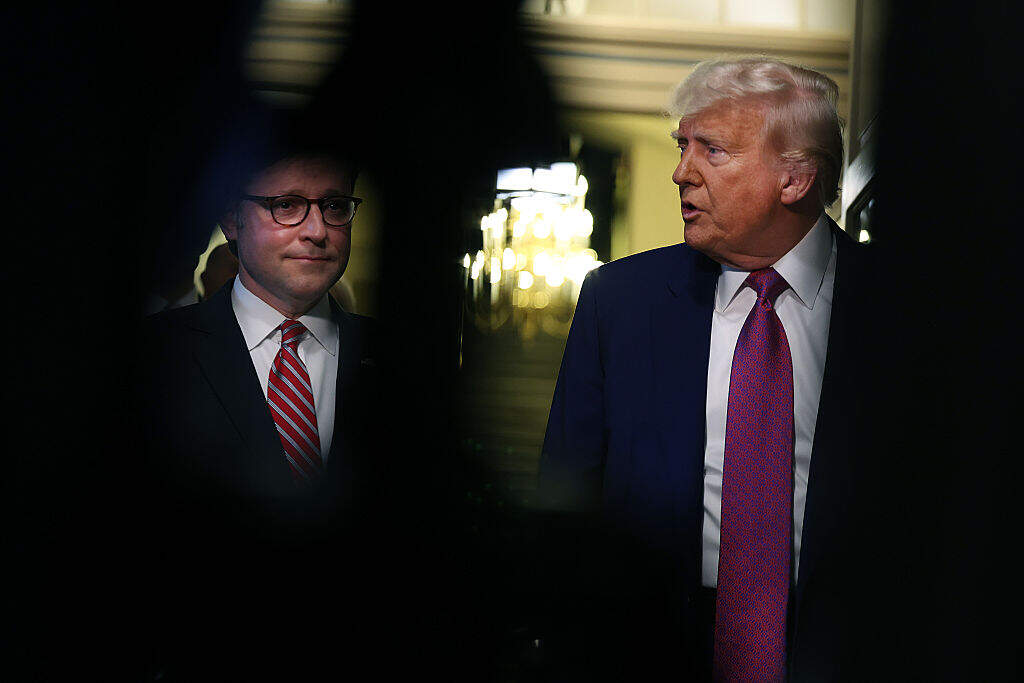
The Congressional Budget Office estimates the current budget bill will add $3 trillion to the federal deficit over the next decade. On Point wraps up a weeklong exploration of what Trump's budget bill tells us about government spending and our financial future.
Guests
Stephanie Kelton, professor of economics and public policy at Stony Brook University. Author of the New York Times bestseller "The Deficit Myth: Modern Monetary Theory and the Birth of the People's Economy."
Douglas Holtz-Eakin, president of American Action Forum. Chief economist of the President’s Council of Economic Advisers under President George W. Bush. Former director of the Congressional Budget Office.
Transcript
Part I
MEGHNA CHAKRABARTI: We've been spending the week looking into several major parts of the One Big Beautiful Bill Act, the budget reconciliation bill that contains some historic changes that will have an impact on virtually all Americans. On Monday of this week, we talked about health care and the $880 billion Medicaid cut over 10 years that the House has proposed.
Just after that show, the Senate released its proposal, which would make even deeper cuts to Medicaid. The bill also seeks to do things like shorten the enrollment window and lower subsidies for people who receive their insurance through the Affordable Care Act.
On Tuesday, we talked taxes. There's the no taxes on tips proposal and changes in taxes on social security benefits. The tax cuts overall are heavily tilted towards America's top income earners. People making more than $1 million per year would receive a tax cut or let's call it an income gain of almost $90,000.
That's a 4.3% increase. The bottom 20% of earners would gain just $90 or a 0.06% increase. Okay, put another way, the 1.2 million Americans with those million-plus incomes would receive more total tax cuts than all of the 127 million Americans with incomes below $100,000. On Wednesday, we looked into cuts in food assistance, primarily SNAP benefits.
The House proposes a $300 billion cut to the program that's reducing the anti-hunger program by roughly 30%. The largest cut ever in SNAP history. The health care and food assistance cuts I just mentioned are designed to help pay for the tax reductions we spoke about. And yesterday we examined one federal agency that's getting a huge funding increase more than the agency itself even asked for. The One Big Beautiful Bill Act will send the Pentagon's budget above the $1 trillion mark.
Now all told, that leads us to today and the question. How are you going to pay for it? Especially since the programmatic cuts themselves aren't going to cover it. This question used to be a defining value of the Republican Party.
NIXON: To increase our national debt means raising your prices. Is that what you want for America?
REAGAN: This country has been held captive by the threat of ever-increasing deficits.
BUSH: Unrestrained government spending is a dangerous road to deficits. So we must take a different path.
CHAKRABARTI: Presidents Richard Nixon, Ronald Reagan, and George W. Bush there. But the current Republican-led House budget bill is expected to take a path to even higher deficits.
This budget would raise the deficit by something like $3 trillion over the next decade. So what's happened here? Does anyone of either party actually really care about deficits anymore? Did they ever, and what does it mean for the nation's fiscal future and how lawmakers year after year choose to allocate trillions of dollars, as they like to say, of your taxpayer money?
So that's what we're gonna talk about today. And joining us to do so is Douglas Holtz-Eakin. He's the president of the American Action Forum, former Chief Economist of the President's Council of Economic Advisors. He had that position under President George W. Bush, and from 2003 to 2005, he was the director of the Congressional Budget Office.
Douglas Holtz-Eakin. Welcome back to On Point.
DOUGLAS HOLTZ-EAKIN: Thank you. Great to be on.
CHAKRABARTI: Okay, so I wanna just quickly describe to Americans what the CBO does. The House's own website says the CBO provides Congress with objective, non-partisan, and timely information. And estimates related to federal, economic and budgetary decisions.
The CBOs own website says: The Congressional Budget Office conducts objective impartial analysis and helps Congress make effective budget and economic policy. And interestingly offers an alternative to the information provided by the Office of Management and Budget, OMB, which sits in the White House.
So Douglas, can you just describe to us in some detail what is the process that the CBO goes through in order to give a score to a budget bill or to estimate how much of a budget might add or reduce the deficit?
HOLTZ-EAKIN: It's a very elaborate process. It begins roughly in November when they start putting together a forecast for the U.S. economy.
Over the next 10 years that forecast gets nailed down somewhere in December, and that gets released in January. So once you know what the economy's going to do, you can then look at the current laws governing taxes and spending and ask what happens to the federal budget if you put it on autopilot and just let the laws play out.
That's known as the baseline. That's what happens if you do nothing. And then when Congress proposes legislation, you ask the question, how would that baseline change? How much more or less will come in the way of taxes? How much more or less will go out in the way of spending in each year for the next 10 years?
So the score is those numbers. What is the impact on the budget over the 10-year budget window in terms of revenue spending and ultimately the deficit and debt?
CHAKRABARTI: Okay, so revenue and spending. Let's talk about the revenue side. Because obviously one direct form of revenue is just taxes. But the CBO must factor in growth estimates as well.
HOLTZ-EAKIN: Yes, the CBO has a baseline outlook for the economy, has some growth. The trend growth rate in the U.S. economy right now is about 1.8% per year. And if a bill is large enough and the One Big Beautiful Bill Act qualifies for this, CBO has to look not just at the current growth rate, but how would the bill itself change the growth rate?
And as a result, if it grows faster, you get more revenue than you might otherwise have gotten, you have less in the way of unemployment benefits and things like that, so you have less spending. If on the other hand, it grows slower, then the reverse is true. You'll get less revenue, you'll spend more, and so you can factor that into the CBO score.
That's what's known as dynamic scoring.
CHAKRABARTI: This seems really important, right? Because a score can change pretty dramatically based on how CBO or any other group thinks about potential future growth, right? Because we've heard oftentimes over the past several weeks house Republicans say that this is, the House speaker said himself, it's going to put jet fuel.
It's gonna be jet fuel on the U.S. economy and provide like incredible amounts of growth. Do you see that as a legitimate forecast?
HOLTZ-EAKIN: That's not what I would expect to have happen. It is true the dynamic scoring could potentially change the score dramatically, in practice it never has. And there are a number of reasons for that.
Number one, the U.S. economy is very large, $30 trillion of income every year, moving it is very hard. And so changing the growth rate by 2, 3, 4 tenths of a percent per year is a big accomplishment. To do that, you have to have very disciplined policies.
Economies grow by choosing not to eat and consume, but instead to put some money aside, save it, invest it in education or software or buildings or equipment, or some other productive investment that makes the economy larger next year. And thus allows more workers to earn more money. And that discipline, give up something in the present to get something in the future is the heart of economic growth.
I will say lovingly that your Congress is not usually very disciplined. It likes to do stuff now. (LAUGHS) So they proposed these bills, and they say, we're gonna get this growth. And then if you look at what's actually in the bill, it usually doesn't turn out to be that way. And I, when I did the very first dynamic score for Congress, when we showed them the results, I thought, they will learn the lesson that you cannot have big spending programs along with these tax incentives.
And they will be more disciplined. What they concluded was, I did it wrong. And I think that set the tone for everyone since.
CHAKRABARTI: We're gonna talk about that. Because the CBO doesn't know what it's doing, as a refrain that we've been hearing also recently. When was that first dynamic score?
Remind me of the year.
HOLTZ-EAKIN: That was 2003.
CHAKRABARTI: Ah, okay. Good. 2003. Okay. I actually wanna talk to you about that in a few minutes. We will get to that. On Tuesday when we talked to members of the Tax Foundation, for example, on their projection of what the proposed tax cuts would do, we were told that their estimate is that the growth contributor in the bill is pretty low and they think it would help the economy grow by less than 1%.
In terms of specifically the tax cut portion of the bill. Does that sort of jive with your thinking?
HOLTZ-EAKIN: Yeah. There's a lot of language that surrounds the bill, but for the listeners, it extends current law. That's the first thing it does. And so that's not gonna change anything.
That's just doing more of the same. The second thing it does is provide some better investment incentives for firms. They are the ability to deduct in the first year that you make the purchase equipment. Some structures and R&D, but they're temporary. They last four years.
And then there's this slew of campaign proposals, no tax on tips over time. Special stuff for seniors, deduction or auto loan interest, state and local tax deductions. All of that is charitable junk and will do nothing for economic growth over a 10-year period. And so there's not really much in there that's pro-growth policy and what comes out is not much growth.
CHAKRABARTI: And this was actually, this is the significant change from 2017, right?
HOLTZ-EAKIN: Yes.
CHAKRABARTI: Yeah, exactly.
HOLTZ-EAKIN: Okay. So the CBO now for this budget proposal has estimated that it will increase the nation's deficit by $3.4 trillion, including interest over 10 years. So Douglas put that in perspective for us, in comparison to previous budgets.
Is that a lot? Is that a little, is it cause for a concern? How would you look at that number?
HOLTZ-EAKIN: It is a lot of money, $3.4 trillion. It is relatively small compared to what we've already done, which is well over $33 trillion of borrowing. So it increases the debt by about 10%.
CHAKRABARTI: That's a lot.
HOLTZ-EAKIN: It's more than anything else though, a missed opportunity. This was a chance to actually go the other direction, to take and get our deficits and our debt under some control. And I thought the gold standard here would be to do a pro-growth tax reform, much like 2017, but which was going to be deficit neutral with regard to current law.
And current law is a big tax increase, because the tax law is sunset. So that would've been deficit reduction and pro growth tax policy. That's the gold standard, but we're nowhere close to that. I thought the minimum should be, don't make the current problem worse. We're not close to that either.
We're going the wrong direction and we're not getting much growth. It seems like a really big, missed opportunity.
Part II
CHAKRABARTI: A little earlier I played a couple of voices from Republican presidents talking about their deep concern about the nation's rising debt and deficits. To be sure that concern has also been echoed historically by Democrats, and here are a few.
CARTER: Deficit spending should not be a feature of our budget.
CLINTON: We have to cut the deficit because the more we spend paying off the debt, the less tax dollars we have to invest in jobs and education and the future of this country.
OBAMA: We can't just cut our way to prosperity, if we're serious about reducing the deficit, we have to combine spending cuts with revenue.
CHAKRABARTI: So those are presidents, Jimmy Carter, Bill Clinton, and Barack Obama. Doug, I wanna bring in Stephanie Kelton into the conversation. She's a professor of economics and public policy at Stony Brook University and author of "The Deficit Myth: Modern Monetary Theory and the Birth of the People's Economy."
Professor Kelton, welcome back to the show.
STEPHANIE KELTON: Thanks for having me.
CHAKRABARTI: I'm deliberately just like taking a bat to the hornet's nest of traditional economic theory by bringing you on and talking about MMT here. But let's get some more numbers on the table here. I had mentioned earlier that the CBO says the budget bill will increase the debt by $3.4 trillion. The Center for Responsible Federal Budget says it will increase the deficit by 8.4% of GDP. Tax Policy Center, an additional $3 trillion. The Yale Budget Lab says that short-term GDP growth and long-term decline in growth will reduce the GDP, would be 3% smaller than expected.
So that's got an impact on deficits. Wharton School says it will add $3 trillion to the deficit, and the Tax Foundation, as we mentioned a little earlier, says that revenue losses for the federal government would be close to $4 trillion over the next 10 years. Do any of those numbers, Professor Kelton, give you heart palpitations.
KELTON: No, they don't. Look, I'm less unnerved by the budgetary effects of the One Big Beautiful Bill Act, and more concerned about the human, environmental inflationary impacts. The number that falls out of the budget box at the end of each year. This deficit really doesn't, in and of itself, tell us much that's useful, or I think very important.
CHAKRABARTI: Okay. Why?
KELTON: Okay. You know, Meghna, the thing that people don't, I think, appreciate about this number is that you can't look at it in a vacuum. It exists in the context of the rest of the economy. So all of the numbers that you just ran through and said, the deficit might be this number or that number, or the other number, you could easily reread that script.
And instead of using the word deficit, use the word surplus. And instead of using the word government, say non-government, in other words, CBO estimates that the surplus going to the non-government part of the economy will be $3 trillion and change over the next 10 years. Whoa! What a different conversation we would be having if we understood that on the other side of the government deficit lies a financial surplus that is equal in magnitude, that goes to the non-government part of our economy. In other words, every deficit is good for someone. The question is always, for whom? Who gets that windfall? Where is it going? And is it helping us to accomplish things in our economy?
Is it giving us better health care, better education, better infrastructure, and so forth and so on? Those are the things that matter to me.
CHAKRABARTI: Professor Kelton, the money doesn't come, just doesn't come out of thin air, right? Like calling something a surplus when it's conventionally called a deficit doesn't eliminate the truth that the money has to come from somewhere.
And the way the global financial system works, and correct me if I'm wrong, is we are getting further in debt to other people, right?
KELTON: No, actually I don't think that is right. When you say the money has to come from somewhere, I think you can get in the weeds, and I can do that, if you think listeners are interested.
But I'll tell you in very simple terms where the money comes from. It comes from someone at the Federal Reserve changing the numbers up, in the accounts, as Congress makes decisions about how it wants to spend in tax. Okay? It is writing legislation like it's doing now, and that legislation is essentially a set of instructions. And those instructions say to the government's bank, the Federal Reserve, get ready.
We are going to debit and credit different accounts in the following ways. Tax cuts mean we're going to be debiting, subtracting less money from people's accounts over the next 10 years. And the spending that we want to do on immigration and defense and so forth means we're going to be crediting accounts.
Meghna, there's no other way for it to work. The money comes out of, I'm sorry to have to tell people this, it comes out of the keyboard of the Federal Reserve. It's just changing numbers up and down. When the government spends more than it collects in tax payments, it is adding more than it subtracts, which is why the rest of the economy ends up with that surplus.
CHAKRABARTI: Okay. Douglas Holtz-Eakin, let me turn back to you here. Because, look, what Professor Kelton is saying comes from this school of modern monetary theory. And to be fair, it has been quite rejected by most other economists. So what what's your response to Professor Kelton's sort of reframing of what deficits actually are, that we could potentially look at them as positives for non-government spending.
HOLTZ-EAKIN: I just don't think the data support that view is the bottom line. Last year the federal government ran a deficit of $1.8 trillion. And that means that it spent about $7 trillion and it raised about 5.2% in revenues and it borrowed the rest.
When it raised the 5.2, it took money out of people's paychecks. I don't think that felt like the Federal Reserve typing away to keyboard. It was just gone from your paycheck. And when we went out and borrowed $1.8 trillion it did it for two reasons. Number one, over a trillion of that was interest on previous borrowing.
And so that's now a very big part of the federal budget. And one of the clips that you heard was president saying, look, we don't want to be spending the money on interest. We want to be spending it on real things that help people. And I would echo that. That $1 trillion gives you a lot of budgetary and flexibility that has to come first and you don't get to do other objectives.
The second problem is when you borrow the $1.8 trillion, it's not available for me to borrow, you to borrow, a company to borrow, a university to borrow. Those are funds that are crowding out the non-government sector, the private sector, and those actors are the ones who actually produce economic growth in the economy.
They're out there training people. They're out there building factories. They're out there modernizing those factories. And I think if you look at what's gone on in the United States, we've run big deficits. In the 21st century, we've averaged over 5% of GDP, 5% of national income. It didn't used to be that way.
In the 20th century, 1960 to 2000, we averaged 2.2%. You heard the voices of fiscal propriety in those clips. And it actually matters. Because in the 20th century, we grew rapidly enough that income per person doubled every 29 years. So the standard of living doubled in roughly one working career. The 21st century's been much, much worse.
We've grown a full percentage point slower. The standard of living doubles every 56 years. Now, I don't think you can blame deficits on all of that. But it's certainly not helping. And so it's not a good thing for the non-government sector. It's not a good thing for the average American. It's turned into a problem that needs to be addressed.
CHAKRABARTI: In this sense, what Professor Kelton was saying earlier, it is spot on, right? Because those higher deficit numbers, the larger fraction of GDP that you just mentioned from 2000 onwards. Those went to pay for things like a couple of multi-trillion-dollar wars for many rounds of tax cuts. So doesn't that get back to what she was saying, of what are we actually spending deficits on?
That's what really matters. And you even said it's a missed, we have a missed opportunity here.
HOLTZ-EAKIN: Yeah, no. How you spend the money does matter, of course. But how much you spend and how you pay for it also matters. So one of the, again, the 21st century just seems to be different. Deficits haven't mattered to either party.
No one's cared a bit, and that is very different. In the 20th century, we had the emergencies. We had world wars. We had World War II, and in the aftermath of emergencies, they brought the debt back down. And so there was a response to the deficits getting large and getting back to normal.
And they ran a balanced budget toward the end of the 20th century. Under President Clinton. In the 21st century we have big disasters. We had the Great Recession; we had the pandemic. The debt only went up. And layered on top of that is the structural mismatch between entitlement spending and the revenues.
So we have two sources of deficits that are very different than in the 20th century, and we have not dealt with them, and the debt has only gone up.
CHAKRABARTI: Okay. Professor Kelton, let me come back to you. I know that Douglas has just said a lot, but I want to zero in on one thing for now, and that is I don't, obviously I don't take issue with your description of how like money is created at the Fed, but there is the reality of debt service, right? Like that is part of the picture here. And just put simply, if more and more money is going to debt service, that could have gone to other things, domestic programs to help people.
And that debt servicing is going up because of the size of the deficit. That must be cause for concern. That's not a good thing.
KELTON: It's a good thing for the people who are receiving the interest income.
CHAKRABARTI: Exactly. Which isn't the American people.
KELTON: It is the American people. It look who holds U.S. treasuries.
People who have put dollars in, put some of their savings in money market accounts, people who have U.S. treasuries as savings bonds, and the rest of it, people with 401ks.
CHAKRABARTI: Also, the Chinese government as well.
KELTON: Yeah, sure. Look, but understand that the interest payments go to someone.
They go to various institutions, they go to insurance companies, pension funds, hedge funds, banks, regular investors, foreign investors, and the rest. What is the fastest growing part of the federal budget as we sit here today? It is interest expenditure. Why is that? The main reason is because the Federal Reserve raised interest rates from zero to five and a quarter percent in an effort to bring down inflation.
And so interest rates are still very high, and it is true that we are paying a lot of interest each year. It is also true that if Congress decided that it wanted to spend more on other priorities, that it can do so. That interest, paying interest doesn't mean that you're out of money, that you don't have the capacity to spend in other areas of the budget.
We may be entering a war. Does anybody really believe that because of how much money we're spending on interest every year, that we're not going to be able to afford to fund a war effort, if Congress decides or whatever, that we end up in a war, we're gonna do that. Meghna, there is no finite supply of money.
That's the problem. And when Douglas talks about, there won't be money for banks to lend for other priorities. If the government is borrowing, it's gobbling up all of the dollars that are available, leaving behind less money for banks to lend to consumers, to households, to business. And so that's not how banking works.
Banks, when a bank makes a loan, a deposit is created. That's what banks do. Banks are not financially constrained. They're not reserve constrained. They create money when they make a loan. So the money supply is elastic in that sense. Milton Friedman understood this. This is basic monetary money and banking. For crying out loud.
CHAKRABARTI: But let just jump in here, Professor Kelton. Again, how money is created, how the money supply is created by a sovereign government. Agreed. But you really, you have to work a little harder to sell me on the idea that ever-increasing debt service payments aren't a problem because, sure, some of it might go to pension funds, et cetera.
A lot of it is going to other countries that own that debt. But even if it's going to like people's treasury bonds. What it's not doing, and I know you care about this, because you advised Senator Bernie Sanders in two of his campaigns, his presidential campaigns. What it's not doing is going to things like people who rely on Medicaid, people who rely on SNAP.
The very programs that we're talking, we've been talking about this week, that are facing just disastrous cuts, because those interest payments must be made. And for — Go ahead.
KELTON: I'll say they're not facing disastrous cuts because of interest. They're facing disastrous cuts because Republicans have decided to put these programs in the cross hairs and to slash $1 trillion in spending on these programs.
It's not because we can't afford to continue to provide Medicaid benefits and SNAP benefits and so forth, it's because Republicans don't want to support these programs. It isn't because we can't afford to do so because of the interest. Look, Meghna, if we wanted to reduce interest, we could do something like Congress has done historically.
Congress could tell the Federal Reserve, you have essentially hijacked a significant part of our budget, and we don't like that. We want to bring interest payments down. We don't think this is the best use of fiscal space. In the World War II, in the immediate period after World War II, the Congress and Treasury and Fed worked together to do exactly that.
Interest on tenure treasuries was not allowed to go above 2.5%. Interest on T-bills was not allowed to go above three eighths of a percent. We could, Congress could take control of that part of its budget if it chose to do. Congress can also choose to spend on other priorities while also spending on interest. The constraint, the problem is inflation and that word hasn't even come up yet, but inflation is where you get the real sense of whether the budget is under control or becoming excessive.
CHAKRABARTI: Okay.
KELTON: Right now. We could have that conversation. We should have that conversation. Should we worry about the deficit?
CHAKRABARTI: Douglas Holtz-Eakin, go ahead.
HOLTZ-EAKIN: I think the notion that the Fed controls interest rates just overstates the case. It controls one interest rate, the rate on overnight borrowing between large commercial banks. It's a very short-term interest rate. And the rest is decided by market forces.
And so last fall, when the Fed cut the short-term rate by 100 basis points, 10-year treasuries went up 100 basis points and interest costs in the budget went up, the Fed went, did exactly what Professor Kelton is asking it to do, and we didn't get the result that she would predict. So that's a difficulty in that line of reasoning. Fed really doesn't control interest rates.
CHAKRABARTI: Okay. You get 30 seconds professor. Go ahead.
KELTON: Yeah, that's saying the Fed controls the overnight interest rate, and the example that I just gave was the period where the Federal Reserve took control of the yield curve. The Fed can do that. It can control interest rates across the yield curve. It doesn't have to restrict itself to just moving the overnight interest rate.
And longer-term interest rates are bond markets trying to figure out what the Federal Reserve is going to do with policy. They're forward looking and they're trying to understand the Fed's reaction function, and sometimes market participants have an opinion about whether the Fed is correct in terms of what it's signaling it's gonna do with interest rates and rates move around at the longer end.
Part III
CHAKRABARTI: I just want to play some voices from lawmakers themselves. First of all, here are two of the very, very few Republicans who still will vociferously object to the budget bills as proposed. This is House Republican Thomas Massie of Kentucky. He was only one of two Republicans to vote against the House version of the bill, and here's what he says.
THOMAS MASSIE: This bill dramatically increases deficits in the near term, but promises our government will be fiscally responsible five years from now. Where have we heard that before? How do you bind a future Congress to these promises? This bill is a debt bomb ticking,
CHAKRABARTI: And here is Senate Republican Rand Paul, also of Kentucky, one of the most vocal critics of the Big Beautiful Bill's impact on the deficit.
He was on CNBC a couple of weeks ago.
RAND PAUL: The main thing that I object to is raising the debt ceiling, $4 or $5 trillion. That's an indication that we'll borrow that much. It's an indication that we'll put the debt on the back burner. We'll have no more discussion of it for a year or two. And really, we're locked in a year right now where in March of this year, most of the Republicans, not me, voted to continue the Biden spending levels in March.
So the deficit here at the end of the fiscal year and the end of September. It will be about $2.2 trillion. I'm not for that. So I voted against the spending levels. But now they want me to vote for $5 trillion worth of increase in a debt ceiling, and I'm just not for that. That's not conservative.
CHAKRABARTI: Okay. That was Senator Rand Paul, and here's how speaker Mike Johnson rejecting the idea completely, that the budget would do anything to increase the deficit. He was with Kristen Welker on NBC earlier this month.
KRISTEN WELKER: Mr. Speaker, the Joint Committee on Taxation, the Committee for a Responsible Federal budget, the Tax Foundation, the Penn Wharton Budget Model, all say this will add trillions of dollars to the deficit.
Are you really telling the American people this will not add one penny to the debt and deficit? You can guarantee that?
MIKE JOHNSON: I am telling you this is going to reduce the deficit. The Committee for Responsible Budgeting, they're not even, I don't think they're assuming any economic growth. That's not realistic.
A lot of these groups use what they call static scoring and not dynamic scoring. Dynamic scoring in layman's terms, is reality that we are going to spur on tremendous economic growth here.
CHAKRABARTI: Well, Douglas Holtz-Eakin. There it is again. Dynamic scoring, which you brought to Congress in 2003.
HOLTZ-EAKIN: (LAUGHS)
CHAKRABARTI: Remind me a little bit about what happened then, because when you applied that dynamic scoring, I think a lot of folks ended up being unhappy about it.
HOLTZ-EAKIN: Very unhappy. There had been a lot of pressure for the CBO to produce dynamic scores, and so what I did was take the president's budget that came out in that year, and we said, okay, let's imagine the president's budget was enacted as proposed.
And see what happens to the macro economy. For people who remember those years, that was the year in which the president was proposing the 2003 tax cuts. Which were viewed as very pro-growth tax cuts and there was no reason to disagree with that. But at the same time, they're also proposing the Medicare prescription drug plan, a big new spending program $400 billion over 10 years and then lots of other stuff.
We were in the middle of combat wars in Iraq and Afghanistan; there was a lot going on. So we put that all in one place and said here's what you get. And the answer was essentially no change in the growth rate of the U.S. economy. And needless to say, Republicans in Congress were very unhappy with this bottom line.
And as I mentioned earlier, they just assumed we did it wrong. And they told me you did it wrong. And I explained to them that if you want to produce economic growth, you have to produce disciplined budgetary and legislative efforts that are pro-growth and don't do things like fight wars, which is not pro-growth, and subsidize additional consumption of healthcare, which is not pro-growth.
It's good in its own way, but understand what they're trying to do. And so I view that as the same thing going on in this One Big Beautiful Bill Act. There's a lot going on there. There's the tax pieces, but there's also the Medicaid cuts. There are all sorts of energy features in there.
There's a 10-year moratorium on regulation of AI at the state level. Now, some of this is probably going to come out, because it's not appropriate for a budget bill, but people are like, to pull out their favorite provision and say, isn't this wonderful? Look what it's going to do. You have to score the whole bill, and the CBO is scoring the whole bill along with help from the joint committee on taxation.
You get a very different answer when you look at the entirety of legislation.
CHAKRABARTI: Yeah. So Professor Kelton, let me ask you this. In listening to the House speaker there assert with just absolute certainty that the budget is not going to increase the deficit, when literally no legitimate analysis that I've been able to find agrees with that.
Douglas said this earlier, he doesn't quite, he can't, we don't really understand what's happened to the Republican party, especially since the year 2000. But I wonder if it's just maybe everyone's just a hidden MMT theorist on Capitol Hill now, and have they ever really cared about deficits, Professor Kelton?
KELTON: If they were hidden MMT theorists, then I think the conversation would be mostly about the inflationary impacts of what Congress is proposing. Because that's the primary focus of an MMT theorist. It isn't the deficit, per se. It's the capacity of the economy to safely absorb whatever stimulus Congress is attempting to add.
And as Douglas just rightly said, this is a mixture of some kind of soft stimulus because of the way the tax cuts are structured. Once again, like in 2017, the benefits go overwhelmingly to those at the very top. They have a much smaller, marginal propensity to spend out of that income.
They will save a lot of that windfall. Therefore, it doesn't do much to boost economic activity. And then alongside that, you've got cuts, more than a trillion dollars just in programs like Medicaid and SNAP. And so that is contractionary.
So on balance, you end up with something that I think you're right, doesn't do much to boost the economy, which is why you don't get the windfall benefits and the higher revenue that some Republicans are attempting to say it's going to be forthcoming.
And therefore, it's not going to add to the deficit. You're right, there's no credible study out there that tells you that the deficit is not going to go up. But for me, that isn't the real issue. It isn't about whether the deficit increases. It's a distributional question.
Are we hurting people? Gratuitously? Yes. Are we exacerbating income and wealth inequality? Yes. Are we going to get a boon to the economy and lots of job creation, all the rest of it? No. Is it likely to spur or accelerate inflation? I think that's the open question here, because some of the new tax cuts on overtime and tips and some of that, those sort of things.
Those are front loaded and temporary. And then some of the cuts to Medicaid and SNAP are phased in later. So you may get some uptick in activity in the first few years. And then as the cuts come in, more fiscal drag.
CHAKRABARTI: Yeah. Okay. So what the impact will it be on inflation, good point. Douglas, let me turn back to you on something. Because having worked in Washington, in the CBO and in other capacities I still, I have to say, I'm still struck by the House speaker looking directly into a camera and saying, Uh-uh, no deficit growth whatsoever. Even though he is a smart man, he knows that absolutely nobody is predicting that.
Do you have any insight on what's actually going on here?
HOLTZ-EAKIN: Not great insight. I think this has more to do with the president's demand for loyalty and fealty than anything else. He demands that of his administration. You have to echo what he says, or your viewed disloyal. And certainly, Republicans on the Hill have felt the same pressures with regard to how they discussed the bill. But, just for the record, the administration is saying that the growth rate will go to 3% on average. 1.8 to 3% is not going to happen. That, I went back and actually checked.
Was there any time in CBOs history that it could have predicted an increase of 1.2 percentage points in the trend growth rate and been right? And the answer was there were six quarters back in the 1990s just prior to the big boom that might have been true. It's never been true in the 21st century. So don't ask CBO to make a forecast of something that's just not going to happen.
CHAKRABARTI: Okay, so one more thing about calculations. Because the way the media works, as you both know, high profile lawmakers and presidential advisors will go on TV shows, occasionally radio shows, but they'll go on TV shows and they'll say something and they'll have 30 seconds to say it, and that then just filters its way across the infosphere. And it becomes more and more watered down and separated from the context in which the claim was originally made.
I want to produce some clarity around what some folks are actually saying. The CBO, as we talked about earlier, estimates that the budget reconciliation bill would add, what, $2.5 trillion to the deficit. That's CBO. Over in the White House, the Office of Management and Budget, currently directed by Russell Vought, told Fox News Sunday this month that he thinks the CBO is entirely wrong for a particular reason.
RUSSELL VOUGHT: They are wrong, and that's because all of the watchdogs use an artificial baseline. That is part of the way that Washington, D.C. does business here, in which they assume that all spending is eternal, but tax relief in 2017 was to sunset.
And as a result, when you just extend tax relief, you're in a situation where it looks like this major cost. And of course that's not a cost. If it would not to occur, it would be a major tax increase to the American people. And so when you adjust for that baseline, that big game, and this is putting aside the economic growth that we think that they also understate. When you adjust for that, it is $1.4 trillion in reduced deficits and debt.
CHAKRABARTI: Okay, Douglas, you had mentioned baselines before and what Vought is saying here is the real baseline is essentially 2016. That's what he is saying. Because if the tax cuts were to sunset, the new baseline would be pre 2017 tax cuts. And so therefore, by extending the tax cuts, you have a reduction in the deficit.
HOLTZ-EAKIN: I want to agree with Russell Vought on one thing. The way the budget baseline is constructed, it is not symmetric. If there's a spending program that Congress does not reauthorize, doesn't do anything to take care of, and it's bigger than $50 million. By law, CBO has to carry it in the baseline, as if it had been reauthorized and was gonna be appropriated and all that.
And if its tax cut is sunset, it goes away. You don't continue it even though Congress didn't do its business and extend it. So there is an imbalance there. But if you want to change the baseline, go legislate changing the baseline. Don't just make it up in mid argument, which is what Republicans are doing this time.
I'm not a fan of that. And the second thing is, if you use the current law baseline, you reveal the mismatch between what they're saying and the actual growth impacts. If you're just doing what you did before, so there's no deficit impact, there's also no growth impact. You don't get to get zero deficit impact and huge growth.
You can't have them both simultaneously. So either you accept the deficits and argue that they're done in favor of good growth policy. I would disagree with that, but you can make that argument. Or you don't accept the deficit, you say, we're not getting any growth. You can't have it both ways.
CHAKRABARTI: Aha. Okay. Wait. You know what? Fiscal policy is so complex. I want to just be sure that I understood this correctly, that what Vought here is saying, is that by having or changing the baseline as I guess he wants to do, you get, he gets to claim a deficit reduction. But then he's, what? Not acknowledging the limited growth that would come along with that? Is that what you're saying?
HOLTZ-EAKIN: Yeah. So if what he's really saying is, let's just look at the 2017 law on the sunset. What he's saying is it exists right now, and if it was a spending program, it would continue to exist into the future. We would just extend it.
So if you do that, then there are no new deficits from extending the 2017 law. We have deficits, but there are no new ones. But it's also true that you haven't done anything. So there's no new growth either.
So doing nothing produces no deficits. It also produces no growth.They wanna say doing nothing produces no deficits and a lot of growth.
CHAKRABARTI: Got it.
HOLTZ-EAKIN: Sorry.
CHAKRABARTI: Okay. Okay. Thank you for that clarification. Professor Kelton, let me turn to you. Because the overarching question here is, for better or for worse, deficits are going to continue to grow. But the question is, what are we spending the money on? And I wanted to ask you one particular thing about what history has to teach us, right?
Because under Ronald Reagan there was a ton of deficit spending. And tax cuts. But he also, in 1986 helped pass a legislation that essentially blocked loopholes that allowed corporations to ultimately pay nothing so that their share of federal revenue actually rose a little bit.
And I wonder if, again, actually Douglas talked about this earlier, like there are other things that you can do to create revenue that would then ideally be spent on the American people. But what I'm not hearing very much anymore is other than apocryphal growth that Douglas has been talking about, any like solid plan to create more revenue.
That's an option too, right?
KELTON: It's always an option for Congress to vote to change the tax code in various ways. When Democrats had control of the House, the Senate and the White House under President Biden, there was talk of doing things like raising tax rates at the top.
Closing loopholes and so forth. There are some egregious loopholes in the tax code. Two that are often referred to are the carried interest loophole in the step-up in basis. And even with Democrats in total control, you did not have an appetite for significant tax increases. You might remember that President Biden had the Build Back Better agenda, and he wanted to spend some $3.5 trillion and totally offset all of the spending with new revenue. But the votes simply weren't there. And Democrats didn't wanna do it. Republicans clearly don't wanna do it.
President Trump toyed a little bit with the idea of raising taxes on those at the top, the appetite is just not there. People are more comfortable with deficits than tax increases.
The first draft of this transcript was created by Descript, an AI transcription tool. An On Point producer then thoroughly reviewed, corrected, and reformatted the transcript before publication. The use of this AI tool creates the capacity to provide these transcripts.
This program aired on June 20, 2025.