Support WBUR
How Trump cuts are causing a ‘brain drain’ in American science
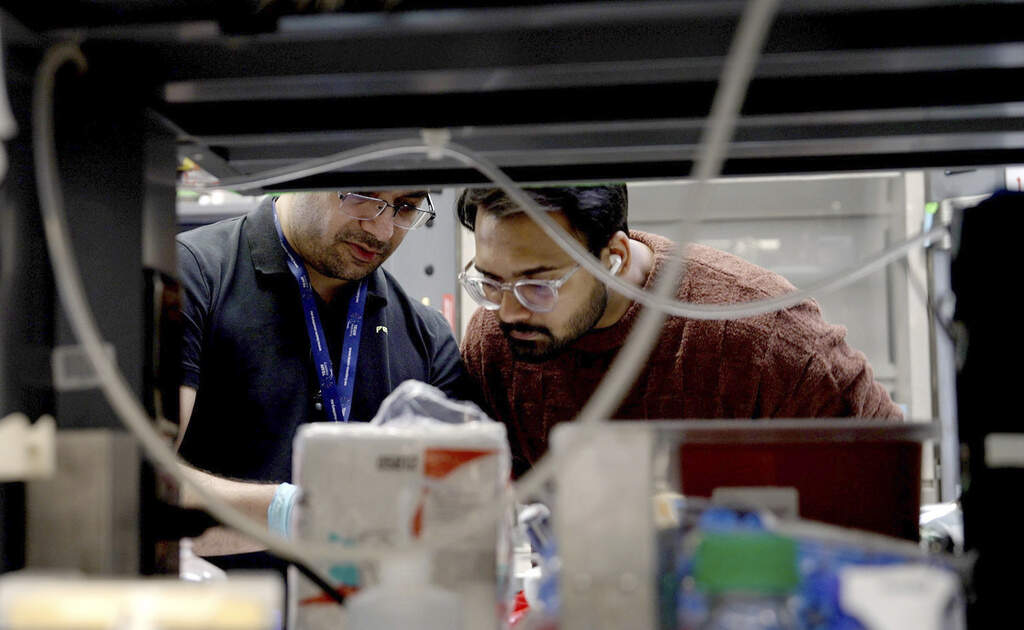
The Trump administration is attacking American academic institutions on multiple fronts, including cutting grant funding and targeting foreign exchange programs. That gives other countries a chance to surpass the U.S. in scientific discovery.
Guests
Dr. Gökhan Hotamışlıgil, physician-scientist and senior faculty member at Harvard’s T.H. Chan School of Public Health.
Marcia McNutt, president of the National Academy of Sciences.
Also Featured
Valerie Niemann, postdoctoral researcher at the University of Bern in Switzerland.
Christina Larson, science writer at the Associated Press.
Anne Simon, professor in the Department of Cell Biology and Molecular Genetics at the University of Maryland.
Transcript
Part I
MEGHNA CHAKRABARTI: This is On Point. I'm Meghna Chakrabarti.
PRESIDENT JOHN. F. KENNEDY [Tape]: We choose to go to the Moon in this decade and do the other things not because they are easy, but because they are hard. Because that goal will serve to organize and measure the best of our energies and skills. Because that challenge is one that we're willing to accept. One we are unwilling to postpone. And one we intend to win.
CHAKRABARTI: President John F. Kennedy there, of course, September 12, 1962, in his historic speech at Rice University, announcing that the United States would put a man on the moon before the end of that decade.
Well, just a couple of days ago, we hit the 56th anniversary of the moment the U.S. met that goal when Neil Armstrong stepped onto the lunar surface July 20, 1969.
NEIL ARMSTRONG: I'm gonna step off the LM. That's one small step for man, one giant leap for mankind.
CHAKRABARTI: Back in 1962, when Kennedy announced what seemed to be an impossible goal, he knew he had his critics, especially those who would say that the race to the moon would be a colossal failure and a colossal waste of taxpayer money. To them, he said this.
KENNEDY: However, I think we're going to do it. And I think that we must pay what needs to be paid. I don't think we ought to waste any money, but I think we ought to do the job.
CHAKRABARTI: "We must pay what needs to be paid." And so the job was done.
Well now, 56 years later, the Trump administration does not think NASA is worth the money anymore. The White House proposes to cut NASA's budget by 24%. The administration proposes a similar gutting of the National Science Foundation. Though the proposals are meeting with significant resistance in the Senate, the Trump's administration's position on funding the next generation of scientific research is clear.
Imagine then what that means for people like Valerie Niemann. She just turned 30 years old this year. She's graduated from Stanford University with a PhD in chemical engineering. She's interested in developing hydrogen electricity for fuel cells. It's kind of a follow-on from the research that NASA has blazed the trail on.
And for her, the Trump administration has essentially foreclosed a future doing that research in the United States.
VALERIE NIEMANN: Anecdotally, I've known people that have like, kind of interviewed with research groups, they've established that they're gonna become a postdoc. But then because of funding cuts and hiring freezes, they cannot take that job.
CHAKRABARTI: In the past six months, the Trump administration has cut billions of dollars from American research institutions, not just in science, but in health and other sectors, too. There's an estimate that overall it could amount to a one-third cut in overall science funding by the federal government this year alone.
And so for Valerie, this means she's gotta look abroad.
NIEMANN: I was already pretty excited or pretty much looking into opportunities in Europe as one of the pathways for after my PhD, especially if I were to stay in academia. But, of course, with the change in administration and the change in priorities, it kind of really motivated me to accept this postdoc position and sign my contract and move to Switzerland from California.
CHAKRABARTI: So you just heard her there. She's no longer in the United States. In fact, Valerie is at the University of Bern in Switzerland where she is continuing her work in chemical engineering. She says she misses her family back in the U.S. but feels secure for at least the next couple of years.
NIEMANN: And it actually was kind of like a relief a bit to come here and especially the standard of living here is really great. So having public transportation, having good access to healthcare, having a good salary, like, these things kind of covering my basic needs, that was really a relief.
Maybe some members of my family don't quite understand the gravity of the situation. Even traveling back to the U.S., I'm a little bit like nervous about, but it is still my home.
CHAKRABARTI: The journal Nature found in a poll back in March of 1,600 scientists in the United States that a whopping three-quarters of them — 75% of them — are considering leaving the country. This basically is the definition of a potential brain drain of American scientists. Especially those who are just beginning their career, their research in their fields.
"The journal Nature found in a poll of 1,600 scientists in the United States that a whopping three-quarters of them are considering leaving the country."
For Valerie, she says she would love to be able to work in the U.S. and at times feels guilty for leaving. But professionally, she believes she just does not have a home here.
NIEMANN: There's this advice that my granddad once told me, like, "Bloom where you're planted." And so opportunities and the way life has gone has led me to where I am here. And so I'll do the best that I can here and hope for the best. And, you know, if there are things I can do to help colleagues in the U.S., I would.
CHAKRABARTI: It wasn't that long ago that the United States was the place in the world where the best and brightest from around the world wanted to come. And now young scientists like Valerie feel like they have to leave.
So what is the cost of this brain drain, this potential brain drain on the United States? What's the cost of it to scientific development and research as a whole? And how are other countries standing to benefit from the cuts in funding to basic scientific research here in the United States?
Well, joining me first today is Gökhan Hotamışlıgil. He's a physician-scientist and senior faculty member at Harvard's T.H. Chan School of Public Health.
Dr. Hotamışlıgil, welcome to On Point.
GÖKHAN HOTAMIŞLIGIL: Yeah. Thank you, Meghna. Thank you for having me on.
CHAKRABARTI: Can you describe a little bit of what your research is in and how much do you rely on federal funding to do that research?
HOTAMIŞLIGIL: Yeah. We work on metabolism in my group for the past 30 years. Metabolism is a very fundamental process which deals with all the energy flow in the body. And for that reason, I mean, every reaction is dependent on metabolism. Therefore, everything related to health or disease somewhat crosses road with metabolism.
And so we are trying to understand the fundamental mechanisms and then how we can convert that understanding into solutions for the world's most prominent chronic disease clusters, such as age-associated or obesity-associated diseases.
CHAKRABARTI: And how much does that research then rely on federal funding in order to be able to make the kind of discoveries you hope to make?
HOTAMIŞLIGIL: I mean, it's crucial, of course. I mean, over the 30 years, I mean, we have had many lines of federal support to many of our projects. And especially early on, when you're starting as a junior faculty and developing ideas, which are at very early stages, until a time that they reach maturity to allow additional mechanisms to support our work, we are extremely, heavily dependent on federal funding.
So I mean, over the past 30 years, I have always had federal funding at least in part supporting our work. Of course, we also receive funding from other institutions.
CHAKRABARTI: Do you have that federal funding now?
HOTAMIŞLIGIL: No.
CHAKRABARTI: What has happened to it?
HOTAMIŞLIGIL: Well, I mean, I was caught in a transition phase. So it has two domains. One is of course we also have federal funding to support our graduate education, meaning our doctoral students. So I was a principal investigator on one of those training grants which supported graduate education. And that was terminated. So with that, of course we lost our ability to support our graduate students and now trying to juggle and find ways to honor our commitments.
And for my research funds, I was just at the stage of renewing my federal grants. And, of course, that did not happen.
CHAKRABARTI: Mm. The renewals did not happen. Okay. So I opened the hour today talking about NSF grants and NASA funding. But to your point, really we're talking about the scientific research endeavor of the United States overall feeling a huge amount of uncertainty. I mean, NIH has been freezing billions and billions of dollars, right, in grant money.
HOTAMIŞLIGIL: Yeah.
CHAKRABARTI: What has this meant — I don't know if for you personally, for your colleagues, for the younger researchers that you're with? I mean, are people talking about like not being able to do their work in the United States anymore?
HOTAMIŞLIGIL: Oh, yes, very much so. I mean, as you may know, Meghna, we have lost the entirety of our federal funding in our school. So, I mean, 100%.
CHAKRABARTI: This is for Harvard specifically, yes. Because Harvard's under — special sights by the Trump administration on Harvard. But continue.
HOTAMIŞLIGIL: So that means many programs that are heavily or sometimes entirely dependent on this grant funding, they will not be able to continue the work either temporarily or permanently. And so beyond that, of course, these labs will not be able to find mechanisms to retain their teams.
So scientific enterprise is not something like is on a switch which you can turn on and off and start from where you left off. So that once the teams disassemble and the research operations halt, it becomes extremely difficult to reinitiate those.
"Scientific enterprise is not ... a switch which you can turn on and off and start from where you left off."
So I mean, many of the labs gave notices to their members and then that's at the end of the current cycle, whenever that is applicable to those labs, the personnel will be terminated. And in some cases I think same will apply to faculty starting with, with junior faculty, once they are unable to fund their research, there are no mechanisms to entirely preserve their research enterprise.
So it has layers and layers of implications. But as you mentioned in the beginning of your program, one really big concern in addition to losing this really vibrant infrastructure is losing the future scientists who are planning, inspired to pursue science or are pursuing science at different stages of their doctoral programs or search for postdoctoral opportunities. So this is a bigger concern that will impact the long-term health of scientific enterprise.
Part II
CHAKRABARTI: The journal Nature analyzed some data from its job platform that has associated with the journal to track where scientists are looking for work. There have been major jumps in the number of U.S. applicants looking for jobs in Canada up by 41%; Europe, up by 32%. China up by 20% and other Asian countries up by almost 40% compared to the same period in 2024. So there's a little bit of data here.
Professor Hotamışlıgil, can you just tell me again in a little bit more detail if you have had examples in your lab, in your research group or amongst your colleagues, of people, whether they're young scientists who are concerned that their, for example, their visas won't be renewed and they have to leave? Or other young scientists who are just saying, "I don't think the kind of research that I want to do is going to be supported here anymore, so I have to go someplace else?"
I mean, have you seen specific examples of that in your own work?
HOTAMIŞLIGIL: Yes. I mean, in my own laboratory, of course, when we are at the transition stage, oftentimes we keep control of our numbers. So we are keeping a smaller group. But even within, of course, a smaller group, we have about 30 to 40% of our fellows and students are internationals.
And of course they are concerned not only funding, but other aspects of their livelihood. And, I mean, for these young scientists, the pursuit of a scientific career is already extremely stressful, even under the best of circumstances, there's so many uncertainties about the science itself, which are inherent to the job. And of course there are career development stresses, job market stresses, et cetera. And, on top of that, when they are not able to pursue the questions that they're pursuing in the most vigorous way, they become extremely stressed.
And of course we felt this in my own group as well. And to a large extent I was able to keep my group in its small size. But we did lose a postdoctoral fellow, for example, who couldn't really bear with the possibility that at the end of the fiscal year, there may be no funds to support her work or support her visa and again, an international fellow. So we lost her to another laboratory which does not feel that kind of pressures.
CHAKRABARTI: Okay. Well, you know, the Trump administration says, you know, that American applicants could make up the difference — especially if it's international students who are currently here right now, or international researchers who feel like they can no longer stay, the Trump administration says with certainty that they believe it's a net gain for America because it would make room for young American scientists. What do you think?
HOTAMIŞLIGIL: Well, I mean, I don't have the concrete numbers and statistics about this. But I can tell you from my experience and the experience that we see, for example, in our department where I've served as the chair of the department for 15 years, that the majority of our fellows are international.
And so at the graduate student level, it may be correct, provided that we don't really discourage the young generation and the bright minds to seek alternative careers. But among our postdoctoral fellows, at least in my group, half of my fellows over the past 30 years have been internationals. So it is very difficult for me to envision that if we lose that pipeline, we will be able to make it up by American applications.
Of course, if you can, this is more than welcome. We do want to stimulate the percentage of the Americans who are interested and excited about a scientific career. But in medicine and in academic science, this is hardly the case.
CHAKRABARTI: Mm. And also that doesn't obviate the truth that even if there are more young Americans who want to go into these fields, if the funding isn't there, how would they do the research?
Okay, so Dr. Hotamışlıgil, hang on here for just a second, because there's just — you know, we're pretty data-driven here at On Point as well. (LAUGHS) And there's just this mounting volume of evidence that shows that the world really is looking at this as an unprecedented opportunity to pluck the best and brightest from the United States here.
I mean, the New York Times had reported that American Nobel Laureate Ardem Patapoutian's federal grant was frozen by the Trump administration. And just shortly after that, he got an email from China offering him 20 years of funding if he agreed to relocate to China. He declined that. That was reported by the New York Times. Over in Australia, that country's Strategic Policy Institute says, "This is a once in a century brain gain opportunity for Australians."
So the idea that many abroad are using this moment as an opportunity right now is indeed true.
CHRISTINA LARSON: There was a sense of urgency that this moment is a kind of opening to reach out to scientists who are based in the U.S.
CHAKRABARTI: This is Christina Larson, science writer at the Associated Press. She spoke to a dozen institutions across the world actively recruiting U.S.-based scientists.
In Canada, the University of Montreal has launched an $18 million fundraising campaign to attract early career researchers. Denmark just proposed a fast-track program with the goal of bringing in 200 U.S.-based researchers to Denmark in the next three years. And in France, one university has a new program called A Safe Place for Science.
LARSON: And the pitch in this case is, to quote from some of their publicity materials, to welcome U.S. scientists, who in quotes, may feel threatened or hindered in their research by changes in the United States.
"The pitch is ... to welcome U.S. scientists who 'may feel threatened or hindered in their research by changes in the United States.'"
CHAKRABARTI: There's also a Chinese headhunting company, which posted a social media ad in February welcoming "global talent" to the emerging tech hub of Shenzhen. Or a program in Australia, as I mentioned earlier, aimed at senior level researchers at the tops of their fields. Christina says that it's unclear how successful the efforts will be in the long term, but most countries are making a similar pitch.
LARSON: I think they appealed to a scientist's desire for continuity. Because scientific research, scientific discoveries aren't the product of something that you do in six months or one year. But you know, building long-term data sets, building long-term collaborations. Scientists — more than some fields, but certainly not uniquely — it's very helpful to know what your trajectory is for the next three years, five years, 10 years, if possible.
CHAKRABARTI: So while many foreign university leaders and organizations are seizing this moment to advance industries like biotech or artificial intelligence in their countries, Christina Larson also says these same nations are feeling uncertain about the future of science globally if the United States really does step back.
LARSON: What the U.S. had accomplished since World War II by investing in science, by creating an ecosystem where federal funding and university funding support a wide range of scientific projects, there was so much that they told me they looked up to in the U.S. scientific system. And so there was a sense of confusion and some people even expressed fear that they saw that system as changing, even as they were trying to recruit currently U.S.-based scientists to their own institutions.
CHAKRABARTI: So that's Christina Larson with the Associated Press.
Well, let me bring Marcia McNutt into the program now. She's the president of the National Academy of Sciences.
Dr. McNutt, welcome to On Point.
MARCIA MCNUTT: Thank you, Meghna. And thank you so much for having this critically important conversation.
CHAKRABARTI: In your career as a scientist yourself and also a leader in the sciences in the United States, have you ever experienced a moment like this?
MCNUTT: No. This moment is unprecedented in terms of the clawing back of the science that made America great.
CHAKRABARTI: So, I mean the Trump administration, as I told Dr. Hotamışlıgil, they insist that this is going to put America first by cutting the funding for what they believe is wasteful research.
MCNUTT: Well, I think the problem with their approach to this is by the time we have number one, lost out on the top international talent that could make America great, and by the time we have discouraged Americans from going into science because of the dreadful prospects for jobs for them, it's going to be so far beyond the Trump administration that we see the ramifications of this, that they're already gonna be gone. They will have done their damage, but not be around to be held accountable.
CHAKRABARTI: Mm. But can you tell me more about how you are measuring this seeming potential brain drain? I mean, that's the headline that's being used in a lot of different places. But it's hard to measure. And I just also wanna check in terms of the robustness of our own analysis to be sure that we're not overstating the case.
MCNUTT: Yes. Well, I think it's hard to actually overstate the case. Right now, if you look back at what made American science great, most Americans alive today do not remember a time when the U.S. was not the science powerhouse that it is today.
Before World War II, actually, the majority of Nobel Prizes went to German science. But as World War II was ramping up, the top Jewish scientists fled Germany and fled many parts of Europe, came to the U.S. That's how we got Albert Einstein. And then after the war, we brought the German rocket scientists to America. And that's what got us to the moon.
Before World War II, the majority of Nobel Prizes went to German science. [T]he top Jewish scientists ... fled many parts of Europe, came to the U.S. That's how we got Albert Einstein."
So we are having done to us exactly what we did to Germany. And history's shown how that worked out for Germany when they lost their sciences, scientists, their top scientists because of policies that they enacted.
CHAKRABARTI: Mm. Dr. McNutt. So presuming that this continues over the course of the Trump administration — and I do wanna acknowledge that, as I mentioned at the top of the show, for example, to proposed NSF cuts, the Senate seems to be pushing back a little bit on that so we dunno exactly what's gonna happen over the remainder of this year.
But the political ambition of the Trump administration is clear. So, like, presuming that doesn't change, many Americans might be like, "Well, okay, so that means that this basic science might get done elsewhere in the world, but the way the world is, the United States will still benefit from the outcomes of that research." Right? If a cancer cure is created in China, I will still be able to use it in the United States. So what's the big deal?
MCNUTT: Yeah. Yeah. Okay. So let me start by saying, I think of science in terms of its applications as being in three different categories. There is the industry relevant science that leads to new drugs, better tools, better communication methods, everything that makes for our quality of life being better, but companies being able to profit from it. So that's one group of science that's done. And that's the science that I think under the Trump administration will probably fare quite well.
But then there are two other types of science. One is the blue-sky basic research that as you rightly point out, Meghna, is published globally in journals that are accessible wherever you are. So that science we would still have access to even if it's not done in America, but we don't get first access.
Because that blue-sky research, industry's not gonna fund it because they don't know what the application is. When quantum mechanics was developed back in the early part of the 20th century, no one knew at that time that it was going to be the foundation of the information age as it is now.
What actually facilitates science being made into profitable products ... is not just being able to read it in a peer-reviewed journal."
But what actually facilitates science being made into profitable products once we do realize what it can be used for is not just being able to read it in a peer-reviewed journal. It is the students and the postdocs and the faculty who were responsible for that major breakthrough walking into the labs in America and helping industry apply that for new tools and processes. And that's what we're gonna lose out on because we were not in the front. And then the third part --
CHAKRABARTI: Right. And --
MCNUTT: Oh, let me just end with the third part, which I think is most under attack right now is applied science for public good that is done by the federal government. So this is NIH work. This is work at the USGS, work at the Fish and Wildlife Service. These are scientists who are applying fundamental discovery to make our lives and our environment better. And there's no profit motive for it. So if no one — the government is the only reasonable organization to support that work because we all benefit.
CHAKRABARTI: Mm. And forgive me for having interrupted you there, Dr. McNutt. But I just wanted to underline something you said that, that the science that is that fundamental sort of blue-sky science that you said that is generated here in the United States, so much of it stays here in terms of then down-the-line development of actual application — new businesses, new entire sectors of human existence.
Dr. Hotamışlıgil, let me turn back to you here. You heard Dr. McNutt say that the federal government is the only institution that can fund some of this stuff that does not have immediate application. Do you think that's true?
HOTAMIŞLIGIL: Yes, I fully agree. And because science is a continuum and it is difficult to predict when will the applications will emerge. And oftentimes they emerge from places where we haven't really imagined at the onset. So that continuity is very critical. And that could, I think, only be taking place with a long-term funding structure from the federal government. Without that project reaching maturity, it's very difficult to capitalize on the translational aspects.
Part III
CHAKRABARTI: Here's some more data here. The National Science Foundation that I've mentioned a couple of times over the course of this conversation has its budget cut by more than 50%. That's the proposal from the Trump administration. And that would wipe out support for almost 80% of the early career researchers that the NSF supports. And that's according to the agency's own estimate.
Okay. So here's how that is actually playing out. Dr. Anne Simon is a professor in the Department of Cell Biology and molecular genetics at the University of Maryland. She's a major researcher in the fight against a disease that's devastating America's citrus industry.
This is the first part of a conversation that our producer Will had with her. And in January, she had a $1.5 million USDA grant completely frozen. More than six months later, she still does not know why.
DR. ANNE SIMON: And this is a real problem. It's the not knowing. You know, why are these grants being rescinded from people? Why are these grants being frozen? Nobody tells you anything. They just are.
I'm writing a grant proposal right now and I'm trying not to use some words that word checkers aren't — we think, we think this is happening, that word checkers are going over proposals looking for, quote-unquote "banned" words like "systemic" and "groups." And you know, systemic, that's how viruses move in plants. They move systemically. I have to use other words.
They're looking for systemic racism. This is a citrus grant. It has nothing to do with systemic racism, but it could get flagged for words. So this is what we're facing right now.
CHAKRABARTI: Now, Dr. Simon also says that while that's frustrating enough, she's even more troubled by the fact that she has run out of money to pay for her long-term post-doctoral researcher.
SIMON: He's driving for Uber right now. That's what he's doing. This incredibly talented PhD with 15 to 20 years of postdoctoral experience. And there are simply no jobs. And so yes, he's driving for Uber. Is this what we're doing with our talented scientists? Who is gonna go into science if they see this as a possibility?
"This incredibly talented PhD with 15 to 20 years of postdoctoral experience ... he's driving for Uber."
CHAKRABARTI: Well, the Trump administration has said at least a little bit about why they're doing this. Michael Kratsios is director of the White House Office of Science and Technology Policy, and on May 19, he gave a speech at the National Academy of Sciences.
And in that speech he said the Trump Administration's decision to cancel billions of dollars in federal grants are a wake-up moment or a moment of clarity, as he said, for the scientific community, because he wants them to rethink priorities and spend federal dollars more efficiently.
MICHAEL KRATSIOS: We are seeing diminishing returns. For example, despite biomedical research budgets soaring since the 1990s, scientific progress has stalled. New drug approvals have flatlined or even declined. More researchers are needed to achieve the same outputs. And the workforce training has stagnated.
More money has not meant more scientific discovery and total dollars spent has not been a proxy for scientific impact.
CHAKRABARTI: And Dr. McNutt, that was a speech, as I said, given at the National Academy of Sciences. And you introduced him just before that speech. Can you tell me what your thoughts were as he was giving it and what the response was even by the audience as they heard what he had to say?
MCNUTT: Well, first of all, I think that his proposition that we are getting less bang for our buck with more investment in science is something that we're actually looking into right now at the academy to find out, first of all, is this true? From what I understand, this assertion that we are getting less for our money is based on a rather roundabout method that was using citations in papers to try to decide whether fields are being revolutionized at the same pace that they were.
So first of all, we're gonna look into that method, find out whether it really has any validity behind it. But then we also wanna look at all sorts of factors that influence the rate at which science discovery is made. For example, the success rate for scientific proposals has been dropping fairly steadily, almost (UNINTELLIGIBLE) in the last 40, 45 years.
And we do know that as funding becomes more competitive for research, then the reviewers, the peer reviewers that decide what is to be funded, start to get more conservative. They look for reasons not to fund a project rather than for reasons to fund it. So one of my concerns about the approach of Kratsios and OSTP is are we sure that cutting budgets even further won't lead to even more safe incremental science being done because it's hard to object to it and less high-risk, high-reward research being undertaken.
CHAKRABARTI: Right. So let me just follow up with that. Because I was very interested to hear him say that he's measuring, the Trump administration is measuring scientific progress by different metrics such as new drug approvals.
Okay. Well, you could actually talk about regulation as being a reason why new drug approvals haven't kept pace with whatever the Trump administration wants it to. And that has nothing to do with science, that has to do with regulation, safety, politics. But that's also an end-use case. Right? Like, the drug approval is the end of the line that can come decades after the initial scientific research is done.
And I'm just wondering if you — and actually let me just turn this first to Dr. Hotamışlıgil, because he's been sitting here very patiently — if you think that's — is that a good way to measure what scientific progress ought to look like?
HOTAMIŞLIGIL: Yeah, I mean, probably not. And not just for regulation, but for a variety of reasons.
Because if you compare what was the scientific landscape 50 years ago and today, it is very different. And, of course, there cannot be a linear return, whether you measure it by citations or papers or patents or drugs, so there will be, of course, an anticipated drop in the rate. Again, everything depends on the details of the calculation.
And second of all, I think the science today, especially in biomedical field, but probably in other fields, is very different than what it was 20, 30 years ago in terms of its cost. Per unit of productivity is far more costly because there's a lot more technology, a lot more analytical platforms that are incorporated now into our daily operations. And the questions are of course far more challenging than I think the basic fundamental problems that scientists faced 50 years ago. So actually there will be a increase.
CHAKRABARTI: Can I just jump in here for a second? Because I think this is a really, really important point that I'd love to get clarity on. Because we've heard a lot of criticism of these so-called indirect costs, right? I mean, that's what you're pointing at here.
The Trump administration seems to see that anyone beyond the bench researcher pipetting samples into a machine, that any person beyond that is one of those waste, you know, wasteful, indirect costs. But what do some of those indirect costs actually entail? I mean, we have what technicians to run these very sophisticated, I don't know, the very machines I was just talking about. What are those indirect costs?
HOTAMIŞLIGIL: I mean they range. There are many categories.
CHAKRABARTI: Yeah.
HOTAMIŞLIGIL: But, of course some of which are actually, maybe actually a great deal of which are also in response to federal regulations. Regulations about safety, compliance — I mean layers and layers. Many of which are I think necessary and healthy. Because we do want to have, I mean, safe research environments.
We work with potentially volatile materials. And for those acquisition of those control disposal use, requires many layers of services from the institutions which are not covered by research dollars. So that infrastructure is supported by by the indirect costs, and that is directly influencing the practice of science.
CHAKRABARTI: Mm. Okay. I feel like I could do a whole hour on what indirect costs actually are.
HOTAMIŞLIGIL: (LAUGHS) You sure can.
CHAKRABARTI: (LAUGHS) But we've only got about five or six minutes left here. And Dr. Hotamışlıgil, I did want to ask you, in the absence of the federal funding that you have lost in just the past few months, where have you been able to claw some funding from?
I mean, Dr. McNutt earlier said that some of the science that had been historically done here in the United States could only be funded by the federal government because it had no immediate application. But that doesn't mean that the private sector isn't also seeing this as an opportunity as well here in this country.
HOTAMIŞLIGIL: Yes, it is true. And maybe I should start by saying that of course, we have been fortunate to receive, I mean, federal funding for many, many decades. And also funding from other organizations, foundations, you know, the American Diabetes Association, American Heart Association, et cetera, as well as some of our internal funds to spend that time where we could have more applications and translational possibilities of our mature work.
And with that, of course, yes, I have been recently — maybe that's what you're referring to — I've been recently very fortunate to make an agreement with a private equity firm that is supporting, just signed a couple of weeks ago, an agreement to support our work on the fundamental science end. So, very interesting model. But also in parallel, invest into a structure which will recognize the translational possibilities which will emerge from the maturity level that our project has reached.
"I've been recently very fortunate to make an agreement with a private equity firm ... to support our work on the fundamental science end."
And so this parallel structure will allow us to continue our work at the fundamental end, and then also develop a translational path to convert us into a medicine.
CHAKRABARTI: And who would own the rights to that? Who would own the IP to that? The private equity firm?
HOTAMIŞLIGIL: Yeah. Yes, the private equity licenses are intellectual property. And with that, they invest into the development aspects, which are not really so suitable to pursue in the academic environment anyway.
So we will develop prototype medications and a pipeline of that and transfer this to a biotechnology firm, which will then do the development work and then clinical trials. So we will remain in the preclinical area, and then the rest will be developed by this entity.
CHAKRABARTI: I see. So Dr. McNutt, Dr. Hotamışlıgil is not the only researcher who has been approached by private equity to help keep their research going. I mean, this is a huge opportunity for those groups.
And I'm wondering, again, thinking about what the Trump administration's stated priorities are, they might see this as, you know, again, a net positive because they're seeking to quote-unquote, "reprivatize" a lot of the endeavors that have been funded by the federal government. If that happens and the research can continue, what's the problem?
MCNUTT: Well, I agree if we could find some other source of funding.
People have talked a lot about, well, can't foundations pick up the loss in federal funding? And it is true that of the very basic blue-sky research that's done at universities, nearly half of it, even prior to this year, was funded by foundations. But I doubt that private equity or foundations will have, in the near term, anywhere near the capacity to compensate for what we're losing in terms of federal support.
"I doubt that private equity or foundations will have, in the near term, anywhere near the capacity to compensate for what we're losing in terms of federal support."
And let me give you a specific example. Take the LIGO project. The gravitational wave detector that NSF invested for so long in and just a few years ago made the startling discovery that they had actually detected gravitational waves. Now, that's the kind of long-term investment in facilities, in people, and in big science that I don't think is necessarily gonna come out of private equity.
Private equity has a much shorter time horizon. And do we have applications for gravitational waves right now? No. But do I believe that someday we will? Absolutely. Just like discovering the double helix or relativity has led to new products and new industries, it's going to happen.
CHAKRABARTI: Hmm. Well, also, I mean this, what you're saying is it makes us very myopic in our belief in what the purpose of science is, right? Like it has to have an immediate ROI versus the unpredictable return that could benefit all of humanity in the future from science that's being done today that doesn't have any purpose.
But that, again, back to this brain drain issue, that research can still happen now in other countries. So I guess the point is, does the U.S. ultimately lose out if it's still happening elsewhere?
MCNUTT: Yeah, so I guess what my concern is is that I have seen the U.S. even before this year be a very fickle partner in terms of these international collaborations. CERN and other big facilities, if we aren't at the table, we aren't in the game. And we have been so reticent to make long-term commitments to these big international projects. And it is a part of science diplomacy too, that we're losing out on.
CHAKRABARTI: Mm. Well, Dr. Marcia McNutt is the president of the National Academy of Sciences. Dr. McNutt, thank you so much for joining us today.
MCNUTT: Thank you, Meghna. This is, as I say, an important conversation, and thank you for including me.
CHAKRABARTI: And Dr. Gökhan Hotamışlıgil, physician-scientist and senior faculty member at the Harvard School of Public Health. Dr. Hotamışlıgil, thank you so much for being with us.
HOTAMIŞLIGIL: Yeah, thank you, Meghna. Thank you for having me on for this really absolutely critical topic.
The first draft of this transcript was created by Descript, an AI transcription tool. An On Point producer then thoroughly reviewed, corrected, and reformatted the transcript before publication. The use of this AI tool creates the capacity to provide these transcripts.
This program aired on July 22, 2025.